
The Smell of the Sea Before the Words
There is a moment at the edge of the ocean — you have stood there, or you will — when the smell reaches you before anything else. Salt and something older than salt. The particular rot of seaweed exposed by a retreating tide, the mineral coldness rising off the water like breath from a basement, the faint sweetness of decay that isn’t unpleasant so much as honest. The sea doesn’t smell like life. It smells like life and death held in the same fist, indistinguishable, neither one apologizing for the other. You stand there and the water moves without caring whether you are watching. Something large shifts beneath the surface. You feel, for a moment, that the world was already complete before you arrived and will remain so after you leave, and that this fact is neither tragic nor comforting but simply the truth, stated without inflection.

Rachel Carson grew up sixty miles from the nearest coast. Springdale, Pennsylvania, in the years just after the turn of the twentieth century, was a mill town on the Allegheny River, smoky and landlocked, the kind of place where the horizon was interrupted by factory stacks rather than open water. She was born in 1907, the youngest of three children, in a farmhouse on sixty-five acres that her parents worked with more determination than success. The land was modest. The ambitions her mother Maria held for her daughter were not.
Maria Carson was the kind of woman history tends to forget because she worked entirely inside the life of another person. She read to Rachel from the beginning — not nursery simplifications but real books, books about animals and birds and the natural world rendered with full complexity. She took her daughter into the fields behind the house and taught her to move quietly enough that the living world would not reorganize itself around their presence. This is a form of education that no institution has ever managed to replicate, because it cannot be scheduled. It requires someone who believes, at a cellular level, that attention is itself a moral act.
The paradox that would define Carson’s entire life was already present in that Pennsylvania childhood: she loved the sea before she had ever seen it. She encountered it first in the pages of books, in the descriptions of tides and creatures and depths that seemed to her not exotic but familiar, as though she were recognizing something she had always known rather than learning something new. The natural world, wherever she encountered it, operated for her as a language she had been born already fluent in. The fields and woods around Springdale were not substitutes for the coast she hadn’t yet reached. They were the same text, written in a different hand.
She published her first story at age ten in St. Nicholas Magazine, a periodical that invited submissions from young readers and had already, by that point, published early work by F. Scott Fitzgerald and E.B. White. The story was about a soldier and his dog. The sea was nowhere in it. But the attention was already there, already precise, already animated by the conviction that if you looked carefully enough at any living thing, it would yield something essential.
Charles Darwin had argued in 1859 that the natural world was not a backdrop to human history but its actual substance, the medium through which everything that mattered had happened and was happening still. Carson would spend her entire adult life translating that argument into prose that people could not put down. But the translation had begun in a field in Pennsylvania, with a mother who believed that a child’s capacity for wonder was not a phase to be grown out of but a faculty to be sharpened until it could cut through almost anything.
The ocean was waiting. She would find it eventually. But she already knew what it was going to say.
Eve of the Irises
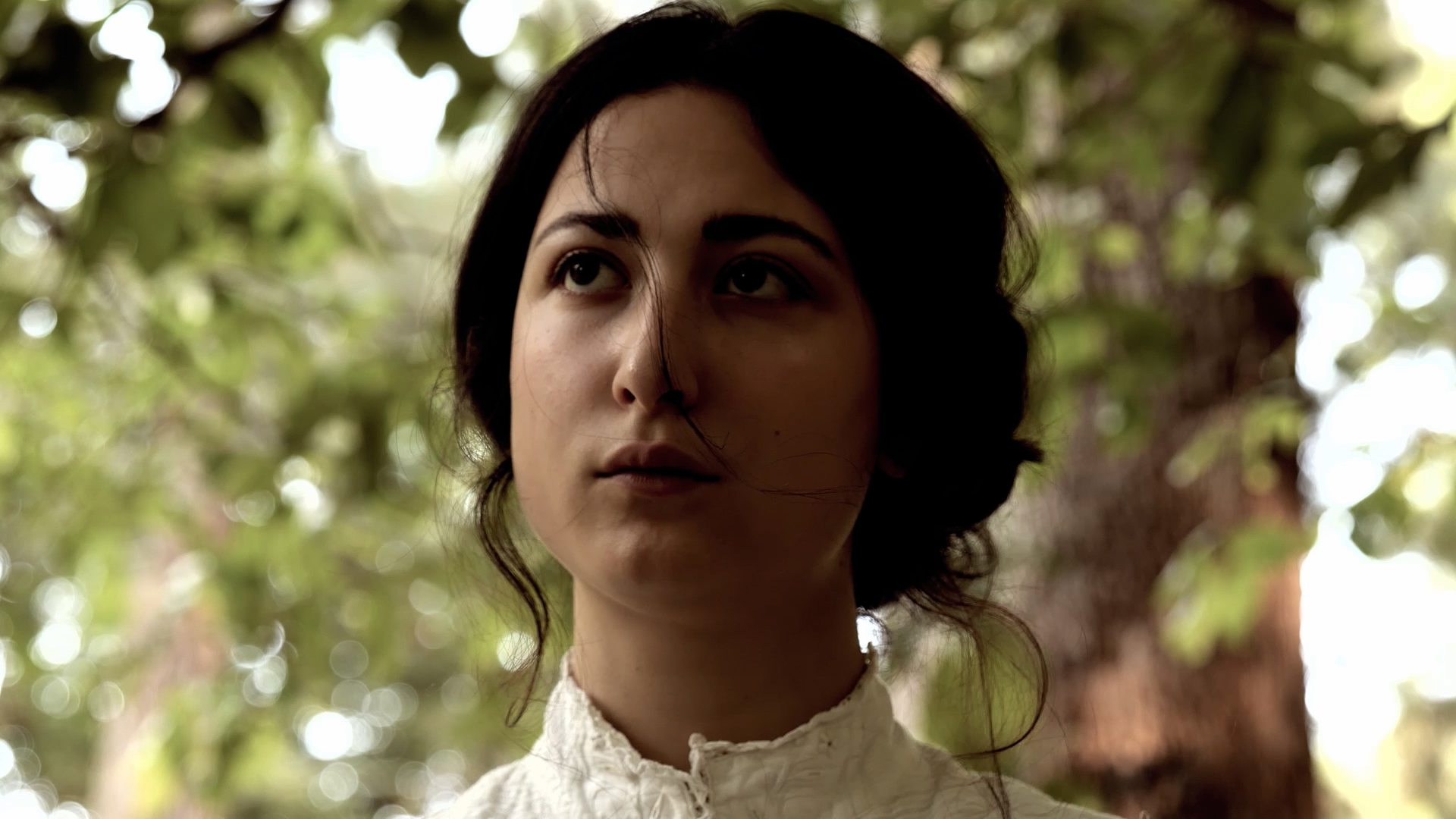
Documentary, by Isabel Russinova, Rodolfo Martinelli Carraresi, Italy, 2026
Eva of the Irises is a historical biographical docu-film about the scientist Eva Mameli Calvino, a botanist and pioneer of environmentalism in Italy, mother of the writer Italo, born in Sassari in 1886. The film, based on a multidisciplinary approach that combines several genres—such as theatre, documentary, cinema, and research—moves between memories, reflections on life, as well as the goals and missions the scholar still wished to achieve.
The multifaceted artistic sensibility of Isabel Russinova is expressed across many fields, from writing to acting, from directing to civic engagement, and finds one of its highest expressions in the docu-film Eva of the Irises, created with Rodolfo Martinelli Carraresi. The film blends scientific rigor and poetic refinement to portray the extraordinary figure of the botanist Eva Mameli Calvino, mother of Italo Calvino but above all an independent protagonist of 20th-century scientific culture. It is told through a combination of archival materials, interviews, and evocative staging capable of elegantly and profoundly conveying her intense human and professional story.
LANGUAGE: Italian
SUBTITLES: English, Spanish, French, Portuguese
What Science Does to a Woman
There is a particular kind of exhaustion that comes not from ignorance but from knowing. You walk into a room carrying the answer, and you learn, slowly, through a hundred small corrections and averted gazes, that the answer must be repackaged as a question before anyone will receive it. Not because you are wrong. Because you are a woman.
Rachel Carson knew this room. She had earned her master’s degree in zoology from Johns Hopkins in 1932, studying the embryological development of the catfish kidney with a precision that her professors acknowledged and her institution quietly filed away. Johns Hopkins had only recently and reluctantly opened its graduate programs to women, and the tolerance extended was exactly that — tolerance, not welcome. The distinction matters enormously. Tolerance keeps you at the threshold. It does not pull up a chair.
She joined the U.S. Bureau of Fisheries in 1936 as a junior aquatic biologist, one of only two women to have passed the civil service exam at the professional level. The title sounds like arrival. It was not. The Bureau was a world of men who wore their expertise as a kind of territorial marking, and the administrative structure confirmed what the social atmosphere only implied: women answered phones, typed reports, managed files. Carson did all of these things too, because the salary was forty-nine hundred dollars a year and she had a family to keep alive.
Her father had died in 1935, leaving nothing. Her mother Maria had always been the gravitational center of her life — the woman who had read to her from the fields behind their Pennsylvania farmhouse, who had taught her that the natural world was not backdrop but text. Now Maria was dependent. And then came the nieces: Marian’s daughters, orphaned in successive years of illness and poverty, drawn into a household that Carson held together through a combination of editorial moonlighting, borrowed money, and the particular discipline of someone who cannot afford to stop. Simone de Beauvoir, writing in The Second Sex in 1949, described the female intellectual as someone condemned to prove her legitimacy continuously, in ways her male counterpart never must — not because she lacks the capacity, but because the institutions that confer legitimacy were built without her in mind. Carson’s life in those years was a living diagram of that argument. She was not merely surviving the institution. She was financing her own exclusion with her own labor.
What strikes you, looking at those years, is not the hardship in isolation but the specific shape it took. Poverty is not gender-neutral. When a man struggles financially, his intellectual work is framed as heroic sacrifice. When a woman does the same, the struggle becomes evidence of her proper place — proof that the domestic overwhelms the cerebral, that she cannot fully inhabit both worlds. Carson inhabited both worlds completely and paid for the audacity in a currency no one acknowledged as currency: the invisible tax of being taken seriously only after translation.
She wrote radio scripts for the Bureau, a series called Romance Under the Waters, because her supervisor Elmer Higgins had discovered she could write in a way that reached people without condescending to them. That discovery was offered as a compliment. It functioned as a reassignment. The scientist became the communicator. The mind that understood the biochemistry of marine organisms was handed a microphone and pointed toward the public, away from the laboratory, away from the peer-reviewed page where authority was officially minted.
And yet something happened in that displacement that no one at the Bureau intended. Carson discovered that language, handled with the same rigor she brought to taxonomy, could do something peer review could not: it could make a person feel the ocean before they understood it. She had been pushed to the edge of the institution. At the edge, she found the open water.

The Sea Trilogy and the Courage of Beauty
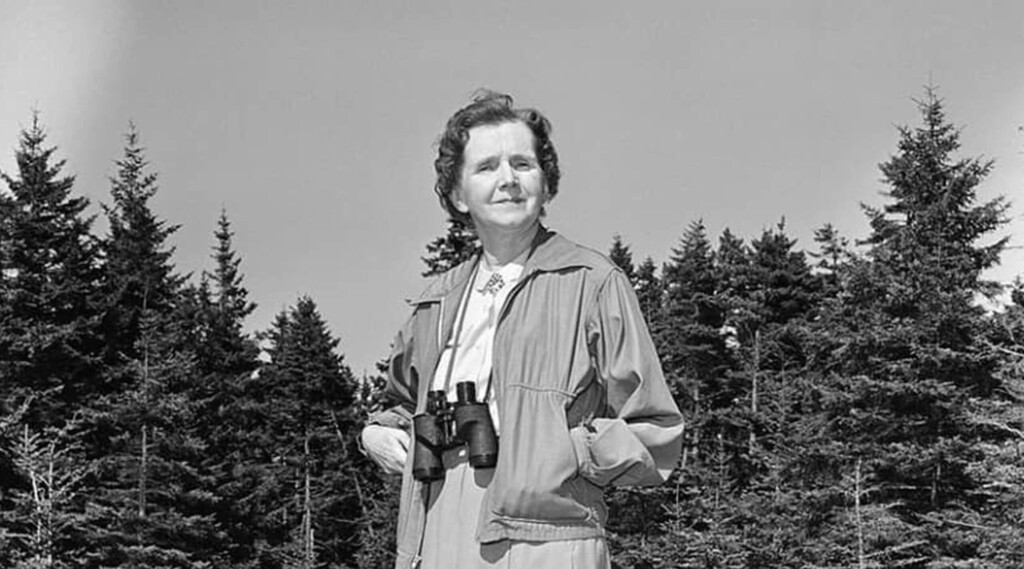
There is a particular kind of loneliness in being right about something the world is not yet ready to hear. Not wrong-lonely, which has its own blunt dignity, but right-lonely — the loneliness of someone who has found a door and cannot convince anyone else that the room behind it exists. Carson spent the better part of two decades standing in that corridor, describing what she could see through the keyhole, writing sentences so precise and so alive that they constituted, by themselves, an argument about the nature of knowledge.
What she was arguing — though she would never have used the word argument, preferring instead to simply show — was that beauty is not decoration. It is not the ribbon tied around a fact to make it more palatable to readers who find science cold. Beauty, in the way Carson practiced it, was epistemological. It was a mode of access. When she wrote about the sanderlings running ahead of the surf on a winter beach, their legs like tiny mechanical instruments measuring the threshold between sea and land, she was not ornamenting a biological observation. She was insisting that the emotional register in which you encounter a thing determines what you are able to understand about it.
John Dewey, in his 1934 work Art as Experience, argued that aesthetic experience is not a category separate from ordinary knowing but rather the fullest realization of it — the moment when experience achieves a coherence and intensity that allows genuine comprehension. Most experience, Dewey wrote, is incomplete, distracted, fragmented. Aesthetic experience is what happens when perception and feeling and thought converge into something whole. Carson was not reading Dewey at her desk and taking notes. She was living his argument in the tidal zones of Maine and the Chesapeake, learning that you cannot separate the shiver of recognition from the act of understanding.
Her first book arrived in 1941, a portrait of the Atlantic coast told from below the surface, following the migrations of fish and birds through an annual cycle as though the ocean itself were the protagonist. It sold almost nothing. The timing was difficult — Pearl Harbor came weeks after publication — but the deeper problem was that a book which refused to place the human observer at the center of the narrative was, in 1941, essentially a provocation. The creatures moved through their world entirely indifferent to human categories, and Carson rendered this indifference without apology.
A decade later, the same refusal produced a different result. The second book, a geological and biological history of the oceans, reached a public that had just survived a world war and was discovering, perhaps for the first time, a hunger for scale — for something that dwarfed the century’s catastrophes by placing them inside deep time. It sat on the New York Times bestseller list for eighty-six consecutive weeks. It was translated into thirty-two languages. The letters arrived by the hundreds from people who said they had never read anything like it, who said it had changed something in how they moved through the world. Carson received them in a small rented house where she was supporting her elderly mother, a nephew who had become her ward, and later a grandnephew after her niece died young. The royalties, when they came, were real, but the professional recognition lagged in the particular way it lags for women who write beautifully about science — praised as stylists, overlooked as thinkers.
The third book, published in 1955, was perhaps the quietest and the most radical. It moved along the edge of the sea with a patience that bordered on the meditative, cataloguing the organisms of the rocky shore, the sandy beach, the coral reef, not as specimens but as presences — each one carrying the weight of an evolutionary history measured in hundreds of millions of years. You come away from it understanding that every tide pool is a philosophical argument about the persistence of form against chaos. Carson never said so directly.
The Poison in the Garden
You walk into a garden and something is wrong. You cannot name it immediately. The roses are perfect, the lawn immaculate, the light falling through the leaves exactly as it should. And then it reaches you — the absence. No sparrows on the fence. No thrush moving through the undergrowth. No blackbird alarm call from somewhere behind the hedge. The garden is performing its appearance while something underneath it has gone quiet forever.
This is how it arrived for Carson too — not as a theory, not as a scientific hypothesis, but as a letter. In January 1958, her friend Olga Huckins wrote to her describing what had happened to the private bird sanctuary she and her husband kept near Duxbury, Massachusetts, after the state conducted aerial DDT spraying to control mosquitoes. The letter described birds found dying on the ground, their beaks gaping, their feet clenched. It described a silence that had moved in where there had been life. Huckins asked Carson if she knew anyone in Washington who might listen. Carson did not redirect the letter. She absorbed it. What had been a vague professional concern crystallized into something personal and unavoidable — the kind of knowledge you cannot unknow.
DDT had been celebrated since its wartime introduction as one of modernity’s great victories. By the mid-1950s it was being deployed across American suburbs and farmlands with a confidence bordering on evangelism, sprayed from aircraft over millions of acres in state and federal programs aimed at the fire ant, the gypsy moth, the mosquito. The chemical industry had constructed around it an aura of safety that was, in the precise sense of the word, manufactured. Publicity campaigns showed housewives smiling as planes passed overhead. Scientists who raised doubts found their funding threatened and their reputations questioned. The logic was circular and self-sealing: DDT is safe because we say it is safe, and we say it is safe because it is profitable for it to be so.
What Carson understood — and what took four years of research to document into the manuscript that became Silent Spring in 1962 — was that the danger was not in the acute dose. It was in the accumulation. She drew on the concept that ecologists were beginning to formalize: biomagnification, the process by which a chemical present in trace amounts in water or soil concentrates as it moves up the food chain, doubling and multiplying in the fatty tissues of each successive predator until the robin eating earthworms, or the eagle eating fish, carries a burden that was never intended and never calculated. The garden looks alive. The garden is dying from the inside.
There is a particular horror in contamination that leaves no visible wound. A woman walks through a landscape that seems entirely intact — the color of the grass, the movement of clouds, the ordinary afternoon light — and cannot locate the wrongness she senses. It is not paranoia. The wrongness is real, it simply operates below the threshold of what the eye can confirm. This is the epistemological trap Carson was writing against: a culture that had decided that what could not be seen could not be dangerous, that the invisible was the same as the absent.
The sociologist Ulrich Beck, writing decades later in Risk Society in 1986, described the defining feature of modern industrial hazard as precisely this invisibility — risks that escape perception, that require instruments and expertise and time to become legible, that are therefore structurally easy to deny. Carson arrived at this insight through birds falling silent in a Massachusetts garden, not through social theory. The felt knowledge came first. The evidence followed because she refused to let the feeling go unverified.
Huckins’s letter described a sanctuary turned into something that still wore the face of a sanctuary while everything that made it one had been erased.
Silent Spring and the Machinery of Denial
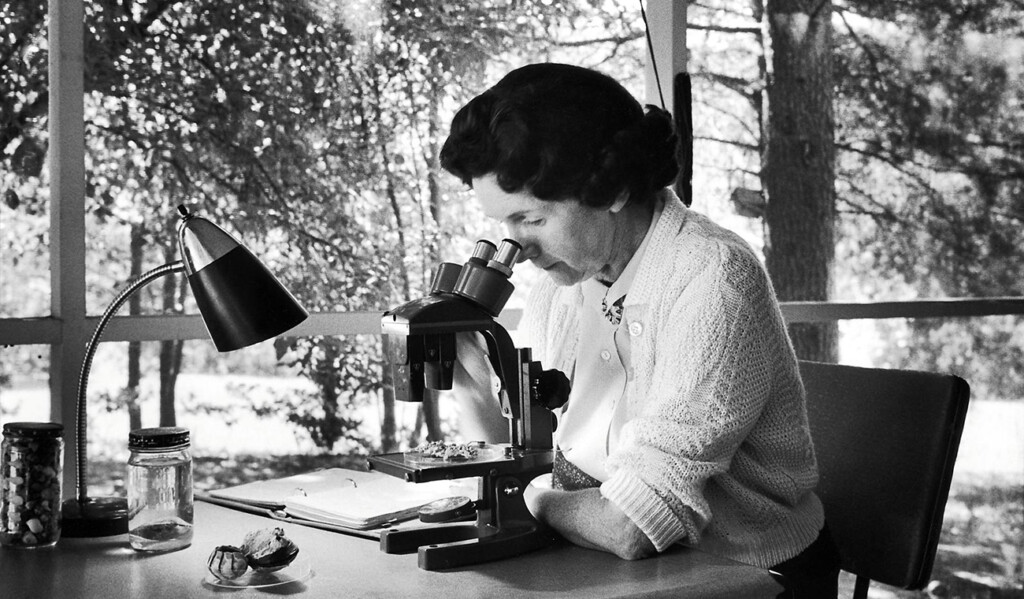
The book arrived in serialized form in The New Yorker in the summer of 1962, and before it even reached bookstore shelves, the letters had already begun. Not letters of praise. Letters from lawyers.
Velsicol Chemical Corporation threatened legal action against Houghton Mifflin, Carson’s publisher, warning that Silent Spring contained “inaccurate and disparaging statements” about chlordane and heptachlor. The National Agricultural Chemicals Association mobilized immediately, spending what would amount to approximately $250,000 — a staggering sum for the era — on a coordinated counter-campaign: pamphlets, press releases, hired scientists, and the deliberate seeding of doubt into every conversation the book had started. The strategy was not to refute Carson’s evidence point by point. That would have required engaging with it seriously. The strategy was to make her seem like someone whose evidence need not be taken seriously at all.
Naomi Oreskes and Erik Conway, in their 2010 work Merchants of Doubt, documented with forensic precision how this playbook had been used before and would be used again: identify a scientist whose findings threaten commercial interest, manufacture the appearance of legitimate scientific controversy where little exists, and redirect public attention from the findings to the credibility of the finder. The goal is not to win the argument. The goal is to make the argument seem unresolved indefinitely. Carson encountered this machinery at full force, and she encountered something the playbook had never needed to make explicit before, because it had never been quite so useful: she was a woman.
The attacks on her personhood were not incidental to the attacks on her science. They were the attacks on her science, dressed in different clothes. She was called hysterical. She was called a fanatic. She was described, with the particular cruelty reserved for women who do not organize their lives around men, as a spinster — the word deployed not merely as description but as diagnosis, as if the absence of a husband explained the presence of an obsession. Robert White-Stevens, a biochemist working for American Cyanamid, appeared on television repeatedly to counter her claims, and in his more unguarded moments made clear that what disturbed him most was not her methodology but her emotional attachment to birds and wildlife, the implication being that such attachment was itself a form of irrationality, a woman’s softness mistaken for science.
There is a trap embedded in this logic so old it has become architectural. It works like this: if you are dispassionate, you are credible. If you show care for something beyond human commerce, you are sentimental. If you are a woman who shows that care, you are doubly disqualified — once for the sentiment, once for the gender that supposedly produces it. The trap has no exit within its own terms. Passion disqualifies you; its absence would have made you invisible in the first place. Carson had spent a decade marshaling evidence with a rigor that her detractors never matched, and the response was to suggest that her relationship with nature was too intimate, too maternal, too personal to constitute knowledge.
Think of the moment when someone speaks a difficult truth with absolute clarity, and the room does not respond to what was said but to the way their hands were trembling when they said it. The trembling becomes the story. The content becomes secondary evidence in a trial about composure.
What Carson had written was not, in any serious scientific assessment, wrong. The President’s Science Advisory Committee, convened by John F. Kennedy in direct response to the book, released its report in May 1963 and largely vindicated her findings, recommending immediate restrictions on pesticide use and calling for sustained monitoring of chemical contamination. The machinery of denial had failed to stop the facts. But it had done something more durable: it had attached a question mark to the kind of person who speaks them, and that question mark, unlike any particular pesticide, does not degrade.
A vision curated by a filmmaker, not an algorithm
In this video I explain our vision
The Body That Knew Before the Mind Admitted
There is a particular kind of courage in continuing to speak when you already know the cost of speaking. You have seen it, perhaps, in someone who keeps talking at a dinner table long after the conversation has turned against them — not from stubbornness, but because the truth they are carrying is too heavy to set down, and they understand, with a clarity that sits just below the level of words, that silence now would cost more than exposure. Rachel Carson understood this in her bones. Quite literally in her bones, as it turned out.
She was diagnosed with breast cancer in 1960, two years before Silent Spring reached the public. She was fifty-three years old, already diminished by the treatments, already watching her body stage its own slow rebellion, and she chose to tell almost no one. Not the press. Not the colleagues who would use it against her. Not the audiences who would later see her testify before Congress, frail and precise, and not realize they were watching a woman address the nation from inside her own dying. She kept writing. She kept revising. She kept answering letters.
The cultural logic of that silence deserves examination. Susan Sontag, writing in Illness as Metaphor in 1978, identified the way cancer had accumulated a moral vocabulary entirely distinct from its biology — a disease understood as shameful, as evidence of psychological failure, of repressed emotion, of something the sufferer had somehow invited through weakness of character. This was not merely a metaphor. It was a mechanism of control. A sick woman in 1960 was, culturally speaking, a diminished woman. Her arguments became symptoms. Her urgency became hysteria. Her knowledge became suspect because the vessel carrying it was failing.
Carson had spent years watching how the bodies of animals registered chemical contamination before any human institution was willing to name what was happening. The robins falling from suburban lawns, the fish surfacing belly-up in streams near agricultural fields — their bodies were the first documents, written in a language that science had the tools to read but that economics had every incentive to mistranslate. She understood bodily knowledge as a form of evidence. And yet she could not afford to let her own body become evidence in the hands of those who wanted to discredit her. The irony is not subtle. It is the kind of irony that does not ask to be appreciated.
There is a scene that lives in the imagination long after you encounter it: a man at a lectern, speaking calmly and with great precision about the slow destruction of a system he loves, and only gradually, as the camera holds on his face, does the audience in the hall begin to thin, and you understand that they have been leaving not because they disagree but because they cannot bear to stay, and he knows this, and he continues anyway, until the room holds almost no one, and still his voice does not crack. He is not speaking to the people who left. He is speaking to the record. Carson testified before the Senate Subcommittee on Pesticides in June 1963. She was wearing a dark wig. Her joints ached. She spoke for hours.
Sontag argued that stripping illness of its metaphorical weight was a precondition for treating the sick person as a full human being rather than a symbol of their own decline. Carson never had that luxury. Her illness and her argument were entangled whether she willed it or not. The chemicals she described as carcinogenic were chemically related to the compounds that may have contributed to her own tumor’s growth. Her body was, in the most uncomfortable sense, inside her thesis.
She died in April 1964, eighteen months after publication. Silent Spring had already become something larger than a book, and she would not live to see what it set in motion.
What We Call Progress and What It Costs
You stand at the edge of a field and feel something that takes a moment to name. The rows extend to the horizon with a geometric precision that is almost musical, each plant identical to the one beside it, the whole surface of the earth arranged into a pattern that suggests mastery, control, the human mind imposed on living matter. It is beautiful. And then, in the same breath, before you have finished thinking the word beautiful, something else arrives — a wrongness you cannot immediately locate, a silence where there should be sound, an absence dressed up as abundance.
This is the landscape Carson was writing about, and writing against. Not the dramatic wasteland, not the smoking ruin, but the orderly, productive, photogenic field that has been quietly evacuated of everything that did not serve a single economic purpose. The wrongness you feel is not sentiment. It is information.
The cultural mechanism she identified in 1962 had been building for decades before Silent Spring gave it a name. It rests on a foundational assumption so deeply embedded in modern industrial society that questioning it marks you immediately as irrational, nostalgic, or simply ignorant of how things work. The assumption is this: that technological intervention in natural systems is neutral, inevitable, and modern, and that any hesitation before it belongs to an earlier, less enlightened time. Progress, in this framework, is a one-way door. You walk through it or you are left behind.
Hannah Arendt, writing in 1963 about the trial of Adolf Eichmann, introduced a concept that has since been borrowed, contested, and misread in roughly equal measure. What she observed was not the presence of extraordinary malice but its absence — the bureaucratic personality that commits atrocity not through hatred but through compliance, through the suspension of individual moral judgment in favor of institutional role, through the performance of competence within a system whose ends are never personally examined. Arendt called it the banality of evil, and the phrase disturbed people precisely because it removed the comfort of a monster. If evil requires a monster, you are safe. If it requires only an ordinary person doing their job correctly, the category expands to include almost everyone.
Carson understood this mechanism without using Arendt’s language. The chemists who formulated the pesticides were not villains. The government officials who approved them were not corrupt, or not primarily corrupt. The farmers who applied them were following expert recommendation. The sales representatives who promoted them believed in what they were selling. The damage was distributed across a thousand ordinary decisions, each one defensible in isolation, the cumulative effect invisible to anyone standing at only one point in the chain. No single hand held the poison. The poison was everywhere.
The sociologist Ulrich Beck, writing in 1986 in Risk Society, would later describe this as the characteristic condition of late modernity: the production of hazards that are systemic, invisible to the individual, and generated not by exceptional events but by the normal functioning of institutions. Beck’s central insight was that the risks of industrial civilization cannot be assigned to individual actors because they emerge from the structure itself. Carson had understood this twenty-four years earlier, working from biology rather than sociology, from the specific death of specific birds rather than from theory.
What makes her argument so difficult to dismiss, and so persistently unwelcome, is that it does not require you to find a villain. It requires something harder: that you examine the system you are embedded in, that you hold simultaneously the idea that the person at each node of the chain may be decent, competent, and well-intentioned, and that the chain itself is producing something catastrophic. The discomfort this produces is not confusion. It is moral clarity arriving in a form that offers no easy relief, no external object onto which the problem can be projected and contained.
The Silence She Left Behind

The book is still there, on the shelf, spine faded to a pale olive-gray, positioned between a field guide to birds and something about the history of the English garden. You have seen it in a thousand homes. Sometimes it has a bookmark in the first forty pages. Sometimes the pages are still crisp at the edges, unbroken, the way pages stay when they have been opened once, respectfully, and then returned to their place. It is honored there. It is displayed. It performs the function of a conscience that has been acknowledged and then politely set aside.
Rachel Carson died in April 1964, two years after Silent Spring reached the world and changed it — or rather, changed the conversation about it, which is not the same thing. She was fifty-six years old. She had written the book while managing breast cancer, exhaustion, and a campaign of professional destruction orchestrated by the chemical industry with a precision and a viciousness that should embarrass anyone who still believes science operates in a neutral space. She finished it anyway. The book sold over two million copies in the years following publication. It is credited with catalyzing the American environmental movement, inspiring the creation of the Environmental Protection Agency in 1970, and contributing to the eventual ban on DDT for agricultural use in the United States in 1972. These are the facts that get repeated. They are true and they are also a kind of burial, because they allow us to place Carson in the category of problems that were addressed, of battles that were won, of history that has been properly processed.
But the IPBES global assessment, published in its updated synthesis in 2023, estimates that approximately one million species face extinction within decades, many within human lifetimes already being lived. Insect populations across Europe have declined by more than seventy-five percent in protected natural areas over the last twenty-seven years, according to the 2017 study from Krefeld, Germany, which measured biomass rather than species count — meaning the sheer weight of living insects in the air has collapsed. Neonicotinoids, the class of pesticides that became dominant in the late twentieth century, are now present in the waterways of every continent where they have been measured. Carson did not know the specific chemistry. She knew the structure of the problem with a clarity that still reads like prophecy, which is not because she was prophetic but because she was correct, and correctness about inconvenient things tends to get recycled as mysticism rather than absorbed as information.
This is what Erik Erikson, writing about what he called the problem of generativity — the capacity of one generation to truly transmit care for the future to those who follow — identified as the deepest failure possible within a civilization: not the failure to understand, but the failure to act upon understanding. The knowledge arrives. It is received with admiration. It is given prizes and shelf space and citations. And then the system that produced the problem continues, slightly modified, essentially intact, because the knowledge was never actually integrated into the way decisions are made about money and land and time.
You know what something smells like when it should not be there. That particular sharpness in the air in early May, over a field that was wildflower the week before, the kind of smell that has no business in a spring morning and yet arrives anyway, invisible, already inside your lungs before you have recognized what it is. Carson described the world paying attention to its own destruction and choosing, again and again, the convenience of not fully knowing. The book on the shelf is part of that choice — present enough to signal awareness, closed enough to leave everything undisturbed, its pale spine facing outward like a small monument to what it means to know something completely, to have been told, and to have found a way to keep living as though you had not.
🌿 Nature, Life, and the Courage to Speak Truth
Rachel Carson devoted her life to understanding the natural world and warning humanity of its fragility. These articles explore kindred spirits — thinkers, writers, and artists who, like Carson, confronted mortality, meaning, and the urgency of speaking out before it was too late.
Georgia O’Keeffe: Life and Works
Georgia O’Keeffe, like Rachel Carson, found profound meaning in the natural landscape and made it the central subject of her life’s work. Her paintings of desert flowers, bones, and vast skies carry the same reverent attention to the nonhuman world that defines Carson’s prose. Both women challenged the conventions of their fields and carved out singular, uncompromising visions.
GO TO THE SELECTION: Georgia O’Keeffe: Life and Works
Albert Camus: Life and Philosophical Thought
Albert Camus grappled with the absurdity of existence and the moral imperative to act despite it — a tension Rachel Carson understood intimately as she wrote Silent Spring knowing the forces arrayed against her. His philosophy of rebellion and lucidity in the face of indifference resonates deeply with Carson’s own courage in confronting the chemical industry. Both figures remind us that intellectual honesty can itself be a radical act.
GO TO THE SELECTION: Albert Camus: Life and Philosophical Thought
Montaigne: Life and Essays
Montaigne invented a form of writing rooted in careful self-observation and an unflinching curiosity about the natural world and human frailty. Like Carson, he believed that attentive, honest attention to life — in all its transience — was the foundation of wisdom. His essays remain a model for the kind of reflective, engaged nonfiction that Carson would later bring to environmental writing.
GO TO THE SELECTION: Montaigne: Life and Essays
Viktor Frankl: Life and Logotherapy
Viktor Frankl’s logotherapy emerged from his search for meaning in the most extreme circumstances, arguing that purpose is something discovered through engagement with the world rather than imposed upon it. Rachel Carson similarly found meaning through her deep commitment to the living Earth and to warning future generations of its peril. Both Frankl and Carson demonstrate that a life oriented toward something beyond oneself carries an extraordinary moral force.
GO TO THE SELECTION: Viktor Frankl: Life and Logotherapy
Discover More on Indiecinema
If these voices of courage, nature, and meaning have stirred something in you, Indiecinema streaming is the place to continue the journey. Explore a curated selection of independent and documentary films that illuminate the lives of thinkers and visionaries who dared to change the world — stream them now on Indiecinema.
👉 EXPLORE THE CATALOG: Watch Indie Films in Streaming
A vision curated by a filmmaker, not an algorithm
In this video I explain our vision

