
The Tower Room and the Weight of Self
You close the door and the silence lands on you like a physical thing. Not the peaceful silence you imagined when you wanted this, when you fantasized about finally being alone with your thoughts — but something heavier, almost accusatory. The room is yours. The books are yours. The chair fits the particular curve of your back. And yet something in the arrangement feels suddenly strange, as if the space is waiting for you to explain yourself, to justify your presence in it, to say something coherent about who you are now that there is no one else in the room to perform for.

This is not rest. This is exposure.
Michel Eyquem de Montaigne knew this sensation with a precision that bordered on clinical, though he would never have described it that way. In 1571, at thirty-eight years old, he retired to the round tower of his family château in the Périgord region of southwest France, and what he initiated there was not the serene philosophical retreat that later centuries would romanticize into something enviable. It was, at its origin, an act of mourning so profound it had nowhere else to go. His closest friend, Étienne de La Boétie — jurist, humanist, the man Montaigne would later describe with the aching simplicity of “because it was him, because it was me” — had died in 1563. Eight years is a long time to carry a grief that has no adequate container. The tower was the container.
He had the beams of his library ceiling inscribed with sentences from Lucretius, Sextus Empiricus, Ecclesiastes. Fifty-seven maxims in total, questions and paradoxes about knowledge, certainty, the nature of things. Not decorations. Diagnoses. The most frequently recurring was the Greek phrase from the Pyrrhonists: “What do I know?” Not posed as a rhetorical flourish but as a genuine and destabilizing inquiry — one he would spend the next twenty years trying to answer by the only means available to him, which was to look, with extraordinary patience and without obvious mercy, at himself.
What is remarkable about this is not the intellectual ambition but the psychological honesty required to sustain it. The philosopher Charles Taylor, in his 1989 work Sources of the Self, identifies Montaigne as one of the decisive figures in the construction of modern inwardness — the idea that the self is something to be explored rather than simply assumed. But Taylor’s framing, though useful, misses something about the texture of what Montaigne was actually doing in that tower. He was not building a philosophy. He was trying to survive a kind of internal weather that had no name yet.
There is a scene — a man alone in a room, years after a loss that officially everyone else has moved on from, sitting at a desk and beginning to write about nothing in particular, about his digestion, about his fear of death, about what he noticed this morning, about the way his memory works and doesn’t work — and the writing is the thing that keeps him from dissolving entirely into the silence. This is not a metaphor for Montaigne’s project. This is Montaigne’s project, with nothing abstracted away.
He called what he was doing Essais, from the French verb essayer, to try, to attempt, to test. The word is important not as etymology but as attitude. An essay, in his original conception, was not an argument but a probe — something you sent into the territory of a subject, including the subject of yourself, without any guarantee it would come back with an answer. The form enacted its own epistemology. Uncertainty was not a failure of the method. It was the method.
The tower room still stands. People visit it. They look at the inscribed beams and take photographs. They almost never sit long enough to feel what it was designed to produce.
Don Barry: A Quixotic Exploration
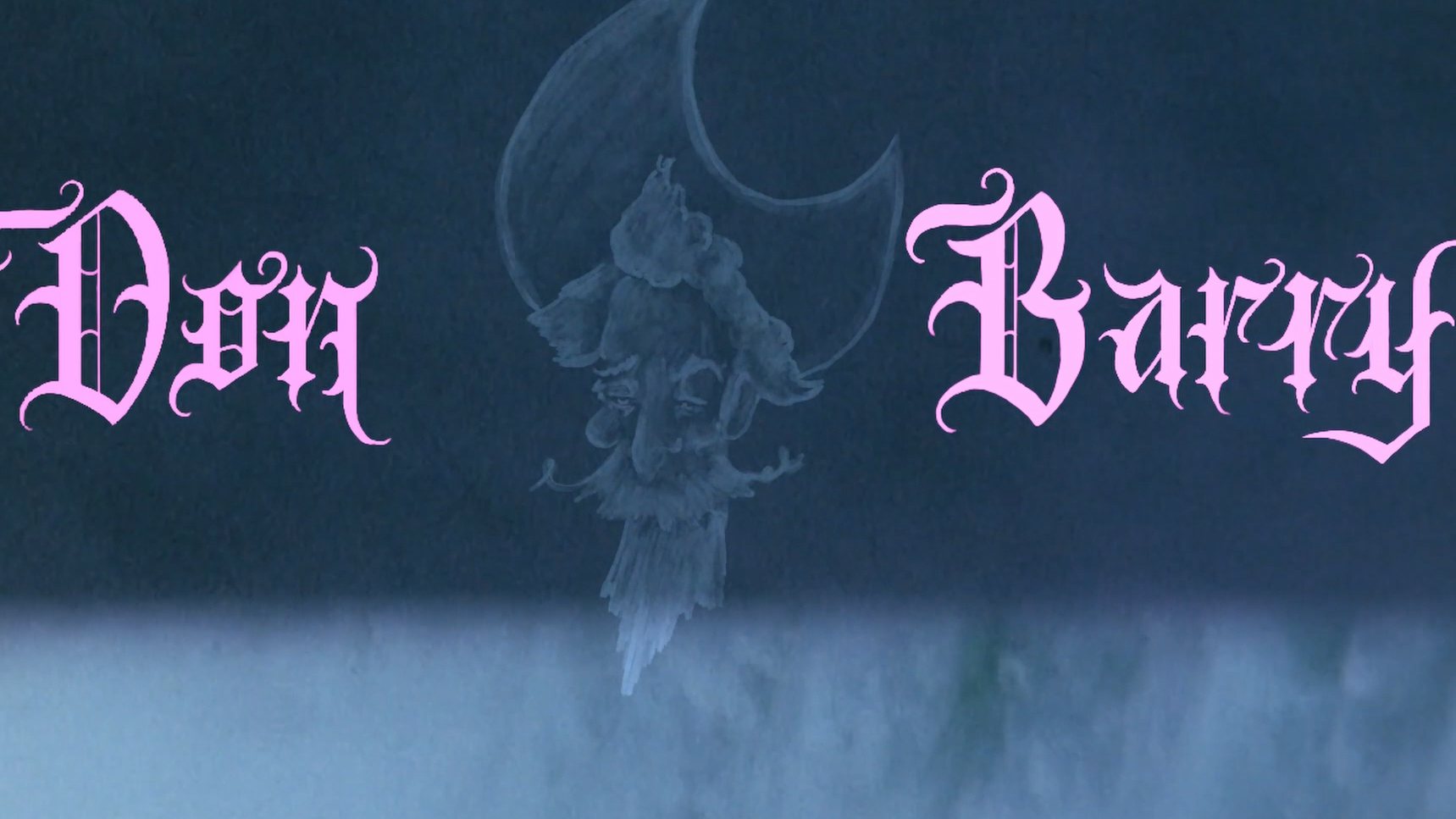
Docufiction, Experimental, by Paul Smart, Mexico, 2026.
Don Barry: A Quixotic Exploration is a debut feature that places the biography of an eighty-year-old experimental filmmaker and artist, Barry Gerson, within the metanarrative of Miguel de Cervantes’ Don Quixote. Don Barry was filmed in the city of Guanajuato during the 51st edition of the Cervantino Festival, as well as during the vibrant Day of the Dead celebrations held in the city’s UNESCO-listed tunnels. The film honors the director’s long friendship with artist Barry Gerson, drawing inspiration from Cervantes’ Don Quixote. Paul Smart’s directorial choices create something new that celebrates life and goes beyond conventional storytelling. A search for magic in our real lives. A moving film about the meaning of life, art, and death. Not to be missed.
Paul Smart is a proud outsider filmmaker with a long history of film screenings. In the 1980s, he emerged in New York’s vibrant youth art scene, working in theater production and later filmmaking, before retreating to rural upstate New York, in the Catskill Mountains, where he made a living writing and screening independent films in old parish halls for rural audiences, many of whom had never seen a film.
LANGUAGE: English
SUBTITLES: Spanish, French, German, Portuguese
A Man Who Decided to Watch Himself
You already know the feeling of catching yourself in a mirror at an unexpected angle — not the one you arranged, not the pose you rehearse before leaving the house, but the accidental side-view that shows you something slightly foreign, slightly uncomfortable, undeniably yours. Most people look away within a second. Montaigne decided, somewhere around 1572, to keep looking.
This is not a small decision. To make yourself the object of sustained, methodical attention — not to celebrate what you find, not to correct it, not to construct from it a lesson for others — requires a violence against everything your culture has told you intellectual work is for. The Renaissance inherited from antiquity a clear mandate: you write to persuade, to instruct, to immortalize virtue. Cicero built his philosophical dialogues as performances of civic wisdom. Seneca’s letters to Lucilius, for all their intimacy, are finally hortatory — they move always toward the exemplary, toward the you who could become better if you applied the correct principles. Even the Stoics, who urged self-examination with genuine rigor, examined the self only insofar as it could be brought into alignment with reason, with nature, with the universal. The gaze turned inward was always in service of a gaze turned upward.
Montaigne broke this entirely, and he knew it. In the opening address of the Essays he is almost apologetic about the rupture: I am myself the matter of my book. The line sits there in 1580 like a small detonation. Not a hero. Not a saint. Not a statesman whose life illuminates public virtue. Just himself — contradictory, changeable, forgetting things he knew yesterday, afraid of certain smells, unable to concentrate in the morning, inconsistent in his opinions from one chapter to the next and largely unbothered by this. The confession is not humble. Humility would have been easier, would have fit the period’s conventions perfectly. This was something far stranger: an epistemological claim. That one ordinary man, examined without the armor of idealization, might tell us more about the human condition than any catalogue of heroic examples.
The philosopher Charles Taylor, in Sources of the Self published in 1989, identifies Montaigne as one of the founders of what he calls radical reflexivity — the turn toward first-person inwardness as a legitimate and irreducible source of truth. But Taylor’s framing, precise as it is, still risks making the gesture sound too philosophical, too composed. What Montaigne actually did was messier and more unsettling than any theoretical category suggests. He watched himself change his mind. He recorded his own cowardice alongside his occasional courage. He noted the gap between what he believed in the morning and what he believed by evening without rushing to resolve it. He caught himself performing wisdom and wrote about the performance.
There is a man who spends years building a case, carefully assembling the evidence of his own reasonableness, his own equanimity, only to notice one afternoon that his hands are trembling slightly when a stranger disagrees with him. The trembling is the truth. Everything else was architecture. Montaigne understood this and refused to demolish the trembling in favor of the architecture.
The tradition he was dismantling did not vanish easily. It never does. The demand that self-examination serve moral improvement — that you look at yourself only in order to become more correct, more disciplined, more useful to the collective project of being human — is not a Renaissance convention. It is something older and more persistent, sewn into the fabric of how literate cultures have always justified the act of writing about oneself. Confessions require sin. Memoirs require triumph. Diaries are private, hidden, excused. But to publish your own fluctuations, your own unresolved contradictions, as if they constituted a form of knowledge — that required a kind of nerve that has no comfortable name.

What La Boétie’s Death Actually Did
There is a moment, familiar to anyone who has ever lost someone too soon, when you find yourself holding an object that belonged to them — a book with their handwriting in the margins, a coat still carrying their shape — and you do not know whether keeping it would be an act of love or a refusal to accept what has happened. You stand in the middle of a room that once held another life and is now just a room. The silence is not peaceful. It is the silence of something violently removed.
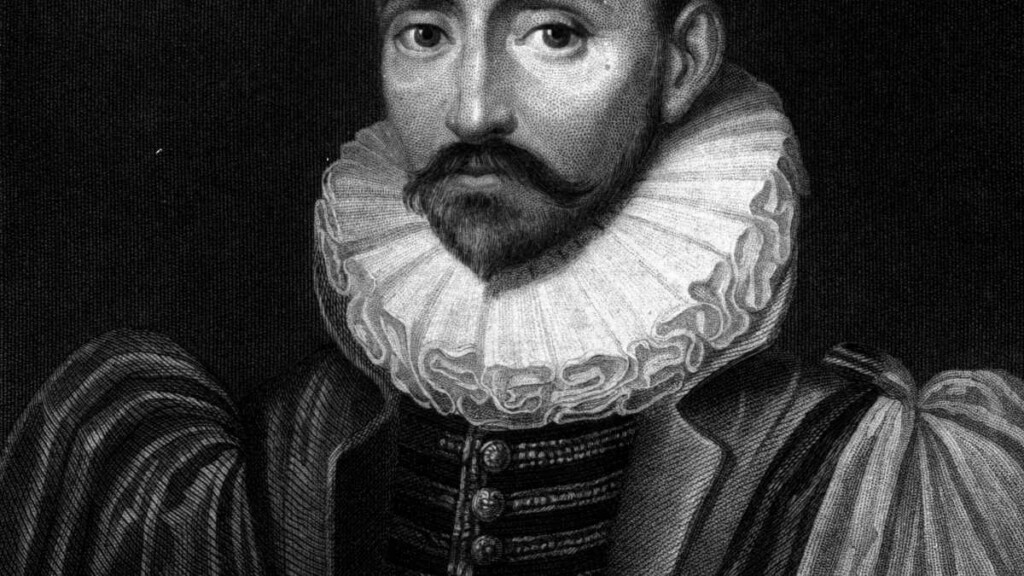
This is where the Essays begin. Not in a library. Not in philosophical serenity. In the aftermath of a death that Montaigne described, years later, as the loss of his other self. Étienne de La Boétie died in August 1563, at thirty-two years old, probably of dysentery, though the body rarely consults our sense of narrative proportion when it decides to stop. Montaigne was at his side. He recorded the final hours with a precision that reads less like documentation than like a man trying to keep something alive by naming every detail of its disappearing.
They had been friends for five years. That number is worth pausing over, because what it held was not a lifetime of accumulated history but something more intense and perhaps more honest: a friendship chosen in full consciousness, by two adults who recognized each other across a room and decided, without ceremony, that this was the person. Montaigne would later write in the essay “De l’amitié” that if pressed to explain why he had loved La Boétie, his only answer was: because it was him, because it was me. It is one of the few times in the history of Western thought when a philosopher admits that the deepest attachments are not explainable, only confessable.
La Boétie had written, probably at the age of eighteen, a text that would haunt French political thought for centuries. His Discourse on Voluntary Servitude asked the most uncomfortable question a political thinker can ask: not why tyrants oppress, but why people consent. Not how power enforces submission, but how submission produces and sustains power from below, through habit, through laziness, through the human preference for familiar chains over uncertain freedom. The diagnosis was not that rulers were monsters. The diagnosis was that the governed were accomplices. La Boétie died before he could see what his own century would do with that idea — the French Wars of Religion were already beginning, and his text would be reprinted by Huguenot propagandists as a weapon.
What Montaigne did with the grief is the thing. He sorted through the belongings. He edited La Boétie’s papers, saw to their publication, kept the manuscripts. And then, somewhere in the weight of all that absence, he began to write about himself. The connection is not incidental. The psychoanalyst André Green, working much later on the phenomenology of loss, would describe what he called “the dead mother complex” — a condition in which mourning, when it cannot complete itself, turns inward and begins to cathect the self as a substitute object. The self becomes interesting precisely when the other who made you interesting to yourself is gone. You examine yourself because there is no longer anyone to examine you, to reflect you back, to make you real through their attention.
This is what the Essays are built on. Not Stoic exercises, not Renaissance humanism in its triumphant mode, but the particular epistemological crisis of a man who no longer had anyone to be known by. Montaigne invented a literary form — the essay, meaning attempt, a word that already concedes failure before it begins — because he needed somewhere to put a person who no longer had anywhere to go. The writing is the house he built for the dead.
And then slowly, stubbornly, he moved in himself.
The Body Refuses to Be Philosophized Away
There is a particular kind of terror that arrives not with noise but with fluorescent light. You are sitting in a plastic chair, the kind that forces your spine into a shape it never asked for, and somewhere behind a closed door someone is reading a sheet of paper that concerns your body. Not your ideas. Not your ambitions. Not the careful architecture of the self you have spent decades assembling. Your body, specifically, in its chemical particulars, its cellular behavior, its stubborn insistence on existing according to rules you were never consulted about. And every philosophical position you have ever held — every conviction about meaning, about agency, about the primacy of consciousness — dissolves into the single brutal fact that you are meat that is afraid.
Montaigne knew this waiting room. He lived in it for years. His kidney stones were not a biographical footnote but a recurring philosophical education, one his body administered whether he wished to attend or not. He wrote about the pain with a precision that most philosophers reserve for logical propositions: the burning, the blockage, the humiliation of a mind that considers itself sovereign suddenly subordinated to a stone smaller than a pea. He did not spiritualize the experience. He did not extract a lesson about endurance or transcendence. He simply reported what happened inside a body that was also, inseparably and permanently, him. This was, in its quiet way, a radical act.
Paul Valéry wrote that the body is the most profound philosophical problem, and he meant it as a provocation aimed precisely at the tradition that had spent centuries pretending otherwise. The tradition that would follow Montaigne chose, almost unanimously, to treat the body as an embarrassment to be managed, a lower frequency to be transcended or at least controlled by the superior instrument of reason. René Descartes, writing his Meditations in 1641, roughly forty-five years after Montaigne’s death, performed the most consequential act of philosophical housekeeping in Western history: he separated the thinking thing from the extended thing, the res cogitans from the res extensa, and in doing so gave European philosophy permission to ignore the body for three centuries while imagining it was talking about the whole human being.
Montaigne had refused this permission before it was even formally offered. He wrote about his sexual appetite with the same equanimity he brought to questions of mortality. He noted his digestion, his fatigue, the specific quality of his laziness on cold mornings. He observed that the fear of death was not a philosophical problem to be solved but a physical event to be witnessed — the heart accelerating, the hands going cold, the mind losing its usual grip on its own narratives. He did not write about a man who feared death. He wrote about what it felt like to be a body that feared death, and the distinction is everything.
What Descartes severed, Montaigne had held together, and the cost of that severance has been borne not by philosophy but by every person who has ever sat in a waiting room and felt their abstract self dissolve. The man in the plastic chair does not need a theory of mind. He needs someone who has thought seriously about what it means that his hands are shaking while he tries to read a magazine about kitchen renovations. He needs someone who will not tell him that the shaking is separable from the thinking, that the body’s panic is beneath the dignity of serious reflection. He needs, in other words, exactly what Montaigne offered: a philosopher who had himself sat with the same panic, who had written about it not to overcome it but to look at it directly, without the protective lens of abstraction, and to say simply — this too is what we are.
The Essays as a Form That Thinks
There is a particular kind of reader who returns to the same book not to find what they found before, but to find out what they have become since. They do not go back for answers. They go back because the book, somehow, refuses to finish thinking.
This is not a quality most books possess. It is, in fact, a quality that most books actively resist, since books are generally built to arrive somewhere, to deposit a conclusion, to leave the reader standing on solid ground with something transferable in their pocket. Montaigne built the opposite. He built a form whose very name confesses its incompleteness — essai, from the French verb essayer, to attempt, to try, to test without guarantee of outcome. Not a treatise. Not a demonstration. A trial run of the mind, conducted in public, preserved in ink, and left without a verdict.
Between 1580, when the first two Books appeared, and 1588, when the third Book arrived alongside a substantially revised edition of the earlier ones, Montaigne produced 107 of these attempts. He then continued annotating and expanding them until his death in 1592, so that what survives is a text in perpetual revision, a mind that kept returning to its own traces and finding them insufficient, not because it had been wrong, but because it had moved. The edition known as the Bordeaux Copy, covered in handwritten additions in Montaigne’s own hand, is perhaps the most honest manuscript in Western literature: a man arguing with himself across time, leaving both versions visible.
Sarah Bakewell understood something essential when she organized her 2010 study of Montaigne around the question of how to live, not because Montaigne answers that question, but because he refuses to, magnificently and at length. Her book became unexpectedly popular, which surprised some literary critics and surprised no one who had ever read Montaigne during a period of personal unraveling. Bakewell’s approach was itself essayistic, circling her subject without pinning it, letting the biography and the philosophy bleed into each other the way they do in Montaigne’s own pages. What she demonstrated, perhaps without entirely intending to, is that reading Montaigne is always an act of identification before it is an act of analysis. You recognize him. You recognize yourself in him. These two recognitions are sometimes indistinguishable.
Stefan Zweig wrote his essay on Montaigne in 1942, in exile in Brazil, in the final months of his life. He was a man who had lost his country, his language’s public audience, his sense of historical ground. He turned to Montaigne the way one turns to the only mirror that does not lie, and what Zweig found there was a portrait of someone who had also survived an age of collective madness by retreating into the sovereignty of the self — not as escape, but as resistance. The essay was unfinished when Zweig died by suicide in February of that year. Which means that one of the most important readings of Montaigne in the twentieth century is itself an essai in the truest sense: a thought that did not conclude because the thinker was taken before the conclusion came.
This is not a coincidence the way literary coincidences usually are, neat and a little forced. It is something closer to a structural truth about what Montaigne’s form does to its readers. It teaches them to think without the crutch of arrival. It models inconclusiveness not as failure but as epistemological honesty — the acknowledgment that a self in motion cannot produce static truths, that any sentence written today about who you are contains within it the seed of its own future revision. The philosopher Richard Rorty, writing in the 1980s about irony and contingency, would have recognized in Montaigne a precursor: someone who understood that holding your beliefs lightly is not weakness but the only intellectually defensible posture available to a finite creature in a world that keeps changing its shape.
A vision curated by a filmmaker, not an algorithm
In this video I explain our vision
Freedom Is the Trap You Build Yourself

There is a moment when a man sits across from an official, fills out a form, chooses between two options printed on a page, and feels, briefly, the warmth of self-determination. He chose. He exercised his will. The form is stamped, the clerk nods, and he walks out into the corridor carrying the mild satisfaction of someone who has navigated the world on his own terms. What he does not see — what the corridor does not reveal — is that the form only ever had two options, that both led to the same room, and that the clerk nodded before he even finished writing.
Montaigne watched this happen to everyone around him and, more honestly, to himself. His skepticism was not the cold academic variety borrowed whole from Pyrrho of Elis — though Pyrrho was there, whispering underneath. Pyrrho had argued in the fourth century BCE that nothing can be known with certainty, that suspension of judgment is the only rational response to a world that contradicts itself at every turn. Montaigne absorbed this, but he did something more dangerous with it: he turned the doubt inward, onto the very instrument of doubting. Not just what do I know, but who is this I that claims to know anything, including itself.
In the final essay of the Essais, “On Experience,” written in 1588 and among the last pages he would revise before his death, Montaigne arrives at what sounds like a celebration of ordinary life but is in fact a quiet demolition. He writes that custom is our greatest teacher and our most invisible jailer. Not law. Not religion. Not authority with its visible face. Custom — the accumulated pressure of how things are done, how they have always been done, so thoroughly absorbed that it no longer feels like pressure at all. It feels like preference. It feels like character. It feels like you.
Think of the man who believes he chose his profession freely, who experiences his daily habits as expressions of an interior self, who has never once paused to ask where the menu of available selves was printed and by whom. Montaigne would not mock him. He would recognize him, because he recognized himself in exactly this condition. The tower at Château de Montaigne was not an escape from custom — it was custom with better lighting. Even solitude, he admitted, arrives already furnished.
Pierre Bourdieu would name this furnishing four centuries later. His concept of habitus — developed across works including Outline of a Theory of Practice in 1972 and The Logic of Practice in 1980 — describes the system of durable dispositions that social life deposits in the body before the mind is aware enough to object. The habitus does not constrain from outside. It operates as the very grammar of perception, the invisible syntax through which you read every situation and generate what you experience as a spontaneous response. You do not feel the habitus. You feel like yourself.
What Montaigne intuited without the terminology was precisely this: that the most effective prison is the one whose walls you have internalized so completely that you experience them as the boundaries of your own desire. He noticed that he preferred certain foods, certain hours, certain postures, and he noticed — this was the genuinely rare part — that these preferences had histories he had not chosen. They were deposited. They were inherited. They wore his name.
The modern fantasy of autonomous selfhood — the individual who selects an identity from an open field, who curates a life, who optimizes choices — would have struck Montaigne not as liberation but as the most sophisticated version of the old trap. The bars have been replaced with preferences. The warden has been replaced with your own voice, telling you that this is exactly what you wanted.
The Political Man Who Refused Ideology
You know that specific chill that descends over a dinner table when someone declines to condemn what everyone else has already condemned. Not defends it, not attacks the consensus, simply refuses to perform the expected verdict. The air changes. Glasses are set down with slightly more deliberation than necessary. Someone asks, with that careful lightness that is really a warning, “So you’re saying you don’t have a position?” And what they mean, what everyone in the room means, is that the absence of their position is itself a moral failure. To not belong to the side that is obviously correct is to belong to the other one. The logic of the room permits no third space.
Montaigne spent four years living inside that logic at a scale where the stakes were not social discomfort but massacre. He served as mayor of Bordeaux from 1581 to 1585, during the most vicious phase of the French Wars of Religion, a conflict that had already produced the St. Bartholomew’s Day Massacre of 1572, in which somewhere between five and thirty thousand Protestants were killed across France in a matter of weeks. Bordeaux was a city suspended between confessional armies, between Henri de Navarre’s Protestant forces and the Catholic League, between a king whose authority was collapsing and local powers filling the vacuum with violence. Everyone in every room Montaigne entered had already decided. He had not.
This is not the portrait of a coward or a diplomat. It is the portrait of someone who had read enough history to understand what certainty does to people. In the Essays, he returns obsessively to the way the human mind generates conviction with a speed and enthusiasm wildly disproportionate to its actual knowledge. He watched men who could not locate a theological difference if their lives depended on it — and in those years, lives did depend on it — kill each other over formulations they had memorized rather than understood. The ideology was not the cause of the violence. The ideology was the permission slip.
Hannah Arendt, writing nearly four centuries later in The Origins of Totalitarianism, identified this mechanism with surgical precision. Ideological thinking, she argued, is characterized not by the content of its claims but by a particular relationship to reality: it substitutes a logical system for experienced truth, demanding that what is seen conform to what is deduced. Once you accept the first premise, everything follows with iron necessity. The horror she was describing had specific addresses in the twentieth century, but the structure she identified is as old as any room where someone asks, with that careful lightness, which side you are on. The system does not need you to believe. It needs you to perform belief. And the performance, once begun, has its own momentum.
Montaigne refused the performance. As mayor, he negotiated, he maintained communication with both sides, he kept Bordeaux from becoming a battlefield without declaring himself a soldier for either army. He was accused, by the logic of both camps, of exactly what the dinner table accuses the silent guest: of hiding something, of cowardice dressed as philosophy, of a neutrality that was really complicity with the enemy — whichever enemy you happened to be. His response, in the Essays, is not a defense of neutrality. It is something sharper. He argues that the man who claims perfect certainty about which God wants which prayer recited in which language has, in that very certainty, revealed the limits of his self-examination. The confidence is the symptom. The person who has truly looked at himself knows how much darkness is in there, how many contradictory impulses, how provisional every conclusion. Absolute political conviction, for Montaigne, was less a sign of strength than a sign of someone who had not yet met themselves in a quiet room and found the encounter uncomfortable.
He Was Writing to Someone Who Hadn’t Been Born Yet
It is past midnight and you are in bed with a book you expected to find merely interesting, and then something happens that is difficult to explain to anyone who hasn’t experienced it. You read a sentence written by a man who has been dead for four centuries and your hand stops moving. Not because the sentence is beautiful, though it may be, but because it describes something you have never managed to say about yourself — something you weren’t even sure could be said, something that lived in you as a vague pressure without language, and now it has language, and the language is exact. You reach for a pencil and underline it, and then you sit there in the silence of your own room feeling the particular vertigo of being known by someone who never knew you existed.
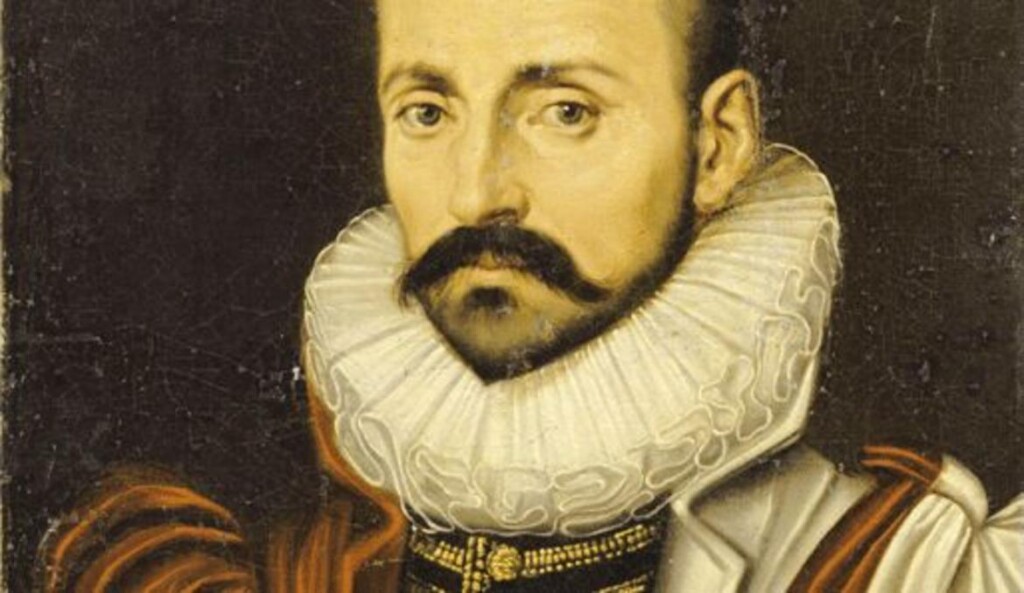
This is the uncanny arithmetic of Montaigne’s project. He wrote in a round stone tower on his family estate in the Périgord region of southwestern France, largely between 1571 and 1592, in a room whose ceiling beams he had inscribed with Greek and Latin aphorisms. He had no audience in any certain sense. He was writing, as he himself admitted with a kind of defiant casualness, about one particular man, himself, and he seemed genuinely uncertain whether anyone would care. And yet the Essays, first published in 1580 and expanded through two more editions in his lifetime, have never been out of print. The vertigo you feel at midnight with a pencil in your hand is felt by readers in languages Montaigne had never heard, in countries that did not exist when he was alive, in conditions of life he could not have imagined. This is not the ordinary survival of a classic text. Something stranger is happening.
What is strange is not that he described human nature in general terms capacious enough to absorb any reader. He didn’t do that. He was relentlessly particular, notoriously so. He described his digestion, his fear of horses, his complicated feelings about his own father, the specific quality of his grief for his friend La Boétie, who died in 1563, the way his memory failed him in ways he found both alarming and faintly comic. He was not constructing a universal portrait. He was making a detailed record of one man’s inner weather. And yet that record somehow reaches you across five centuries and locates something you didn’t know had an address.
The philosopher Paul Ricoeur spent much of his career thinking about why narratives of selfhood feel simultaneously like invention and discovery, and his conclusion in Oneself as Another, published in 1992, was that identity is not a possession but a task, something that requires the mediation of stories and symbols to become legible even to the person who lives it. Montaigne understood this intuitively, perhaps before anyone else had the vocabulary for it. He wrote the self into existence by watching it, and in doing so he created a kind of mirror that doesn’t reflect what you look like but what you are like, which is a different and more disturbing technology.
The self he described — unreliable, internally contradictory, unable to hold a stable position on anything including itself, opaque to its own motives, briefly illuminated by experience and then clouded again — is not a self that history has improved. We have not, in five hundred years, resolved the instability Montaigne documented. We have built institutions, developed sciences, constructed ideologies and therapeutic systems, all of them organized in various ways around the project of making the self more coherent, more manageable, more knowable to itself. And still you find yourself at midnight underlining a sentence written in a tower in Périgord, feeling recognized by a dead man more precisely than by anyone sitting at the table with you, and the question that does not quite leave the room is what it means that this is still the self we are.
🌿 Essays, Existence, and the Examined Life
Montaigne’s Essays stand as one of the founding monuments of Western self-reflection, a practice of turning inward to understand the human condition in all its contradictions. The articles gathered here trace a path through thinkers and writers who, like Montaigne, dared to confront life’s deepest uncertainties with honesty and philosophical rigor. Follow these threads to deepen your encounter with the essay as an act of living thought.
Schopenhauer: Life and Philosophical Thought
Schopenhauer, like Montaigne, made the personal encounter with suffering and will the very center of his philosophical inquiry. His exploration of desire, renunciation, and the nature of existence resonates with Montaigne’s restless questioning of what it means to live well. Reading Schopenhauer alongside the Essays reveals how Western philosophy continually returns to the same irreducible human anxieties.
GO TO THE SELECTION: Schopenhauer: Life and Philosophical Thought
Albert Camus: Life and Philosophical Thought
Albert Camus inherited Montaigne’s unflinching willingness to look at life without the comfort of illusions, transforming that honesty into a full philosophical vision of the absurd. His thought, rooted in Mediterranean humanism and existential courage, echoes the Gascon essayist’s insistence on living fully within uncertainty. Together, these two figures form a continuous thread of engaged, lucid humanism in French thought.
GO TO THE SELECTION: Albert Camus: Life and Philosophical Thought
Viktor Frankl: Life and Logotherapy
Viktor Frankl‘s logotherapy emerged from the most extreme confrontation with meaninglessness imaginable, yet its conclusions share with Montaigne a deep trust in the individual’s capacity to find orientation in life. Both thinkers insist that meaning is not given but actively created through honest self-examination and responsible engagement with existence. Frankl’s work offers a twentieth-century answer to questions Montaigne first posed in the tower of his library.
GO TO THE SELECTION: Viktor Frankl: Life and Logotherapy
Hannah Arendt: the Philosopher Who Unmasked the Banality of Evil
Hannah Arendt‘s unflinching analysis of evil, judgment, and the public life of the mind places her in a long tradition of moral essayists to which Montaigne unmistakably belongs. Her insistence on thinking without guardrails and her refusal of comfortable abstraction mirror the spirit of the Essays in a modern political key. Reading Arendt alongside Montaigne illuminates how the practice of honest thinking remains a radical and necessary act across the centuries.
GO TO THE SELECTION: Hannah Arendt: the Philosopher Who Unmasked the Banality of Evil
Discover the Cinema of Ideas on Indiecinema
If these philosophical journeys have stirred something in you, Indiecinema streaming is the natural next step: a curated space where independent and auteur films explore the very questions that Montaigne, Camus, Frankl, and Arendt refused to leave unanswered. Join us and let cinema become your next essay on the human condition.
👉 EXPLORE THE CATALOG: Watch Indie Films in Streaming
A vision curated by a filmmaker, not an algorithm
In this video I explain our vision

