
The Glow Before Breakfast
Before your eyes have fully adjusted to the light, your thumb is already moving. You are not awake yet, not really — the dream has barely released you, your body still holds the warmth of sleep, and yet your hand has already found the phone on the nightstand with the practiced certainty of a reflex, something closer to breathing than to choice. The screen flares. You squint. And then you begin.

You scroll through an argument about a politician you had already forgotten by last week. You pass a photograph of a sunset over a coastline you will never visit, posted by someone you met once at a party in 2019. There is an advertisement for shoes that somehow already knows your size. There is outrage — there is always outrage — this morning directed at someone who said something, or failed to say something, or said it in the wrong tone at the wrong moment, and the outrage is absolute and sincere and will be completely replaced by tomorrow. There is a celebrity whose marriage has ended, and the grief of strangers over this is genuine, palpable, shared in comment sections with the earnestness of people consoling a mutual friend. There is a video of an animal doing something almost human. There is a death toll from somewhere. There is a recipe. There is another advertisement, this one for something you mentioned aloud two days ago in a private conversation.
You have not yet spoken a single word to another person. You have not yet drunk water, or looked out a window, or registered what kind of day is arriving outside your walls. And yet you have already consumed more images, opinions, emotional signals, and fragmentary information than your grandparents would have encountered in a week. This is not a metaphor. This is not an exaggeration designed to make you feel guilty. This is simply the texture of the first four minutes of your day, and it has become so ordinary that the strangeness of it has entirely vanished.
That vanishing is the thing worth examining.
There is a particular quality to the information you absorbed in those four minutes, and it has nothing to do with whether it was true or false, important or trivial, well-intentioned or manipulative. It has to do with what it asked of you. It asked nothing. It required no sustained attention, no prior knowledge, no consequence. The sunset and the death toll and the failed marriage and the animal video arrived with identical weight, presented in the same format, demanding the same response — a fraction of a second of your awareness, a possible tap of your thumb, and then the next thing. Context was not just absent; context was the enemy of the format. The format needed you to keep moving.
You kept moving.
And here is what is difficult to hold onto, precisely because the morning has already started pulling you forward into its ordinary demands: the way information is delivered to you is not neutral. It has never been neutral. Every medium through which human beings have communicated with one another — the town square, the printed page, the telegraph, the television, and now the luminous rectangle you hold in your hand — carries within its structure a set of assumptions about what thinking is, what truth looks like, what counts as a serious claim about the world. The medium does not just carry the message. The medium shapes what kinds of messages are even possible, which ideas can be spoken and which cannot survive the translation, which emotions are amplified and which are quietly starved.
Someone understood this with uncomfortable precision, long before the phone existed, long before the scroll had been invented. He was watching something else — something that seemed, at the time, almost innocent. He was watching television. And what he saw there frightened him deeply.
The Lost Poet

Drama, by Fabio Del Greco, Italy, 2024.
Dante Mezzadri wants to see an old friend, nicknamed the Iguana, whom he has lost sight of for many years, and who has managed to turn their shared youthful passion for poetry into a job, becoming a famous writer and poet. The man escapes from his bourgeois life and his wife to live homeless on the Roman coast, printing and trying to sell his poetry collections. At night he sleeps in a park of old carnival floats, inside a papier-mâché tank, and waits for the opportunity to meet his old friend, who however never shows up for appointments in the places they frequented when they were young, now in ruins. Dante's poetry books do not interest anyone and to support himself he is forced to "change product": he starts selling the infamous "cannibal pill" on behalf of young drug dealers, a new drug that sells like hot cakes and causes sensory and consumerist ecstasy. However, he realizes that this powerful drug is very dangerous for those who take it, he comes into conflict with his ethical conscience and throws all the pills into the sea. However, the dealers want to collect their money.
Shot over a period of 2 years, the film is a reflection on the cultural and artistic rubble of the society in which the protagonist lives, in an increasingly mechanized, consumerist and arid world. Dante Mezzadri is yet another human being who has renounced his inspiration and his creativity, but unlike many he is not willing to give his life to a system that distances him from his true identity. The physical world around him, however, seems constructed in such a way that it seems impossible to escape from this "invisible cage". The enthusiasm of the people he meets is ignited only by sensory gratification, by unreal visions of personal affirmation and success, by "metaverses" that offer an escape into an illusory and destructive reality. The poet's house on the coast, where he met with his friends as a young man, is just a pile of abandoned rubble. What happened to all those who wanted to become poets and ended up becoming something else? Are there internal forces with which that house can be "rebuilt"?
LANGUAGE: Italian
SUBTITLES: English, Spanish, French, German, Portuguese
A Man Who Saw It Coming in 1985
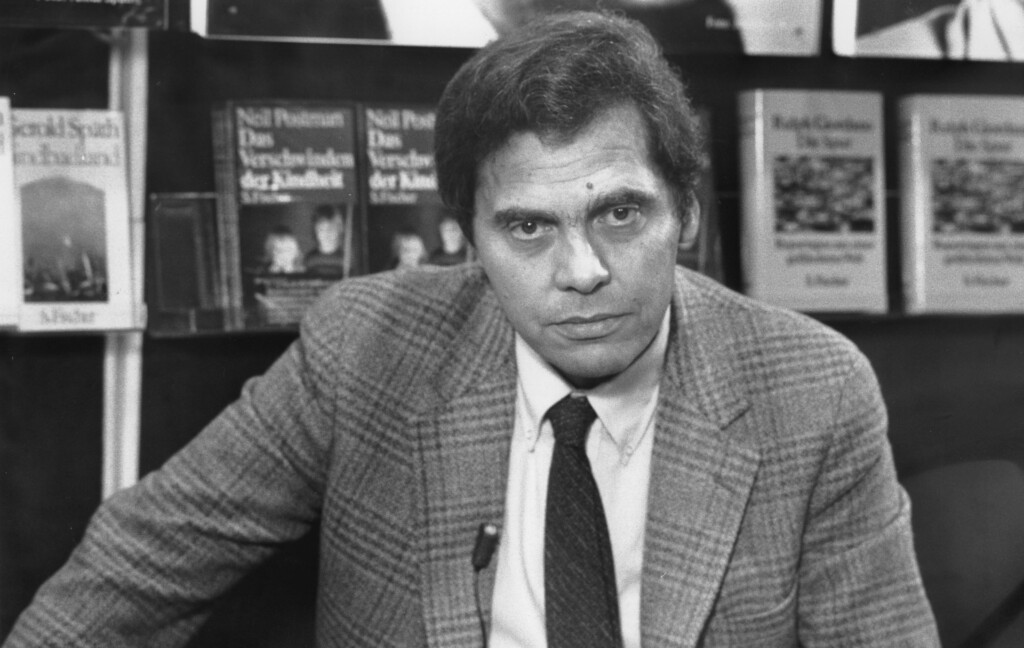
He was born in 1931 in New York City, which means he grew up watching a world reorganize itself around a screen. Not metaphorically. Literally. The television set arrived in American living rooms during his formative years with the force of a natural event, something between a revolution and a weather change, and most people responded the way people respond to weather: they adapted, complained briefly about the cold, and then forgot what summer had felt like. Postman did not forget. Something in him refused the adaptation, not out of nostalgia or conservatism, but out of a particular kind of attention that some people are cursed with from birth — the attention that notices what everyone else is in the process of normalizing.
He studied at the City College of New York and then at Columbia, institutions that in the postwar years were still places where the question of what an educated person owed to the public carried genuine weight. This was the intellectual atmosphere of his formation: serious, civic, somewhat combative, deeply suspicious of easy pleasures disguised as democratic access. He came of age reading people who believed that the quality of a culture’s discourse was not incidental to its politics but constitutive of them. That ideas had consequences. That the form in which information was delivered was not neutral packaging but active shaping force.
It was Marshall McLuhan who gave Postman the conceptual vocabulary to articulate what he was already sensing. McLuhan’s famous formulation — that the medium is the message — was for Postman not an intellectual provocation to be debated at conferences but a diagnostic tool to be applied with urgency. Together they belonged to what became known as media ecology, a field that treated communication environments the way biologists treat ecosystems: as total systems in which every element affects every other, in which the introduction of a new species changes everything that was already living there. When television entered that ecosystem, Postman understood that something older and slower and more demanding was being displaced. He spent decades trying to say what.
By 1985, when Amusing Ourselves to Death was published, the evidence was everywhere for those willing to read it. Ronald Reagan had just won a landslide re-election. Reagan, a former actor, had understood something about the new media landscape that his opponents kept failing to grasp: that in a television culture, the impression of competence matters more than its demonstration, that warmth and clarity of image can substitute for depth of argument, that what you look like saying a thing has largely replaced what the thing means. His campaign managers understood this with a precision that bordered on the clinical. Postman understood it from the opposite direction, with a horror that bordered on the prophetic.
MTV had been broadcasting for four years by then. The average American was watching television for more than seven hours a day. The three major networks controlled virtually all of prime-time viewing. News programs were competing not on the basis of information but on the basis of entertainment value, and the competition was quietly, irreversibly changing what news meant. Postman watched all of this and reached for Aldous Huxley rather than George Orwell, which was itself a significant intellectual choice. Orwell had imagined a future in which truth was suppressed by force. Huxley had imagined one in which it was rendered irrelevant by pleasure. Postman’s argument was that Huxley had been right, and that the mechanism of irrelevance was already fully operational, already embedded in the furniture of ordinary American life.
What made him unusual was not the anxiety — many people were anxious about television. What made him unusual was the precision of his diagnosis, the clarity with which he could trace the epistemological consequences of a culture organized around image and immediate gratification rather than print and sustained argument. He had seen something. And he had found the words for it before most people had even noticed there was something to see.

Huxley Was Right, Orwell Was Wrong
There is a man sitting in front of the television at the end of a long Tuesday. He has been watching the news for three hours. He knows that something happened somewhere, that someone said something about someone else, that a number was mentioned in connection with a crisis he vaguely remembers from last week. He feels, if he is honest, slightly dazed — not uninformed exactly, but not informed either. Something in between, a kind of warm static. And yet he will do it again tomorrow, and the day after, because the experience itself was not unpleasant. That is precisely the point.
Postman understood something that most of his contemporaries were not yet willing to say plainly: the danger was never the boot. It was the sofa. It was the comfort. It was the fact that you could be deprived of your capacity for serious thought and feel, throughout the entire process, reasonably entertained.
The intellectual architecture of the twentieth century had been built largely around one fear. Orwell had given that fear its sharpest form — the image of a totalitarian state crushing individual consciousness through surveillance, censorship, and physical terror. It was a fear born in the fires of real history, in Stalin’s purges and Hitler’s book burnings, in the mechanisms of coercion that had made the mid-century a slaughterhouse of the mind. Orwell feared the people who would burn books, who would ban thought, who would impose silence by force. He feared those who would hate us into submission.
Huxley feared something more insidious and, as it turned out, more accurate. In his vision, no one would need to burn books. Books would simply become irrelevant. People would not be forbidden to think; they would be too distracted to bother. They would be given so much pleasure, so much stimulation, so much sensation carefully engineered to satisfy without nourishing, that the very desire for depth would atrophy like an unused muscle. Huxley feared those who would give us so much that we would want nothing more.
Postman made the distinction with surgical precision in the opening pages of his work. Orwell’s nightmare, he wrote, was of external oppression. Huxley’s was of an oppression that comes from within, that we would not merely tolerate but celebrate, an oppression wearing the face of entertainment. And when Postman looked at American television in 1985, he did not see Orwell anywhere. He saw Huxley, everywhere, in everything.
What television had produced was something Postman called the peek-a-boo world — a phrase that deserves to land with more weight than it usually does. In a peek-a-boo world, information appears and then vanishes. It surfaces without context, without history, without consequence, and then it is replaced by something else, equally vivid and equally hollow. A famine. A scandal. A celebrity. A war. Each item arrives with the urgency of revelation and disappears without leaving a trace in the structure of understanding. You are perpetually surprised. You are perpetually uninformed. And the two feelings are somehow indistinguishable from each other.
The man on the sofa after three hours of broadcast news is not a passive victim in the Orwellian sense. No one forced him to sit there. No state apparatus compelled his attention. He chose this, freely, willingly, with a kind of low-grade pleasure that asks nothing of him and gives him just enough sensation to feel engaged without ever requiring him to actually be so. This is what Huxley meant. This is what Postman was pointing at — not the tyranny of prohibition but the tyranny of abundance, not the silence enforced by a censor but the noise that makes silence unthinkable.
The boot leaves a mark. The sofa just holds its shape around you, slowly, until the shape it holds is yours.
The Medium Is the Disaster
Marshall McLuhan said the medium is the message, and most people who have repeated that phrase have done so with a kind of intellectual delight, as though they had just discovered a clever trick. McLuhan himself often seemed exhilarated by what he was describing. The electric age, for him, was a retribalizing force, a return to acoustic immersiveness, a global village humming with participation. There was something almost ecstatic in his tone, the tone of a man watching a fireworks display and marveling at the chemistry of light. Postman read McLuhan carefully and drew an entirely different conclusion from the same premises. If the medium is the message, then what message does television send? Not this program or that broadcast, not the news or the sitcom or the nature documentary, but the form itself, the grammar of the thing, the structural logic that governs every second of what appears on screen. That question, which McLuhan opened and then seemed to dance around, Postman walked into with the seriousness of a doctor entering a ward.
The television grammar is not neutral. It is built around the cut, the dissolve, the sequence of images that must not linger too long before the eye grows restless. Thirty seconds is not an arbitrary unit. It is the metabolism of the medium, the pulse rate at which attention must be refreshed or lost entirely. Every segment competes with the segment before and after it for the same scarce resource: the willingness to keep watching. This means that complexity is not merely unwelcome but structurally forbidden. An argument that requires you to hold five premises in mind simultaneously, to weigh them against each other, to suspend judgment until the fifth step is reached, is an argument that television cannot make. The medium does not have that syntax. It has images, it has affect, it has the imperative of entertainment above everything else, because the moment something ceases to entertain it ceases to exist on screen.
Walter Ong, whose Orality and Literacy appeared in 1982, the same year Postman was sharpening the arguments that would become his most famous book, had mapped the cognitive territory with extraordinary precision. Print culture, Ong showed, did not merely record thought. It restructured it. The sequential, linear, argumentative self that could hold a syllogism in mind, that could read a paragraph and then re-read it, that could carry a private interior life sustained by solitary engagement with a text, that self was not natural. It was manufactured by centuries of literacy. Gutenberg did not print books. He printed a new kind of human being. And Postman understood, with a clarity that was almost painful, that television was methodically dismantling that same being, not through malice but through the logic of its own form.
There is a man who wakes every day without short-term memory, navigating the world entirely through polaroid photographs and notes he has tattooed onto his own skin. He moves with extraordinary confidence. He acts on his evidence, draws conclusions, makes decisions. From the outside, he looks like a functioning person. But the continuity that would allow him to evaluate his own evidence, to notice that he has misread a clue or followed a false trail, is precisely what he lacks. Each fragment is vivid. Each fragment is acted upon. What he cannot do is build a self from the accumulation of fragments, because accumulation requires sequence, and sequence requires memory, and memory requires the kind of sustained cognitive architecture that his condition has destroyed. Postman looked at the television audience and saw something structurally similar: vivid fragments, each one emotionally immediate, none of them cohering into the argumentative chain that produces genuine understanding. The tattooed man keeps moving forward. He is never paralyzed. That is the most frightening part.
Politics Becomes a Cologne Advertisement
There is a moment, repeated every few years, when you stand in a crowd or sit on your couch watching a screen, and something enormous seems to be happening. A figure at a podium speaks in cadences designed to feel historic. The lighting is immaculate. The flags behind him are arranged with the precision of a Renaissance altarpiece. You feel something — not quite belief, not quite hope, but something adjacent to both, something warm and slightly breathless. And then it ends, and you go home, and by Tuesday nothing has changed, and you cannot quite remember what was actually said, only how it felt to watch it.
This is not political apathy. This is politics functioning exactly as designed.
Postman understood something that most media critics of his era circled without landing: the problem was never that television made politicians dishonest. Politicians had always lied. The problem was that television made the distinction between true and false structurally beside the point. What survived on screen was not argument but image, not position but atmosphere. The medium did not distort political discourse. It replaced it with something else entirely, something that looked identical from the outside but operated on completely different principles.
The evidence arrived quietly in September 1960, when two men sat under studio lights and debated each other before seventy million Americans. Those who heard the exchange on radio believed one man had won. Those who watched the screen believed the other had. The content was identical. The light on one man’s face was not. The history of what followed is well known, but what it revealed has never fully been absorbed: from that moment forward, the management of visual composition became the central act of democratic politics. Not spin, not rhetoric, not even charisma in the old sense — but the precise choreography of how a human being looks while speaking words that may or may not mean anything.
By the early 1980s, this understanding had hardened into operational doctrine. A president’s handlers would deliberately allow journalists to broadcast footage that contradicted the verbal content of a speech, confident that the image would cancel the words every time. When a reporter pointed out the discrepancy — here is what he said, here is what the facts show — the response from inside the campaign was almost cheerful: it doesn’t matter, because people will remember what they saw, not what they heard. This was not cynicism. It was empiricism.
Guy Debord had named the underlying architecture seventeen years earlier, in 1967, with the cold precision of someone describing a disease from inside the body. Modern social life, he argued, had not simply been mediated by images — it had been replaced by them. The spectacle was not a collection of images but a social relationship between people, mediated by images. Lived experience had been hollowed out and its representation installed in its place, more vivid, more portable, more emotionally satisfying than the original. People no longer participated in events. They witnessed their representation and called the witnessing participation.
This is exactly what happens at every rally, every convention, every carefully orchestrated moment of political theater you have ever watched. The crowd inside the arena, the crowd watching at home — both are audiences. Both are experiencing a performance of power, not power itself. The emotions are real. The tears, the anger, the surge of collective identity — none of that is manufactured. But the object of those emotions has been carefully substituted. You are moved by the image of a decision being made, not by a decision being made. You feel the weight of history without history occurring.
Postman called this the problem of a culture that had confused entertainment with discourse. But perhaps the more precise word is replacement. Entertainment did not degrade political discourse. It occupied its address, wore its clothes, and answered to its name, while political discourse itself quietly ceased to exist.
A vision curated by a filmmaker, not an algorithm
In this video I explain our vision
Education as Entertainment, or the Slow Erasure of Difficulty

There is a moment you might recognize if you have ever stood on the other side of a classroom. The teacher is speaking — genuinely, with the kind of urgency that only comes from someone who has lived inside a subject for decades — about something ancient and genuinely difficult. The syntax of dead languages, perhaps, or the slow geological logic of continental drift. The students are present. Eyes open. No one is asleep, no one is visibly distracted. And yet nothing is moving. The silence is not the silence of concentration. It is the silence of surfaces that have stopped receiving impressions altogether. They are absent in the only way the chronically overstimulated can be absent: entirely, while remaining in the room.
Neil Postman looked at that room and understood something that most education reformers have consistently refused to understand: the problem was not the curriculum, not the teacher’s training, not the funding levels, not the class size. The problem was that television had already been there first, and it had restructured the very neurological contract that learning requires. Not through any single piece of content it delivered, but through the expectations it installed about what receiving information is supposed to feel like.
His argument about Sesame Street remains one of the most uncomfortable things he ever wrote, precisely because it targets something universally celebrated. The show debuted in 1969, designed with the explicit mission of preparing disadvantaged children for school by making learning appealing, and it succeeded at exactly that — while failing at something no one had thought to protect. What it taught, Postman argued, was not how to engage with school. It taught children to expect school to be television. Fast, bright, segmented, immediately rewarding, never sustained beyond the tolerance of a three-minute attention arc. When school then refused to be television — when it asked for patience, for sitting with confusion, for returning to the same problem across multiple days — it did not seem rigorous. It seemed broken.
John Dewey had mapped the deeper structure of this problem decades before television existed. In Experience and Education, published in 1938, Dewey distinguished between experiences that genuinely educate and experiences that merely entertain or even miseducate — and the criterion was not pleasure or displeasure but whether the experience opened the learner toward further growth or closed them. What Dewey understood, and what Postman inherited and sharpened, is that real learning is constitutively uncomfortable. It requires the tolerance of not-yet-knowing, the willingness to sit inside a question that has not resolved, the capacity to be frustrated without fleeing. These are not incidental features of education that good pedagogy might eventually design away. They are structurally necessary. Remove them and you have not made learning more accessible. You have replaced learning with something else that resembles it only superficially.
Television cannot structurally accommodate any of this. Not because the people making it are cynical or stupid, but because its economic logic is built on the elimination of discomfort as quickly as possible. Every second a viewer is bored, they are one thumb movement from being gone. The medium is therefore constitutionally incapable of modeling what genuine intellectual engagement looks like — which is, at its core, a kind of disciplined suffering, a voluntary remaining inside difficulty.
The students with open eyes and processing nothing are not lazy. They are rational. They have been trained by ten thousand hours of frictionless content delivery to expect that if something does not yield its meaning within seconds, the problem is with the content, not with them. The teacher standing before them is not boring. The teacher is simply operating in a register that no longer has a receiver. The frequency is real. The signal is clean. But the capacity to tune into that particular bandwidth has been slowly, methodically, cheerfully educated away.
What We Lost When We Stopped Reading
There was a time, not mythological but measurable, when the primary technology of public life was the sentence. Not the image, not the signal, not the notification — the sentence, with its subordinate clauses and its demands on patience, its refusal to resolve before it was ready. Postman called this the Age of Typography, and he located it with historical precision: roughly the period between the mid-sixteenth century and the late nineteenth, when print was not merely a medium but a cognitive environment that shaped how Americans thought, argued, and conceived of themselves as citizens. The Lincoln-Douglas debates of 1858 ran for seven hours across seven Illinois towns. Audiences stood in open fields and followed intricate legal and moral argumentation without amplification, without visual aid, without anything except the spoken word unfolding in grammatical time. They were not passive consumers of spectacle. They were readers, even when listening, because print had trained their minds to hold complexity across duration.
This is not nostalgia. Postman was not mourning a golden age that never had its own brutalities. He was making a structural argument: that the form of communication available to a culture determines the kind of thinking that culture considers normal, and therefore the kind it considers possible. When Alexis de Tocqueville traveled through America in the 1830s and noted, with barely concealed astonishment, that farmers and laborers debated constitutional questions with genuine sophistication, he was observing the cognitive effect of a print-saturated society. The newspaper, the pamphlet, the sermon — these were not supplements to public life. They were its architecture.
Walter Benjamin understood, from a different angle, what is destroyed when that architecture collapses. In his 1935 essay on mechanical reproduction, he introduced the concept of aura — the irreducible quality of an original work that depends on its singularity, its presence in a specific place and time, its embeddedness in a tradition of meaning. When an image becomes infinitely reproducible, when it can be stripped from its context and circulated anywhere at any speed, the aura evaporates. What remains is a surface without depth, a stimulus without memory. Benjamin was writing about visual art, but the logic extends. Language reproduced without the conditions of its original reading — without silence, without duration, without the demand for interpretation — becomes something similar: signal without resonance.
She found the letter at the bottom of a box that had belonged to a woman she had never met, a distant relative dead thirty years before her own birth. The paper had yellowed but not crumbled. The handwriting was deliberate, unhurried, each word chosen as if the writer understood that language was the only instrument available to make one interior life legible to another. She read slowly because she had to — the syntax was dense, the references assumed a shared world she had to reconstruct as she went. And somewhere in the third paragraph, something happened that had nothing to do with information. The dead woman’s grief pressed against her from across a century, not as data but as weight. She was not entertained. She was not informed. She was altered, and she sat with the letter in her hands long after she had finished reading, because putting it down felt like a kind of abandonment.
You know this feeling. You may not have encountered it recently, but you know it — the way certain language, certain densities of written thought, can reorganize something in you that you did not know needed reorganizing. Postman’s argument is that this capacity is not innate. It is trained. It is produced by sustained exposure to a particular kind of reading, the kind that does not resolve quickly, that withholds its meaning until you have earned it. And it is precisely this capacity — the ability to be altered rather than merely stimulated — that the Age of Television began to systematically dismantle, not through censorship or force, but through the gentler violence of replacement.
The Infinite Scroll as Epistemological Condition
The television Postman described in 1985 was, by any contemporary measure, a relatively blunt instrument. It occupied a fixed corner of a room. You had to walk toward it. You could, in theory, walk away. What replaced it does not occupy a corner of anything — it occupies the interior of attention itself, a screen that travels in your pocket, that knows your face well enough to unlock at a glance, that has been engineered with a precision Postman could only have intuited to produce what neuroscientists now call the dopaminergic loop of variable reward: the same neurological mechanism that makes a slot machine irresistible applied to the delivery of information, opinion, outrage, and affirmation in an endless, frictionless cascade.
The scroll is not a metaphor. It is a technical architecture designed by people who understood, with clinical accuracy, that the human nervous system cannot easily distinguish between significance and the neurological signature of significance. Tristan Harris, who worked inside that architecture before becoming its most articulate critic, described the dynamic with an economy that would have interested Postman: a handful of engineers in their twenties were, he said, making decisions that affected the attention of two billion people. Not their opinions. Their attention — which is to say, their capacity to be present, to think consecutively, to sit with difficulty long enough for it to become understanding.
Byung-Chul Han, writing in 2012 in a short, precise book that reads less like philosophy than like a diagnosis delivered at speed, argued that we have entered what he called the transparency society — a world in which everything is made visible, everything is accelerated, everything is optimized for frictionless circulation, and in which contemplation has become structurally impossible. Transparency, he writes, is not clarity. It is the elimination of the negative — of resistance, opacity, otherness, everything that slows the movement of information and therefore, in the economy of attention, costs something. A world of total transparency is a world in which nothing can be truly seen, because seeing requires distance, requires shadow, requires the willingness to remain with what does not immediately yield its meaning.
This is the condition Postman’s television prepared, and that the smartphone has completed. The medium has not simply changed in speed or portability. It has changed in intimacy. It is with you in the bathroom at three in the morning. It is the last thing your eyes process before sleep and the first thing they reach for upon waking, before language, before thought, before the self has properly reconstituted itself from the night. The information it delivers is not neutral. It has been selected by an algorithm that knows, with statistical confidence, what will keep you looking — and what keeps you looking is almost never what is true or important, but what is arousing, enraging, or flattering to your existing sense of yourself.
Postman believed that the danger was not ignorance but the simulation of knowledge — the feeling of being informed in the absence of the cognitive work that genuine understanding requires. What the infinite scroll has added to that danger is scale, speed, and the abolition of the pause in which reflection might occur. Jean Baudrillard, whose Simulacra and Simulation appeared just three years before Postman’s book, described a world in which the image no longer refers to any reality but becomes its own reality — the map that precedes the territory, the representation that replaces the thing. We are now living inside that description so completely that pointing to it has itself become a form of content, digestible, shareable, forgettable within the hour.
You are at a dinner table. The people around you are people you love, and someone has just said something true and difficult — the kind of thing that requires silence before it can be answered, the kind of thing that, if answered honestly, would change the shape of the evening and perhaps of something larger. And before anyone can speak, three phones on the table light up simultaneously, and every face in the room drops, just for a moment, just briefly, and the moment — that singular, unrepeatable knot of human difficulty and possibility — dissolves quietly into the glow, and no one notices that it is gone.
📺 Media, Power, and the Crisis of Meaning
Neil Postman’s warning about a culture drowning in entertainment echoes across decades of critical thought. These related articles explore the deeper currents — philosophical, sociological, and aesthetic — that flow beneath the surface of media society and its seductions.
Mass Social Homologation Today
Mass social homologation is precisely the cultural condition Postman feared most: a society so saturated with trivial stimulation that critical thought dissolves into passive conformity. This article examines how contemporary media ecosystems flatten individual consciousness into shared, managed spectacle. Reading it alongside Postman reveals a disturbing continuity between his 1980s diagnosis and our present digital reality.
GO TO THE SELECTION: Mass Social Homologation Today
Herbert Marcuse and Art: The Aesthetic Dimension
Herbert Marcuse’s concept of the aesthetic dimension offers a radical counterpoint to Postman’s media critique, arguing that genuine art retains the power to subvert the one-dimensional society produced by mass culture. Where Postman mourned the colonization of public discourse by entertainment, Marcuse sought in art a last refuge of negation and authentic human longing. Together, these thinkers form a powerful indictment of a civilization that mistakes amusement for freedom.
GO TO THE SELECTION: Herbert Marcuse and Art: The Aesthetic Dimension
The Psychology of Power: History and Theory
The psychology of power illuminates the structural forces that make media manipulation not merely possible but systematically desirable to those who benefit from a distracted populace. Postman understood that television was not simply a neutral tool but a medium that reshaped the very epistemology of public life, concentrating authority in spectacle rather than argument. This article provides the psychological and sociological framework to understand why such systems persist and reproduce themselves.
GO TO THE SELECTION: The Psychology of Power: History and Theory
Shelley and the Defence of Poetry: Poets as Legislators
Shelley’s fierce defence of poetry as the true legislation of human imagination stands in poignant contrast to Postman’s despair over a culture surrendered to the image and the soundbite. Where Postman saw the word — serious, sequential, demanding — being displaced by the entertaining flash of television, Shelley saw language at its highest as the very instrument of moral and political renewal. This article rekindles the Romantic faith in creative expression as resistance against the tyranny of trivial amusement.
GO TO THE SELECTION: Shelley and the Defence of Poetry: Poets as Legislators
Discover Cinema That Refuses to Entertain You Mindlessly
If Postman’s critique of passive entertainment has stirred something in you, Indiecinema is the streaming platform that answers with depth. Explore independent and avant-garde films that challenge, provoke, and demand your full attention — because some stories are worth more than distraction.
👉 EXPLORE THE CATALOG: Watch Indie Films in Streaming
A vision curated by a filmmaker, not an algorithm
In this video I explain our vision

