
The Street Corner at Dusk
You are walking home. The route is the same one you have walked a hundred times, the same cracked pavement, the same iron railing outside number forty-three with its flaking black paint, the same amber cone of streetlight that never quite reaches the gap between two buildings where the alley bends away into darkness. And then something shifts. Not dramatically. Not with any of the machinery of horror. A smell that does not belong to the season, something organic and faintly sweet beneath the diesel and wet stone. A sound that stops exactly when you become aware of it. A shadow at the edge of the alley that your eye registers and then, when you look directly, refuses to confirm. You keep walking. Of course you keep walking. But for three or four seconds the surface of the familiar world has thinned to something almost translucent, and behind it you have sensed, without seeing, a pressure that has no name in the vocabulary you use for ordinary things.

This is not fear. Fear has an object. What you felt had none. It was closer to the sensation described by Rudolf Otto in Das Heilige, published in 1917, where he coined the term numinous to identify the experience of encountering something that is simultaneously fascinating and terrifying, wholly other, irreducible to rational category. Otto was writing about religion but he was really writing about that alley. He was writing about the three seconds in which the world stopped being furniture and became something that looked back.
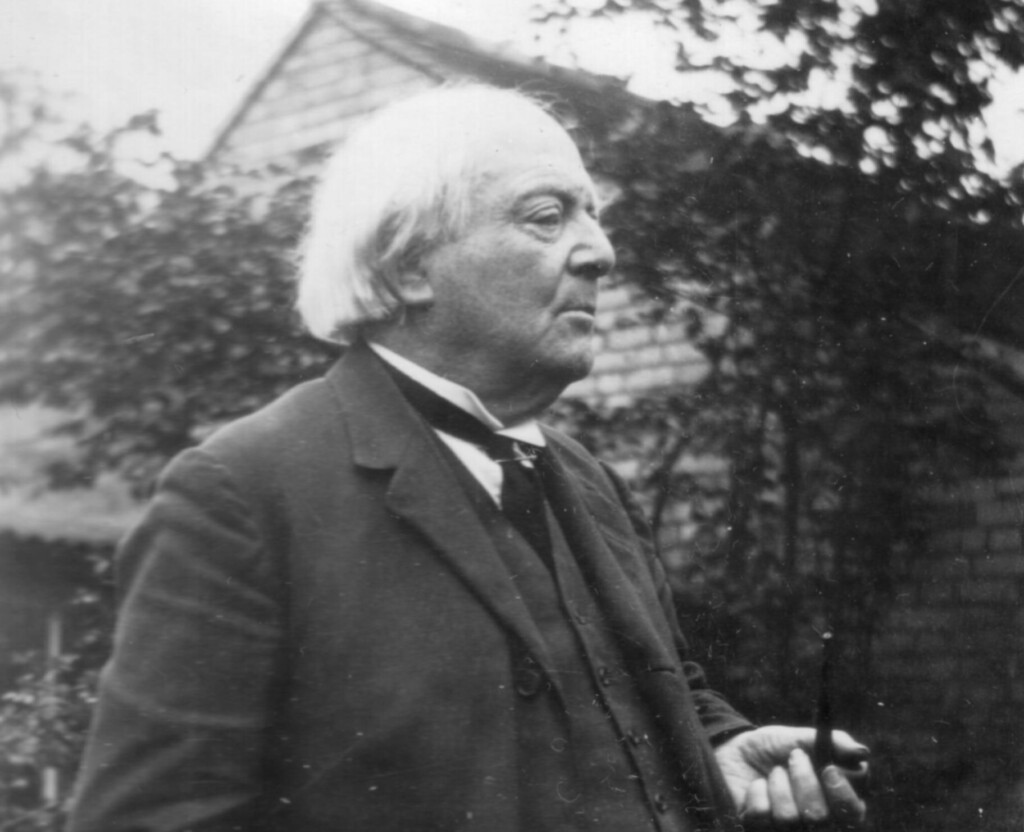
Arthur Machen spent his entire literary life trying to find language adequate to exactly that sensation. Born in Caerleon-on-Usk in Wales in 1863, he grew up in a landscape saturated with Roman ruins and Celtic mythology, a place where the historical layers of human presence were so compressed that the past did not feel past but rather parallel, pressing against the present from the other side of a membrane that occasionally grew thin. His father was an Anglican clergyman. The church, the hills, the remains of a Roman amphitheatre visible from the garden: this was the geography that formed him, and it formed in him a particular conviction that would drive everything he wrote. The conviction was not supernatural in any comfortable or commercial sense. It was stranger and more disturbing than that. Machen believed that behind the recognizable surface of the world there existed another order of reality, not metaphorical, not psychological, but ontological, and that contact with it was not a fantasy but a structural possibility of human experience.
The question this raises is one that literary criticism has consistently tried to domesticate by filing it under genre. The uncanny, the weird, the gothic: these are useful labels and they have produced serious scholarship, but they carry within them a subtle act of containment. To call something a literary device is to agree, in advance, that it refers to nothing outside the text. Machen resisted this containment not through argument but through the quality of his prose, which operates like the alley at dusk rather than like a thesis. His sentences do not explain the thinning of the world. They perform it.
The Great God Pan, published in 1894, is the work in which this performance reaches its first and perhaps most concentrated expression. It was called monstrous by one reviewer, the work of a diseased imagination by another. Oscar Wilde, who had his own complicated relationship with surfaces and what lies beneath them, praised it. The novel is short, structurally peculiar, and in certain passages genuinely difficult to read without something happening to the air in the room around you. That difficulty is not accidental. It is the point. And to understand what Machen was doing requires going back to that street corner, to that smell that did not belong to the season, and taking it seriously as evidence rather than dismissing it as nerves.
Venetian Arcanum
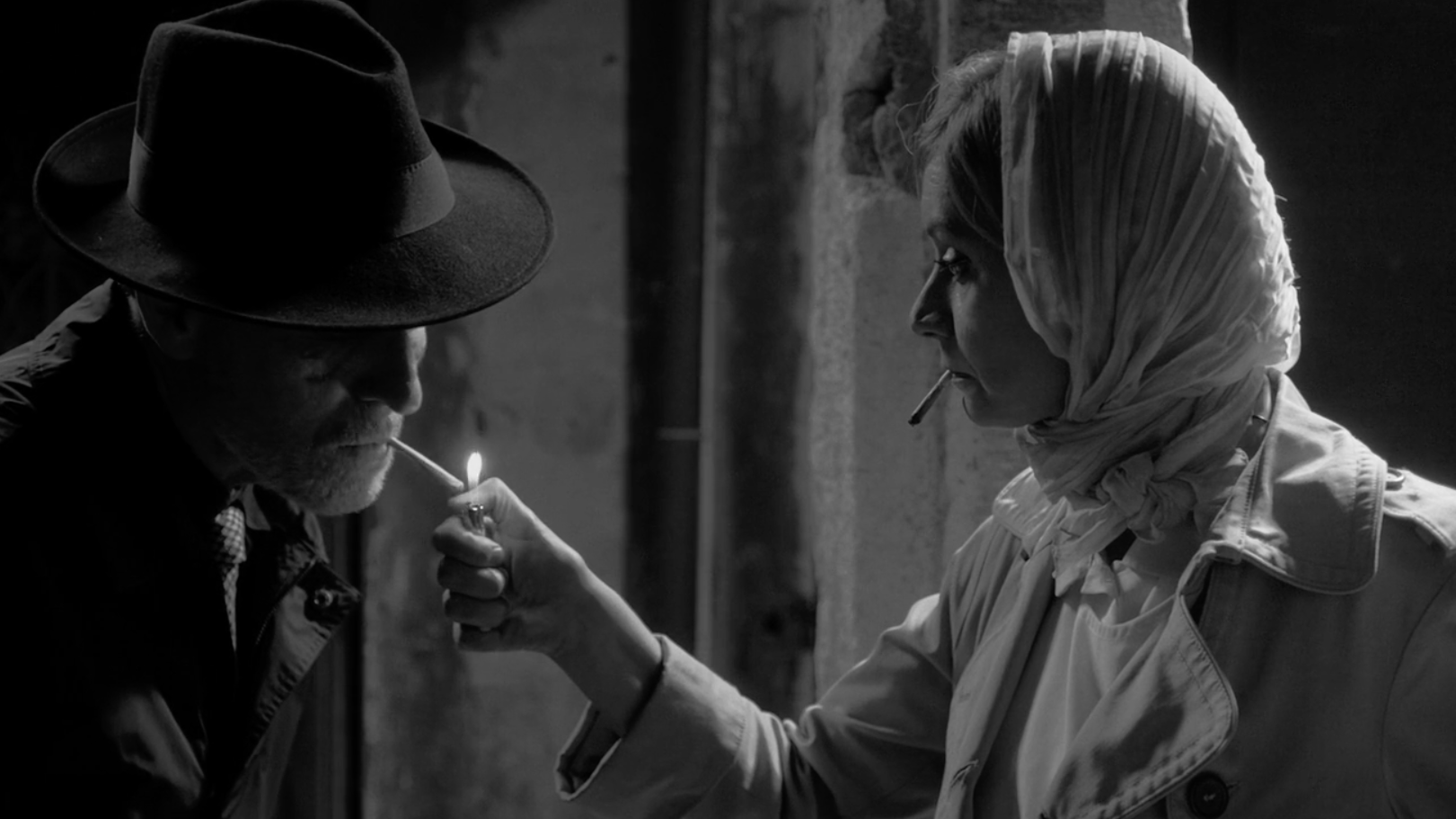
Thriller, by Serge Turgeon, Italy, 2025.
In Venice, a mysterious presence appears once every century or two, haunting the canals and hidden corners of the city. Driven by a sense of destiny, a woman decides to search for it. Following its elusive traces, she is drawn deeper and deeper into the city’s arcane secrets. Reality and myth begin to blur, and Venice itself transforms into a labyrinth of dangers.
LANGUAGE: Italian
SUBTITLES: English
A Man Born in the Wrong Century
He was born in 1863 in a town where the ground itself remembers things. Caerleon-on-Usk, in southeastern Wales, sits on the ruins of a Roman legionary fortress, Isca Augusta, where the Second Augustan Legion was garrisoned for nearly two centuries. Walk the wrong field there and you turn up amphitheatre stones. The Arthurian legends claim it as the site of Camelot’s court. The mythology is not decorative — it is geological, compressed into the earth the way coal is, something ancient pressing up through everything. To be a child there is to learn, before you learn anything else, that time does not move in one direction and that the visible world is a thin membrane stretched over something enormous and unnameable.
His father was an Anglican clergyman of modest means, which is another way of saying the family was poor in the particular way that is most corrosive: poor while maintaining the posture of respectability, poor while surrounded by books and Latin and the rhetoric of spiritual distinction. Arthur Machen grew up in that specific household atmosphere where transcendence was the daily currency and material comfort was chronically, quietly absent. It is the kind of childhood that produces either a ferocious pragmatist or a man permanently convinced that the invisible world outranks the visible one. Machen became the latter with a completeness that never wavered.
He arrived in London in 1880 at seventeen, carrying almost nothing. What he possessed instead of money or connections was a certainty so private it had no language yet — the conviction that he was the custodian of something the age had not thought to ask for. London in 1880 was a city of hard commercial velocities, of empire administered through paperwork, of a bourgeois culture that had made utility into theology. Machen found himself cataloguing books for a medical publisher, tutoring students in subjects that bored him, translating obscure texts from French and Latin for fees that barely covered a room. He translated the Heptameron of Marguerite de Navarre. He worked on the Memoirs of Casanova. These were not accidents of circumstance — they were the reading of a man whose interior life was already running in a completely different register than the century around him.
The philosopher Charles Taylor, in his 1989 study Sources of the Self, describes how modernity progressively evacuated the idea of cosmic order from everyday experience, replacing a world saturated with meaning by a world of neutral facts available for instrumental use. Machen lived this evacuation as a personal catastrophe. He did not theorize it. He felt it as a kind of continuous low-grade wrongness, the sensation of being present in an era that had made a catastrophic error about what reality fundamentally was. He was not nostalgic in any sentimental sense. He was constitutionally convinced that the Romantic and Celtic and occult currents he had absorbed from Caerleon’s saturated soil were not fantasies but perceptions — that the world his contemporaries were so efficiently administering was a deliberate and ultimately suicidal forgetting.
What does it mean to live as though you carry a knowledge no market has priced? It means a specific kind of poverty that is not merely financial. It means watching the transactions of your age — its certainties, its ambitions, its definitions of progress — with the remote bafflement of someone who speaks a language for which no dictionary yet exists. Machen spent over a decade in this condition, invisible in the ordinary sense, employed in the margins of literary commerce, sustained by nothing more verifiable than an interior pressure that insisted he was right and the century was wrong. The sociologist Pierre Bourdieu would have recognized the structure immediately: a man rich in a form of cultural capital that the dominant field had not yet learned to convert into anything exchangeable. The suffering of that position is not dramatic. It is slow, grinding, and almost completely silent.

The Great God Pan and the Anatomy of Terror
The surgeon’s hands are steady. He has spent years preparing for this moment, has written papers no journal would publish, has argued in private correspondence with men who thought him a crank or a visionary or both. The young woman on the table, Mary, has consented — or has been made to consent, which in the grammar of Victorian medicine amounts to the same thing. What he intends to do is not remove anything. He intends to open something. A precise intervention at the base of the brain, a surgical parting of whatever membrane separates ordinary human perception from the reality that underlies it. He believes, with the fervor of a man who has confused obsession with discovery, that consciousness is a locked room and he has found the key.
What follows is not revelation. Mary survives the procedure but returns from it as something that can no longer be called present. She is there, breathing, occasionally speaking, but the thing behind her eyes has migrated somewhere the rest of her cannot follow. She has seen, the surgeon believes, the Great God Pan. She has seen the actual substrate of the world. And the nervous system, which was built to process surfaces, to handle the manageable fiction of cause and effect and solid objects and social faces, simply cannot hold what was forced through it.
William James, writing just eight years later in The Varieties of Religious Experience, published in 1902, was working from the opposite direction toward the same abyss. His argument, refined from earlier lectures and sharpened by his own lifelong struggle with depression and perceptual instability, was that normal waking consciousness is not a window but an editing system. The brain does not show you reality. It shows you the portion of reality that is useful for survival, stripped of everything too large, too fast, too slow, too strange, or too total to be actionable. James called this the fringe of consciousness, that peripheral buzz of experience that ordinary attention systematically suppresses. Mystical states, he argued, are not additions to consciousness but subtractions from its filtering function. You do not gain access to more. You lose the protection of less.
Machen dramatized exactly this before James theorized it, and the convergence is not coincidental. Both men were living inside a cultural moment that was interrogating the reliability of perception from every angle simultaneously — through the new psychology of Charcot and Janet, through the Society for Psychical Research founded in 1882, through the fissures opening in Newtonian physics. The question was not whether reality had hidden depths. The question was what happened to a human being who actually touched them.
The novella’s structure enacts this terror formally. It does not show you what Mary saw. It cannot, and the refusal is not a failure of imagination but a precise philosophical gesture. The horror propagates through witnesses, through consequences, through a woman named Helen who is born from whatever Mary encountered and who moves through the world leaving dissolution in her wake. You never see the thing itself. You see only what proximity to it does to people. Faces change. Men who were solid become translucent, then hollow, then nothing. The thing Machen will not name or describe is not a monster in any conventional sense. It is the unfiltered real, and the unfiltered real, experienced by an organism designed for useful illusions, operates identically to annihilation.
James wrote that the further limits of our being plunge into an altogether other dimension of existence. He meant it with cautious academic reverence. Machen had already written what that dimension does when it plunges back.
The Victorian Veil and Its Enforcers
The dinner party proceeds. Crystal glasses catch the candlelight with the precision of a demonstration. The cutlery is arranged according to rules that took centuries to formalize. Someone is saying something confident about railways, about the expansion of telegraph lines, about the measurable improvement of the human condition, and everyone at the table nods with the satisfied gravity of people who have solved a problem they were never quite sure how to name. And outside the tall windows, something moves through the garden. Not an animal. Not the wind. Something that does not belong to any taxonomy anyone has bothered to publish, drifting between the hedgerows with the patience of a geological era, utterly indifferent to the crystal and the cutlery and the confident voices inside.
Nobody looks up.
This is the scene that Victorian civilization had perfected: the performance of not looking. Auguste Comte had given it a philosophical spine in his Cours de philosophie positive, published across six volumes between 1830 and 1842, where he arranged human knowledge into a hierarchy that moved triumphantly from theology through metaphysics toward positive science, each stage superseding the last like a staircase leading upward toward clarity and measurement. The supernatural was not disproved so much as retired, aged out, rendered structurally unnecessary by a civilization that had learned to count its own achievements with increasing satisfaction. Herbert Spencer then dressed this confidence in evolutionary language, arguing in his Synthetic Philosophy that society itself obeyed the laws of progressive differentiation, that complexity was destiny, that the direction of history was forward and upward and legible. What could not be measured could eventually be measured. What resisted understanding was simply waiting to be understood.
What Machen recognized, with the instinctive certainty of someone who had grown up in a borderland where the old world had never fully surrendered to the new, was that this confidence was not knowledge. It was a social compact. A collective agreement to treat the boundaries of the visible as the boundaries of the real.
Walter Pater understood this from an entirely different angle. His Studies in the History of the Renaissance, published in 1873, did not argue against positivism so much as burn quietly beside it, suggesting in its famous conclusion that what mattered was not the accumulation of verifiable data but the intensity of a single burning moment, the flame of consciousness against the brevity of everything. Pater was not interested in the supernatural, but he was interested in the same gap that Machen was excavating: the gap between the official surface of experience and whatever was actually pressing against it from below.
Horror literature in this period was not what it is often described as having been. It was not entertainment for the nervous. It was not a holiday from seriousness. It was a philosophical counter-offensive conducted against the century’s most comfortable assumption: that reality was, in principle, manageable. That the human mind, given sufficient time and sufficient method, could map everything that existed and file it appropriately. What Machen and the writers working in proximity to his obsessions were doing was insisting, with the full force of their formal craft, that the map was not the territory and that the territory contained things for which no map had ever been attempted.
The man at the dinner table does not look out the window because looking would cost him everything. His certainty, his comfort, his ability to continue lifting the crystal glass with that precise confident gesture. The civilization outside him has built its entire apparatus of meaning on the premise that nothing moves through the garden that cannot be named. And so he keeps his eyes on the conversation, and the conversation keeps moving, and outside the dark thing drifts between the hedgerows with the patience of something that has been waiting since before the first railway was laid.
Pan Is Not a Monster — Pan Is a Structure
The grass does not move. There is no wind. You have stopped walking without knowing why, somewhere in the middle of a field that stretches in every direction without offering a single landmark, and something in the quality of the silence has shifted — not into threat exactly, but into attention. The field is watching you. Not metaphorically. Something in the cellular hum of those ten thousand blades of green is oriented toward you, and your nervous system has registered it before your conscious mind could form a denial. You take another step and the feeling intensifies rather than passing. You do not run, but you want to.
This is not madness. This is older than madness. It is the sensation that the naturalist philosopher Walter Burkert, writing in his 1985 Greek Religion, traces back to the foundational terror at the heart of early Greek devotion — not the fear of gods as authorities or judges, but the fear of a world that was entirely, inescapably alive. The Greeks who named the forest god Pan were not building mythology. They were trying to contain an experience that had no comfortable form. Pan was the principle before the principle had a name — the quivering in reality itself, the sense that matter is not neutral, not passive, not waiting to be acted upon. Matter is acting. It has always been acting.
Machen understood this with a precision that has rarely been credited to horror fiction. The Great God Pan is not a story about a demon summoned from elsewhere. It is a story about a veil — the word is Machen’s own — being briefly torn from the face of a universe that was never inanimate to begin with. Dr. Raymond does not create something. He reveals something. The surgery he performs on Mary does not introduce an alien element into the world. It removes a filter that consensus reality installs in every human nervous system as the price of functional life. What Mary sees in that moment of exposure is what is actually there. The horror is not supernatural intrusion. The horror is natural disclosure.
Baruch Spinoza, whose Ethics was published posthumously in 1677, proposed that what we call God and what we call Nature are a single substance moving through itself — natura naturans, nature naturing, the generative force that is not separate from matter but is matter in its most fundamental operation. Spinoza was excommunicated for it at twenty-three. The institution understood the stakes clearly even when the philosophy was phrased with geometric precision. If the divine is not above the world but is the world’s own self-organizing vitality, then nothing is simply a thing. There are no objects. There are only processes at different speeds of becoming. Machen reached the same conclusion from the opposite direction — not through rationalist philosophy but through mystical horror, not through axioms but through the face of a woman whose expression no language has the architecture to describe.
Henri Bergson would call it the élan vital — the vital impulse that drives matter into ever more complex self-organization, published in Creative Evolution in 1907, the same decade Machen was at his most metaphysically saturated. Bergson did not mean this as poetry. He meant it as physics before physics had the instruments. The universe is not a clock. It is a hunger. It is reaching.
Which means Pan is not a monster. Pan is the structure beneath the fiction of inertness that civilized consciousness requires in order to function. You need the grass to be just grass. You need the field to be a measurable, indifferent expanse of biomass. The moment you cannot maintain that fiction — the moment your body knows, in the field, that something is oriented toward you — you have briefly, involuntarily touched what Mary could not stop seeing. The question is not whether you survived it.
A vision curated by a filmmaker, not an algorithm
In this video I explain our vision
London as the Mouth of the Abyss

There is a particular quality of light in London on a November afternoon, when the sky becomes the colour of old pewter and the streets narrow into themselves, and you find yourself walking somewhere between Aldgate and Bishopsgate and you realize, without quite knowing how you know it, that you are treading on top of something. Not metaphorically. Literally. The Roman wall runs beneath your feet, beneath the Victorian brick, beneath the Georgian stone, beneath everything the city has piled on top of itself in its desperate eagerness to forget. The layers do not sleep. They press upward.
This is where Machen lived for years in conditions that bordered on destitution, cataloguing books for a living, writing pieces for magazines that paid almost nothing, eating badly, walking constantly because walking was free. The walking was not incidental. It was the method. He moved through London the way a reader moves through a palimpsest, aware that every surface is also an erasure, that every street name contains a burial. In the years when he was deepest in poverty, deepest in his work with the Hermetic Order of the Golden Dawn and his long conversations with A.E. Waite about ritual, symbol, and the persistence of pre-Christian mystery beneath Christian civilization, he understood London not as a modern capital but as a wound that had never properly closed.
Michel de Certeau argued in 1980, in The Practice of Everyday Life, that the city is a text written over older texts, and that the act of walking through urban space is always, at some level, an act of reading against the grain of official cartography. The map the city presents to you is the map of amnesia. It shows you what the city has decided to remember. The walker who drifts, who wanders without the map’s authority, begins to read what the city has decided to forget. Machen was this walker before de Certeau had words for him.
Think of the man who walks through a city and begins to see the Roman walls beneath the Victorian brick beneath the glass towers, the layers collapsing into a single moment of terrible simultaneity. He is not having a breakdown. He is having a perception that the city works very hard to prevent. Urban modernity performs amnesia as a civic function, almost a civic duty. The glass tower must not know about the plague pit beneath it. The coffee shop must not acknowledge the workhouse wall it was built against. The city’s psychological health, such as it is, depends on this enforced forgetting. Machen’s London refuses it.
In The Hill of Dreams, the young man who arrives in London carrying his manuscript and his vision finds the city physically hostile to consciousness of any depth. The crowds, the noise, the grinding mechanical rhythm of commercial life, all of it operates as a suppression system. What London is suppressing, always, is the older London beneath it, and beneath that London the still older landscape, the forest, the marsh, the Roman encampment, the thing that was here before any of that. The horror in Machen is not a monster arriving from outside. It is the substratum returning from below.
The Three Impostors turns London into a labyrinth of false surfaces, a city where every face conceals another face, where the ordinary street hides a passage into something ancient and catastrophic. The White People understands that the landscape of vision is not the countryside alone but anywhere the forgetting is incomplete. Waite and Machen discussed this in the language of Kabbalah and Rosicrucianism, but what they were really discussing was topology. How many layers can you press together before the pressure causes them to bleed into each other? How thin does the membrane between centuries have to become before you can push a hand through it?
The answer London gave Machen, year after year of poverty and walking and looking, was: thinner than you think.
The Reader Who Cannot Unsee
There is a moment when a child tells you something and you stop breathing. Not because what they say is frightening in itself, but because you recognize it. The words are theirs, the voice is small and matter-of-fact, but the thing being described belongs to you — to something you sealed away long before they were born, something you were certain no one else could have seen. The child is not warning you. The child is simply reporting. And the cold that moves through you is not fear of what is in the basement. It is the realization that the basement was always yours.
This is precisely the mechanism Machen understood and weaponized with a precision that most horror writers never achieve. He does not show you the thing. He shows you the edge of it, the reaction to it, the white face of someone returning from a room you are never permitted to enter. The horror in his work exists almost entirely in the gap he creates and then watches you fill. Wolfgang Iser, writing in The Act of Reading in 1978, argued that literary meaning is not transmitted from text to reader but produced between them — that what is withheld, the strategic blank, is where the reader becomes an involuntary co-author. Machen wrote an entire theology of blanks. Every sentence in The Great God Pan that declines to describe what Helen Vaughan actually does, every witness statement that trails into silence or madness, every drawing discovered and then summarized rather than depicted — these are not failures of nerve. They are invitations. They are the door left open at the back of a house you thought you knew.
Freud’s 1919 essay on the uncanny, the Unheimliche, gives this a name and a mechanism. The word itself is the clue: unheimlich, literally un-homely, the eerie quality that attaches not to what is foreign but to what is familiar. What disturbs is not the monster encountered in an unknown place. What disturbs is the thing you recognize in it. Freud traced the sensation to repressed material — beliefs, fears, fantasies — that were never truly eliminated but only buried, and that return wearing the mask of the external world. The horror, he argued, was always a homecoming. Machen’s prose is designed, consciously or not, to trigger precisely this return. The vagueness is not atmospheric decoration. It is a mirror angled so that what you see in it is drawn from your own stored darkness, not his.
This is why The Great God Pan unsettles readers who cannot explain why they are unsettled. There is almost nothing there, empirically. A woman is born from an experiment. Men encounter her and are destroyed. The destruction is consistently described at one remove, in letters and reported speech and inference. The content of the horror is structurally withheld. And yet readers in 1894 called it the most terrifying thing they had encountered in print, and readers now, more than a century later, feel the same residue of wrongness after finishing it — a sense of having glimpsed something that the text technically never showed them. What they glimpsed was their own. Machen handed them an incomplete image and their unconscious completed it using materials already present, materials they had good reason to keep dark.
The child in the doorway is still talking. The adult is listening with an expression that has stopped belonging to this conversation and started belonging to an older one. The child does not notice. The child only knows what they saw. But you — standing there, hearing the description — are suddenly aware that you have been the co-author of something all along. That the terror was collaborative from the first sentence. That Machen did not bring it. He only knew how to knock on the door you had already locked.
What the Fin de Siècle Knew and Forgot to Tell Us
There is a particular quality of stillness that comes before a decision not to act. You have been working late, the building empty, the hum of servers the only sound, and the numbers on the screen have just resolved into a pattern that should not be there. Not an error. Not a glitch in the dataset. A pattern. Something that answers back. And you sit very still, and you do not reach for the phone, and after a long moment you close the file and go home, and in the morning you describe it to no one.
This is not cowardice. It is something more interesting than cowardice, and more honest than we usually admit. It is the recognition, instantaneous and wordless, that some findings cannot be reported without destroying the framework inside which reporting is possible. The scientist in that moment is not choosing ignorance. She is choosing the coherence of the world she has to live in on Monday morning.
Machen understood this choice, and he understood that entire civilizations make it, collectively, without ever holding a meeting. The 1890s were precisely the decade when the choice became visible, because so many voices were naming the same anomaly from so many different angles simultaneously. Nietzsche had declared the death of God in 1882 in “The Gay Science,” but the implications were still detonating through European thought a decade later, and what they detonated was not atheism so much as a sudden vertiginous awareness that the Enlightenment’s confident map of reality had been drawn over an abyss. Freud was assembling the first scaffolding of what would become “The Interpretation of Dreams” in 1900, finding in the unconscious not a quaint repository of repressed memories but a vast parallel processing system that preceded and exceeded rational thought. Bergson, in “Time and Free Will” published in 1889, was arguing that duration, lived time, was irreducible to the measured intervals science preferred, that something in experience escaped the clock entirely. These were not fringe positions. They were the mainstream of serious European intellectual life, and they were all saying the same thing in different languages: the map is not the territory, and the territory is stranger and more demanding than the map had admitted.
Machen said it in the language of terror, which is perhaps why he was eventually shelved as a genre writer rather than recognized as a philosopher of perception. Genre is the category we assign to truths we do not want to discuss in polite company. When Helen Vaughan walks through a village and leaves behind her a trail of suicides and dissolutions, Machen is not writing horror. He is writing epistemology. He is describing what happens to a nervous system that encounters reality without the filters Western modernity spent three centuries constructing. The filters are not weakness. They are infrastructure. The question is what we have agreed to build on top of them, and what we have agreed to ignore in order to build it.
William James, whose “Varieties of Religious Experience” appeared in 1902, spent a lifetime arguing that the boundary between ordinary consciousness and something vastly larger was thinner than the educated classes preferred to believe, and that the refusal to investigate that boundary was not scientific rigor but cultural defensiveness wearing the costume of method. He was not wrong, and neither was Machen, and neither, in their different vocabularies, were Nietzsche or Freud or Bergson. They were a generation that looked at the Enlightenment settlement and saw simultaneously its magnificence and its cost. What was classified, filed, and forgotten was not the horror. It was the seriousness of the question underneath it: if there is a layer of reality we have entered into a collective agreement not to perceive, the thing we are most carefully protecting ourselves from may not be madness or dissolution or the face of Pan, but the knowledge that the agreement was always a choice, and that choices, unlike facts, can be unmade.
🌿 The Hidden Face of Nature and the Occult
Arthur Machen’s world is one of ancient terror lurking beneath the surface of the ordinary, where pagan forces and forbidden knowledge threaten to dissolve the boundaries of the human. These related articles explore the esoteric, the mystical, and the uncanny traditions that share the same dark soil as Machen’s visionary fiction.
Aleister Crowley: the Great Beast and the Religion of Will
Aleister Crowley, like Machen, inhabited the shadowy borderlands between Victorian respectability and transgressive occult practice. His religion of the Will, rooted in ceremonial magic and the exploration of forbidden gnosis, echoes the terrifying revelation at the heart of The Great God Pan. Understanding Crowley illuminates the broader fin-de-siècle obsession with forces that lie beyond human moral categories.
GO TO THE SELECTION: Aleister Crowley: the Great Beast and the Religion of Will
What Is Alchemy: History and Origins
Alchemy, in its deepest sense, is the art of transforming matter and consciousness through contact with hidden principles of nature — a pursuit that resonates profoundly with Machen’s vision of reality as a thin veil over something monstrous and divine. This article traces the origins and history of alchemical thought, revealing how the pursuit of the Great Work shaped Western esoteric culture. Machen himself was a member of the Hermetic Order of the Golden Dawn, and this background is essential to reading his work with full depth.
GO TO THE SELECTION: What Is Alchemy: History and Origins
Giordano Bruno and the Hermetic Tradition
Giordano Bruno’s Hermetic tradition offered a radically animist vision of nature as alive, spirited, and secretly responsive to human imagination — a world in which the Great God Pan would feel entirely at home. Bruno’s persecution by the Church reflects the same tension between official reality and hidden knowledge that Machen dramatizes in his fiction. This article explores how Hermetic philosophy reshaped the Renaissance understanding of the cosmos.
GO TO THE SELECTION: Giordano Bruno and the Hermetic Tradition
Meister Eckhart: Life and Mystical Philosophy
Meister Eckhart’s mystical philosophy plunges into the terrifying depths of divinity, dissolving the self in a union that is as annihilating as it is transcendent — a mystical logic that mirrors, in sacred form, the catastrophic revelation suffered by Machen’s characters. His concept of the Godhead beyond God points toward the same abyss that the Great God Pan embodies from the opposite, pagan shore. Reading Eckhart alongside Machen reveals how thin the wall between mystical ecstasy and horror truly is.
GO TO THE SELECTION: Meister Eckhart: Life and Mystical Philosophy
Discover the Cinema of the Invisible on Indiecinema
If Arthur Machen’s world of hidden gods and forbidden visions speaks to you, Indiecinema is the streaming platform where that same spirit lives in moving images. Explore our curated selection of esoteric, mystical, and visionary independent films that dare to look behind the veil of the ordinary.
👉 EXPLORE THE CATALOG: Watch Indie Films in Streaming
A vision curated by a filmmaker, not an algorithm
In this video I explain our vision

