
The Glass You Live Inside
You are standing at a red light, and without thinking, you reach for your phone. Not because anything happened. Not because anyone called. You reach for it the way you might reach for a glass of water in the middle of the night — reflexively, before thirst has even announced itself. The screen lights up. Three notifications. A discount from a store you walked past two days ago. A suggested route to a place you mentioned in a conversation you did not type. A reminder for an appointment you made on a different device entirely. You swipe them away and pocket the phone. The light turns green. You drive.

Nothing about this moment felt like surveillance. That is precisely the point.
There is a version of being watched that belongs to history books and political horror — the secret police knock, the neighbor who reports, the file opened in your name in a building you will never see. That version at least had the decency to feel like what it was. What you live inside now is something different in texture, something that has learned to feel like convenience, like personalization, like the ambient hum of a world that simply knows you. And because it does not frighten you, because it often genuinely helps you, you have made your peace with it in a way that would have been unthinkable to anyone who lived through the architectures of coercion that the twentieth century built. You have not surrendered. You have opted in, enthusiastically, repeatedly, at every screen that asked.
Michel Foucault, in his 1975 work Discipline and Punish, described the essential mechanism of modern power not as force but as visibility. He borrowed Jeremy Bentham‘s blueprint for the Panopticon — a prison designed so that inmates could always be seen but could never confirm whether they were being observed at any given moment — and read in it something that vastly exceeded the prison walls. The genius of the design, Foucault argued, was not that it surveilled constantly but that it made constant surveillance unnecessary. Once you internalized the possibility of being watched, you watched yourself. The guard could be absent. The discipline remained. Power, in its most efficient form, does not need to be exercised. It only needs to be believable.
What Foucault could not have fully anticipated was the moment when the inmates would build the Panopticon themselves, voluntarily, in their pockets, on their wrists, in the devices they carry into their bedrooms and place on their nightstands before sleep. The architecture of control that once required the state, the institution, the employer to construct and maintain now exists because billions of people found it useful enough to want it, and cheap enough to afford it. The watchtower did not disappear. It migrated inward, became a preference setting, a terms-of-service checkbox no one reads.
The paradox this produces is genuinely vertiginous if you let yourself feel it. The watcher is invisible — not hidden, exactly, but distributed into infrastructure so ordinary it has become environmental, like air pressure or background noise. You do not see the data center. You do not see the algorithm parsing the pause you made before clicking away from that product page. You do not see the forty-seven different entities that received a profile update when you swiped your loyalty card at the pharmacy this morning. And yet you are not innocent in this arrangement. You are not a victim in any simple sense. You are complicit in a way that does not feel like complicity because the returns have been real enough and the costs invisible enough that the transaction felt fair when you made it, every single time.
This is not a story about technology. It is a story about what human beings do when visibility becomes the condition of belonging.
Before the Panopticon Had a Name
Think about the moment you first learned to confess. Not in any formal religious sense, necessarily, but the moment you understood that someone with authority over you expected not just your behavior to be legible, but your interior life. The priest behind the latticed screen, or the school counselor leaning forward with practiced concern, or the HR form asking you to self-evaluate your performance — the architecture is always the same. You produce yourself as a readable text. Someone else holds the interpretive power.
This is not a modern invention. It does not begin with cameras or algorithms or even with Bentham’s famously unbuilt prison. It begins, in one of its most consequential forms, in 1215, when the Fourth Lateran Council made annual confession obligatory for all Catholics across Christendom. What that decree institutionalized was not merely a spiritual practice but a technology of knowledge extraction at civilizational scale. Tens of millions of people, across centuries, trained themselves to excavate their own thoughts, desires, and transgressions and deliver them, verbally, to a designated authority. Michel Foucault understood this with uncomfortable precision. In “Discipline and Punish,” published in 1975, he traced the genealogy of modern surveillance not to Jeremy Bentham‘s 1791 panopticon design but to the far older and more intimate mechanisms of pastoral power — the shepherd who must know each sheep individually, not to protect them exactly, but to account for them.
Feudal record-keeping operated through a similar logic, if less spiritually decorated. The Domesday Book, commissioned by William the Conqueror in 1086, was not a census in any modern bureaucratic sense. It was an act of total territorial legibility. Every hide of land, every mill, every villager with productive value was catalogued, assessed, and rendered knowable to a power structure that had just violently reorganized the landscape. The purpose was fiscal and military, yes, but underneath that purpose was something more foundational: the assertion that nothing within the kingdom should exist outside the king’s knowledge. Invisibility was not just inconvenient for power — it was structurally threatening to it.
Colonial census systems extended this logic across oceans and centuries. When the British administered India through the census operations beginning seriously in 1871, they were not simply counting people. They were producing categories — caste, religion, tribe, criminal tendency — that had previously been fluid, contested, locally negotiated. Bernard Cohn, in his essential 1996 work “Colonialism and Its Forms of Knowledge,” demonstrated how the colonial state used enumeration to harden social divisions into administrative facts, making populations not only countable but governable through the very act of classification. The census did not describe a social reality; it manufactured one that power could then manage.
What Foucault codified in 1975, and what Bentham had schematized almost two centuries earlier, was not therefore a new apparatus but a new transparency about an old one. The panopticon — that circular prison where a central tower of potential observation disciplines the inmates regardless of whether anyone is actually watching — is genuinely elegant as a diagram. But its elegance lies in making visible a principle that confession booths and feudal surveys and colonial registers had been practicing for centuries without needing to articulate it. You behave as if you are being watched because the possibility of the watching eye has been installed inside you. That installation is the work not of one institution but of a long historical accumulation of institutions, each contributing another layer of internalized surveillance to the subject they produce.
The genius of Foucault’s contribution was not the discovery of this mechanism but the refusal to treat it as natural or inevitable. Power, he insisted, is not a thing that someone possesses. It is a relation that circulates, and its most durable form is the one you carry out on yourself, the one you perform before anyone asks you to.

The Architecture of Obedience
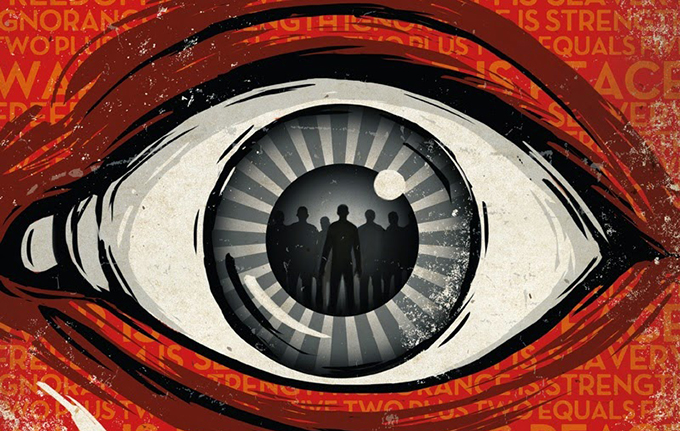
There is a particular kind of stillness that comes over a person the moment they suspect they are being watched. Not the flinch of someone caught in an act, but something slower and more corrosive — a gradual reorganization of the body, a tightening of the shoulders, a recalibration of every small gesture toward some imagined standard of acceptability. You have felt it. Everyone has. The question worth asking is not when you first felt it, but how early in your life it became indistinguishable from simply being alive.
A man sits in a small room with a mirror on one wall. He was told, before being left alone, that observers might be watching from behind the glass. Might be. The door closed, the silence settled, and now he is utterly alone with that single conditional word. He does not know if anyone is there. He cannot know. And so he sits in a way that assumes someone is. His hands, which would otherwise fidget or reach toward his face, remain arranged in a posture of composure. He is performing reasonableness for a possible audience of no one.
This is not an anomaly. This is the perfection of a system two centuries in the making.
Jeremy Bentham published his Panopticon letters in 1787, proposing a circular prison in which a single watchman positioned in a central tower could, in theory, observe every inmate at any moment. The crucial detail — the one Bentham himself understood as the architectural genius of the proposal — was that the inmates could never verify whether the watchman was actually watching. The tower’s windows were to be fitted with blinds, creating permanent observational asymmetry. The inspector sees without being seen. The inspected can never confirm whether they are, at any given instant, under scrutiny. The result is that the inspected must behave as though the scrutiny is constant. The system requires no watchman at all to function. It only requires the credible possibility of one.
Michel Foucault, building on Bentham’s blueprint in Discipline and Punish in 1975, understood this not as a curiosity of penal architecture but as the diagram of an entire civilization. What Bentham designed for a prison, the nineteenth century built into schools, hospitals, factories, military barracks and workhouses with remarkable consistency. The spatial logic was always the same: arrange bodies so that they can be seen from a fixed point of authority, and ensure that those bodies can never be certain when the seeing is occurring. Foucault called this the internalization of the gaze — the moment when external surveillance becomes unnecessary because the subject has taken the warden inside and appointed him permanent resident of their own consciousness.
The factory floor of the industrial revolution was not designed for efficiency alone. Its open layout, its foremen’s platforms elevated above the rows of workers, its absence of interior walls that might allow a conversation to vanish from sight — these were not incidental features. They were, as the historian E.P. Thompson documented in The Making of the English Working Class in 1963, instruments of behavioral production. The body of the worker was being retrained not merely to perform tasks but to perform submission, to move and speak and pause in ways legible to authority. The architecture preceded the ideology. The building taught the lesson before the foreman spoke a word.
The man in the room with the mirror eventually straightens his back. He folds his hands with a deliberateness that would not exist if he were genuinely alone. He is manufacturing a version of himself acceptable to whoever might be watching, which is to say he is manufacturing a version of himself acceptable to the abstract principle of being watched. He has become his own surveillance officer. Bentham would have recognized the achievement immediately. The room has done its work. It does not matter whether the glass is empty.
Seeing Like a State
Before she ever filled out a single form, she already existed in the system. Not as a person, exactly, but as a pattern — a cluster of inferences assembled from the trails she left without knowing she was leaving them. Her purchasing rhythm suggested a woman in her late thirties, probably with children under ten, almost certainly in the process of a life transition. The algorithm had noticed before she had. It knew she was pregnant before her mother did, before she did. It sent her coupons for prenatal vitamins and unscented soap, and she assumed it was coincidence, the way we always assume coincidence when the machinery of legibility is working too smoothly to see.
This is not a new invention. It is an old ambition wearing new clothes.
James C. Scott, in his 1998 work Seeing Like a State, identifies a project that runs underneath the entire history of modern governance — the drive to make populations legible. Not known, not understood, but readable. Simplified into forms that administration can process, map, and act upon. The state, Scott argues, has never been interested in the full complexity of human life. It has been interested in what can be measured, standardized, and controlled. Everything else — the local knowledge, the informal arrangement, the vernacular practice — registers as noise, or worse, as threat.
The cadastral map was one of the first instruments of this simplification. When French administrators in the eighteenth century began producing detailed surveys of land, they were not merely drawing geography. They were rewriting the relationship between people and place in a language the state could read. Common lands that communities had used for centuries through informal and customary agreements suddenly had to be legible — bounded, measured, attributed to an owner. What resisted this translation was erased, not by violence immediately, but by the slower erasure of becoming administratively nonexistent.
Surnames followed the same logic. For most of human history, a person’s name was relational and contextual — you were known in your village by your trade, your father’s name, your physical characteristic, a nickname that carried history. When states began mandating fixed inherited surnames in Europe — a process largely complete in most Western countries by the mid-nineteenth century — they were not honoring identity. They were tagging it. The surname was a tracking device, a way to follow a person across administrative records, tax rolls, military conscription lists. It made you findable in ways you had not previously been findable.
Standardized weights and measures, which Scott also examines, worked the same way. The old local measures — the bushel calibrated to a specific region’s grain, the foot derived from actual human proportion — were not inefficient. They were illegible to central power. The metric system was not just a scientific achievement. It was a political one. It collapsed local difference into universal comparability, and universal comparability is what makes a population governable from a distance.
She never thought about any of this when she opened a rewards card at a pharmacy. She was thinking about the discount on vitamins. But the data she generated that day — her age, her address, her purchasing pattern, eventually her pregnancy — entered a system of legibility far older than digital technology, older than computers, older than the nation-state as it now exists. The architecture of inference that reconstructed her identity from fragments she never consciously provided is the direct descendant of the cadastral surveyor, the surname administrator, the metrologist sent from Paris to standardize the countryside.
Scott’s insight is not that states are malicious. It is more unsettling than that. It is that legibility produces a particular kind of blindness in those who practice it. The more sophisticated the system of reading, the more invisible become the dimensions of life that the system cannot read. She was seen, precisely and completely, as a data profile. Which meant she was not seen at all.
The Watchers Who Forgot They Were Watching
You sit across from someone you have known for years, moving pieces across a board, and the conversation meanders through the ordinary territories of complaint and memory and mild ambition. What you do not know — what you will not know for decades, until a file is declassified and handed to you by a researcher who seems almost apologetic — is that the room has been listening. Not a person. Not even an intention, exactly. A mechanism. Someone, somewhere, pressed record and then went home for dinner.
This is not a metaphor for paranoia. It is the operational texture of the twentieth century’s most ambitious surveillance states, and what makes it genuinely disturbing is not the watching but the forgetting — the way the watcher, over time, ceased to experience himself as watching at all. A bureaucrat in Leipzig in 1975 files a report on his neighbor’s visitors, the tone of his neighbor’s voice through the wall, the hour the lights go out. He does not think of himself as an informant in any morally weighted sense. He thinks of himself as someone doing paperwork. The Stasi, at its peak in the 1980s, maintained a network of approximately 90,000 full-time officers and, by some estimates, between 170,000 and 200,000 unofficial collaborators in a country of sixteen million people — a ratio of surveillance density that Hannah Arendt, writing about the mechanics of totalitarian administration in “The Origins of Totalitarianism” in 1951, would have recognized immediately as the systemic conversion of moral actors into functional nodes.
Arendt’s argument was precise and uncomfortable: that evil in bureaucratic systems does not require malice, only procedure. The person filing the report is not monstrous. He is, in the most clinical sense, doing his job. And the job has been designed so that no single action within it feels like the decisive one. The informant does not arrest anyone. The officer who reads the report does not interrogate anyone. The analyst who flags the pattern does not sentence anyone. Responsibility is distributed so finely that it disappears entirely.
COINTELPRO, the FBI’s domestic surveillance and disruption program that ran from 1956 to 1971, operated on exactly this principle. At its height it targeted not foreign agents but American citizens — civil rights organizers, antiwar activists, journalists — through a bureaucratic architecture so compartmentalized that individual agents could reasonably claim they never understood the full shape of what they were participating in. The Senate’s Church Committee, which exposed the program in 1975, documented operations that included anonymous letters designed to destroy marriages, fabricated evidence planted with employers, surveillance files maintained on figures as constitutionally protected as members of Congress.
What the Church Committee could not fully document was the psychological normalization that made all of it possible — the process by which surveillance became, for its practitioners, simply the background condition of their professional lives. By the time CCTV cameras began appearing in British city centers in the early 1990s, initially justified by the specific and genuine threat of IRA bombing campaigns, that normalization had been exported from the state apparatus into the built environment itself. By 2002, the United Kingdom had an estimated 4.2 million cameras — roughly one for every fourteen people — and surveys consistently showed that the majority of the population not only accepted this but actively welcomed it. The watchers had become invisible. More precisely, they had become infrastructure.
Michel Foucault, in “Discipline and Punish” published in 1975, argued that the true achievement of modern surveillance was not the observation of behavior but the internalization of the possibility of observation — that people would begin to regulate themselves precisely because they could never be certain whether they were being watched. But Foucault’s model assumed a self-aware apparatus. What the twentieth century actually produced was something stranger: a system in which neither the watched nor the watcher was certain of anything at all, including their own role in it.
A vision curated by a filmmaker, not an algorithm
In this video I explain our vision
The Digital Inversion: You Are the Product

You open an app and it already knows. Not approximately, not by coincidence — it knows with the precision of something that has been watching you for longer than you have been watching yourself. The recommended post appears before you have articulated the desire. The advertisement surfaces for the thing you mentioned aloud three days ago, or perhaps only thought about, and the boundary between those two possibilities has become genuinely unclear to you. You scroll not to find but to confirm what is already being offered, and in that distinction lives something that should disturb you far more than it does.
This is not serendipity and it is not magic. It is the endpoint of an architecture built systematically over two decades, accelerating sharply after September 2001 when governments discovered that mass data collection could be reframed as security necessity, and then mutating again after June 2013 when Edward Snowden‘s disclosures revealed that the infrastructure of digital surveillance had grown into something without historical precedent in scope or intimacy. What Snowden exposed was not a secret program operating at the margins of legality. It was the normalized condition of modern connected life, so embedded that most people, upon learning its dimensions, simply continued scrolling.
Shoshana Zuboff spent years building the theoretical architecture to explain why this continuation felt almost involuntary. In her 2019 work The Age of Surveillance Capitalism, she identified something that standard privacy discourse had consistently failed to name: the raw material being extracted from human behavior is not data in any neutral sense. It is behavioral surplus — the excess signal generated by your actions online that goes beyond what is needed to provide you a service, and which is then processed, packaged, and sold as predictions about your future behavior. She calls these transactions behavioral futures markets, and their logic is not fundamentally different from commodity futures trading, except that the commodity is you, specifically the probabilistic version of you that can be sold to advertisers, insurers, political campaigns, and anyone else willing to pay for a reliable forecast of what you will do next.
The man in the apartment does not know he has been processed. He is watching a video that the platform selected not because an algorithm guessed he might enjoy it, but because his engagement with it — his pause, his replay, his emotional micro-response tracked through interaction patterns — will generate data that refines the behavioral model used to sell predictions about millions of people like him. He is not the customer. He is the mine. The service is free in the same way that a fishing net is free to the fish.
Zuboff draws a sharp distinction between industrial capitalism, which exploited nature and labor, and surveillance capitalism, which claims human experience itself as its raw material. This is not a metaphor. Between 2006 and 2019, the market capitalization of companies whose primary revenue model depends on behavioral data extraction grew from negligible to constituting some of the largest corporate valuations in human history. The infrastructure required to sustain this extraction — the server farms, the algorithmic systems, the legal frameworks carefully constructed to prevent regulatory interference — represents one of the largest capital investments ever made in monitoring human beings.
What makes Zuboff’s framework philosophically unsettling beyond its economic analysis is her insistence that this system does not merely observe behavior — it seeks to shape it. The goal of behavioral prediction markets is not passive forecasting but the modification of behavior toward outcomes that increase the value of the predictions being sold. You are being nudged, herded, and habituated in directions that serve the model, and the feeling you have that you are freely choosing what to read, what to want, what to feel indignant about — that feeling is precisely what the system requires you to maintain in order to function.
You scroll again. The feed refreshes. Something appears that feels, uncannily, like it was made for you.
The Willing Body: Desire, Performance, and the Selfie Panopticon
You check your reflection in the phone screen before you press record. Not to see yourself — you tell yourself that — but to make sure the light is right, the angle is right, that the version of you about to speak is the version you have decided to authorize. This adjustment happens in less than two seconds. It has become as automatic as breathing.
There is a man who spends weeks under observation, a single camera fixed on him in a room he cannot leave. At first he ignores it. He reads, paces, eats without ceremony, scratches himself, stares at the ceiling in the particular blank way that human beings stare when they believe no one is watching. Then something shifts — not dramatically, not all at once. He begins to sit straighter. He begins to eat more deliberately. He tilts his chin at a slightly more favorable angle when he speaks. He has not been told to do any of this. No one has rewarded him for it. The camera has said nothing. But the camera does not need to say anything, because the camera’s silence is not neutrality — it is an invitation, and the body answers before the mind has agreed to.
Guy Debord understood this in 1967 with a clarity that feels almost unbearable now, writing in “The Society of the Spectacle” that modern social life had become an immense accumulation of spectacles, that everything directly lived had moved into representation. He was describing television and advertising, but he was also describing something about the structure of desire itself — the way that visibility and value had become synonymous, so that to be unseen was to be, in some operative social sense, without worth. What he could not have anticipated was the degree to which each individual would eventually become both the broadcaster and the spectacle simultaneously, the camera operator and the performance, the watcher and the watched folded into a single gesture.
David Lyon, working four decades later in his framework for surveillance studies, identified what he called the “surveillant assemblage” — not a single watching eye but a distributed, capillary system in which data flows in every direction at once, in which the subject is not simply observed but actively participates in their own documentation. Lyon’s crucial insight was that surveillance had ceased to be something done to people from above and had become something people invited, cultivated, sometimes desperately sought. The panopticon, in its original Benthamite architecture, required a prisoner who did not know whether they were being watched at any given moment. The contemporary condition is stranger: the prisoner builds the tower themselves, installs the camera, and then performs for it with genuine feeling.
This is what makes the selfie a more philosophically disturbing object than it first appears. It is not vanity in any classical sense — vanity at least involves a private pleasure, a secret satisfaction in the mirror. The selfie is vanity that has externalized itself completely, that cannot exist without transmission, without the implied audience, without the metrics that will arrive afterward to confirm or deny the value of the performance. Erving Goffman spent his career showing how all social life involves dramaturgical performance, how we manage impressions and maintain front stages — but Goffman’s performers at least knew they were performing for rooms they could see, for audiences whose reactions were immediate and legible. The contemporary self performs for a statistical abstraction, for an average engagement rate, for an imagined collective gaze that never quite materializes into actual human recognition.
The man in the room eventually stops knowing when he is performing and when he is simply existing. The boundary dissolves so gradually that there is no moment he could point to as the crossing. This is not a failure of self-awareness. It is the completion of a process that the architecture of visibility had been engineering from the beginning, patiently, without hurry, waiting for the body to teach itself what the system had always already required.
What Remains When the Gaze Never Lifts
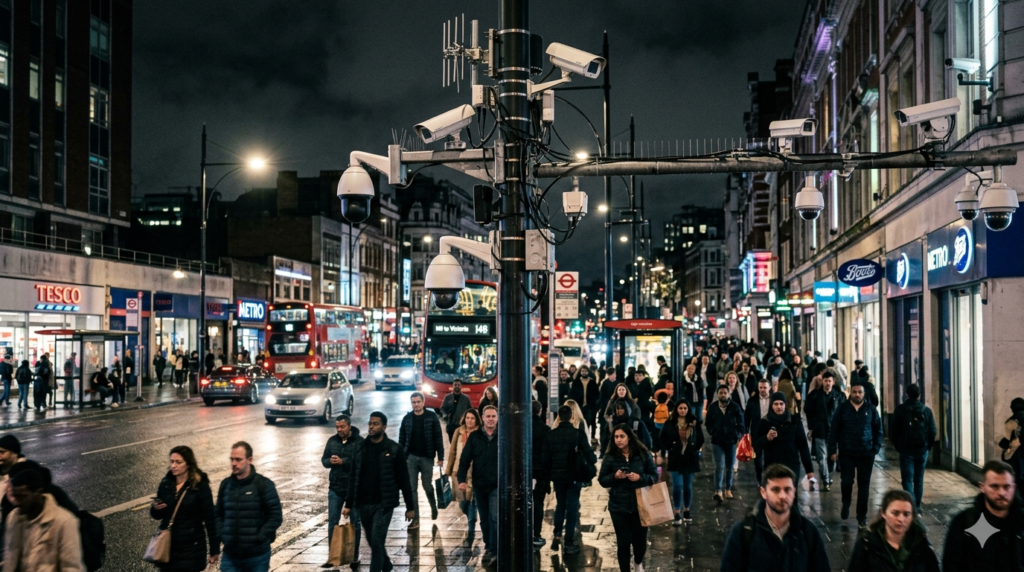
You close the app, set the phone face-down on the table, and feel, for a moment, something like relief. Then you pick it up again. Not because anything has changed, not because a notification arrived, but because the gesture of setting it down already felt like a performance — as if the absence of looking were itself a kind of statement addressed to no one and everyone simultaneously. This is not a trivial compulsion. It is the lived texture of what it means to inhabit a system where the gaze has become ambient, atmospheric, indistinguishable from the air you breathe in any room with a wifi signal.
Giorgio Agamben spent decades tracing the mechanisms by which political power reduces human beings to what he called bare life — zoe stripped of bios, biological existence evacuated of its political and relational density, rendered manageable, classifiable, governable at the level of the body itself. His analysis in Homo Sacer drew on Carl Schmitt and Foucault simultaneously, pushing both toward a conclusion neither had fully articulated: that the state of exception, originally conceived as a temporary suspension of law, had become the permanent operating condition of modern governance. What surveillance capitalism has accomplished is something structurally analogous but far more intimate. The exception is no longer declared from above by a sovereign. It is volunteered from below, one click at a time, one terms-of-service agreement that nobody reads, one location permission granted in exchange for knowing whether the restaurant is still open.
Byung-Chul Han, writing in 2012 with the quiet precision of someone watching a civilization dissolve its own membranes, argued that transparency is not the opposite of power but one of its most refined instruments. The Transparency Society describes a world where the demand for visibility has become so total that interiority itself is experienced as a form of resistance, almost as deviance. When everything must be legible, when opacity is rebranded as either incompetence or guilt, the human subject does not become more free through exposure — it becomes more administrable. Han’s insight cuts deeper than most surveillance critiques because he locates the violence not in the watcher but in the watched, in the internalized compulsion to render oneself readable, to pre-emptively translate the self into data before the algorithm can do it imperfectly.
The psychological literature confirms what Han reasons philosophically. Studies on chilling effects — a term borrowed from First Amendment jurisprudence and applied to behavioral research by scholars like Jon Penney, whose 2016 empirical work documented significant drops in Wikipedia searches for terrorism-related topics following the Snowden revelations — demonstrate that people modify their behavior not when they are punished but when they merely believe they might be observed. The panopticon does not need to be staffed. It needs only to be believed. And belief, once installed, operates with a thoroughness that no human warden could match, because it runs continuously, without shifts, without fatigue, without the small mercies of inattention.
What remains, then, of the self that forms itself in private — in the unobserved moment, in the thought that goes unspoken, in the room where no one is watching? Psychoanalysis from Winnicott onward has insisted that the capacity to be alone, genuinely alone without an internalized audience, is not a luxury but a developmental achievement, a prerequisite for authentic selfhood. The unobserved self is where desire discovers its own shape before social pressure can redirect it. But if the infrastructure of contemporary life has made that solitude structurally unavailable — not forbidden, not punished, simply engineered out of existence by devices that are always listening, platforms that are always recording, algorithms that are always modeling the next move before you have consciously decided to make it — then the question is not whether you are being watched, but whether the part of you that would exist without the watching still has anywhere left to live.
🔍 Power, Control, and the Watched City
The surveillance society did not emerge from nowhere — it grew from deeper roots in political philosophy, urban theory, and the mechanisms of power. These related articles trace the intellectual genealogy of control, from the disciplined city to the observed mind.
The Psychology of Power: History and Theory
The psychology of power explores how authority is internalized, projected, and exercised across institutions and individuals. Understanding surveillance requires grasping how power shapes behavior even in the absence of direct coercion. This article provides essential theoretical grounding for any serious study of social control.
GO TO THE SELECTION: The Psychology of Power: History and Theory
Philosophy of the City: History and Theory
The philosophy of the city asks what it means to live within designed, monitored, and administered urban space. From ancient polis to the modern smart city, urban planning has always carried within it a logic of visibility and regulation. This piece illuminates the spatial dimension of surveillance as a historical and philosophical problem.
GO TO THE SELECTION: Philosophy of the City: History and Theory
Georg Simmel and the Metropolis: The Metropolis and Mental Life
Georg Simmel‘s landmark essay on the metropolis describes how city life transforms the inner life of its inhabitants through constant stimulation and anonymous observation. His concept of the blasé attitude can be read as a psychological defense against perpetual exposure. This analysis is indispensable for understanding how surveillance reshapes subjectivity.
GO TO THE SELECTION: Georg Simmel and the Metropolis: The Metropolis and Mental Life
Situationist Psychogeography: The City as Lived Space
Situationist psychogeography reframes the city as a lived, emotionally charged terrain resistant to top-down mapping and control. The dérive and détournement were direct responses to a society the Situationists saw as spectacularly administered and surveilled. This article connects urban experience to resistance against the logic of visibility.
GO TO THE SELECTION: Situationist Psychogeography: The City as Lived Space
Explore the Cinema of Power and Resistance
If these ideas about surveillance, control, and the politics of visibility move you, Indiecinema streaming is the place to follow them into film. Discover independent and art-house cinema that dares to question who is watching, who is watched, and why — streaming now on Indiecinema.
👉 EXPLORE THE CATALOG: Watch Indie Films in Streaming
A vision curated by a filmmaker, not an algorithm
In this video I explain our vision

