
The Body That Would Not Stay Still
You know the feeling of a body that will not cooperate. The cough that arrives at two in the morning, the chest that tightens before you have even formed a single useful thought, the sheets damp not from desire but from a war your own biology declared without your consent. You know it as an inconvenience. For Robert Louis Stevenson it was the entire architecture of a life.

He bled from his lungs before he had written anything worth keeping. He bled again while he was writing the things that would outlast nearly everyone who read them in his lifetime. He bled in Edinburgh, in the French countryside, in Swiss mountains, in the Adirondacks, and finally on a volcanic island in the South Pacific where he died at forty-four with a body that had been trying to kill him since childhood. The hemorrhages were not metaphor. They were fact, recurring and unglamorous, leaving him horizontal for days at a stretch with strict orders not to speak, not to excite himself, not to do precisely the things that made him who he was.
What he did instead was dictate. When his hands could not hold a pen and his voice was the only instrument left to him, he dictated to his wife Fanny, to his stepson Lloyd, to anyone who could sit beside the bed and keep pace with a mind that simply refused to observe the same emergency his body was announcing. In 1885, during one such hemorrhagic confinement, the first draft of what would become one of the most structurally perfect horror novellas in the English language arrived in something between three and six days. He was thirty-five years old. His lungs were in open rebellion. He wrote anyway, not through them but around them, finding the speed that illness paradoxically grants to those who understand that time is not a background condition but the only real resource ever at stake.
Susan Sontag argued in Illness as Metaphor, published in 1978, that tuberculosis acquired a romantic mythology in the nineteenth century, a mythology that aestheticized suffering into a kind of spiritual refinement, as though the consumption of the body produced the elevation of the mind. Stevenson is often conscripted into this mythology against his will, made posthumously beautiful by his disease, his youth, his Pacific exile. But if you look at the actual record, what you see is not romance. What you see is a man in a continuous administrative negotiation with physical catastrophe, rationing his hours, his voice, his upright posture, deciding with each morning what portion of a finite biological allowance he was prepared to spend on the page.
He traveled not because wandering suited the romantic image of the artist but because warmth and altitude genuinely extended his functional hours, and functional hours were the only currency he had. Davos, Bournemouth, Saranac Lake, Samoa: each address was a medical calculation dressed as an adventure. He understood this and found it neither tragic nor ennobling. He found it, as far as the letters suggest, simply the condition. The condition under which everything was written. The condition that gave every sentence a specific gravity that purely healthy writers rarely need to locate in themselves.
There is a particular quality of attention that emerges when you cannot assume tomorrow is available for revision. It is not urgency in the theatrical sense. It is something quieter and more precise, a kind of editorial ruthlessness that arrives not from craft alone but from the body’s own impatience with waste. Stevenson’s prose has this quality in its bones. The sentences do not accumulate lazily. They move, they press forward, they carry the unmistakable rhythm of someone who learned early that the body grants no extensions and the work must therefore be ready before it is entirely finished.
Scotland as a Wound That Teaches
Edinburgh in the 1850s was not one city but two cities pressed against each other so tightly they had learned to pretend the other did not exist. The New Town rose in Georgian symmetry, all rational proportion and civic confidence, while the Old Town rotted upward in its impossible tenements, twelve stories of human density where tuberculosis moved through families the way rumor moves through a congregation. You could walk from one world to the other in eight minutes. Almost nobody did.
Into this divided geography Robert Louis Stevenson was born in 1850, into the New Town comfort of a family whose name meant something specific and load-bearing: the Stevensons built lighthouses. His grandfather Robert had engineered the Bell Rock lighthouse in 1811, a structure rising from a submerged reef in the North Sea that engineers still study as an act of controlled audacity against nature. His father Thomas continued the tradition, and the tradition continued its pressure downward, onto a son who was sickly, restless, and constitutionally unable to pretend that stone and mathematics were the same thing as meaning. The expectation was geological in its weight. You inherit the profession the way you inherit the jaw, and refusing it feels less like a choice than an amputation.
What Calvinism did to Scotland — what it did specifically to the kind of household Stevenson grew up inside — was to install a surveillance apparatus so thorough that it eventually became internal. Michel Foucault would describe this mechanism in Discipline and Punish in 1975 as the panopticon, the structure where the watched eventually watch themselves, but Foucault was describing prisons. In the Presbyterian moral architecture of mid-Victorian Edinburgh, the prison had no visible walls. The guilt arrived before the transgression. Stevenson’s nurse Alison Cunningham, whom he called Cummie and to whom he dedicated A Child’s Garden of Verses in 1885, read to him obsessively from scripture and Covenanting martyrology, filling his childhood nights with images of divine punishment and heroic suffering. He loved her and was terrified by what she loved. That doubling never left him.
His biographer Frank McLynn, writing in 1993, observed that Stevenson’s entire literary career can be understood as a prolonged negotiation with the Calvinist split between surface and depth, between the respectable face presented to the world and the unspeakable truth living underneath it. This is not metaphor. It is the structural logic of a city where the middle class built their drawing rooms twenty feet above streets where children died of cholera in numbers the municipal authorities found easiest not to count. The Edinburgh of Stevenson’s formation recorded 53 deaths per thousand in its poorest parishes during the 1860s — a figure that was not hidden exactly, only filed somewhere that required no one to look directly at it.
When he finally told his father he would not become an engineer, and then told him he would not become a lawyer either, but a writer, Thomas Stevenson experienced this as a kind of theological crisis. A writer was not a profession. It was an evasion of profession, which in the Calvinist grammar of productive suffering amounted to a moral failure. The arguments between them were long, corrosive, and never entirely resolved, because they were never really about engineering. They were about whether a man could justify his existence through something as ungovernable as language.
What Edinburgh taught Stevenson, and what no other city could have taught him in quite this way, was that every surface is a lid. That the respectable and the damned are not opposites but collaborators in a shared suppression. That geography itself can be a lie — the clean street that ends abruptly, the elegant facade behind which the staircase descends into something that has no name in polite company. He carried this lesson into every room he ever wrote.

The Double Life as Philosophical Condition
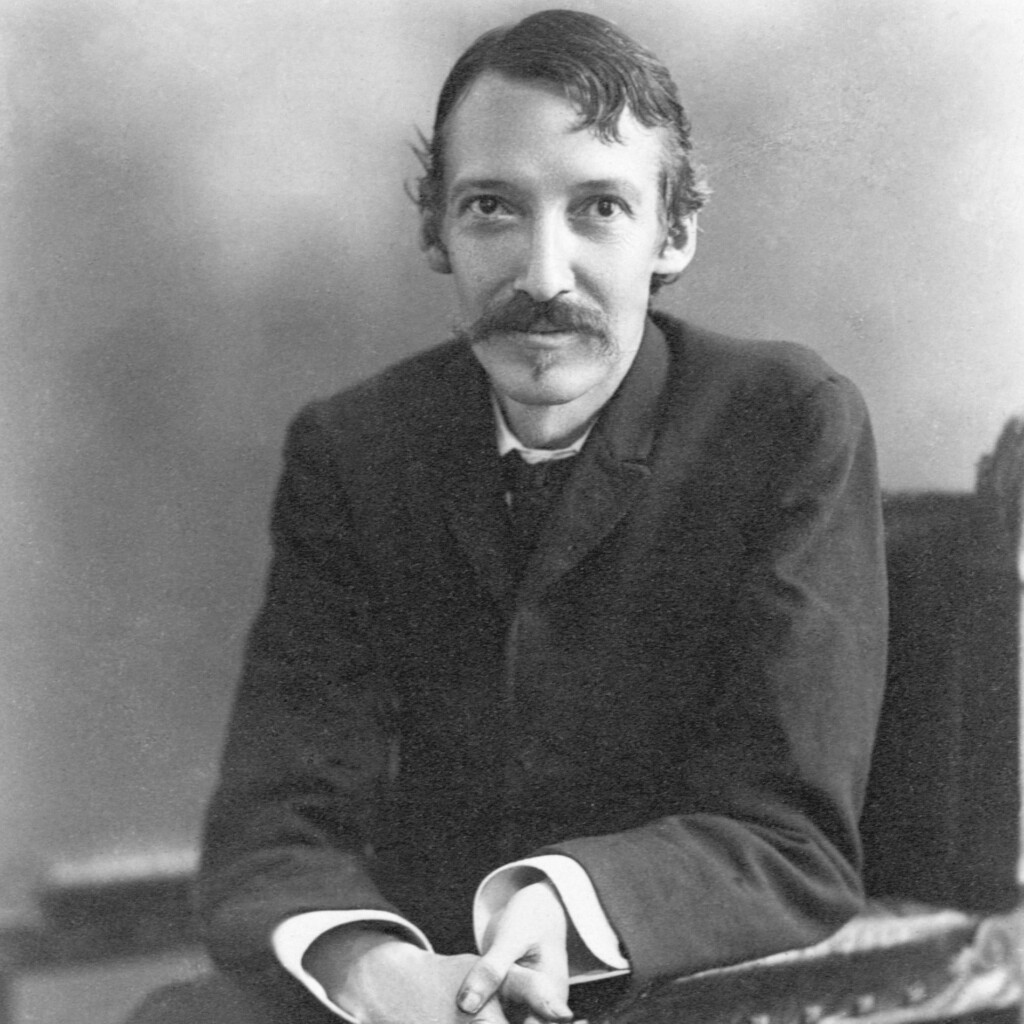
There is a version of you that exists only in fluorescent light — in meeting rooms, at family dinners, across countertops where you hand someone a coffee and say you are fine. That version knows how to modulate its voice, when to laugh, which angers to swallow before they reach the face. It is not a lie, exactly. It is a performance so practiced it has become indistinguishable from sincerity, and that is precisely what makes it so exhausting to maintain.
Stevenson understood this before he had the language for it, before anyone did. He spent decades performing the role of the cheerful invalid, the adventurous Scotsman, the optimistic wanderer who transformed every hemorrhage into anecdote and every bedridden month into productive correspondence. The letters were bright, the essays were warm, the public face was constructed with the careful intelligence of a man who knew that survival — social, financial, emotional — depended on its coherence. And beneath it, something else moved. Something that had no name until he gave it one.
When the story of the doctor who brews himself into someone else first appeared in 1886, it sold forty thousand copies in six months in Britain alone. The Victorians recognized something in it that went beyond horror, beyond allegory. They recognized the architecture of their own daily lives. William James, writing in 1902 in The Varieties of Religious Experience, gave this recognition its most precise philosophical form: the divided self, he argued, is not a pathology but a structural condition of consciousness. The healthy soul is not the unified one but the one that has learned to negotiate between its irreconcilable parts. James was writing about religious conversion, but what he described was universal — the sense that inside any single person there are at minimum two competing centers of gravity, each with its own desires, its own ethics, its own definition of what the body is for.
There is a man who has spent years building a life of perfect legibility — the respected position, the correct opinions, the marriage that photographs well. One evening he mixes something into a glass, and what walks out of the room is not a monster but a relief. What Stevenson captured was not the drama of evil erupting from goodness. It was the drama of suppression itself. The creature that emerges is not the opposite of the doctor. It is everything the doctor compressed into silence in order to function. The horror is not transformation. The horror is recognition.
This is what psychoanalysis would later attempt to formalize, clumsily and at great length, through concepts of repression and the unconscious. But Stevenson arrived at the same territory through sheer autobiographical honesty. He had lived in Edinburgh, that city of literal division — the respectable New Town built above the hidden wynds and closes of the Old, wealth and squalor sharing the same geological formation, separated by architecture and pretense. He had slipped between those worlds himself as a young man, nights spent in parts of the city his father’s friends did not know existed, carrying back with him experiences that could never enter his daytime self without destroying it.
Erik Erikson, in Identity and the Life Cycle published in 1959, would argue that the construction of identity is never a completion but an ongoing negotiation with the social mirror — that who you are is always partly who others require you to be, and the self that persists beneath that requirement is not more authentic, only less visible. Stevenson did not need Erikson to tell him this. He had been living the proof of it since adolescence, performing health when he was ill, performing faith when he had none, performing cheerfulness when the only honest response to his situation was rage.
The question his story leaves open is the one you already know: which one is the real you, or whether that question has ever made sense at all.
Treasure Island and the Mythology of Escape
There is a map drawn by hand, inked with careful pleasure, coastlines traced with the devotion of someone who needs the territory to be real before the first word is written. Stevenson drew it himself during a Scottish summer in 1881, playing with his stepson, and what emerged was not a child’s game but a compulsion — the need to make the elsewhere visible, to give coordinates to the unreachable. The novel that followed the map, published in 1883 first in serial installments in Young Folks magazine before appearing as a book, would sell in numbers that surprised everyone and surprise no one in retrospect. It answered something the Victorian reader could not name but recognized immediately: the longing to be elsewhere, to cut the rope, to let the tide take you.
But look more carefully at what the departure in that story actually carries. The boy who leaves his mother’s inn on the Bristol waterfront is not escaping into freedom. He is escaping into a structure more violent, more hierarchical, and more morally treacherous than the one he left. The island waiting for him at the end of the voyage is already occupied by greed, by murder, by the calculation of men who have traded every softness for survival. Long John Silver, that magnificent villain who refuses to stay villain, understands something the boy will spend the entire journey learning: that the treasure is never the point. The treasure is the story you tell yourself about why the crossing was necessary.
Stevenson knew this because he had crossed repeatedly and found the crossing itself to be the lie. He walked through the Cévennes in 1878, alone except for a donkey named Modestine, and wrote about it with the honesty of a man who suspected himself. He had gone to France partly for his health, partly for a woman, partly because Scotland suffocated him in ways he could articulate only in fiction. He reached California in 1879, following Fanny Osbourne across an ocean and a continent in a journey that nearly killed him, the poverty and the tuberculosis and the sheer physical ordeal of it documented later with a clarity that reads like confession. And then the South Pacific, the final displacement — Samoa, the house at Vailima, the life that looked from the outside like paradise and was, from the inside, still Robert Louis Stevenson: restless, ill, writing against time.
Think of the man on the boat, the one who stands at the stern watching the coastline disappear. He believes he is leaving. He has organized the departure for months, perhaps years, investing it with the significance of a rebirth. What he cannot see — what the horizon conceals from him with its gorgeous indifference — is that he has packed everything he most needed to escape. The arguments he has not finished. The grief he has postponed. The version of himself he has never been able to like. Erik Erikson, writing on identity and the life cycle, described what he called the “moratorium” — the prolonged pause between roles, the suspension in which a person neither commits nor abandons — and recognized that for some temperaments this pause becomes the permanent condition. The voyage is the moratorium made literal. The island is the fantasy that the moratorium will eventually resolve into something.
Stevenson’s genius was to encode all of this into an adventure story so propulsive that generations of readers consumed the critique without noticing it. The violence is never incidental in that novel. It is structural. Every alliance shifts. Every map lies. The treasure, when found, is split under threat of further bloodshed, and the boy who returns home is not the boy who left, not because he has grown in the sentimental sense, but because he has seen what men are willing to do for coordinates on a piece of paper.
Illness, Time, and the Ethics of the Unfinished
There is something Stevenson knew about time that most writers only discover too late, which is that the sentence you are writing right now may be the last one. Not as morbid arithmetic, but as a condition of the work itself. He wrote through fevers, through hemorrhages that stained the manuscripts, through mornings when sitting upright required a kind of courage most people reserve for battlefields. By the time he died in Samoa in December 1894, at forty-four, he was mid-sentence in the truest possible sense. Weir of Hermiston broke off during a scene of such compressed emotional power that scholars have spent generations arguing about where it was going, which is precisely the point. It was not going anywhere. It was already there.
Paul Ricoeur, in his three-volume Temps et récit published between 1983 and 1985, argued that narrative identity is not something a self possesses but something it performs through time, through the act of emplotment, the ongoing story a person constructs to make their existence cohere. The self, for Ricoeur, is not a stable noun but a narrative verb, perpetually conjugated. What happens then when the conjugation simply stops? When the verb is cut not at a period but mid-clause? Ricoeur’s framework, for all its elegance, presupposes something like the possibility of completion, or at least the gesture toward it. Weir of Hermiston refuses even the gesture.
What we have is this: a father and a son locked in a silence more eloquent than most writers manage in a lifetime of finished books. The father is a hanging judge, brutal in his certainty, armored against doubt the way certain men are armored against love. The son is learning, slowly and at great cost, that tenderness is not weakness but a different kind of courage. Their confrontation had not yet come when Stevenson fell. We know it was coming. We can feel its gravitational pull in every scene that precedes the silence. And then the silence.
The incompleteness of Weir of Hermiston does not diminish it. It exposes something that completion systematically conceals, which is the degree to which every narrative depends on the reader to sustain it. Roland Barthes understood this, of course, though he framed it differently in his 1967 essay on the death of the author, arguing that the reader is where meaning is born rather than where it arrives. But Stevenson’s unfinished manuscript goes further than theory allows. It does not merely invite the reader’s interpretation. It conscripts the reader’s imagination into service. You are not reading a fragment. You are being handed a moral obligation.
There is a particular quality of attention that an unfinished work demands, and it is not the comfortable attention of someone who trusts the author to resolve things. It is the attention of someone who has been left alone in a room with a tension that will never be discharged. The father and the son. The judge and the tender heart. They are still in that room. Stevenson put them there and walked out of history before he could open the door and let in the resolution we tell ourselves we need.
What illness taught Stevenson, what decades of proximity to his own possible extinction refined in him, was an ethics of the present sentence. Not the final chapter. Not the arc. The sentence being written now, which must carry everything, because it may carry everything alone. Keats had understood this, dying at twenty-five in 1821 with his odes already complete in the only sense that matters. Schubert left his Eighth Symphony in two movements in 1822 and never returned to it, and those two movements have haunted concert halls ever since not despite their silence but because of it.
The unfinished work does not ask for your pity. It asks for your presence.
A vision curated by a filmmaker, not an algorithm
In this video I explain our vision
The Colonized Paradise and the Limits of the Romantic Gaze

There is a particular kind of love that sees clearly and distorts simultaneously, that reaches across distance with genuine tenderness while never quite releasing the hand that holds the measuring stick. Stevenson arrived in Samoa in 1890 and built his house at Vailima with something closer to devotion than to colonial ambition. He learned the language, took a Samoan name — Tusitala, the teller of tales — ate at the same table as the men who worked his land, and eventually stood before a chief’s council to speak on behalf of people whose sovereignty was being systematically dismantled by German, British, and American interests competing for the Pacific like children dividing a sweet they have no right to unwrap.
His letters to the Times of London, collected and published in 1892 as A Footnote to History: Eight Years of Trouble in Samoa, are documents of genuine moral courage. He named names. He accused the German consul Becker of deliberate provocation, catalogued the cynicism of treaty negotiations that converted living political structures into administrative conveniences, and wrote with a fury that embarrassed his friends at home and made him, in certain London drawing rooms, a nuisance. He was not performing solidarity. He was close enough to the ground to smell the real consequences of the decisions being made thousands of miles away by men who had never once looked at what they were redrawing.
And yet. The Samoan chiefs who built him a road as a gesture of gratitude appear in his writing as figures of almost ceremonial nobility, draped in the light that European Romanticism had been casting over the non-European world since at least Rousseau‘s 1755 Discourse on Inequality — the same light that transfigures the observed into the picturesque, the political into the pastoral. Frantz Fanon would later describe this as the colonial gaze’s most seductive trick: the colonizer who loves the colonized most completely is still the one doing the loving, still the one whose categories determine what is beautiful, what is dignified, what is worth defending. The Samoan people in Stevenson’s prose are brave, loyal, ancient, and noble in ways that locate their value precisely where a European reader in 1892 could recognize and receive it.
This is not hypocrisy. It is something more uncomfortable: the structural limit of a genuinely good intention operating inside a language that was built, word by word, to center one kind of human experience as the measure of all others. Edward Said, whose Orientalism appeared in 1978 and permanently altered the intellectual landscape for reading nineteenth-century European encounters with non-Western cultures, argued that even the most sympathetic Western observer cannot step outside the discursive framework that conditions what he is able to see. Stevenson loved Samoa with his whole heart and described it with the eyes he had been given, which were not neutral instruments.
A man walks away from the council fire where something real has just been decided, something that will protect or abandon real families in real villages, and he goes home to write about it in a language that cannot quite accommodate what he witnessed without reshaping it into something the language already knows how to hold. The physical tenderness is genuine — his grief when Samoan friends died, his rage at bureaucratic indifference to Samoan suffering, the specific weight of daily life at Vailima that fills his letters with concrete breath. None of that is performance.
But admiration that cannot imagine the admired making claims that exceed the admirer’s framework is not yet equality. It is something warmer than contempt and something less than the full recognition of another sovereignty. Whether that distinction diminishes what Stevenson did, or simply names the condition under which he did it, is a question his prose leaves wide open, unresolved at every page.
The Reader Who Needed the Myth
There is a lamp on a table, and a child bent over a book so closely that the light catches the edge of their hair. The house is quiet. Everyone else has gone to bed. The child is not reading anymore, not exactly — they have crossed some threshold where the marks on the page have dissolved and what remains is only the salt smell of a harbor, the weight of a chest, the absolute certainty that somewhere this happened and someone lived it. That belief, held in the body before the mind has a chance to interrogate it, is not naivety. It is the precise mechanism the culture needed.
The late Victorian reading public was a machine running on controlled release. Between 1880 and 1900, the British Empire administered roughly a quarter of the earth’s land surface and something close to four hundred million people, and the men who ran that apparatus came home to terraced houses in Kensington and Cheltenham and felt, in the domestic lamplight, a specific kind of suffocation. The adventure story was not entertainment for these readers. It was pressure management. Stevenson understood this instinctively, even when he resisted it consciously. Treasure Island, serialized in Young Folks beginning in 1881, arrived at exactly the moment when the imperial project was old enough to have produced its first generation of men who had been formed by its mythology before they were old enough to question it. They had been the child under the lamp. Now they were clerks and colonial administrators and solicitors, and the book gave them back the version of themselves they had needed to believe in.
What the French sociologist Pierre Bourdieu called the habitus — the internalized structure of expectation that shapes what we perceive as natural or possible — was being actively manufactured through popular fiction in ways that no educational institution could have achieved with such efficiency. The adventure narrative did not merely entertain; it installed a grammar of legitimate desire. The world had edges worth reaching. Risk was ennobling. Treasure existed and could be found by the brave and the clever. These were not innocent propositions. They were the narrative scaffolding of expansion, and they worked because they first worked on the body of a child who was not yet equipped to notice what was being built inside them.
There is a man standing at a desk in a colonial office somewhere, annotating a map with routes and resource estimates, and somewhere in the architecture of his confidence is that child’s certainty — the smell of the harbor, the absolute truth of the chest. He does not know this. The connection is not available to conscious inspection. That is precisely what makes it functional.
Stevenson himself was a compromised messenger. He knew that the romance form carried ideological weight even as he reached for something more psychologically honest within it. Dr. Jekyll and Mr. Hyde, published in 1886, is the confession that the adventure narrative could not make about itself — the acknowledgment that the respectable self and the violent self are not opponents but collaborators, that the man who runs the empire and the man who takes what he wants without apology are the same man in different clothes. The reading public consumed that text too, and managed, with extraordinary cultural agility, to receive it as Gothic entertainment rather than as diagnosis.
The child under the lamp grows up into someone who has learned to want certain things and not others, to fear certain freedoms and call that fear prudence, to find the shape of a quest natural and the shape of stillness suspect. The myth does not expire when they close the book. It migrates. It finds new hosts. It sits inside the adult’s chest like a compass needle that always points toward somewhere that was never real, insisting, quietly, that they have simply not yet been brave enough to find it.
Style as Survival Strategy
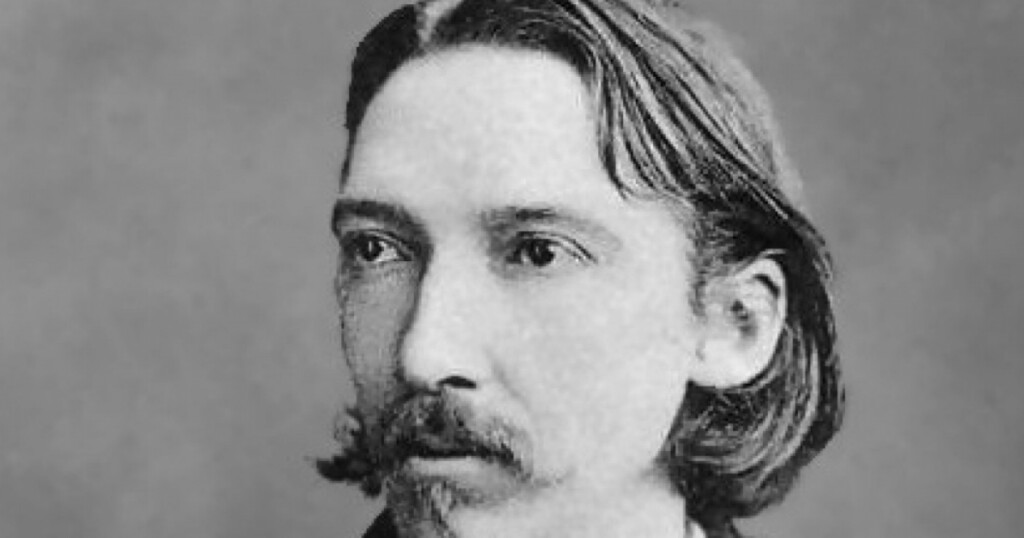
There is a kind of writing that comes from abundance, from the writer who has time and health and the reasonable expectation of more mornings. And then there is the other kind, the kind that comes from a man who wakes each day uncertain whether his lungs will cooperate, who has spent weeks unable to hold a pen, who measures his existence not in years but in the small mercies of a body that has not yet given out. Stevenson belonged entirely to the second category, and his prose knows it. Every sentence carries that knowledge in its bones.
In 1885, he published an essay on the technical elements of style in which he argued something that most writers of his era would have found eccentric, almost perverse: that rhythm is not decoration applied to meaning after the fact, but the architecture of meaning itself. He was precise about it, almost clinical. The arrangement of syllables, the placement of stressed and unstressed beats, the way a sentence gathers momentum or releases it through punctuation — these were not aesthetic preferences but structural necessities, as load-bearing as the joints of a building. Remove the rhythm and you do not have the same thought expressed more plainly. You have a different thought, or no thought at all. This was not the argument of a man who enjoyed style as a luxury. It was the argument of a man who had discovered that form is the only container that holds.
What the essay does not say, but what every page of his fiction demonstrates, is that this obsessive attention to the music of sentences was also a survival strategy. When the body becomes unreliable, when fever arrives without invitation and the hemorrhage threatens again and the doctors speak in careful voices, the sentence becomes the one domain where control remains possible. You cannot govern your own blood. You cannot negotiate with your bronchial tubes. But you can revise a clause. You can shift an adjective three words to the left and feel the whole sentence breathe differently. This is not a small thing. For Stevenson, it was perhaps the largest thing available.
Proust, who also wrote from within a body that refused cooperation, understood this dynamic viscerally — the cork-lined room, the manuscript growing while the man diminished, as though the prose were being fed by the very energy the body could no longer use for living. Keats knew it too, writing his odes in the months when tuberculosis was already doing its quiet demolition work, packing more sensation into a single stanza than most poets manage in a career. There is a category of literature that exists because its author could not afford imprecision, could not waste a morning on a sentence that did not earn its place. Stevenson belongs to that category completely.
But the question his prose finally asks is stranger and more unsettling than the question of posterity. We tend to romanticize the dying artist by telling ourselves that they wrote for the ages, that they transmuted suffering into monuments designed to outlast them. This is a comforting story and it is probably false, or at least incomplete. The more honest possibility is that Stevenson revised his sentences with such ferocious care not because he was thinking about readers a century hence, but because the act of revision was itself a form of presence. To be inside a sentence, working it, feeling where it resists and where it yields, is to be undeniably alive in that moment. Not alive in the abstract, not alive in the sense of biological continuity, but alive in the only way that finally matters: aware, engaged, here. Style, for Stevenson, was not the record of a life. It was the mechanism by which a life, however fragile, continued to occur.
🗝️ Strange Dualities: Literature, Identity, and the Hidden Self
Robert Louis Stevenson’s life and works are steeped in duality, adventure, and the shadowy corridors of the human psyche. His fiction probes the tension between civilization and instinct, morality and transgression, the respectable surface and the dark interior. These related articles trace parallel journeys through literature, philosophy, and the imagination.
Virginia Woolf: Life and Works
Virginia Woolf, like Stevenson, wrestled with the fragile boundaries of selfhood and the demands of a literary life constrained by social expectation. Her modernist prose redefined how interiority could be rendered on the page, pushing narrative into the flowing currents of consciousness. Reading Woolf alongside Stevenson illuminates how Victorian unease about identity evolved into the full psychological complexity of the twentieth century.
GO TO THE SELECTION: Virginia Woolf: Life and Works
Johann Wolfgang von Goethe: Life and Works
Johann Wolfgang von Goethe stands as one of the towering presences behind the Romantic imagination that shaped Stevenson’s sensibility, particularly in his treatment of the divided self and the pursuit of forbidden knowledge. Goethe’s Faust, with its bargain between the human spirit and darker forces, echoes directly in the gothic laboratory of Dr. Jekyll. Exploring Goethe’s life and works enriches our understanding of the European literary tradition from which Stevenson drew so powerfully.
GO TO THE SELECTION: Johann Wolfgang von Goethe: Life and Works
Albert Camus: Life and Philosophical Thought
Albert Camus, though writing nearly a century after Stevenson, shares with him a profound fascination with the absurdity of human existence and the moral weight of individual choice. Camus’s philosophical thought illuminates the existential undercurrents in Stevenson’s adventure narratives and tales of transformation, where characters are perpetually confronted with the limits of their own nature. Together, these two writers map the restless territory between freedom and fate.
GO TO THE SELECTION: Albert Camus: Life and Philosophical Thought
Eco’s The Name of the Rose: Meaning and Analysis
Umberto Eco‘s The Name of the Rose is a labyrinthine novel of secrets, hidden texts, and the perilous pursuit of knowledge, themes that resonate deeply with Stevenson’s gothic and adventure fiction. Both writers understood that narrative itself can function as a maze, drawing the reader deeper into mystery while withholding final certainty. Eco’s analysis of signs and meaning offers a compelling intellectual framework for revisiting Stevenson’s layered storytelling.
GO TO THE SELECTION: Eco’s The Name of the Rose: Meaning and Analysis
Discover the Stories That Cinema Dares to Tell
If these literary journeys have stirred your curiosity about the stranger, darker corners of human experience, Indiecinema is the streaming platform where independent cinema brings those same questions to life on screen. From intimate character studies to visionary genre films, Indiecinema curates the works that mainstream platforms leave in the shadows. Explore, stream, and let the stories find you.
👉 EXPLORE THE CATALOG: Watch Indie Films in Streaming
A vision curated by a filmmaker, not an algorithm
In this video I explain our vision

