
The Village at the Edge of Everything
The road out of Guardialfiera does not so much end as dissolve — into ochre dust, into the particular silence of a Molisan August, into a sky so white with heat that it ceases to look like sky at all and becomes instead something closer to erasure. A man walks it carrying nothing, or carrying so little that the difference is philosophical. His hands are the color of the soil because for three generations his family has put those hands into that soil and received back just enough to remain grateful for the following year’s chance to do it again. He does not complain about this. Complaining would require a vocabulary of alternatives, and that vocabulary was never part of what got passed down.

This is the landscape — literal and psychological — that Francesco Jovine spent his entire literary life trying to put into language that could be seen from the outside without betraying the inside. Born in 1902 in Guardialfiera, a small hilltop town in the province of Campobasso, Jovine grew up inside the very world he would later describe: the agrarian south of Italy, the mezzogiorno, a region that had watched Unification arrive in 1861 like a new landlord who simply replaced the old one without adjusting the rent. By the time Jovine was born, the south had already been living for forty years inside the paradox that the Risorgimento promised liberation and delivered, for the peasant class, a more bureaucratically efficient version of subjugation. The latifondo system — vast estates owned by absentee nobles and managed through a chain of intermediaries who each extracted their portion — was not a relic the new Italian state had failed to dismantle. It was a structure the new Italian state had, with considerable energy, left carefully intact.
Jovine trained as a teacher, a biographical fact that matters more than it might first appear. Teaching in the rural south in the 1920s and 1930s was not an act of professional ambition; it was an act of proximity to a world that the Italian literary establishment, centered in Rome and Milan and Florence, was largely content to treat as atmospheric backdrop rather than historical subject. He taught in the same villages whose names appeared in no newspaper unless a flood or a landslide made them briefly visible. He ate at the same tables where the arithmetic of survival — how much grain, how many months, what can be deferred — was the only mathematics that mattered. His first significant prose works appeared in the 1930s, and in them you can already sense a writer doing something that Italian realism had not quite learned to do: not describing poverty from above, with the compassionate distance of the educated observer, but inhabiting it at eye level, where the horizon is not a metaphor for possibility but simply the line beyond which you cannot see the next problem coming.
What makes this biographical foundation consequential is precisely what it refuses. The rural south as Jovine encountered it and rendered it is not picturesque. There is no consolation in the landscape, no nobility of suffering that redeems the suffering itself. Antonio Gramsci, writing from a Fascist prison cell between 1929 and 1935 in what would become the Prison Notebooks, had already identified the structural reason for this: the southern peasantry was not simply poor, it was politically atomized by design, cut off from any organic intellectual class that might translate its experience into collective agency. The south’s silence was not natural. It had been constructed, maintained, reproduced across generations through a combination of economic dependency, educational exclusion, and a cultural apparatus that told the peasant his condition was the expression of geography or God rather than of history and power.
Jovine understood this not as theory but as the texture of particular mornings — the sound of a door opening before dawn, the weight of a tool picked up without enthusiasm, the specific quality of a silence that knows it is being watched but has learned, across centuries, not to look back.
The Smartphone Woman
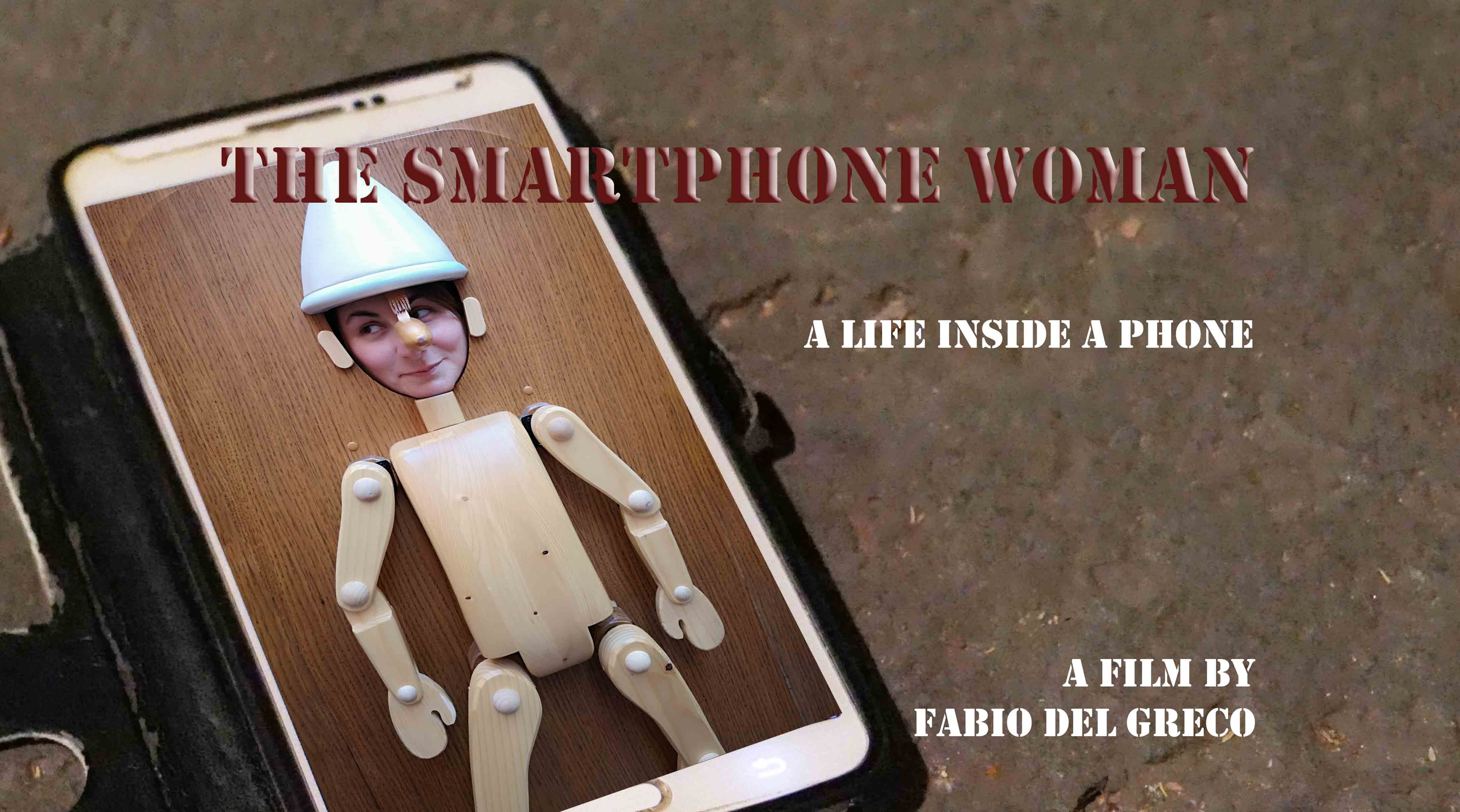
Drama, thriller, dark comedy, by Fabio Del Greco, Italy 2020.
On a bridge over the Tiber River, an elderly and severely ill man has decided to end his life, but an unusual discovery changes his mind: he comes across a lost smartphone. Intrigued, he decides to return home and watch the videos contained within it. On the screen, a series of videos unfold, telling the story of a woman who has emigrated from southern Italy to Rome to work as a teacher in schools and her struggles with integration in a social reality she cannot fully grasp.
"The Smartphone Woman" is a realistic tale of a woman's life and her complex relationship with an "infernal" city. It portrays the challenges she faces, her connection to her origins, the social discomfort she discovers in the outskirts, and the eerie presence of the ghosts of ancient Roman empire. Fabio Del Greco employs a fragmented style, using pieces of "real life" shot with the smartphone, to construct a narrative that ambiguously oscillates between fiction and truth. This creates a captivating exploration of the discomfort and alienation within the bustling city, contrasting with the peaceful village life from which the protagonist hails. The film is constructed with a variety of heterogeneous characters and situations, an emotional kaleidoscope, weaving between evenings of exploration in the Eternal City and daily struggles. Realistic smartphone-shot videos are alternated with a narrative thread reminiscent of film noir and, ultimately, surrealism in the finale. On screen, a succession of grotesque characters unfolds, representing the director's vision of a tumultuous humanity. The film's potency lies in the emotion it manages to convey and in the protagonist's naive perspective. "The Smartphone Woman" is a must-see for enthusiasts of independent and experimental cinema.
LANGUAGE: italian
SUBTITLES: English, French, German, Portuguese, Spanish
A Son of the Molise
His formation was fractured in the way that produces either paralysis or extraordinary perception. He studied, moved, climbed the educational ladder that liberal Italy had constructed as its great democratic promise, and eventually arrived in Rome, where he worked as a schoolteacher for much of his adult life. Teaching elementary school in the capital while carrying the memory of Guardialfiera inside him created a specific kind of double consciousness — not the heroic alienation that intellectuals sometimes perform, but something quieter and more corrosive. He was surrounded by people who had grown up in a world of sidewalks, of institutions that functioned, of a state that was at least nominally present in daily life. He knew a different arithmetic: the arithmetic of absentee landlords, of latifondo land concentrated in aristocratic hands, of peasants who had technically been citizens since 1861 but who experienced that citizenship as an abstraction so remote it barely registered.
There is a particular kind of writer who can only write truthfully about one place, not because they lack imagination but because one place has claimed them too completely to allow for casual invention. Jovine was that kind of writer. His characters speak with the cadences of Molise even when the narrative is constructing something larger than local color. His peasants are not symbols of the eternal south; they are specific men and women trapped in specific historical arrangements, and the precision of that specificity comes directly from having been, as a child, inside the texture of their lives. Carlo Levi published Cristo si è fermato a Eboli in 1945 and gave the Italian literary world an outsider’s stunning account of the meridione. Jovine was doing something harder and less celebrated: writing from inside, which means writing without the consoling distance that makes observation feel like understanding.
What he could never quite resolve was whether writing about that world was a form of return or a form of departure — whether the act of turning Guardialfiera into literature honored it or, in some irreducible way, betrayed it by transforming lived necessity into aesthetic object.

The Fascist Years and the Weight of Silence
There is a particular kind of silence that is not the absence of speech but its most disciplined form. You have felt it, probably, in a room where something true could not be said — where the air itself seemed to tighten around the unspoken, and everyone continued eating, or nodding, or laughing at the wrong moments, because the alternative was a cost no one was prepared to pay. Francesco Jovine knew that room. He lived in it for most of the 1930s, and what he built inside it was not a compromise. It was a technique.
He published Un uomo provvisorio in 1934, three years after the Fascist regime had effectively sealed Italy’s cultural institutions into a system of surveillance and ideological conformity. The title itself — a provisional man, a temporary man — already carries a charge that the regime would not have known how to prosecute but that a careful reader could not miss. The protagonist exists in a state of unresolved suspension, unable to act on his own convictions, drifting through social obligations that feel borrowed rather than chosen. Jovine was thirty years old. He had come from Guardialfiera, a village in the Molise region of southern Italy, carrying inside him the specific grammar of a world that Rome and Milan had never bothered to accurately translate. That grammar — of peasant endurance, of land and seasonal violence, of dignity held like a stone in the palm — was not the grammar the regime wanted to hear. So Jovine displaced it. He moved the argument into character, into atmosphere, into the pressure that accumulates beneath what people cannot say to each other across a table.
This is precisely what Walter Benjamin, writing through the same decade in a different endangered country, identified as the condition of the storyteller who has lost the shared social experience that once made narrative possible. In his 1936 essay “The Storyteller,” Benjamin argues that the art of telling stories is the art of exchanging experience, and that when experience is systematically devalued — by war, by ideology, by the industrial erasure of communal time — the story does not disappear. It goes underground. It encodes. Jovine’s fiction does exactly this: it moves the political argument into the body of the narrative the way a fever moves through the body of a person who cannot afford to stop working.
By the time Ladro di galline appeared in 1940, the same year Italy entered the Second World War, Jovine had refined this method into something almost surgical. The title figure — a thief of chickens, a man prosecuted for the smallest possible act of material desperation — is not a symbol. He is too specific, too bodily present in the prose for that. But the architecture of his situation, the legal and moral machinery that crushes him for taking something negligible while the larger thefts go unnamed and unpunished, maps onto a social reality that the regime’s censors could not easily locate and confiscate because it wore the clothing of a regional anecdote. This is what Gramsci — imprisoned since 1926, writing his notebooks in fragments the censor was meant to find incomprehensible — called the operation of hegemony: the way power does not only forbid but shapes the very categories through which the forbidden might be thought. Jovine was writing from inside that shaping, and his response was not to break the frame directly but to use the frame against itself, to let the regional, the small, the seemingly peripheral carry the weight of the argument that could not stand upright in the open.
What this costs a writer is not obvious from the outside. The reader receives a coherent story. What they do not see is the continuous pressure of self-translation — the permanent act of encoding an argument you are not permitted to make, knowing that some of your readers will find it and others will simply enjoy the surface, and that this ambiguity is not a flaw but the only available form of honesty in a room where the air has already been decided for you.
The Feudal Wound That Never Closed
There is a particular kind of silence that settles over a village at harvest time, not the silence of rest but the silence of exhaustion so complete it has become indistinguishable from acceptance. Francesco Jovine knew that silence from the inside. He had grown up inside it, in Guardialfiera, in that stretch of Molise where the land itself seemed to weigh on the people who worked it, and when he began writing fiction in earnest through the 1930s and into the 1940s, he was not reaching backward into memory for atmosphere. He was performing a diagnosis.
What Jovine’s fiction does — and this is where its force exceeds mere regional realism — is dramatize the precise mechanisms by which that continuation operated in daily life, in the body, in the silences between people who had learned not to say certain things aloud. His most celebrated novel, Le terre del Sacramento, published in 1950 just two years before his death, follows Luca Marano through the Molise countryside in the years immediately preceding and during the Fascist consolidation of power. The sacremental lands of the title are peasant plots historically tied to the Church, technically inalienable, practically contested by every force with enough legal vocabulary or physical intimidation to contest them. Luca is not a hero in any consoling sense. He is a man who believes, with the particular stubbornness of someone who has nothing else, that the land is his by a justice older than any deed of ownership. That belief destroys him. And Jovine does not present this destruction as tragedy in the classical sense, as the fall of someone exceptional. He presents it as the statistical outcome of a system functioning exactly as designed.
The Gramscian insight that sharpens all of this is the concept of the southern intellectual as a mediator not of emancipation but of subordination. The local notary, the minor priest, the small landowner with a little education and enormous social leverage — these figures in Jovine’s world are not villains in the melodramatic sense. They are operators of a structure they did not invent and do not need to consciously perpetuate. They simply occupy the position the structure makes available to them and act accordingly. This is what distinguishes Jovine from the sentimental regionalism that Italian literature had used the south for throughout the nineteenth century, from the verismo of Verga onward — a tradition that, for all its gritty surfaces, frequently aestheticized rural poverty in ways that left the structural causes untouched, even invisible. Jovine refuses that comfort. He is interested not in the picturesque suffering of peasants but in the architecture of the cage, who built it, who maintains it, and, most unsettlingly, who inside the cage has learned to call it home.
The wound he keeps returning to is not the poverty itself but the internalization of its legitimacy — the moment a man stops asking why and starts asking only how much.
Le terre del Sacramento: The Land as a Character That Speaks
There is a moment in the novel when a man walks across a field he has worked for thirty years and realizes, with a clarity that arrives like nausea, that the field does not belong to him. Not in any legal sense he has recently discovered, but in a deeper, older sense that the law only formalized. The land has always belonged to someone else. His labor was never investment; it was extraction. And the ground beneath his feet, the same ground he has touched every morning since childhood, is suddenly alien territory, a foreign country he has been trespassing through his entire life.
Le terre del Sacramento, published in 1950 and awarded the Viareggio Prize that same year, is the book in which Jovine’s entire intellectual project finds its gravitational center. Everything he had been circling — the fragmented identity of southern Italy, the psychology of dispossession, the gap between institutional language and lived experience — collapses into a single narrative architecture set in the Molise of the early twentieth century, during the period of land agitation that followed the First World War. But to call it a historical novel would be to mistake the container for the substance. The history is there, precise and documented, but it functions the way weather functions in a room: you don’t look at it directly, you feel it in your skin.
The land in this novel is not a backdrop. Jovine understood something that most political fiction refuses to acknowledge — that the relationship between a peasant and the earth he cultivates is not economic first, not political first, but ontological. It is a matter of being. When the latifundia system, that sprawling inheritance of feudal land concentration that had survived the Risorgimento virtually intact, denies a man the right to what he has made productive, it is not merely stealing from him. It is performing a kind of metaphysical erasure. Antonio Gramsci, writing from prison in the 1930s, had already identified the Southern Question as a structural condition rather than a cultural failure, arguing in his Prison Notebooks that the peasantry had been historically excluded from any real participation in the national project. Jovine had read Gramsci, understood him, and then did something Gramsci could not do from a cell: he rendered that argument as flesh.
The protagonist Luca Marano moves through the novel not as a hero in the classical sense but as a man inside a gravity he cannot name. His revolt is not the product of ideology. It is the product of accumulated contact with injustice — small humiliations, broken promises, the specific texture of being always just outside the boundary of what is permitted. Jovine gives him no manifesto. He gives him hands that know how to work, a body that has learned the particular demands of particular soil, and a dawning, terrible recognition that the system surrounding him was designed, generations ago, precisely to ensure that his competence would never translate into ownership. The tragedy is not that he fails. The tragedy is that the failure was architectural, built into the foundations before he was born.
What makes the novel devastating rather than merely bleak is the precision of its language. Jovine writes in an Italian that has absorbed the cadences of the local, without resorting to dialect as folklore. The words carry weight the way the land carries weight — not picturesque, not metaphorical, but resistant. You push against them. Erich Auerbach, in Mimesis, published in 1946, described the highest realism as the mode that refuses to separate the everyday from the historically momentous, insisting that ordinary scenes contain within them the full pressure of their historical moment. Jovine had arrived at that same understanding through a different door, through biography rather than philology, and what he built with it was a novel in which a man walking across a field is simultaneously a man and a century, a personal defeat and a structural verdict, a single body moving through
A vision curated by a filmmaker, not an algorithm
In this video I explain our vision
The Illusion of Progress and the Peasant Who Doesn’t Fit

There is a version of history that most people carry around without questioning it, a clean narrative in which modernity arrives like dawn — gradual, inevitable, illuminating. Industrialization happens. Literacy spreads. The peasant, freed from feudal chains, steps into the twentieth century alongside everyone else. This is the story that modern nations tell about themselves, and it is, in crucial ways, a lie built from the perspective of those who benefited from the transition and then wrote the textbooks.
Francesco Jovine spent his literary life documenting the other version. In his Molise, the peasant did not step into modernity. He was absorbed by it, processed by it, occasionally discarded by it, and throughout all of this he was never consulted. The land reforms that arrived from Rome, the bureaucratic structures imposed after Unification in 1861, the Fascist rural policies of the 1920s and 1930s — all of these descended upon the southern peasant as weather descends upon someone without shelter. He could react. He could suffer or resist or adapt. What he could not do was author the conditions of his own existence. Antonio Gramsci, writing from a Fascist prison cell in the early 1930s in what would become the Prison Notebooks, gave this condition its most precise name: subalternity. The subaltern is not simply poor or marginal. The subaltern is the person upon whom history acts, who is never recognized as history’s subject, whose voice — when it appears at all in the official record — appears translated, mediated, deformed by the language of those above them.
What makes Jovine remarkable is that his fiction does not simply illustrate this concept. It inhabits it from the inside. His characters in Le terre del Sacramento, published in 1950, do not speak in the tones of victims awaiting redemption. They speak in the rhythms of people who have developed an entire interior civilization — a system of knowledge about land, weather, obligation, and endurance — that the modernizing state cannot read and therefore cannot value. Luca Marano, the peasant protagonist, carries within him a form of dignity that the novel never sentimentalizes and the political structures around him never acknowledge. This is the trap that Gramsci understood: the subaltern is made invisible not through hatred but through a more efficient mechanism, the simple assumption that his experience does not constitute knowledge, that his relationship to the land does not constitute culture.
Carlo Levi, who was exiled to Lucania in 1935 by the Fascist regime and wrote Christ Stopped at Eboli from that experience, arrived at a parallel diagnosis through an entirely different route. Levi was a painter and intellectual from Turin, not a southerner, not a peasant, and yet his time in that village cracked open something in him. He saw that the peasants of Lucania did not experience time the way the state experienced time. They did not believe in progress as a linear force arriving from Rome. They believed, as he wrote, that Christ had stopped at Eboli — that the world of history, of improvement, of political salvation had simply never reached them. This was not resignation. It was a different ontology, a different way of inhabiting duration, one that the progressive narrative of the Italian nation-state had no category for and therefore simply erased.
What Jovine and Levi, coming from different angles, made visible together is something the comfortable reader resists with considerable force: that liberation is not a single event that lifts all boats. The modernization that reorganized Italian society across the late nineteenth and early twentieth centuries genuinely liberated some people while simultaneously consolidating the invisibility of others. The peasant who does not fit the new order is not a residue, not a failure, not someone who simply didn’t try hard enough to modernize. He is evidence that the order itself was constructed in a way that required his exclusion to function — that his marginality was not a bug in the system but something closer to a structural feature that the system had no particular interest in repairing.
Death Before Recognition: What It Means to Arrive Too Late
There is a particular cruelty in the timing of certain deaths, one that literary history prefers to frame as tragedy rather than examine as symptom. Francesco Jovine died in April 1950, in Rome, at fifty-one years old, of a heart condition that had been wearing him down for years. Le terre del Sacramento, the novel he had spent the better part of a decade constructing, appeared that same year — the same months, nearly the same weeks. He never read a single serious review. He never sat in a room where someone told him what his book had done to them, never watched the culture decide what kind of writer he was, never had the chance to refuse the categories they would inevitably press him into. He died at the exact moment his voice might have finally been heard, which raises a question that literary culture habitually avoids: what does it mean to arrive too late, and who, exactly, benefits from that lateness?
The instinct is to call it tragic irony, to reach for pathos, to light a candle at the altar of the unrecognized genius. Lionel Trilling, writing in the early 1950s about the liberal imagination and its appetite for art that confirms rather than disturbs, observed that a culture tends to absorb its most difficult voices not by silencing them outright but by timing its admiration carefully — honoring the work just enough to prevent it from doing further damage. The posthumous prize, the delayed canonization, the respectful footnote: these are not failures of the critical apparatus. They are its most refined functions. When Jovine received the Premio Viareggio in 1950, awarded after his death, the gesture was impeccable in its uselessness. He could not complicate the award. He could not give an uncomfortable speech, align himself with the wrong political faction, publish a follow-up that ruined the narrative. The prize landed on a silence, and silences are extraordinarily convenient.
What followed across the 1950s and into the 1960s was the process Pierre Bourdieu would later describe with clinical precision in The Rules of Art — the way a literary field incorporates marginal or disruptive work by assigning it a geographic or sociological label that quarantines its universality. Jovine became a southern writer. Le terre del Sacramento became a document of Molisan peasant life, a piece of regional testimony, valuable precisely because it could be kept in its place. The novel’s actual argumentative structure — its insistence that the violence done to the contadini was not a local anomaly but the operating logic of Italian modernity itself — was not refuted. It was simply not followed. Critics praised the prose, admired the ethnographic texture, noted the Gramscian sympathies, and then returned the book to its shelf between other southern voices, where it would be cited without being fully confronted.
This is what it means to arrive too late: not that no one reads you, but that the reading is managed. The reader who might have argued back, demanded clarification, forced the author into a second position, never gets that argument. The author is frozen at the moment of the work’s release, unable to revise, unable to radicalize, unable to disappoint. Death, in this configuration, is not only a biological event but a cultural convenience, transforming a living provocation into a manageable monument. Gramsci himself, whom Jovine had absorbed deeply and whose Prison Notebooks were being assembled and published in those same postwar years, had written about the southern question as something the Italian intellectual class preferred to study rather than resolve — to describe with sympathy from a safe and northern distance. Jovine had done something more uncomfortable than describe it. He had written from inside the wound, with the formal ambition of someone who believed the wound was the center of the story, not its provincial margin. That belief did not survive his death in the form he had held it.
The Reader Standing in the Field
You finish the last page and set the book down, and for a moment the room feels slightly different — not transformed, not illuminated, just slightly off, the way a familiar street looks when you walk it in the other direction. That discomfort is not accidental. It is, in fact, the most honest thing Jovine ever produced, more honest than any single sentence or image, because it arrives in you rather than on the page.
The temptation, of course, is to locate everything he wrote safely in the past. The latifondo is gone, or so the official story goes. The great estates were broken up by the land reform of 1950, the Legge Sila and its extensions, which redistributed roughly 700,000 hectares across southern Italy in the decade following the war. The sharecroppers who walked behind oxen in Jovine’s Molise became, in the textbooks, the beneficiaries of a modern democratic state finally honoring its constitutional promises. The arc of history bent, and bent correctly. This is the narrative that makes Jovine a museum piece, a writer you admire from behind glass, someone who documented a world that no longer exists and therefore requires from you no particular reckoning.
But Gramsci, writing from a prison cell in the early 1930s while Jovine was still drafting the stories that would become his earliest published work, had already identified the mechanism by which a ruling class survives its own apparent defeat. Hegemony does not require the preservation of its original forms. It requires only the preservation of its logic, its grammar, the deep structure of who deserves what and why. The latifondo as a physical reality could disappear entirely and leave its metaphysics perfectly intact, embedded in school systems that reward the cultural capital of the already-cultured, in labor markets that call precarity by the name of flexibility, in the persistent geographic transfer of wealth from south to north that the economist Adriano Giannola documented across decades of Svimez reports, showing year after year that the gap in per capita income between the Italian Mezzogiorno and the northern regions not only failed to close after the postwar boom but in several periods actively widened.
What Jovine understood, and what his fiction enacts rather than argues, is that the most durable form of domination is the one that has convinced the dominated to narrate their own subordination as fate, or as failure, or as the neutral outcome of talent meeting opportunity in a fair arena. Luca Marano does not simply lose. He loses in a way that feels, to the reader who has internalized the myth of meritocracy, almost inevitable — because the myth requires that someone like him, without connections, without inherited cultural authority, without the invisible passport of class, should always arrive a step too late to a door that was never really open. The cruelty of the novel is not in its violence. It is in its plausibility.
Pierre Bourdieu spent much of his career — from the early fieldwork in Algeria and Béarn in the 1960s through the magisterial architecture of Distinction in 1979 — demonstrating precisely this mechanism: that social reproduction disguises itself as individual trajectory, that the field always favors those who were shaped by the field, and that the greatest achievement of any established order is to make its arbitrariness appear as nature. Jovine arrived at the same conclusion through fiction, through dialect, through the specific gravity of Molisan soil, decades before the sociological language existed to name it cleanly.
So the reader who finishes Le terre del Sacramento and feels nothing, or feels only a respectful historical sadness, is not a neutral witness. They are, in a way Jovine would have recognized immediately, the proof of his argument — someone so thoroughly at home inside the myth that the myth itself has become invisible, which is exactly where myths do their best and most lasting work.
🌾 Voices from the Italian South: Literature and Identity
Francesco Jovine, the Molisan author whose fiction gave voice to the peasant world of southern Italy, belongs to a broader tradition of Italian writers who explored regional identity, social struggle, and the deep roots of rural life. These related articles illuminate the literary and cultural landscape that shaped and surrounded his work.
Grazia Deledda: Life and Works
Grazia Deledda was the first Italian woman to win the Nobel Prize in Literature, and her fiction shares with Jovine’s a deep immersion in the rural traditions and social tensions of a peripheral Italian region. Her Sardinian world, like Jovine’s Molise, is rendered with ethnographic precision and lyrical intensity. Understanding Deledda’s narrative universe helps situate Jovine within the broader current of Italian regionalist literature.
GO TO THE SELECTION: Grazia Deledda: Life and Works
Deledda’s Reeds in the Wind: Meaning and Analysis
Deledda’s Reeds in the Wind is one of the masterpieces of Italian regional literature, depicting the slow dissolution of a noble family against the backdrop of Sardinian rural life. Its themes of tradition, fatalism, and social change resonate directly with the world Jovine portrayed in his own novels. This analysis offers essential tools for reading the literature of the Italian margins with deeper awareness.
GO TO THE SELECTION: Deledda’s Reeds in the Wind: Meaning and Analysis
Antonio Gramsci: vita e pensiero politico
Antonio Gramsci, born in Sardinia and imprisoned by Fascism, developed a political and cultural thought deeply attentive to the ‘Southern Question’ and the role of subaltern classes in Italian history. His reflections on hegemony, popular culture, and the peasantry illuminate the social fabric that Jovine sought to represent in his fiction. Gramsci’s thought provides a crucial intellectual framework for understanding the political dimension of Jovine’s literary project.
GO TO THE SELECTION: Antonio Gramsci: vita e pensiero politico
Cesare Pavese and Poetry: Hard Labor
Cesare Pavese was one of the defining voices of postwar Italian literature, whose poetry and prose engaged with the peasant world of Piedmont and the myth of origins rooted in the land. Like Jovine, Pavese wrestled with the relationship between modernity and archaic rural life, between political commitment and the poetic imagination. His collection Hard Labor stands as a landmark in the tradition of socially engaged Italian poetry.
GO TO THE SELECTION: Cesare Pavese and Poetry: Hard Labor
Discover the Cinema of Memory and the Land on Indiecinema
The themes explored in Jovine’s work — the struggle of the dispossessed, the beauty and harshness of rural life, the search for justice and identity — find powerful echoes in independent cinema. On Indiecinema streaming you can discover films that carry on this tradition of committed storytelling, bearing witness to the world’s forgotten margins with the same passion and humanity.
👉 EXPLORE THE CATALOG: Watch Indie Films in Streaming
A vision curated by a filmmaker, not an algorithm
In this video I explain our vision

