
The Boy Who Would Not Be Tamed
You are fourteen years old and the walls of the building are not stone — they are expectation. Every corridor smells of obedience dressed as piety, every meal is taken in silence that is not peace but suppression, and the boys around you have already learned to fold themselves into the shape the institution requires. You have not. You will not. And the terrible thing, the thing that will haunt every decade that follows, is that you do not yet know whether your refusal is courage or catastrophe.

Hermann Hesse arrived at the Evangelical Theological Seminary in Maulbronn in 1891 as a scholarship student, a boy from a deeply devout Pietist family who had already been marked for the church. His father Johannes, a Baltic German missionary, and his mother Marie, born into a family of distinguished theologians and scholars, had constructed a spiritual architecture around their son that was genuinely loving and genuinely suffocating in equal measure. The seminary at Maulbronn, a medieval monastery in Württemberg whose Gothic cloisters had been receiving young men for centuries, was the next logical stone in that architecture. In March 1892, after less than a year, Hesse fled. He simply walked out. He was found in a field the following day, having spent the night alone in the cold, and was returned. What followed was not a triumphant act of rebellion but a prolonged psychological unraveling — nervous collapse, a suicide attempt at fifteen, institutionalization at the asylum in Stetten and then the sanatorium at Bad Boll, sessions with the theologian and faith healer Christoph Blumhardt, and eventually a period under the care of a neurologist in Basel. By the time he was seventeen, Hesse had already passed through systems designed to classify, correct, and contain the self, and none of them had worked.
This is not a story about a sensitive boy who suffered. Sensitivity is too soft a word for what was actually happening. What institutions like Maulbronn practiced was the systematic conversion of interiority into compliance, and Hesse was simply someone whose interior refused the transaction. Erik Erikson, writing in 1968 in Identity: Youth and Crisis, described the adolescent ego as engaged in a fundamental negotiation between selfhood and social demand — but he was careful to note that certain historical and institutional structures do not negotiate, they conscript. The Württemberg seminary system was not interested in the boy’s inner life except insofar as it could be redirected toward theological service. When the inner life proved unredirectable, the institution’s response was to pathologize it. Hesse was not ill. He was illegible to a system that had no vocabulary for him.
What the biographical record shows, when read without the softening gloss of literary hagiography, is a young man who had already absorbed a contradiction so deep it would take decades of writing to process. His family’s Pietism was not cold orthodoxy — it was warm, earnest, and saturated with genuine spiritual longing. His mother Marie kept journals of striking psychological and literary sensitivity, and his grandfather Hermann Gundert was a philologist of Sanskrit and a translator who had spent decades in India, bringing into the household an awareness of non-Christian thought that was unusual for a German Protestant family of that era. Hesse grew up simultaneously inside Christian devotion and at the edge of something much older and stranger. The seminary asked him to choose the former and forget the latter. The refusal to do so was not adolescent theatrics. It was the first, most honest thing he ever did.
He would work as a bookseller’s apprentice in Tübingen, then in Basel. He would publish his first book of poems, Romantische Lieder, in 1899, followed by an early prose work in 1900. He was teaching himself, through reading and solitude, what no institution had been willing to teach him — that the wound of not belonging is sometimes the only honest credential a writer can carry.
I Am Nothing

Drama, thriller, by Fabio Del Greco, Italy, 2015.
The story revolves around Vasco, a Roman builder who, at the age of 74, enjoys a life of absolute comfort. His human parable takes a dramatic turn when a mysterious encounter leads him to an ambush. Having survived, but marked by a long coma, Vasco wakes up with a new sensitivity, developing an intimate and poetic bond with nature. This new relationship with the world around him leads him to deeply explore himself, in an internal and external journey. through Italy, the United States and India, in search of a higher meaning and a cure. In parallel, the threat of a planetary cataclysm adds an epic dimension to the story.
I Am Nothing explores universal themes such as time, memory, oblivion and the connection with nature. Fabio Del Greco creates an existential drama full of food for thought. The director skillfully combines different visual materials, mixing archive images with nature photographs and dreamlike visions. This visual experimentation translates into an editing that captures the viewer's attention, guiding him through a cycle of creation and destruction. The sequences that alternate the buildings, Vasco's pride, with Indian landfills and natural landscapes create a hypnotic rhythm, underlining the beauty and fragility of life. Vasco's existential journey is a hymn to transformation and rebirth. The evolution of the protagonist, from unbridled luxury to the rediscovery of purity, represents a powerful metaphor on the meaning of life and the need to reconnect with authentic values. Io sono nulla stands out for its ability to combine introspection and visual experimentation, offering a suggestive and engaging narration. It is a film that invites us to reflect on the human condition, on our relationship with power and nature, and on the possibility of finding ourselves through change. A work that leaves its mark and lends itself to multiple readings.
LANGUAGE: Italian
SUBTITLES: English, Spanish, French, German, Portuguese
Pietism, Pressure, and the Architecture of Guilt
You are nine years old and you have done something wrong — not gravely wrong, not wrong by anyone else’s standard, but wrong by the standard of the house you live in, which is to say wrong by the standard of God, which is to say wrong absolutely and without appeal. The feeling that follows is not quite shame and not quite fear. It is something more architectural than either: a weight distributed evenly through the body, a sense that the self has been found structurally deficient, that the flaw is not in the act but in the one who performed it. Hermann Hesse knew this feeling before he knew how to name it, and he spent the next seven decades trying to build, in language, a room large enough to contain it.
The house in Calw, Württemberg, where Hesse was born in 1877, was not merely religious in the ambient, cultural sense that characterized much of provincial German Protestant life. It was Pietist — which is a specific and demanding thing. Pietism, the movement that had spread through Swabia since the late seventeenth century following Philipp Jakob Spener’s 1675 manifesto Pia Desideria, did not concern itself primarily with doctrine or institutional allegiance. It concerned itself with interiority, with the continuous moral examination of one’s own soul, with the conviction that faith must be felt, verified, and constantly re-earned through personal spiritual vigilance. It was, in effect, a technology for producing a particular kind of inner life — one organized around the certainty of one’s own inadequacy before something infinite.
Hesse’s maternal grandfather, Hermann Gundert, was not a peripheral figure in this tradition. He was one of its exemplars: a Sanskrit scholar, a missionary who had spent decades in India, a man of extraordinary intellectual force whose translations and ethnographic work were genuinely significant contributions to nineteenth-century comparative linguistics. His presence in the family’s moral atmosphere was not softened by distance or abstraction. It was a living standard, and standards of that magnitude do not simply set the bar — they alter the ground beneath the person trying to reach it. Hesse’s father Johannes, himself a missionary who had worked in India before returning to edit a Pietist publishing house in Basel, carried that inheritance with the particular weariness of a man who has absorbed a great demand and transmitted it without fully processing it himself.
What this environment produced in the young Hesse was not orthodox faith. It produced something more durable and more treacherous: a conscience structured in the image of faith, a moral interiority that retained all the architecture of guilt long after the theological furniture had been removed. Erik Erikson, writing in 1958 about Luther but diagnosing something far broader in Young Man Luther, argued that the Protestant inner voice does not disappear when belief does — it migrates, takes up residence in the psyche under new names, and continues to prosecute the self with the same relentless jurisdiction. Hesse’s entire fictional project can be read as a series of attempts to negotiate with that prosecuting voice without simply surrendering to it or destroying it entirely.
The characters who would emerge from his imagination decades later — young men torn between obedience and desire, between the spiritual and the sensual, between what they were formed to be and what they recognized themselves as — were not invented. They were excavated. The split they carry inside them, that vertiginous gap between the sacred and the forbidden, between the father’s world and the body’s world, was not a literary device Hesse selected from available options.

Demian and the Theology of the Self
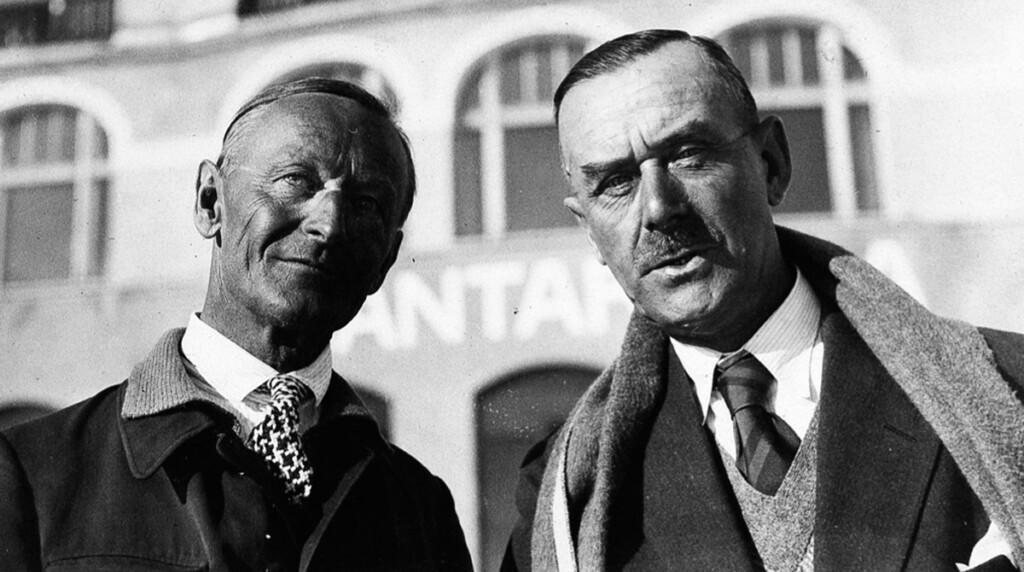
You are nineteen years old in 1919, the war has just ended, and the country that sent your older brother to die in a trench has handed you back a world made of rubble and official explanations. Someone passes you a slim novel by an author you have never heard of — Emil Sinclair — and within the first twenty pages you feel, with a physical certainty that embarrasses you slightly, that this book was written for you specifically, about the exact fissure running down the center of your chest that you could never name.
That sensation, multiplied across sixty thousand readers within months of publication, is not a literary event. It is a diagnostic result. Hermann Hesse published Demian in 1919 under a pseudonym precisely because the book needed to arrive without the baggage of an established identity — it needed to feel discovered rather than authored, unearthed rather than sold. The deception worked so completely that Hesse was awarded the Fontane Prize for new writers before the ruse was exposed, at which point he returned the prize with a letter that managed to be both gracious and quietly contemptuous of the entire machinery of literary recognition. The pseudonym was not vanity; it was structural. A book about the fraudulence of inherited identity could not arrive wearing one.
The theological center of Demian is the god Abraxas, a Gnostic figure Hesse lifted from the margins of early Christian heresy — a deity who contains light and darkness without resolving them into moral hierarchy. The Gnostics who invoked Abraxas in the second century were not being poetic. They were making a metaphysical claim that the ordered cosmos of Roman state religion was a fraud, that the real divine principle exceeded the clean divisions of good and evil that civic authority needed its citizens to internalize. Hesse understood that this was not mysticism but surgery. To place Abraxas at the spiritual center of a novel read by a generation that had watched its fathers’ moral certainties produce industrial slaughter was to offer not comfort but detonation. The Kaiser’s Germany had run on a theology of righteous order, and Hesse was proposing that the entire architecture of that order — its virtues, its duties, its clean separation of the decent from the degenerate — was the disease, not the cure.
What made this philosophically precise rather than merely rebellious was Hesse’s direct encounter, beginning in 1916, with Josef Lang, a practicing disciple of Carl Gustav Jung in Zurich. The sessions Hesse underwent during a period of profound personal collapse — his father’s death, the dissolution of his marriage, his own nervous breakdown — introduced him to Jung’s concept of individuation as it was then being developed: the process by which a self becomes genuinely its own by integrating the shadow, the unlived life, the parts the ego has declared inadmissible. Jung’s Psychological Types, published in 1921, would formalize much of this, but Hesse was absorbing it in raw, therapeutic form years earlier. The Demian that emerged from those sessions is not a novel about a young man finding himself. It is a novel about the violence required to stop being the self that other people’s fear assembled for you.
The character Demian functions not as a friend or mentor in any conventional sense but as an externalized psychic function — the part of the protagonist Emil Sinclair that already knows what Sinclair’s social formation has trained him to suppress. Every scene between them is an interrogation of a premise Sinclair has accepted without examination. The mark of Cain, reinterpreted early in the novel not as shame but as distinction, is the conceptual key: what civilization has taught you to hide as damnation is precisely the feature that marks you as someone who refused the comfort of the herd’s fear. Hesse was not writing theology. He was writing the interior experience of a mind discovering that its own depths had been colonized by an authority that would rather produce obedience than produce human beings.
Siddhartha and the Trap of Enlightenment Tourism
You have read it on a train, or in a hammock somewhere, or in the particular silence of a rented room far from home, and you felt — briefly, powerfully — that the answer was close. The thin novel slid into your hands like a permission slip. Something in you exhaled.
That exhale is exactly what the text was not designed to produce. Hermann Hesse traveled to what was then Ceylon and Sumatra in 1911, returned ill and unsettled rather than illuminated, and spent eleven years turning that failure of transcendence into the most misread spiritual document of the twentieth century. Siddhartha, published in 1922, is not a map to enlightenment. It is a methodical destruction of every road that promises to lead there.
The novel’s protagonist abandons the Brahmin rituals of his father without nostalgia, then abandons the ascetic Samanas, then — and this is the moment most readers skim past in their hurry toward the river — he sits before Gautama the Buddha himself, listens to the teaching, acknowledges it as perfect, and walks away. He walks away not from a false doctrine but from the truest one available. Hesse is doing something philosophically violent here: he is arguing that even correct knowledge, received from outside, calcifies into a second-hand life. The Buddha’s teaching, in this telling, is not wrong. It is simply not Siddhartha’s. No transmission can cross that gap.
This argument had been sharpened by Hesse’s reading of Arthur Schopenhauer’s The World as Will and Representation, which had colonized German intellectual life since the mid-nineteenth century and offered a frame in which individual will is the fundamental torment of existence. But where Schopenhauer located release in aesthetic experience and the denial of desire, Hesse pushed further into the uncomfortable territory Carl Jung was simultaneously mapping — the idea that the self cannot be evacuated, only integrated. Jung and Hesse were in correspondence and, more significantly, Hesse underwent Jungian analysis in 1916 with Josef Lang, a student of Jung’s, a fact that left legible marks on every character who splits, doubles, or drowns in Siddhartha’s arc. The river at the novel’s end is not a symbol of peace. It is a symbol of simultaneity — all voices, all times, all contradictions held without resolution. The Sanskrit word used there is Om, which does not mean calm. It means the whole catastrophe, undivided.
Western readers in the 1960s and 1970s consumed the novel in numbers that still stagger — translations sold in the millions, and the American paperback edition became an object inseparable from a particular fantasy of Eastern wisdom as accessible shortcut, a fantasy the counterculture needed badly and the publishing industry was happy to supply. What they extracted was the ending, the river, the old ferryman, the beatific smile. What they set aside was the middle hundred pages in which Siddhartha becomes a wealthy merchant, a compulsive gambler, a man hollowed out by sensory saturation — not as a detour from the spiritual path but as its necessary continuation. Hesse was not decorating a pilgrimage with a cautionary interlude. He was insisting that the sewage of ordinary failure is the material from which whatever wisdom exists must be made. There is no clean version.
The trap the novel sets is elegant and almost invisible: it is written so beautifully, so serenely, in prose that carries the reader forward with the ease of moving water, that the form itself contradicts the argument. You feel enlightened reading about the impossibility of feeling enlightened. You arrive at the last page soothed, and the text has just told you, in precise and unambiguous language, that being soothed by someone else’s formulation is the one thing that will not save you — and whether that irony was Hesse’s gift or his private joke remains genuinely unclear.
The Kempinsky Method

Drama, by Federico Salsano, Italy 2020.
The introspective imaginary road movie of a man in the maze of his own mind, his memories of his youth, his never dormant passions and contradictory truths. The road is made of water, the destination is falsely unknown. His traveling companions are three mysterious men, projections of his imagination and of different aspects of his personality: the perennial melancholy, the crazy creative, the introverted child. He is also followed by a female presence that tells the umpteenth human story. At a certain point of the crossing he decides to abandon the boat and his ghosts of him diving into the sea and arrives swimming on a deserted beach, naked, with a small Pinocchio puppet closed by a padlock.
In this splendid film life is like a long sea voyage and the human being is a small creature confronting immensity. Sometimes the ocean is calm, other times there are terrible storms. Sometimes we are captains of a boat with a well-defined route, other times we are shipwrecked in search of a land in which to save ourselves. But despite the long journey and the movement in physical space, there are other questions that resonate in the mind: who are these men I travel with? What is the mystery of this immense mass of water that seems to be made of my memories? You can circumnavigate the whole world but the main question always remains the same: who am I really?
LANGUAGE: italian
SUBTITLES: english, spanish, portuguese, german, french
The Steppenwolf Paradox
You are sitting in a rented room that smells of paper and cold coffee, and you have just decided, with complete sincerity, that you are too complex for the life around you. The neighbors bore you. The furniture offends you. The job, the routine, the small pleasures of ordinary people — these things confirm what you already suspect about yourself: that you are not like them, that you carry something heavier and more refined, that your suffering is evidence of depth. This is precisely where Hermann Hesse sets the trap, and almost no one who walks into it notices the mechanism closing behind them.
Der Steppenwolf appeared in 1927, when Hesse was fifty years old, freshly divorced for the second time, navigating a crisis that was equal parts personal collapse and cultural vertigo in a Weimar Republic visibly coming apart at its seams. The novel’s protagonist, Harry Haller, is a middle-aged intellectual who despises the bourgeois world with an intensity that is itself bourgeois in its furniture, its habits, and its fundamental orientation toward comfort. Haller rents rooms in respectable houses. He reads good books. He listens to Mozart. His rebellion is conducted entirely within the vocabulary of the class he claims to have transcended, which is not a paradox the novel resolves — it is the novel’s actual spine.
Friedrich Nietzsche, writing in Beyond Good and Evil in 1886, had already dismantled the idea that any human being possesses a unified, coherent self that can be alienated from its surroundings. What the culture calls “the individual” is a committee of drives, impulses, inherited valuations, and biological pressures dressed in the costume of coherent will. Haller, who believes himself divided between wolf and man, between primal freedom and civilized constraint, is operating inside a myth of internal duality that flatters him enormously. The binary is not a diagnosis. It is a decoration. It allows him to experience his own mediocrity as a form of tragic grandeur, his paralysis as proof of sensitivity too acute for ordinary resolution.
What Hesse does with ruthless structural intelligence is build a novel that mirrors this self-deception without ever stepping outside it to offer correction. The Magic Theatre in the book’s final third is not liberation. It is the same ego performing in a more expensive venue. Every door in that theatre opens onto another version of Haller’s own desires — violence, sexuality, surrender — and the carnival atmosphere does not dissolve the self so much as it gives the self permission to feel its neuroses as aesthetic experiences. The reader who arrives at those pages feeling exhilarated is, at that moment, Haller. That is not a flaw in the reading experience. It is the text functioning exactly as designed.
What makes this genuinely difficult is that Hesse is not outside the trap either. The novel was read across the 1960s counterculture — particularly in the United States, where its German-language sales had been modest but its English translation, reprinted by Holt, Rinehart and Winston in 1963, sold millions of copies and became a kind of handbook for a generation that wanted its alienation validated and poeticized. That generation found in Haller a mirror, and the mirror told them they were special in their suffering, which is precisely the function Haller needed the mirror to perform. A book written from inside a crisis about the seductiveness of self-mythology became itself a myth that millions used to seduce themselves.
The genuine destabilization in the text is not Haller’s encounter with Hermine or Pablo or the saxophone jazz of the Weimar nightclub. It is the preface, written by Haller’s landlady’s nephew, who observes the man plainly, without metaphysics, and finds him merely odd, slightly pitiable, and not particularly remarkable. That observer has no theory of the wolf. And he is the only person in the book who is not suffering.
A vision curated by a filmmaker, not an algorithm
In this video I explain our vision
Switzerland, Exile, and the Politics of Neutrality

You receive a letter calling you a traitor. Not a formal accusation — something worse, something handwritten, from a reader who once loved your books and now wants you to know that your pacifism during wartime is indistinguishable, in his view, from collaboration with the enemy. Hermann Hesse received hundreds of letters like this between 1914 and 1918, and the cumulative weight of them was not incidental to his biography. It was the cost of being one of the very few German-language writers who refused to transform his pen into a recruiting instrument.
The move to Bern in 1912 is typically narrated as a retreat — a sensitive artist seeking clean air and distance from the industrial noise of modernity. What that narration erases is the timing of what followed. When Germany entered the First World War in August 1914 and the literary establishment mobilized with startling speed, figures of enormous cultural prestige signed manifestos, wrote patriotic verse, and cast the war as a spiritual purification. Hesse did not. His essay “O Freunde, nicht diese Töne,” published in November 1914 in the Neue Zürcher Zeitung, called for writers to refuse nationalist intoxication and to remember their obligation to a humanity that crossed borders. The response in Germany was swift and vicious. Publishers distanced themselves. Readers cancelled subscriptions. A writer who had sold enormously well, whose Peter Camenzind in 1904 had made him a household name, found himself accused of cowardice and cultural betrayal by the very audience that had made him.
What is philosophically precise about this moment is that Hesse’s position was not the comfortable neutrality it has sometimes been made to appear. It was not silence. Silence would have been the easier path — to say nothing, to tend his garden in Bern, to let the war run its course. Instead he chose exposure, and the exposure was real. His wife suffered a nervous breakdown during the war years, his father died, his finances collapsed, and he himself entered a psychological crisis severe enough that he underwent treatment with Josef Lang, a student of Carl Gustav Jung, beginning in 1916. The interior journey documented later in Demian in 1919 was not separate from the political moment — it was produced by it, forged under the specific pressure of watching a civilization he had believed in dismantle itself with extraordinary efficiency.
Swiss naturalization in 1923 is another gesture that becomes more legible when read politically rather than sentimentally. By that point Hesse had no German readership worth protecting. What the citizenship represented was a legal consolidation of an already-accomplished fact: he had placed himself outside the jurisdiction of German cultural nationalism, not as an act of indifference but as a permanent refusal of a particular kind of belonging. When the National Socialists came to power in 1933, that refusal acquired a clarity that could no longer be dismissed as mere aestheticism. While writers like Gottfried Benn initially accommodated the new regime, and while the machinery of Gleichschaltung absorbed or silenced most of the literary culture Hesse had grown up within, he continued to use his position at a German-language book review column — which he edited until 1936 — to recommend Jewish authors and émigré writers whose books were being burned inside Germany.
The accusation that Hesse was merely an interior writer, a novelist of private spiritual crisis with no genuine political conscience, tends to rely on a very selective reading of the archive. It ignores the letters, the wartime essays, the book recommendations made under conditions where recommending the wrong name carried institutional consequences. It also relies on a false opposition, the idea that interiority and political commitment cannot occupy the same person simultaneously — an opposition that the twentieth century’s most brutal regimes worked very hard to install in the cultural imagination, precisely because it was so useful to them.
The Glass Bead Game as Diagnosis
You have spent years inside a system that rewards you for how well you can speak about things without touching them. The seminar, the journal, the conference panel — each one a smaller version of the same architecture: thought that refers only to other thought, language that validates itself by citing language, prestige distributed according to how fluently you can remain suspended above the actual world. You know this. You have felt the particular vertigo of realizing, mid-sentence, that you are performing intelligence rather than exercising it. What Hesse completed in 1943, after twelve years of writing, is a 500-page novel about exactly that feeling — and somehow, despite winning the Nobel Prize in 1946, it remains the least read of his major works, which is itself a symptom of the disease it describes.
Das Glasperlenspiel constructs a future society called Castalia, a province of pure intellectual life where an elite caste of scholars has been freed from economics, politics, and ordinary human friction to devote themselves entirely to the Glass Bead Game — an infinite combinatory system that weaves together mathematics, music theory, philosophy, and all the accumulated forms of human knowledge into patterns of ever-increasing elegance. It sounds, and is clearly meant to sound at first, like paradise. No war, no commerce, no vulgarity. Only the life of the mind, perfected. Hesse was not satirizing stupidity. He was doing something far more unsettling: diagnosing the pathology that lives inside refinement itself.
The protagonist, Josef Knecht, rises to become the Magister Ludi — the supreme master of the Game — and at the height of his achievement he resigns. Not because the Game is corrupt or the institution cruel. He leaves because he has understood that Castalia has severed the connection between thought and consequence so completely that the entire civilization has become a beautiful parasite, sustained by a world it no longer acknowledges, producing meaning for an audience of itself. The word Knecht in German means servant, and the irony is precise: the most liberated man in the most liberated society discovers he has been in service to an abstraction.
What Hesse understood, writing this in the middle of a world war he was watching from exile in Switzerland, is that aesthetic and intellectual sophistication offer no immunity against civilizational collapse — they can, in fact, accelerate it by providing a population of educated people with a convincing reason to look away. The sociologist Thorstein Veblen had already identified something adjacent to this in 1899 in The Theory of the Leisure Class, calling it conspicuous learning: the display of useless knowledge as a marker of status, where the uselessness is precisely the point. Hesse takes that observation and scales it to an entire culture, and then asks what happens when that culture achieves its own ideal.
The answer is that it produces exquisitely articulate people who have lost the capacity to be changed by what they think. Knowledge in Castalia circulates without friction because it is never allowed to make contact with anything that could resist it. There is no student in that world who is failing, no family being destroyed, no body in pain — nothing that would force a thought to prove itself against reality. And so the thoughts become more and more beautiful, and more and more weightless, until the Game itself is indistinguishable from an elaborate ritual for managing the terror of meaninglessness.
Every literary culture, every academic department, every intellectual community that has ever congratulated itself on its own seriousness is somewhere inside that architecture. The question Hesse embeds in the novel’s structure — not stated, never argued, simply demonstrated across five hundred pages — is whether the sophistication you have accumulated has made you more capable of living, or whether it has become the most elegant cage you have ever built for yourself, and the most difficult to see from inside.
What the Nobel Could Not Canonize
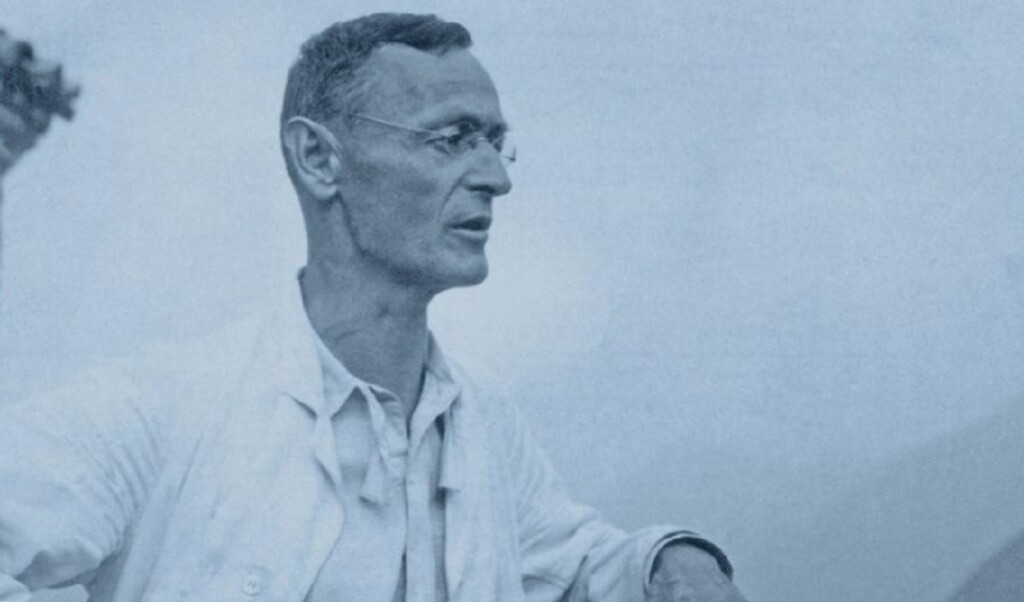
You are handed a paperback with a lotus on the cover, its spine already cracked by whoever owned it before you, and somewhere in the margins someone has written the word “beautiful” next to a passage about letting go. This is the afterlife of a writer who once described the human self as a laughingstock, a fiction maintained only through constant, exhausting performance — and what has survived of that description is the warm feeling people carry away from it.
The Nobel Prize arrived in 1946, awarded to a man who had spent decades being dismissed by German literary culture as sentimental, provincial, or simply irrelevant to the catastrophes unfolding around him. The Swedish Academy cited his courageous independence and his humanist ideals, language that performs the very reduction it pretends to honor. To call a writer courageous and humanist is to sand down every edge that made the work dangerous. The prize did not recognize what Hesse had actually written — it recognized a version of him that could be safely celebrated without disturbing anyone at the dinner table where the ceremony would be discussed.
The second transformation was slower and more total. Through the 1960s and into the 1970s, American paperback publishers moved millions of copies of Siddhartha and Steppenwolf through college bookstores and head shops, and the counterculture absorbed them as confirmation of what it already believed: that inner freedom was available, that the self could be shed like a garment, that the road inward led somewhere better than the road outward. What the readers were metabolizing was not Hesse’s actual argument but its skeleton, stripped of the irony, the self-contempt, the structural pessimism about whether transformation is even possible for someone constitutionally modern. By 1968, Hesse was the best-selling author in the world. That number is not a measure of influence. It is a measure of successful domestication.
The sociologist Pierre Bourdieu, writing in The Rules of Art in 1992, described how the literary field neutralizes threatening texts by converting their symbolic violence into cultural capital — the work becomes prestigious precisely because it has been made safe enough to be prestigious. The wound becomes credential. What Hesse wrote about the impossibility of authentic selfhood in a society that manufactures and sells identity became, through the machinery of reception, a manual for finding your authentic self. The critique was inverted without a single word being changed, because the words were never the point — the institutional frame around them was.
This is not a failure unique to readers who should have known better. It is how cultures protect themselves from what they cannot afford to understand. A text that genuinely destabilizes the category of the individual self cannot be widely read by a culture whose entire economic and political architecture depends on that category remaining stable. So the culture reads it, buys it, prints it in ten million copies — and in doing so, performs the absorption that neutralizes it. The danger is not ignored. It is embraced to death.
What remains, underneath the covers with lotuses and the syllabi that teach Siddhartha as a story about self-discovery, is a body of work that has not actually been read — not in the sense of being received as it was sent. Hesse spent his life writing about the impossibility of the peace his readers found in his pages, about the comedy and the horror of wanting arrival in a structure that offers only motion. The millions of readers who found comfort were not wrong to find comfort. But they found it in the same way someone finds warmth by burning a letter — the heat is real, and the message is gone.
🌀 Souls in Search: Mysticism, Literature, and Inner Journeys
Hermann Hesse’s work stands at the crossroads of Eastern spirituality, Western literature, and the restless search for selfhood. His novels — from Siddhartha to The Glass Bead Game — trace the labyrinthine paths of souls seeking wholeness. The following articles explore kindred spirits and philosophical landscapes that illuminate Hesse’s world.
Johann Wolfgang von Goethe: Life and Works
Johann Wolfgang von Goethe was one of the towering influences on Hesse’s literary and spiritual imagination, shaping his understanding of self-cultivation and the tension between reason and feeling. Like Hesse, Goethe pursued a synthetic vision of human experience that embraced art, science, and mysticism as facets of a single truth. Reading Goethe alongside Hesse reveals a deep genealogy of German inwardness and the pursuit of Bildung.
GO TO THE SELECTION: Johann Wolfgang von Goethe: Life and Works
Jungian Individuation and the Great Work
Jungian individuation — the lifelong process of integrating the unconscious into conscious life — is perhaps the most illuminating psychological framework for reading Hesse’s novels. Hesse was in direct contact with Carl Jung and underwent analysis, an experience that profoundly marked works like Demian and Steppenwolf. The alchemical metaphor of the Great Work mirrors Hesse’s narrative arc of dissolution and reintegration of the self.
GO TO THE SELECTION: Jungian Individuation and the Great Work
Ramana Maharshi: Life and Teachings
Ramana Maharshi, the Indian sage of non-duality and self-inquiry, represents the kind of Eastern wisdom that deeply captivated Hesse throughout his life. Hesse’s journey to India and his lifelong dialogue with Hindu and Buddhist thought find a living embodiment in Maharshi’s radical simplicity and direct pointing to the Self. Siddhartha, in particular, breathes the same air of contemplative stillness that defines Maharshi’s teaching.
GO TO THE SELECTION: Ramana Maharshi: Life and Teachings
Meister Eckhart: Life and Mystical Philosophy
Meister Eckhart’s mystical philosophy of detachment and the ground of the soul resonates profoundly with the inner landscapes Hesse mapped in his fiction. Both Eckhart and Hesse point toward a silence beneath the noise of personality, a sacred core that cannot be taught but only uncovered. Hesse’s characters — Narcissus, Goldmund, Siddhartha — all undertake a journey that mirrors Eckhart’s mystical path toward union with the divine ground.
GO TO THE SELECTION: Meister Eckhart: Life and Mystical Philosophy
Discover the Cinema of Inner Transformation on Indiecinema
If Hermann Hesse’s world of seekers and dreamers speaks to you, Indiecinema is the streaming home for films that share that same restless depth. Explore independent and art-house cinema that dares to ask the questions Hesse never stopped asking — about identity, meaning, and the soul’s long journey home. Join us and let the maze keep unfolding.
👉 EXPLORE THE CATALOG: Watch Indie Films in Streaming
A vision curated by a filmmaker, not an algorithm
In this video I explain our vision

