
The Hill That Does Not Move
You are standing on the slope of a red hill in southern India, and the year is 1896, and you are watching a boy die. Not literally — the body is still there, thin and upright, moving through the dust with bare feet — but the person who left home three weeks ago is already gone. He is sixteen. He has written a note in chalk on a scrap of paper telling his family not to search for him, left a few coins to cover the cost of the train ticket he used, and walked into the world stripped of the single most fundamental thing a human being carries: the assumption that the one doing the living and the one being lived are the same entity. He did not reach this through years of study. He reached it through a single afternoon of lying on the floor of his uncle’s house in Madurai, convinced he was dying, and deciding — with extraordinary precision — to investigate what exactly was about to be destroyed.

What Venkataraman Iyer discovered in that room in 1896, and what he would spend the next fifty-four years attempting to transmit without ever quite managing to turn it into a system, is something that nearly every spiritual tradition has circled without naming directly: that the self which fears death is not a thing that exists in the way a chair or a hunger or a memory exists. It is a gesture. A repetition. An act so habitual it has forgotten it is an act. The boy who walked to Arunachala had not read the Mandukya Upanishad with scholarly rigor. He had, instead, done something philosophically ruthless — he had traced the pronoun “I” back to its source and found nothing stable there. Not emptiness in the nihilistic sense, but a kind of luminous openness that seemed, paradoxically, more real than the anxious identity it replaced.
The hill itself matters here, and not as backdrop. Arunachala, which rises 2,682 feet above the Tamil plain near Tiruvannamalai, carries a theological weight in Shaivite tradition that predates the boy’s arrival by centuries. The Skanda Purana identifies it as the physical form of Shiva, the axis around which the world pivots, the fire-linga that once blazed so high that Brahma and Vishnu could not find its crown or root. This is not incidental mythology. When the young Venkataraman arrived at the hill and fell to his knees at the Arunachaleswarar temple in what eyewitnesses described as a state closer to seizure than devotion, he was not discovering a metaphor. He was, within the logic of his own tradition, recognizing something. The convergence between the inner event in his uncle’s house and the outer form of the mountain was, for him, one single fact expressed twice.
What makes this difficult for a modern reader is not the mysticism. We are, most of us, more comfortable with mysticism than we pretend. What makes it difficult is the radical passivity of what followed. He did not found a school immediately. He did not lecture. For years he sat — first in the dark vaults beneath the temple, then in a mango grove, then in a cave on the hill called Virupaksha — largely silent, largely unaware of whether he was eating, burning from insect bites he did not notice, his body maintained by the barely-there interventions of a small group of people who found him and decided, for reasons they could not always articulate, that something in his presence required protection. Paul Brunton, the British journalist who came to Tiruvannamalai in 1931 skeptical of everything and left having written a book that would introduce Ramana Maharshi to the English-speaking world, described sitting with him as the experience of a silence that pressed against you from the inside.
That pressure is what the rest of this requires you to take seriously.
I Am Nothing
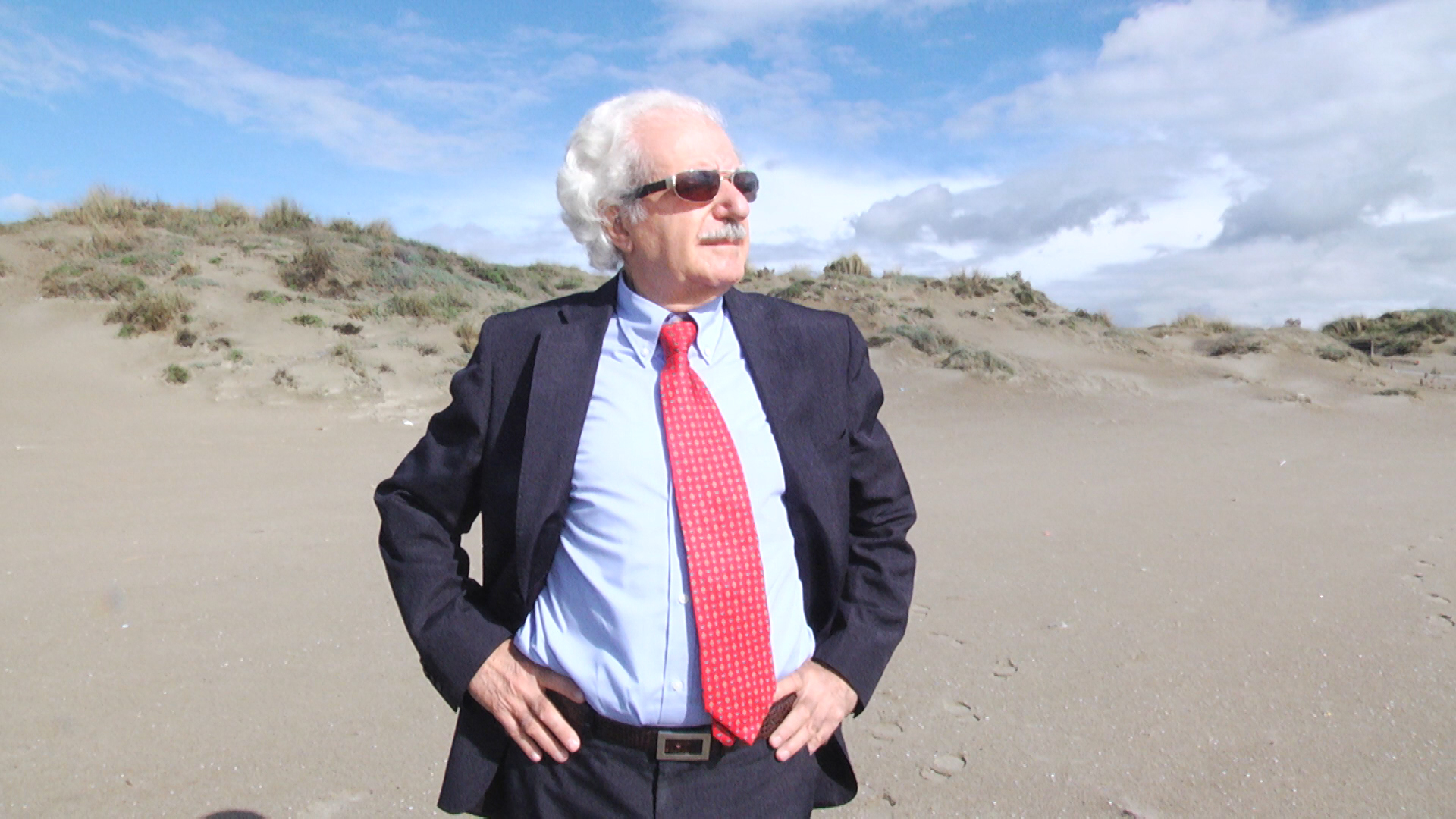
Drama, thriller, by Fabio Del Greco, Italy, 2015.
The story revolves around Vasco, a Roman builder who, at the age of 74, enjoys a life of absolute comfort. His human parable takes a dramatic turn when a mysterious encounter leads him to an ambush. Having survived, but marked by a long coma, Vasco wakes up with a new sensitivity, developing an intimate and poetic bond with nature. This new relationship with the world around him leads him to deeply explore himself, in an internal and external journey. through Italy, the United States and India, in search of a higher meaning and a cure. In parallel, the threat of a planetary cataclysm adds an epic dimension to the story.
I Am Nothing explores universal themes such as time, memory, oblivion and the connection with nature. Fabio Del Greco creates an existential drama full of food for thought. The director skillfully combines different visual materials, mixing archive images with nature photographs and dreamlike visions. This visual experimentation translates into an editing that captures the viewer's attention, guiding him through a cycle of creation and destruction. The sequences that alternate the buildings, Vasco's pride, with Indian landfills and natural landscapes create a hypnotic rhythm, underlining the beauty and fragility of life. Vasco's existential journey is a hymn to transformation and rebirth. The evolution of the protagonist, from unbridled luxury to the rediscovery of purity, represents a powerful metaphor on the meaning of life and the need to reconnect with authentic values. Io sono nulla stands out for its ability to combine introspection and visual experimentation, offering a suggestive and engaging narration. It is a film that invites us to reflect on the human condition, on our relationship with power and nature, and on the possibility of finding ourselves through change. A work that leaves its mark and lends itself to multiple readings.
LANGUAGE: Italian
SUBTITLES: English, Spanish, French, German, Portuguese
Death as the First Philosophy
You are sixteen years old, lying flat on the floor of your uncle’s house in Madurai, and something is happening to your body that has no name yet. Not illness. Not dream. Your limbs go rigid, your breath thins to almost nothing, and you decide — with a clarity that surprises you even as it arrives — to treat what is coming as real. You do not call for anyone. You let the dying proceed.
What happened to Venkataraman Iyer in 1896 was not metaphor and was not pathology. He felt, with the certainty of a man who has just touched a hot surface, that his body was dead and that he was not. The experience lasted perhaps thirty minutes. It did not produce a theory. It produced a fact — or something that functioned as a fact with more authority than anything he had learned in school. He would never return to ordinary adolescent life. By the following month he had left for Tiruvannamalai, abandoned his family, his name, and any residual interest in the kind of knowledge that arrives through argument.
William James, writing in 1902 in The Varieties of Religious Experience, identified exactly this structure without knowing Ramana existed. James argued that mystical states carry what he called a noetic quality — they are not merely feelings but states of knowledge, delivering insight into depths of truth that the discursive intellect cannot reach and, crucially, cannot subsequently disprove. He was careful and empirical about this: he was not endorsing the content of any particular vision but insisting on the epistemological status of the event itself. Something was being known. The question was whether the Western philosophical tradition had any room for that kind of knowing.
It largely did not. The Cartesian inheritance that structured European thought from the seventeenth century onward had placed reason at the origin of valid knowledge. You doubt first, then you reason, then you conclude. Descartes’ 1641 Meditations on First Philosophy built an entire architecture of certainty on the premise that the thinking subject is the ground from which everything else must be verified. What this framework could not metabolize was an event in which the subject temporarily dissolved and returned carrying information. That sequence — dissolution before understanding — inverted the required order. It produced knowledge without a knower, or at least without the kind of knower the tradition had specified as prerequisite.
The deeper provocation is not that Ramana experienced something unusual but that the experience was, by his own repeated account, self-validating in a way that no subsequent argument could touch. Philosophers from Kant onward had assumed that the conditions of possible experience were fixed and universal — that human cognition operated within structures that were stable, impersonal, and essentially the same for everyone standing upright and awake. The near-death event does not negotiate with those structures. It suspends them. And what it delivers in that suspension carries, for the person who undergoes it, more evidential weight than anything reasoned from the outside in.
This is uncomfortable not because it is irrational but because it is arational in a way that exposes the circularity of rationalism’s own defenses. To say that noetic mystical states cannot constitute genuine knowledge is already to have assumed a definition of knowledge that excludes them — which is not an argument but a boundary drawn in advance. James saw this with his characteristic pragmatist precision: the test of any state of mind, he insisted, must be what it does, how it functions, what transformation it produces in the person who undergoes it. By that measure, what happened to Ramana on that floor in Madurai was one of the most consequential epistemological events of the twentieth century — and it happened entirely without concepts, without language, and before the boy had read a single line of philosophy.

The Self That Was Never Born
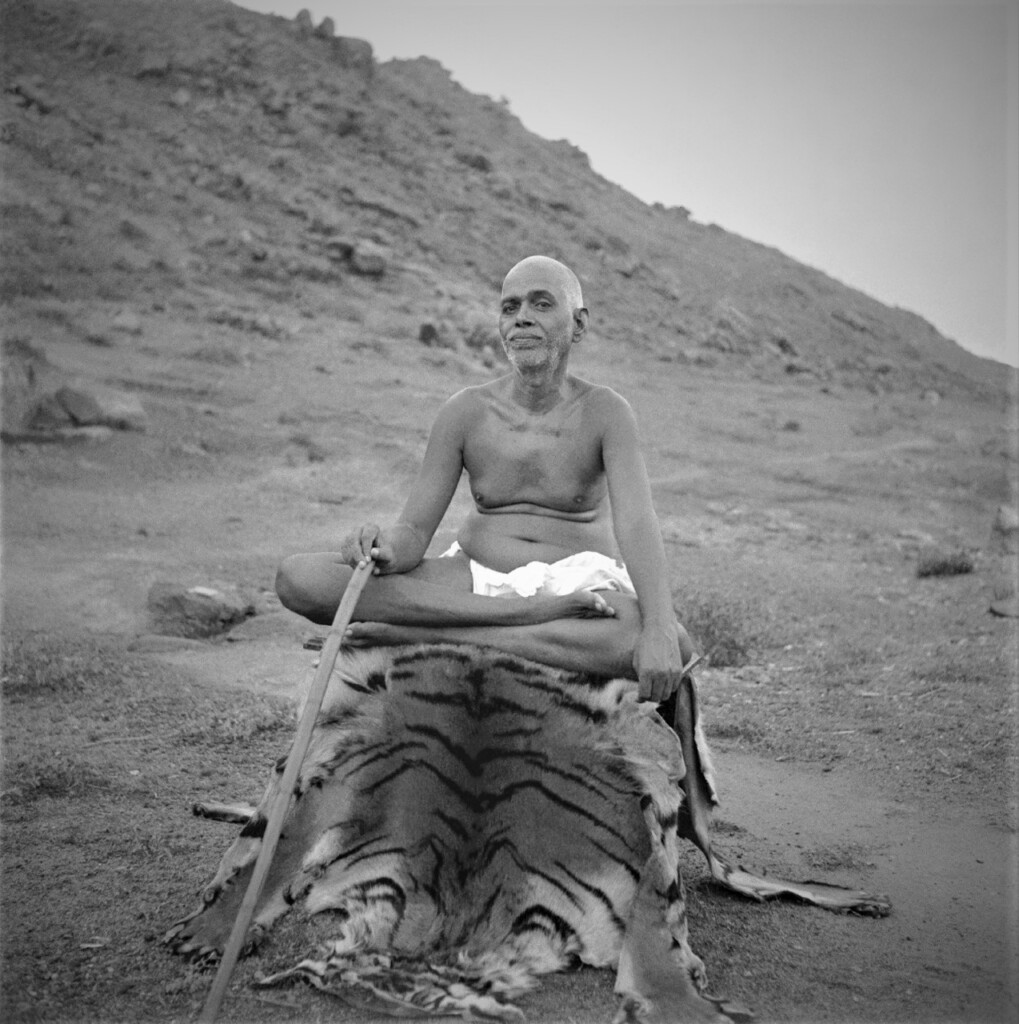
You reach for yourself constantly — in mirrors, in the reactions of others, in the story you rehearse about where you came from and what you have survived — and each time you reach, something slips. Not because you are elusive, but because the instrument doing the reaching is the same thing you are trying to catch.
The question Ramana Maharshi posed at sixteen, lying on the floor of his uncle’s house in Madurai and pressing his own limbs to feel whether death had already arrived, was not a therapeutic exercise. It was not an invitation to sit quietly and breathe. It was a structural rupture in the grammar of selfhood itself. “Who am I?” appears, on the surface, to be a question that expects a name, a history, a personality in response. But Ramana’s insistence — recorded across decades of dialogues compiled in works like Nan Yar, published in Tamil in 1923 — was that the question, when pursued with absolute sincerity, does not produce an answer. It dissolves the questioner.
Gottlob Frege, writing in 1892 in his landmark essay Uber Sinn und Bedeutung, drew a distinction that philosophy has never fully recovered from: the difference between the sense of a word and its reference. The morning star and the evening star carry different senses — different cognitive content, different paths of meaning — but refer to the same object, the planet Venus. The word “I” presents the strangest possible case within this framework, because its reference shifts with every speaker who utters it, and yet its sense — what it seems to mean, this feeling of inwardness, of being the one who is speaking — remains hauntingly constant. Everyone who says “I” feels they are pointing to something uniquely and irreducibly theirs. And yet no sentence containing the word “I” can actually capture what it points to. The moment you say “I am a teacher” or “I am afraid” or “I am the one who remembers,” you have replaced the reference with a predicate, a description, an attribute — and attributes can be lost, changed, forgotten. What remains when they are all subtracted is not nothing. It is the disturbance that Ramana’s question was designed to locate.
What ordinary identity costs to maintain is rarely calculated honestly. The psychologist William James, in his Principles of Psychology published in 1890, identified what he called the “social self” as the recognition a person receives from others — and noted, with unusual candor, that a person has as many social selves as there are individuals who recognize them. This multiplicity is not freedom; it is labor. Every interaction requires a small renegotiation of which self is being presented, which history is being activated, which wound is being concealed. The philosopher Thomas Metzinger, in Being No One from 2003, pushed this further by arguing that what we experience as selfhood is a model — a representational construct the brain generates to maintain coherent behavior — and that this model is transparent in the technical sense: we look through it without seeing it as a model at all. We mistake the map for the territory and then spend our lives defending the map’s borders.
A man sits across from Ramana in the Virupaksha Cave on Arunachala sometime in the 1920s, having traveled weeks to ask about liberation. He has brought a notebook. He expects doctrine. What he receives instead is silence, and then a counter-question: who is the one asking? He writes in his notebook that nothing happened. He is wrong. Something was subtracted from the architecture of his certainty, and the subtraction left no debris — which is precisely why it could not be recognized as an event. The “I” that arrived with questions had nowhere to file the experience, because the experience was not about the “I” at all. It was the first moment he had ever stood, unknowingly, on the other side of it.
The ground there has no name yet, and perhaps that is the only honest thing left to say about it.
Silence as a Transmission Technology
You sit across from someone who says nothing, and something in you begins to move. Not toward speech, not toward thought, but toward an edge you did not know you were approaching. This is not metaphor. This is what Paul Brunton recorded in painstaking detail after his weeks at Tiruvannamalai in the early 1930s, published in 1934 as A Search in Secret India — a book that would become, almost accidentally, the document that cracked open Western awareness of a man who had barely moved from a single hill for three decades. Brunton arrived skeptical, a journalist by instinct, trained to extract information through questions. He left with something he could not name and spent the rest of his career trying to approximate it in language.
What he described was not enlightenment, not vision, not any of the dramatic ruptures that spiritual literature promises. It was closer to a cessation — a slowing of the internal noise he had not realized was constant until it stopped. He sat in the hall at Ramanasramam, the sage across from him in undisturbed stillness, and reported that his mental agitation simply dissolved without his willing it to. Brunton was careful not to claim mystical causation. He was also careful not to deny it. The honesty of that ambivalence is precisely what gave his account its strange credibility.
The philosophical problem this raises is not small. Western epistemology since Descartes has operated on the assumption that meaning travels through a medium — that understanding requires encoding, transmission, and decoding. Language is the paradigm case, but the model extends to gesture, text, image, any semiotic system you care to name. What Brunton and dozens of visitors after him described is a transmission that appears to bypass the medium entirely, which is either a breakdown of the epistemological model or evidence that the model was always incomplete. The Indian philosophical tradition had a name for what Ramana was understood to be doing: upadesa, instruction, but in its most refined form, mouna upadesa, silent instruction. The tradition did not treat this as paradox. It treated it as the most direct form of communication possible, the one that requires the fewest translations.
The neurologist Antonio Damasio, in his 1999 work The Feeling of What Happens, argued that consciousness is not primarily a linguistic phenomenon — that the self is constituted first at the level of felt bodily states, and that language arrives later, as a kind of annotation. If that architecture is accurate, then a transmission that operates below the threshold of language is not mystically impossible. It is structurally coherent. The body registers what the analytical mind has not yet processed. Visitors to Ramana often reported the physical dimension of the experience before anything else — a heaviness in the chest, a warmth, a sudden involuntary quieting of breath. These are not the symptoms of intellectual persuasion.
The German philosopher Karl Jaspers wrote in 1932, in Philosophy, about what he called “existential communication” — a form of encounter between persons that cannot be reduced to the exchange of propositions, in which one human being becomes, for another, a kind of summons toward their own deepest possibility. Jaspers was writing about intimate human relation in general, not about saints in southern India. But the structure he identified maps with uncomfortable precision onto what was being reported at Tiruvannamalai. The presence of another person, at sufficient depth of being, does something that their words cannot replicate or replace.
The Guru Trap and Its Seductions
You sit cross-legged on the floor of the ashram, having traveled four thousand miles, and the moment the old man glances in your direction you feel something crack open behind your sternum. You do not know whether what you are experiencing is genuine contact with something real or the most elaborate placebo ever constructed by human longing. The terror is that it might be both simultaneously, and that the distinction may not matter as much as you need it to.
Max Weber, writing in Wirtschaft und Gesellschaft in 1922, identified the process he called the routinization of charisma — the mechanism by which the raw, disruptive force of an extraordinary individual gets absorbed, bureaucratized, and finally domesticated by the institutions that form around it. He was describing early Christianity and its conversion into church hierarchy, but the template fits with an almost uncomfortable precision onto what happened at the foot of Arunachala during the final decades of Ramana’s life. The man who had arrived as a teenager with no possessions, no doctrine, no intention of teaching anyone anything, found himself by the 1930s at the center of a functioning ashram with a managing committee, a publication wing, visiting dignitaries, and a growing international correspondence handled by secretaries. The charisma had not disappeared. It had been given an address.
What Weber’s framework allows us to see is not cynicism but inevitability. The people who gathered around Ramana were not, for the most part, opportunists manufacturing a product. Many were genuinely transformed by proximity to him. The problem is structural: human communities cannot sustain pure disruption. They require schedules, roles, hierarchies of access, and explanatory narratives. So the silence gets transcribed. The glance gets interpreted. The presence gets converted into a body of teachings, and the teachings get arranged into progressions, and the progressions get sold to the next wave of seekers as a map of exactly the territory that the original experience had suggested was unmappable. By 1950, when Ramana died, there existed a sufficiently robust institutional apparatus to ensure that the destabilization he embodied could be packaged and delivered in manageable doses indefinitely.
The cruelest part of this process is that it consumed Ramana’s own explicit disclaimers. He said repeatedly, in terms that left almost no room for misinterpretation, that the guru is not an external figure but the self recognizing itself — that dependence on a physical teacher was itself an obstacle to the very recognition the teacher was pointing toward. Arthur Osborne, one of his closest Western devotees and his biographer, documented these statements carefully in Ramana Maharshi and the Path of Self-Knowledge, published in 1954. And yet those statements were immediately re-incorporated into the devotional structure as evidence of Ramana’s exceptional humility, which itself became a quality to be venerated, which itself deepened the devotional relationship he had explicitly said was the wrong relationship to have with him. The rejection of the role became proof of fitness for the role. The system digested its own antidote.
This is not a failure particular to Ramana’s followers. It is what happens when a genuine encounter with uncertainty meets the human need for certainty at institutional scale. The sociologist Richard Sennett, examining how authority functions in modern life in Authority published in 1980, noted that figures who refuse to perform authority often consolidate it more effectively than those who claim it openly, because the refusal reads as transcendence rather than absence. The crowd fills the vacuum with projection, and the projection is sturdier than anything the figure himself could have constructed. Ramana, sitting silent on his couch, declining to appoint successors, occasionally telling visitors to stop attending him and go sit with themselves — each of these gestures arrived at the devotee’s eye as confirmation that something worth attending was present. The silence became its own eloquence.
A vision curated by a filmmaker, not an algorithm
In this video I explain our vision
Advaita Without the Packaging
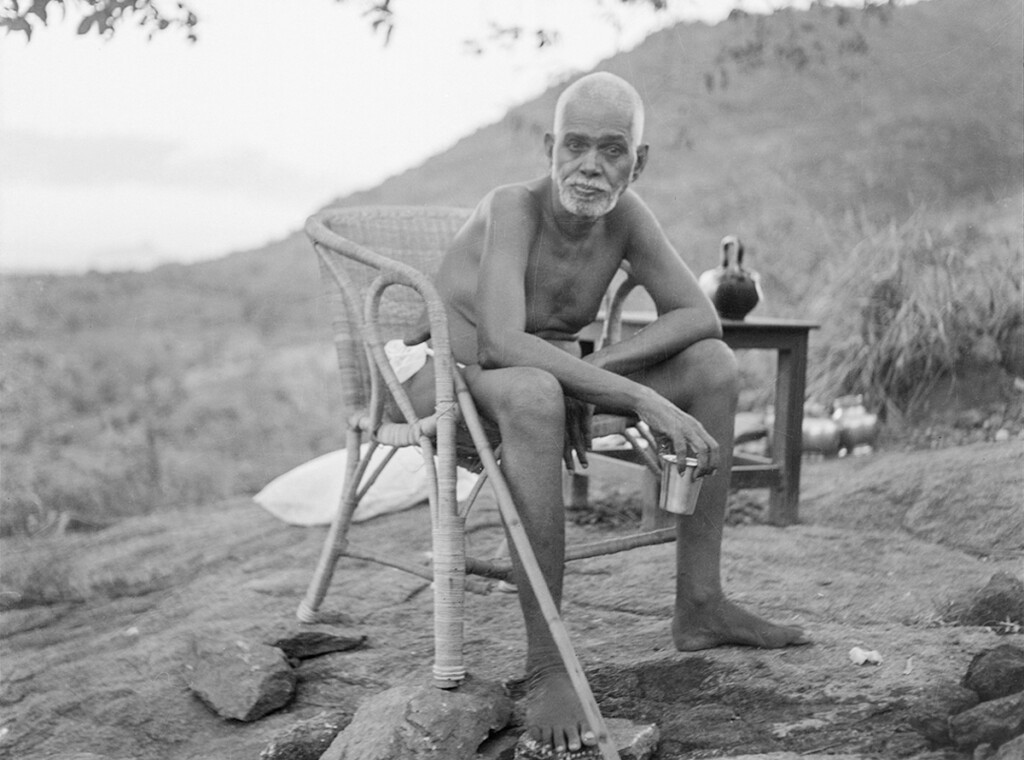
You have been given an answer before. You nod. The explanation was thorough, the logic was airtight, and something in you quietly registered that the question you originally brought has not moved an inch. The answer filled the room and left the original ache exactly where it was.
Adi Shankaracharya understood, somewhere around 788 CE, that the deepest error a human being makes is not moral but ontological — the confusion of the conditioned self with the ground of awareness itself. His Advaita Vedanta, elaborated across the Brahmasutra Bhashya and the Vivekachudamani, constructed one of the most formidable philosophical architectures in recorded thought: maya as the veil of superimposition, Brahman as the sole reality, the individual self as nothing more than a reflective illusion mistaking itself for its source. It is a complete system. It has premises, proofs, a technical vocabulary, and a hierarchical pedagogy designed to move the student from ignorance to understanding through graduated stages of reasoning. It is, in every formal sense, philosophy doing what philosophy does — building a structure rigorous enough to survive attack.
Ramana dismantled none of this. He simply declined to enter the building. What he offered instead was not a counter-argument, not a rival system, not even a simplified version — it was a single question returned to the questioner like a mirror held too close to avoid. “Who asks?” Not as rhetoric. Not as Socratic provocation designed to expose ignorance before replacing it with knowledge. As a genuine terminus. The question was not meant to precede an answer; it was meant to exhaust the questioner’s confidence that there is a someone doing the asking in the first place.
Ludwig Wittgenstein, working from an entirely different civilizational position in his Philosophical Investigations of 1953, arrived at something structurally cognate when he argued that most philosophical problems are not solved but dissolved — that they arise not from the world’s complexity but from language running against the boundaries of its own use, generating pseudo-questions that feel profound precisely because they cannot be answered. “A philosophical problem,” he wrote, “has the form: I don’t know my way about.” The therapy he proposed was not a new map but the patient attention to how the old maps had been misread. He was not building a doctrine. He was watching what happened when a concept was used correctly, and then watching what happened when it was used in the dark.
Ramana’s refusal of system is not, in this light, the position of someone who lacked the intellectual equipment to construct one. He had read the Vedantic canon with precision; he could discuss Shankara with technical fluency when pressed. The refusal was diagnostic. A system, however brilliant, addresses the questioner as someone capable of receiving an answer — it presupposes that the problem is one of missing information. The “Who am I?” inquiry does not presuppose this. It presupposes instead that the one who feels uninformed is itself the confusion being investigated. To hand that person a doctrine is to hand them another possession when the problem is precisely their relationship to possessing.
This places Ramana in a stranger position than either the traditional Advaitin or the Western analytic philosopher: he is not anti-intellectual, but he has located the point at which intellect begins to function as a defense mechanism rather than a tool. Every system, including Shankara’s, can be memorized. Memorization can be mistaken for understanding. Understanding can be mistaken for realization. Each step of the ladder feels like progress while the distance from the ground remains unchanged. What cannot be memorized, stockpiled, or intellectually rehearsed is the moment the question turns back on itself and finds no one standing there to receive the answer — because that moment does not belong to a system.
It belongs, if it belongs anywhere, to the silence that follows when a very good question has finally been taken seriously enough to stop waiting for a reply.
What the West Heard and What It Missed
You encounter the teaching for the first time the way most Westerners did — through a book with a soft cover and a photograph of a man sitting in perfect stillness, and you tell yourself you are ready for whatever it contains. What you are actually ready for is a version of it that has already been pre-digested, pre-softened, and routed through a century of translation errors that were never linguistic.
Carl Jung engaged Ramana Maharshi’s existence directly in his 1944 commentary appended to the German edition of Heinrich Zimmer’s “Der Weg zum Selbst,” and the engagement is instructive precisely where it fails. Jung acknowledged Ramana as a genuine phenomenon, a man who had arrived at something rare and real. Then he pivoted, with characteristic elegance, to the argument that the Eastern path of Self-inquiry was not available to Westerners, whose psychological work still required them to build and consolidate a stable ego before any dissolution could be safely attempted. The argument sounds reasonable. It sounds, in fact, like wisdom. What it performs, without naming itself as such, is the subordination of the destination to the traveler’s comfort — a philosophical maneuver that converts the teaching from a diagnosis into a prescription, from a fire into a warming lamp. Jung’s framework of individuation, developed across works like “Psychological Types” and “Aion,” presupposes that the self being integrated is real and worth integrating. The entire architecture of his thought depends on that premise. Ramana’s central inquiry did not challenge the process of integration. It challenged the reality of the one integrating. These are not compatible positions sitting at different ends of a spectrum. They are mutually exclusive starting points.
The mistranslation that Jung inaugurated with scholarly gravity was then democratized by the countercultural movements of the 1960s, which inherited the photograph without the fire behind it. When figures like Alan Watts circulated Eastern non-dual thought through lecture circuits and paperback books — Watts published “Psychotherapy East and West” in 1961 — the teaching arrived in living rooms already wearing the costume of psychological liberation. The Self became a deeper, truer version of the personal self. Awakening became a more authentic form of becoming. The Maharshi’s instruction to ask “Who am I?” was received as an invitation to discover a richer interior landscape, when the instruction’s actual pressure was toward the collapse of the assumption that there was an interior at all, or a person standing inside it doing the discovering. Thousands of seekers made the journey to India not to be annihilated but to be completed, which is perhaps the most resilient defense the ego has ever produced: it learns to use the weapon aimed at it as a tool for its own fortification.
What made the teaching genuinely dangerous in its original context was not its content but its proximity — the fact that Ramana himself sat in the hall and his presence operated on something prior to understanding. Paul Brunton, whose 1934 “A Search in Secret India” introduced Ramana to the widest Western audience of his era, described experiences of mental suspension in Ramana’s company that he could not account for through any model he possessed. Brunton was a journalist and popularizer, not a philosopher, and his honesty about his own inadequacy is, ironically, more accurate than Jung’s confident framework. He did not know what had happened to him. That not-knowing was the closest the Western record came to touching what the teaching actually was.
The self-help industry that metastasized across the last four decades of the twentieth century and into the present did not distort the teaching because it was cynical. It distorted it because the teaching, as a commodity, had to produce a consumer who would return. Dissolution doesn’t return. It has nowhere to go back to.
The Body That Stayed
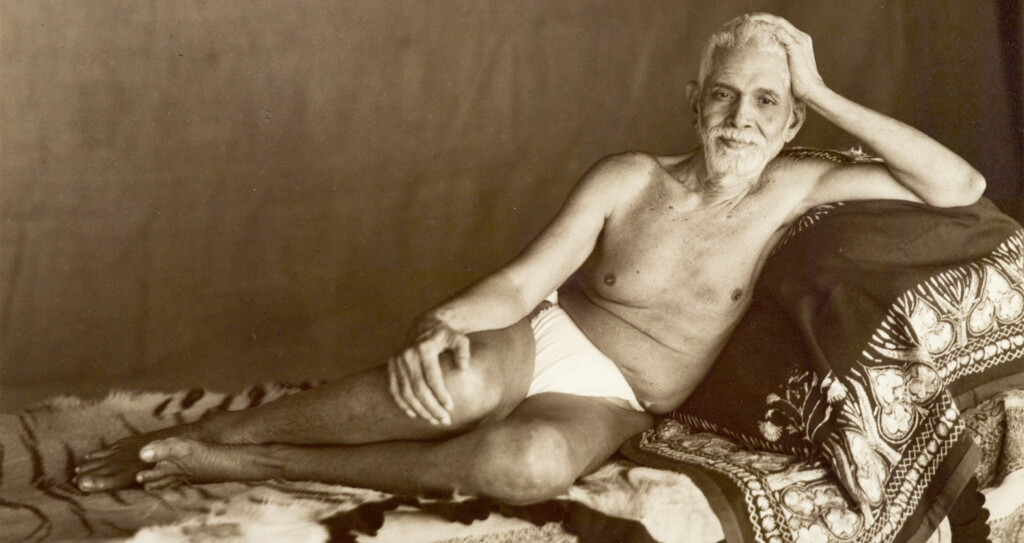
You are sitting across from a man who has not moved from the same hill in fifty years, and he is asking you, gently, what it is you came here looking for — and the question lands not as wisdom but as embarrassment, because you realize you brought your suffering dressed up as a quest.
Ramana Maharshi died on the fourteenth of April, 1950, of sarcoma, a cancer that consumed his left arm in stages over the final years of his life. Surgeons operated four times. The tumor returned each time, larger. Devotees wept. They begged him to heal himself, to use whatever interior power they were certain he possessed, and he looked at them with what witnesses consistently described as amusement — not cruelty, not detachment in the cold sense, but something closer to the expression of a person watching others panic over weather. He told them there was nothing to be concerned about, and he meant it in a way that had nothing to do with bravery.
The cultural machinery surrounding holy men in every tradition runs on a very specific fuel: the expectation that transcendence announces itself through renunciation made visible. The shaved head, the skeletal frame, the refusal of comfort, the performance of indifference to the body — these are not spiritual realities but theatrical conventions, and they serve a precise social function. They allow the observer to locate the sacred at a safe distance, to treat it as a category that applies to exceptional bodies in exceptional circumstances, and therefore to exempt their own ordinary life from any serious reckoning. The saint suffers spectacularly so that you do not have to ask what you are doing with your Tuesday afternoon.
Ramana broke this contract entirely. He lived at Ramanasramam in a room where anyone could walk in. He ate what was cooked for the ashram community, no more and no less, and became visibly upset on the rare occasions when food was prepared separately for him. Paul Brunton, who traveled to Tiruvannamalai in 1931 and documented his encounter in A Search in Secret India, arrived expecting someone theatrical — and found a man sitting quietly who seemed entirely uninterested in being found. The ordinariness was not a pose. It was the content.
What disturbs about this is not its gentleness but its implication. If the body is neither an obstacle to be punished nor a temple to be worshipped but simply the current shape of experience, then the entire architecture of self-improvement — the diets, the disciplines, the programs of transformation, the industries built on the premise that you need to become something other than what you are — rests on a misunderstanding so foundational it becomes uncomfortable to examine. The philosopher and physician Georg Groddeck wrote in 1923 in The Book of the It that the body thinks, and that the ego’s belief in its own governance is a fiction the body tolerates. Ramana arrived at something structurally similar from an entirely different direction: not through medicine but through the simple, devastating question of who, exactly, it is that claims to be suffering.
The cancer moved through his body and he continued giving darshan, answering questions, watching squirrels. When devotees said they could not bear to see him in pain, he replied that the pain was in the body, and that they should ask who it was that was watching the body. He was not performing equanimity. He was pointing at something that the performance of equanimity deliberately obscures — that the witness of experience is not improved by the experience being pleasant, and is not diminished by its being brutal. He remained completely himself until the moment he was not, and the ordinariness of that continuity is the most unsettling teaching he ever offered, precisely because it requires nothing of you except the willingness to stop looking away from what is already here.
🕉️ Paths of the Self: Mysticism, Silence, and Inner Truth
Ramana Maharshi’s radical inquiry into the nature of the Self — ‘Who am I?’ — places his teachings at the crossroads of mystical philosophy, contemplative practice, and the perennial search for liberation. The following articles explore kindred territories: the dissolution of ego, the architecture of inner transformation, and the traditions that have mapped the invisible landscapes of consciousness.
Meister Eckhart: Life and Mystical Philosophy
Meister Eckhart, the 14th-century Dominican mystic, developed a philosophy of radical detachment that strikes a deep resonance with Ramana Maharshi’s teaching of Self-inquiry. For both thinkers, the highest truth is not reached through accumulation of knowledge but through the stripping away of the ego until pure awareness alone remains. Eckhart’s concept of the ‘ground of the soul’ mirrors Maharshi’s Atman — the silent, luminous core that was never born and never dies.
GO TO THE SELECTION: Meister Eckhart: Life and Mystical Philosophy
Medieval Mysticism: History and Main Figures
Medieval mysticism produced a constellation of figures — from Hildegard of Bingen to Julian of Norwich — who sought direct experiential union with the divine, bypassing dogma and institutional religion. Their inner journeys share a structural kinship with the Advaita Vedanta path articulated by Ramana Maharshi, where silence and surrender become the supreme method. This article traces the rich history and varied forms of contemplative experience across the Christian mystical tradition.
GO TO THE SELECTION: Medieval Mysticism: History and Main Figures
Jiddu Krishnamurti: the Man Who Refused to Be God
Jiddu Krishnamurti, like Ramana Maharshi, dismantled the very framework of spiritual seeking by insisting that no teacher, no path, and no system could deliver the liberation the seeker already was. His radical negation of authority — including the authority projected onto himself — echoes Maharshi’s pointing finger: the questioner and the answer are not two. Together, these two towering figures of 20th-century spirituality invite us to question the very one who is searching.
GO TO THE SELECTION: Jiddu Krishnamurti: the Man Who Refused to Be God
Universal Consciousness
The concept of Universal Consciousness stands at the philosophical heart of Ramana Maharshi’s vision: the individual self, upon deep inquiry, is revealed to be nothing other than the one undivided Awareness that underlies all existence. This article explores how this idea has resonated across Eastern and Western thought, from Vedanta to quantum physics, from mysticism to contemporary philosophy of mind. Understanding this concept deepens the encounter with Maharshi’s core teaching that the Self alone is real.
GO TO THE SELECTION: Universal Consciousness
Cinema as a Mirror of the Soul
If these explorations of consciousness, silence, and the inner life have stirred something in you, Indiecinema streaming is where that journey continues on screen. Discover independent and spiritual films that dare to ask the same questions Ramana Maharshi asked — and let cinema become its own form of self-inquiry.
👉 EXPLORE THE CATALOG: Watch Indie Films in Streaming
A vision curated by a filmmaker, not an algorithm
In this video I explain our vision

