
The Shore You Keep Returning To
You are standing at a door you have stood at a thousand times before, and something is wrong. Not with the door — the door is exactly as you left it, the same slight warp in the wood, the same paint flaking at the lower corner where winter kept getting in. What is wrong is the scale of the thing. It is smaller than memory insists it should be, and that smallness carries a particular cruelty, because you did not travel all this way to find a reduced version of something you had made enormous inside yourself. You touch the handle. You do not go in immediately. You stand there in the precise gap between what you carried with you all the years away and what is actually in front of you, and you understand, in a way no one warned you about, that the return you imagined was never really about the place.

This is the oldest story the Western tradition knows how to tell. Not the voyage out, not the monster, not the seduction of the foreign shore — the oldest story is the one about coming back, and why coming back is the most violent act a human being can perform on themselves. Homer’s Odyssey, composed in oral tradition sometime in the eighth century BCE and recorded in the Greek that schoolchildren have been forced to mangle for two and a half millennia, is not fundamentally a poem about adventure. It is a poem about the terror of homecoming, and the Greeks had a word for it that we have never adequately replaced: nostos. Not nostalgia, which is a sentimental dilution invented by the Swiss physician Johannes Hofer in 1688 to describe a medical condition in soldiers who could not stop weeping for home. Nostos is something older and more dangerous — the return itself, the act of coming back, and all the destruction that act necessarily carries with it.
Odysseus spends ten years fighting at Troy and another ten years trying to get home, and the poem’s brutal irony is that the homecoming, when it finally arrives, requires as much blood as the war did. He slaughters the suitors occupying his house, he tests his own wife before revealing himself, he is unrecognized by nearly everyone who once knew him. The Greek text lingers on these misrecognitions with an attention that is almost clinical. His dog Argos recognizes him and immediately dies, as if the recognition itself is fatal — as if the old world cannot survive contact with the man who left it. This is not incidental drama. It is the poem’s central argument: that the self who departed and the self who returns are not the same person, and the gap between them is not something that can be closed by sentiment or willpower or the mere fact of physical presence on familiar ground.
What Homer understood, and what most cultures built on top of his work have systematically tried to forget, is that the longing to return is not a longing for a place. It is a longing for a version of yourself that no longer exists. You are not trying to go home. You are trying to go back to the person you were when that place still had the power to make you feel whole, and that person is gone in the same irreversible way that childhood is gone — not dead exactly, but inaccessible, sealed off behind a door that looks identical to the one in front of you but opens onto nothing you can actually enter. The Odyssey spends nearly twelve thousand lines circling this wound without ever pretending it can be healed. That is not a failure of resolution. That is the most honest thing literature has ever done with the human compulsion to return to what we have already, irrevocably, left behind.
The Kempinsky Method

Drama, by Federico Salsano, Italy 2020.
The introspective imaginary road movie of a man in the maze of his own mind, his memories of his youth, his never dormant passions and contradictory truths. The road is made of water, the destination is falsely unknown. His traveling companions are three mysterious men, projections of his imagination and of different aspects of his personality: the perennial melancholy, the crazy creative, the introverted child. He is also followed by a female presence that tells the umpteenth human story. At a certain point of the crossing he decides to abandon the boat and his ghosts of him diving into the sea and arrives swimming on a deserted beach, naked, with a small Pinocchio puppet closed by a padlock.
In this splendid film life is like a long sea voyage and the human being is a small creature confronting immensity. Sometimes the ocean is calm, other times there are terrible storms. Sometimes we are captains of a boat with a well-defined route, other times we are shipwrecked in search of a land in which to save ourselves. But despite the long journey and the movement in physical space, there are other questions that resonate in the mind: who are these men I travel with? What is the mystery of this immense mass of water that seems to be made of my memories? You can circumnavigate the whole world but the main question always remains the same: who am I really?
LANGUAGE: italian
SUBTITLES: english, spanish, portuguese, german, french
Nostos as a Greek Obsession, Not a Universal Gift
You are standing at the edge of a harbor that smells of salt and rotting wood, watching a man who has not slept in what feels like years stare at water that refuses to be still. He does not look triumphant. He looks like someone who has forgotten the grammar of ordinary life — how to sit at a table, how to speak without calculating the exit, how to want something that isn’t survival. The war made him fluent in a language that his home country does not speak, and now the sea stretches between him and the place where that language will become a liability.
The Greeks had a word for this passage, and they meant it as an honor: nostos, the homecoming, the return voyage that completes the warrior’s arc and restores him to the world that sent him out. But Gregory Nagy, in his foundational work on Homeric oral tradition, has argued something that quietly detonates this reading. In “The Best of the Achaeans,” published in 1979, Nagy demonstrates that nostos is not separable from kleos, the glory of a warrior’s renown, and that these two values pull against each other with a structural ferocity the text never fully resolves. Kleos is what the dead accumulate — the undying fame that survives the man, the story told in his absence. Nostos is what the living pursue — the physical return, the body arriving back in the house where it began. The man who achieves one necessarily risks the other. Achilles is given the choice explicitly: a short life of incomparable glory, or a long life of ordinary return. He chooses kleos, and Homer’s Iliad is the monument to that choice. Odysseus makes the opposite bet, and the Odyssey is what that bet costs him across ten years and every form of humiliation the Mediterranean can manufacture.
What this means is that nostos was never a universal human instinct dressed in Greek clothing. It was a culturally specific, militarized ideal, shaped by a society that organized masculine identity almost entirely around the axis of war and the return from war. The archetype of the returning hero was not a natural emotional truth that the Greeks happened to articulate — it was a technology of meaning designed to make the veteran’s trauma legible, to insert his broken re-entry into a narrative frame large enough to absorb it without producing questions the community couldn’t answer. The return voyage gave the suffering a plot. The plot made the suffering bearable. And the culture that produced the plot also produced the war that made the suffering necessary in the first place.
This is where the concept begins to reveal its internal fault lines. Nostos in the Odyssey is never described as a simple desire to go home in the way one desires warmth or food. It is an obligation tethered to honor, witnessed by gods, measured by the community waiting on the other shore. Penelope weaves and unravels not out of love alone but because the entire social order of Ithaca is suspended in the space of Odysseus’s absence. His return is not personal resolution — it is political restoration. The household, the oikos, cannot function without the patriarch at its center, and the suitors who occupy his hall are not merely romantic rivals but symptoms of a sovereignty vacuum that the community experiences as existential threat. His nostos is therefore not his own. It belongs, structurally, to everyone who needs the order he represents to reassert itself.
Which means that from the very beginning, the homecoming was never really about coming home. It was about reinstalling a system. The man at the center of that system had already been changed beyond recognition by the decade that made his return necessary, and no one waiting on the shore had been given a word for what that change actually looked like from the inside.

Odysseus Was Never the Hero You Were Sold
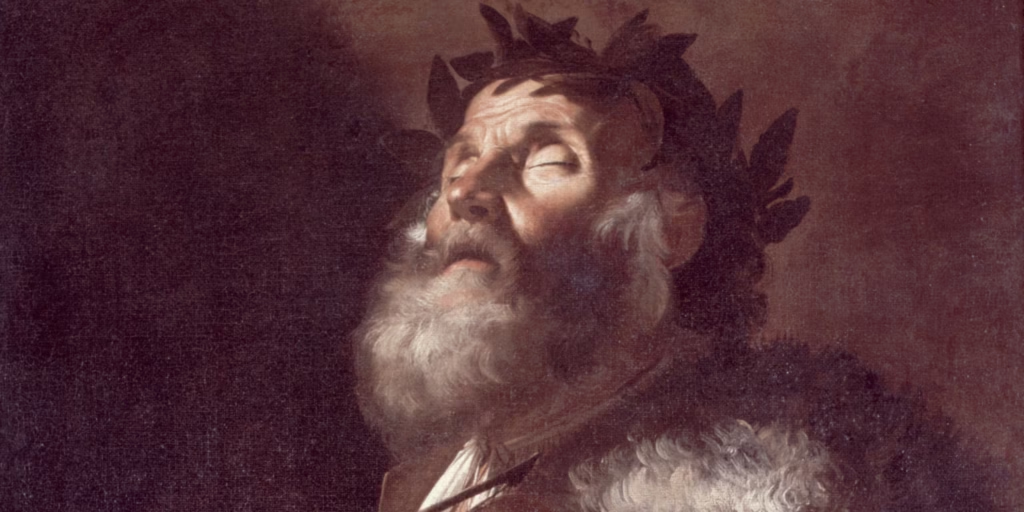
You already know what you did with the story. You heard the word hero and you filled in the shape before the sentence finished — loyal, clever, enduring, homeward. You gave Odysseus the face of someone who deserved to return.
Pietro Pucci, writing in 1987 in his study Odysseus Polutropos, performs an act of radical philological honesty that most popular retellings have quietly refused to inherit. The title itself is the wound. Polutropos, the epithet that opens the Odyssey in its very first line, does not mean resourceful in any clean or admirable sense. It means, with full etymological weight, the man of many turns — a creature of perpetual deflection, of language that bends back on itself, of identity that shifts according to what the moment demands. Pucci reads this not as heroic adaptability but as a constitutive instability, a self that is defined by its own opacity, including to itself. Odysseus lies to everyone in the poem. He lies to Athena, who appreciates him for it. He lies to Eumaeus, his loyal swineherd, while accepting his hospitality. He constructs elaborate false biographies so persuasive, so detailed, that they begin to read less like tactical fictions and more like alternative selves he auditions and abandons. The man who returns to Ithaca is not a man who survived the journey intact. He is a man who survived by becoming someone else so many times that the original is no longer verifiable.
What the romanticized reading systematically refuses to examine is the arithmetic of his wandering. Ten years of war. Ten more years of return across a journey whose geography, even in antiquity, scholars recognized as deliberately non-cartographic — these are not real places you could sail to, they are the topography of avoidance. Calypso offers him immortality and he claims he refuses out of love for Penelope, yet he spends seven years in her bed on Ogygia. Seven. The text does not explain this gap with suffering or imprisonment alone. Homer gives us a man sitting on a shore weeping toward the horizon, and then gives us seven years of nights inside the goddess’s cave. The poem holds both truths simultaneously without resolving them, which is precisely what the sanitized version of Odysseus cannot afford to do.
The Sirens episode is almost too precise in its symbolism to bear honest scrutiny. Odysseus has himself tied to the mast not because he fears death but because he wants to hear the song and survive it — to have the experience without the consequence. This is not courage. It is the posture of a man who has learned to structure his desires so that accountability is always technically someone else’s problem. He hears what the Sirens actually sing, which is not seduction but knowledge, the promise that they know everything that happened at Troy, that they can give him the complete story of his own life. He wants that. He wants to be told who he was. And then he sails past.
There is a particular kind of person who constructs their life as a series of near-escapes and delays, who is always almost home, always on the verge of the reckoning they keep deferring with the next adventure, the next island, the next compelling detour that arrives with just enough moral cover to justify the extension. The Odyssey does not celebrate this. It documents it with the uncomfortable precision of a text that has been mistaken for propaganda when it was always closer to a case file. Penelope waits twenty years. Telemachus grows up fatherless. Laertes, Odysseus’s father, is found at the end of the poem living in filth on a farm, having wasted into grief. The cost of the hero’s journey is almost entirely paid by people who were not consulted about the itinerary.
What does it mean to spend three thousand years calling this man the model of return?
The Nineteen-Year Lie We Call Loyalty
You have read this story as a love story. A man pines for home, for his wife, for the smoke rising from his own hearth — and across ten years of wandering he holds his shape, stays himself, refuses to be dissolved by the world’s seductions. That is the version you received. But sit with the actual text for a moment, not the myth of the text, and something begins to shift. Odysseus spends seven years on Ogygia not as a prisoner in any meaningful physical sense but as a lover, sharing Calypso’s bed each night, eating, sleeping, living in a grotto furnished with cedar and sweet-smelling cypress while a fire burned at the hearth. Homer tells us he wept during the days, looking out to sea. He also tells us, without apparent contradiction, that he returned to her bed each night willingly. Seven years is not a layover. It is a life. The weeping was real, and the sleeping was real, and the poem holds both without flinching — but its readers have consistently chosen which detail to keep.
The selective memory applied to Odysseus is not a modern phenomenon. Edith Hall, in her 2008 work The Return of Ulysses: A Cultural History of Homer’s Odyssey, traces how Western tradition has systematically edited the poem’s moral texture, elevating the homecoming narrative while suppressing its uglier arithmetic. Circe is another year. The Phaeacians are indulgence, feasting, athletic games, a princess who barely conceals her attraction to the stranger. The poem accounts for roughly two decades of absence, and what fills that time is not suffering endured in darkness but experience — enormous, sensual, world-expanding experience — that Penelope, locked in a house in Ithaca, surrounded by men eating her resources and threatening her son, was never offered. The asymmetry is not incidental to the story. It is the story’s skeleton.
What returns to Ithaca is not the same man who left, and the poem knows this even if the reunion scene tries to paper over it. Odysseus arrives in disguise, watches, tests, and finally reveals himself through an act of mass violence so precise it reads less like a homecoming than an occupation. One hundred and eight suitors are killed. The killing is celebrated as justice. But consider what follows in Book 22, in a passage that rarely makes it into popular retellings: twelve slave women who had slept with the suitors — women who had no legal personhood, no capacity to refuse men who had commandeered the household for years — are hanged on Odysseus’s orders. Not killed cleanly. Hanged, so that, as Homer writes, their feet twitched for a little while and then were still. They are punished for surviving under conditions that offered them no alternative. Odysseus, who spent years in the beds of goddesses, returns home to execute women for the same flexibility he exercised freely across half the Mediterranean.
The moral architecture does not merely wobble here. It reveals its actual foundation: loyalty is a demand made of those with nowhere else to go. Penelope’s fidelity is not celebrated because fidelity is a virtue; it is celebrated because a man needed to know his property was intact when he came back to claim it. The entire emotional force of nostos — the longing, the endurance, the tears on the shore — depends on something remaining fixed while one person moves. Someone has to be the place that waits. Someone has to be Ithaca. And the poem, for all its beauty, never asks whether that person had longings of her own that deserved a ship and a sea and nineteen years of risk and discovery.
What the tradition calls loyalty, the text, read without mercy, reveals as a system of unequal exposure — one body freed to wander through the full catastrophe of living, another body required to hold still and call the waiting devotion.
What Psychoanalysis Did With the Journey
You are sitting in a therapist’s office, or a weekend workshop, or halfway through a book with a matte cover and a compass rose on the front, and someone is telling you that you are the hero of your own journey. The sentence lands with the warmth of recognition. It feels ancient, as if it has always been true, as if the Greeks themselves leaned across the centuries to whisper it specifically to you.
What actually happened is considerably less flattering. In 1951, Carl Jung published Aion, a dense and frequently punishing work on the phenomenology of the self, in which the hero’s mythological descent and return became a structural metaphor for what he called individuation — the process by which the psyche integrates its shadow material, reconciles its opposites, and achieves something like wholeness. Jung was drawing on a genuine clinical intuition: that suffering reorganizes the interior life, that the person who emerges from a crisis is not the same as the one who entered it. This was not a trivial observation. But it was also an interpretation, a frame placed over material that was never asking to be a diagram of psychological development.
Joseph Campbell absorbed this framework and in 1949, with The Hero with a Thousand Faces, performed one of the most consequential acts of intellectual smoothing in the twentieth century. He identified the monomyth — the departure, the initiation, the return — across hundreds of narratives from dozens of cultures, and concluded that they all expressed the same deep grammar of the human soul. The breadth was genuinely staggering. The cost was invisibility. By arguing that every hero’s journey said the same thing, Campbell dissolved the specificity of each one, including the Odyssey, into a single universal template that could be lifted out of any context and applied to any life. The original Greek nostos, with its cargo of Bronze Age obligation, its gods who intervene arbitrarily and sometimes maliciously, its homecoming soaked in the blood of one hundred and eight men slaughtered in a dining hall, became an abstraction about self-actualization.
What was lost in that translation is not a minor footnote. The violence of the Odyssey is not decorative. It is the point. Odysseus does not return transformed by introspection; he returns as a killing machine who strings a bow no one else can draw and systematically executes the men who ate his food and slept under his roof. The suitors are not symbolic antagonists representing the ego’s resistance to growth. They are young men from prominent families who made a social miscalculation about a property dispute, and they die with arrows in their throats while begging. There is no integration. There is domination, reasserted with extreme and deliberate brutality. The ancient audience understood this as the restoration of a cosmic and social order, not as the completion of a self.
The psychological model required the arc to end in healing, which meant it required the violence to be metaphor. Once violence becomes metaphor, it stops being violence. And once it stops being violence, the culture that produced it stops being answerable for what it valued. The Iliad and the Odyssey were not cautionary tales about the cost of war dressed up in adventure. They were the founding documents of an aristocratic warrior civilization that considered the capacity for organized killing a primary social virtue. The hero’s suffering was real, but it was not redemptive in any modern therapeutic sense — it was the price paid for glory, and glory was worth the price.
A vision curated by a filmmaker, not an algorithm
In this video I explain our vision
The Cultural Industry of Return

At an airport departure gate, a soldier adjusts his beret in the reflection of a glass partition while his wife repositions their youngest child on her hip for the third time. Someone has already raised a phone. The photograph is not waiting for him to come back — it is being taken now, before the plane has even boarded, because the return is not an event that will happen but a narrative that must be seeded in advance. The homecoming already exists as a story before the absence has been lived. What is being produced in that moment is not a memory of reunion but a template, a script into which the actual return will later be required to fit.
Paul Connerton, writing in 1989, made an argument that most people find uncomfortable precisely because it is so precise: societies do not remember spontaneously, they perform memory through ceremonies and bodily habits that are taught, rehearsed, and enforced. His How Societies Remember demonstrated that commemorative rites are never innocent reproductions of the past — they are active constructions that shape what the past is allowed to mean. The soldier’s family at the gate is not expressing feeling. They are participating in a ceremony that precedes them by decades, if not centuries, in which the return of the warrior requires a specific cast, a specific arrangement of bodies, a specific emotional register. The grief of departure and the joy of return are not felt first and then expressed — they are prescribed, and the feeling follows the prescription.
This is not cynicism. It is the more disturbing possibility that most of what we experience as deeply personal emotional life is in fact a rehearsal of inherited choreography. The soldier does not know he is performing. Neither does his wife. The sincerity is total and that is exactly what makes Connerton’s observation so difficult to dismiss — the script does not require awareness of itself to function. It only requires participants willing to take their places, and there is no shortage of those, because the alternative is to stand outside the ceremony entirely, which carries its own form of social death.
Homer understood something close to this, even if his vocabulary was different. The Odyssey is obsessed not only with return but with recognition — anagnorisis, the moment when the returned one is identified by those who stayed. Odysseus does not simply arrive home; he is tested, disguised, gradually revealed through a sequence of recognitions so elaborately staged that they read less like homecoming and more like theater. The disguise he wears is not merely tactical. It allows the recognitions to occur in the correct order, to the correct audience, with the correct emotional weight. He is managing his own return as a dramatic production, ensuring that each witness receives the revelation at the moment of maximum effect. What the poem presents as a hero’s cunning is also a performance of reintegration, a social ceremony dressed in the language of adventure.
The cultural industry around military return, around the prodigal child, around the emigrant who comes back after years, has industrialized this ceremony without changing its essential structure. It has added cameras, news segments, stadium reunions with synchronized music, and viral videos in which children are surprised by fathers emerging from behind classroom doors. What these productions share is the insistence that the return confirm something — the value of the one who left, the fidelity of those who waited, the coherence of a family or a nation that absence threatened to dissolve. The return is not allowed to be ambiguous. It is not allowed to arrive carrying damage, estrangement, the irreconcilable changes that time enacts on bodies and attachments. The ceremony forecloses all of that before the door even opens.
What no photograph at the departure gate can prepare anyone for is the silence that falls on the third evening, when the ceremony is over and two people who have been living entirely different lives sit across a table and discover they have no common language for what they have each become.
Home as a Weapon of Stasis
You come back after years away and someone who knew you before looks at you with that particular expression — not quite recognition, not quite disappointment — as if they are comparing two photographs and finding the second one unconvincing. What they want is continuity. What they are actually demanding is your surrender to the person you were before you left, before you were changed by everything the road did to you. The return, in this moment, reveals itself as a kind of tribunal.
This is not incidental to the myth of the wanderer coming home. It is the myth’s hidden machinery. The story of Odysseus reaching Ithaca after twenty years is also a story about whether a man’s identity can survive radical discontinuity — and whether, if it cannot, the community will accept the difference. The answer Homer gives is structurally conservative: Odysseus must prove himself through the trial of the bow, must reassert his claim to wife, bed, and throne. The return is validated by the restoration of hierarchy. The wanderer earns his home by demonstrating that the wanderer has, in the deepest sense, ceased to exist.
Simone Weil, writing in London in 1943 while the Europe she had fled was consuming itself, articulated something that tears open this logic. In The Need for Roots, she argued that rootedness is among the most important and most neglected of all human needs — but she was precise, even ruthless, about what this means. To be rooted is not to be comfortable. It is to be in genuine, living contact with a particular community, a particular past, a particular set of obligations. The key word is obligations. Not rights. Not entitlements. Obligations. Weil was describing something that costs. And because it costs, it can be leveraged.
The history of the word home in political language is a history of exactly this leverage. European nationalism throughout the nineteenth century built its most durable emotional architecture on the premise that belonging to a place was a form of essence — that to be truly of a land was to be a particular kind of person, with particular loyalties, speaking a particular language, worshipping in a particular building. Ernest Renan’s 1882 lecture “What Is a Nation?” at the Sorbonne tried to resist this by arguing that the nation is a daily plebiscite, a constant act of collective will rather than a fixed inheritance. It was a sophisticated argument and it lost, practically everywhere, to the blood-and-soil alternative, because blood and soil do not require the exhausting work of continuous consent.
What gets suppressed in the myth of return, then, is not just the wanderer’s transformation. It is the transformation of the place itself. Ithaca changed. Penelope changed. The suitors are not an interruption to the natural order — they are evidence that social structures do not hold themselves in suspension waiting for the patriarch to return. The fantasy of the frozen household, of the wife who has not moved on, of the throne that has remained legitimately vacant, is a fantasy of social stasis dressed as loyalty. Odysseus comes home not to reconnect with a living community but to re-impose an order that the community had been, in his absence, slowly dismantling.
This is where the myth becomes indistinguishable from ideology. The displaced are told to hold on, to endure, to keep faith with the idea of return, because return will restore everything. The refugees of the twentieth century — and there were tens of millions of them between 1914 and 1950 alone, catalogued with bureaucratic horror in the League of Nations records — were frequently managed through precisely this promise. Stay oriented toward home. Do not adapt too completely. Do not become something else. The myth that was supposed to sustain them also suspended them, kept them in a state of incompletion that served the political interests of those negotiating their fate at tables they were never invited to sit at.
The Shroud Penelope Never Finished
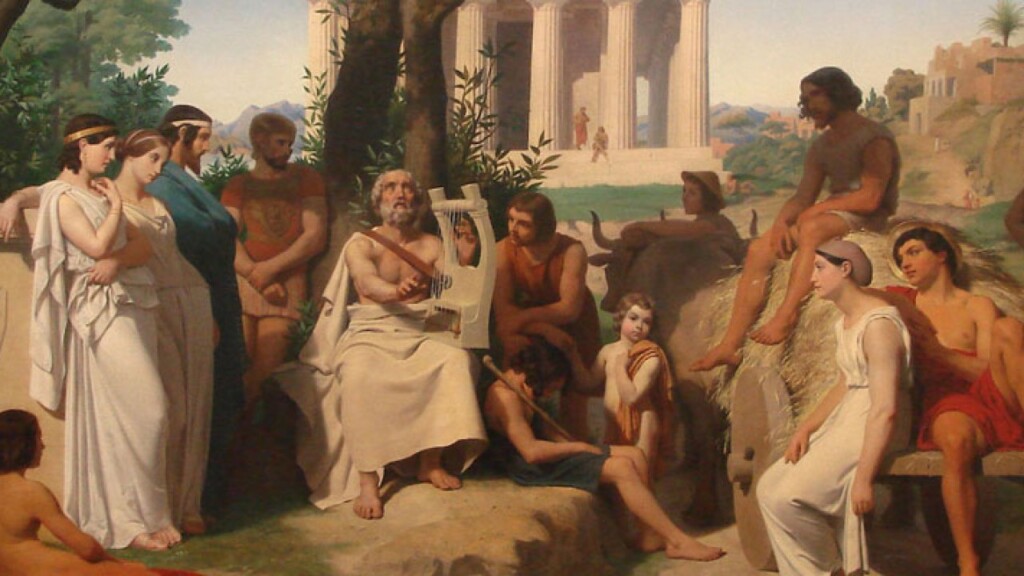
You have been waiting so long for something that you have quietly begun to suspect the waiting itself is the point — not the arrival, not the resolution, but the suspended state in which you are neither the person who left nor the person who will eventually have to answer for coming back.
Penelope understood this with a precision that the entire epic quietly refuses to reward. While Odysseus accumulated experiences, gods, shipwrecks, and seductions across ten years of wandering after ten years of war, she sat at a loom and performed an act that classical scholarship spent centuries misreading as loyalty. The shroud she wove for Laertes by day and unraveled by night, for three years before a servant betrayed her, was not a trick. It was a theory of existence that she had arrived at alone, without a Circe to instruct her, without a Tiresias to prophesy, without the patronage of Athena manifesting in disguise to tell her which direction to walk.
What the loom actually contained was a refusal to let completion become a trap. To finish the shroud was to eliminate the one condition that kept her sovereign over her own situation. The suitors waited for the shroud because they believed, as Odysseus believed, as the entire heroic tradition believed, that the end of a task constitutes a legitimate claim on whoever performed it. Finish the work and submit to the consequences. The logic is so deeply embedded in Western moral architecture that almost no one stops to ask whether it is actually just. The anthropologist David Graeber, in “Debt: The First 5,000 Years” published in 2011, spent four hundred pages demonstrating that the entire framework of obligation, completion, and repayment is a historical construction imposed through violence and then naturalized as common sense. Penelope, working in the dark of her room, had located the seam in that construction before political economy existed as a discipline.
There is a man sitting in an office somewhere right now who has been managing a project for two years, deliberately leaving the final report unfinished, not because he is lazy or afraid, but because he has understood, beneath the level of articulate thought, that the moment he submits it, his role becomes purely administrative and someone else inherits the creative authority he currently holds. He would not describe what he does as philosophy. He would probably call it procrastination and feel vaguely ashamed. But the structure of his behavior is identical to Penelope’s, and the difference is that she was conscious of it, which is what the epic cannot quite allow her to say out loud.
The philosopher Simone de Beauvoir argued in “The Second Sex” in 1949 that women under patriarchal structures are defined not by what they do but by what they wait for — condemned to immanence while men pursue transcendence. But this reading, however precise in its sociology, misses what Penelope had actually engineered. She did not wait passively. She built a machine for producing time, a device that generated the one resource she needed and that no suitor could manufacture or steal. The unraveling was not the negation of the weaving. It was the weaving continued by other means, which is a far more radical gesture than anything Odysseus achieved by surviving.
Odysseus returned with stories. He had been changed, certainly, worn by salt and grief and the specific exhaustion of someone who has had to reinvent himself too many times to trust any single version. But he returned in order to claim. The nostos was always oriented toward possession — the bed, the kingdom, the woman, the proof that he was still who he had been. Penelope had spent twenty years becoming someone for whom possession was no longer the organizing principle of identity, and the epic ends without finding a language adequate to what she had become in the process.
🌊 Wandering Souls: Myth, Return, and the Journey Home
Homer’s Odyssey is more than an epic voyage — it is the foundational myth of the human soul’s longing to return to itself. The articles gathered here explore the deep structures of myth, archetype, and cyclical time that echo through the Odyssean narrative across centuries of thought.
Eliade’s The Myth of the Eternal Return: Analysis
Mircea Eliade’s analysis of the eternal return illuminates how ancient cultures — including Homer’s world — conceived of time not as linear progress but as sacred repetition. The myth of nostos, the homecoming, resonates deeply with Eliade’s notion that return is not mere geography but a re-entry into primordial, meaningful time. Understanding this framework transforms the Odyssey from adventure story into a ritual of cosmic regeneration.
GO TO THE SELECTION: Eliade’s The Myth of the Eternal Return: Analysis
The Labyrinth of Knossos: History and Myth of the Minotaur
The Labyrinth of Knossos stands as one of the most powerful mythological settings in the Greek imagination, a space of disorientation, trial, and ultimate confrontation with the monstrous. Like Odysseus navigating monsters and enchantresses, Theseus must find his path through a constructed chaos before earning the right to return. The labyrinth thus becomes the archetypal image of the journey inward that precedes every true homecoming.
GO TO THE SELECTION: The Labyrinth of Knossos: History and Myth of the Minotaur
The Hero’s Journey as Inner Transformation
Joseph Campbell’s model of the hero’s journey finds its earliest and most complete expression in Homer’s Odyssey, where every departure, ordeal, and return carries the weight of inner transformation. This article explores how the heroic arc functions not merely as narrative structure but as a map of psychological and spiritual initiation. Odysseus’s return to Ithaca, stripped of illusions and tested to the core, exemplifies the hero reborn through suffering.
GO TO THE SELECTION: The Hero’s Journey as Inner Transformation
Mircea Eliade and the Myth of the Eternal Return
Eliade’s broader meditation on the myth of the eternal return provides the philosophical bedrock for understanding why nostos — the ache to return home — is never simply nostalgic but cosmologically charged. For Eliade, the return to origins is a re-creation of the self and the world, a sacred act that abolishes profane time. Homer’s Odysseus, in fighting his way back to Ithaca, enacts precisely this archetype of sacred re-integration.
GO TO THE SELECTION: Mircea Eliade and the Myth of the Eternal Return
Discover the Cinema of the Mythic Journey on Indiecinema
If the myth of return and the hero’s inner voyage stir something deep within you, Indiecinema’s streaming platform is your Ithaca. Explore a curated selection of independent films that dive into myth, identity, and the transformative power of the journey — stories that dare to ask who we truly are when we finally arrive home.
👉 EXPLORE THE CATALOG: Watch Indie Films in Streaming
A vision curated by a filmmaker, not an algorithm
In this video I explain our vision

