
The Threshold You Didn’t Choose
You didn’t see it coming, or you did and told yourself you were wrong. The email arrives on a Tuesday, or the person across the table stops meeting your eyes, or the doctor pauses in a way that doctors are trained not to pause, and something that had been solid — something you had built routines around, something you had mistaken for the permanent architecture of your life — simply stops being there. You are sitting in the same chair. The room has not changed. And yet the coordinates by which you had been navigating have quietly, irrevocably, shifted.

Nobody tells you that this is the beginning. The literature, the mythology, the self-help industry dressed in ancient metaphor — none of it prepares you for how unglamorous the threshold actually is. There is no cloak, no sword, no mentor arriving with cryptic instructions. There is a severance letter, or a door closing with terrible gentleness, or a number on a page that rearranges your understanding of how much time you have. The call to transformation does not come with a sense of calling. It comes with nausea.
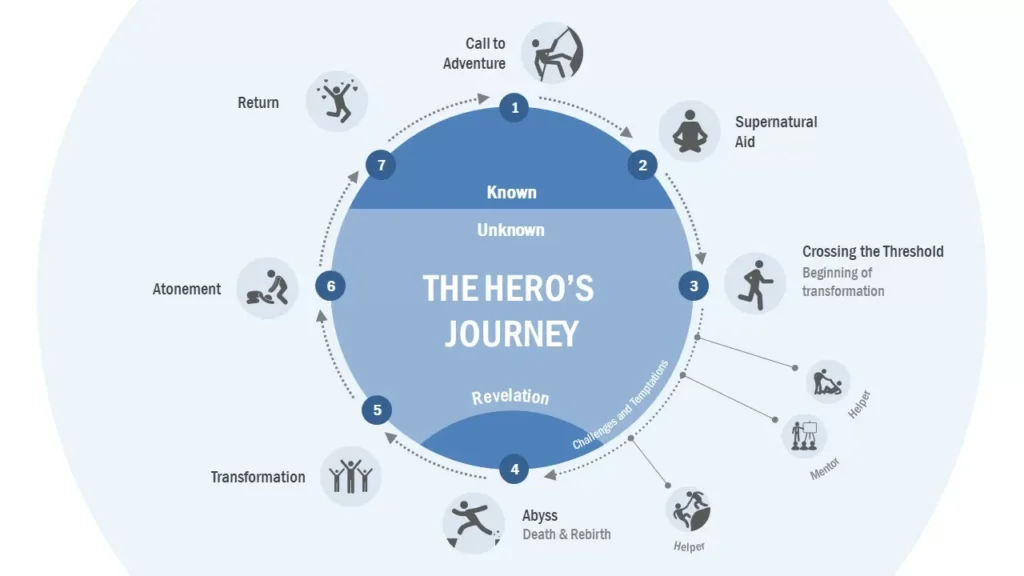
Joseph Campbell spent the better part of his scholarly life, from the 1940s through the publication of The Hero with a Thousand Faces in 1949, mapping the structural grammar beneath the world’s mythologies, and what he found was not a story about glory. It was a story about rupture. The hero’s journey begins not with the hero choosing adventure but with the world making choice impossible. The ordinary world becomes uninhabitable. Something is lost, something is taken, something dies. The departure is not a decision in the way we use that word — it is a condition, a pressure that mounts until remaining still costs more than moving into the unknown. Campbell’s monomyth is often flattened into a triumphalist arc, a template for screenwriting workshops and corporate keynote speeches, but its original weight is closer to grief than to ambition.
What Campbell intuited, and what the clinical literature has since measured, is that identity itself is largely a construction of continuity. The psychologist Dan McAdams, in his decades of research on narrative identity, demonstrated that people understand themselves primarily through the stories they can tell about their own lives — coherent, causally linked, directional. When a major loss event disrupts that narrative, the self does not merely feel threatened. It functionally destabilizes. The ground you were standing on was not ground; it was story. And when the story breaks, you fall through.
This is not metaphor. Studies on involuntary job loss conducted throughout the 1980s and 1990s revealed that unemployed individuals showed measurable disruptions in circadian rhythm, immune function, and cognitive performance — not simply because of financial pressure, but because the loss of a structured social role removes the temporal scaffolding around which selfhood is organized. You are not just without work. You are without the daily grammar that told you who you were. The collapse is ontological before it is practical.
And so the person standing at the threshold — which is not a threshold they chose, which looks nothing like a threshold in any mythological sense, which looks like a parking lot or a kitchen table or a waiting room with fluorescent lights — that person is not experiencing the romantic vertigo of departure. They are experiencing the specific terror of a self that no longer coheres. The old map is useless. The new territory has not yet revealed its contours. There is an interval, and the interval is not poetic. It is the interval before poetic meaning can be retroactively constructed, and while you are inside it, it simply feels like being lost.
What no tradition quite tells you, and what the body already knows, is that this is the moment from which everything else will later be dated.
I Am Nothing
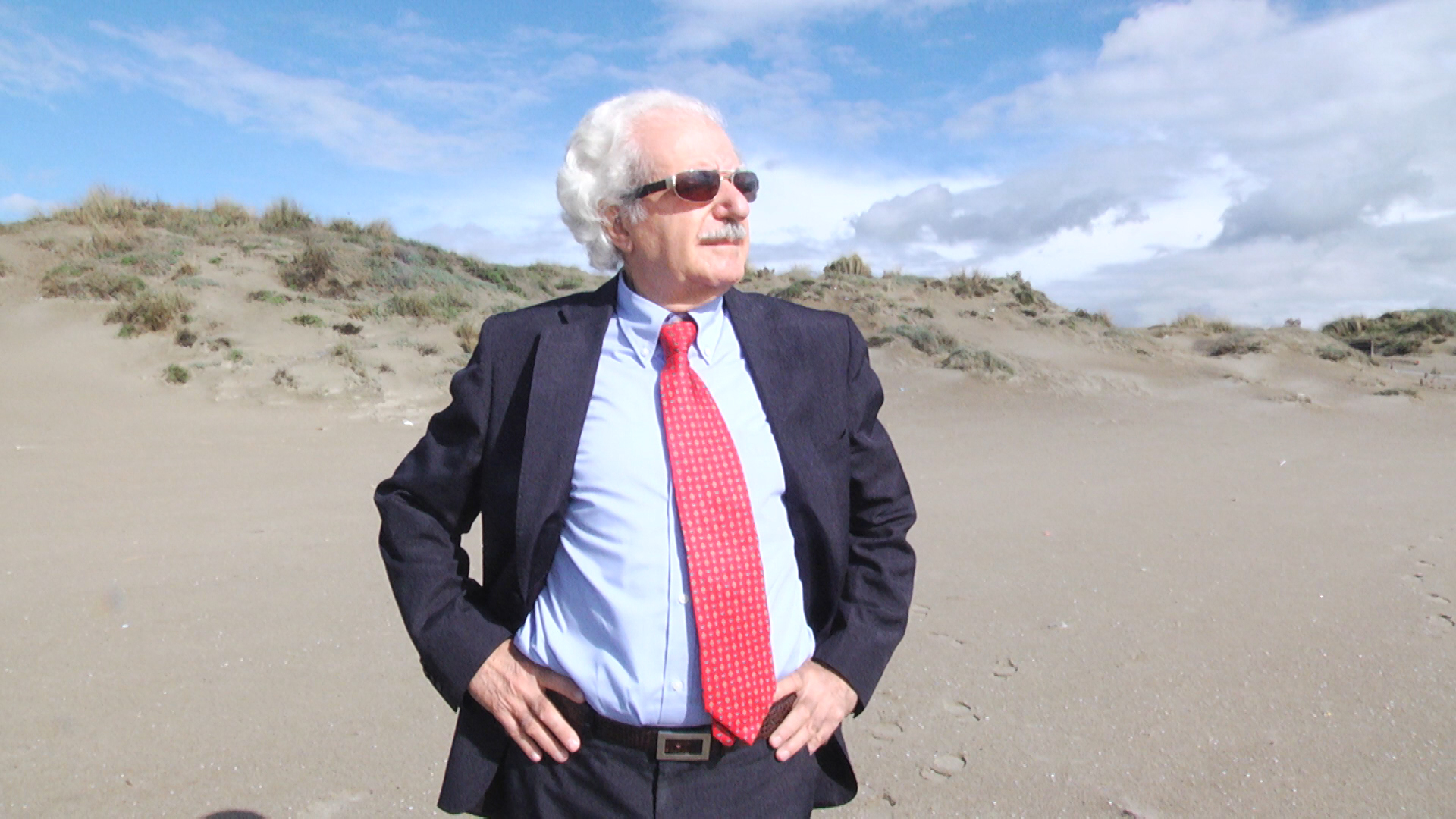
Drama, thriller, by Fabio Del Greco, Italy, 2015.
The story revolves around Vasco, a Roman builder who, at the age of 74, enjoys a life of absolute comfort. His human parable takes a dramatic turn when a mysterious encounter leads him to an ambush. Having survived, but marked by a long coma, Vasco wakes up with a new sensitivity, developing an intimate and poetic bond with nature. This new relationship with the world around him leads him to deeply explore himself, in an internal and external journey. through Italy, the United States and India, in search of a higher meaning and a cure. In parallel, the threat of a planetary cataclysm adds an epic dimension to the story.
I Am Nothing explores universal themes such as time, memory, oblivion and the connection with nature. Fabio Del Greco creates an existential drama full of food for thought. The director skillfully combines different visual materials, mixing archive images with nature photographs and dreamlike visions. This visual experimentation translates into an editing that captures the viewer's attention, guiding him through a cycle of creation and destruction. The sequences that alternate the buildings, Vasco's pride, with Indian landfills and natural landscapes create a hypnotic rhythm, underlining the beauty and fragility of life. Vasco's existential journey is a hymn to transformation and rebirth. The evolution of the protagonist, from unbridled luxury to the rediscovery of purity, represents a powerful metaphor on the meaning of life and the need to reconnect with authentic values. Io sono nulla stands out for its ability to combine introspection and visual experimentation, offering a suggestive and engaging narration. It is a film that invites us to reflect on the human condition, on our relationship with power and nature, and on the possibility of finding ourselves through change. A work that leaves its mark and lends itself to multiple readings.
LANGUAGE: Italian
SUBTITLES: English, Spanish, French, German, Portuguese
Campbell’s Map Was Not Drawn for You
You have probably held the map in your hands without knowing it. The twelve stages, the threshold guardians, the road of trials, the return with the elixir — not because you read Joseph Campbell’s 1949 work, but because the architecture of that work was folded into nearly every story you were told mattered. Campbell spent decades cross-referencing Gilgamesh, the Mahabharata, Osiris myths, and Navajo emergence tales, and what he found was not a formula for success but a record of rupture. The monomyth, as he called it borrowing from James Joyce, was a map of what happens when a self is broken open and does not fully reassemble. That is a very different thing from what we were sold.
Hollywood absorbed the framework with extraordinary speed after Christopher Vogler reduced Campbell’s 630 dense pages into a seven-page memo circulated at Disney in 1985, later expanded into The Writer’s Journey in 1992. The memo was practical, efficient, and catastrophically selective. What survived the compression was the architecture of triumph — the departure, the ordeal, the return with new power. What was quietly discarded was the interior devastation that Campbell considered the point. For Campbell, drawing heavily on Carl Jung‘s psychology of individuation, the hero’s journey was never primarily about acquiring something from the outside world. It was about the collapse of the persona, the constructed social self, and the terrifying encounter with what Jung called the Shadow — the parts of the self the ego refuses to house. The elixir the hero brings back was not a skill or a reward. It was a transformed relationship to one’s own darkness.
When a framework designed to describe ego dissolution gets repackaged as a blueprint for ego victory, something structurally dishonest enters the culture. Self-help publishing recognized the commercial utility of Campbell’s vocabulary almost immediately, and by the 1990s the bookstore shelves were dense with language about the hero within, the call to adventure, the transformation that awaits. But the transformation being sold was cosmetic — a rebranding of the self rather than its genuine undoing. Campbell had been explicit in interviews, particularly in his conversations with Bill Moyers broadcast in 1988 as The Power of Myth, that the mythological hero was not a winner in any worldly sense. Oedipus is blinded. Prometheus is chained to a rock. Psyche descends into the underworld and nearly does not return. The ancient stories were not parables about getting what you want.
The distortion runs deeper than marketing. When a psychological map is mistaken for a motivational one, it begins to function as a trap rather than a guide. A person who encounters genuine disintegration — the kind that does not resolve, the kind that does not deliver reward at the end of the third act — has no framework for understanding where they are. The cultural version of the hero’s journey told them that darkness is a tunnel with a light at the end. The actual mythological tradition Campbell was documenting said something closer to the opposite: that the willingness to remain in the darkness without guarantee of exit is the transformation itself. The Zen tradition Campbell wove through his later lectures had a phrase for the moment before enlightenment — it looked, from the inside, indistinguishable from despair.
What the Hollywood compression and the self-help industry both required was a hero who comes back. Campbell’s sources were full of heroes who do not, or who come back so altered that the community cannot recognize them, or who return bearing something the community violently refuses to receive. Cassandra is the prophet no one believes. Tiresias is blind. The grail knight who actually reaches the grail in the oldest versions of the legend does not use it to restore himself. He asks a question, and the question itself is the act.

The Ordeal Is Not a Test You Can Study For
You are standing in a room you have never entered, and somehow every object in it is yours. The furniture is wrong, the light is bad, the proportions make no sense — and yet the handwriting on the wall is unmistakably your own. This is not metaphor as decoration. This is the precise phenomenology of what happens when the structures you built to survive long enough to become yourself begin to crack under the weight of what they were never designed to hold.
Carl Gustav Jung spent decades trying to articulate why the encounter with the unconscious feels less like discovery and more like ambush. In Psychology and Alchemy, published in 1944, he traced the medieval alchemist’s obsession with transmutation not as proto-chemistry but as a projection of the psyche’s own unfinished business — the base metals were never lead and mercury, they were rage kept polite, grief kept productive, desire kept respectable. The alchemists were trying to do in their laboratories what the psyche demands be done in the dark: not purification, but integration. The gold they sought was not a substance. It was a self that had finally stopped pretending.
What Jung called individuation is frequently misread as a process of becoming more — more whole, more realized, more luminous. But the actual literature describes something far less comfortable. Individuation is the willingness to meet the Shadow, which is not evil in the cinematic sense but is rather everything you could not afford to be in order to remain loved, safe, or functional. The Shadow is the repository of the abandoned. And what makes it genuinely terrifying is not that it contains your worst impulses but that it contains your most alive ones — the ones that threatened the relationships or the self-concept that got you through childhood. The ordeal in the innermost cave is not a dragon. It is the face behind the face you show the world, and it has been waiting with extraordinary patience.
The hero narrative, in most of its cultural packaging, suggests that the cave is a crucible of courage — that the right preparation, the right weapon, the right mentor has given you what you need to survive what waits inside. This is the version of transformation that the culture can sell, because it leaves the fundamental architecture of the self intact. You go in, you fight, you come out changed but still recognizably you, still holding the same name, still pointed in the same direction. What actually happens in genuine psychological confrontation is structurally different and far more disorienting: the identity you carried into the cave does not survive the encounter. The version of you that was heroic enough to descend is not the version that ascends.
James Hollis, the Jungian analyst who spent the better part of four decades translating this into clinical language, described in The Middle Passage what he called the first adulthood — the project of building a self sturdy enough to function in the world, to hold down a life, to satisfy the internalized demands of family and culture. The crisis, when it comes, is not the collapse of that project’s success. It is the collapse of the project’s premise. You built yourself around answers to questions you were never allowed to examine. The ordeal reveals that the questions were wrong from the beginning, and that the strength you developed to carry those wrong answers has been quietly strangling the life it was supposed to protect.
This is why the ordeal cannot be studied for. There is no curriculum for the dissolution of the self you needed in order to survive long enough to discover you needed a different one. The cave does not test your knowledge or your discipline or your resolve. It tests nothing. It simply reveals the distance between the person you became and the person you actually are — and insists, without mercy or apology, that you finally reckon with the gap.
What Societies Do with Their Unfinished Heroes
You are sitting in a waiting room — not a metaphorical one, but an actual fluorescent-lit room with plastic chairs — waiting for someone in a white coat to tell you what is wrong with you. You have been unable to concentrate at work for three months. You have lost interest in things that used to define you. You feel simultaneously restless and numb, suspended between a life that no longer fits and another that has not yet shown its shape. The person across the desk will give this state a name, probably several, and the naming will feel like relief, because at least a named thing can be treated, managed, returned to function. What will not be said — what the entire architecture of that room is designed to prevent from being said — is that you might simply be in the middle of something.
Arnold van Gennep, writing in 1909 in Les Rites de Passage, identified a structural pattern running through virtually every known human culture: the movement from one social identity to another is never instantaneous. It passes through three stages — separation, transition, and incorporation — and it is the middle stage, the transitional one, that van Gennep called the liminal phase, from the Latin limen, threshold. Pre-modern societies did not merely acknowledge this phase. They built entire institutional frameworks around it, surrounding the person in transition with ritual containers — isolation, ordeal, symbolic death, communal witnessing — precisely because they understood that a human being between identities is not a broken human being. They are a dangerous and necessary one.
Victor Turner extended this insight in the 1960s, observing in The Ritual Process that liminal individuals occupy a paradox: they are simultaneously nothing and everything, stripped of their former status before the new one has been conferred. Turner called this condition “betwixt and between,” and what struck him most was not its difficulty but its generative power. The liminal person, unmoored from social structure, becomes capable of perceiving that structure from the outside — its arbitrariness, its violence, its constructed quality. Communities that understood this used liminal individuals not as liabilities but as sources of renewal, seers, shamans, or catalysts of collective reinvention.
The modern West did not inherit this understanding. What it inherited instead was an economic system that requires continuous output, and a psychological framework built almost entirely around the restoration of that output. The Diagnostic and Statistical Manual of Mental Disorders, now in its fifth edition, contains no category for “person undergoing necessary dissolution.” It contains categories for depression, anxiety, adjustment disorder, and burnout — all of which can accurately describe the same state that a fourteenth-century initiation rite would have recognized as the sacred wound before the crossing. The difference is not in the suffering. The difference is in what the surrounding culture decides the suffering means.
This is not a nostalgic argument for returning to ritual scarification or tribal isolation chambers. It is an observation about what disappears when a society loses the conceptual vocabulary for transformation. What disappears is the legitimacy of the in-between state itself. The person who cannot yet say what they are becoming — who has surrendered a former self and not yet found the next — encounters not a container but a demand: name your diagnosis, update your resume, justify your absence from productivity. The liminal state, which van Gennep saw as structurally inevitable and Turner saw as socially generative, becomes instead a personal failure, a weakness of character, a thing to be corrected rather than inhabited.
And so the unfinished hero is returned, prematurely, to the world of function. The wound gets medicated before it has spoken. The threshold gets paved over before the crossing is complete. The question that never gets asked — not in that fluorescent room, not in most of the conversations that follow — is what the dissolution was actually trying to accomplish.
The Road of Trials Is Mostly Boredom and Shame
There is a man sitting at a kitchen table at two in the afternoon on a Wednesday. He has been sitting there for forty minutes. He is not writing, not meditating, not crying. He made coffee and let it go cold. Outside, traffic moves with complete indifference. Nothing about this moment will appear in any account he gives of himself later, not because he is lying, but because the human mind has a nearly physiological inability to assign narrative weight to stillness that produces no visible result. He is, in fact, in the middle of the most significant passage of his adult life. No one watching him would know this. He barely knows it himself.
The problem with the road of trials is that Joseph Campbell described it in 1949, in The Hero with a Thousand Faces, using material drawn from myth, ritual, and collective storytelling — forms that had already stripped the lived experience down to its structurally necessary moments. What remained after that distillation was arc, drama, legible ordeal. The dragon. The descent. The wound that teaches. What did not survive the compression was the vast, featureless interior landscape where most transformation actually occurs: the weeks of not knowing whether you have changed or simply stopped trying, the mornings indistinguishable from each other, the sensation that is not quite grief and not quite numbness but something without a name that no literary tradition found worth preserving.
Shame, in particular, refuses the narrative frame. Brené Brown’s research at the University of Houston, published across a decade of studies beginning in the early 2000s, documented something that should have been obvious but apparently was not: shame thrives in silence and in the absence of story, not because it cannot be narrated, but because the narrating self finds the material too resistant to heroic form. You cannot make shame into a trial you overcame without immediately falsifying it. The moment it becomes a chapter, it has already been aestheticized, defanged, turned into evidence of your eventual triumph. The real experience is exactly the opposite of that — it is the conviction that there is no chapter, no arc, no eventual anything, only the recurring exposure of what you actually are beneath the person you worked so hard to assemble.
William James, writing in The Principles of Psychology in 1890, observed that habits are the enormous flywheel of society and that most human change is not the dramatic rupture we celebrate but the slow, invisible rerouting of neural pattern — what he called the plasticity of organic matter. He was describing something biological, but the cultural implication is devastating: if genuine transformation is mostly rerouting, mostly quiet restructuring below the threshold of story, then the stories we tell about transformation are almost necessarily about something else. They are about the moments legible enough to be told, which means they are about the surface, the crisis point, the before and after — not the unnarrateable middle where the actual work gets done in the dark.
The hunger for narrative coherence is not innocent. It functions as an escape route from the precise experience that transformation requires you to stay inside. When the man at the kitchen table eventually rises, makes new coffee, and continues through his afternoon, he will feel the pull to interpret what those forty minutes meant, to locate them on a map that has a destination marked. That pull is not wisdom arriving. It is the ego’s immune response to disorientation. The story format we impose on inner life is not a tool for understanding it — it is a defense against the full weight of experiencing it without knowing where it leads, and most people choose the story over the vertigo, every time, because the vertigo has no guaranteed arc and the story at least pretends to.
A vision curated by a filmmaker, not an algorithm
In this video I explain our vision
The Mentor Was Never Going to Save You

You have spent years, perhaps decades, looking for the person who would finally tell you the truth about yourself — a therapist who cuts deeper than the others, a teacher whose syllables land like keys in old locks, a stranger at a dinner table who seems to see through the social performance and speak directly to whatever is unfinished in you. You have rehearsed the encounter. You know roughly what they would say, and you know how it would feel to hear it. The problem is not that you have not found them. The problem is that the search itself is doing something for you that you have not been willing to examine.
James Hillman, in Re-Visioning Psychology published in 1975, dismantled the therapeutic relationship as a site of heroic rescue with a precision that made clinicians uncomfortable for good reason. His argument was not that guides are useless but that the cultural hunger for the wise figure — the one who holds the map, who has already survived what you are entering — is itself a symptom of the refusal to not-know. The mentor archetype in the classical hero narrative is not primarily a source of answers. It is a mirror held up in darkness. What you see in it is the shape of your own reluctance.
This is why the most transformative teachers in recorded history — across Sufi lineages, in the Socratic dialogues, in the behavior of the Zen master who answers every sincere question with a harder question — have operated through strategic withholding. They understood something the modern coaching industry has systematically reversed: that premature clarity is a form of violence against the psyche’s process. When someone gives you the answer before you have fully inhabited the question, they have stolen from you the only experience that would make the answer real. You leave the session feeling understood and return, six months later, with the same wound dressed in new vocabulary.
The cultural fantasy of the wise guide has intensified rather than diminished in an era flooded with therapeutic language. Millions of people now carry the DSM-5’s diagnostic categories as personal mythologies, finding in a clinical label the guru they could not locate in human form. The label tells them what they are, which is another way of being told who is responsible. Diagnosis without transformation is a very efficient way to stop moving. It provides the gravity of an answer with none of the turbulence of actual descent.
What Hillman was pointing toward is something older and less comfortable than any mentorship model can contain: that the psyche does not want to be fixed by another person. It wants to be witnessed in its own unfolding, and there is a radical difference between those two gestures. The witness does not intervene. The witness does not save. The witness makes it harder to look away from what is actually happening — which is precisely why genuine mentors throughout history have so often been experienced, in the moment of encounter, as cruel, evasive, or impossible to grasp. They refuse to stand between the traveler and the abyss. Their function is to confirm that the abyss is real and that you are capable of entering it without a handrail.
The search for a mentor, when it becomes compulsive, is almost always a postponement dressed as preparation. There is always one more book, one more practitioner, one more retreat in the mountains of someone else’s spiritual tradition. Each addition feels like getting closer. And it is getting closer — to a threshold, not to the crossing of it. At some point, the guide’s real service is to become useless to you, to have given you just enough disturbance that you no longer need them to authorize your descent. The ones who stay indispensable have failed at the only thing that mattered.
Return as Rupture, Not Homecoming
You come back and no one knows what to do with you. Not because you have changed your hairstyle or your address, but because the frequency you now operate on is not the one they tuned to when they first learned your name. The room recognizes your face but not the person wearing it, and that gap — small, almost polite — is the most disorienting thing you will ever feel. You expected difficulty. You did not expect invisibility.
Homer understood this with a cruelty that no subsequent romantic retelling has managed to fully dilute. Odysseus returns to Ithaca after twenty years of war and shipwreck and divine interference, and the first creature to recognize him is a dying dog. His wife does not know him. His son circles him with suspicion. His own household has reorganized itself around his absence so thoroughly that his presence registers as an intrusion rather than a restoration. What follows is not a reunion but a massacre — he kills the suitors not as a triumphant king reclaiming his throne but as someone who has become capable of a violence so precise and so cold that it belongs to a different moral register than the world he re-entered. The Odyssey published around the eighth century BCE is not a story about going home. It is a story about the impossibility of going home once the self has been genuinely remade.
Anthropologists studying rites of passage have documented this estrangement with clinical precision. Arnold van Gennep, in his 1909 work Les rites de passage, identified the structure that Joseph Campbell would later popularize: separation, liminality, reincorporation. But what van Gennep actually observed in the communities he studied was that reincorporation was rarely seamless. The returning initiate was often given a new name, new clothing, new social position — because everyone tacitly acknowledged that the person who left and the person who returned were not the same entity, and the community had to be reorganized to account for that fact. The ritual was not a celebration of return. It was a negotiated settlement between two incompatible realities.
What popular culture systematically removes from this structure is the negotiation. The hero comes back and the village cheers, the family embraces, the lover runs across a field. This narrative is not wrong because it is too optimistic. It is wrong because it mistakes the form of reunion for its substance. A person who has undergone genuine inner transformation — who has dismantled a foundational assumption about identity, value, or meaning — cannot simply slot back into the conversational rhythms, the shared jokes, the unspoken agreements that held a community together before they left. Those structures were built for the previous version. Sitting at the old table feels like wearing a coat that fits in all the right measurements but somehow belongs to someone else’s body.
The cruelty is that this new exile is entirely illegible to those who cause it. The family that cannot reach you is not being cruel. The friends who look at you with a faint, unplaceable concern are not failing you. They are doing exactly what communities have always done: they are trying to preserve coherence. Sociologist Émile Durkheim spent much of his career demonstrating that social groups exert enormous, largely unconscious pressure toward conformity not out of malice but out of structural self-preservation. The returning transformed person represents a small tear in the collective fabric, and the collective’s first instinct is always to sew it shut, to re-narrate the change as temporary, as exhaustion, as something that will settle once the person has rested and remembered who they are.
But that is precisely the problem. They remember exactly who they are. And that new knowledge has no homeland yet, no community built around its specific grammar, no table set for the particular hunger it carries.
The Self That Survives Is Not the One That Left

You come back and the house is the same. The furniture holds its position with the indifference of objects that have never needed you. The people who love you say you seem different, and what they mean, though they would never phrase it this way, is that they are waiting for you to become familiar again, to slide back into the outline you left behind like a coat on a hook.
But the outline no longer fits. This is not metaphor. It is the precise structural problem of every genuine transformation: the life constructed around the previous self does not dissolve simply because the self has. It persists. It demands. It calls you by your old name.
Simone Weil, writing in the early 1940s in notebooks that would be published posthumously as Gravity and Grace, proposed a concept she called decreation — the voluntary relinquishment of the constructed ego not as self-improvement but as a kind of holy erasure. She was not describing the hero who returns stronger. She was describing something far more unsettling: the possibility that the deepest spiritual and psychological movement a person can make is not toward a more complete self but away from selfhood as a project altogether. For Weil, the ego that clings to its own continuity, that accumulates experience and calls the accumulation growth, is the very mechanism that prevents transformation. What survives a genuine journey, she suggested, is not a better version of what left — it is something that can no longer be located in the same coordinates.
This cuts against nearly everything the culture of self-development has sold under the banner of the hero’s journey. The workshops, the memoirs, the therapeutic frameworks all tend toward the same implicit promise: you will come back more fully yourself. But Weil’s decreation does not promise fullness. It describes a vacancy that is not emptiness but openness — and most people, confronted with that vacancy in themselves, immediately begin to fill it. The filling is what gets called integration. The vacancy is what was actually earned.
What makes this philosophically intractable is that the very act of narrating the journey reconstitutes a self. The moment you begin to say what happened to you — to a therapist, a partner, a journal, a reader — you are already rebuilding the structure that the journey dismantled. Language requires a speaker. A speaker requires a stable enough subject to bear the weight of the sentence. And so the telling, which feels like processing, is also a subtle form of undoing. Not a betrayal, but an inevitable compromise between what was experienced and what can be communicated without losing the listener entirely.
The ancient texts understood this without theorizing it. In the Odyssey, composed across an oral tradition before it was ever written down, Odysseus returns to Ithaca in disguise. The disguise is tactical, yes — he is testing loyalties, hunting usurpers. But it is also structurally truthful in a way Homer may not have consciously intended. The man who returns cannot simply announce himself. He must prove he is who he says he is by demonstrating knowledge only the original self would possess. Identity, after profound absence, is no longer self-evident. It must be performed, demonstrated, verified against a standard set by someone who no longer quite exists.
And so the person who survived the fire, the grief, the dissolution — whatever form the journey took — arrives back at the ordinary world carrying something that the ordinary world has no category for. The job is still there. The relationships still need tending. Tuesday still comes. And somewhere in the gap between what was broken open and what is being asked of you by the next hour, there lives a tension that no return can fully resolve, because the life that waited was built for someone who is no longer entirely the one who came back to live it.
🌀 Paths of the Soul: Myth, Symbol, and Inner Quest
The Hero’s Journey is not merely an adventure across outer landscapes — it is a map of the psyche’s deepest transformations. From ancient myth to modern psychology, the call to adventure has always pointed inward, toward dissolution and rebirth. These related readings illuminate the hidden architecture of inner change.
Jungian Individuation and the Great Work
Jungian individuation is perhaps the most direct psychological parallel to the Hero’s Journey, describing the lifelong process by which the self integrates its shadow, anima, and other unconscious elements. Jung saw the alchemical Great Work as a symbolic language for this inner labor, where lead transforms into gold just as the wounded hero becomes whole. Reading this piece alongside Campbell deepens the understanding of transformation as a sacred psychological necessity.
GO TO THE SELECTION: Jungian Individuation and the Great Work
Spiritual Alchemy: Inner Transformation and Symbolism
Spiritual alchemy offers a rich symbolic vocabulary for the stages of inner transformation — nigredo, albedo, and rubedo — that map strikingly onto the hero’s descent, ordeal, and return. Far from being a primitive proto-chemistry, alchemy encoded a profound psychology of the soul’s purification and renewal. This article reveals how the hermetic tradition anticipated many of the insights that Joseph Campbell would later systematize in mythological terms.
GO TO THE SELECTION: Spiritual Alchemy: Inner Transformation and Symbolism
Otto Rank: Life and The Myth of the Birth of the Hero
Otto Rank‘s foundational work on the myth of the hero’s birth established a psychological framework for understanding why cultures universally produce stories of the chosen individual who separates from the ordinary world to fulfill a destiny. Rank saw in these myths the projection of deep unconscious struggles around identity, separation, and self-creation. His analysis is an essential precursor to Campbell’s monomyth and to any serious study of the journey as inner transformation.
GO TO THE SELECTION: Otto Rank: Life and The Myth of the Birth of the Hero
Medieval Mysticism: History and Main Figures
Medieval mysticism charted inner journeys of extraordinary depth, from Meister Eckhart‘s annihilation of the ego in the Godhead to Bernard of Clairvaux‘s ascending stages of love. These contemplative traditions understood that the soul must pass through darkness and unknowing before arriving at union — a structure that mirrors the hero’s ordeal and transcendence. Exploring medieval mysticism reveals that the Hero’s Journey is not only a narrative archetype but a lived spiritual practice with centuries of mapped terrain.
GO TO THE SELECTION: Medieval Mysticism: History and Main Figures
Discover the Cinema of Inner Transformation on Indiecinema
If these reflections on myth, alchemy, and the soul’s journey have stirred something in you, Indiecinema’s streaming platform offers a carefully curated selection of independent films that explore exactly these depths — from initiatory dramas to visionary cinema that maps the invisible landscapes of the self. Step beyond the mainstream and let independent cinema be your guide through the labyrinth.
👉 EXPLORE THE CATALOG: Watch Indie Films in Streaming
A vision curated by a filmmaker, not an algorithm
In this video I explain our vision

