
The Rain You Already Know
You are standing on a wet street at two in the morning, and the rain is doing what rain always does in these moments — it is making everything look like a reflection of something more significant than it actually is. The puddles catch the neon from a bar sign above a door you have no intention of entering. The light wavers. You pull your collar up, not because you are cold, but because you have seen this gesture somewhere and it feels correct. That is the first thing worth noticing: you are cold, yes, but you are also performing being cold. There is a witness inside you who never sleeps, cataloguing the angles, noting that you are the kind of person who stands alone on wet streets at two in the morning, and finding that identity moderately satisfying.

Nobody is watching you. That is the unbearable part. The city continues its indifferent machinery — a taxi accelerates through a puddle fifty meters away, someone laughs behind glass, a traffic light cycles through its colors for an empty intersection as though fulfilling a contract with a civilization that has temporarily stepped out. And still you compose the image of yourself standing there, because the alternative — standing there without composing anything, simply being a body in the rain — is a possibility so vertiginous that the mind refuses it instinctively. You are not dramatic. You are not romanticizing your solitude. You are doing something stranger and more compulsive: you are narrating yourself into existence in real time, and the grammar you are using was handed to you by sources you have never fully examined.
That grammar has a history, and it is longer and stranger than most people suspect. What you experience as a private mood — that particular texture of urban alienation, the soaked coat, the feeling of being simultaneously the protagonist and the audience of your own life — is in fact the residue of a collision between two mid-twentieth-century crises that happened to produce, almost accidentally, one of the most durable emotional templates Western culture has ever manufactured. The collision was not philosophical in the academic sense, though philosophers were nearby, watching. It was industrial, economic, aesthetic, and deeply afraid.
The fear came first. Europe had spent five years discovering what its civilization was actually capable of when the restraints were removed, and the discovery was not reassuring. The systematic murder of six million Jews, the reduction of Dresden to ash in forty-eight hours in February 1945, the detonations over Hiroshima and Nagasaki in August of the same year — these were not aberrations. They were the products of rationality, of engineering, of bureaucratic efficiency applied without limit. The Enlightenment project, the faith that reason would liberate humanity, had provided the technical vocabulary for industrialized slaughter. This was not a minor intellectual embarrassment. It was a foundational rupture.
Into that rupture, two things descended simultaneously and began to hybridize in ways nobody planned. One was a set of philosophical ideas about radical freedom, contingency, and the absence of inherent meaning — ideas that had been circulating in European thought since at least Kierkegaard’s assault on Hegelian systematizing in the 1840s, but that now found an audience suddenly desperate for a framework that could absorb catastrophe without lying about it. The other was a style of filmmaking arriving from an unlikely direction: the German expressionist directors who had fled the Nazi rise to power and carried with them to Hollywood a visual language of oblique shadows, destabilized geometry, and faces lit from below as though illuminated by something morally unreliable.
These two inheritances had no formal agreement with each other. They did not arrive together. They simply found, in the same postwar darkness, that they were describing the same thing — and the thing they were describing was you, standing on that street, performing the awareness of your own solitude for an audience that does not exist.
A Better Life
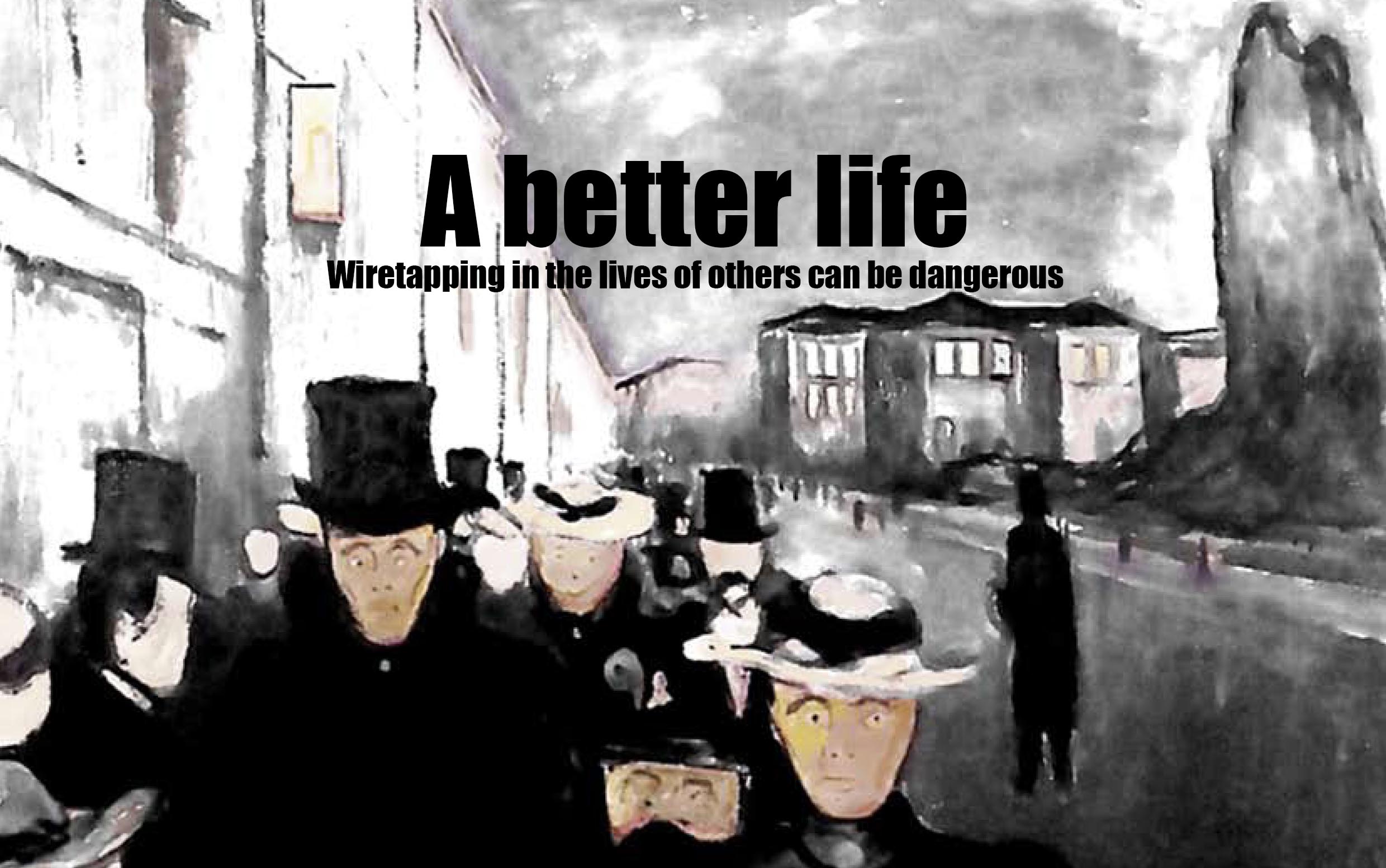
Drama, thriller, by Fabio Del Greco, Italy, 2007.
Rome: Andrea Casadei is a young investigator specializing in audio wiretapping who conducts investigations commissioned by husbands betrayed by their wives, or by parents worried about what their children are doing outside the home. But what interests him most is understanding the human soul, listening to casual conversations in the streets, knowing what people think. He often meets in Piazza Navona with his friend Gigi, a frustrated street artist obsessed with success at all costs, with whom he shares a passion for wiretapping. Shocked by the mystery of the disappearance of Ciccio Simpatia, another street artist common friend, Andrea decides to abandon the commissioned works to seek a better life and reflect on his own and others' existence. He will meet the actress Marina and with a bug he will slowly enter her life until he discovers her most unthinkable secrets. The film deals with an important theme of contemporary Western society: the lack of love. The mysterious and tormented figure of Marina is reflected in a gloomy and soulless Rome.
Director Fabio Del Greco declared about his film: "Perhaps this film is a reflection on the art of observing, of listening, in short, of what one does when one leaves the real world to tell about it. Perhaps he wants to talk about the subtle relationship between the mirages of success touted by today's society, power and the most authentic human relationships.A 'dark cloud' hangs over the city: it is engulfing everyone in a sort of indistinct, uniform mass, where everyone thinks the same things, where everyone they are more alone. Where is the truest part that makes us unique? Maybe you can try to intercept it only secretly."
LANGUAGE: Italian
SUBTITLES: English, Spanish, French, German, Portuguese, Dutch.
When Philosophy Learned to Smoke
You are sitting in a café in Paris, sometime in the winter of 1944, and the man across from you is not looking at you. He is looking through you, or perhaps through the wall behind you, or perhaps through something that has no physical location at all. The city outside has been liberated for a few months but liberation does not feel the way anyone said it would. The streets smell of burnt paper and something else that everyone knows and nobody names. The man across from you lights a cigarette and says nothing, because there is nothing to say that would not be a lie, and he has recently decided, with great intellectual precision, that lying is the only truly unforgivable act a person can commit against themselves.
What emerged from that historical moment was not a school of thought in any academic sense. It was a reckoning. Jean-Paul Sartre published Being and Nothingness in 1943, under German occupation, in a city where the cost of saying the wrong thing to the wrong person was measured in disappearances. The book is nine hundred pages of dense phenomenological argument, but its animating wound is simple and devastating: there is no pre-given human nature, no divine blueprint, no essence waiting to be discovered. Existence precedes essence. You arrive before your meaning does, and meaning never quite catches up. This was not a comfortable proposition in ordinary times. In occupied Paris, where the collaborator and the resistant often wore the same face until the moment of decision, it was something close to an accurate description of daily life.
Albert Camus had already detonated something quieter and more lethal in 1942. The Stranger opens with a sentence that has disordered more readers than almost any other in the twentieth century — a mother has died, the narrator is uncertain whether it happened today or yesterday, and his uncertainty carries no guilt. Camus understood that the scandal of that sentence was not moral but ontological. Meursault does not lack feeling because he is broken. He lacks the narrative tissue that normally connects feeling to social performance, and his society will eventually kill him not for the crime he commits but for his failure to perform grief correctly. The trial at the center of the novel is not about murder. It is about the state’s demand that individuals maintain the fiction of coherent, legible inner lives. What terrified readers in 1942 was not Meursault’s coldness. It was their own recognition.
The French Occupation had done something to European consciousness that no ideological system was prepared to process cleanly. It had demonstrated, with bureaucratic thoroughness, that civilization was not a permanent achievement but a temporary arrangement, and that the arrangements could be dismantled by ordinary people following ordinary orders with ordinary careers at stake. Hannah Arendt would spend twenty years trying to formulate what she saw in Adolf Eichmann’s face in Jerusalem in 1961 — the absence of the demonic, the presence of something far more disturbing, which was competence without reflection. But the existentialists felt this before they could name it, because they were living inside the evidence while the evidence was still being manufactured.
Noir as an aesthetic mode arrived in this landscape not as entertainment but as environmental realism. The darkness in its visual grammar — the shadows cutting across faces at angles that make identity uncertain, the rain-slicked streets that reflect a distorted version of everything above them — was not stylistic excess. It was meteorologically accurate. A devastated Europe had produced thinkers who refused consolation because consolation required pretending that the catastrophe had been an aberration rather than a revelation. What noir and existentialism shared was not pessimism, which is still a kind of comfort. What they shared was the refusal to look away from what the light, when it finally came on, had actually shown.

The Genre That Refused to Be a Genre
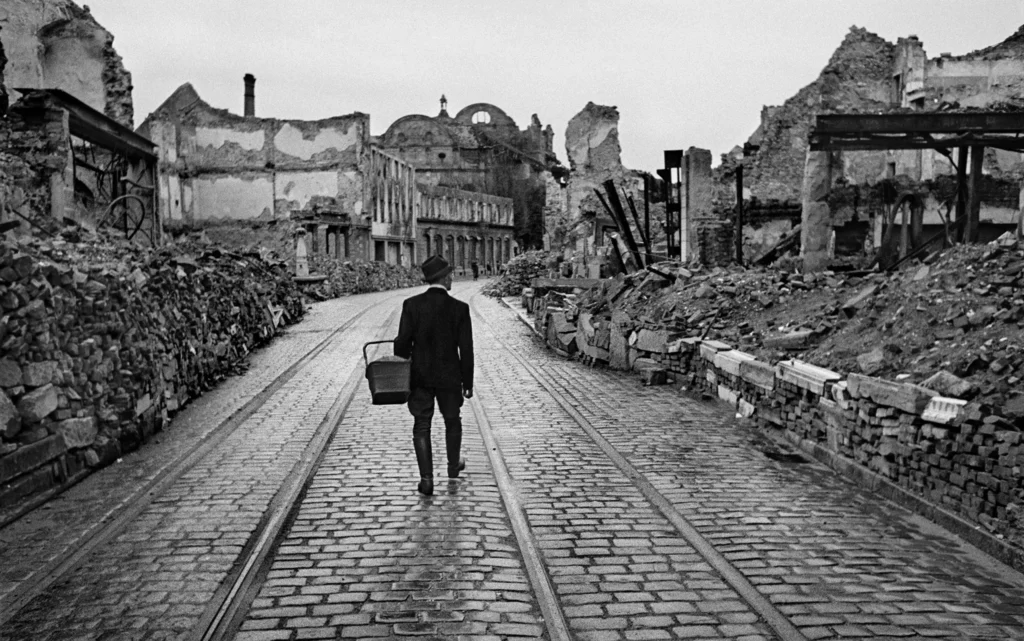
You are reading a story about moral failure before you realize it is also about you. The detective does not solve the crime so much as absorb it, carrying the city’s rot through every rain-slicked alley, every conversation with a woman whose motives he cannot trust, every moment when the law reveals itself to be simply another gang with better stationery. Dashiell Hammett invented this figure in the pulp pages of Black Mask magazine beginning in 1923, and what he was really inventing was a literary ethics built on disillusionment — not cynicism as pose, but as epistemology. His Continental Op and later Sam Spade do not doubt human nature as a philosophical exercise. They doubt it because they have been paid to watch it closely, and it has never once surprised them in an upward direction.
Raymond Chandler, writing a decade later, understood that Hammett had cracked something open but had not named it. In his 1944 essay “The Simple Art of Murder,” Chandler argued that Hammett had taken murder away from the English country house and given it back to the people who actually commit murders for reasons that are not exotic but economic, social, and almost drearily legible. Philip Marlowe walks through Los Angeles in the late 1930s and what he sees is a city whose glamour is a direct product of its exploitation — the swimming pools and the citrus groves and the movie money all floating on a substructure of racial exclusion, corrupt police, and oil wealth that had already eaten the government twice. The private eye does not stand outside this. He is a minor actor in it, underpaid and occasionally beaten, preserving something he calls a code not because the code works but because abandoning it would leave him with nothing to distinguish himself from the men he investigates.
When the European directors arrived in Hollywood — Fritz Lang in 1934, Billy Wilder in 1934, Otto Preminger in 1935, Robert Siodmak in 1940 — they brought with them a visual grammar that had been shaped by Weimar-era Expressionism, by the angular shadows and distorted geometries of a cinema that had already learned to treat domestic space as a threat. They had also, several of them, fled fascism. They understood at a physiological level that institutions could reverse, that legality and justice were separable, that the smiling face of order was perfectly capable of organizing a massacre. When they lit an American crime film, they were not being stylistically eccentric. They were being accurate about something that the American hard-boiled tradition had intuited in prose but had not yet fully seen.
The term “film noir” itself was coined by the French critic Nino Frank in 1946, applied retrospectively to a cluster of films already in circulation — Double Indemnity, Laura, Murder My Sweet, The Woman in the Window. The naming arrived after the fact, which is itself significant. No studio greenlit a noir. No producer in the early 1940s sat down to commission a body of work defined by moral ambiguity, femmes fatales, and the structural impossibility of justice. The genre was identified only once critics could look backward at a pattern that the industry had produced without intending to produce it. This is not a minor detail of film history. It means that what we call noir was always something leaking through the official surface of entertainment — a pressure that the culture was generating and could not quite contain within its preferred narratives of triumph and resolution.
What the genre refused, formally, was the closed case. In Hammett’s The Maltese Falcon, published in 1930, Spade solves the mystery and delivers the murderer, and it costs him something that cannot be recovered. The crime is technically resolved. The world that produced the crime is entirely intact, and everyone in it already knows where the next one will come from.
Guilt Without God
You are already guilty before you have done anything. That is the particular cruelty of the noir world — not that its characters commit sins and suffer consequences, but that they arrive at the first frame already soaked in something they cannot name, already carrying a verdict handed down by no court, signed by no judge. The private detective lights a cigarette in a room he should not be in. The woman appears at the door with a story that does not add up. Neither of them chose this. And yet the weight is already there, atmospheric and total, the way humidity precedes a storm.
What produced that weight historically was not a philosophical argument but a civilizational rupture so catastrophic that the structures used to assign meaning to suffering simply buckled. Two world wars killed approximately seventy million people between 1914 and 1945, and the more devastating consequence was not the death count but the theological silence that followed. Providence — the organizing narrative that suffering serves a higher purpose, that history bends toward justice, that a cosmic bookkeeper tracks every sparrow — did not survive the trenches at Verdun or the photographs from Auschwitz. What remained was action without sanction, choice without compass, consequence without redemption. This is not a metaphor. It is the precise condition in which American noir was produced and consumed.
Søren Kierkegaard had anticipated the anatomy of this condition with uncomfortable precision in The Concept of Anxiety, written in 1844, a full century before the genre crystallized. His central insight was that anxiety is not the fear of a specific threat but the dizziness that overtakes consciousness when it recognizes its own freedom — the vertiginous sensation of standing at the edge of possibility with no external authority to dictate the next step. He described it as the dread that accompanies freedom itself, not freedom as liberation but freedom as terrifying exposure. When the providential framework collapses, every human being becomes a Kierkegaardian subject: suspended above their own choices, unable to appeal to God, history, or nature for justification, and therefore permanently guilty not of what they did but of having chosen at all.
Noir’s morally compromised detective is the exact embodiment of this condition made narrative. He operates in a world where institutional authority — the police, the law, the church — has already been revealed as corrupt or indifferent. He cannot appeal upward. He can only move forward through a sequence of choices that each implicate him further, not because he is evil but because choosing is itself contaminating in a world without coordinates. The femme fatale is not a villain in this architecture; she is the figure who makes the freedom visible, who forces the choice into the open, who refuses to let the protagonist pretend that neutrality is available. She does not seduce him toward sin. She confronts him with the fact that he was never innocent.
What makes this more than literary atmosphere is that the audience recognized themselves in it. The men who watched these films in the late 1940s had returned from theaters of war where the moral grammar they were raised on had been systematically invalidated. They had made choices under conditions that no ethical framework fully covered. They had survived events that no redemptive narrative could adequately absorb. The noir universe did not offer them consolation or instruction. It offered them recognition — a world that looked like the interior landscape they had brought home and could not describe at dinner.
The guilt that saturates noir has no object that can be confessed away, no priest who can dissolve it, no God whose forgiveness would settle the account. It is structural. It belongs to the condition of being conscious and free in a universe that has stopped answering,
The City as Philosophical Argument
You step out of a doorway at 2 a.m. into a street that seems designed to make you disappear. The buildings lean toward each other overhead like conspirators. The wet pavement throws back a light that belongs to no identifiable source. You do not feel watched so much as you feel processed — sorted into the category of figure moving against ground, stripped of whatever you thought made you particular.
Walter Benjamin spent over thirteen years assembling his unfinished monument to urban perception, the Arcades Project, and what he found inside the covered passages of nineteenth-century Paris was not commerce but ontology. The arcade was a space that promised shelter while delivering a more refined form of exposure — a corridor in which the individual walks toward something perpetually receding, seduced by window displays that reflect his own face back to him distorted. Benjamin understood that the city was not a container for human life but an argument about what human life was worth, and the answer it gave was statistical, fungible, endlessly replaceable.
Georg Simmel, writing in 1903 in his essay “The Metropolis and Mental Life,” identified the exact mechanism: the modern city bombards its inhabitants with such a density of stimuli that the only psychic survival strategy is the development of what he called the blasé attitude — a flattening of emotional response, a deliberate anesthesia of the interior. Simmel was not morally condemning this adaptation. He was describing its iron logic. The person who allowed the city to move them at every intersection, every crowded tram, every anonymous transaction would simply be destroyed. The armor is not vanity. It is triage.
What existentialist noir does — and this is its specific architectural genius — is build cities that have internalized this violence and formalized it into geometry. The streets are too narrow for comfort and too wide for intimacy. The rooms compress the body without protecting it. Staircases lead to floors that offer no sanctuary. The shadows are not decorative; they are structural, weight-bearing elements of the space, necessary to hold up the sense that something has already been decided before the protagonist arrived. The labyrinth here is not a puzzle to be solved. It is a statement about the nature of the terrain: there is no center, and even if you found it, the center would contain nothing that justified the journey.
This geometry does direct philosophical work. When a character in this genre walks into a room and immediately scans for exits, the audience understands this not as paranoia but as architectural literacy — the body reading the building correctly, recognizing that the space was not designed for its ease but for its management. Michel Foucault’s analysis of Bentham’s panopticon, laid out in Discipline and Punish in 1975, describes a structure that produces compliance through the mere possibility of observation, not its actuality. Noir architecture operates on the same principle, but inverts it: instead of the terror of being seen, it produces the terror of being unseen — of mattering so little to the city’s vast indifferent machinery that your disappearance would register as nothing more than a minor fluctuation in foot traffic.
The solitary figure moving through these streets is not romantic. The romanticism is a lie the genre occasionally tells itself, and the more honest texts refuse it. The figure is alone because the city has made solidarity geometrically impossible — the distances between people are maintained not by hostility but by architecture, by the design of doorways that do not face each other, by the sound insulation that turns every apartment into a sealed chamber. The city in existentialist noir is not a backdrop against which human drama unfolds. It is the drama’s first cause, the condition that makes every other condition possible, the argument that was already finished before any character opened their mouth to begin speaking.
A vision curated by a filmmaker, not an algorithm
In this video I explain our vision
A Second Scene: The Confession That Changes Nothing

He sits across from the detective in a room that smells of fluorescent light and old paper, and he tells everything. Not reluctantly — that is the thing that unsettles the air in that room — but with a kind of exhausted precision, the way a man empties his pockets before surgery. The names, the dates, the sequence of decisions that each felt, at the time, like the only possible decision. The detective’s pen moves. The transcript grows. Somewhere in a municipal filing system, the truth will be preserved in triplicate, witnessed by a notary, stamped with the seal of a jurisdiction that existed before he was born and will exist long after the room is repainted and the desk is replaced. And yet nothing in his face changes. Not relief. Not grief. Something closer to the expression of a man who has handed over luggage he was tired of carrying and immediately realized the weight had been internal all along.
Jean-Paul Sartre argued in Being and Nothingness, published in 1943, that bad faith is not a lie told to others but a lie told to oneself about the nature of one’s own freedom. The mechanism is precise: a person converts their own choices into facts, their own contingency into necessity, and in doing so evacuates the terror of being the author of their life. Confession to an institution — legal, religious, bureaucratic — offers exactly this conversion at scale. The state receives your story, codifies it, and returns it to you as verdict, as sentence, as official record. The existential problem is that none of this constitutes genuine reckoning. The document is not the act. The transcript is not the guilt. The filing is not the confrontation with what was actually done, by a free subject, who could have done otherwise.
This is where noir becomes philosophically ruthless in a way that courtroom drama almost never is. The genre has always understood that institutions process events without understanding them. Raymond Chandler, writing in 1944 in his essay “The Simple Art of Murder,” described the detective’s function not as restoring order but as moving through a world where order is a fiction maintained by those with the power to enforce it. The locked room in noir is never really about what happened inside it. It is about the gap between what can be stated and what can be known — and, beneath that, about whether knowledge of one’s own acts can ever be transferred to another consciousness without being fundamentally falsified in transit.
What the confession scene stages is not catharsis but its structural impossibility. The detective who writes it down is not a witness in any philosophically serious sense. He is a function. He converts experience into record. Hannah Arendt, in The Human Condition from 1958, drew a distinction between labor, work, and action — where action alone belongs to the realm of human plurality, the space where we appear before one another as distinct, irreplaceable subjects. A confession extracted by procedure and filed by institution takes place entirely outside that space. It is work, at best. The person confessing does not appear before another human being; they appear before a role, a form, a mechanism designed precisely to neutralize the singular weight of what is being said.
The man in the locked room understands this, which is why his face does not change. He has not been heard. He has been processed. The distinction is everything, and noir keeps returning to it not because it is pessimistic but because it is honest about what institutional language actually does to lived experience. The confession that satisfies the law and leaves the confessor unchanged is not a failure of one man’s psychology — it is evidence of something structural, a gap built into the architecture of every system that promises to adjudicate the interior life from the outside.
Women, Fate, and the Displacement of Dread
You have seen her before you have understood her — the woman who walks into a room and changes the air pressure, who looks at a man as though she already knows what he will do before he does it, who carries some unnamed knowledge that seems, inexplicably, to put her outside the logic of punishment that governs everyone else. You have felt the specific discomfort she produces, and you have probably called it desire, because desire is the only socially acceptable container for that particular unease.
What noir was actually doing with this figure, between roughly 1941 and 1958, had very little to do with sexuality and almost everything to do with administrative panic. The United States had spent four years deploying women into factories, offices, and logistical roles that the culture had previously declared them constitutionally unfit to perform. When the men returned, something had changed that could not be easily reversed — not in the women, but in the visible evidence that the entire architecture of female limitation had been consensual rather than natural. The femme fatale is what happens when a culture needs to punish a freedom it cannot openly name. She is not a character. She is a verdict dressed as a character.
Simone de Beauvoir, writing in 1949 in The Second Sex, described the precise mechanism at work: woman is not born other, she is made other, constituted as the negative term against which man defines his subjectivity. What noir added to this structure was the element of retribution. The dangerous woman in these films is dangerous not because she is violent or deceitful in any statistically meaningful way, but because she has desires of her own that do not include the man’s survival as their precondition. She wants money, freedom, escape — the same things every male protagonist wants — and the narrative treats this as monstrousness. The crime is not murder. The crime is interiority.
There is a particular asymmetry in how fate operates across gender in this genre. The male protagonist drifts, suffers, is acted upon by circumstances he cannot fully comprehend — and this passivity reads as tragic depth, as existential weight, as the mark of a serious soul navigating an indifferent universe. The woman who acts with equivalent deliberateness is coded as predatory. The man’s helplessness is philosophical. The woman’s agency is pathological. This is not a coincidence of storytelling convention. It is the operating logic of a social order that had to reassert itself after a rupture it could not acknowledge having survived.
De Beauvoir’s analysis went further than the political, however, and it is the further reach that cuts deepest here. She argued that man projects onto woman everything he cannot integrate about himself — contingency, embodiment, the mortality that his projects attempt to transcend. The femme fatale absorbs the existential dread of the male subject who produces her. She is not the source of danger. She is the screen onto which danger is displaced so that it can be confronted in an externalized, punishable form. When she is destroyed at the end — and she almost always is — what is being ritually expelled is not a person but a collection of anxieties that were never hers to begin with.
What makes this legible as history rather than literary criticism is the precision of the timing. The Production Code, which governed Hollywood content from 1934, provided the moral grammar within which these narratives had to conclude: transgression must be punished, order must be restored. But the transgression being punished in noir is rarely the transgression named in the plot. The named transgression is theft, or adultery, or conspiracy. The actual transgression — the one the camera’s fear gives away — is a woman who chose. And the social terror of the unchosen woman, the one who refuses to make herself the instrument of a story she did not write,
What the Darkness Was Actually Saying
You are standing in a line — a real one, the kind that exists in government offices and insurance portals and HR systems — and you are filling out a form that asks you to describe your goals. Not your needs. Your goals. The distinction matters to whoever designed the form, and you comply, because you have learned that compliance is the cost of access, and access is the only currency the system recognizes. You write something true enough to be legible and vague enough to be safe. You submit. You wait. This is freedom in its contemporary administrative form, and it is, in its quiet way, the most unsettling thing noir ever predicted.
The genre did not predict it through prophecy. It predicted it through diagnosis. When Albert Camus published L’Étranger in 1942, the scandal was not Meursault’s indifference to his mother’s death — it was the courtroom’s insistence on manufacturing meaning retroactively, on constructing a coherent self from evidence that was never meant to cohere. The judicial machine needed a legible subject, a soul with traceable motives and recoverable intentions. What it found instead was a man who acted without the narrative infrastructure that institutions require. The horror was not existential. It was procedural. The system could not process a person who refused to pre-interpret himself for its benefit.
What noir understood, and what made it genuinely threatening rather than merely melancholic, was that the absence of cosmic guarantee does not produce paralysis — it produces a peculiar kind of vertigo in which action becomes both necessary and unverifiable. Jean-Paul Sartre’s 1945 lecture “Existentialism Is a Humanism” framed this as liberation: if there is no predetermined essence, you invent yourself through choice. But noir knew something Sartre’s lecture softened: invention without witness is indistinguishable from disappearance. The detective who solves the case in a city that does not care, the woman who escapes a false life into another that may be equally constructed — these figures are not celebrating freedom. They are testing whether action means anything when no structure will confirm it.
The philosophical payload was never nihilism. Nihilism is passive; it waits for meaninglessness to arrive and then settles into it like furniture. What existentialist noir carried was far more demanding — the insistence that meaning must be produced under conditions of permanent uncertainty, without the comfort of retrospective validation, without the promise that the record will be kept or the gesture witnessed. Hannah Arendt, writing in The Human Condition in 1958, argued that action derives its meaning from the public realm, from being seen and remembered within a community of other actors. Noir quietly dismantled that premise: its protagonists act in cities where the public realm is corrupt, surveilled, or simply indifferent, and yet they act anyway, because the alternative is not safety — it is the deeper erasure of having never chosen at all.
This is why the question does not stay historical. The contemporary reader who feels the weight of bureaucratic freedom — who is technically able to choose everything and structurally prevented from choosing anything that matters — is not experiencing a new problem. They are experiencing the same crisis the genre anatomized, now scaled into systems of soft compulsion so pervasive that resistance requires not courage but imagination, the capacity to recognize that the form asking about your goals is not neutral, that the interface designed to feel like agency is precisely where agency has been most carefully extracted. Noir did not offer a solution to this because solutions belong to genres that believe in resolution. What it offered was something rarer and more durable: a precise account of what it feels like to be a subject in a world organized around the management of subjectivity, and the stubborn, unrewarded insistence that feeling it clearly is not nothing.
🌀 Lost in the Labyrinth: Meaning, Dread & Endless Corridors
Existentialist noir is built on disorientation — the sense that the exit may not exist, that identity dissolves under pressure, and that meaning must be forged in darkness. These themes echo across literature, philosophy, and cinema, forming an infinite maze of their own. The articles below trace the deepest roots of that labyrinthine tradition.
Jorge Luis Borges and the Labyrinth of Identity
Borges spent his literary life mapping the corridors between self and other, reality and illusion. His labyrinths are not merely architectural — they are existential traps in which identity fractures and multiplies endlessly. This essay explores how his obsession with the maze anticipates the moral and psychological disorientation at the heart of existentialist noir.
GO TO THE SELECTION: Jorge Luis Borges and the Labyrinth of Identity
Jorge Luis Borges: Life and Works
Before understanding the labyrinth as metaphor, one must understand the mind that made it canonical in modern literature. Borges transformed the short story into a philosophical instrument, bending time, space, and selfhood into impossible geometries. His life and body of work form the essential foundation for any exploration of noir’s existential dimension.
GO TO THE SELECTION: Jorge Luis Borges: Life and Works
Waiting for Godot by Beckett: Analysis
Beckett’s Waiting for Godot is perhaps the most radical dramatization of existential paralysis ever staged — a play in which the maze has no walls, only an infinite, featureless plain. The characters wait, doubt, and circle back, trapped not by stone corridors but by the absence of meaning itself. This analysis reveals how Beckett’s theatre resonates profoundly with the stagnation and dread of existentialist noir.
GO TO THE SELECTION: Waiting for Godot by Beckett: Analysis
Samuel Beckett: Life and Works
Samuel Beckett’s entire oeuvre is a sustained descent into the human condition stripped of comfort, narrative resolution, or redemptive arc — the very atmosphere that defines existentialist noir. His language erodes certainty just as noir cinematography erodes light, leaving characters adrift in an indeterminate world. This biographical and literary portrait reveals the man behind modernity’s most uncompromising vision of the maze.
GO TO THE SELECTION: Samuel Beckett: Life and Works
Discover More on Indiecinema
If these labyrinths of meaning have stirred something in you, Indiecinema is the place to follow that thread further. Our streaming platform curates independent films that dare to explore existential dread, moral ambiguity, and the beauty of unanswered questions. Step inside — the maze is waiting.
👉 EXPLORE THE CATALOG: Watch Indie Films in Streaming
A vision curated by a filmmaker, not an algorithm
In this video I explain our vision

