
The Wait That Eats You Alive
You have been sitting with your phone face-up on the table for forty minutes. Not reading, not thinking in any productive sense, just existing in that particular suspension where the body is present but the self has evacuated to some anteroom of time, waiting for permission to return. The coffee has gone cold. You know this because you touched the cup once, registering the temperature as information that required no response. Outside, people are moving with what appears to be purpose. You watch them the way you might watch fish in a tank — with a dim, unearned envy for creatures whose element you cannot enter. The call may come. It may not. And the terrible thing, the thing you will not say aloud even to yourself, is that you are no longer sure which outcome frightens you more.

This is not a metaphor. This is a physiological condition. The body under prolonged anticipation enters a state that neuroscientists have identified as distinct from either rest or action — a kind of suspended activation, the nervous system primed but given nothing to discharge itself against. The muscles hold a readiness they cannot spend. The mind circles the same coordinates compulsively, not because it expects to find something new there, but because stopping the circling would mean admitting that there is nothing to find. Waiting is not the absence of experience. It is a specific and consuming one, with its own texture, its own grammar, its own capacity to devour a life from the inside while leaving the exterior perfectly intact.
Samuel Beckett understood this at a depth that most writers approach only accidentally, if at all. When Waiting for Godot premiered in Paris on January 5, 1953, at the Théâtre de Babylone, the audience encountered something that defied every convention of dramatic expectation: two men on a bare stage, beside a single leafless tree, doing essentially nothing while waiting for someone who never arrives. The critical establishment largely did not know what to make of it. Audiences, however — particularly those who had lived through the Second World War, through occupation, through the specific annihilation of any faith that history moves toward something — recognized it immediately and viscerally. They laughed, which surprised people. But laughter was exactly the right response, because Beckett had not written a tragedy about waiting. He had written its precise clinical diagram.
What the play refuses to do is what most human beings spend their lives doing: it refuses to pretend that the waiting is for something real. Vladimir and Estragon cannot confirm that Godot exists, cannot confirm they have the right day, cannot confirm that their presence at this particular location serves any function whatsoever. And yet they stay. They stay because leaving would require them to inhabit a different kind of emptiness — one without even the organizing fiction of an expected arrival. The wait, for all its cruelty, gives them a structure. Remove it and you do not get freedom. You get the void without furniture.
Martin Heidegger, writing in Being and Time in 1927, described what he called thrownness — the condition of finding oneself already in a situation one did not choose, already committed to a world whose terms were set before one arrived. Beckett’s two tramps are thrown not into a world of projects and possibilities but into a single, recursive appointment whose terms cannot be renegotiated. They did not design their wait. They inherited it, or perhaps simply found themselves inside it one morning, the way most people find themselves inside their lives — without having clearly decided to enter.
The play ran for three hundred and thirty-five performances. That number is not incidental. It suggests that what Beckett had exposed was not an existentialist curiosity or a theatrical experiment but something people needed to sit in front of repeatedly, the way you return to a mirror not for new information but because the confirmation itself is the point.
The Kempinsky Method

Drama, by Federico Salsano, Italy 2020.
The introspective imaginary road movie of a man in the maze of his own mind, his memories of his youth, his never dormant passions and contradictory truths. The road is made of water, the destination is falsely unknown. His traveling companions are three mysterious men, projections of his imagination and of different aspects of his personality: the perennial melancholy, the crazy creative, the introverted child. He is also followed by a female presence that tells the umpteenth human story. At a certain point of the crossing he decides to abandon the boat and his ghosts of him diving into the sea and arrives swimming on a deserted beach, naked, with a small Pinocchio puppet closed by a padlock.
In this splendid film life is like a long sea voyage and the human being is a small creature confronting immensity. Sometimes the ocean is calm, other times there are terrible storms. Sometimes we are captains of a boat with a well-defined route, other times we are shipwrecked in search of a land in which to save ourselves. But despite the long journey and the movement in physical space, there are other questions that resonate in the mind: who are these men I travel with? What is the mystery of this immense mass of water that seems to be made of my memories? You can circumnavigate the whole world but the main question always remains the same: who am I really?
LANGUAGE: italian
SUBTITLES: english, spanish, portuguese, german, french
Beckett’s Biographical Abyss and the Birth of the Play
You are sitting in a room that is not yours, writing in a language that is not your mother tongue, and the words come easier precisely because of that distance. Not the ease of fluency, but the ease of amputation — the relief of a man who has cut off his own hand and finds, to his bewilderment, that he can still hold a pen.
Samuel Beckett wrote Waiting for Godot in French between October 1948 and January 1949, in what he later described as a period of feverish, almost compulsive production. The play emerged alongside three novels — Molloy, Malone Dies, and The Unnamable — all written in French within roughly the same compressed window of time. Scholars have often called this his great creative surge, a phrase that sanitizes what was, by almost every biographical measure, a state closer to controlled disintegration. He was in his early forties. The war had left him with a France he barely recognized and a self he had even less claim to. He had spent years in the French Resistance, hiding in unoccupied zones, surviving on translations and silence. When it ended, the silence did not lift.
The choice of French has been explained in multiple, often contradictory ways — that it stripped him of literary habit, that it denied him the seductions of his native Irish English, that it forced a kind of grammatical nakedness. Beckett himself said it was easier to write without style in French, a statement that sounds modest until you understand how violently he meant it. Style, for a writer formed in the shadow of James Joyce, whose Ulysses he had helped annotate and whose maximalist excess he had absorbed and then recoiled from, was not decoration. It was inheritance, pressure, the accumulated weight of an entire literary tradition pressing down on every sentence. French was an escape not from difficulty but from the particular difficulty of being himself in English — an Irishman educated at Trinity College Dublin, a Protestant in a Catholic country, a modernist disciple who had spent his twenties trying to become something other than what his biography demanded.
But self-dispossession is not the same as self-erasure. The French of Godot is deliberately flattened, drained of idiom, almost clinical in its refusal of ornament — and this is a decision that carries enormous metaphysical weight. When Vladimir and Estragon speak in that play, they speak in a language that seems to belong to no one. Their dialogue does not feel translated; it feels arrived at. Beckett later translated the play into English himself, and the two versions are not mirrors — they are different instruments playing the same absence. The French version, En attendant Godot, has a slightly more archaic formality; the English one has a bleaker, almost comedic flatness. In both, the language is performing its own insufficiency in real time.
What made 1948 and 1949 so generative was also what made them so brutal. Beckett’s mother had died in 1950, but the years immediately before were marked by her decline and by his own psychological crisis — a rupture he described in terms that echo directly in his fiction, a revelation of his own inner darkness that he located, with uncomfortable precision, to a night in his mother’s house in Dublin in 1945. He saw, or claimed to see, that everything he had been writing toward was wrong — that the direction was not expansion but contraction, not the accumulation of reference and allusion that marks high modernism, but the systematic removal of everything that could be removed until only the irreducible remained. Godot is the most public monument to that private excavation.
The postwar European context gave this excavation a stage. Albert Camus had published The Myth of Sisyphus in 1942. Jean-Paul Sartre‘s Being and Nothingness appeared in 1943. The intellectual atmosphere in Paris was saturated with the question of whether human existence could be justified without recourse to any structure — theological, historical, or rational — that transcended it. Beckett absorbed this atmosphere and then refused its consolations entirely, including the consolation of philosophy itself as a form of heroic clarity.

Vladimir and Estragon as a Single Fractured Consciousness
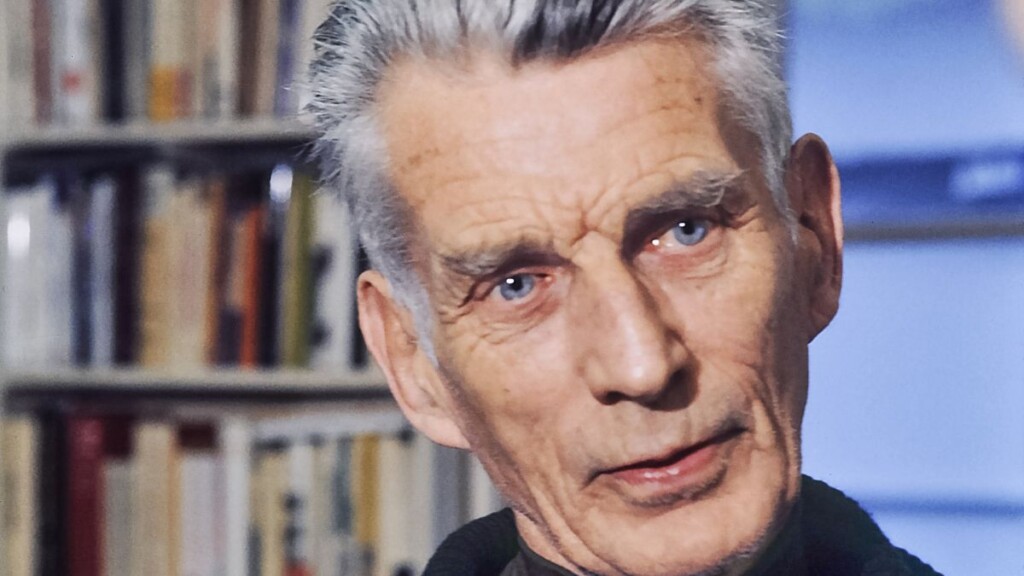
You have known this feeling before, even if you have never named it: the part of you that constructs reasons, builds arguments, reaches for meaning, while somewhere below it another part simply aches, simply hungers, simply wants to lie down on the earth and stop. The two do not speak the same language. They share the same skull and yet they are strangers.
This is the architecture Beckett engineers in Vladimir and Estragon — not two men waiting together, but one impossible being split down the middle and forced to enact its own internal war in full public view. Vladimir reaches compulsively for interpretation. He tracks time, recalls yesterday, insists on the appointment with Godot as though narrative continuity were a form of survival. Estragon forgets. He wakes from sleep not refreshed but battered, his feet raw in his boots, his body already lodged in complaint before a single thought has formed. Where Vladimir needs the story to cohere, Estragon barely concedes that there is a story at all. This is not a personality difference. It is a structural rift at the core of human experience, the unbridgeable gap between cognition and sensation that philosophers have been circling for centuries.
William James, writing in The Principles of Psychology in 1890, described consciousness not as a unified substance but as a stream — discontinuous, shifting, stitched together by habit and selective attention into the illusion of a coherent self. What Beckett stages is what happens when the stitching tears. The stream forks. Estragon lives in pure presentness, in the body’s immediate report, while Vladimir lives in the gap between moments, constructing meaning across time like a man building a bridge over water that keeps moving. Neither mode is complete. Neither can survive alone. And yet they make each other’s existence a form of ongoing low-grade torment.
The codependency between them is not incidental — it is the engine of the play’s stasis. Each time Estragon moves toward departure, Vladimir’s rationalism reconstitutes the obligation to wait. Each time Vladimir’s interpretation threatens to collapse into absurdity, Estragon’s passive corporeal presence — simply there, simply suffering, simply real — pulls the play back from pure abstraction. They cannot separate because separation would mean the dissolution of the very entity they together constitute. This is not love in any romantic sense. It is something closer to what the neurologist Antonio Damasio described in Descartes’ Error, published in 1994 — the clinical reality that reason divorced from bodily feeling becomes not purer but catastrophically unmoored, incapable even of basic decision. Vladimir without Estragon would be an intelligence spinning in a void. Estragon without Vladimir would be a body with no grammar for its pain.
What makes the deadlock irreversible rather than merely dramatic is that neither impulse can win. Resolution would require either that the body submit entirely to the mind’s rationalizations — that suffering be explained away and therefore ended — or that the mind surrender to the body’s absolute presentness and abandon all waiting, all hope, all narrative structure. The first is the lie every ideology sells. The second is what certain traditions call enlightenment and what most people call despair. Beckett refuses both exits. His formal innovation, the repetition that is not quite repetition, the dialogue that circles without completing, the act structure that doubles without resolving — all of it is the formal consequence of this philosophical deadlock made theatrical.
There is a long tradition of reading doubles in literature as shadow selves, repressed halves, hidden truths. That tradition assumes a stable primary self from which the double departs. Beckett removes the primary. There is no original Vladimir of whom Estragon is the shadow. Neither precedes the other. They arrive already incomplete, already constitutively dependent on what they cannot become, waiting at the edge of a meaning that was never deposited there for them to find.
The Godot Problem: What Is Never Named Cannot Be Dismissed
You have spent your entire life waiting for something you cannot name. Not the promotion, not the relationship, not the moment your parents finally said the right thing — beneath all of those, something older and more structureless, a sense that the actual event, the one that would make the sequence of days cohere, has not yet arrived. You have organized your behavior around its coming without ever being forced to define it. That is not a personal failure. That is the architecture Beckett built and left unlocked.
When Samuel Beckett was asked, repeatedly and with increasing desperation by actors, directors, and critics, who or what Godot is, he gave the same answer in different registers: he did not know. Not as performance of modesty. Not as a clever deflection protecting some deeper truth he was hoarding. The refusal was the point. He understood, with the cold precision of someone who had watched European civilization burn itself down by 1945 and still required its survivors to locate meaning in the rubble, that naming the object of waiting would instantly domesticate it. A named Godot becomes a thesis. An unnamed one becomes a mirror.
Jean-Paul Sartre, writing in Being and Nothingness in 1943, described bad faith as the particular human talent for pretending that one’s situation is fixed, determined, and therefore exempt from the terror of choice. The waiter who performs being a waiter so thoroughly that he forgets he could walk out — this is not a quaint philosophical example. It is a description of how most people navigate most of their lives. The performance of expecting Godot, the daily ritual of sending Boy with his message, the insistence that tomorrow he will definitely come, is not hope. It is the mechanism Sartre identified: a way of converting open existence into something that feels bounded and therefore bearable.
What is more disturbing is that societies have always been extraordinarily skilled at manufacturing collective Godots. The kingdom of heaven. The classless society. The technological singularity. The moment the nation is finally great again. These are not equivalent in their moral weight or historical consequences, but they share a structural function: they allow enormous numbers of people to defer the confrontation with contingency by pointing toward a horizon that perpetually recedes. The French historian Pierre Nora, in his work on sites of memory published across the 1980s, showed how communities construct symbolic anchors not because the past demands them but because the present cannot sustain itself without them. The object being waited for is always less important than the waiting itself, because the waiting is what organizes identity.
Beckett knew, having spent the war years in the French Resistance under the name “Uncle Sam,” hiding, moving, surviving by managing uncertainty minute to minute, that the dramatic action most people recognize as their actual life is not the moments of arrival but the texture of suspension between them. Vladimir and Estragon do not suffer from a lack of Godot. They suffer from what the waiting has done to their capacity to act, to leave, to decide that the road itself is the only available truth. They cannot go. They remain. The last line of each act says they do not move.
The philosophical violence of leaving Godot unnamed is that it forces the audience to fill the gap themselves, and in doing so, to catch themselves in the act of projection. Whatever you decided Godot was in the first twenty minutes of watching — you brought that. Beckett did not plant it. He simply built the hole the correct shape and size to receive whatever you most need to believe is coming. And the question that the play refuses to resolve is not whether Godot will arrive, but whether the person waiting has already decided, somewhere below conscious access, that arrival would be the one thing they could not actually survive.
Theater of Repetition as Cultural Mirror
You have done this before. Not this exactly, but something close enough that the difference barely registers — the same alarm, the same commute, the same lunch, the same exhaustion worn like a coat you forgot you were still wearing. The repetition is so complete that memory and anticipation collapse into a single, indistinguishable sensation, and you call it Tuesday.
This is precisely the terrain Samuel Beckett was charting when he constructed Act II of Waiting for Godot as an almost perfect echo of Act I. The willow tree has a few leaves now. Estragon cannot remember yesterday. Vladimir insists something has changed, but the evidence keeps dissolving under examination. Lucky and Pozzo return — Pozzo now blind, the rope shorter, the dynamic identical in its cruelty. The boy arrives again with the same message: Godot will not come today. The two men resolve to leave. They do not move. The curtain falls on what is technically a different night but is experientially the same night, endlessly reinstated. Beckett did not construct this architecture as a stylistic choice. He constructed it as a diagnosis.
Henri Bergson, writing in Le Rire in 1900, proposed that laughter is the social corrective triggered when a living being begins to behave like a machine — when the fluid, adaptive quality of human consciousness is replaced by rigid, automatic repetition. He called it the mechanical encrusted upon the living, and he framed the comic effect as society’s way of shaking the automaton back into awareness. What Bergson could not fully anticipate, writing at the turn of a century whose industrialization was still accelerating, was the condition in which the mechanical encrustation becomes so total that there is no longer a living substrate beneath it to correct. The comedy stops being corrective and becomes existential. Beckett arrived at that territory fifty years later and found it fully inhabited.
The industrial organization of time — the standardized workday, the shift, the clock-in and clock-out — did not merely reshape economics. It restructured human self-perception at the level of expectation. Sociologist Hartmut Rosa, in his 2013 work Social Acceleration, documents how the compression of time under modernity produces not greater freedom but a peculiar form of paralysis he calls frenetic standstill: more activity, less movement, faster motion toward nowhere in particular. Vladimir and Estragon are not lazy men waiting passively. They are extraordinarily busy — talking, arguing, performing vaudeville routines, managing their hats, debating the reliability of the Gospels. The busyness is relentless. The progress is nonexistent. This is not a failure of character. It is a structural condition rendered visible.
What makes the circular structure of the play genuinely unsettling rather than merely clever is that audiences in 1953, at the Théâtre de Babylone in Paris, laughed. The laughter was real and documented. Beckett knew it would be there, because the mechanical is always faintly comic before it becomes terrifying. The play exploits the gap between those two recognitions — the moment you laugh and the moment the laugh catches in your throat because you have understood what you were laughing at. Most cultural forms work hard to prevent that second moment from arriving. Waiting for Godot was engineered specifically to produce it.
Every society constructs rituals of repetition and calls them meaning — the weekly gathering, the annual celebration, the daily routine elevated into identity. The anthropologist Claude Lévi-Strauss argued in Structural Anthropology that myth functions precisely by cycling through the same opposition repeatedly, not to resolve it but to make it bearable through reiteration. What Beckett suggested, with his mirrored acts and his absent god, is that the ritual continues long after the myth has ceased to convince anyone — that the cycling persists not because it works but because stopping would require confronting what the motion was concealing all along, and that confrontation is the one thing the structure was built to prevent.
A vision curated by a filmmaker, not an algorithm
In this video I explain our vision
Power, Dependency, and the Pozzo-Lucky Trap

You have probably, at some point in your life, held a leash — not necessarily a literal one. Perhaps it was a job title, a salary you controlled, a silence you could end or extend. The person on the other end of that leash did not simply obey you. They confirmed you. Without their subordination, your authority was a costume with no body inside it.
This is the precise architecture Beckett constructs with Pozzo and Lucky, and it is not a caricature of power — it is power’s most honest self-portrait. Pozzo drives Lucky across the stage with a rope around his neck, barks commands, forces performance on demand, and yet cannot stop talking about him. Cannot stop referencing him, explaining him, defining himself in opposition to him. The dependency runs in both directions, which is exactly what makes the arrangement so durable and so suffocating. Remove Lucky and Pozzo does not become free. He becomes nothing.
Hegel identified this structural trap in the Phenomenology of Spirit in 1807 with a precision that has never been fully absorbed by the cultures that claim to have read him. The master, having risked death to dominate the slave, finds himself dependent on the slave’s recognition for the very self-consciousness he fought to secure. The slave, by working, by transforming the world through labor, develops an interior life and a relationship to reality that the master — who merely consumes — never can. Domination produces the dominated person’s depth at the direct expense of the dominator’s. This is not a metaphor. It is a description of what happens inside families where one person’s emotional volatility is sustained by another person’s constant management of it, inside corporations where a manager’s sense of competence is entirely produced by a team’s invisible labor, inside any institution where the person holding the rope has long since forgotten how to carry their own weight.
What Beckett adds to Hegel — and this is the move that makes the play unbearable in the way that true things are unbearable — is the element of time. In Act Two, Pozzo is blind and Lucky is mute. The degradation has progressed. The rope is still there. The arrangement has not dissolved; it has simply rotted while remaining structurally intact. This is not a story of revolution or awakening. It is a story of a system that self-perpetuates through the exhaustion of everyone inside it, including the one nominally on top. Pozzo, by the second act, cannot remember the previous day. He has lost not just his sight but his continuity. He requires Lucky not only to move but to exist in time at all.
The French sociologist Pierre Bourdieu, in his 1979 work Distinction, traced how this kind of hierarchical dependency reproduces itself not through force but through what he called symbolic violence — the internalized acceptance, by the dominated, of the categories that diminish them. Lucky, when commanded to think, produces a torrential and collapsing monologue that begins in academic language and dissolves into repetition and noise. It is not mere degradation. It is the performance of a mind that was once capable of coherent thought, now trained to exhibit its own disintegration on command. The audience laughs, uncomfortably, because they recognize the shape of it — the meeting where someone speaks at length to demonstrate competence while saying nothing, the performance of productivity demanded by an institution that would be threatened by actual independent thought.
What the Pozzo-Lucky dynamic refuses to offer is the comfort of a villain. Pozzo is not evil in any satisfying sense. He is simply a man who has organized his entire existence around a relation that would destroy him if it ended. The rope is not a symbol of his strength. It is evidence of how little he has outside of it.
The Rope, the Tree, the Failed Suicide: Why They Stay
You have a rope. It is not long enough, or it will break, or you do not quite know how to tie the knot, and so you do not die. This is not a story about survival. This is not a story about the will to live reasserting itself at the crucial moment, the animal body overriding the exhausted mind. This is a story about incompetence as a form of continuation — about how the failure to end things becomes, by default, the same as choosing to remain.
When Vladimir and Estragon turn the rope over in their hands and calculate whether it will hold the weight of a man, what Beckett stages is not a crisis but a rehearsal for one. The logistics defeat them before the courage or the cowardice can even enter the room. The branch might break. One of them might survive and be left alone, which would be worse. They do not have enough rope. And so they wait again, which is what they were already doing, which is what they have apparently always been doing. The geometry of the decision collapses into the geometry of inaction, and the two become identical. Waiting and failing to die are revealed as the same gesture performed at different speeds.
In 1942, Albert Camus opened The Myth of Sisyphus by declaring that there is only one truly serious philosophical question, and that question is whether life is worth living. Everything else — whether the universe has order, whether history has direction, whether God exists — is secondary, because if the answer to the first question is no, none of the others matter. Camus was writing in the middle of a war that had already made the question feel less theoretical than it had been in peacetime philosophy, and yet his framing remained stubbornly logical: either you affirm existence under conditions of absurdity, or you do not, and the refusal to choose is itself a choice you keep making every morning you wake up. What Beckett does, writing Godot in French between 1948 and 1949 in what he later called a period of creative frenzy born from deliberate self-limitation, is dramatize exactly the moment Camus skips over — the moment before affirmation, the moment before even refusal, the moment of sheer mechanical inertia that most human lives actually occupy.
The tree on that bare stage is not a symbol of nature or renewal. It has one branch and it acquires a few leaves between the acts, which critics have spent decades interpreting as signs of hope or irony or biological indifference. But the tree is also simply a place to hang yourself if the rope holds, and the rope does not hold, and the leaves change nothing about that. What the tree does is stand there, unchanged in its essential function as both a possible exit and a landmark — they return to it because they have nowhere else to go, because it is the one fixed point in a landscape that offers nothing else to orient by. You do not stay near the tree out of hope. You stay because leaving would require knowing where you were going.
Survival in Godot is never earned. It is never the product of resilience or meaning recovered or connection preserved. It is the product of postponement running out of energy before the postponed thing ever arrives. Estragon forgets each day entirely by the next; Vladimir remembers and that is his particular torment, because memory without event is just duration wearing the costume of significance. Neither of them chose to be here, in the sense that choosing implies a moment of deliberate selection among actual alternatives. They are here the way most people are where they are — because they stopped somewhere and the stopping hardened around them into something that now resembles a life.
What remains when you strip away the comfort of narrative, of progress, of the idea that endurance itself is a form of meaning, is a man holding a piece of rope that is not quite long enough, doing the arithmetic, and putting it back in his pocket.
The Boy Messenger and the Machinery of False Promise
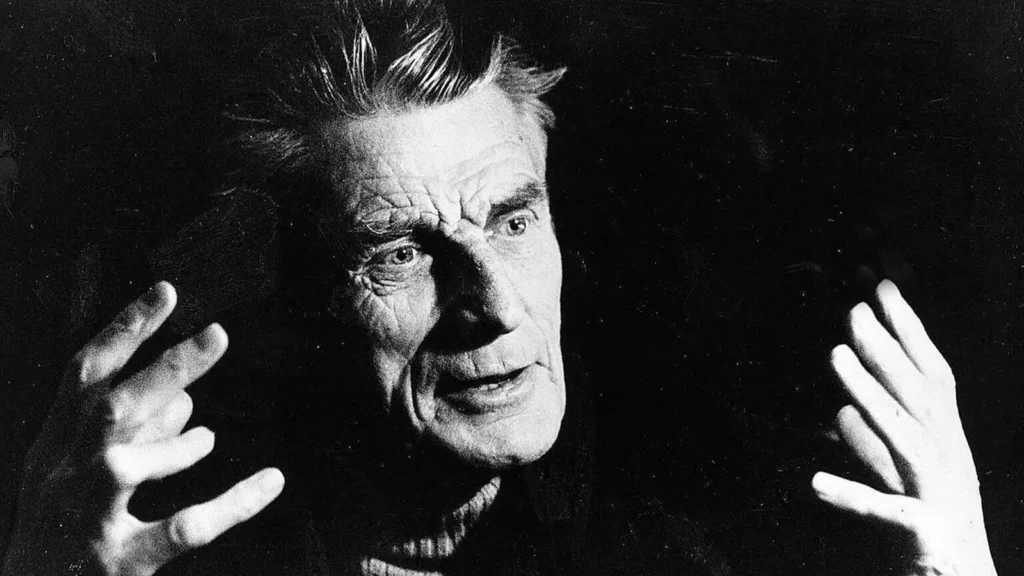
He arrives each evening with the same face and the same message, and each evening he claims not to have come before. This is not a minor detail of stagecraft. It is the most precise anatomical cut in the entire play. The boy who tells Vladimir and Estragon that Godot will not come tonight but surely will come tomorrow is not a messenger of bad news. He is a messenger of perfect, self-renewing hope, and that distinction is the difference between disappointment and captivity.
What Beckett understood, writing the play between October 1948 and January 1949 in a burst of what he himself called “a frenzy of writing,” is that systems of control rarely operate through outright denial. They operate through the management of anticipation. The boy does not say Godot does not exist. He does not say Godot will never come. He says tomorrow, and that single syllable is enough to reset the entire mechanism, to wind the clock back to the beginning, to make the waiting feel not futile but merely incomplete. There is a profound difference between a promise broken and a promise deferred, and institutional power has always known which one produces obedience.
The Catholic Church spent centuries constructing eschatology around precisely this architecture. The Kingdom of God is not here yet, but it is coming, and your suffering in the meantime is not meaningless but preparatory. The Soviet apparatus told its citizens throughout the 1930s and 1940s that the true communist society was still ahead, that present austerity and terror were the necessary passage, that the radiant future would justify everything. Neither system needed to deliver. Both needed only to keep tomorrow credible. What the boy offers Vladimir and Estragon is theologically and politically identical to these structures: the perpetual adjacency of fulfillment, close enough to sustain the wait, far enough to never arrive.
There is a woman sitting in a village somewhere in the early twentieth century who has been told her son disappeared in a war that ended eleven years ago. Every few months a local official visits and tells her the case is still open, that there may be new information soon, that she should not lose hope. She does not lose hope. She cannot. The hope is not hers to keep or discard. It has been installed in her by the very machinery that depends on her continued waiting. By the time she understands this, she has already given the best years of her resistance to the keeping of it.
Theodor Adorno, in his 1961 essay on the play, argued that Beckett refuses the audience any foothold of meaning, that the work produces what Adorno called the “expression of the inexpressible” — a form whose emptiness is itself the content. But what Adorno’s reading perhaps underweights is the operational precision of the boy. The play is not only about the absence of meaning. It is about the specific technology by which that absence is made to feel like a temporary condition. The boy is not a symbol of existential void. He is a functionary. He performs a task that keeps the system running, and he performs it without malice, without awareness, and without memory, which is the most chilling part of all.
An institution that forgets it has made a promise can make it again with full sincerity. A religion that genuinely believes in its own tomorrow does not lie when it preaches it. A political movement whose cadres truly expect the revolution’s vindication are not cynics but something more dangerous: true believers in a deferral they will never stop renewing. The boy is not cruel. He is simply doing what the structure requires of him, and the structure requires that he return tomorrow, and the day after, and every day after that, carrying the same message in the same clean hands, remembering nothing, promising everything.
🎭 Waiting, Absurdity, and the Human Condition
Beckett’s Waiting for Godot stands as one of the most radical explorations of existential paralysis, language, and the absurd in all of modern literature. Its themes of meaningless waiting, failed communication, and the persistence of hope against all reason resonate deeply with a broad tradition of philosophical and literary inquiry. The articles below trace the same labyrinthine corridors of human existence.
Camus’s Myth of Sisyphus: The Absurd Explained
Camus’s essay on Sisyphus is perhaps the most essential companion piece to Beckett’s drama, as both works circle the same existential void with unflinching honesty. Where Godot’s tramps wait endlessly, Sisyphus rolls his boulder in eternal repetition, and Camus insists we must imagine him happy. This shared embrace of the absurd as a condition of authentic living makes both works indispensable to each other.
GO TO THE SELECTION: Camus’s Myth of Sisyphus: The Absurd Explained
Brecht’s The Threepenny Opera: Analysis
Brecht’s Threepenny Opera, like Waiting for Godot, dismantles theatrical illusion and forces the audience into uncomfortable self-awareness. Both works use alienation and formal disruption to expose the mechanisms of a society that leaves its most marginal figures in perpetual suspension. Reading Brecht alongside Beckett reveals how the mid-twentieth century stage became the primary arena for philosophical revolt.
GO TO THE SELECTION: Brecht’s The Threepenny Opera: Analysis
Kafka and Bureaucracy: The Trial and The Castle
Kafka’s bureaucratic labyrinths in The Trial and The Castle prefigure Beckett’s existential stalemates with eerie precision. In Kafka, characters wait for judgments that never arrive and seek access to powers that remain forever opaque, just as Vladimir and Estragon await a Godot who never comes. This article traces how Kafka’s prose architecture became a foundational template for the theatre of the absurd.
GO TO THE SELECTION: Kafka and Bureaucracy: The Trial and The Castle
Mann’s Doctor Faustus: Analysis
Thomas Mann‘s Doctor Faustus explores the pact between artistic genius and demonic forces, staging a spiritual crisis that mirrors the exhaustion of meaning at the heart of Beckett’s work. Both novels confront the collapse of humanist certainty in the aftermath of catastrophic historical violence. Together they illuminate how postwar literature was compelled to reinvent its very language in order to speak the unspeakable.
GO TO THE SELECTION: Mann’s Doctor Faustus: Analysis
Discover Cinema That Asks the Same Questions
If Beckett’s theatre teaches us anything, it is that the most profound art lives in the space between expectation and silence. On Indiecinema streaming you will find independent and avant-garde films that share that same restless courage — works that refuse easy answers and invite you to sit with uncertainty, just as Godot’s tramps have always done. Explore our curated catalog and let the waiting become a journey.
👉 EXPLORE THE CATALOG: Watch Indie Films in Streaming
A vision curated by a filmmaker, not an algorithm
In this video I explain our vision

