
The Man Who Staged Waiting
You are sitting in a waiting room — not the kind with numbered tickets and fluorescent lights, though those exist too — but the deeper kind, the one that has no door marked “exit” and no clerk who will eventually call your name. You are waiting for something to resolve, for a conversation to finally mean what it seemed to promise, for the version of your life that you were told was coming if you simply held on long enough. The chairs are adequate. The light is tolerable. Nothing is wrong, exactly, and that is precisely the problem. You are suspended in a grammar that has misplaced its verb.

This is not a metaphor Samuel Beckett invented. He excavated it. Born on Good Friday, April 13, 1906, in Foxrock, a prosperous suburb south of Dublin, he arrived into a world that already spoke in the cadences of deferral. The date matters in the way biographical details matter when they are almost too neat to be coincidental: the day Christianity marks as the pause between death and resurrection, the interval when nothing is confirmed and the story has not yet decided what it is. Whether Beckett ever made much of this himself is beside the point. The fact lodged itself in the record, and the record has its own gravity.
Foxrock in 1906 was the kind of place that organized itself around what it was not. It was not Catholic, not nationalist, not poor, not quite English, and not entirely Irish. The Protestant Anglo-Irish middle class that produced Beckett occupied a peculiar stratum of colonial existence: prosperous enough to maintain distance from the Catholic majority, but too provincial and too Irish to be fully absorbed into the British establishment they still half-resembled. His father, William Beckett, was a quantity surveyor, a man who measured things for a living, who quantified the distance between what was planned and what was built. His mother, Mary Roe, known as May, was devout, exacting, and capable of a silence that functioned as its own form of verdict. The household was not cruel. It was refined in its disappointments.
The philosopher Charles Taylor, in Sources of the Self published in 1989, traced how modernity produced a subject haunted by the gap between its inner life and any available external validation — a self that is always slightly more than what any institution, faith, or relationship can confirm. Beckett did not read Taylor, but he grew up embodying the condition Taylor would eventually describe. The Anglo-Irish Protestant world offered its children a framework — respectability, education, a particular accent, a set of manners — that was already losing its authority even as it was being transmitted. To inherit a set of values whose social ground is shifting beneath your feet is to be handed a map of a country that is quietly ceasing to exist.
He was educated at Portora Royal School in Enniskillen, the same institution that had shaped Oscar Wilde a generation earlier, which tells you something about the narrow channels through which Protestant Irish intellectual life was funneled. He excelled, particularly in cricket and French, two activities that reward patience, precision, and the management of futility. He went on to Trinity College Dublin, studied modern languages, graduated with a gold medal in 1927, and arrived in Paris the following year as a lecteur at the École Normale Supérieure — a position that placed him inside French intellectual life at the precise moment it was becoming the laboratory of European modernism. He met James Joyce almost immediately, and that encounter would function less like an influence and more like a pressure system, the kind that shapes weather rather than suggesting it.
But before Joyce, before Paris, before the career that would culminate in the Nobel Prize for Literature awarded in 1969, there was the boy in Foxrock, learning how to wait without appearing to wait.
The Kempinsky Method

Drama, by Federico Salsano, Italy 2020.
The introspective imaginary road movie of a man in the maze of his own mind, his memories of his youth, his never dormant passions and contradictory truths. The road is made of water, the destination is falsely unknown. His traveling companions are three mysterious men, projections of his imagination and of different aspects of his personality: the perennial melancholy, the crazy creative, the introverted child. He is also followed by a female presence that tells the umpteenth human story. At a certain point of the crossing he decides to abandon the boat and his ghosts of him diving into the sea and arrives swimming on a deserted beach, naked, with a small Pinocchio puppet closed by a padlock.
In this splendid film life is like a long sea voyage and the human being is a small creature confronting immensity. Sometimes the ocean is calm, other times there are terrible storms. Sometimes we are captains of a boat with a well-defined route, other times we are shipwrecked in search of a land in which to save ourselves. But despite the long journey and the movement in physical space, there are other questions that resonate in the mind: who are these men I travel with? What is the mystery of this immense mass of water that seems to be made of my memories? You can circumnavigate the whole world but the main question always remains the same: who am I really?
LANGUAGE: italian
SUBTITLES: english, spanish, portuguese, german, french
Trinity, Paris, and the Refusal of Belonging
You sit in a lecture hall that smells of old wood and certainty, surrounded by men who have already decided what literature is, and you begin to understand that the most dangerous education is the one that works.
Trinity College Dublin in the early 1920s was an institution that wore its Protestant Anglo-Irish identity like armor, a place structurally designed to produce administrators of inherited culture rather than its interrogators. Beckett arrived there in 1923, read Modern Languages, and excelled with the particular efficiency of someone who has not yet decided whether to use what he is learning. He graduated with a gold medal in 1927, which is the kind of biographical detail that sounds like arrival but was in fact a door opening onto a much longer corridor of refusal. The prize meant he had mastered a system whose premises he would spend the next five decades methodically dismantling.
The lectureship at the École Normale Supérieure in Paris, which he took up in 1928 as an exchange teacher, placed him inside one of the most intellectually pressurized environments in Europe, a place where ideas arrived already wearing the weight of their own importance. It was there that Thomas MacGreevy, the Irish poet and critic who would remain one of Beckett’s closest correspondents across decades, made the introduction that would alter everything. James Joyce was by then already legendary in the specific way that living people become legendary: surrounded by disciples, half-blind, working on what would become Finnegans Wake, the text that would not appear in final form until 1939, a book attempting nothing less than the dream-logic of the entire Western unconscious condensed into a single night of sleep.
Beckett became useful to Joyce in practical ways first, reading to him, running errands for a man whose deteriorating eyesight had made the physical world increasingly mediated. But the intellectual proximity was something more complicated than discipleship. What Beckett witnessed was a writer in the grip of a maximalist ambition so total it had consumed the possibility of outside perspective. Joyce was adding, always adding, dense linguistic strata upon strata, the word multiplying itself until it threatened to collapse under its own referential mass. The 1929 essay Beckett contributed to the collaborative volume Our Exagmination Round His Factification for Incamination of Work in Progress was a brilliant defense of Joycean method, but defenses are not endorsements — they are often the last thing a person writes before changing direction entirely.
What Beckett absorbed from those years was not technique but a negative lesson, the kind that only proximity to genuine greatness can teach. He saw what happened when a writer’s ambition pointed outward, toward total inclusion, toward the annihilation of silence through sheer verbal accumulation. The result was magnificent, unrepeatable, and in some fundamental sense a closed system: you could live inside Ulysses or Finnegans Wake, but you could not inherit them, could not use them as a beginning because they were themselves an ending, a literature that had eaten its own future. Theodor Adorno, writing later in Aesthetic Theory published posthumously in 1970, would describe the modernist artwork as defined by the tension between its materials and the historical impossibility of their innocent use. Beckett seems to have felt this before Adorno formulated it.
The minimalism that would define everything from Waiting for Godot onward was not a stylistic preference. It was an epistemological position arrived at through confrontation with the opposite extreme. Silence in Beckett is not the silence of a man with nothing to say. It is the silence of someone who has stood inside the loudest room imaginable and understood that the noise was a symptom — of anxiety, of the self’s terror at its own emptiness, of the writer’s compulsion to fill the void precisely because they cannot bear to name what the void actually is.

The Epiphany in the Storm

You are standing in a shed. The roof is corrugated iron and the storm outside is not metaphorical — it is the actual Irish Sea thrashing the coast at Dún Laoghaire in 1945, and the man inside is thirty-nine years old, recently returned from occupied France, carrying the residue of resistance work and near-death and the long specific exhaustion of having survived. Something breaks open in him that night. Not inspiration in the Romantic sense, not a visitation of light, but its precise opposite: a recognition that everything he had been trying to do — accumulate learning, match the erudition of his mentor, build literature from knowledge outward — was a fundamental error. What arrived in that shed was not an answer. It was permission to know nothing, and to begin there.
This is not the language of mysticism, though it rhymes with it dangerously. The via negativa — the apophatic tradition running from Pseudo-Dionysius through Meister Eckhart into the great negative theologians — held that the divine could only be approached by stripping away every positive attribute, every confident naming, every accumulated doctrine. What you cannot say outlasts what you can. Beckett was not a theologian and had no interest in salvaging God, but the structural logic seized him entirely: that truth, or whatever stood in its place, was more honestly pursued through subtraction than addition, through failure as method rather than failure as accident. He would later describe this moment to James Knowlson, whose 1996 biography Damned to Fame remains the most rigorous account of Beckett’s life, as the pivotal turn — the moment he understood that his own weakness, his ignorance, his darkness, were not obstacles to writing but the very material of it.
The consequence was immediate and radical. Where his earlier work had pressed outward toward Joyce’s oceanic accumulation — the density of reference, the multilingual punning, the performance of total cultural absorption — the new direction inverted that entire gravitational field. Less. Less again. Molloy, written in French in 1947, begins with a man who cannot remember how he arrived where he is, narrating backward through a collapse of physical and cognitive capacity. The novel does not mourn this deterioration. It inhabits it with something closer to relief, as though the shedding of certainty were the only form of honesty available to a consciousness that has outlasted its own coherence.
Georg Wilhelm Friedrich Hegel argued in the Phenomenology of Spirit that consciousness advances through negation, that each stage of knowing destroys what came before in order to constitute something higher. Beckett takes this structure and removes the teleology entirely. There is negation, constant and merciless, but no synthesis waiting at the end of it. Malone Dies continues the trilogy’s project with a dying man inventorying his possessions and his stories, watching both dissolve before he can complete the account. The inventory fails. The stories contradict themselves. The dying takes longer than the narrative can sustain. What is left is not resolution but an exposure of the machinery by which humans try to impose sequence on experience that has none.
By the time The Unnamable appeared in 1953, completing what Beckett himself called an impasse rather than a trilogy, the narrator has been stripped of body, location, name, and grammatical certainty. “I can’t go on, I’ll go on” is not a paradox resolved by dialectical cleverness — it is a description of the actual phenomenology of consciousness that cannot stop, that persists past every reason to persist, that finds the act of continuing indistinguishable from the act of failing to stop. Simone Weil, writing in the same post-war years in Waiting for God, described attention as a form of self-emptying, a clearing away of the self so that something else might be received. Beckett’s narrators empty themselves of everything and receive only the continuation of the emptying, which turns out to be inexhaustible, which turns out to be,
Language as a Trap You Cannot Exit
You are sitting at a desk, writing in a language that is not the one your mother used when she called you back inside. The sentences come slower. The idioms you would normally reach for — those automatic rescue ropes of fluency — are not there. Every word has to be earned. And in that friction, something terrifying becomes visible: language was never expressing you. You were always just filling in the blanks it prepared in advance.
This is not a metaphor for Samuel Beckett’s decision to begin writing in French in the late 1940s. It is precisely what happened. After the Second World War, after years of working in English and in the long gravitational shadow of James Joyce, Beckett made a choice that his contemporaries largely misread as eccentricity. He abandoned the language of his Irish Protestant upbringing and began composing in a tongue that offered him no inherited oratorical shelter. The novels Molloy, Malone Dies, and The Unnamable — written in French between 1947 and 1950, then self-translated into English — were not the work of a man performing artistic exile. They were the work of a man who had deliberately broken the instrument to see what it was actually made of.
Gilles Deleuze and Félix Guattari, in their 1975 study of Franz Kafka, introduced a framework that illuminates this act with unsettling precision. A minor literature, they argued, is not the literature of a minor language — it is what a minority does with a major language, deterritorializing it, stripping it of its comfortable sediment, making it stutter and crack under the weight of what it normally conceals. Kafka writing in German as a Prague Jew enacted this. Beckett writing in French as an Irishman who could have written in the dominant literary English of his era enacted something structurally identical and psychologically more violent. He chose the foreign precisely because the familiar had become a kind of lie.
What the familiar hides is the degree to which eloquence is a social performance masquerading as sincerity. English, for Beckett, carried centuries of rhetorical inheritance — the sermon, the novel of manners, the philosophical essay, the lyric tradition. These forms do not simply convey thought; they pre-shape it, pre-authorize it, pre-dignify it. To write in them was to participate in a long consensus about what a sentence ought to sound like when a serious person is being serious. French, stripped of that particular inheritance, forced him to write sentences that had nowhere decorative to hide. The poverty became the method.
The result was a prose that performed its own failure as its content. Characters in the trilogy speak at length about their inability to speak, use language to describe language’s inadequacy, generate clauses that cancel themselves within the same breath. This is not stylistic nihilism. It is a rigorous phenomenology of what happens when you refuse to let the machinery of expression run on autopilot. Ludwig Wittgenstein, in the Philosophical Investigations published in 1953, argued that the limits of one’s language are not the limits of one’s world but of the world one has been handed — that private meaning is a philosophical illusion, that words are moves in shared games we did not design. Beckett arrived at the same territory from the other direction, not through analytic philosophy but through the act of writing itself, through the experience of sitting inside a language and finding the exits sealed.
What you discover when exits are sealed is that you were never speaking freely to begin with. Every sentence you have uttered in your life was a negotiation with inherited form, and the eloquence you took to be self-expression was largely a fluency in conformity. The question Beckett’s work leaves hanging — not as a lesson but as an open wound — is whether there is a single thought you have ever had that was not already spoken for you before you opened your mouth.
Waiting for Godot and the Theater of Non-Event
The night of January 5, 1953, you are sitting in a small theater on the Left Bank, and nothing is happening. Two men stand on a bare stage near a tree that may or may not be dead, and they talk, and they wait, and the thing they are waiting for does not come. The audience around you shifts in their seats. Several people leave. Those who stay are not sure, afterward, whether they have witnessed a masterpiece or been subjected to an elaborate joke at their expense. Both responses, it turns out, are correct.
Within a decade, En attendant Godot had been translated into more than twenty languages and performed on nearly every continent, including a 1957 production staged for fifteen hundred inmates at San Quentin, men who reportedly understood the play immediately and completely, with a directness that no Parisian intellectual had managed. The prisoners did not debate the symbolism. They recognized the situation. They were living inside it.
The critical apparatus that built up around the play almost immediately began doing the work that the play itself refuses to do: providing meaning, anchoring the uncertainty to something stable. Godot became God, or death, or salvation, or the Communist revolution, or the existential horizon. Roger Blin‘s direction, the Matisse-like sparseness of the staging, the Irish cadences flattening into French and back again — all of it was recruited into a system of interpretation that Beckett himself consistently and sometimes contemptuously resisted. When pressed about who Godot was, he said that if he knew, he would have said so in the play. This was not false modesty. It was a diagnostic refusal, a refusal to let the audience escape into allegory.
What the allegorical readings systematically avoid is the play’s most uncomfortable proposition: that Vladimir and Estragon are not in an exceptional situation. They are not figures of cosmic abandonment or philosophical desolation. They are figures of Tuesday afternoon. The waiting they enact is not a dramatic metaphor for the human condition in some grand theological sense — it is a precise and merciless documentation of how the majority of conscious human hours are actually structured. You fill time with someone else not because the time contains something worth filling, but because the alternative, being alone with the absence of event, is insupportable. The conversation is not communication. It is noise against silence. The routines, the arguments, the little cruelties and small tenderness between the two men — these are not symbols of anything. They are the performance itself, running because the performance must keep running, because stopping means acknowledging that there is no audience, no arrival, no second act in the sense that matters.
Erving Goffman published The Presentation of Self in Everyday Life in 1959, six years after the premiere, and built an entire sociological architecture around the idea that social interaction is fundamentally theatrical — that people perform for each other constantly, managing impressions, sustaining roles, maintaining the fiction of a coherent self before witnesses. What Beckett had already staged was the logical endpoint of that architecture: performance continuing even when the witnesses are unreliable, the audience absent, the roles stripped of their justifying narrative. Vladimir and Estragon keep performing for each other because performance is all that holds the self together when the external validating structure has failed to appear. Godot’s non-arrival is not the tragedy. It is simply the condition made visible.
There is a particular kind of courage in a theatrical work that refuses to reward the attention it demands. Most drama, even the most formally adventurous, offers the audience something in exchange for their time — catharsis, revelation, the aesthetic pleasure of structure resolving. Beckett understood that the refusal of that exchange was not a formal experiment but a truth-telling act, and that audiences would resent it precisely to the degree that it was accurate about them.
A vision curated by a filmmaker, not an algorithm
In this video I explain our vision
Endgame, Power, and the Room That Cannot End

You already know this room. You have lived in versions of it — the office where you stay past six because leaving feels like a kind of abandonment, the relationship where every departure is rehearsed but never executed, the household where one person commands from a fixed position and the other circles endlessly, performing tasks that satisfy no one, least of all themselves. Beckett built it with four walls, two windows too high to see through, a dying father in a bin, and a man in a wheelchair who cannot stand but whose voice fills every cubic inch of available air.
Fin de partie, which premiered in French at the Royal Court Theatre in London on April 3, 1957, is not a play about the end of the world, though audiences have always wanted it to be. Apocalypse is easier. If the world outside is dying, the room makes sense as shelter. But Beckett refuses that comfort. The world outside may be dead, or it may simply be unwatched. It does not matter. What matters is that Clov cannot leave, and Hamm cannot move, and neither of these facts is the result of physical necessity alone.
Michel Foucault, writing nearly two decades later in Surveiller et punir in 1975, described how modern power stopped needing chains. The great institutional innovation of the nineteenth century was not the dungeon but the arrangement — the spatial and relational architecture that made subjects police themselves, internalize the gaze, remain in place not because escape was physically blocked but because the subject had ceased to imagine themselves as someone for whom escape was a meaningful category. Bentham’s panopticon was the diagram. Hamm’s chair is its domestic counterpart. He cannot see without Clov describing the world to him. Clov cannot act without Hamm’s authorization. Each one is the other’s prosthesis, and the system perpetuates itself precisely because dismantling it would require both of them to become something neither has the vocabulary to name.
What makes the play a precise anatomy rather than a metaphor is that Beckett never allows the dependency to appear as weakness. Hamm bullies, controls, narrates his own suffering with a performer’s deliberate timing. He is tyrannical in the way that only the genuinely helpless can be — because helplessness, when it cannot be escaped, becomes a form of governance. The person who needs everything controls the emotional weather of everyone around them. Families understand this. Institutions understand this. The hospital ward, the care home, the marriage in its fifteenth year of unhappiness — these are not exceptional structures. They are the norm, and the norm depends not on violence but on the mutual terror of the vacancy that would follow separation.
Clov’s repeated declarations that he will leave function in the play the way resignation letters function in certain workplaces: as pressure valves that release enough tension to make continuation possible. The threat of departure sustains the arrangement. Every time Clov reaches the door and stops, Hamm’s authority is not undermined but confirmed, because Clov’s return proves that even the one with legs cannot walk out. The power here is not located in Hamm alone. It is located in the structure between them, which is why eliminating one figure would not end it. The structure would reconstitute itself with new inhabitants, as it always has.
Beckett had spent the war years in hiding, had watched entire arrangements of European life collapse and then, astonishingly, reassemble into almost identical configurations with different names. He knew that sealed rooms are not exceptions. They are what human beings build when they need to feel that something, at least, will hold. The paradox is that what holds them inside the room is not the walls. It is the unspoken agreement that the question of whether to leave will never be answered — only asked, again and again, in slightly different language, until asking itself becomes the only form of living either of them knows how to do.
The Nobel and the Silence That Followed
You are standing in a room where someone is being congratulated for having spent their entire life insisting that congratulation means nothing. The handshakes are firm. The speeches are eloquent. The cameras record everything. And the man being honored is not there, because he is in Tunisia, helping a friend build something, saying nothing about why he has chosen not to attend the ceremony in Stockholm where, in December 1969, the Swedish Academy awarded him the Nobel Prize in Literature. The official citation praised his writing for giving “new elevation to human destitution.” The institution had found a way to frame the negation as affirmation, the wound as monument, the refusal as a kind of achievement one could safely applaud.
What happens when a system of cultural prestige absorbs a body of work whose entire architecture is built on the illegitimacy of prestige? The answer is not destruction. The answer is digestion. Guy Debord, writing two years before that Stockholm ceremony in The Society of the Spectacle, had already named this process with unsentimental precision: recuperation, the mechanism by which any gesture of refusal is converted into a consumable image of refusal, stripped of its danger, repackaged as style. The avant-garde becomes the new academy. The critique becomes the syllabus. The man who wrote that there is nothing to express and nothing with which to express it is awarded the world’s most prestigious literary prize, and the contradiction is not felt as contradiction — it is felt as depth. The prize did not misunderstand Beckett. It understood him perfectly and consumed him anyway.
What makes this more than irony is the structural logic Debord was tracing: late capitalism does not suppress its critics, it promotes them. The shelf life of transgression is extended precisely by giving it an institutional address. Beckett’s drama of failure, of language collapsing under the weight of what language cannot carry, entered university curricula, became the subject of dissertations in forty languages, was performed in prisons and opera houses with equal solemnity. By 1986, the Grove Press catalogue listed over thirty critical studies of Endgame alone. The negation had become an object of study, which is to say, an object. The thing that could not be finished became a subject for conferences on how it could not be finished.
Beckett himself responded to the prize with what his biographer James Knowlson, in Damned to Fame published in 1996, described as genuine distress — not false modesty, but a specific kind of anguish at having the silence made loud. He donated the prize money quietly and gave no lecture. What he produced in the years that followed was not silence in the everyday sense but something structurally more severe: texts that contracted toward the irreducible, works so spare they seemed to be testing whether literature could survive its own evacuation. Ill Seen Ill Said from 1981 runs to fewer than forty pages and reads like a document written after language has already resigned. Worstward Ho from 1983 contains the phrase that would be extracted, framed, and posted on office walls and motivational slides around the world — “Try again. Fail again. Fail better” — a sentence torn from a context in which failure is not a strategy but a condition, not an encouragement but a verdict. The recuperation was total. The most uncompromising argument against perseverance-as-virtue became the century’s most popular slogan for resilience.
This is the particular violence that institutions do to difficult art: not censorship but caption. They do not silence the work. They retitle it. They hand it a function it was built to refuse and invite the audience to feel moved by the depth of the refusal while experiencing none of its discomfort. The reader who weeps at the beauty of Beckett’s despair and then returns to their life unchanged has not misread him — they have been
Dying Sentences and the Unfinished Body
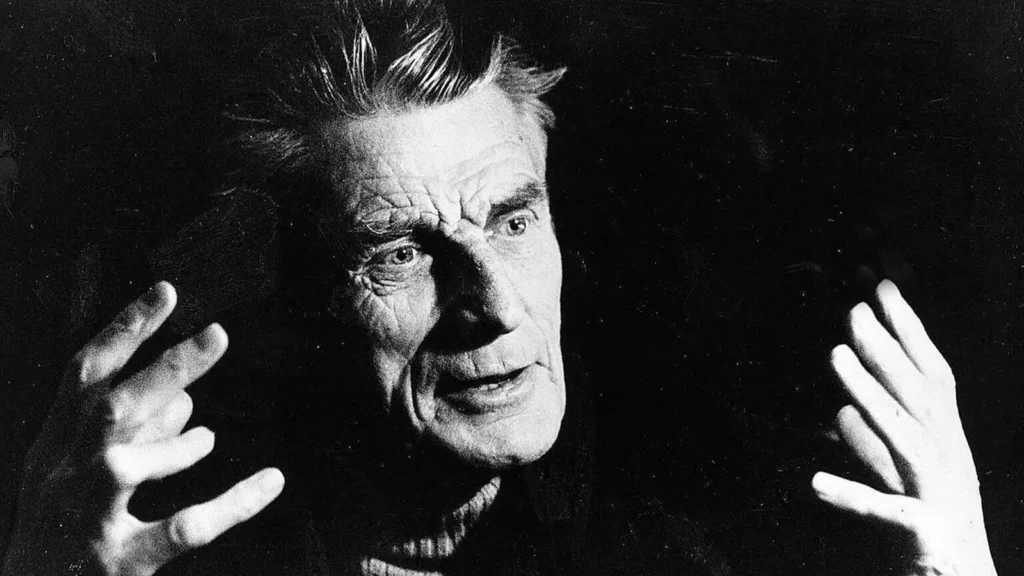
You are reading a sentence that does not know how to end, and somewhere in your body you recognize it — not as a literary device but as a fact about waking up at three in the morning with the sense that the thread connecting you to yourself has gone slack, that the voice narrating your life is still running but has lost its referent.
That is the condition Beckett wrote from and toward in the last decade of his life, producing three short prose works that together constitute something closer to a medical record than a literary trilogy. Company, published in 1980, opens with a body lying in the dark, a voice coming to it from without, and the radical uncertainty of whether the voice is companionship or symptom. The prose is stripped to a syntax so minimal it reads like the output of a brain doing triage, keeping only what is strictly necessary to generate the next unit of meaning. By 1981, Ill Seen Ill Said had introduced an old woman crossing a field, perceived by a consciousness whose perceptual apparatus is visibly breaking down, the words themselves marked by the deterioration: ill seen, ill said, not lying but failing at the level of instrument. The failure is not metaphorical. Beckett was in his mid-seventies, suffering from emphysema, glaucoma, and Parkinson’s tremors that made writing physically difficult. The sentence bearing witness to the old woman’s crossing is also a sentence being written by a hand that shakes.
What this does to the concept of consciousness is more disturbing than anything Descartes or Locke managed, because it refuses the consolation of abstraction. The philosophical tradition largely treated consciousness as the one thing exempt from doubt, the residue left after everything else is dissolved — Descartes’s cogito standing as the purest case, the thinking that survives its own demolition. But what Beckett observed in himself and transcribed into Worstward Ho in 1983 is a consciousness that is not substrate-independent, not a flame that burns cleanly above the body, but something produced by tissue, dependent on tissue, degrading with tissue. The famous opening imperative of that text — “On. Say on. Be said on.” — is not an affirmation of life. It is a command issued to a system running on diminishing resources, a directive to keep generating output when the input is failing. The philosophy of mind spent the twentieth century asking whether consciousness could be explained in physical terms; Beckett simply watched his own fail and wrote it down.
There is a brutality in reading these texts that readers often mistake for coldness. It is not cold. A surgeon is not cold when she cuts. What Beckett eliminated was sentimentality’s function as anesthetic — the small doses of meaning and resolution that readers expect to receive so that the experience of consciousness unraveling can be domesticated into something that ultimately confirms the self rather than threatens it. Worstward Ho refuses this at the level of grammar. Its sentences syntactically collapse and reconstruct, fail and continue, producing a rhythm that is biological before it is literary — the rhythm of a system attempting to maintain coherence under progressive degradation. Samuel Beckett died on December 22, 1989, in a nursing home in Paris, and was buried four days later beside his wife Suzanne in the Montparnasse Cemetery. He had been writing until he could no longer write. The last works exist not as testament but as evidence of something that kept generating sentences even when the body had nearly exhausted its capacity to hold sentences upright.
The wound these texts leave in the reader is precisely the absence of the resolution that the tradition of the dying artist typically provides — the final lucidity, the achieved meaning, the consolation of a life that closes like a sentence with its subject and verb in agreement, the world made grammatical one last time before it goes dark.
🌀 The Abyss of Existence: Beckett and His World
Samuel Beckett’s work inhabits a universe of waiting, silence, and the stubborn persistence of being. To understand his labyrinthine vision, one must explore the writers, thinkers, and artistic currents that share his obsession with absurdity, alienation, and the limits of language. These four articles open the doors to that shared existential maze.
Albert Camus: Life and Philosophical Thought
Albert Camus, like Beckett, confronted the fundamental absurdity of human existence and refused easy consolations. His philosophical framework of the absurd — the collision between humanity’s hunger for meaning and the universe’s silence — resonates deeply with Beckett’s theatrical worlds of waiting and futility. Reading Camus alongside Beckett illuminates the shared existential landscape that defined postwar European thought.
GO TO THE SELECTION: Albert Camus: Life and Philosophical Thought
Kafka and Bureaucracy: The Trial and The Castle
Franz Kafka‘s world of impenetrable bureaucracies and protagonists trapped in systems they cannot comprehend prefigures many of Beckett’s central themes. Both writers populate their works with figures who wait endlessly, who speak compulsively, and who are denied any clear verdict or exit. The parallel between Kafka’s castles and Beckett’s barren landscapes reveals a common architecture of modern despair.
GO TO THE SELECTION: Kafka and Bureaucracy: The Trial and The Castle
Bertolt Brecht: Life and Works
Bertolt Brecht and Samuel Beckett represent two towering and contrasting responses to the crisis of twentieth-century theatre. Where Brecht sought to provoke political consciousness through alienation effects and social critique, Beckett stripped drama down to its bare existential bones. Together, they redefined what theatre could be and what it was permitted to ask of its audience.
GO TO THE SELECTION: Bertolt Brecht: Life and Works
William James and Consciousness: The Stream of Thought
William James‘s exploration of consciousness as a continuous, flowing stream directly influenced the literary innovations that Beckett would later push to their radical extreme. Beckett’s interior monologues and fragmented voices in works like The Unnamable can be read as a dark extension of James’s psychological insights into the nature of thought and selfhood. Understanding James’s philosophy of mind enriches our grasp of why Beckett’s prose feels both relentless and inescapable.
GO TO THE SELECTION: William James and Consciousness: The Stream of Thought
Discover the Cinema of Existential Risk on Indiecinema
If Beckett’s universe of waiting and uncertainty has stirred something in you, Indiecinema streaming is the place where that feeling finds its visual counterpart. Our curated selection of independent and avant-garde films explores the same abyssal questions — identity, silence, the meaning of existence — through the most daring cinematic voices of our time. Step inside and let the screen become your stage.
👉 EXPLORE THE CATALOG: Watch Indie Films in Streaming
A vision curated by a filmmaker, not an algorithm
In this video I explain our vision

