
The Mirror You Chose to Step Into
You wake up and before your eyes have fully adjusted to the light, before you have spoken a word or eaten anything or decided what kind of day this will be, you have already reached for the phone. Not because something urgent is waiting. Because the motion has become reflexive, muscular, pre-conscious — the same way the tongue finds a loose tooth. You scroll. And what you are scrolling through is not the world. It is a curated archive of a self you are in the process of constructing, a hall of mirrors you built plank by plank and now inhabit as though you were born there.

Notice what happens when something genuinely beautiful crosses your day — a particular quality of afternoon light, a conversation that cracked something open, the specific silence after rain on hot pavement. The first instinct is not to remain inside it. The first instinct is to capture it, frame it, and release it into the network where it can be witnessed. Where it can be confirmed. The experience has not been negated by this, not exactly, but it has been interrupted at its most tender point, redirected from the interior toward the exterior before it had time to sediment into anything permanent. What you consumed was not the moment. What you consumed was the image of having had the moment.
Daniel Boorstin identified the architecture of this condition with uncomfortable precision in 1962, in a book called The Image: A Guide to Pseudo-Events in America, written at a time when television was still a novelty and the internet did not exist as a concept available to any living mind. His argument was not that Americans were becoming shallow — that accusation is as old as Tocqueville and produces nothing new. His argument was structural: that a civilization had systematically replaced the original with its own representation, and had then begun to prefer the representation. Not because people were foolish, but because the image is, in almost every measurable way, more satisfying than the thing it depicts. It is cleaner, more available, more repeatable, more controllable. The original event happens once and carries all the friction and ambiguity of actual time. The image can be revisited, shared, cropped, improved.
What Boorstin called the pseudo-event — a happening staged not to occur but to be reported, not to matter but to circulate — was in 1962 primarily the domain of press conferences, publicity stunts, and manufactured celebrity. The logic he was describing has since migrated inward, colonized the private life, and handed the production tools to every individual with a camera and a profile. The press conference is now your birthday photograph. The publicity stunt is now your engagement announcement. The manufactured celebrity is now you, performing continuity and coherence for an audience that includes your mother, your former colleague, and a stranger in another country who has never heard your voice.
There is a particular cruelty in how natural this feels. No one forced the frame onto your life. You stepped into it voluntarily, often eagerly, because the alternative — a life that accumulates without documentation, without external witness, without the mild narcotic of periodic validation — felt somehow insufficient. Less real, even. And here is where the trap closes in a way that deserves to be looked at directly: the image was supposed to represent the life, to point back toward it, to serve it. But the moment you begin making decisions — about where to eat, how to dress, which friendship to maintain, which version of grief is presentable — based on what the image requires, the relationship has inverted. The representation is no longer pointing at the life. The life is pointing at the representation, arranging itself in service of a product it will never fully become.
A Better Life
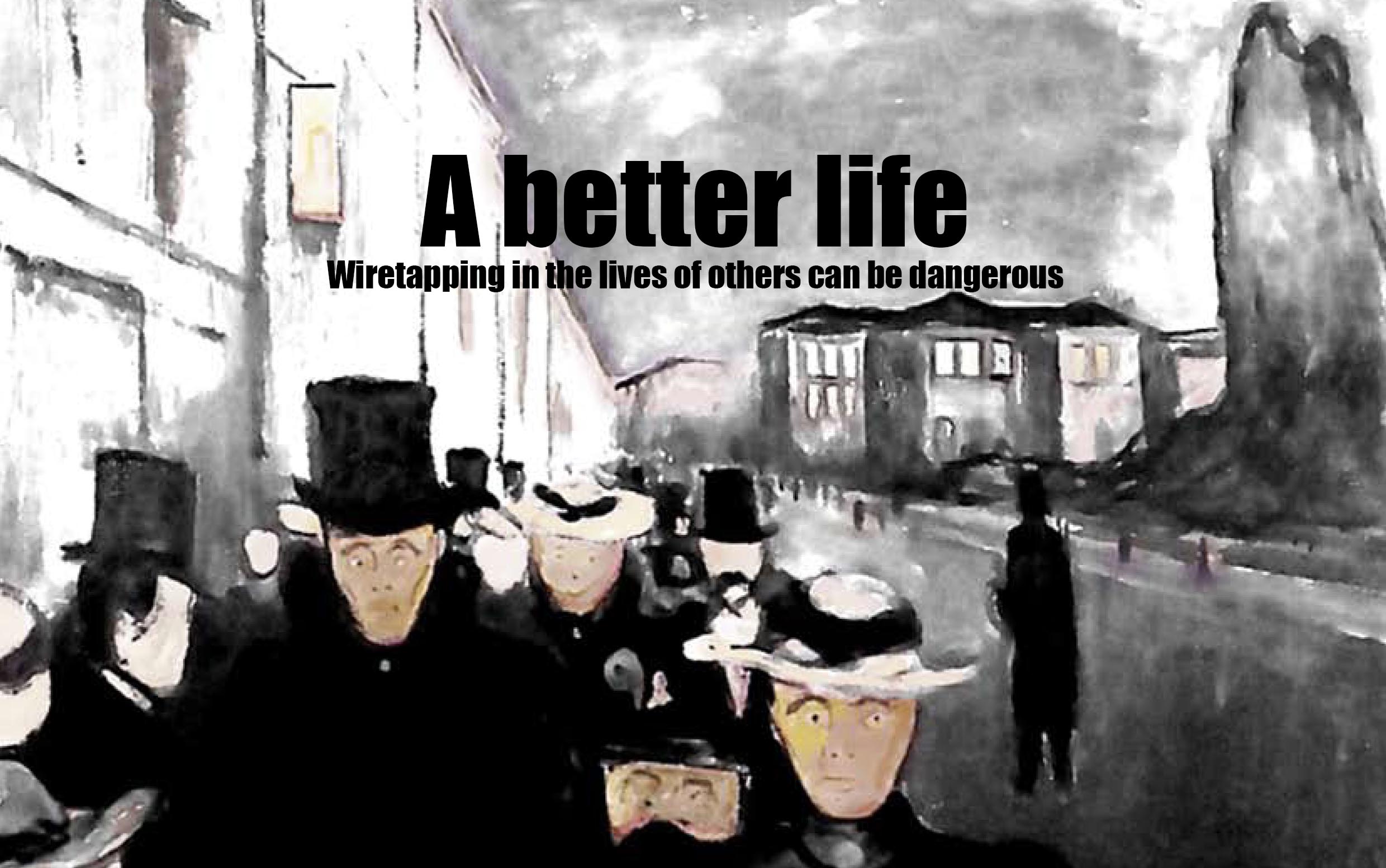
Drama, thriller, by Fabio Del Greco, Italy, 2007.
Rome: Andrea Casadei is a young investigator specializing in audio wiretapping who conducts investigations commissioned by husbands betrayed by their wives, or by parents worried about what their children are doing outside the home. But what interests him most is understanding the human soul, listening to casual conversations in the streets, knowing what people think. He often meets in Piazza Navona with his friend Gigi, a frustrated street artist obsessed with success at all costs, with whom he shares a passion for wiretapping. Shocked by the mystery of the disappearance of Ciccio Simpatia, another street artist common friend, Andrea decides to abandon the commissioned works to seek a better life and reflect on his own and others' existence. He will meet the actress Marina and with a bug he will slowly enter her life until he discovers her most unthinkable secrets. The film deals with an important theme of contemporary Western society: the lack of love. The mysterious and tormented figure of Marina is reflected in a gloomy and soulless Rome.
Director Fabio Del Greco declared about his film: "Perhaps this film is a reflection on the art of observing, of listening, in short, of what one does when one leaves the real world to tell about it. Perhaps he wants to talk about the subtle relationship between the mirages of success touted by today's society, power and the most authentic human relationships.A 'dark cloud' hangs over the city: it is engulfing everyone in a sort of indistinct, uniform mass, where everyone thinks the same things, where everyone they are more alone. Where is the truest part that makes us unique? Maybe you can try to intercept it only secretly."
LANGUAGE: Italian
SUBTITLES: English, Spanish, French, German, Portuguese, Dutch.
Boorstin’s Diagnosis and the Birth of the Pseudo-Event
You are sitting in a press conference — not because something happened, but because the press conference itself is what is supposed to happen. There is no event prior to this room. The microphones were set up before anyone had anything to say. The cameras arrived before the story existed. What you are watching is not the reporting of reality but the construction of it, and the man at the podium knows this, and the journalists know this, and everyone in the room has agreed, without signing anything, to pretend otherwise.
Daniel Boorstin named this agreement in 1962, and the name he gave it was the pseudo-event. In The Image: A Guide to Pseudo-Events in America, he made an argument that was not pessimistic so much as clinical — a diagnosis delivered without the comfort of a cure. His claim was precise and devastating: modern American culture had developed a systematic preference for fabricated events over spontaneous ones, not because people were stupid or corrupt, but because the machinery of communication had made the fabricated event more reliable, more repeatable, more photogenic, and therefore more real in every practical sense that mattered. The pseudo-event, he wrote, is not a lie exactly. It is something stranger — an event that is neither true nor false but simply arranged.
The press conference was his sharpest example, and it was well chosen because it had already become so normalized by 1962 that most people had ceased to notice it was a form at all. The institutional press conference — as a routine, scheduled, architecturally designed encounter between power and media — had emerged in its modern American form in the early twentieth century, formalized by Woodrow Wilson’s administration and industrialized by the postwar communications apparatus. By the time Boorstin was writing, it had become the default format for political reality. Nothing was considered to have happened until it had been said at a podium. The event and its announcement had collapsed into a single gesture, and the announcement had won.
What made Boorstin’s analysis genuinely unsettling was not the examples he chose but the structure he identified beneath them. A pseudo-event, he argued, has four defining characteristics: it is not spontaneous but planned; it is planted primarily for the purpose of being reported; its relation to the underlying reality of the situation is ambiguous; and it is usually intended to be a self-fulfilling prophecy. That last quality is the one that lingers. The press conference creates the news it claims to cover. The celebrity profile manufactures the fame it appears merely to document. Magazine profiles of Hollywood figures in the 1950s — a form Boorstin examined with forensic patience — were not journalism about celebrities. They were the mechanism by which celebrity itself was produced. The publicist, the editor, the photographer, and the subject operated inside a closed circuit in which exposure generated demand for more exposure, and the person at the center became famous for being covered rather than covered for being famous.
This is the epistemic inversion Boorstin spent the book tracing: a civilization that had learned to prefer the copy to the original, the interview to the deed, the image to the person. He was drawing on something Alexis de Tocqueville had intuited in Democracy in America as early as 1835 — that democratic cultures tend to produce a kind of equality of surface, a flattening of distinction, in which what something appears to be becomes more socially negotiable than what it is. Boorstin pushed this further into the specific machinery of the twentieth century: print runs, wire services, the photograph, the newsreel, the television broadcast. Each new medium accelerated the cycle. Each acceleration made the staged event more economically rational than the authentic one. By 1962, the infrastructure for manufacturing consensus reality was not a conspiracy. It was just an industry, and it was hiring.

When Reality Began Imitating Its Own Advertisement

You are watching the evening news in 1958, and something has changed that you cannot yet name. The anchor’s face is familiar in a way your neighbor’s face is not. His cadence, his authority, his slight pause before the serious story — you have absorbed these as ambient truth, the way you absorb the temperature of a room. You have not chosen to trust him. Trust happened to you, incrementally, through sheer repetition of his presence in your living room, and by the time you notice it, the architecture of your belief has already been built by someone else.
Daniel Boorstin was not the first to worry about mass media, but he was perhaps the first to locate the rupture with surgical precision — not in propaganda, not in advertising’s obvious cynicism, but in something more structural and therefore more durable. What he identified in The Image, published in 1961, was a civilizational pivot point that had occurred somewhere in the decade after World War Two, when American prosperity and American technology arrived at the same historical moment and produced something neither could have generated alone. The returning soldier who had fought for ideals — democracy, freedom, the dignity of the individual — came home to a country that was increasingly organized around images of those ideals rather than their substance. The distinction is not semantic. It is the difference between a flag and the republic it claims to represent.
Cheap photographic reproduction was the first accelerant. By the early 1950s, Life magazine was reaching over five million households weekly, delivering not the world but a curated photographic approximation of the world that felt more vivid, more dramatic, and more legible than any unmediated experience. Walter Benjamin had theorized in 1935, in his essay “The Work of Art in the Age of Mechanical Reproduction,” that reproductive technology destroys what he called the “aura” of an original — its singularity, its rootedness in a specific time and place. Boorstin extended this diagnosis from art into civic life: when the image of an event could be produced, distributed, and consumed faster than the event itself could be understood, the image became the event. The photograph of a political speech mattered more than the speech. The magazine cover mattered more than the person on it. The representation colonized the thing represented and then quietly evicted it.
Television completed what print had begun, but its mechanism was different and more intimate. Print asks you to go to it; television arrived in the living room and never left. By 1960, nearly ninety percent of American homes contained a television set, a saturation rate achieved in under fifteen years — faster than indoor plumbing had spread in the previous century. This was not merely a technological statistic. It was a reorganization of domestic consciousness. The television did not supplement reality; it competed with it, and it competed with structural advantages: its images were brighter, its narratives more compressed, its emotional signals more reliable than the ambiguous messiness of actual human life. A family argument resolves in twenty-two minutes. A war becomes comprehensible through three minutes of footage and a correspondent’s summary. Grief looks a specific way because you have seen it performed by professionals.
What Boorstin grasped, and what remains genuinely unsettling about his analysis, is that this was not a conspiracy. No single advertiser, no network executive, no government committee decided that Americans should prefer images to realities. The preference emerged organically from the machinery of abundance itself — from the fact that images were cheaper to produce, faster to distribute, and more emotionally satisfying than the difficult, unresolved texture of actual events. The market did not distort American culture. American culture became, structurally, a market for distortion, and it did so precisely at the moment when it had the resources and the technology to demand something better.
The Machinery of Glamour and the Death of the Hero
You are standing in a movie theater lobby in 1953, studying a cardboard standee of a woman you have never actually seen perform anything. She is not a dancer, not a singer in any way you could verify from where you stand. She is a face, a proportioned silhouette, a name printed in a particular font chosen by a man in a corner office who understood that legibility and desire operate on the same neural frequency. You do not know what she has done. You know only that she exists publicly, which is already enough to make her real to you in a way your own neighbor is not.
Daniel Boorstin, writing in The Image in 1962, drew the line with surgical coldness: the hero is known for his achievements, the celebrity for his well-knownness. The distinction sounds almost tautological until you realize it carries an entire theory of causation inside it. The hero produced something first, and the recognition followed as consequence. The celebrity inverts this entirely — the recognition is produced first, industrially, and achievement is then retrofitted around it, or never arrives at all and is simply never missed. What Boorstin was tracking was not a cultural degradation in taste but a structural substitution, a replacement of one apparatus with another, and the hinge point was not gradual. It was made of specific decisions, at specific addresses, in specific years.
By the late 1920s, the major Hollywood studios had developed what their own internal documents called the star system with frank mechanical honesty. Metro-Goldwyn-Mayer, under Louis B. Mayer and the production executive Irving Thalberg, was manufacturing public personalities with the same vertical integration it used to distribute films. A person arrived, was renamed, physically altered, given a fabricated biography polished enough to appear spontaneous, and then released into a press apparatus that was itself owned or contractually controlled. Louella Parsons and Hedda Hopper were not journalists operating with editorial independence; they were pressure valves in a system of managed disclosure, and every studio understood this. The celebrity was not a corruption of the star — the celebrity was the industrial product the star system had always been designed to produce. Boorstin saw this, but what he perhaps underweighted was how completely the audience was incorporated into the machinery, not as passive consumers but as necessary workers who agreed, repeatedly and willingly, to perform the labor of believing.
Advertising agencies accelerated the same logic in a different register. By 1941, the J. Walter Thompson agency was operating what it internally described as a personality transfer model, attaching human figures to products not because those figures had any credible relationship to the product but because the visibility of the figure could colonize the visibility of the object. The athlete endorsing a cigarette, the actress endorsing a cold cream: what was being sold was not expertise but proximity to a face the public had already been trained to recognize. Recognition itself became the transferable currency, detached entirely from the original act or quality that had supposedly generated it. At this point the heroic model doesn’t decline — it simply becomes operationally useless to the system.
What makes this brutal rather than merely cynical is the feedback it created in the culture’s understanding of aspiration itself. A generation raised inside this system did not learn to desire achievement and then seek recognition. They learned to desire recognition and then seek whatever achievement could most efficiently produce it. The distinction matters because it changes the internal architecture of ambition, the very shape of what a person wants when they want something for themselves. Ernest Becker, in The Denial of Death, published in 1973, argued that the hunger for symbolic immortality — for being seen, remembered, mattering beyond the biological — is the primary driver of human motivation. The star system did not create that hunger. It simply learned to charge admission at the only gate through which that hunger believed it could be fed.
A Man on a Screen Confessing Everything
You are watching someone cry on a screen, and something in your chest responds before your mind can catch up. The figure speaks in fragments, voice breaking at the right moment, eyes wet but holding contact with the camera lens as though it were a face. They are telling you something they have never told anyone. Except they have told three million people, and the telling was scheduled, and there was a thumbnail designed to catch you mid-scroll, and the crying was real but the architecture around it was constructed with the same precision as a television pilot.
Daniel Boorstin identified in 1962 what he called the pseudo-event: an occurrence staged not to happen but to be reported, whose success is measured entirely by the coverage it generates and not by any consequence it produces in the world. He was writing about press conferences and publicity stunts, about the machinery of mid-century American celebrity, but the category he opened has expanded so far beyond his original examples that those examples now look quaint. The press conference at least maintained the fiction of a barrier between the public figure and the private person. What has replaced it collapses that barrier entirely and calls the collapse courage.
The confession became a genre sometime in the late twentieth century, passed through talk show formats that trained audiences to receive personal disclosure as entertainment, and arrived in the present moment as the dominant mode of public self-presentation. By the early 2010s, researchers studying parasocial relationships found that viewers who watched figures perform emotional vulnerability reported higher levels of felt intimacy than those who watched the same figures in conventional interviews, despite having no greater actual contact. The intimacy was a product of technique, not truth. What felt like closeness was a response to a learned grammar of disclosure, a set of signals developed across decades of broadcast therapy culture, refined by reality television, and finally handed to individuals with smartphones and publishing platforms.
What Boorstin could not have fully anticipated is that the performer is not always cynical, and that makes the trap more total, not less. The figure crying on the screen may genuinely be crying. The pain may be real. The desire to be seen may be real. But by the time that pain enters the broadcast apparatus, something has happened to it that cannot be undone by sincerity. Erving Goffman, in The Presentation of Self in Everyday Life, published in 1959, argued that all social interaction involves a performance, a management of impressions conducted across what he called the front stage. His point was not that people are liars but that identity is always partly assembled for an audience. The modern confessional platform simply removes every architectural feature that once separated front stage from back, and then sells the removal as revelation.
The audience, meanwhile, is not passive. It participates in maintaining the genre by rewarding its conventions. Disclosures that break the expected form, that come without narrative resolution or emotional catharsis or implicit lesson, tend to be received as unstable, even threatening. The market for authenticity is as regulated as any other market, and it enforces its norms through the same mechanisms of approval and withdrawal. What gets amplified is not the rawest truth but the most legible performance of rawness, the version that satisfies the genre’s internal logic and sends the viewer away feeling they have witnessed something rare. Boorstin’s word for this was the image: not a lie exactly, but a synthetic alternative to reality that becomes more real than what it replaced, because it is more available, more consistent, and more satisfying to encounter.
The figure on the screen finishes speaking. The comments flood in. People say they feel less alone. The figure reads them, and for a moment the feedback loop closes so tightly it is impossible to say where the need to be seen ends and the performance of needing begins.
A vision curated by a filmmaker, not an algorithm
In this video I explain our vision
The Travelers Who Never Arrived Anywhere
You have stood inside the Pantheon. You know this because you have a photograph of yourself standing inside the Pantheon, the oculus above you letting in that precise circle of Roman light, your expression calibrated somewhere between reverence and the awareness of being watched. The experience lasted perhaps eleven minutes before the group moved on, and what you carried out with you was not Rome but the confirmation that you had been to Rome, which is a different thing entirely, a thing that requires Wi-Fi to fully exist.
Daniel Boorstin identified this substitution in The Image with a precision that still stings, published in 1962 at a moment when jet travel was just beginning to democratize the world’s surfaces for the American middle class. His distinction between the traveler and the tourist was not sentimental nostalgia for the age of the Grand Tour. It was a structural argument. The traveler, he wrote, went out into the world submitting to its conditions, accepting discomfort, delay, incomprehension, and genuine encounter as the price of contact. The tourist, by contrast, purchases immunity from all of that. The entire apparatus of modern travel, the package deal, the guided itinerary, the hotel that replicates home’s comforts in a foreign city, the air-conditioned coach that moves its passengers through a landscape they never enter, exists precisely to guarantee that nothing genuinely unexpected will occur. The tourist pays not to encounter the world but to receive proof of having been adjacent to it.
What makes this more than a complaint about bad travelers is its epistemological weight. The guidebook is the grammar of this insulation. By the time Boorstin was writing, the Baedeker tradition had already been standardizing European experience for nearly a century, Karl Baedeker’s first guide appearing in 1827, the series eventually achieving a cultural authority so complete that travelers reported feeling disappointed when real places failed to match their descriptions. Notice what has happened there: the standard of measurement has inverted. The world is being evaluated against the representation of the world, and found wanting. The sensation of contact with reality is being produced by contact with the apparatus that mediates reality, and the subject cannot feel the difference because the apparatus is specifically engineered to feel seamless, warm, and confirming.
This is not a problem of tourism alone. It is the structure of knowledge itself in a society organized around the consumption of pre-processed experience. The sociologist Zygmunt Bauman, writing in Liquid Modernity in 2000, described the contemporary subject as a consumer who moves through life collecting sensations rather than building commitments, someone for whom depth of engagement has been replaced by breadth of exposure. But exposure without friction, without the resistance of the genuinely other, produces something that resembles knowledge from a distance while being its structural opposite. You have been informed about a place without having been changed by it, which is precisely the guarantee the industry sells.
Boorstin’s sharpest observation was that the tourist actively wants this. The resistance is not only on the supply side. There is a demand for insulation, a preference for the experience that confirms expectations rather than violating them, that delivers the famous cathedral on schedule without requiring you to wait in rain or navigate confusion or feel genuinely small in the way that real encounters with history tend to make a person feel. The package tour is not imposed on a passive public; it answers a genuine desire to collect the sensation of experience without absorbing its costs.
The Image as Self-Fulfilling Architecture
You already know what you wanted before you wanted it. That is not a poetic claim — it is a functional description of how desire operates inside a culture that has been producing images of desire longer than any living person can remember. Boorstin’s deepest alarm, buried beneath his catalogues of pseudo-events and celebrity manufacture in “The Image” published in 1962, was not that Americans were being deceived. Deception implies a truth being hidden. His alarm was ontological: that the image had ceased to represent anything outside itself and had begun to author the conditions of lived experience, so that experience arrived already formatted, already expected, already slightly disappointing in the particular way that only fulfilled fantasies can disappoint.
The architectural metaphor is not decorative. A building shapes the movements of the bodies inside it without any of those bodies having designed it or, often, even noticed it. The image economy works precisely this way — not through coercion but through pre-formation. When a honeymoon destination has been photographed millions of times before any couple boards the plane, the couple does not arrive to discover something; they arrive to verify. The verification may produce pleasure, but it is a closed pleasure, the pleasure of confirmation rather than encounter. What has been lost is not obvious, because what has been lost is the capacity to want something that has not already been pre-packaged as wantable. Guy Debord, working eight years after Boorstin in “The Society of the Spectacle,” named this condition with cold precision: the spectacle is not a collection of images but a social relation among people mediated by images. The distinction matters enormously. You are not simply looking at pictures. You are becoming someone for whom certain pictures feel like home.
The self-fulfilling dimension accelerates when institutions begin optimizing themselves to match the image rather than the image being corrected to match the institution. Universities discovered this early. By the 1990s, administrators were making capital decisions — building recreational facilities, redesigning quads, installing a certain quality of stone facade — not because students needed these things but because the promotional photograph required them. The photograph preceded the building. The ranking system U.S. News and World Report began publishing in 1983 created a feedback loop so powerful that schools restructured admissions policies, financial aid strategies, and even class sizes to improve their numerical position in a list whose methodology rewarded the appearance of selectivity over the actuality of education. The image of excellence consumed the resources that might have produced it.
This is the structure Boorstin feared: not propaganda, which at least maintains the pretense of pointing toward something real, but a closed circuit in which the image sets the standard, the institution performs toward the standard, and the human being calibrates desire to the performance. The original referent — what a university education might actually do to a mind, what a landscape might actually do to a body, what intimacy might actually feel like between people who have not rehearsed it — recedes to the point of theoretical irrelevance. Reality is not suppressed. It simply becomes the raw material that the image refines into something more consistent, more legible, more reproducible.
What makes the architecture so difficult to exit is that it flatters the people inside it. The tourist who photographs the cathedral is not a passive victim; she is an active participant in a system that rewards participation with a sense of agency and meaning. The photograph feels like possession. The experience of framing the shot feels like attention, even like love. Daniel Boorstin was writing about a country in which television had been commercially dominant for barely a decade, in which roughly 90 percent of American households owned a set by 1960, and in which the average viewing time was already climbing past five hours daily. He could not have predicted the precise mechanisms that followed, but he had already identified their grammar — the grammar of a desire that generates itself, endlessly, from its own reflection, and mistakes the echo for a voice.
What Cannot Be Photographed Cannot Be Sold
You are standing in a hospital corridor at two in the morning, and nothing about what you are feeling can be framed. There is no angle, no light source, no moment of decisive composition that could extract meaning from the fluorescent hum, the paper cup going cold in your hand, the specific quality of waiting that has no narrative arc because it will not resolve tonight or possibly ever. The camera in your pocket is useless not because the technology fails but because what is happening inside you has no surface. It cannot be photographed. And because it cannot be photographed, the broader culture has almost no vocabulary for it.
Daniel Boorstin argued in 1962 that the image had displaced the ideal, that Americans had grown more attached to their own reflections than to any reality those reflections were supposed to represent. But the deeper consequence of that displacement was not merely aesthetic inflation — it was a systematic impoverishment of the interior. When representation becomes the measure of existence, the experiences that resist representation begin to lose their claim to reality altogether. They do not disappear. They simply become unspeakable in public, which in a culture saturated with public speech amounts to nearly the same thing.
Grief is the obvious case, and yet it is still shocking how thoroughly the image economy mishandles it. What gets circulated is not grief but the announcement of grief — the candlelight vigil photographed from above, the tear on a cheekbone caught at the right moment, the tribute post with its careful caption. These are not cynical fabrications. The people producing them are genuinely suffering. But the suffering itself, the part that happens at two in the morning with no audience, the part that is ugly and repetitive and offers no insight, that part is not transmissible. It leaves no trace in the feed. And so a person moving through real loss begins to feel, at some wordless register, that their actual experience does not quite count — that the unfilmable interior is somehow less legitimate than the version that could have been shown.
The sociologist Erving Goffman, writing in The Presentation of Self in Everyday Life in 1959, described social life as a theater of managed impressions, but he retained the assumption that there was still a backstage, still a region where the performance was suspended and something more private obtained. What the image economy has done in the decades since is colonize the backstage. The selfie taken in the therapist’s waiting room is not a joke about oversharing — it is evidence that the compulsion to perform has followed interiority into its last remaining shelter.
Genuine transformation resists this logic most violently of all, because genuine transformation is slow, non-linear, and visually inert. The long interior work of becoming — the months in which a person is neither the self they were nor the self they will be, the years of sitting with a difficulty without resolving it, the almost imperceptible revision of what one values — produces nothing that can be posted, shared, monetized, or even described with much precision. It is the experiential equivalent of geological time. And a culture organized around the rapid circulation of images has no patience for geology.
What gets sold instead is the transformation story, which is always a before and an after with the middle cut out. The middle is where the actual work lives. The middle is boredom, confusion, regression, the suspicion that nothing is changing. It cannot be photographed because it has no shape. It cannot be sold because it promises nothing. And so it gets edited out of the cultural narrative of change, leaving people alone in the middle of their own lives with the private suspicion that they are doing something wrong, that real transformation must look more like the version that arrives with good lighting and a caption.
The image economy does not lie to you about what exists. It simply makes the unrepresentable feel like it does not quite.
🪞 Images, Illusions & the Architecture of Deception
Boorstin’s The Image dissects how modern society constructs and consumes pseudo-events, celebrity, and manufactured reality. This unsettling diagnosis of spectacle finds deep resonance across literature and philosophy, where identity, illusion, and the nature of truth are endlessly interrogated. The articles below trace the labyrinthine connections between Boorstin’s media critique and the great thinkers who mapped the maze of human self-deception.
Jorge Luis Borges and the Labyrinth of Identity
Borges spent a literary lifetime constructing labyrinths of identity, mirrors, and infinite regress that eerily anticipate Boorstin’s argument that images eventually replace the real. In stories like Tlön, Uqbar, Orbis Tertius, a fabricated world gradually supersedes the authentic one—a process Boorstin would recognize as the ultimate pseudo-event. Borges reveals that the maze of illusion is not merely a media phenomenon but a fundamental condition of human consciousness.
GO TO THE SELECTION: Jorge Luis Borges and the Labyrinth of Identity
Jorge Luis Borges: Life and Works
Understanding Borges’s life and intellectual universe is essential for grasping why his fiction functions as a philosophical twin to Boorstin’s cultural critique. His encyclopedic engagement with copies, forgeries, and infinite libraries mirrors Boorstin’s concern with a world saturated by reproductions of reproductions. Together, they form a devastating portrait of a civilization that has lost its grip on the original.
GO TO THE SELECTION: Jorge Luis Borges: Life and Works
One, No One and One Hundred Thousand by Pirandello
Pirandello’s radical theatrical experiment with identity and performance directly prefigures the logic of celebrity and image-management that Boorstin would later analyze in American culture. In One, No One and One Hundred Thousand, the self dissolves under the weight of other people’s perceptions, becoming a kind of living pseudo-event. Pirandello demonstrates that the crisis of the image is not born from television but from the very structure of social existence.
GO TO THE SELECTION: One, No One and One Hundred Thousand
Waiting for Godot by Beckett: Analysis
Beckett’s Waiting for Godot stages a world where expectation and spectacle have entirely replaced action and substance—a dramatic embodiment of Boorstin’s thesis about the triumph of the pseudo-event. Vladimir and Estragon wait endlessly for an arrival that never comes, caught in a loop of performed existence with no authentic core beneath the surface. The play functions as a bleak theatrical proof that image and ritual can fully colonize human life, leaving only the waiting itself.
GO TO THE SELECTION: Waiting for Godot by Beckett: Analysis
Explore the Cinema of the Real on Indiecinema
If Boorstin’s critique of manufactured images has sharpened your hunger for authentic storytelling, Indiecinema is your destination. Our streaming platform champions independent films that resist spectacle and dare to illuminate the genuine complexity of human experience. Step beyond the pseudo-event and discover cinema that truly means something.
👉 EXPLORE THE CATALOG: Watch Indie Films in Streaming
A vision curated by a filmmaker, not an algorithm
In this video I explain our vision

