
The Man Standing at the Edge
You are standing with your back to everything you have ever known. The fog below is not atmospheric effect — it is the erasure of coordinates, the swallowing of every familiar landmark that once told you where you stood in relation to the world. Your coat whips slightly in the wind. You are holding a walking stick, which suggests you have been moving, which suggests you arrived here from somewhere, which is precisely the detail that makes this unbearable rather than sublime. You did not fall into this void. You walked to its edge on your own legs, with deliberate steps, and now you face it with no clear indication of what you intend to do next.

Caspar David Friedrich painted this figure in 1818, and he painted him from behind for a reason that has nothing to do with compositional elegance. The turned back is not a device. It is an argument. It refuses to give you a face to read, an expression to interpret, an emotional signal to receive and process and file away as belonging to someone else’s crisis. The figure’s anonymity is an accusation. You cannot locate his despair in him without locating it in yourself first, and Friedrich understood — with the precision of a man who had spent his entire working life inside a grief he could never fully articulate — that the most honest thing he could offer was not a window onto someone else’s inner life, but a mirror angled so sharply that you can no longer pretend you are merely looking.
He was born in 1774 in Greifswald, a Baltic port town, and by the time he was thirteen he had watched his brother Johann Christoffer fall through the ice of a frozen pond and drown — some accounts suggest he fell in attempting to save him, which would mean he spent his remaining decades carrying not only loss but the particular violence of a rescue that failed. Whether or not that precise geometry of guilt is accurate, it is certain that death arrived in Friedrich’s childhood with an intimacy that most people only encounter in adulthood, and that he never developed the psychological scar tissue that lets ordinary people treat mortality as an abstraction. He felt it as a physical fact, as permanent weather.
The Romantics are typically taught to us as optimists drunk on nature, believers in the redemptive power of mountains and moonlight, enthusiasts who pushed back against the rationalism of the Enlightenment by insisting that feeling was its own form of knowledge. But Friedrich was doing something far more corrosive than celebration. When he placed a human figure at the edge of a precipice, he was not suggesting that the landscape would heal that figure. He was suggesting that the landscape has no idea the figure exists. The fog does not care. The mountains beyond it are indifferent with a totality that no human indifference can match, because human indifference at least implies the theoretical possibility of attention withheld. The natural world in Friedrich’s paintings is not cruel. It is simply and completely elsewhere.
This is the discomfort that slides under the skin when you stand before that canvas long enough. The posture you initially read as heroic — the straight spine, the elevated vantage point, the commanding view — gradually reveals itself as something closer to paralysis dressed up in the visual language of mastery. The man is not surveying his domain. He is standing at the boundary of everything the human mind has constructed to make existence navigable, and what lies beyond it is not freedom or revelation or spiritual transcendence. It is the simple and devastating fact that the world was here before consciousness arrived to observe it, and will continue without the faintest structural alteration once consciousness is gone.
Simon Marsden’s Haunted Life In Pictures
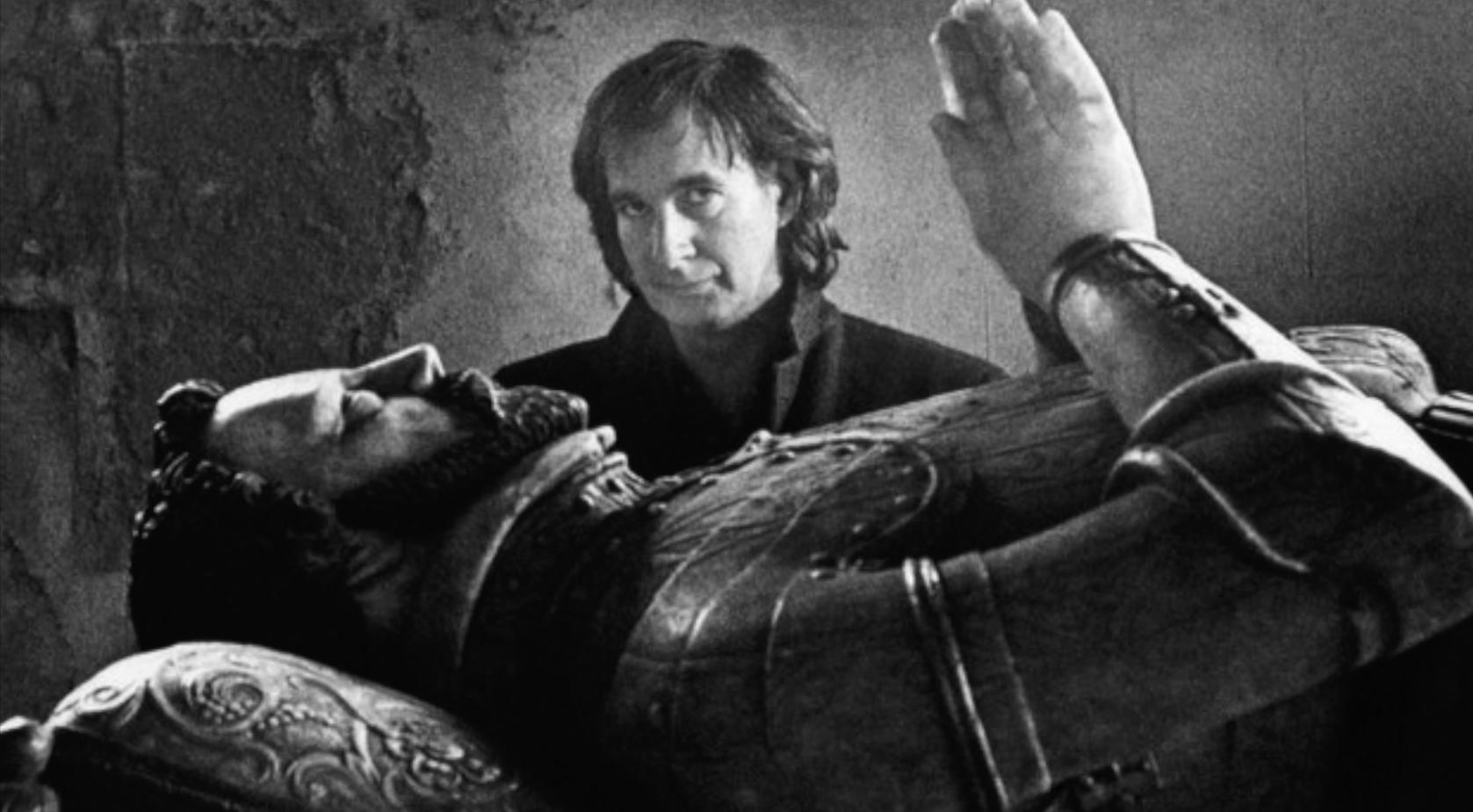
Documentary, by Jason Figgis, United States, 2019.
This documentary retraces the life and work of Simon Marsden, widely regarded as one of the foremost photographers of the supernatural. Premiered at the British Film Institute in London, the film offers a fascinating journey into his creative universe, appealing not only to photography enthusiasts but also to scholars, teachers, students, and anyone intrigued by the mysteries of the unseen. Through evocative imagery and first-hand accounts, it explores the artistic path of a photographer whose work has appeared in books, on U2 album covers, and in museum exhibitions around the world.
Although convinced of the existence of ghosts, Marsden never claimed to capture them directly with his camera. Instead, he used black-and-white infrared film to record the atmosphere and the invisible traces that, in his view, spirits left imprinted upon places. From the landscapes of Ireland to the vast expanses of Russia, passing through Venice and the American Southwest, he transformed historic buildings, ruins, and haunting locations into deeply evocative images capable of suggesting dark and unsettling stories. His photographs continue to captivate the imagination, demonstrating how the most powerful works of art can leave a lasting impression on those who behold them.
LANGUAGE: English
SUBTITLES: Spanish, French, German, Portuguese
Romanticism Was Not About Beauty
You have been told, at some point in your education or simply by the accumulated weight of cultural repetition, that the Romantics were dreamers — sensitive souls who looked at mountains and wept, who wrote poems about clouds and died young and beautiful. The image has been so thoroughly laundered that it now sits comfortably on decorative calendars and the covers of paperback editions sold in museum gift shops. This is not a misreading. It is something more deliberate than that.
Isaiah Berlin, in his 1999 lectures collected as The Roots of Romanticism, argued something that most people who invoke the word Romantic have never absorbed: that Romanticism was not primarily an aesthetic movement but a philosophical earthquake, and that what it demolished was not a style but an entire structure of belief. The Enlightenment had proposed, with extraordinary confidence, that the universe was rational, that human beings were capable of understanding it through reason, and that once understood it could be mastered and improved. This was not merely an intellectual position — it was a civilizational posture, the foundation on which the 18th century built its self-regard. The Romantics looked at this posture and found it, at its root, a lie.
What they were insisting on was not that the world was beautiful but that it was irreducible. That there were dimensions of human experience — will, passion, the encounter with nature as something genuinely overwhelming — that could not be mapped, quantified, or resolved into a system. Berlin traced this through Hamann, through Herder, through Schiller, and found in each of them a fury at the idea that the human being could be adequately described by any formula. The violence of that refusal was not decorative. It was ontological. They were not saying that reason was insufficient for some tasks. They were saying that the Enlightenment project had produced a kind of spiritual mutilation, a world made legible at the cost of everything that mattered about being alive in it.
This is an uncomfortable idea, and the 19th century, which inherited Romanticism in the years after Friedrich was already painting, proved remarkably efficient at making it comfortable. What began as a rupture was gradually aestheticized — framed, literally, hung on walls, taught in schools as a love of nature and an appreciation for feeling. By the time the movement had been processed through bourgeois European culture, it had been transformed from a philosophical challenge into a mood. A painting of a stormy sea became evidence of sublime taste. A poem about mortality became evidence of sensitivity. The radicalism of the original gesture — the insistence that the real is ultimately ungraspable, that certainty is a form of cowardice — was drained out, and what remained was the atmosphere without the argument.
The mechanism by which societies neutralize threatening ideas by converting them into aesthetic preferences is not particular to Romanticism. But what is particular here is the speed and the thoroughness. By 1850, barely two decades after Friedrich’s death, the philosophical terror at the heart of the movement had been so effectively domesticated that critics were already writing about German Romantic painting in the language of picturesque sentiment. The word sublime, which Kant had used in 1790 in the Critique of Judgment to describe the experience of being confronted by something that exceeded the mind’s capacity to contain it — an experience he explicitly distinguished from pleasure — had been quietly reclassified as a type of pleasant awe. What had been vertigo became elevation. What had been the collapse of certainty became the confirmation of refined feeling.
Friedrich never painted refined feeling. He painted the place where the self runs out of ground, where the eye reaches forward into something that will not resolve, and where the figure standing at the edge of the canvas is not admiring the view but has simply run out of world.

Friedrich’s Germany Was a Wound
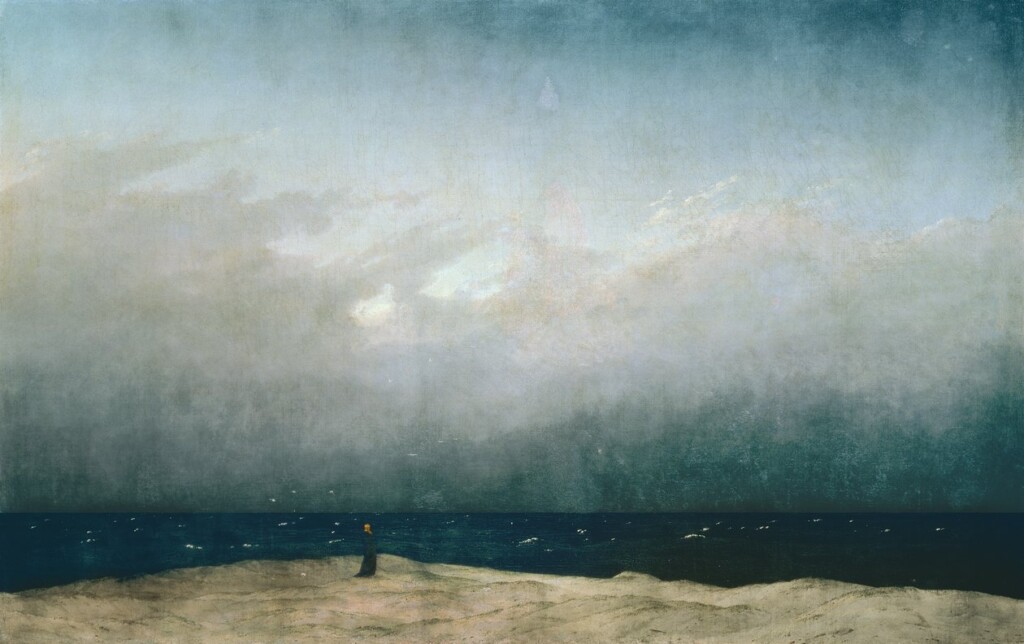
You are sitting in a room that no longer belongs to your country, and the language being spoken in the street below is not yours. This is not a metaphor Caspar David Friedrich needed to construct — it was the texture of his daily life. He was born in 1774 in Greifswald, a Baltic port city that was at the time Swedish territory, and he would spend his most productive decades watching the map of Europe redraw itself around him with the casual violence of a man rearranging furniture in someone else’s house. By the time Napoleon’s armies moved through the German territories in the first decade of the nineteenth century, Friedrich was already painting landscapes in which the ground itself seemed to be processing something too large for human language.
The German nation Friedrich believed in did not exist. What existed were dozens of fractured principalities, competing loyalties, and an idea of cultural unity that intellectuals like Herder had spent the previous generation trying to assemble from folk songs and grammar and shared longing. Johann Gottfried Herder’s “Ideas on the Philosophy of the History of Humanity,” published between 1784 and 1791, had argued that peoples were rooted in their landscapes, that soil and climate shaped consciousness — and Friedrich painted as if he had absorbed this not as philosophy but as grief. His forests and coastlines were not decorative backgrounds. They were the body of something that kept being dismembered.
After the Congress of Vienna in 1815, the hopes that had briefly flickered around nationalist resistance to French occupation were methodically extinguished. The Restoration didn’t just suppress political movements — it treated longing itself as seditious. The German Confederation that emerged from Vienna was a conservative apparatus designed to prevent exactly the kind of unified, constitutionally governed nation that a generation of young Germans had imagined fighting for. Friedrich’s friend and intellectual companion, the theologian Gotthard Ludwig Kosegarten, had preached sermons on Baltic shores about the sacred relationship between landscape and spiritual community. By 1815, those sermons had become nostalgia for a future that had been legally prohibited.
What Friedrich did in response was paint time rather than place. His ruins — the Gothic abbeys dissolving into fog, the oak trees stripped to skeletal forms — were not romantic atmosphere. The Abbey in the Oakwood, completed in 1810, places a procession of monks at the threshold of a gutted medieval structure under a winter sky that has the quality of permanent closing. Medieval Gothic architecture carried a specific charge in Friedrich’s cultural moment: it represented the last period in which German-speaking peoples had something resembling collective spiritual and civic identity. To paint its ruins was to paint the historical fact that something had been broken long before Napoleon, and that what was being mourned was not a golden age but the persistent human need to believe one had existed.
Weather in Friedrich is never merely atmospheric. The fog rolling in from the Elbe, the ice floes grinding against each other in the Arctic Sea, the light that arrives at an angle suggesting it may not return — these are the physical registers of political reality. When armies pass through a landscape and leave, what remains is not peace but a particular quality of silence, the silence of a place that has been made to understand its own contingency. Friedrich painted that silence with the precision of a cartographer mapping the aftermath of catastrophe. His skies are not sublime in the way tourism posters have since made the word mean. They are sublime in Edmund Burke’s 1757 formulation — experiences that produce astonishment so complete it borders on terror, that strip the observer of the comfortable distance between themselves and what they are witnessing.
He never left the wound open in any obvious way. There is no blood in Friedrich, no battlefield, no weeping figure. The horror is geological — pressed into stone, diffused into light, carried forward in the posture of a single figure standing at the edge of everything they cannot change.
The Theology No Church Would Claim
You are standing in front of a canvas where the church has already been replaced by oak trees. Not metaphorically — literally. Friedrich painted Gothic ruins strangled by roots, stone arches crumbling back into forest floor, and the trees themselves rising in the shape of vaulted naves, their bare winter branches crossing overhead like ribbed ceilings in Cologne or Reims. The congregation is absent. The priest is absent. What remains is the vertical fact of the tree, which has been reaching toward the same sky for three hundred years without asking anyone’s permission.
Friedrich said it plainly, in a sentence that neither the Lutheran clergy nor the Berlin rationalists knew what to do with: “The divine is everywhere, even in a grain of sand.” That is not a comforting statement. Comfort would require the divine to be somewhere in particular — in a sacrament, in a text, in a designated hour on Sunday morning. A God distributed evenly across all matter, including the grain of sand under your boot heel, is a God that cannot be institutionally managed, cannot be tithed, cannot be made to sanction one people’s claim over another’s. Friedrich’s theology was structurally incompatible with organized religion not because it was atheist but because it was too saturated with the sacred to leave room for a church’s monopoly on access.
The German Romantic movement gave him intellectual company for a time. Friedrich Schleiermacher had argued in 1799, in his Speeches on Religion, that authentic religious feeling was not doctrine but intuition — a direct, trembling sense of dependency on the infinite. That gave painters like Friedrich a framework. But Schleiermacher was still working inside Protestantism, still trying to save religion from its cultured despisers by making it more inward. Friedrich went somewhere Schleiermacher would not follow: he made the inward sensation outward, atmospheric, geological. He painted fog as if fog were ontologically prior to human consciousness. His mists do not obscure the divine — they are the divine, in the same way that a body is not a vehicle for a soul but is the soul in its only available form.
Secular rationalism found this equally intolerable. By the 1820s, with Hegel consolidating his lectures on aesthetics at the University of Berlin and positioning art as a stage the human spirit had largely moved through on its way to philosophy, Friedrich’s insistence on painting as a site of genuine encounter with the absolute looked like a refusal to mature. The art critic and theologian Daniel Rauch dismissed his work as foggy to the point of meaninglessness. What they could not absorb was that Friedrich understood meaninglessness differently — not as absence but as excess, as what happens when significance exceeds the containers language has built for it.
Consider what vertigo actually is, physiologically: it is the condition of having two contradictory signals about orientation arriving simultaneously, the inner ear saying one thing and the eyes saying another. Friedrich’s canvases induce something structurally identical. The eye is given a horizon — clear, measured, compositionally stable — and simultaneously given a void that the rational mind cannot resolve into safety. The Wanderer above the Sea of Fog, painted around 1818, is not a man surveying conquered territory. He is a man at the precise moment when the ground’s logic has run out, when the fog below him is not a weather condition but an epistemological one, and the only honest response is to keep standing there without resolving it into meaning.
The mystics he most closely resembles — Meister Eckhart in the fourteenth century, speaking of the Godhead as a darkness beyond all names — were also the ones the Church found most dangerous, most in need of silence or condemnation. Eckhart’s propositions were condemned by Pope John XXII in 1329, twenty-eight of them listed as heretical or suspect, precisely because they located God in a place the institution could not administer.
What the Figure’s Back Actually Means
You are standing with your back to the painter, looking out at something you cannot name. The ridge drops away beneath you into valleys of vapor, and the horizon refuses to resolve into anything fixed — it keeps pulling, keeps receding, keeps denying you the satisfaction of an edge. You are not the subject of this image. The landscape is not the subject either. The space between you and the unreachable distance is the subject, and it is a space that has no floor.
This is Friedrich’s most deliberate structural argument, and it has been systematically misread for two centuries. The figure with its back turned — the Rückenfigur, recurring across dozens of canvases between roughly 1808 and 1835 — is almost universally described as an invitation: stand here, project yourself into this silhouette, borrow this body and make the sublime yours. That reading is not merely incomplete. It is the precise inversion of what Friedrich was constructing. The turned back is not an open door. It is a locked one, and the lock is the point.
Immanuel Kant published the Critique of Pure Reason in 1781, and what he argued there — with a precision that still unsettles anyone who reads it slowly — is that the human mind does not receive the world. It constitutes it. What we perceive is always already processed through the a priori structures of space, time, and causality that the mind imposes on raw sensory data. The thing-in-itself, the noumenon, the object as it actually exists independent of all human cognition, remains permanently inaccessible. We are not spectators of reality. We are its inadvertent architects, and the building we construct will always have one room we cannot enter.
Friedrich was not reading Kant as a footnote to his painting. He was painting Kant’s conclusion as a physical fact. The figure faces the landscape, and the facing accomplishes nothing. Perception does not penetrate. The mountains do not yield. The fog does not part because someone is watching it. The act of looking, however intense, however sustained, hits a wall that precedes it — a wall built not by distance but by the very structure of the mind doing the looking. What Friedrich renders in oil and pigment is the noumenal wall: the permanent horizon that is not geographical but cognitive, not atmospheric but constitutive.
The figure’s back also does something more unsettling than any philosophical argument could do in prose. It refuses the viewer’s identification at the level of the face. The face is where we read interiority — fear, wonder, comprehension, defeat. Strip the face away and what remains is a posture, a direction, a relationship to space. The figure is defined entirely by what it is oriented toward, not by what it feels about that orientation. This is not humility. It is something harder: the absolute irrelevance of the emotional response to the scale of what is being faced. Whether the figure standing at that ridge feels awe or terror or nothing at all changes precisely nothing about the ridge. The infinite does not register the witness.
There is a painting from around 1818 in which a man in dark clothing stands at a cliff edge above clouds and mountains, and for a long time critics have treated it as a self-portrait in spirit — Friedrich placing himself, or us, at the threshold of transcendence. But the threshold logic is wrong because it implies the possibility of crossing. What Friedrich understood, and what Kant had argued with ruthless intellectual rigor, is that the threshold is not a door between two states. It is the final state. The standing is not preliminary to seeing. The standing is all there is, and the back turned toward us is not an invitation to take the figure’s place but a demonstration that the place itself offers no more than this: a posture in front of something that will never be fully known.
A vision curated by a filmmaker, not an algorithm
In this video I explain our vision
The Collaborator of Solitude
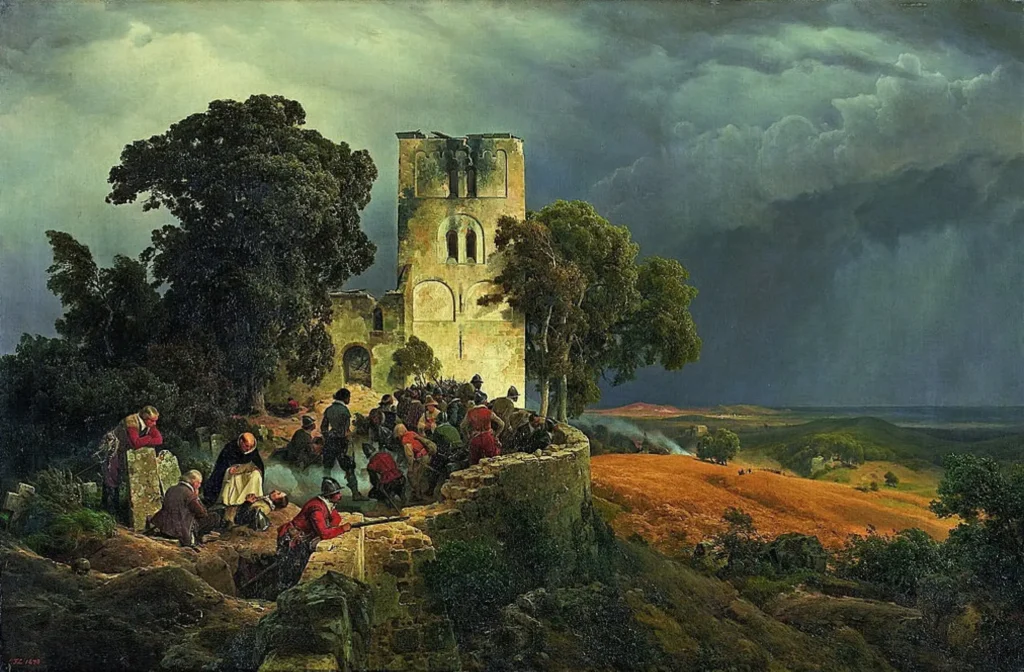
You are driving on an empty highway at three in the morning, somewhere between two cities that have stopped meaning anything to you, and the headlights carve a tunnel through the dark that ends exactly where your certainty ends. There is no one in the other lane. The radio found static an hour ago. And something strange happens: the erasure feels accurate. Not frightening, not melancholic in the way that requires company to complete itself — just precise. As though the landscape has finally agreed to reflect a condition that was already there before you got in the car.
Friedrich painted this before the car existed, before the highway, before the particular loneliness of infrastructures built for mass movement that somehow amplify isolation. His figures do not appear lost. That is the detail that keeps resisting easy interpretation. The wanderer on the ridge in Wanderer Above the Sea of Fog, completed around 1818, does not look like someone who took a wrong turn. He looks like someone who arrived. The fog beneath him is not an obstacle; it is the content of the landscape, the substance of a world that refuses to be fully legible. He is not conquering it. He is simply present inside an incompleteness that was always the actual shape of things.
What Friedrich intuited, and what took sociology another century to name, is that belonging is not a natural state interrupted by crisis — it is a managed illusion that requires constant institutional maintenance. Émile Durkheim, writing in 1897 in Le Suicide, identified what he called anomie: the specific suffering that emerges not from poverty or failure but from the collapse of normative frameworks, the moment when collective systems of meaning stop generating binding force. Durkheim was studying death rates, but he was also mapping a particular kind of standing-in-the-fog, the sensation of being present in a world that no longer tells you where the edges are. Friedrich was painting that sensation seventy years earlier, not as a symptom of civilization’s deterioration but as its quietly arriving destination.
The Reformation had already fractured the architecture of mediated meaning in northern Europe. By Friedrich’s lifetime, Protestant theology had removed the priest as necessary intermediary between the self and the divine, which sounds like liberation until you realize that liberation and exposure are sometimes the same door opened from different sides. The individual now stood responsible for his own spiritual location, with no institution to triangulate his position. Friedrich’s landscapes are the visual logic of that arrangement: one figure, no intermediary, and a horizon that does not promise arrival.
What makes this more than historical curiosity is that the condition has not reversed — it has scaled. The collective frameworks that might have replaced theological ones, the nation, the class, the ideological movement, have each in turn revealed their constructed nature, leaving behind a residue of ironic distance that makes full belonging feel naive rather than possible. Peter Berger observed in The Sacred Canopy in 1967 that modernity does not merely secularize belief; it pluralizes it, fragmenting any single structure of meaning into competing options, each of which undermines the others simply by existing simultaneously. You cannot choose your cosmology with full conviction when the act of choosing is itself visible to you. And once that visibility is installed, the highway at three in the morning stops being an accident and starts being an honest account of how consciousness actually sits inside the world.
Friedrich did not mourn this. That is perhaps the hardest thing to absorb about his work when you stand in front of it long enough. The paintings do not weep for the lost village, the lost congregation, the lost certainty of a sky populated with responsive divine presences. They look at what replaced all of that — which is scale, silence, the self returned to itself without insulation — and they find it, if not comfortable, then at least worth facing with open eyes and a straight back.
Why His Reputation Died and Was Resurrected Wrong
You are reading his work right now in a gallery, standing close enough to see the brushwork, and something in your chest tightens — not with beauty, but with something closer to vertigo. That response is correct. It is also, historically speaking, almost an accident, because for nearly a century the conditions required to even encounter Friedrich’s paintings in public barely existed.
He died in Dresden in 1840 with his reputation already contracting around him. The Romantic fever that had briefly made his canvases feel urgent had cooled, and what replaced it was a bourgeois realism more interested in accurate foliage than in the metaphysical weight a single human silhouette could carry against a horizon. By the mid-nineteenth century he was a footnote, then less than a footnote — a provincial German painter of uncertain relevance, his work dispersed across collections that often didn’t know what they held. The great cataloguing efforts that would restore his name had not yet begun. He existed in the historical record the way a sound exists after it has stopped: as a faint disturbance in an otherwise settled medium.
The twentieth century offered him a resurrection of the worst possible kind. By the 1930s, certain paintings — Wanderer Above the Sea of Fog, the soaring eagles, the Gothic ruins dissolving into Germanic mist — had been recruited into the visual vocabulary of National Socialist aesthetics. This was not incidental decoration. The ideologues of that cultural apparatus were looking for a German sublime, a landscape tradition that could anchor racial mythology to soil and sky, and Friedrich’s imagery of solitary figures commanding vast Nordic wilderness fitted the template with terrible convenience. He could not refuse. The dead cannot police their own afterlives. What was extracted from his work was the silhouette without the abyss, the grandeur without the dread — a heroic poster where there had been an existential confession.
That contamination was thorough enough to make serious postwar engagement with his work genuinely complicated. German critics approached him with the caution of someone disarming something they suspect is still live. International scholarship largely sidestepped him. The silence lasted long enough that when the rehabilitation finally arrived — centered on the landmark 1974 Hamburg retrospective that brought unprecedented crowds and critical attention — it arrived hungry, almost desperate to reclaim something that had been made ugly.
The reclamation succeeded in restoring his visibility. It failed in reading him with any precision. What the 1970s needed, apparently, was a proto-environmentalist, a spiritual ancestor of ecological consciousness, a painter who had intuited the fragility of the natural world before the industrial machine had finished its first century of damage. This reading was comforting and it was wrong. Coupled with it came a softer misreading: Friedrich as contemplative guide, his Rückenfiguren transformed into invitations to mindful self-reflection, his abysses rebranded as spaces of personal transcendence. Museums began selling the Wanderer on tote bags. The vertigo was decorative now.
What these rehabilitations shared was a need to neutralize the actual structure of his vision — which was not consolation, not ecological mourning, not an invitation to feel good about feeling small. The encounter he staged between the human figure and the infinite was not designed to resolve. Georg Wilhelm Friedrich Hegel, writing in his Aesthetics in the same decades Friedrich was producing his major work, described the Romantic tendency in art as the spirit’s withdrawal inward, the soul finding the external world inadequate to its depth. Friedrich did not depict that withdrawal as peaceful. He depicted it as a condition that cannot be undone, a threshold crossed without the possibility of return, and the figure in the fog is not meditating — it is caught.
The danger in his paintings is structural, not atmospheric. Remove it and you still have beautiful images of mist and rock and solitary human beings. But the specific thing he built into the geometry of attention — the way the viewer’s eye is forced to stand behind the figure and look with it into something that offers no answer — that mechanism has no tote bag equivalent, and its absence in the popular reception of his work reveals more about the limits of cultural rehabilitation than about the paintings themselves.
The Painting That Has No Viewer
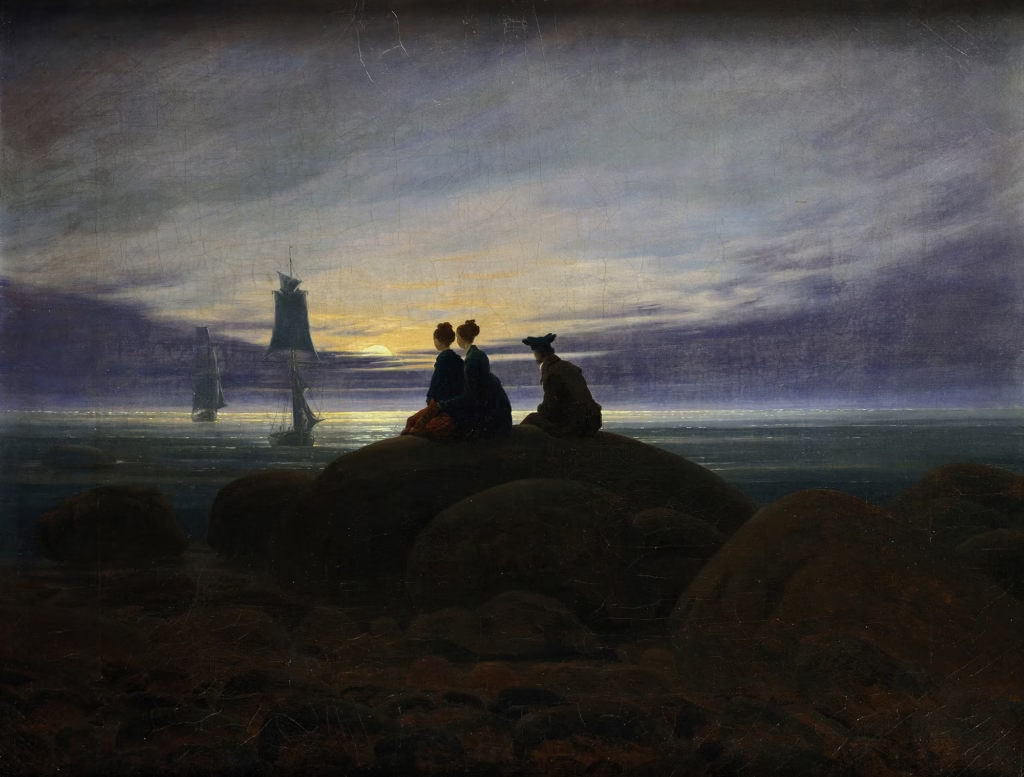
You stand before it and realize, after a moment that arrives like a slow drop in temperature, that it has not registered your presence.
The canvas Friedrich completed in 1810 offers almost nothing to hold. A strip of dark earth along the bottom third, a vast and colorless sky pressing down from above, and somewhere in the lower left, a figure so reduced in scale that calling him a monk requires a kind of interpretive charity — he is, more precisely, a mark. Not a symbol, not a protagonist, not a narrative anchor. A mark. The sea between earth and sky is not stormy or dramatic or sublime in any of the ways the eighteenth century had agreed sublimity should function. It is simply there, and it is indifferent, and the indifference is the entire statement.
Heinrich von Kleist, reviewing the painting that year with the poet Clemens Brentano, reached for a word that art criticism rarely permits itself. He wrote that standing before it produced something like the feeling of being annihilated — as if one’s eyelids had been cut away, as if the painting refused to offer the viewer the usual mercy of a point of entry. Most paintings, even the most austere, establish a tacit contract with the person looking. They provide a foreground, a gesture, a diagonal that draws the eye inward, some arrangement that whispers: you belong here, this was made for you, enter. Friedrich tore that contract up. He did not merely eliminate the picturesque conventions of staffage and framing trees and luminous focal points. He eliminated the structural hospitality of the image itself.
What Kleist named as annihilation is actually something more precise: the collapse of the viewer’s assumption that perception is inherently relational, that a work of art exists in a condition of waiting, that it needs your gaze to become complete. Western pictorial tradition from Alberti’s 1435 theorization of perspective in Della Pittura forward had built its entire architecture on the implied presence of a viewer — the vanishing point is meaningless without an eye. A painting is, in that tradition, a kind of address. Friedrich composed something closer to a monologue delivered to an empty room, already finished before you arrived, continuing after you leave.
The monk is not gazing out on your behalf. This is the trap most viewers fall into: they recruit the small figure as a surrogate, projecting themselves into his position, using his contemplation as a bridge between their own consciousness and the void beyond. But Friedrich’s spatial arithmetic refuses this. The figure is not positioned at the painting’s center of gravity; he lists slightly to the left, absorbing no particular drama, commanding no view. The horizon line itself is barely legible, sky and sea bleeding into one another in tones so close that the fundamental organizing logic of landscape — the separation of elements, the readable depth — quietly dissolves. There is no promise of the far shore.
When the German Romantic movement spoke of Sehnsucht, that specific longing for something that cannot be named and cannot be reached, it generally preserved a subject who longs, a self whose desire gives the infinity its shape and poignancy. Friedrich removed even that consolation. The longing in this painting belongs to no one. The vastness is not waiting to be felt by someone sensitive enough to receive it. It simply extends, without address, without invitation, without the faint warmth of having been arranged for human eyes.
That is what makes it the most honest painting of the infinite that Western art produced in that century — not because it depicts the infinite accurately, which is impossible, but because it refuses to make the infinite comfortable, refuses to scale it to the human need for meaning, refuses to let the viewer stand before it and feel, in that standing, that the universe has noticed them back.
🌌 Gazing into the Infinite: Art, Nature, and the Sublime
Caspar David Friedrich painted longing itself — the human figure dwarfed by fog, mountains, and endless sky. His work belongs to a tradition of thought that links the aesthetics of the sublime to philosophy, literature, and the deepest questions about existence. These articles trace the invisible threads that connect his canvases to ideas that have haunted Western culture for centuries.
Johann Wolfgang von Goethe: Life and Works
Johann Wolfgang von Goethe was Friedrich’s contemporary and, like him, believed that nature was not mere backdrop but a living language the human spirit must learn to read. Goethe’s scientific mysticism and his search for the Urphänomen — the primal phenomenon underlying all visible forms — echo Friedrich’s own attempt to find the eternal in a winter landscape. Understanding Goethe is essential to understanding the German Romantic soul that Friedrich so powerfully embodied.
GO TO THE SELECTION: Johann Wolfgang von Goethe: Life and Works
Schopenhauer: Life and Philosophical Thought
Schopenhauer placed the contemplation of nature at the very heart of aesthetic experience, arguing that great art temporarily liberates the individual will from suffering by dissolving the self into pure perception. Friedrich’s wanderer standing before the sea of fog is almost a visual illustration of this Schopenhauerian state — a moment in which the ego vanishes and only the infinite remains. No philosopher comes closer to explaining why Friedrich’s paintings feel simultaneously devastating and consoling.
GO TO THE SELECTION: Schopenhauer: Life and Philosophical Thought
Martin Heidegger: Life and Philosophical Thought
Martin Heidegger‘s meditation on Being and Time revolves around concepts — thrownness, anxiety, the call of conscience — that resonate with uncanny precision when placed before Friedrich’s solitary figures in vast, indifferent landscapes. For Heidegger, authentic existence requires confronting the openness of Being, the same vertiginous openness that Friedrich painted into every horizon. His philosophy offers a profound philosophical grammar for the existential mood that Friedrich’s art evokes without words.
GO TO THE SELECTION: Martin Heidegger: Life and Philosophical Thought
Light in Painting: History and Symbolism
Light in painting is never merely illumination — it is theology, emotion, and philosophy made visible, and few artists understood this as deeply as Friedrich. His diffuse, sourceless light filtering through mist or breaking over icy peaks carries a spiritual charge that links him to a centuries-long tradition of painters who used luminosity to suggest transcendence. This exploration of light’s symbolic history provides an indispensable visual context for reading Friedrich’s canvases as meditations on the divine.
GO TO THE SELECTION: Light in Painting: History and Symbolism
Discover Cinema That Touches the Infinite on Indiecinema
If Friedrich’s art has stirred something in you — a longing for depth, for beauty that doesn’t flinch from darkness — then independent cinema is your next horizon. On Indiecinema you will find films that share his spirit: works that dare to contemplate solitude, nature, and the mysteries of existence without easy answers. Step into the stream and let the images carry you further.
👉 EXPLORE THE CATALOG: Watch Indie Films in Streaming
A vision curated by a filmmaker, not an algorithm
In this video I explain our vision

