
The Arrival Scene: A Civilization Reframed as Chaos
You step off the ship at Calcutta in 1803 and the first thing that hits you is not the heat, though the heat is extraordinary. It is the density. Not poverty, not squalor — though your journals will later use those words — but sheer human density, the press of bodies moving with a logic your eyes cannot yet parse, vendors and priests and merchants and water-carriers threading through each other in patterns that look, to you, exactly like chaos. This is the founding perceptual error of empire, and it happens before a single policy is written, before a single law is imposed. The disorder you see is not in the street. It is in the gap between two civilizational grammars, and you have just mistaken the gap for evidence.

What the British colonial administrator encountered in India was not a vacuum of governance but one of the most administratively sophisticated civilizations on the planet. The Mughal revenue system, the zamorin trade networks of the Malabar Coast, the intricate caste-based legal arbitration that had functioned for centuries — none of these were legible to eyes trained on Westminster procedure. Illegibility was then diagnosed as absence. This is not a metaphor. It is the precise mechanism by which the East India Company, granted its first trading charter by Elizabeth I in 1600, transformed commercial interest into moral necessity within two generations. Once you cannot read a system, you can tell yourself there is no system. And once there is no system, you are not conquering — you are building.
The philosopher Frantz Fanon, writing in The Wretched of the Earth in 1961, identified this perceptual move as the foundational violence of colonialism — not the gun, but the prior act of ontological erasure that makes the gun feel like construction equipment. What strikes a reader of that text in 2024 is how precisely Fanon’s analysis maps onto the administrative literature produced by the Company’s servants in Bengal and Madras between 1757 and 1820. The reports sent back to London do not read as conquest narratives. They read as rescue operations. Robert Clive’s dispatches after Plassey in 1757 are saturated with the language of stabilization, of restoring order to a region in turmoil. The turmoil, of course, had been substantially generated by the Company’s own commercial pressure on the Bengal nawabs, but that causal chain had already been severed in the telling.
There is a specific document worth dwelling on here. James Mill’s The History of British India, published in 1817, was written by a man who had never visited India and could not read a single Indian language. It became the primary textbook used to train British civil servants entering the Indian subcontinent for decades. Mill applied a strict stadial theory of civilization — the Scottish Enlightenment’s developmental ladder from savagery to commercial society — and placed India firmly on the lower rungs, characterized by what he called the absence of historical consciousness and rational jurisprudence. The argument did not survive serious scholarly scrutiny even in the nineteenth century. But it did not need to. It was not a scholarly argument. It was a hiring manual. The men who read it arrived in India already knowing what they would find, which meant they were constitutionally incapable of finding anything else.
The psychological architecture this produced was not cynicism. That would have been easier to dismantle. It was sincerity. The administrators who dismantled traditional Indian textile industries, who replaced Persian with English as the language of courts in 1837, who classified and ranked and sorted three hundred million people through the machinery of the census — most of them believed, with genuine earnestness, that they were reversing a long decline. The violence was laundered through conviction long before it passed through policy, which is precisely why the cultural consequences ran deeper than any single act of governance could account for.
Thirsty
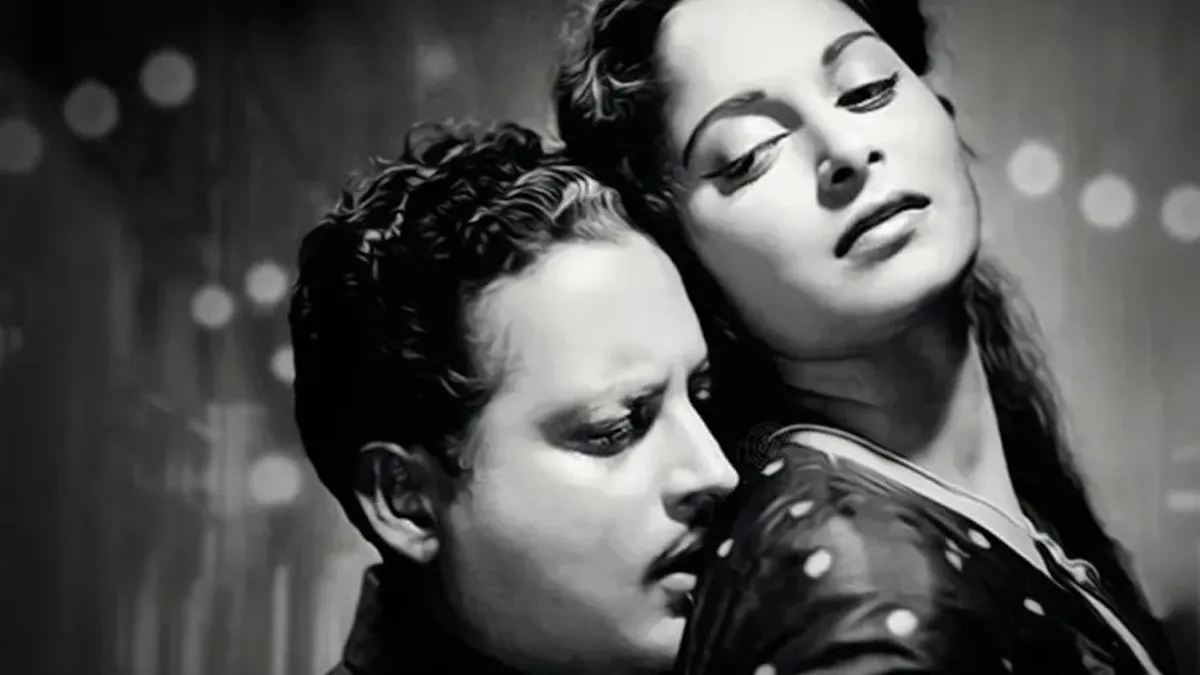
Drama, musical, by Guru Dutt, India, 1957
Thirsty is the heartbreaking story of Vijay, a young poet living in Calcutta who dreams of giving voice to the suffering and injustice of the world through his verses. Idealistic and sensitive, Vijay clashes with a society that despises his art because it is not profitable and does not cater to the tastes of the public. His brothers consider him a failure, the woman he loves leaves him for a marriage of convenience, and his poems are ignored by publishers. Only Gulabo, a prostitute with a pure heart, recognizes the beauty and truth of his words. When a misunderstanding leads everyone to believe Vijay is dead, his name and poetry suddenly become famous, exposing the hypocrisy of those who had previously rejected him.
Watching Thirsty means immersing oneself in a work that goes beyond melodrama, blending poetry, music, and imagery into a profound reflection on the human soul and the value of art. Guru Dutt, director and protagonist, creates one of the most intense and poetic films in world cinema, where black-and-white cinematography, expressive framing, and evocative lyrics produce an atmosphere of poignant melancholy. It is a film about the misunderstanding of the artist, pure love, and society’s hypocrisy, but also a universal critique of materialism and opportunism. Even today, Thirsty moves and provokes thought because it sincerely tells the story of the need to remain true to oneself in a world that measures people’s worth solely by their success.
LANGUAGE: Hindi
SUBTITLES: English, Spanish, French, German, Portuguese
The Bureaucratic Machine and the Illusion of Progress
You receive a letter informing you that your application to join the civil service has been accepted. The document is printed on heavy paper, stamped, signed by someone whose name you cannot read. You have passed examinations in Latin, Greek, and mathematics. You have demonstrated familiarity with English constitutional law. You have never been asked a single question about the place you are being sent to govern.
The Indian Civil Service, formalized under the Government of India Act of 1858, was not an accident of administrative improvisation. It was a deliberate architecture, designed in London for a territory whose complexity London had no genuine interest in understanding. The examination system — a meritocracy on paper — required candidates to travel to England at their own expense for testing, a barrier that effectively screened out most Indian applicants until the late nineteenth century, when a small number began passing despite the structural obstacles. By 1915, fewer than five percent of ICS officers were Indian. The machinery was calibrated to produce not administrators but custodians of extraction: men trained to maintain order, collect revenue, and translate British commercial interest into the language of civic duty.
Ranajit Guha, writing in “Dominance without Hegemony” published in 1997, made a distinction that cuts through almost every comfortable narrative about colonial administration. He separated dominance — the exercise of power through coercion and institutional force — from hegemony, which requires the consent of the governed, their genuine internalization of the ruling order’s values as their own. British colonial rule in India, Guha argued, never achieved hegemony. It remained, structurally and culturally, dominance: a power that ruled but never persuaded, that administered but never belonged. What the bureaucratic machine accomplished was something more subtle and more durable than either conquest or conversion — it normalized the posture of subordination by dressing it in the vocabulary of participation.
A district collector under the Raj did not arrive with a sword. He arrived with forms. With censuses, land surveys, revenue assessments, judicial procedures. The Census of India, conducted decennially from 1871 onward, did not merely count people — it hardened fluid social categories into fixed administrative identities. Caste, which had operated historically as a contextual and regionally variable set of social relations, was taxonomized into a rigid hierarchy printed in columns and cross-referenced with occupational data. Once a category exists in a government ledger, it begins to exert pressure on the people inside it. Identity stops being negotiated and starts being administered.
The language of improvement accompanied all of this without embarrassment. Thomas Macaulay’s Minute on Education of 1835 had already established the philosophical scaffolding: a class of Indians trained to serve as interpreters between British administrators and the Indian masses, people who were “Indian in blood and colour, but English in taste, in opinions, in morals, and in intellect.” The sentence is often quoted for its arrogance. It is less often read for its function. Macaulay was not describing a cultural ideal — he was designing a transmission belt. The educated Indian intermediary was not a beneficiary of imperial generosity. He was infrastructure.
What this produced over generations was a particular psychological formation: a population trained to navigate bureaucratic structures they had not designed, to appeal to legal frameworks written against their interests, to understand their own political agency primarily as the capacity to file a complaint through proper channels. The petition became the dominant form of Indian political life for much of the nineteenth century. Thousands of petitions reached Parliament between 1833 and 1857, meticulously drafted, citing precedent, requesting modest modifications to revenue policy or asking for representation in legislative councils. Parliament received them, tabled them, and in most cases did nothing. The gesture of appeal had been successfully substituted for the possibility of power, and the substitution felt, to everyone performing it, like civic engagement.

What the Railways Actually Moved
You are standing on a platform somewhere in Rajasthan in 1890, watching an iron locomotive exhale steam into the dry heat, and what you feel, if you have been taught the right lessons, is gratitude. Progress has arrived. The empire has given you rails.
The locomotive was real. The gratitude was engineered. What moved along those tracks was not primarily people or commerce in any sense that benefited the subcontinent — it was extraction dressed in the costume of civilization. By 1900, approximately 40,000 miles of railway line had been laid across India, a figure that colonial administrators cited with the pride of men who had built something eternal. What they did not announce, because announcements of that kind tend to complicate the narrative, was the financial architecture underneath those rails: a guaranteed return of five percent annually to British investors, paid by the Indian taxpayer, regardless of whether any given line turned a profit. Risk had been socialized onto the colonized. Return had been privatized into British hands. This was not an oversight. It was the design.
The mechanism was almost elegant in its cruelty. When a railway line failed to generate sufficient revenue — and many lines, routed not to serve Indian commercial needs but to move raw cotton, grain, and troops toward ports — the Indian government made up the difference. This guarantee structure meant that British capital faced essentially zero downside exposure while Indian revenue absorbed every loss. Karl Polanyi, writing in The Great Transformation in 1944, described how market societies disguise their coercive foundations beneath the language of natural law and mutual benefit. The railway guarantee was precisely this: a financial instrument that called itself infrastructure while functioning as a transfer mechanism, its altruism a syntax error in the original code.
Economist Utsa Patnaik spent years working through two centuries of trade data, tax records, and balance of payment statistics, arriving at a figure that the mainstream history of empire finds deeply inconvenient: approximately 45 trillion dollars drained from India between 1765 and 1938, a number she presented in a 2018 paper published through Columbia University Press, equivalent in her calculations to roughly 17 to 18 trillion pounds sterling. The railways were not peripheral to this drain — they were one of its primary arteries. Raw materials moved outward at low cost. Finished goods moved inward at protected prices. The tracks did not connect India to itself. They connected India’s interior to British ports.
What makes this particularly difficult to absorb is that the myth of infrastructural benevolence survives intact in popular consciousness even among people who consider themselves historically literate. The railways appear in tourist literature, in nationalist nostalgia, in political speeches across the spectrum. They feel like something left behind, a gift from a difficult relationship. But a gift you pay for yourself, and then continue paying for through the interest obligations of a guaranteed return structure, and then watch transfer your own agricultural surplus to a foreign market, is not a gift. It is a lease written in someone else’s language.
Mike Davis, in Late Victorian Holocausts published in 2001, traced how British India’s railway network was present during each of the major famines of the 1870s and 1890s — and rather than moving grain toward starving populations, it frequently moved grain away from them, toward export. In 1876, while somewhere between six and ten million people died in the Deccan and Madras famines, India exported a record amount of wheat to Britain. The railways made this possible. Speed and reach, those great promises of modernity, had been oriented in a specific direction by the financial logic underneath them, and that direction was outward, away, toward the ships.
The steel lines in the earth were real. What they meant depended entirely on who was allowed to ask the question.
The English Language as Cognitive Occupation
You are handed a job application form and you realize, before you have written a single word, that your qualification for the position will be measured not by what you know but by how well you perform knowing it in a language that was never yours to begin with. The form does not ask this openly. It does not need to.
Thomas Babington Macaulay sat in Calcutta in 1835 and wrote what may be the most consequential bureaucratic document in the history of colonial administration. His Minute on Education argued, without embarrassment, that a single shelf of good European literature was worth the entire native learning of India and Arabia. The argument was not made from ignorance — Macaulay had read enough to know he was lying, at least partially — but from strategic clarity. What he was designing was not a school system. He was engineering a class of people, in his own words, Indian in blood and color but English in taste, in opinions, in morals, and in intellect. The goal was the production of a human buffer layer: administrators who could translate empire downward to the population and translate compliance upward to London.
What this required was not simply teaching English. It required a prior act of epistemological demolition. Sanskrit and Persian had functioned for centuries as carriers of law, medicine, mathematics, astronomy, and statecraft. The Bakhshali manuscript, written somewhere between the third and seventh centuries, contains the earliest known symbolic use of zero as a placeholder — a conceptual leap that would anchor every calculation modernity has since performed. Nalanda, before its burning, had housed nine million manuscripts and drawn scholars from China, Korea, Persia, and Turkey. None of this was unknown to the British. The suppression of existing knowledge systems was not the collateral damage of empire; it was one of its primary instruments.
When you drain legitimacy from a language, you drain it from everyone who thinks primarily in that language. By routing access to courts, to revenue offices, to railway administration, to civil service examinations through English, colonial governance made cognitive surrender the price of participation. A Brahmin scholar fluent in Sanskrit and Tamil, who had memorized astronomical tables that rivaled anything produced in Europe, found himself functionally illiterate in the apparatus that now controlled his land, his taxes, and his sons’ futures. The body of knowledge he carried became, not false exactly, but socially weightless.
What is remarkable is not that this happened in the nineteenth century but that its architecture remains structurally intact in the twenty-first. Across India, Pakistan, and Bangladesh, English-medium schooling functions as the single most reliable predictor of class mobility — not because English contains knowledge unavailable in other languages, but because the colonial sorting mechanism was never dismantled, only inherited. The government schools that teach in regional languages produce graduates who are shut out of corporate boardrooms, elite universities, and diplomatic corridors occupied by people who went to schools where English was the medium of instruction from age five. Frantz Fanon identified this dynamic in 1952 in Black Skin, White Masks, arguing that colonial language acquisition is never neutral, that to speak a language is to assume the world expressed and implied by that language, which means to assume a civilization that positions the speaker’s origin as the thing to be overcome.
The Indian elite that emerged from Macaulay’s design did not simply adopt English as a tool. They absorbed the hierarchy embedded in the language’s social deployment, and then reproduced it domestically. Independence in 1947 transferred political sovereignty while leaving the linguistic architecture of cognitive stratification largely undisturbed. The Constitution of India lists twenty-two scheduled languages, but the courts that interpret it and the civil service examinations that staff the government that enforces it continue to privilege the one language that was installed precisely to make everything else feel provincial.
The Famine as Policy, Not Failure
The ships are fully loaded. You can see them from the dock if you look past the bodies — and there are bodies, arranged by starvation into postures that no living person would choose, along the roadsides leading out of Madras in 1877. The grain is going to England. It was going to England the year before, and it will go the year after, through the entirety of what the colonial administration chose to call a natural disaster, which is the first and most important lie embedded in the official record. Six million people died between 1876 and 1879 across southern and western India. The monsoon had failed, yes. But monsoons had failed before, and would fail again, without producing this arithmetic of corpses. What produced the corpses was a decision — a series of decisions, made by educated men in good suits, informed by a coherent intellectual framework they believed in with genuine conviction.
Mike Davis, in his 2001 work Late Victorian Holocausts, traced across three continents how the intersection of El Niño climate disruptions and European imperial policy transformed drought into industrial-scale death. The argument is not that colonial administrators were indifferent in the way that a distracted person might be indifferent. It is worse than that. They were attentive. They watched, they calculated, and they concluded that intervention would be more harmful than restraint. The intellectual scaffolding for this conclusion was provided by political economy — specifically the strain of laissez-faire doctrine that treated market forces as self-correcting mechanisms whose interference, however well-intentioned, produced only distortions and dependency. Grain was in the markets. Prices were high because demand was high. To suppress prices through state distribution would, the reasoning went, discourage future production and undermine the commercial order that made civilization possible. That six million people could not participate in those markets because they had no money was not, within this framework, an emergency. It was a sorting function.
Robert Bulwer-Lytton, Viceroy of India from 1876 to 1880, was not a monster in his own self-conception. He was a poet, a diplomat, a man of European culture who had read the right texts and absorbed the period’s governing assumptions about how economies worked and what governments were for. When Richard Temple, the Lieutenant-Governor of Bengal, distributed food relief in an earlier famine and attracted criticism for excessive expenditure, Lytton absorbed the lesson: relief bred dependency, cost money, and offended the principles of sound administration. He issued the Famine Code of 1877 with wage rates deliberately set below subsistence — below what even the colonial government’s own investigators acknowledged as the minimum required to sustain physical labor — on the explicit theory that relief must never be made more attractive than work. People were dying. The policy was calibrated so that dying remained, marginally, the less comfortable option.
What this requires the modern reader to sit with is not the fact of cruelty but the architecture of justification. Ideology is most dangerous not when it is cynical but when it is sincere. Lytton and his circle were not lying to themselves. They had inherited a complete system of thought that organized observable reality into a coherent story, and within that story their choices were rational, even principled. The Cambridge historian Amartya Sen demonstrated in Poverty and Famines in 1981 that famines in the modern period are almost never caused by absolute food shortage — they are caused by failures of entitlement, by the collapse of people’s ability to command food that physically exists. In 1877, India exported approximately 6.4 million hundredweight of wheat to Britain. The food was there. The decision about where it went was made by human beings operating inside an ideological system that had converted the poor into an abstraction — a variable in an equation whose solution was always, somehow, the same.
What the colonial archive calls negligence, the dead might have recognized as something more deliberate — a philosophical position that simply did not include them as subjects to whom it applied.
A vision curated by a filmmaker, not an algorithm
In this video I explain our vision
Caste Hardened Into Law

You think you know what caste is because you have heard the word your entire life, seen it cited in newspaper headlines, watched it weaponized in political speeches, and somewhere along the way you absorbed the assumption that it is ancient, that it is Hindu, that it arrived fully formed from a civilization too old to argue with.
That assumption was manufactured in the nineteenth century, largely in British administrative offices, by men who believed they were doing science.
When the colonial government launched its systematic Census operations beginning in 1871, the stated ambition was classificatory clarity: to know the subcontinent, to enumerate it, to render its bewildering human complexity legible to a bureaucratic apparatus that needed to govern hundreds of millions of people with a relatively thin layer of administrators. Nicholas Dirks, in his landmark 2001 study Castes of Mind, demonstrates with forensic patience that what the Census actually accomplished was something far more consequential than data collection. It took a social landscape that had been genuinely porous, contextual, and regionally varied — where jati distinctions shifted in meaning depending on geography, occupation, ritual context, and political alliance — and compelled it into a grid of fixed, heritable, legally recognizable categories. The act of recording was simultaneously the act of crystallizing. Once your community appeared as a discrete entry in a colonial register, that entry became more real, more durable, and more politically consequential than any lived practice had previously made it.
This is where colonial sociology revealed itself as a technology rather than a discipline. The ethnographers and census commissioners — H.H. Risley being the most influential, whose 1901 Census explicitly ranked castes by nasal index in a grotesque importation of European racial science — were not neutral observers standing outside the system they described. They were generating the system as they described it. Risley genuinely believed that caste was race frozen in social form, and he built administrative machinery that treated this belief as fact, which meant that communities who had navigated social hierarchies with a degree of situational flexibility now found themselves assigned a permanent position, a ranked slot in a colonial taxonomy that carried legal weight, economic consequence, and the imprimatur of imperial science.
The British did not invent hierarchy in India. What they invented was the bureaucratic permanence of hierarchy, its transformation from a contested and negotiable social fact into a codified and enforceable legal fact. There is a difference between a world where your position is disputed and a world where your position is registered, and that difference is the difference between a living argument and a closed file.
What makes Dirks’s argument unsettling is that it cannot be neatly converted into a simple colonial blame narrative, because the rigidification he documents was then absorbed, internalized, and reproduced by Indian political actors themselves, including reformers, nationalists, and eventually the architects of the postcolonial democratic state. Reservation policy — the affirmative action system enshrined in the 1950 Constitution and dramatically expanded after the Mandal Commission report of 1980 triggered riots across the country — operates entirely within the categorical logic the Census created. To claim your entitlement as a member of a Scheduled Caste or an Other Backward Class, you must produce documentation proving membership in a category that the British ethnographic project hardened into legal form. The remedy for colonial classification runs through colonial classification.
This is not an argument against reservation, and it is not a celebration of some imagined pre-colonial fluidity. It is something more uncomfortable: the recognition that the administrative grammar of empire did not dissolve when the British left in August 1947. It persisted inside the institutions, the legal frameworks, the political vocabularies, and the identity structures that independent India inherited and built upon, because there was no other available infrastructure through which to build anything at all.
The Independence That Wasn't a Clean Break
You are handed a map of a place you have never seen, given five weeks to draw a line through it, and told that the line will determine where thirty years of communal tension will discharge itself all at once. Cyril Radcliffe, a London barrister who had never set foot in the subcontinent before July 1947, did exactly this. He arrived, studied census data and railway routes in the suffocating heat of a New Delhi summer, and produced the Radcliffe Line with a speed that guaranteed its violence. Not because Radcliffe was careless, but because the speed itself was the policy. The line was announced two days after independence, on August 17, 1947, which meant that millions of people woke up as citizens of a new nation before they knew which side of a border they now lived on.
The framing of Partition as liberation’s tragic side effect has always required a specific amnesia. It requires forgetting that the British administration held detailed demographic surveys, knew precisely where mixed populations lived, knew where Sikh communities straddled the Punjab division, knew where Muslim-majority districts sat inside Hindu-majority provinces. The violence that followed — somewhere between eight hundred thousand and one million dead, depending on whether you trust Pakistani, Indian, or British estimates, with fifteen million people moving in both directions across a border that had not existed forty-eight hours earlier — was not an unfortunate surprise. Contingency planning for precisely this kind of mass displacement had been circulating in Whitehall since 1946. The decision not to implement it, not to position military forces along anticipated routes of communal conflict, was itself a decision with foreseeable consequences.
Scholars like Ayesha Jalal have spent decades reconstructing the negotiating positions of 1946 and 1947, and what her work in “The Sole Spokesman” and subsequent writing reveals is that partition was not the inevitable culmination of Hindu-Muslim difference but a specific political outcome produced by specific choices, including the Congress leadership’s refusal of a federal arrangement that might have kept the subcontinent unified under a weak center. The Cabinet Mission Plan of 1946 proposed exactly this — a three-tier federation that would have preserved territorial unity while granting significant autonomy to Muslim-majority zones. It collapsed not because the communities could not coexist, but because the political organizations representing them could not share power at the center. That failure was not spontaneous. It grew inside institutional structures that the colonial government had spent decades cultivating — separate electorates introduced in 1909 under the Morley-Minto reforms, the deliberate amplification of communal identity as an administrative sorting mechanism, the conversion of religious difference into political difference over four generations.
What emerged from August 1947 was not two free nations so much as two states born already wounded, each inheriting partitions of their most productive regions, each facing immediate resource crises, each pulled immediately into mutual hostility over Kashmir — a conflict whose legal ambiguity was itself a product of the rushed and poorly designed accession process that the departing power had no interest in resolving cleanly. Britain left a Kashmir question that has never been answered, a water dispute over the Indus river system that required a separate treaty in 1960, and two armies trained to the same British doctrine facing each other across a border that cut through irrigation networks, family ties, and trade routes that had existed for centuries.
The violence of Partition entered both national memories as foundational trauma, and trauma of that magnitude reshapes what a society believes it owes itself, what it believes it must defend, which fears it institutionalizes. Pakistan organized itself around an army that has governed it, directly or from behind elected facades, for most of its existence. India organized itself around a secular constitutional democracy that has spent seventy-five years in tension with the majoritarian logic that Partition simultaneously discredited and unleashed. Neither state was handed sovereignty in the way the word implies — self-determination arrived already conditioned, already aimed at particular enemies, already structurally dependent on the hostility the departing power had made permanent.
The Inheritance No One Chose and Everyone Carries
You are standing in front of a mirror you did not buy, in a house you did not build, and the face looking back at you has already been evaluated by a system that finished operating before you were born — and found you wanting by its own private measures.
This is not metaphor. Frantz Fanon, writing in 1952 in Black Skin, White Masks, identified something that most political discourse still refuses to name with precision: the colonial project does not end when the last administrator boards the last ship. It ends, if it ends at all, when the colonized subject stops organizing their interiority around the colonizer’s measuring stick. And that second ending has not yet arrived in any postcolonial society that inherited British administrative frameworks, because the measuring stick was built into the institutions themselves, not into the people who ran them temporarily. The Indian Civil Service, restructured after 1858 and persisting in modified form as the Indian Administrative Service after 1947, carried within its examination structure, its hierarchies of seniority, its written English requirements, the embedded presumption that rationality had a particular accent and that governance was most legitimate when it resembled its own colonial origin.
Language is where the internalization becomes almost impossible to examine, precisely because you need language to examine anything. English in India today is not simply a practical tool or a neutral medium for professional exchange — it is a class signal, a caste-adjacent marker, a mechanism through which self-worth is distributed unevenly and silently. The child who speaks English at home occupies a different social coordinate from the child who learns it at school as a foreign grammar, and this gap is not experienced as a historical artifact. It is experienced as personal inadequacy, as intelligence itself, as the invisible distance between those who belong to the future and those who are permanently behind. Fanon’s clinical observation — that the colonized person who masters the colonizer’s language experiences a kind of provisional elevation, a fragile inclusion that depends entirely on never forgetting its conditionality — maps with uncomfortable accuracy onto every professional context in contemporary India where English fluency determines not just what you say but whether you are heard at all.
The aesthetic dimension is the most intimate trap. Beauty standards, architectural prestige, literary canon formation, the very grammar of what counts as sophisticated versus vernacular — all of these were restructured during nearly two centuries of British presence, and all of them continued operating on their own momentum after 1947, because they had been absorbed into the desire of the people they were imposed upon. By the time Macaulay wrote his infamous 1835 Minute on Indian Education, explicitly arguing for the production of a class of Indians who would be Indian in blood but British in taste and opinion, he was not describing a future plan. He was naming a machine already in motion, one whose output became self-sustaining once the graduates of that system became the ones who hired, promoted, married, and educated subsequent generations.
What makes postcolonial inheritance uniquely resistant to resolution is that it cannot be refused the way a bequest in a will can be refused. You cannot decline the terms of your own formation. The person who rebels against internalized colonial standards is still using the vocabulary of self-examination that was installed by the very process they are rebelling against, which means even the rebellion carries the fingerprints of what it opposes. Recovery, in any meaningful cultural sense, would require not just retrieving what was suppressed or destroyed — the manuscripts burned, the water systems dismantled, the epistemologies classified as superstition — but constructing a new relationship to the very act of valuing, which is something no political independence movement has ever delivered and no constitutional document has ever contained.
What that reconstruction would require of a living person, standing inside the institutions they inhabit and the preferences they experience as their own, remains a question that refuses the comfort of an answer.
🌏 Empire, Resistance & the Soul of a Subcontinent
The British Raj did not merely redraw borders — it reshaped literature, spirituality, music, and identity across an entire civilization. These articles explore the voices, thinkers, and traditions that both endured and resisted colonial power, tracing the deep cultural wounds and creative fire that colonialism ignited.
Nazrul Islam: The Poet Who Defied an Empire With Verses
Nazrul Islam wrote with the fury of a people denied their own voice, turning Bengali verse into a weapon against imperial domination and religious division. His poems and songs challenged both British authority and the internal fractures that colonialism deliberately deepened. Understanding Nazrul means understanding how poetry can become an act of national survival.
GO TO THE SELECTION: Nazrul Islam: The Poet Who Defied an Empire With Verses
Swami Vivekananda: Life and Works
Swami Vivekananda carried the philosophical heritage of India onto the world stage at a moment when empire sought to define the colonized as culturally inferior. His articulation of Vedanta offered a counter-narrative of dignity, spiritual depth, and civilizational pride against the backdrop of Raj domination. His life and thought remain inseparable from the question of what India chose to preserve under pressure.
GO TO THE SELECTION: Swami Vivekananda: Life and Works
Rabindranath Tagore: Life and Works
Rabindranath Tagore embodied the paradox of a man shaped by colonial modernity yet profoundly critical of its violence and arrogance. His Nobel Prize-winning Gitanjali and his eventual rejection of his British knighthood after the Jallianwala Bagh massacre made him a symbol of dignified resistance. Tagore’s work asks how beauty and justice can coexist when an empire occupies the imagination itself.
GO TO THE SELECTION: Rabindranath Tagore: Life and Works
Poetry as Revolt: Voices That Power Did Not Want to Hear
Colonial power has always understood that controlling language means controlling thought, which is why poetry became one of the most dangerous forms of dissent across South Asia. This article traces the long tradition of verse as revolt, from pre-Partition writers to postcolonial voices who refused silence. It offers an essential lens through which to read the literary consequences of the British Raj.
GO TO THE SELECTION: Poetry as Revolt: Voices That Power Did Not Want to Hear
Discover the Cinema That Empires Tried to Silence
If these histories of resistance, identity, and cultural survival move you, Indiecinema streaming is where the conversation continues — through independent films that dare to tell the stories mainstream cinema leaves unspoken. Explore our curated catalog and let cinema be your next act of curiosity.
👉 EXPLORE THE CATALOG: Watch Indie Films in Streaming
A vision curated by a filmmaker, not an algorithm
In this video I explain our vision

