
The Burned Page
You are holding a piece of paper that should not exist. The ink is dry, the words are arranged in short uneven lines that refuse the left margin’s authority, and before you have read a single sentence, something in your body already knows that whoever wrote this paid a price. You don’t know yet what the poem says. You don’t need to. The form itself is the declaration — the deliberate breaking of the long horizontal line, the refusal to fill the page the way a decree fills a page, the white space held open like a door someone left unlocked on purpose. You feel the weight of it before the meaning arrives, and that feeling is not metaphor. It is the actual mechanism by which poetry has threatened power for as long as power has existed in organized form.

This is not about censorship as a bureaucratic accident. When the Florentine authorities burned books in the fourteenth century, or when Soviet cultural commissars classified Osip Mandelstam’s work as anti-state in 1933 — leading to his arrest, exile, and eventual death in a transit camp near Vladivostok in 1938 — the target was never simply the information contained in the lines. Prose carries information. Poetry carries something structurally different: a mode of address that bypasses the hierarchical contract between speaker and listener. A government report tells you what to think by occupying the position of authority. A poem speaks from beside you, or from inside you, and the power structure has no corresponding institutional response to that posture. It cannot debate it. It cannot out-argue it. It can only erase it.
What makes this particularly disturbing, if you sit with it long enough, is that the danger precedes comprehension. Plato understood this with uncomfortable clarity when he argued in the Republic, written around 380 BCE, that poets must be expelled from the ideal city — not because they lie, exactly, but because they produce a kind of emotional knowledge that circumvents rational governance. He called it a third remove from truth, but what he was actually describing was a direct remove from control. The poem reaches the citizen before the citizen has had time to apply the filters that civic education installs. It arrives in the body as rhythm before it arrives in the mind as argument. That sequence is irreversible, and it is politically catastrophic for any system that depends on managing the order in which people encounter reality.
There is a reason that regimes across centuries and continents — from Augustan Rome’s exile of Ovid in 8 CE, ostensibly for his Ars Amatoria but more precisely for the erotic autonomy it modeled, to the systematic destruction of Nazim Hikmet‘s manuscripts in Turkey throughout the 1930s and 1940s — have treated the poet as a special category of criminal. Not the novelist, not the essayist, not the pamphleteer. The poet. The essayist makes an argument you can refute. The novelist builds a world you can dismiss as fiction. The poet hands you a loaded rhythm and your own nervous system pulls the trigger. You have already felt the thing before you have decided whether you are permitted to feel it.
The burned page, then, is not destroyed because of what it says. It is destroyed because of what it does to the distance between a human being and their own experience. Every apparatus of control depends on mediating that distance — on inserting institutions, doctrines, approved vocabularies between the person and the raw fact of their own life. Poetry is the art form that was built, structurally and from its oldest oral origins, to collapse that distance in a single breath. The Homeric aoidoi did not recite the Iliad to audiences who then went home and filed the information. The words entered them as bodily event, as grief that belonged to no one and everyone simultaneously, traveling through a room the way fire travels — and fire, historically, has only ever been answered with fire.
Thirsty
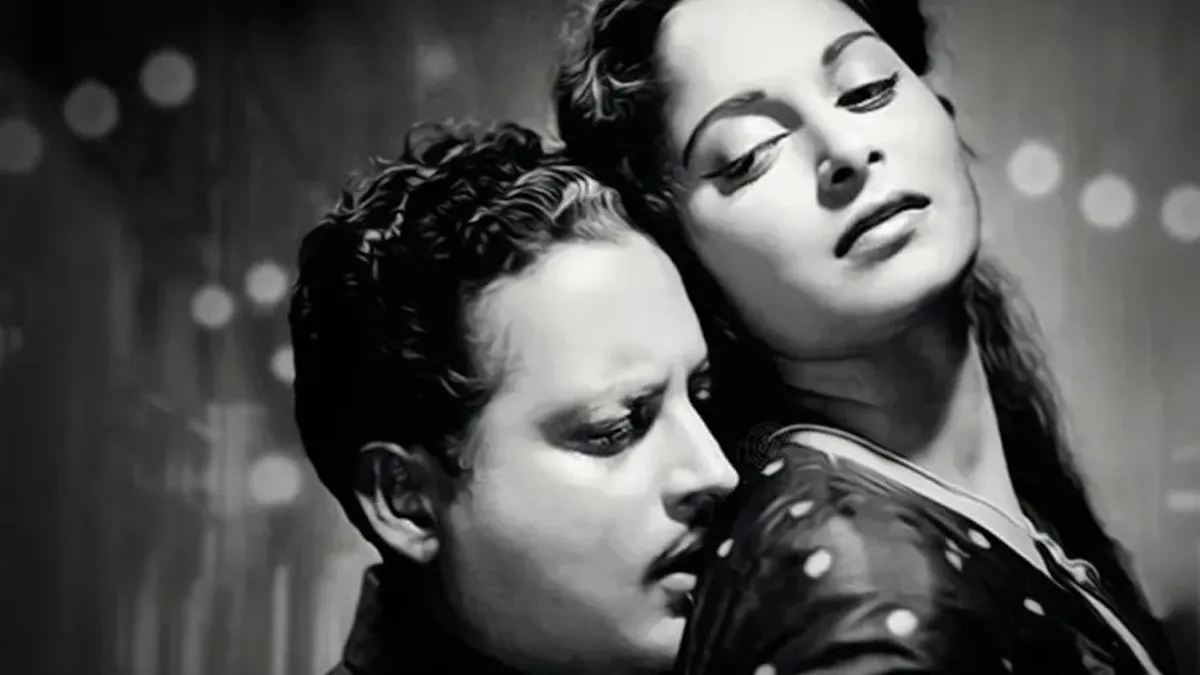
Drama, musical, by Guru Dutt, India, 1957
Thirsty is the heartbreaking story of Vijay, a young poet living in Calcutta who dreams of giving voice to the suffering and injustice of the world through his verses. Idealistic and sensitive, Vijay clashes with a society that despises his art because it is not profitable and does not cater to the tastes of the public. His brothers consider him a failure, the woman he loves leaves him for a marriage of convenience, and his poems are ignored by publishers. Only Gulabo, a prostitute with a pure heart, recognizes the beauty and truth of his words. When a misunderstanding leads everyone to believe Vijay is dead, his name and poetry suddenly become famous, exposing the hypocrisy of those who had previously rejected him.
Watching Thirsty means immersing oneself in a work that goes beyond melodrama, blending poetry, music, and imagery into a profound reflection on the human soul and the value of art. Guru Dutt, director and protagonist, creates one of the most intense and poetic films in world cinema, where black-and-white cinematography, expressive framing, and evocative lyrics produce an atmosphere of poignant melancholy. It is a film about the misunderstanding of the artist, pure love, and society’s hypocrisy, but also a universal critique of materialism and opportunism. Even today, Thirsty moves and provokes thought because it sincerely tells the story of the need to remain true to oneself in a world that measures people’s worth solely by their success.
LANGUAGE: Hindi
SUBTITLES: English, Spanish, French, German, Portuguese
What the State Hears Before You Do
You are already used to the idea that censorship is clumsy, reactive, slow — a blunt instrument wielded by bureaucrats who misunderstand what they are destroying. The archive disagrees. What the historical record shows, with uncomfortable consistency, is that power has often read poetry more carefully than the academies, more precisely than the critics, and far sooner than the general public ever would.
Augustus Caesar banished Ovid in 8 AD, and the official charge was characteristically vague — a poem and a mistake, as Ovid himself described it in his Tristia, carmen et error. The poem was the Ars Amatoria, an instructional text on seduction that had been circulating for nearly a decade before the exile. The timing made no sense if the logic was moral outrage. What the timing does make sense of is political calculation: by 8 AD, the Augustan program of social legislation was fully operational, its codes of marriage, adultery, and civic virtue now enforced with legal teeth. The Ars Amatoria did not simply offend propriety — it undermined the ideological architecture of a regime that had staked its legitimacy on the restoration of Roman moral order. Augustus did not exile Ovid because he had finally read the poem. He exiled him because the poem had finally become dangerous. The state had been watching the distance between a text and its consequences, and it moved the moment that distance closed.
The mechanism here is not censorship as reaction but censorship as anticipation — a reading practice trained to detect the precise moment when a voice shifts from ornament to instrument. What states have understood, and what liberal aesthetics prefers not to, is that poetry operates through accumulation: a metaphor absorbed today becomes a framework for understanding tomorrow, a rhythm internalized in one decade becomes the cadence of protest in the next. Authority does not wait for that chain to complete itself. It intervenes at the link it can still reach.
Osip Mandelstam wrote sixteen lines in November 1933. The poem circulated in manuscript — samizdat before the term existed — and was recited aloud in private apartments to perhaps a dozen trusted people. No public performance. No printed copy. No official readership. Stalin’s security apparatus had a transcript within months, and Mandelstam was arrested in May 1934. The poem was a direct portrait of Stalin as a murderer — the fat fingers like worms, the cockroach mustache, the execution orders signed like documents of pleasure. But what is remarkable is not that the poem was dangerous. What is remarkable is that the state found it faster than any literary institution would have, processed its threat more accurately than any editor would have, and responded with the full machinery of state violence to sixteen lines that most of the country had never read. Nadezhda Mandelstam’s account of those years, published in Hope Against Hope in 1970, describes how she and her husband understood the arrest as confirmation: the poem had worked. The state’s precision was, in its own grotesque way, a form of recognition.
This pattern does not belong only to autocracies, which is the comfortable exception we tend to reach for. The FBI’s Counter Intelligence Program maintained active files on Langston Hughes through the 1950s, tracking his published verse alongside his travel and his associations. The British colonial administration in Kenya arrested Ngugi wa Thiong’o in 1977 without charge and held him for a year following the performance of a play he had written in Gikuyu — a language the colonial infrastructure had spent decades marginalizing, and which now, precisely because of that marginalization, carried the charge of collective address. The linguistic choice was itself the political act, and the state understood that before the audience finished leaving the theater.
Power reads with purpose because it has always understood what aesthetics often pretends to forget: that form is never neutral, and that the vessel shapes what it carries long after the carrier has left the room.

The Lie Embedded in ‘Art for Art’s Sake’
You are handed a poem in a museum and told to feel it the way you feel a painting — at a safe distance, behind glass, without touching.
The doctrine that art exists for its own sake, answerable to nothing beyond itself, did not emerge from some timeless recognition of aesthetic truth. It was manufactured. Théophile Gautier crystallized the formula in the preface to his 1835 novel Mademoiselle de Maupin, declaring that nothing truly beautiful serves any purpose — that utility is the enemy of beauty. The timing was not accidental. France was in the turbulent decades following revolution after revolution, a period when every poem and pamphlet carried the potential to reorganize a crowd’s loyalties. The bourgeois cultural apparatus needed a way to absorb artistic energy without letting it detonate. The solution was elegant: reclassify the most dangerous utterances as purely aesthetic objects, strip them of their address, and hang them somewhere between the opera and the salon, where they could be admired without being heard.
What happened next is a historical sleight of hand so successful that most people inside universities still perform it without noticing. By the time Walter Pater was writing his 1873 work The Renaissance and urging readers to burn always with a hard gem-like flame, the quarantine was nearly complete. Aesthetic intensity had been redirected inward, toward the private trembling of the cultivated individual, away from any collective demand or social wound. Oscar Wilde, who understood this mechanism better than almost anyone, both inhabited and mocked it — but the culture kept the pose and discarded the mockery, leaving only the beautiful surface, which was precisely what the mechanism required.
The politics of declaring art apolitical is that it does not silence dissent; it reclassifies it. A poem that names hunger becomes a meditation on imagery. A verse that indicts a government becomes an exercise in prosody. The disruptive content is not removed — it is reframed as incidental, the way a murder can be reframed as a narrative device. Audre Lorde, writing in 1977 in her essay Poetry Is Not a Luxury, identified this operation with surgical precision: poetry for Black women was not decoration but necessity, a form of thinking that existed before the tools of prose were made available to them. The aesthetic doctrine she was writing against had never been neutral — it had been designed, she implied, to make certain kinds of knowing appear ornamental rather than foundational.
The deeper injury is what the doctrine does to the poet who internalizes it. When Pablo Neruda‘s early surrealist work gave way to the naked political address of his 1950 Canto General, he was accused by critics of betraying his art, of allowing ideology to contaminate lyric purity. The accusation itself is the confession: it reveals that purity was always a position, that the lyric free of politics was never free but rather had already chosen its allegiances — to the silence of those who needed no poem to speak for them because they already held the microphone.
César Vallejo died in Paris in 1938, in poverty, after years of writing poems that refused every aesthetic comfort the European avant-garde was offering him. His collection España, aparta de mí este cáliz, written in response to the Spanish Civil War, was printed in a monastery by Republican soldiers who had learned to operate a press. The books were confiscated. The art was, by any institutional measure, a failure — unread, suppressed, materially defeated. And yet the poem survived not because it was beautiful in the museum sense but because it was true in the way that a wound is true, because it carried inside it the specific gravity of what had actually happened to actual bodies.
The doctrine of pure art cannot account for that survival, which is why it quietly excludes it from the canon whenever possible.
Meter as Memory the Body Cannot Forget
You are reading this sentence, and somewhere beneath your awareness, your body is already scanning it for a beat that isn’t there — waiting for a stress to land, for a syllable to return, for the line to fold back on itself and confirm that you are still inside something held.
This is not metaphor. The neurological architecture of rhythm predates literacy by tens of thousands of years, and Walter Ong, in his 1982 study Orality and Literacy, documented with clinical precision what oral cultures across every continent had already solved intuitively: that formulas, meter, and sonic repetition are not decorative properties of language but mnemonic technologies, the original hard drive of human knowledge. Before there was anything to write, there was the body keeping time, and the body does not forget a pattern it has lived inside. Ong called this the “mnemonics of primary orality” — the way stress and recurrence transform information into something the nervous system can store without external support, without a page, without a room, without safety.
The state has always understood this before its poets do. You can burn a pamphlet, close a newspaper, arrest an editor, and the knowledge it contained dies with its last reader. But a poem that has been spoken aloud, that has lodged its stresses into someone’s chest the way a song lodges in a commuter who cannot name where they first heard it — that poem has entered a distribution system that has no address to raid. The Soviet secret police, the NKVD, operated with extraordinary bureaucratic efficiency against written materials. What they could not efficiently target was the interior of a woman’s mouth.
In Leningrad, between 1935 and 1940, Anna Akhmatova composed the cycle that would eventually be published in 1987 under the title Requiem — fifty years after she wrote it, thirty-two years after her death. She wrote each poem and then burned it. The manuscript existed, for years, only inside the bodies of twelve women who had memorized it, piece by piece, and who gathered occasionally to recite it silently, moving their lips without producing sound, confirming to one another that the text was intact, that they still held it. This is not a fact that belongs to literary history. It is a fact about what the human body can be conscripted to do when form makes it worth the risk. Prose instructions can be memorized too, but they resist the body. Poetry, structured by stress and return, cooperates with it — it wants to be held, it fits the shape of breath.
What meter actually does, physiologically, is impose a predictive structure on incoming language. The brain, encountering a line of verse, begins anticipating syllable weights before they arrive, and when they arrive as expected, the system releases a measurable reward signal. When they deviate strategically — when a poet breaks the expected stress to land a meaning harder than the meter could — the deviation registers as significance. This is why you remember the line that surprised you inside the poem you thought you knew. The form is the delivery mechanism; the break in form is the blade. Neuroscientist Stefan Koelsch’s research into music and emotional memory, published across multiple studies in the 2010s, confirms that rhythmically encoded material is stored through neural pathways distinct from those processing ordinary semantic content, making it substantially more resistant to forgetting and, critically, to the kind of targeted suppression that requires knowing where the information lives.
Power has always preferred prose for its enemies. Prose is arguable, refutable, locatable in a document that can be seized. A metered line, once it enters you, becomes autobiographical — it attaches to the memory of the first time you heard it, the room, the light, the person who said it, and dismantling it would require dismantling you along with it, which is a different kind of operation entirely, and one that even the most efficient police states have found to be, at scale, unworkable.
The Colonial Tongue and the Stolen Instrument
You are handed a knife and told to carve your own name into a stone that has already been carved with someone else’s name for you. That is the precise situation of the colonial poet — not a metaphor, not an approximation, but the structural condition of every writer who grew up speaking the language of the civilization that had classified their ancestors as less than civilization.
The question is not whether to use the instrument. The instrument is all you have. Aimé Césaire, born in Martinique in 1913, educated at the École Normale Supérieure in Paris, wrote his Notebook of a Return to the Native Land between 1935 and 1939 — a text that would be revised obsessively through 1956 — in a French so saturated with violence and beauty that the language itself seemed to buckle under the weight of what it was being forced to confess. He did not write against French. He wrote through it, pushing each syntactic construction past the point where it could continue to pretend innocence. The subordinate clause became an act of accusation. The lyric apostrophe became a wound held open.
What Césaire understood — and this is where the analysis must be precise — is that colonial power does not only occupy territory. It occupies grammar. The civilizing mission was always, at its root, a linguistic project: the systematic replacement of Creole, Wolof, Bambara, Malagasy with the tongue that carried inside it an entire hierarchy of who counted as human and who required management. The Académie française was not a neutral institution. It was a regulatory body for a worldview that required Africa to be silent in order to be legible. To write poetry in French was therefore never an innocent act for a Martinican writer. It was always already a negotiation with a theft.
Frantz Fanon, writing in Black Skin, White Masks in 1952, argued that to speak a language is to assume a world, and that the Black Antillean who masters French acquires a civilization and disavows their own. What Césaire did with the Notebook is refuse that binary entirely. He did not disavow French civilization — he forced French civilization to disavow itself by showing it its own reflection in a language it had invented to avoid exactly that confrontation. The surrealist influence on his style was not decorative; the logic of surrealism, its commitment to the irrational eruption beneath rational surfaces, gave Césaire a formal permission to detonate coherence from inside coherence. The dream-syntax was not escape. It was assault.
There is a specific kind of violence in being forced to mourn in the language of the person who caused the grief. When Césaire writes of the holds of slave ships, of bodies stacked in the dark, he writes in alexandrines that carry the muscle memory of Racine and Rimbaud. The reader who was trained in French literature hears that muscle memory and cannot disown it. The aesthetics they were raised to love is now delivering them the bill for what funded that love. This is what linguistic sabotage actually looks like in practice — not a refusal of the master’s tools but a rerouting of them so they arrive at the master’s door carrying the exact weight they were designed to conceal.
The Notebook was initially published in a surrealist journal in 1939 to almost no readership. Its audience came later, slowly, as decolonization movements across Africa and the Caribbean found in it a formal proof that the oppressor’s language could be made to testify against the oppressor. By the time the final version appeared in 1956, it had already traveled through the hands of a generation who needed precisely that proof — not as consolation, but as method. The poem was not a cry. It was a demonstration of something the empire had insisted was structurally impossible.
A vision curated by a filmmaker, not an algorithm
In this video I explain our vision
When the Crowd Becomes Complicit in Silence

You are sitting in a room full of people who all know the same thing you know, and none of you are saying it. Not because an officer is standing at the door. Because the woman next to you would shift in her seat, and the man across from you would find something urgent to study in the middle distance, and the slight collective adjustment of bodies would communicate, with perfect efficiency, that you had just made everyone uncomfortable. The state does not need to send anyone. The room does its own work.
This is the mechanism that Audre Lorde was diagnosing when she wrote, in 1977, that poetry is not a luxury but a vital necessity of existence — the distillation of experience from which true life can be drawn. The essay is precise and unsparing, but what most readers take from it is the affirmation of poetry’s value. What they receive less willingly is her embedded accusation: that the people most likely to suppress the dissident voice are not the powerful, but the frightened members of the same community who have decided that survival means making no sudden movements. Lorde was not speaking abstractly. She was naming a cost she had paid personally, among Black women, among feminists, among the communities that should have been her readership first and her shield second. The ridicule or the silence she encountered did not come from the White House. It came from the shared table.
Communities develop their own censorship apparatus, and it operates with extraordinary subtlety. It does not announce itself as censorship. It arrives as concern — as the friend who says your work is too angry, too raw, too much, the implication being that the anger itself is the problem rather than the condition producing it. Erving Goffman, in his 1963 study Stigma, traced the way socially marked individuals are pressed to manage their own visibility as a condition of partial acceptance. The dissident poet is a specific variation of this figure: permitted to exist within the community on the condition that their dissidence stays decorative, stylized enough to be called art rather than accusation. The moment the poem gets too close to a specific face in the room, the community retracts its hospitality.
What makes this social suppression more durable than state repression is that it leaves no record. There are no banned books to point to, no arrest warrants to cite, no trial transcripts to unearth decades later and present as evidence of injustice. The poet who goes quiet after years of communal discouragement leaves behind only silence, and silence is indistinguishable from a choice freely made. Historians can document the burning of a manuscript. They cannot document the hundred small moments of ridicule that taught a writer to burn her own work before anyone else could reach it.
The economics of this are brutal in the specific sense that Pierre Bourdieu mapped in The Rules of Art, published in 1992 — the literary field is not exempt from the logic of social capital, and the poet who challenges the community’s self-image is gambling with a form of belonging that cannot be easily repurchased once spent. This is not cynicism; it is structural. The poet who tells the community what it does not want to hear is not merely risking disapproval. She is risking the entire network of recognition, publication, invitation, and solidarity on which any writer’s existence partially depends. The courage required is not the cinematic courage of facing a uniformed enemy. It is the quieter and perhaps more difficult courage of watching the warmth leave the eyes of people you love and continuing to speak anyway.
And the crowd, for its part, rarely experiences itself as complicit. It experiences itself as maintaining standards, as protecting the community’s image, as gently redirecting someone whose pain has started to spill past the acceptable container of metaphor into something that resembles a direct indictment of the people in the room — which, of course, it is.
The Second Scene: A Voice in a Room That Pretends Not to Listen
The room is not a prison. That is the first thing you notice when you walk in — the good lighting, the wine on the table in the back, the chairs arranged in careful rows that suggest welcome. A poet stands at a podium in a municipal cultural center somewhere in a mid-sized European city, reading from a manuscript that took her eleven years to complete. The audience watches with the particular stillness of people who have already decided not to react. They hold their programs. They breathe through their noses. The poem she is reading names a government ministry by name, describes the bureaucratic machinery by which refugee families were separated at a northern port, gives the exact tonnage of a cargo ship repurposed for detention. The room does not move. Someone near the back refills their plastic cup. This is not indifference — it is a performance of indifference, which is a different and more sophisticated instrument entirely.
What has replaced the censor’s red pen is not freedom. Pierre Bourdieu spent the better part of the 1990s, particularly in the lectures collected in “The Rules of Art,” describing how cultural fields develop their own internal mechanisms for neutralizing dissent — not by prohibiting it, but by repositioning it as a subcategory of aesthetic production, something to be evaluated for its formal qualities, submitted to grant panels, rated for its accessibility to diverse audiences. The poem about the detention ship does not get banned. It gets funded at sixty percent of the requested amount, contingent on a community engagement component and a schools outreach program. The poet spends four months writing funding reports. The detonation is scheduled, postponed, and finally absorbed into the annual programming calendar between a jazz quartet and a ceramics workshop.
This is distinct from the Soviet apparatus that imprisoned Osip Mandelstam in 1934 for a sixteen-line poem that circulated only in handwritten copies among a circle of perhaps a dozen people — a poem that Stalin reportedly read and chose to treat as a personal insult rather than a public threat. The state’s recognition that words were dangerous was, paradoxically, a form of respect. The machinery of contemporary cultural administration operates on the opposite assumption: that poetry is categorically non-threatening, that its audience is self-selecting and marginal, that its political content can be safely displayed as evidence of institutional openness without anyone being genuinely disturbed. The monitoring has not disappeared; it has moved from the security bureau into the grant application portal.
What the audience in that well-lit room is performing is something Hannah Arendt identified in a different register in “The Origins of Totalitarianism” — not the banality of evil, exactly, but the banality of witness, the cultivated capacity to be present at a moment of articulated truth and to experience it as cultural programming. The poet finishes. There is applause, measured and warm, the kind that communicates appreciation without acknowledgment. A moderator thanks the funding bodies by name. The poet nods. She knows that the most radical act she performed tonight was not the poem itself but the act of continuing to write it, of refusing to pre-edit for the room, of trusting that language pressed hard enough against a fact will eventually leave a mark even in a space that has been architecturally designed to absorb the blow.
What survives in this context is not the poem that was permitted — it is the poem that was written anyway, that circulates in the manuscript passed hand to hand after the event, that someone photographs on their phone and sends without comment to a person in another city who reads it alone at two in the morning and feels, for a moment, the specific vertigo of being seen by language that was not written for an institution but for the person who needed it most.
What Survives Is Not What Was Allowed to Survive
You have been told, at some point in your education, that the poets you studied survived because they mattered. That is the story the canon tells about itself — a long, patient sorting of the essential from the forgettable, a sedimentation of quality across centuries. What no one said plainly is that survival is a material process before it is an aesthetic judgment, and that material processes are controlled by institutions with interests that have nothing to do with the destabilizing power of a line.
Consider what it actually takes for a poem to reach the twenty-first century. It requires someone wealthy enough to afford ink and vellum, or later a press. It requires a scribe, a printer, a publisher who calculates risk. It requires a patron who does not find the work threatening to his social position, or a state apparatus that tolerates the particular flavor of dissent on display. Sappho survives in fragments precisely because the larger body of her work was not considered worth the theological effort of preservation — roughly nine hundred years after her death, Byzantine scholars were still editing what the church would allow to be copied. What remains of her is what slipped through gaps in a system of exclusion so thorough it did not even need to announce itself as censorship.
The sixteenth-century Spanish Inquisition did not only burn bodies. It maintained indexes of prohibited texts — the Index Librorum Prohibitorum, formalized under Paul IV in 1559, ran through its various editions well into the nineteenth century, and each edition represents not only a list of what was forbidden but an inadvertent map of what was considered genuinely dangerous. The poets who appear on no such list were, in many cases, not there because they were innocent but because they were insufficient — because their revolt had not yet reached the pitch that made power feel its pulse quicken. The ones who made power sweat did not always get the dignity of formal suppression; they were simply not copied, not stored, not remembered by name.
This is the crime the canon conceals most efficiently: not that it elevated the mediocre, but that it trained readers to equate survival with significance. Jorge Luis Borges, writing in the 1940s, understood that libraries are not repositories of knowledge but architectures of forgetting — every book on the shelf implies ten thousand that never made it to the shelf, and the implied absence is the more important fact. The reader who studies the canon in good faith emerges believing they have encountered the most powerful voices; they have, at most, encountered the most tolerable ones.
What troubles this further is the way certain voices were preserved in a state of deliberate dilution. Federico García Lorca was killed by Franco’s forces in August 1936, but his work survived because it was claimed, rapidly and internationally, by a liberal cultural apparatus that needed a martyr more than it needed a revolution. The Lorca that entered the canon is the elegist, the surrealist, the lyric voice of duende — the Lorca whose explicit homosexuality and whose rage at Spanish bourgeois society were softened into aesthetic categories. A poet can survive his death and still not survive the rescue.
What this means for the reader who wants to take poetry seriously as revolt is not that the canon should be abandoned but that it must be read against the grain of its own existence — treated as evidence of a selection process rather than the outcome of a neutral one, with every celebrated line throwing a shadow shaped exactly like the voices that were never given the chance to threaten anyone at all, and whose silence now is the most complete poem the powerful ever made.
🔥 Voices That Dared to Speak Against Power
Poetry has never been a merely aesthetic act — it has always been a weapon, a wound, and a way of surviving. The poets, thinkers, and artists gathered here share one essential quality: they refused silence when silence was the only safe option. Their words still echo as acts of resistance.
Shelley and the Defence of Poetry: Poets as Legislators
Percy Bysshe Shelley famously declared that poets are the unacknowledged legislators of the world, asserting that verse holds the power to reshape societies from within. In his Defence of Poetry, he argued that imagination is the root of all ethical and political progress, making the poet a figure of radical cultural authority. This vision of poetry as a civilizing and subversive force resonates directly with any understanding of verse as revolt.
GO TO THE SELECTION: Shelley and the Defence of Poetry: Poets as Legislators
Pier Paolo Pasolini and Italian Political Corruption
Pier Paolo Pasolini used his poetry, films, and essays as a relentless indictment of the political corruption rotting the Italian state from within. His language was deliberately transgressive, mining the dialects and bodies of those whom power sought to render invisible. Pasolini paid with his life for the ferocity of his testimony, becoming one of the most radical literary martyrs of the twentieth century.
GO TO THE SELECTION: Pier Paolo Pasolini and Italian Political Corruption
Federico García Lorca: Life and Works
Federico García Lorca wrote poetry saturated with the blood of the marginalized — the Roma, the queer, the poor — in a Spain that would soon unleash fascist violence upon all of them. His duende, that dark and urgent creative force, was inseparable from his awareness that beauty and death are politically entwined. Lorca was executed by Francoist forces in 1936, making his silencing a literal act of state terror against poetic revolt.
GO TO THE SELECTION: Federico García Lorca: Life and Works
The Cursed Poet: History and Figures
The figure of the Cursed Poet — Rimbaud, Verlaine, Baudelaire — incarnates the idea that true poetic vision is incompatible with the social order and must therefore be punished by it. These writers were not merely bohemian eccentrics but artists whose formal and moral transgressions constituted a systematic refusal of bourgeois civilization. Understanding the cursed poet is essential to grasping why power has always feared the ones who see too clearly and speak too freely.
GO TO THE SELECTION: The Cursed Poet: History and Figures
Cinema That Also Dares to Speak Truth
If these voices of poetic revolt have stirred something in you, Indiecinema is the streaming space where that fire continues on screen. Discover independent films that share the same uncompromising spirit — works that power would also rather you never saw.
👉 EXPLORE THE CATALOG: Watch Indie Films in Streaming
A vision curated by a filmmaker, not an algorithm
In this video I explain our vision

