
The Boy Who Grew Up Inside a Universe
You are seven years old and the house is never quiet. Not because people are loud — they are, sometimes, in the way large families are loud — but because the house itself breathes. Forty-four rooms in the Jorasanko mansion in Calcutta, 1868, and every corridor carries something: the drone of a harmonium through a half-closed door, the smell of ink and marigold, the sound of a cousin reciting Sanskrit while a servant sweeps ash from a courtyard where last night’s theatrical rehearsal left its ghost. You grow up inside a compound that functions less like a home and more like a civilization with its own internal weather. The Tagore family — Thakur, in Bengali — has been accumulating culture the way others accumulate debt, and by the time Rabindranath arrives as the fourteenth child of Debendranath Tagore and Sarada Devi, the house is so saturated with art, philosophy, music, and spiritual ambition that childhood itself becomes a kind of apprenticeship in the serious business of being alive.

What is rarely said plainly is that this grandeur was also a cage built from contradictions. The Tagores were Pirali Brahmins, a subcaste that had been socially ostracized for generations after alleged contact with Muslim influence — a stigma that paradoxically freed them from certain orthodoxies while branding them within the Hindu social hierarchy. Debendranath was a leader of the Brahmo Samaj, the reform movement that rejected idolatry and caste rigidity, drawing on the Upanishads for a monotheistic spirituality that disturbed both the orthodox Hindus and the Christian missionaries who believed Bengal was ripe for conversion. The child Rabindranath was therefore born into a family that existed in permanent negotiation: too Westernized for traditionalists, too Indian for the colonial apparatus, too heterodox for the majority culture around them. He was shaped by a household that had already decided, before his birth, that existing categories were insufficient.
Outside the compound walls, Calcutta in the 1860s and 1870s was a city being administered as an argument. The British colonial administration had made it the capital of British India, a showcase of imperial modernity — wide avenues, printing presses, European-style colleges — while simultaneously extracting from Bengal a systematic economic subordination that would eventually help trigger the great famine of 1876, killing somewhere between six and ten million people across South India and the Deccan. The Bengal Renaissance, that extraordinary flourishing of literature, science, and philosophy in the nineteenth century, happened not despite colonial pressure but in a ferocious intellectual friction against it. Ram Mohan Roy had already died in Bristol in 1833 having petitioned the British Parliament on Indian rights and having helped abolish sati. The reformist inheritance was already decades old when Tagore was born, and it sat in the Jorasanko house like furniture — present in every room, expected to be used.
What this produced in Tagore was not a childhood of innocence followed by an education. It produced a childhood that was itself already an education in the problem of consciousness under occupation. He was sent briefly to several schools and hated every one of them, finding their rote methods a kind of violence against the mind’s natural movement. His real education happened in the family’s library, in the theatrical productions staged inside the compound, in the songs his family composed and performed, in the long walks he was sometimes permitted across the estate at Shelidah on the Padma River, where water and sky produced in him something he would spend the rest of his life trying to name. He was not a prodigy in the showy sense — not a child performing for adults. He was something stranger: a child who was already listening to something the adults around him could only partially hear.
The difference matters, because it means the poetry that would eventually make him the first non-European to receive the Nobel Prize in Literature in 1913 did not emerge from talent applied to tradition. It emerged from a child who had learned, very early, that the world as presented to him was always leaving something out.
I Am Nothing
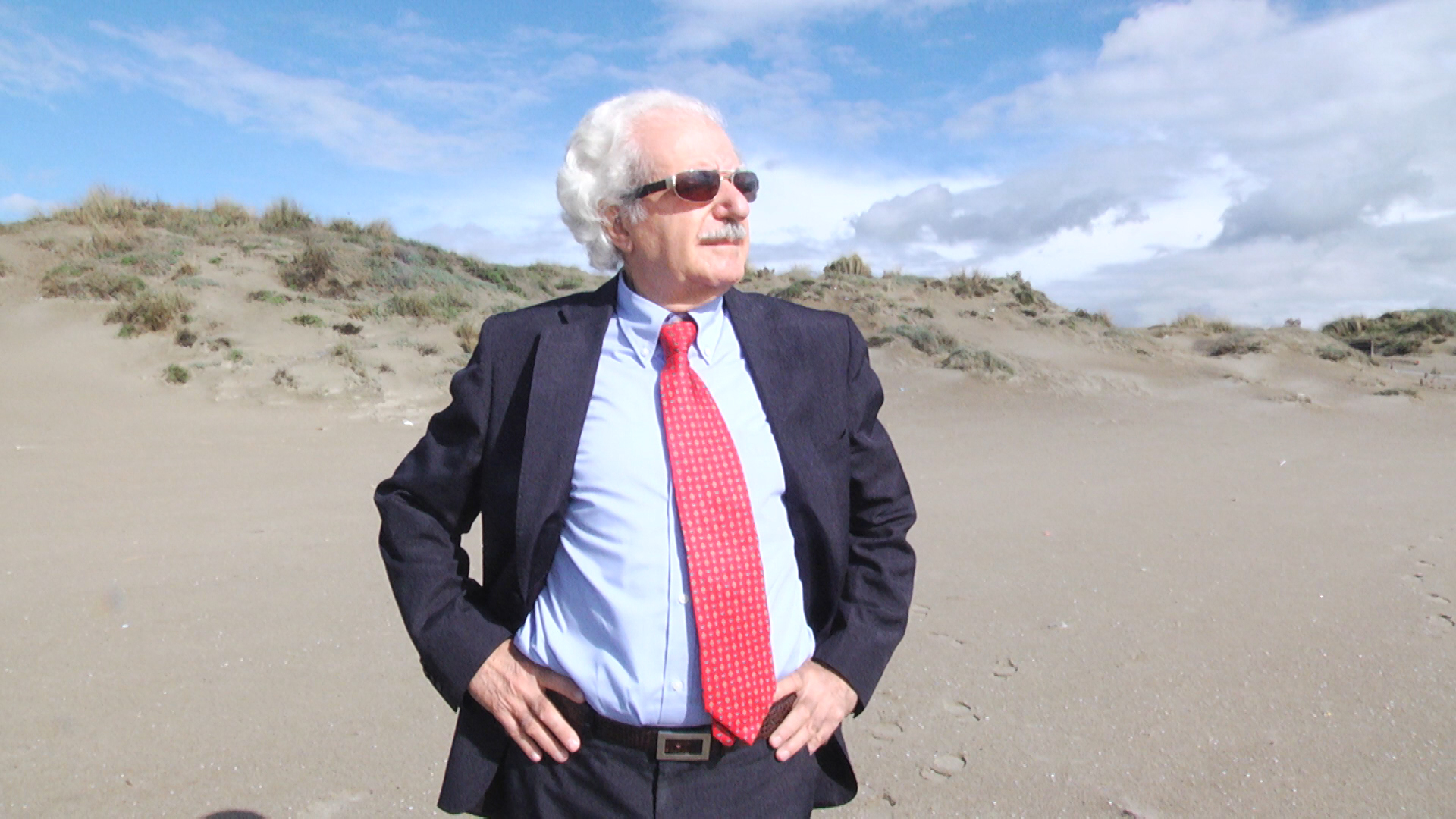
Drama, thriller, by Fabio Del Greco, Italy, 2015.
The story revolves around Vasco, a Roman builder who, at the age of 74, enjoys a life of absolute comfort. His human parable takes a dramatic turn when a mysterious encounter leads him to an ambush. Having survived, but marked by a long coma, Vasco wakes up with a new sensitivity, developing an intimate and poetic bond with nature. This new relationship with the world around him leads him to deeply explore himself, in an internal and external journey. through Italy, the United States and India, in search of a higher meaning and a cure. In parallel, the threat of a planetary cataclysm adds an epic dimension to the story.
I Am Nothing explores universal themes such as time, memory, oblivion and the connection with nature. Fabio Del Greco creates an existential drama full of food for thought. The director skillfully combines different visual materials, mixing archive images with nature photographs and dreamlike visions. This visual experimentation translates into an editing that captures the viewer's attention, guiding him through a cycle of creation and destruction. The sequences that alternate the buildings, Vasco's pride, with Indian landfills and natural landscapes create a hypnotic rhythm, underlining the beauty and fragility of life. Vasco's existential journey is a hymn to transformation and rebirth. The evolution of the protagonist, from unbridled luxury to the rediscovery of purity, represents a powerful metaphor on the meaning of life and the need to reconnect with authentic values. Io sono nulla stands out for its ability to combine introspection and visual experimentation, offering a suggestive and engaging narration. It is a film that invites us to reflect on the human condition, on our relationship with power and nature, and on the possibility of finding ourselves through change. A work that leaves its mark and lends itself to multiple readings.
LANGUAGE: Italian
SUBTITLES: English, Spanish, French, German, Portuguese
A Mind Formed at the Margins of Empire
You sit in a classroom where the ceiling is too low and the windows face a wall, and someone is explaining the world to you in a language that is not yours, using examples drawn from a geography you have never touched, and you understand — not intellectually but in your body — that the knowledge being handed to you was never designed to illuminate your life. It was designed to make your life legible to someone else’s administration.
Tagore understood this before he had the vocabulary to name it. He entered Presidency College, Calcutta, and then the University College London, and he left both — not from laziness or failure, but from a form of revulsion that his later essays would carefully anatomize. The British colonial school, as he described in his 1917 collection Personality and later in the lectures compiled as Talks in China, operated on a principle of severance: it cut the child from the soil of his own intuition and replanted him in a curriculum designed to produce clerks and administrators, people useful to an empire rather than whole to themselves. The formal institution, Tagore argued, treated education as information delivery — the moving of content from a sanctioned source into a passive vessel — and in doing so confused the accumulation of facts with the formation of a person.
What distinguished his critique from simple anti-colonial protest was that it went deeper than politics. He was not merely objecting to the British content of the curriculum; he was objecting to the epistemological structure underneath it — the assumption that knowledge flows in one direction, from the certified expert downward, and that the student’s own sensory, emotional, and imaginative engagement with the world was noise to be quieted rather than the very medium through which understanding becomes real. This is why his own formation, which looked fractured to colonial eyes — tutors at home, independent reading, wandering the estates of the Tagore family in Bengal, absorbing poetry and music and the rhythms of the Padma river — was in fact a coherent philosophical method. Disconnection from the institution was the condition of his connection to the living.
In 1901, he founded Santiniketan on land his father Debendranath had established as a retreat in Birbhum district, West Bengal. He began with five students and a handful of teachers, conducting classes under trees, insisting that the physical openness of the space was not incidental but structural — that the boundary between the classroom and the earth was itself a pedagogical statement. The ashram school he built there deliberately recalled the ancient gurukul tradition, but without nostalgia: Tagore was not trying to restore a golden past. He was trying to create an educational environment where the student’s encounter with beauty, nature, and creative labor was treated as epistemically serious — as a way of knowing, not a reward for knowing. By 1921, Santiniketan had evolved into Visva-Bharati, a university he conceived as a meeting point between Indian and global intellectual traditions, operating on the premise that no single civilization holds the complete inheritance of human thought.
The colonial school had been built on exactly the opposite premise. Macaulay’s 1835 Minute on Indian Education, with its infamous declaration that a single shelf of a good European library was worth more than the whole native literature of India and Arabia, had established the epistemological hierarchy that Tagore’s entire life was organized to dismantle. Not through argument alone — though the arguments exist, precise and devastating — but through the act of building something that worked by different laws, where a child could learn geometry and then sit with a musician and understand that both were ways of attending to pattern, to the structure beneath appearances.
There is something quietly radical in the refusal to be educated by your conquerors on their terms, and something even more radical in building, in response, not a counter-institution that mirrors the original’s rigidity, but a place that looks, from certain angles, almost like freedom.

Gitanjali and the Trap of the Nobel Prize
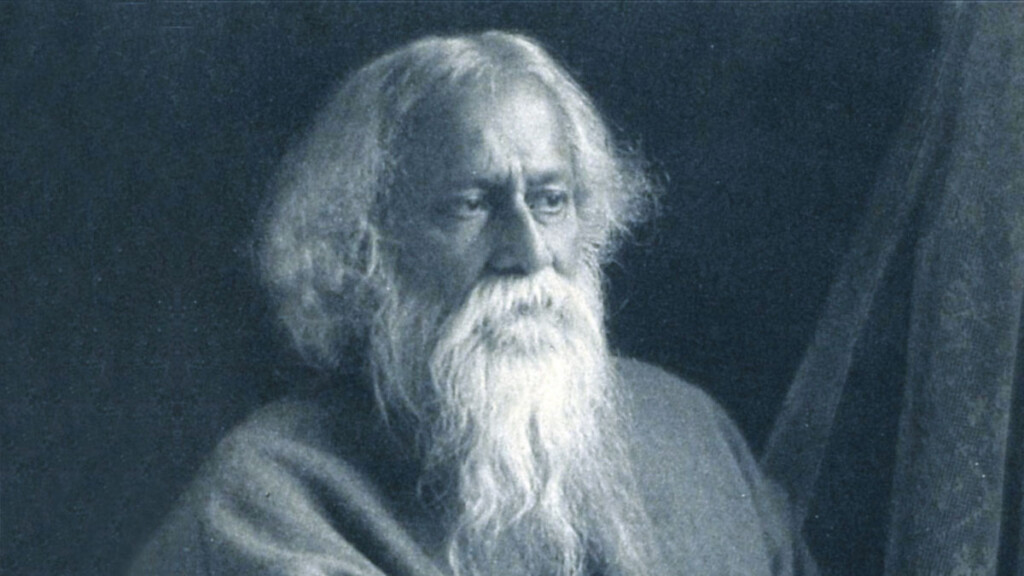
You pick up the slim English volume and feel, almost immediately, that you are holding something designed to be beautiful in your hands — something that asks nothing of you except a vague spiritual surrender. That sensation is not accidental. It is the product of a specific editorial violence committed in 1912, when W.B. Yeats sat with Tagore’s prose translations and smoothed them into a luminous, hovering English that smelled of incense and eternity. Yeats wrote in his introduction to Gitanjali that he had carried the manuscript for days, reading it on trains and in restaurants, moved to tears by what he called “a vision of the world” that the West had forgotten. What he did not say — what he perhaps could not afford to say — was that he had made himself the text’s first colonizer.
The Bengali originals from which Tagore worked are not gentle. The Gitanjali of 1910, published in Calcutta, is a book of devotional intensity, yes, but the devotion is restless, sometimes anguished, occasionally accusatory toward the divine. The Bengali syntax carries its meaning in layers that the verb endings themselves perform — tense, intimacy, and irony braided together in ways that English, a language structurally allergic to ambiguity of that kind, cannot replicate without collapsing into either flatness or excess. When Tagore rendered his own poems into English prose, he was already making concessions. When Yeats then edited those concessions for a Western literary audience primed for the mystical after the exhaustion of Victorian rationalism, what remained was a perfume — spiritually evocative, culturally safe, and politically empty.
The Nobel Committee awarded Tagore the Prize in Literature in 1913, the first non-European to receive it, citing “his profoundly sensitive, fresh and beautiful verse, by which, with consummate skill, he has made his own poetic thought, expressed in his own English words, a part of the literature of the West.” That last phrase deserves to be read slowly and with discomfort. The prize was not given for his Bengali work — the enormous, technically radical body of poetry, drama, fiction, and song that had already transformed an entire literary culture. It was given for the English Gitanjali, for the version of Tagore that Yeats had made legible and appetizing for European consumption. The Swedish Academy, in honoring him, also confined him.
What the Western reception systematically erased was the political fury running beneath Tagore’s surface. The same years that produced Gitanjali also produced his most incendiary essays on nationalism, his fierce opposition to the partition of Bengal in 1905, and his correspondence with figures like Mahatma Gandhi in which he challenged the very terms of the independence movement he also supported. He returned his knighthood in 1919 after the Amritsar Massacre, writing to the Viceroy with a cold precision that had nothing mystical in it — only a man refusing to allow his dignity to be used as decoration for empire. None of this made it into the European image of Tagore. The saint had arrived, and no one wanted to also receive the insurgent.
The trap operates this way: a colonized intellectual achieves maximum global visibility at the exact moment his work is most thoroughly misread. Frantz Fanon observed in The Wretched of the Earth, published in 1961, that the colonized intellectual who seeks recognition from the metropolitan center must always pay with some portion of their own specificity. The recognition arrives, but it arrives for the version of you that the center could digest.
When Nationalism Became the Enemy
You are in a crowd that wants to be free, and the man at the podium is telling you that your hunger for freedom is the disease, not the cure. The room does not erupt in applause. It does not know what to do with this. Somewhere in the audience, a young nationalist shifts in his seat, reaching instinctively for the vocabulary of betrayal.
Tagore delivered his lectures on nationalism in 1916 and 1917, first in Japan, then in the United States, at the precise historical moment when colonized peoples across the globe were discovering that the nation was the one weapon the oppressor understood. The Irish were dying for it. The Indians were organizing around it. And here was Bengal’s most celebrated poet, recipient of the Nobel Prize for Literature in 1913, beloved voice of a culture that had been systematically humiliated for over a century — telling anyone who would listen that nationalism was a mechanical aggregate of power, not a human community, and that its triumph would mean the spiritual death of whatever it claimed to liberate. He published these lectures as Nationalism in 1917, a slim and devastating book that almost no one wanted to read charitably.
What made the position so structurally uncomfortable was not that it came from a position of safety. Tagore lived under the same colonial administration as every Bengali subject. He had watched the 1905 partition of Bengal slice through communities with bureaucratic indifference, had felt the humiliation that European racial hierarchy pressed onto every educated Indian who dared to think in public. His critique of nationalism was not the comfortable skepticism of someone with nothing to lose. It was the dissent of someone who understood the seduction from the inside and refused it anyway. He argued that the European nation-state was itself a kind of organized selfishness, a machine for accumulating collective ego, and that for India to replicate it would be to inherit the pathology rather than escape it.
The break with Gandhi was not a clean rupture but a long and painful divergence. Gandhi had structured an entire liberation movement around the idea that the Indian people constituted a moral nation prior to its political realization. Tagore respected Gandhi’s asceticism and loved him — he gave Gandhi the honorific Mahatma — but he could not follow him into the burning of foreign cloth, could not endorse the swadeshi movement’s implicit equation of economic nationalism with spiritual resistance. When Gandhi asked Indians to destroy their imported textiles in 1921, Tagore wrote against it publicly, arguing that the destruction of goods was not the same as the creation of consciousness. The Bengali intelligentsia, already uneasy with his 1917 lectures, now had a second reason to categorize him as a man who did not understand the urgency of the moment.
Georg Simmel had written in 1908 about how groups cohere through the production of an enemy, through the shared identification of what lies outside the boundary. The nation does this with extraordinary efficiency — it creates belonging through exclusion, love through hatred of the other. Tagore saw this mechanism operating at the civilizational level and understood that once a people had organized themselves around it, the mechanism would not simply dissolve when independence arrived. It would turn inward, or pivot toward a new enemy. He was watching, in 1917, what European nationalism had already produced: a continent lurching toward the catastrophe that would kill seventeen million people by 1918. He saw no reason to believe that Asian or African nationalisms would metabolize the same structure differently.
What disturbs about this position, even now, is that history has not cleanly vindicated either side. The nations born from anti-colonial struggle brought genuine self-determination and genuine violence, sometimes in the same decade. Tagore did not offer a replacement architecture. He offered a warning that arrived before anyone had built the house it was warning against, which is the particular cruelty of a certain kind of clarity.
The Philosophy of the Infinite in the Finite
You have probably felt it without having a name for it — that moment when something ordinary, a specific angle of afternoon light across a floor, the way a particular silence follows a particular sound, carries a weight entirely disproportionate to its physical cause. You did not imagine it. You were not being sentimental. You were touching something Tagore spent his entire intellectual life trying to articulate with precision and without mystical evasion.
The concept he called jiban devata — the deity of life, the indwelling presence that animates individual consciousness and connects it to something neither personal nor impersonal but dynamically both — was not a theological comfort. It was a philosophical instrument. Tagore developed it most rigorously across his Sadhana essays of 1913 and the lectures collected in The Religion of Man in 1931, insisting that selfhood is not a container but a relation, that the human being does not possess experience but is constituted by the friction between the finite and whatever exceeds it. This is not mysticism in the dismissive Western sense of the word. It is closer to what Edmund Husserl was attempting from the other direction in the same decades — a phenomenology of consciousness that refuses to reduce the living subject to a mechanism or to dissolve it into abstraction.
The distance between these two projects became dramatically visible on July 14, 1930, when Tagore met Albert Einstein at Einstein’s villa in Caputh, Germany. Their conversation, later partially transcribed and published, is one of the genuinely strange documents of twentieth-century intellectual history. Einstein argued for the independence of physical reality from human consciousness — a universe that would remain coherent even if humanity vanished entirely. Tagore pressed back, not from a position of idealism in any naive sense, but from the epistemological insistence that truth, as a category available to human minds, cannot be cleanly separated from the structure of human perception. A beauty that no one perceives, he suggested, is not beauty in any meaningful sense. A truth that no mind can access is not truth but a hypothesis about the absence of minds. Einstein found this intolerable. Tagore found Einstein’s counter-position equally insufficient — a faith in objectivity that smuggled in a hidden observer, the transcendent rational mind, without acknowledging it as such.
What neither man said plainly, but what the conversation reveals despite itself, is that both were working at the boundary where empirical methodology runs out of jurisdiction. Einstein’s commitment to an observer-independent reality was itself a metaphysical stance, not a scientific finding. The equations do not tell you whether the universe exists when no one is looking. That is a prior commitment, a choice about what kind of question is worth asking. Tagore’s position was simply more honest about the fact that consciousness is not incidental to the inquiry — it is the medium through which any inquiry occurs at all.
What makes this philosophically significant rather than merely culturally interesting is that Tagore was not defending Eastern thought against Western science. He was identifying a structural blind spot inside both frameworks — the tendency to treat the knowing subject as either irrelevant noise or as a mystical ghost, never as the precise and ordinary condition of everything else. His poems in Gitanjali, for which he received the Nobel Prize in Literature in 1913, are not spiritual hymns in the conventional sense. They are attempts to hold the finite particular — a specific grief, a specific shore, a specific duration of waiting — at exactly the angle where it becomes transparent to something larger without ceasing to be itself. That is technically very difficult to do. Most literature collapses in one direction or the other, becoming either documentary or vague. Tagore knew that the finite does not point toward the infinite by abandoning its own texture. It does so by intensifying it — which means that the philosophical work and the poetic work were, for him, the same gesture performed in different registers, and the question of whether the universe needs a witness to be real is not answered by physics but by the quality of attention you bring to a specific afternoon, a specific floor, a specific angle of light that refuses to mean nothing.
A vision curated by a filmmaker, not an algorithm
In this video I explain our vision
The Artist Who Could Not Be Categorized
Imagine an old man in a room that smells of turpentine and rain, his fingers moving across paper with the deliberate slowness of someone who has stopped trying to be understood. He is not painting to communicate. He is painting because language — his language, the language that made him a god in his own lifetime — has become a cage so gilded and familiar that even he cannot see the bars anymore. The Nobel Prize had arrived in 1913. The lectures, the translations, the global pilgrimages, the disciples who memorized his verses the way others memorize scripture — all of it had calcified around him into a monument he still had to inhabit, breathing, aging, increasingly restless inside the marble.
He was sixty-three when he began to paint seriously. Not as a hobby, not as a gentleman’s diversion, but as a form of controlled demolition. Between 1928 and his death in 1941, Tagore produced more than two thousand paintings and drawings — an output so relentless and so formally strange that it confounded the very admirers who thought they knew him. These were not illustrations of his poems. They were not decorative supplements to his literary imagination. They were refusals. The faces in them are distorted, the animals hybrid and unsettled, the color schemes drawn from no tradition he had publicly claimed. Critics trained on his Gitanjali, published in English in 1912 and praised by W.B. Yeats as proof that the East still held spiritual reserves the exhausted West had squandered, found themselves genuinely lost before these canvases.
This is what happens when a man outlives his own mythology and decides, rather than performing it until death, to vandalize it from the inside. There is a long Western tradition of treating late creative work as summation — the final statement, the gathered wisdom, the serene arrival. Think of how Beethoven’s last quartets were received as transcendence rather than rupture, or how Rembrandt’s late self-portraits were absorbed into a narrative of dignified decline. Tagore’s visual work refuses that comfort entirely. The figures he drew are not serene. They are anxious, faintly menacing, anatomically unresolved. They look like creatures that escaped from a dream he was not proud of having.
What makes this more than artistic eccentricity is the structural parallel to what the sociologist Erving Goffman called the “presentation of self” — the ongoing performance through which identity is maintained in the eyes of others. In The Presentation of Self in Everyday Life, published in 1956, Goffman argued that selfhood is not an interior truth but a social accomplishment, sustained through consistent performance before an audience. Tagore, who had performed “Tagore” for decades across continents and languages, understood this intuitively and found it suffocating. The paintings were the moment he stepped off stage — not gracefully, not with a bow, but sideways, into a room where no one had reserved him a role.
He was also, by this point, watching the political world consume itself in ways that made literary spirituality feel obscene. The 1930s were not a decade that rewarded serenity. Fascism was organizing in Europe. The Indian independence movement was entering its most violent and complicated phase. Tagore had already publicly broken with Gandhi over the politics of nationalism in the early 1920s, arguing in letters and essays that the fetishization of the nation-state was simply European imperialism wearing a different face. His visual work during this period carries that same unease — not as propaganda, not as allegory, but as a texture of dread that cannot be named because naming it would immediately domesticate it.
What the paintings refuse, above all, is resolution. They do not arrive anywhere. They do not conclude. They circle something that cannot be centered, which is precisely the condition of a man who has said everything he was supposed to say and found that saying it changed nothing essential about the world or about himself.
What the World Made of Him and What He Made of the World
You have heard his name invoked at state ceremonies, embossed on government buildings, sung as national anthem in two sovereign countries simultaneously — Bangladesh adopted “Amar Shonar Bangla” in 1971, India had already claimed “Jana Gana Mana” in 1950 — and in neither case did the institution doing the claiming pause long enough to ask what the man actually believed about institutions, nations, or the machinery of collective identity. That silence is not accidental. It is the operating condition of all successful appropriation: you must keep the symbol loud and the thinker quiet.
Indian nationalism needed Tagore for the same reason it needed a certain kind of Bengal — as proof that the subcontinent possessed a civilization deep enough, old enough, and sophisticated enough to deserve sovereignty. His 1913 Nobel Prize for Literature, the first awarded to a non-European writer, arrived at exactly the moment anti-colonial argument required cultural ammunition. The prize was real; the use made of it was a kind of taxidermy. A living intellectual who had written, in Nationalism published in 1917, that the nation is “the organized self-interest of a whole people” and had described nationalist sentiment as a moral intoxication capable of producing the same cruelties as any other form of collective hysteria — this figure could not be displayed without cutting out the parts that cut back.
Bengali cultural identity performed a softer but equally thorough amputation. Tagore became the distilled essence of Rabindra Sangeet, the 2,230 songs he composed, the flowing kurtas, the white beard, the Shantiniketan aesthetic of open-air classrooms and rural simplicity. This is not invention — he did build all of that, and it mattered to him. But the regionalist embrace converted a thinker who had spent years in England, Ireland, Japan, the United States, and Argentina, who had carried on an intellectually electric correspondence with thinkers across four continents, into a figure of local spiritual heritage. The cosmopolitan was folded back into the provincial and called eternal.
UNESCO and the global heritage apparatus completed the work by the late twentieth century with the particular efficiency of international bureaucracies, which canonize by flattening. By 2011, the Rabindra Sangeet tradition had entered the Intangible Cultural Heritage list, a category that preserves the form of something by evacuating its context. Heritage designation is how the living becomes the decorative. Tagore, who believed that education was the practice of freedom and that institutions had a structural tendency toward the spiritual imprisonment of those they claimed to serve, was being administered by precisely the kind of institution he had diagnosed.
None of these appropriations, however, could ever fully metabolize what he did on May 31, 1919. Six weeks after British colonial forces under the command of Reginald Dyer opened fire on an unarmed gathering in Jallianwala Bagh in Amritsar — killing somewhere between 379 and over a thousand people depending on whose count you accepted, wounding more than a thousand others, firing 1,650 rounds into a crowd with no exit — Tagore wrote to the Viceroy Lord Chelmsford and renounced his British knighthood, conferred in 1915. The letter did not rant. It was precise, cold, and devastating: “The time has come when badges of honour make our shame glaring in their incongruous context of humiliation.” Every faction that claimed him found this act inconvenient in a different way. The nationalists needed him as a symbol of cultural prestige, not a man who had accepted imperial honors in the first place and only returned them under the pressure of massacre. The moderates who still negotiated with the British needed the gesture not to have happened quite so publicly. The global institutions that would later name him heritage needed him timeless, which meant they needed him without the specific blood of a specific April afternoon in a specific walled garden from which no one could run.
What a figure reveals about the forces arrayed around him is sometimes more honest than anything he wrote himself.
The Silence He Left Inside the Question
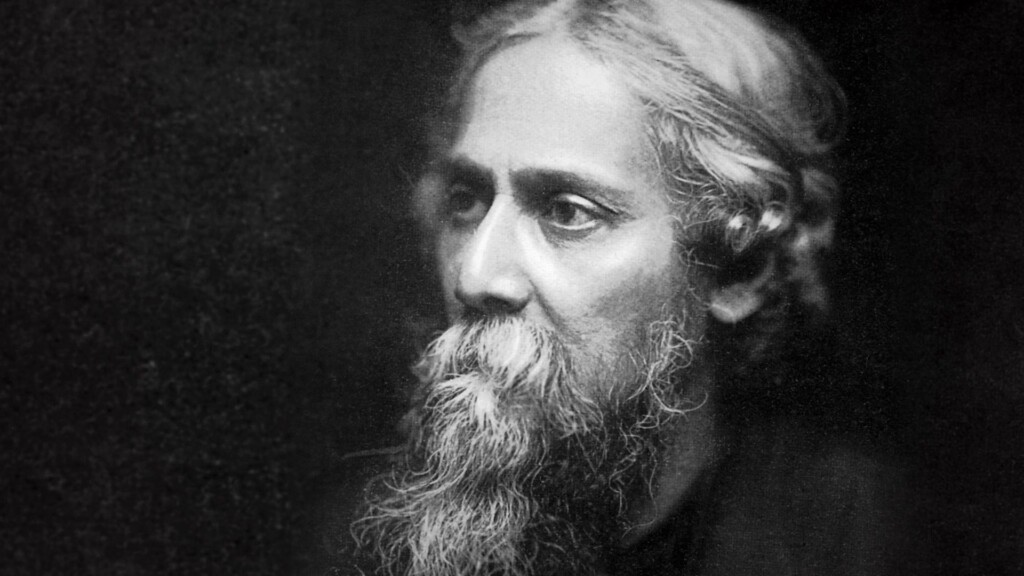
You are sitting with a book you have read three times, and you still cannot say with certainty what it believes. Not because it is vague — Tagore was never vague — but because it holds two convictions simultaneously that most careful minds would insist on separating. He wanted a world without borders of the spirit, a humanity recognizing itself across every language and landscape, and he also believed, with equal ferocity, that such recognition was only possible through deep immersion in the particular: in the Bengali monsoon, in the specific weight of a devotional tradition, in the irreducible grain of a single mother tongue. He did not treat this as a paradox to be resolved. He treated it as the actual condition of being human.
The Western reception of Tagore has never known what to do with this. When W.B. Yeats introduced the English translation of Gitanjali in 1912, he described discovering a poetry where the self dissolves into something larger, and the Nobel Committee awarded Tagore in 1913 partly on those grounds — reading him as a mystical universalist, a voice from the East confirming what European Romanticism had always suspected about spiritual transcendence. What that reading required was the quiet erasure of everything politically and culturally specific in his work. The Tagore who wrote against the Partition of Bengal in 1905, who built a school at Santiniketan explicitly to recover an education rooted in Indian soil and seasonal rhythm, who returned his knighthood in 1919 after the Jallianwala Bagh massacre — this figure was inconvenient for a universalism that only works when the particular source of the voice is forgotten.
Hannah Arendt, in her analysis of how minority cultures survive conquest, observed that the most dangerous imperial move is not prohibition but translation — rendering a culture legible only through the categories of the dominant framework. Tagore understood this threat from inside. His own English renderings of his Bengali poems were, by his own admission, softer and less angular than the originals, and scholars like Supriya Chaudhuri have documented the way his self-translation performed a certain smoothing, a making-palatable, that served Western appetite while quietly hollowing something out. He knew he was doing it. That knowledge does not make him a hypocrite; it makes him a man caught in the structural impossibility of being heard across a border of power without paying some toll at the crossing.
And yet the toll he refused to pay was capitulation to nationalism as the answer. When Rabindranath publicly broke with Gandhi over the Non-Cooperation Movement in the early 1920s, insisting that burning foreign cloth and retreating into economic self-sufficiency was not liberation but a mirror image of the colonial logic it opposed, he was not protecting the Empire. He was protecting something harder to name — a conviction that the self cannot be rebuilt by defining itself solely through what it rejects. His 1916 lectures published as Nationalism diagnosed the nation-state as a mechanical organization that weaponizes collective identity, turning culture into a fortress rather than a conversation. He gave those lectures in Japan and America, to audiences who did not always understand they were included in the critique.
What remains unresolved in his legacy is not a theoretical puzzle but a lived impossibility that every person who has ever felt both deeply rooted and genuinely open to the world carries inside them. The rootedness makes the openness real — without it, universalism is just tourism of the spirit, a comfortable survey of difference from a position of safety. But the rootedness, pushed far enough, becomes the wall that makes encounter impossible. Tagore spent his entire life working inside that gap, not to close it, but to make it habitable, and the question he never answered — the one he perhaps never meant to answer — is whether that gap can be a home, or whether living inside it is simply the most honest form of homelessness available to a thinking person.
🌿 Voices of the Soul: Poetry, Spirit, and Human Depth
Rabindranath Tagore‘s life and works stand at the crossroads of poetry, philosophy, spirituality, and social thought. The following articles explore kindred spirits and intellectual currents that illuminate the world Tagore inhabited and the universal questions he devoted his life to answering.
Pablo Neruda: Life and Works
Pablo Neruda, like Tagore, believed that poetry is not merely an aesthetic exercise but a profound act of bearing witness to human experience. His work traverses love, political struggle, and the natural world with a lyrical intensity that resonates deeply with Tagore’s own vision of the poet as a spiritual and social force. Exploring Neruda’s life and works opens a rich comparative perspective on what it means to write poetry as a form of lived commitment.
GO TO THE SELECTION: Pablo Neruda: Life and Works
Poetry as a Form of Knowledge: History and Theory
Tagore famously conceived of poetry as a means of touching the infinite through the finite, a conviction that places him squarely within a long tradition of thinkers who regard verse as a privileged form of knowledge. This article examines that tradition historically and theoretically, tracing how poets from antiquity to modernity have argued for poetry’s unique capacity to reveal truth. Reading it alongside Tagore’s own essays on creativity and spirituality deepens our understanding of his aesthetic philosophy.
GO TO THE SELECTION: Poetry as a Form of Knowledge: History and Theory
Shelley and the Defence of Poetry: Poets as Legislators
Percy Bysshe Shelley‘s assertion that poets are the unacknowledged legislators of the world echoes powerfully in Tagore’s belief that the artist carries a responsibility toward humanity’s moral and spiritual awakening. This article analyses Shelley’s Defence of Poetry and its argument that imagination is the foundational faculty of civilisation. The parallels with Tagore’s Nobel Prize acceptance and his writings on education and culture are striking and illuminating.
GO TO THE SELECTION: Shelley and the Defence of Poetry: Poets as Legislators
Universal Consciousness
Tagore’s spirituality was not confined to any single religion but aspired toward a universal consciousness that transcended dogma, as expressed most famously in Gitanjali. This article explores the concept of universal consciousness from a philosophical and spiritual perspective, touching on traditions that shaped the Bengali Renaissance in which Tagore was a central figure. Understanding this broader metaphysical horizon helps readers grasp why Tagore’s voice resonated so powerfully across cultures and continents.
GO TO THE SELECTION: Universal Consciousness
Discover the Cinema of the Soul on Indiecinema
If Tagore’s vision of art as a bridge between the human and the infinite moves you, Indiecinema’s streaming platform is your next destination. There you will find a curated selection of independent and world cinema that shares that same commitment to depth, beauty, and the search for meaning. Step beyond the mainstream and let independent film expand your inner world.
👉 EXPLORE THE CATALOG: Watch Indie Films in Streaming
A vision curated by a filmmaker, not an algorithm
In this video I explain our vision

