
The Man Who Refused to Lower His Voice
You are sitting in a room designed to make you small. The ceiling is high enough to remind you that the architecture belongs to someone else, the language of the proceedings is not yours, and the man behind the desk holds a document that can erase the next several years of your life. You have already been told, more than once, that cooperation is the rational choice. That silence is not surrender but strategy. That the poets who survived were the ones who learned to write around the edges of the forbidden. And somewhere inside you, beneath the very reasonable fear, there is something that refuses. Not bravely. Not heroically. Just refuses, the way a body refuses to stay underwater past a certain point, involuntarily, stubbornly, against every instruction from the conscious mind.

Kazi Nazrul Islam walked into that refusal and never walked back out. When the British colonial government in India confiscated his poetry collection Agnibina in 1922, then his journal Dhumketu, then his prose collection Yugbani, and finally had him arrested under sedition charges the same year, the standard expectation was that a young man of twenty-three with no institutional protection and no inherited wealth would eventually recalibrate. The empire had a long history of waiting. It had imprisoned Bal Gangadhar Tilak in 1908 for seditious writing and watched the movement lose momentum. It had seen enough dissidents measure their courage against the machinery of the state and find the machinery heavier. Nazrul’s response to his arrest was to go on a thirty-nine-day hunger strike inside Alipur Jail, during which he wrote his prison diary and composed songs. He was not performing martyrdom. He was simply constitutionally incapable of operating at a lower register.
What makes this historically strange is that Nazrul had no manifesto, no party, no ideological system that required his defiance as a logical consequence. Rabindranath Tagore, who won the Nobel Prize in Literature in 1913 and whose cultural authority in Bengal was effectively absolute, wrote to Nazrul from a position of careful, layered dissent — embedded in aesthetics, cushioned by prestige. Nazrul had none of that insulation. His poem “Bidrohi,” published in 1922 in the Bijli magazine, announced itself in its first lines as a declaration of being everything at once — Shiva, Satan, the destroyer, the creator — not as metaphor but as a refusal of any single assignable identity that an empire could file and prosecute. The colonial bureaucracy was built on categorization. Nazrul’s voice, structurally, could not be categorized, and that alone was a form of sabotage.
The deeper trap that colonial power sets is not censorship but self-censorship, the process by which people begin editing their own thoughts before they reach language, internalizing the parameters of what is sayable until the forbidden and the unthinkable become indistinguishable. Michel Foucault mapped this mechanism across institutions in Discipline and Punish in 1975, showing how power reproduces itself most efficiently not through direct coercion but through the subject’s own surveillance of themselves. The British Raj did not need to silence every poet. It only needed enough visible prosecutions to make every other poet do the silencing internally, voluntarily, preemptively. What Nazrul represented was a failure of this system at the individual level — not because he was fearless, but because whatever mechanism was supposed to install the internal censor had not taken hold.
He was born in 1899 in Churulia, in the Burdwan district of undivided Bengal, into a family of very modest means, lost his father at nine, worked in a bread shop, then joined a theatrical troupe, then enlisted in the British Indian Army in 1917 and served in the 49th Bengal Regiment near the end of the First World War. Every one of those experiences was one in which a person learns their designated place in a hierarchy and adjusts accordingly.
Thirsty
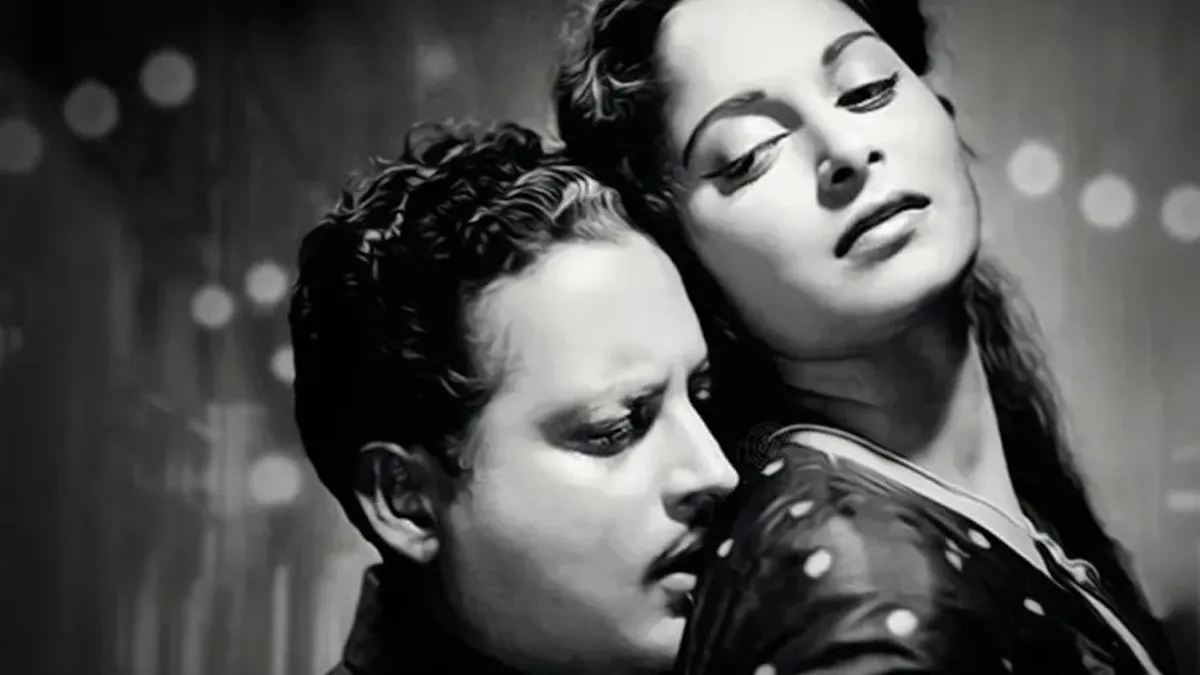
Drama, musical, by Guru Dutt, India, 1957
Thirsty is the heartbreaking story of Vijay, a young poet living in Calcutta who dreams of giving voice to the suffering and injustice of the world through his verses. Idealistic and sensitive, Vijay clashes with a society that despises his art because it is not profitable and does not cater to the tastes of the public. His brothers consider him a failure, the woman he loves leaves him for a marriage of convenience, and his poems are ignored by publishers. Only Gulabo, a prostitute with a pure heart, recognizes the beauty and truth of his words. When a misunderstanding leads everyone to believe Vijay is dead, his name and poetry suddenly become famous, exposing the hypocrisy of those who had previously rejected him.
Watching Thirsty means immersing oneself in a work that goes beyond melodrama, blending poetry, music, and imagery into a profound reflection on the human soul and the value of art. Guru Dutt, director and protagonist, creates one of the most intense and poetic films in world cinema, where black-and-white cinematography, expressive framing, and evocative lyrics produce an atmosphere of poignant melancholy. It is a film about the misunderstanding of the artist, pure love, and society’s hypocrisy, but also a universal critique of materialism and opportunism. Even today, Thirsty moves and provokes thought because it sincerely tells the story of the need to remain true to oneself in a world that measures people’s worth solely by their success.
LANGUAGE: Hindi
SUBTITLES: English, Spanish, French, German, Portuguese
Empire as a Grammar of Silence
You are handed a language and told it is a gift. The teachers smile when they say this. The administrators write it into policy. The missionaries build it into the architecture of salvation itself — learn this tongue, and you will be saved, educated, elevated, made legible to history. What no one mentions, because it requires no mention, is that the gift comes with a concealed clause: your previous voice, the one you were born into, the one that carried your grandmother’s grief and your village’s jokes and the particular cadence of your anger, that voice now belongs to the category of noise.
Frantz Fanon understood this mechanism with a precision that still unsettles readers of The Wretched of the Earth more than six decades after its publication in 1961. His central insight was not that colonialism killed bodies — though it did — but that it murdered the colonized subject’s capacity to author their own reality. The colonial system did not simply occupy land; it occupied the very grammar through which a person could say “I exist” and have that statement recognized as meaningful. What looked like education was, in practice, a slow surgery performed on the imagination, replacing one set of references with another until the colonized person could only see themselves through the eyes that diminished them.
In Bengal under British rule, this surgery had an administrative face. The English Education Act of 1835, championed by Thomas Babington Macaulay in his notorious Minute on Indian Education, explicitly dismantled state support for Arabic and Sanskrit learning in favor of producing, as Macaulay wrote without embarrassment, “a class of persons, Indian in blood and colour, but English in taste, in opinions, in morals, and in intellect.” The document is worth reading slowly, because its cruelty is entirely comfortable with itself. It does not rage. It reasons. And that reasoned comfort is precisely how a civilization dismantles another — not with a sword raised in anger, but with a policy written in elegant prose, by a man who admitted he had never read a page of Arabic or Sanskrit and saw no need to.
The consequence was not merely linguistic. When a colonial administration decides which languages constitute legitimate scholarship, legitimate law, legitimate literature, it simultaneously decides which human experiences can be thought at all. Suffering that arrives in Bengali, in Urdu, in the rhythms of the baul or the qawwali, suffering that has not been translated into the master’s vocabulary, that suffering does not register as a political claim. It registers as folklore. As sentiment. As the emotional texture of a people who have not yet reached the level of articulation that would make their grievances legible to power.
This is the trap that most colonized intellectuals faced in two directions at once. Resist in your own language and you speak only to those already inside the wound, producing what the empire was perfectly content to dismiss as local color. Write in the colonizer’s language and you gain the empire’s ear, but you have already accepted its terms — its subject positions, its implicit hierarchies, its way of organizing what counts as a problem worth naming. The Bengali intellectual who wrote brilliant English essays about the injustice of British rule was, at some structural level, asking the jailer for a key using the jailer’s own vocabulary of locks.
What made Nazrul’s position so radically different was not simply that he wrote in Bengali and Urdu, though he did. It was that he understood language itself as a site of combat rather than a vehicle for messages. Most poets ask: what shall I say? He asked something prior and more dangerous: whose right to speak is being denied, and what would it sound like if that right were seized without asking permission?

Born Into the Wound
You grow up in a house where hunger is not a metaphor. It is the specific silence at the dinner hour, the specific weight of knowing there is no second portion, the specific way a child learns to read the faces of adults who have stopped pretending. Kazi Nazrul Islam was born in 1899 in Churulia, a small settlement in the Burdwan district of Bengal, into exactly this kind of literacy — the literacy of scarcity, which teaches you faster and more permanently than any school.
His father died when Nazrul was nine. The family had no buffer against the collapse that followed. He worked as a child laborer in a mosque, then as a cook, then as an assistant to a theatrical troupe that wandered the region performing jatra — the Bengali folk drama tradition that mixed devotional ecstasy with social satire, sacred music with earthy comedy. Most biographers treat this period as a prologue to the real story, a series of humble origins before the poet emerged. But the jatra circuit was not a waiting room. It was an education in the aesthetics of the dispossessed, a training in the precise art of making beauty under conditions that discourage it.
Bengal in 1899 was not a single cultural world. It was two overlapping worlds that shared geography and often shared poverty but maintained separate cosmological furniture. The Hindu household organized itself around the ritual calendar of the Puranas, the festivals of Durga and Kali, the Sanskrit-inflected prestige of Brahminical learning. The Muslim household — and Nazrul’s was emphatically Muslim, with the theological gravity of a father who served the local mosque — organized itself around the Arabic cadences of the Quran, the Persian lyrical tradition absorbed through Mughal culture, and the syncretic folk devotion of the mazar, the shrine of the local saint where miracles were petitioned and grief was laid down. These were not equivalent positions within a harmonious pluralism. They were asymmetrical inheritances within a society structured by caste, by colonial preference, by the 1905 partition of Bengal itself — Lord Curzon’s administrative surgery that split the province along communal lines and exposed how thoroughly the British understood that division was a more efficient instrument of governance than conquest.
Nazrul grew up absorbing both worlds simultaneously, not as a philosophical project but as a biographical fact. He sang kirtan at Hindu devotional gatherings. He recited marsiya, the Shia elegiac poetry mourning the martyrdom at Karbala, at Muslim commemorations. He learned the baul songs of the wandering mystics who belonged to neither tradition formally and both traditions emotionally. By the time he was old enough to frame a political thought, he had already spent years living inside the contradiction that Bengal’s political class was busily weaponizing — the contradiction between communities that had coexisted in the intimacy of shared poverty and were being reorganized into the clean hostility of separate identity.
There is a specific kind of person produced by this formation: someone who cannot fully inhabit any single identity because they have already felt what each identity excludes. Sociologists have various names for this structural position. W.E.B. Du Bois in 1903, in The Souls of Black Folk, called it double consciousness — the sensation of measuring one’s existence through the eyes of a world that sees you as a problem. Nazrul’s version was not racial but it shared the architecture: the knowledge that your wholeness is illegible to each of the communities that partially claims you. This is not a comfortable place to stand. It is, however, an extraordinary place from which to see.
The wound that Churulia gave him was not simply poverty or early orphanhood, though both marked him in ways that never fully healed. It was the prior wound of being born into an unresolved question that an entire civilization was pretending had already been answered.
The Sedition of Beauty
You read the first lines of “Bidrohi” and something in your chest shifts before your mind catches up — not because you understand it, but because you feel addressed by something that has no interest in your comfort or your comprehension.
Published in the Bijli magazine on January 6, 1922, the poem did not argue. It did not petition. It did not protest in the recognizable grammar of grievance that empires have always known how to absorb and file away. It declared. Kazi Nazrul Islam opened his mouth and claimed simultaneous possession of Shiva’s third eye, Satan’s defiance, the eternal child’s innocence, the destroyer’s fury — not as metaphor, not as poetic license, but as ontological assertion. The speaker of “Bidrohi” is not a man describing rebellion. He is rebellion itself, dressed in the clothes of the cosmos.
This is precisely where the British colonial apparatus found itself without a usable category. The Seditious Meetings Act of 1907, the Press Act amendments that followed, the Criminal Law Amendment Act of 1908 — all of these instruments were built to intercept content, to identify and suppress specific claims about governance, sovereignty, land, or blood. They were designed to operate on declarative statements: we will not pay, we will resist, the Raj must fall. What they had no mechanism for was a voice that claimed to be the storm itself, the trumpet on the last day, the laughter of annihilation. You cannot arrest a cosmological claim. You cannot charge an ontology with sedition.
Walter Benjamin, writing in his 1936 essay “The Work of Art in the Age of Mechanical Reproduction,” observed that fascism aestheticizes politics while revolutionary art politicizes aesthetics. The distinction sounds clean in theory. What “Bidrohi” reveals is that the most dangerous move of all is neither of these — it is to make the aesthetic and the political indistinguishable at the level of experience, so that beauty itself becomes the vehicle of rupture rather than its decoration. When Nazrul wrote “I am the rebel eternal, I raise my head beyond this world, high, ever erect and alone,” he was not illustrating a political position with beautiful language. He was using beauty’s velocity — its capacity to bypass rational defense and land directly in the body — to install a new relationship between the reader and the idea of limit itself.
Power requires that limits feel natural. The colonial project depended not merely on force but on the successful internalization of hierarchy as the order of things — the slow pedagogical work of making subjugation feel like geography. Rabindranath Tagore, whom the Bengal intelligentsia had made into a kind of cultural ceiling, worked largely within the aesthetic of longing, of spiritual aspiration, of the soul reaching toward the transcendent. This was beautiful and it was safe, because longing affirms the distance between the self and what it desires. “Bidrohi” abolished that distance. The speaker does not long for divine power — he inhabits it, claims it, wears it without permission. In 1922, for a Bengali reader under colonial rule, this was not merely inspiring. It was structurally disorienting in a way that no pamphlet could replicate.
The poem spread through Calcutta in days, copied by hand before the magazine’s second edition could be printed. Sufia Kamal, writing decades later in her memoir, described women in purdah reciting lines they could not fully parse but could not stop repeating. This is what beauty does at sufficient intensity — it transmits before it is understood, which means it reaches people before their censors do, before the part of the mind trained to ask whether this is permitted has time to intervene. By the time the colonial administration recognized what had entered the cultural bloodstream, it was already there, already metabolized, already changing what felt possible to say aloud.
The Colonial State Reads Poetry
You are sitting across from a bureaucrat who has just spent three hours reading a poem. Not for pleasure. He is underlining phrases, cross-referencing them against sedition statutes, calculating whether a particular metaphor about fire constitutes incitement. His hands are steady. His expression is the expression of a man doing serious work.
That scene, replicated across the offices of the British colonial administration in Bengal in the early 1920s, tells you something the empire never intended to confess: that it was afraid of stanzas. Not of armies, not of bombs — though it feared those too — but of a specific kind of language that moved through a population faster than any cavalry and left no physical trace until the damage was done. When the colonial state turned its legal apparatus against Kazi Nazrul Islam’s writing, it was not exercising strength. It was disclosing the precise dimensions of its own vulnerability.
Yugbani, the collection suppressed by the British authorities in 1922, was not a manifesto in any conventional sense. It did not outline a political program or call for organized insurrection. What it did was more dangerous by the empire’s own internal logic: it treated the colonized as people with a right to fury. The colonial administration understood, with the clarity that comes from institutional self-interest, that dignity is a more combustible substance than ideology. A population taught to feel righteous anger at its own condition cannot be governed through the ordinary machinery of submission. Nazrul’s language handed that anger back to readers in a form they could carry inside their bodies.
Bisher Bashi, banned the same year, arrived in the wake of Nazrul’s already-published “Bidrohi” — “The Rebel” — which had swept through Bengali intellectual life in 1922 with a velocity that startled even its admirers. The colonial legal response drew on Section 124A of the Indian Penal Code, the sedition provision introduced by Thomas Macaulay and formalized in 1870, which criminalized any attempt to excite “disaffection” toward the British government. The word disaffection is worth holding for a moment. Not disobedience. Not violence. Disaffection — the withdrawal of feeling from an authority that required emotional compliance to sustain itself. The empire, in its own legal language, was admitting that it needed to be loved, or at least not actively resented, to function. Nazrul’s crime, technically speaking, was writing poems that made people feel the wrong things.
Bhanger Gaan, the third collection subjected to prohibition, carried the literal meaning of “Songs of Destruction” — a title the colonial administration could hardly be expected to receive with equanimity. But the pattern of suppression by this point revealed something more structurally significant than any individual act of censorship. Every ban generated new readers. Every court proceeding amplified the very words it sought to silence. The empire’s relationship to Nazrul’s poetry was, by this mechanism, one of involuntary advertisement. Michel Foucault‘s later analysis in Discipline and Punish of how sovereign power makes itself visible through spectacle finds an almost laboratory-perfect illustration here: the state’s attempt to display its authority over a text only confirmed the text’s power to provoke that display.
Nazrul was arrested in 1923. He responded to imprisonment with a hunger strike that lasted thirty-nine days and generated more public attention than any literary review could have produced. The colonial administration had transformed a poet into a symbol with such efficiency that it might as well have commissioned the work. What the British legal machinery failed to account for was the fundamental asymmetry of the situation: a government banning a poem is legible as an admission of danger, while a poet imprisoned for verses becomes something the administration has no bureaucratic category to contain — a person whose suffering is itself a kind of argument, and whose silence inside a prison cell speaks with a volume that no sedition statute was ever designed to measure.
A vision curated by a filmmaker, not an algorithm
In this video I explain our vision
The Trap of the National Hero

You have been taught to celebrate him. That is the first warning sign. The moment a society reaches consensus about a rebel — the moment his face appears on currency, his name on university buildings, his verses recited at state functions by officials who would have jailed him — something has been extracted from the rebellion and the husk has been preserved in its place. Kazi Nazrul Islam became Bangladesh’s national poet by official declaration in 1972, one year after a war of independence that cost perhaps three million lives. The honor was genuine in its grief and real in its affection. It was also, without anyone quite intending it, an act of containment.
Walter Benjamin wrote in his “Theses on the Philosophy of History,” composed in 1940 as fascism consumed Europe and his own escape routes narrowed, that every age must struggle to wrest tradition away from conformism. His seventh thesis is almost unbearably precise on this point: the historical materialist regards it as his task to brush history against the grain. The danger he identified was not forgetting — it was the victor’s memory, the triumphal procession in which the cultural treasures of the defeated are carried along as trophies. Every document of civilization is simultaneously a document of barbarism. A national poet is, by definition, a document of civilization. Which means the question Benjamin forces you to ask is: what barbarity does this particular monument conceal?
What it conceals, in Nazrul’s case, is the specific texture of his threat. He did not write against the British Empire in the abstract. He wrote against the collaboration of Indian elites with that empire, against the religious establishments of both Hinduism and Islam that used divine sanction to enforce caste hierarchy and gender subjugation, against the Bengali middle class that consumed his revolutionary verses at literary salons while paying their servants poverty wages. The poem “Bidrohi,” published in 1922 in the journal Dhumketu, was not a call for national pride — it was a declaration of ontological war against every fixed authority, including the gods themselves. To nationalize that poem, to make it a property of the state, requires surgically removing the blade from the text and framing only the handle.
India performs an equally elegant operation on the same body of work. West Bengal claims Nazrul as a Bengali cultural icon, integrating him into a secular-humanist tradition that sits comfortably alongside Tagore on the same shelf, in the same drawing rooms, disturbing nothing. The Nazrul who spent time in Hugli jail in 1923, who went on hunger strike for forty days to protest colonial censorship, who had his books seized under the Bengal Criminal Law Amendment Act — that Nazrul is acknowledged historically, which is to say he is safely past. The hunger strike happened. It is in the record. It changes nothing about the present arrangement.
This is the specific mechanism that makes the monument a coffin rather than a commemoration. The rebellion is not denied — it is periodized. It is assigned to a completed chapter titled British Colonialism, and by assigning it there, both nations imply that the conditions which produced the rebellion have themselves been resolved. The poet who raged against debt bondage among Bengal’s peasantry in the 1920s is honored by governments that preside over agricultural debt crises in the same geography a century later. The singer who collapsed every boundary between Hindu devotion and Sufi longing is invoked to celebrate national identities whose institutional logic depends on maintaining exactly those boundaries.
His silence, the neurological darkness that descended in 1942 and lasted until his death in 1976, is perhaps the most uncomfortable biographical fact his inheritors must manage. A man who wrote with the velocity and fury of the possessed, who produced over four thousand songs in roughly two decades, simply stopped.
Silence as the Final Sentence
You are sitting across from someone who has not spoken in three years, and you know — because you were there, because you heard it — that this person once made colonial administrators reach for their arrest warrants simply by finishing a sentence. The silence in the room is not peaceful. It is the silence of something that was stopped.
In 1942, Kazi Nazrul Islam lost his voice at forty-three years old. Not metaphorically. The words stopped coming. A progressive neurological disease — later identified as Pick’s disease, a rare form of frontotemporal dementia — dismantled the machinery of his speech and left behind a man who could hear the world continuing without him. He lived this way for thirty-four more years, outlasting partition, outlasting the birth of Bangladesh, outlasting nearly everyone who had once feared him, dying in 1976 with his silence intact. The arithmetic alone is grotesque: he spent more of his adult life mute than he did writing. The empire he defied with four thousand songs and hundreds of poems did not need to imprison him a third time. His own nervous system completed the sentence.
There is a particular cruelty in the specificity of what Pick’s disease destroys. Unlike other dementias that cloud memory or dissolve personality gradually, frontotemporal degeneration attacks language and executive function with targeted precision. The person frequently remains present, aware, responsive — trapped behind a wall that was not built by anyone else’s hands. Neurologist Oliver Sacks, writing across several decades about what he called the “neurology of identity,” documented cases in which patients retained full emotional and even creative intelligence while losing the capacity to externalize it. The torment, he insisted, was not absence but imprisonment. For Nazrul, who had built his entire existence on the premise that language was the one instrument that could not be confiscated, the disease was almost too on-the-nose to be random.
What systems do to bodies that refuse compliance is not always spectacular. There are no dramatic arrests in this part of the story, no burning manuscripts, no courtrooms. The violence is subtler and therefore harder to name. The sociologist Pierre Bourdieu wrote in his 1977 Outline of a Theory of Practice about what he called the incorporation of domination — the process by which social and political pressure is not only internalized psychologically but written into the body itself, into posture, into breathing, into the likelihood of illness. Nazrul had spent decades under conditions of surveillance, imprisonment, imposed poverty, and the particular exhaustion of producing dissent in an environment designed to absorb and neutralize it. His body had been a site of resistance. And then it became something else.
The government of newly independent India moved him to Calcutta in 1942 when the collapse was already underway. Bangladesh, after its liberation in 1971, claimed him as its national poet and brought him to Dhaka. Both nations wanted the symbol. Neither could restore the voice. There is something worth sitting with in that sequence — two states, one person’s silence, and the institutional reflex to assign meaning to a man who could no longer contest whatever meaning they assigned him. The mute Nazrul could be nationalized in ways the speaking Nazrul never could have been, because the speaking Nazrul had spent thirty years refusing to be owned by any single political project, Hindu or Muslim, colonial or nationalist, Bengali or subcontinental.
His 1920s journal Dhumketu — the comet — ran for less than two years before the British authorities seized it. In that short window Nazrul published the poem “Anondomoyeer Agomone,” which earned him forty weeks in jail, and in prison he undertook a hunger strike lasting thirty-nine days that ended only when Gandhi personally wrote to him asking him to stop. The man who fasted until political figures intervened, the man whose words triggered sedition charges, was reduced by biology to the one form of protest no one could politicize or suppress or celebrate: the protest of complete, absolute, unanswerable quiet.
What Gets Inherited and What Gets Buried
You have probably sung one of his songs at a wedding, or heard his name invoked at a national ceremony, and felt, somewhere beneath the occasion, that the name itself had been smoothed into something ceremonial — a word worn so often it no longer cuts.
That smoothing is not accidental. Pierre Nora, writing in his 1984 framework “Les Lieux de Mémoire,” argued that what a culture enshrines in monuments, anthologies, and school curricula is never simply memory — it is memory that has survived a selection process, and that process is always political. The site of memory is constructed precisely because living memory has died. What remains is curated residue. And nowhere is this more visible than in what Bangladesh and West Bengal have done with Kazi Nazrul Islam: they have kept the melodist and quietly interred the insurrectionist.
The love songs survive because they cost nothing. The roughly 4,000 compositions he produced across his lifetime, classified as “Nazrul Geeti,” have been institutionalized, recorded, taught in conservatories, broadcast on state radio. They are beautiful, and their beauty is politically neutral in the way that all aestheticized grief eventually becomes neutral — you can weep at them without being asked to change anything. The revolutionary hymns, the poems that got him arrested under Section 26 of the Bengal Criminal Law Amendment Act in 1922, the furious verses of “Anandamoyeer Agamone” that were banned by colonial authorities — these exist in complete editions but they are rarely the poems taught to children, rarely the lines quoted at public commemorations, rarely the material through which Nazrul is introduced to new generations.
What is even more systematically suppressed is his theological radicalism. Nazrul wrote with equal ferocity from within Hinduism and Islam, not as a gesture of diplomatic ecumenism but as a genuine assault on the idea that either tradition had a monopoly on the divine or on human suffering. His 1926 poem “Manush” — “Human Being” — explicitly indicts the priest and the mullah as gatekeepers of a god who belongs to no institution. That charge, leveled with the same fury he aimed at colonial administrators, has been made palatable by detaching it from its edge. He becomes, in official memory, a symbol of communal harmony — a soft concept, warm and consensual — rather than what he actually was: a thinker who found both religious establishments complicit in keeping ordinary people prostrate.
The mechanism by which a radical is converted into a mascot has been documented with particular precision by cultural historian Priya Joshi, who traced how subcontinental literary canons were first shaped by British publishing markets and then re-inherited by postcolonial nationalist projects that needed founders, not provocateurs. Nazrul’s designation as the national poet of Bangladesh in 1972, the year after liberation, served an immediate political function — it anchored a new nation’s cultural identity — but that anchoring required a static figure, a bronze likeness, not a living question. The man who had written against all flags was conscripted into service beneath one.
His actual silence is the most destabilizing fact in the archive. From 1942 until his death in 1976, Nazrul did not write a single poem, did not compose a single song. Neurological illness had taken language from him entirely. He lived for thirty-four years in a body from which the instrument of everything he had been had been removed. What the state commemorates is the productive years, the singing years, the years that can be framed and hung. The silence — three and a half decades of it — is treated as absence, as tragedy, as the sad coda to a brilliant life, rather than as what it actually is: the most unanswerable argument against the myth of the heroic voice, the reminder that the body which defied an empire was still a body, fragile and finally mute, and that no monument has yet found a way to hold that.
🔥 Voices That Shook Empires: Poetry and Resistance
Nazrul Islam’s defiant verses remind us that poetry is never merely decorative — it is a weapon, a prayer, and a declaration of freedom. These related articles explore other poets, thinkers, and artists who dared to use their voice against oppression, exile, and silence.
Rabindranath Tagore: Life and Works
Rabindranath Tagore stands as the towering literary giant of Bengali culture, whose Gitanjali won the Nobel Prize and brought Indian spiritual thought to the world stage. Like Nazrul, Tagore wrestled with the tensions between colonial subjugation and the longing for cultural self-determination. Understanding Tagore illuminates the literary world Nazrul both inherited and boldly challenged.
GO TO THE SELECTION: Rabindranath Tagore: Life and Works
Tagore’s Gitanjali: Analysis
Tagore’s Gitanjali is a cycle of devotional poems that transformed the way the West understood Indian spirituality and poetic sensibility. Reading it alongside Nazrul’s rebellious hymns reveals how two Bengali poets could address the divine and the political through radically different emotional registers. Together, they define the full spectrum of Bengali literary genius.
GO TO THE SELECTION: Tagore’s Gitanjali: Analysis
Shelley and the Defence of Poetry: Poets as Legislators
Percy Bysshe Shelley‘s Defence of Poetry argues that poets are the unacknowledged legislators of the world — a claim that resonates deeply with Nazrul’s life and mission. Shelley believed that poetic imagination carries the power to liberate minds from tyranny, a conviction Nazrul enacted through every verse he wrote under British rule. This essay remains one of the most passionate defenses of poetry as a force for political and spiritual transformation.
GO TO THE SELECTION: Shelley and the Defence of Poetry: Poets as Legislators
Sri Aurobindo: Life and Works
Sri Aurobindo was another towering Bengali intellectual who challenged British imperialism, eventually turning from revolutionary politics toward a vast spiritual philosophy. His trajectory from nationalist firebrand to mystic sage offers a fascinating parallel and contrast to Nazrul’s own journey between rage and devotion. Exploring Aurobindo’s life helps situate Nazrul within the broader constellation of Indian thinkers who defied empire with both pen and spirit.
GO TO THE SELECTION: Sri Aurobindo: Life and Works
Discover the Cinema of Resistance on Indiecinema
If the spirit of Nazrul’s defiant poetry moves you, explore Indiecinema — our streaming platform dedicated to independent and visionary cinema from around the world. From films about colonial memory to stories of artistic rebellion, Indiecinema brings you the voices that mainstream culture too often silences. Join us and let the screen become your next act of discovery.
👉 EXPLORE THE CATALOG: Watch Indie Films in Streaming
A vision curated by a filmmaker, not an algorithm
In this video I explain our vision

