
The Moment of Recognition
You are mid-sentence when it happens. Not at a party, not across a crowded room in the way the old mythology promises — but in the middle of an argument about something that should be mundane, something about the way institutions calcify around their own founding errors, and the person across from you finishes your thought. Not the polite, social version of finishing a thought, where someone nods and completes the grammar. They finish the idea, the one you had not yet fully articulated even to yourself, and they arrive at the next implication before you do, and for a moment the sensation is closer to vertigo than to warmth. You do not want to kiss them. You want to keep talking until the restaurant closes, until the city goes quiet, until you have excavated every room in this strange new architecture the two of you seem to be building in real time.

This experience has no respectable name, which is precisely why it tends to be misclassified. Western culture has spent centuries constructing elaborate vocabularies for erotic love, for filial devotion, for civic friendship, and has left this particular form almost entirely anonymous, shoved awkwardly into the category of platonic affinity as though Plato himself did not understand the dangerous, destabilizing charge of two minds catching fire against each other. In the Symposium, written around 385 BCE, the speech Plato attributes to Aristophanes imagines love as the reunion of divided beings — but the division he describes is always of the body, always figured in flesh split apart by a frightened god. The soul’s equivalent longing, the ache of an incomplete mind recognizing what it has been missing in another mind, does not survive the translation into myth because it is harder to render in physical comedy and easier to dismiss as mere intellectual enthusiasm.
What actually occurs in that moment of cognitive recognition is neither mere nor casual. The neuroscientist and psychiatrist Iain McGilchrist, in his 2009 work The Master and His Emissary, argues that human attention is not a neutral faculty but a fundamental mode of relating to the world, and that the way someone attends to things — the grain of their perception, what they notice and how they hold it — constitutes something close to a self. When two people discover that their modes of attention are calibrated in unexpectedly similar ways, they are not simply finding common interests. They are encountering a mind that has been shaped by analogous pressures, analogous refusals, analogous leaps of inference. The recognition is constitutional. It touches something structural.
This is why it so frequently arrives as shock rather than comfort. Comfort implies confirmation of what you already knew about yourself. The intellectual encounter of this kind does something more unsettling: it shows you a version of your own cognitive life made visible from outside, which means it also reveals the parts of that life you had been quietly protecting from examination. The other person does not flatter you by agreeing. They accelerate you, which is a different and more threatening gift.
Simone de Beauvoir, writing in her memoirs about the early weeks of her relationship with Jean-Paul Sartre in 1929, described the sensation not as falling in love but as encountering someone who engaged with the world with a matching ferocity, someone whose arguments she could not dismiss and whose presence made her own thinking sharper, faster, and more honest. The erotic dimension came later, or alongside, or tangled irretrievably into the intellectual one — but what she identifies as the origin, the founding event of the relationship, is a conversation in which she felt genuinely challenged for the first time. Not flattered. Not seduced. Challenged. That distinction is the entire territory this essay means to explore.
Thirsty
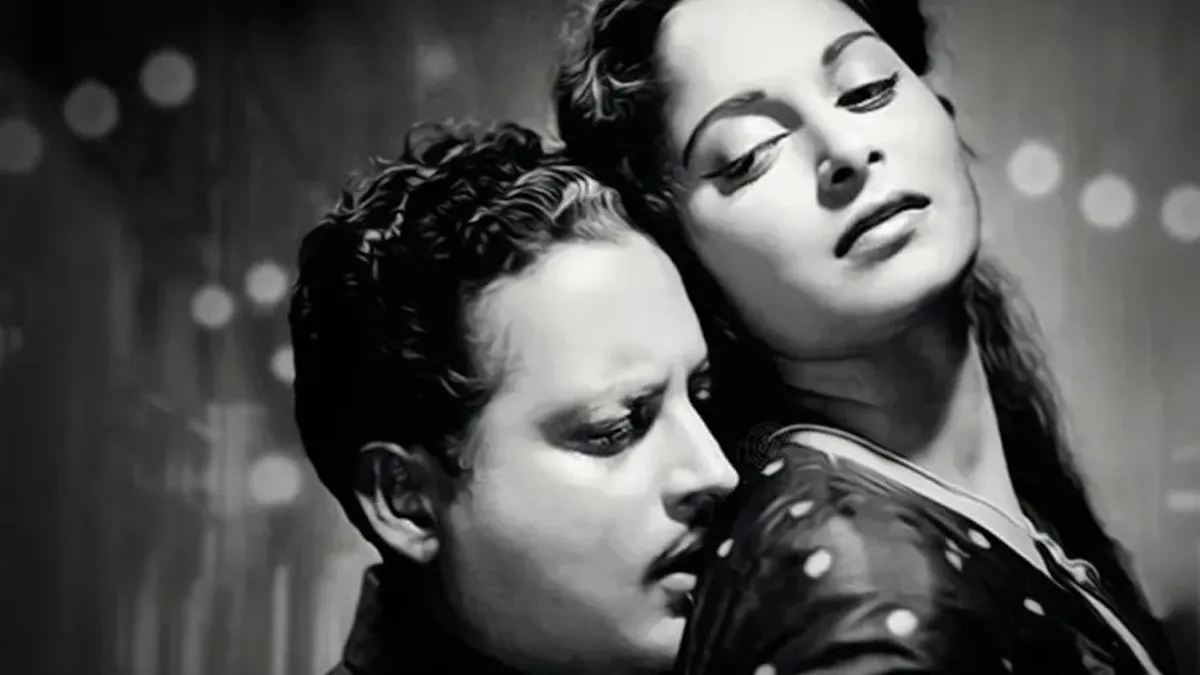
Drama, musical, by Guru Dutt, India, 1957
Thirsty is the heartbreaking story of Vijay, a young poet living in Calcutta who dreams of giving voice to the suffering and injustice of the world through his verses. Idealistic and sensitive, Vijay clashes with a society that despises his art because it is not profitable and does not cater to the tastes of the public. His brothers consider him a failure, the woman he loves leaves him for a marriage of convenience, and his poems are ignored by publishers. Only Gulabo, a prostitute with a pure heart, recognizes the beauty and truth of his words. When a misunderstanding leads everyone to believe Vijay is dead, his name and poetry suddenly become famous, exposing the hypocrisy of those who had previously rejected him.
Watching Thirsty means immersing oneself in a work that goes beyond melodrama, blending poetry, music, and imagery into a profound reflection on the human soul and the value of art. Guru Dutt, director and protagonist, creates one of the most intense and poetic films in world cinema, where black-and-white cinematography, expressive framing, and evocative lyrics produce an atmosphere of poignant melancholy. It is a film about the misunderstanding of the artist, pure love, and society’s hypocrisy, but also a universal critique of materialism and opportunism. Even today, Thirsty moves and provokes thought because it sincerely tells the story of the need to remain true to oneself in a world that measures people’s worth solely by their success.
LANGUAGE: Hindi
SUBTITLES: English, Spanish, French, German, Portuguese
What Eros Actually Named
You are sitting across from someone and the conversation has gone somewhere neither of you planned, and you notice your pulse has changed. Not dramatically — just a small shift, the kind your body makes when it has decided something before your mind catches up. You will probably explain this away later, file it under chemistry or compatibility or the vague warmth of feeling understood. What you will almost certainly not reach for is the word that Plato reached for, the word he placed at the center of the entire philosophical project: eros.
The Symposium, composed around 385 BCE, is a document that Western culture has been quietly misreading for two and a half millennia. The text stages a series of speeches in praise of love at a drinking party in Athens, and the one that matters most — the one Socrates claims not as his own thinking but as something he was taught — belongs to a woman named Diotima of Mantinea. Her speech does not treat intellectual ascent as a metaphor for erotic love or as love’s refined substitute. It treats intellectual ascent as the destination toward which erotic love has always been moving, the telos the whole mechanism was designed to reach. Eros, in Diotima’s account, begins with the body of a single beautiful person, but its internal logic, followed honestly, carries the lover upward through beautiful bodies plural, then through beautiful souls, then through beautiful practices and laws, then through the beauty of knowledge itself, until the lover arrives at what she calls the Beautiful Itself — not an image, not a representation, but the thing. This is not sublimation. There is no loss in this account, no renunciation of desire in exchange for something cleaner. The desire intensifies as it ascends. The philosopher is the most erotic person in the room.
What happened next is the more interesting story. The Neoplatonists, particularly Plotinus writing in the third century CE in his Enneads, inherited this structure but began quietly reweighting it — placing greater emphasis on the soul’s escape from matter than on the continuity of desire across the ascent. By the time Christian theology absorbed Platonic vocabulary, the ladder Diotima described had been restructured into something closer to a hierarchy of renunciation: the body was where you started, and the goal was to leave it behind. Agape, the distinctly Christian form of love, was positioned as the correction of eros rather than its fulfillment. Desire became the problem. Spirit became the solution. The union that Diotima had described as natural — the same force that draws you toward a beautiful face drawing you, by its own internal momentum, toward a beautiful idea — was split along a fault line that would prove permanent.
By the time Descartes formalized the mind-body distinction in the Meditations of 1641, the cultural work had already been done. He gave philosophical architecture to a divorce that had been happening socially for centuries. Desire lived in the body, which was unreliable, animal, mortal. Ideas lived in the mind, which was separable, potentially immortal, closer to God. The result is a taxonomy that most people alive today have inherited without examination: you feel attraction, and then separately, in a different register entirely, you admire someone’s intelligence. The admiration might deepen the attraction, but the two phenomena are understood to be categorically distinct — different systems, different vocabularies, different social scripts. You are allowed to say you find someone’s body beautiful. You are almost never allowed to say, with equal directness and equal erotic charge, that you find their thinking beautiful in a way that moves through you.
The word “intellectual” now carries a faint chill. It suggests distance, abstraction, the absence of heat. This is a remarkably recent invention dressed in ancient clothes, a cultural convention so thoroughly naturalized that it feels like anatomy.

The Neuroscience of Shared Thought
You are sitting across from someone who is explaining something they have spent years thinking about, and you notice, with mild alarm, that your body has stopped fidgeting. Not because you are being polite. Because something anterior to politeness has taken over — some older, less social mechanism has commandeered your attention and is doing something to you without asking permission.
What it is doing, precisely, was mapped by Uri Hasson and his colleagues at Princeton in 2010, published in the Proceedings of the National Academy of Sciences. Using functional MRI to scan pairs of speakers and listeners engaged in genuine narrative exchange, Hasson’s team found that the listener’s brain did not merely receive and decode signals from the speaker’s brain — it began to replicate the speaker’s neural firing patterns with a measurable time delay, as though the skull between two people had temporarily become permeable. Hasson called this neural coupling, and what made it extraordinary was its directionality: the stronger the coupling, the more successfully the listener reported understanding the speaker. The brain synchrony was not a metaphor for comprehension. It was the mechanism of it.
This has unsettling implications for how we think about intimacy, because Western culture has for centuries assigned the body as the primary theater of merger between two people. The entire architecture of romantic literature, from the Petrarchan sonnet to the contemporary rom-com, organizes itself around physical proximity as the culmination of connection — the touch, the embrace, the dissolving of bodily separateness as the sign that two people have truly reached each other. But Hasson’s data suggests that what the body achieves through contact, the mind achieves through sustained, high-quality intellectual exchange, and achieves it with a precision the body cannot rival. Skin registers pressure and warmth. Neural coupling, by contrast, reproduces the actual temporal architecture of another consciousness inside your own.
The qualification matters enormously: the coupling is not automatic. It degrades sharply when the listener cannot follow the speaker, and it disappears entirely in the presence of language without comprehension — Hasson’s team demonstrated this by playing speech in an unfamiliar language to listeners, producing near-zero synchrony despite identical acoustic input. This means that the merger is not triggered by exposure to another person but by the specific act of being genuinely, effortfully understood. You cannot fake your way into someone else’s neural patterns. The brain knows the difference between performed attention and actual tracking of a mind.
What this reveals is that intellectual affinity operates through a channel the body cannot access by itself. Two people who have never touched but who have spent years reading the same texts, finishing each other’s arguments, and correcting each other’s reasoning have been building something measurable in their neural architecture — not as analogy, but as literal structural fact. The 2016 work of Thalia Wheatley at Dartmouth extended Hasson’s findings to show that people who reported greater real-world social closeness exhibited greater spontaneous neural similarity even at rest, suggesting that the synchrony accumulates over time and leaves a residue. Affinity, in other words, is not a feeling that precedes connection — it is a biological deposit left by the history of having genuinely tracked another mind.
The culture that treats intellectual conversation as foreplay, or as a polite prelude to the real event of physical intimacy, has the causality precisely inverted. The conversation is not warming up the nervous system for something more important. The conversation is where the most radical form of merger available to two human nervous systems is actually occurring, in real time, in the oscillating synchrony of prefrontal and temporal cortices that have learned to fire in borrowed patterns. The body arrives late to a party the mind has already been attending for hours, sometimes for years, and mistakes its own entrance for the beginning of the evening.
Why Modernity Made This Illegible
You are sitting across from someone who has just said something that rearranged the furniture of your mind, and your first instinct is not to reach for their hand but to lean forward, slightly breathless, needing to hear what they say next. And somewhere in the architecture of your own response, you feel a faint guilt — as though the absence of warmth in your gesture, the presence of intellectual hunger instead, reveals a deficiency in you, a coldness dressed up as curiosity.
That guilt has a birthday. It was manufactured with remarkable precision in 1761, when Jean-Jacques Rousseau published La Nouvelle Héloïse and handed Western culture a template for what love was supposed to feel like from the inside. The novel sold more copies in the eighteenth century than almost any other work of fiction, and it did something structurally violent to the way intimacy would be conceived for the next two hundred and fifty years: it located authentic connection exclusively in the trembling registers of sentiment, in the ache, the overflow, the surrender of the reasoning self to the storm of feeling. Julie and Saint-Preux do not think their way toward each other. They dissolve. Reason, in Rousseau’s emotional architecture, is the thing you deploy after love has already happened, to manage it, contain it, justify it to others — never the medium through which love itself moves.
What followed was not merely a literary fashion but an epistemological coup. The Romantic movement inherited Rousseau’s premise and industrialized it. By the time Schiller was writing about the naive and the sentimental, by the time Keats was insisting that beauty was truth and nothing else needed saying, the culture had fully naturalized a hierarchy in which feeling was depth and thought was surface. Intellectual engagement between two people could be admired the way one admires a well-constructed bridge — functionally impressive, structurally sound, and entirely without mystery. It was not the thing that kept you awake at three in the morning reaching for someone across the dark.
The consequences were not symmetric across gender. For women, the Romantic model was simultaneously an elevation and a trap: feeling was now the highest register of human experience, and women were assigned custodianship of it, which meant that a woman who bonded primarily through intellectual exchange was subtly masculinized in the cultural imagination, suspected of being unable to feel properly rather than recognized as feeling in a different key. Mary Wollstonecraft saw this with ferocious clarity in A Vindication of the Rights of Woman in 1792, arguing that Rousseau’s sentimental construction of femininity was not an honor but a cage — that a being defined entirely by her emotional receptivity was a being denied the full dignity of her own mind. She was largely ignored for the next century, which is its own kind of data point.
For men, the trap operated differently. The Romantic framework permitted intellectual passion only when it was safely routed through the figure of the solitary genius — Beethoven tormented, Byron self-destructing, the mind as an instrument of individual suffering rather than mutual encounter. A man who found his deepest intimacy in collaborative thought, in the specific pleasure of a mind that met his own and pushed back, was either aestheticized into the safe category of mentor and student or quietly pathologized as someone incapable of real vulnerability. The intellectual bond was always made to stand in for something else, always interpreted as a defense mechanism rather than a mode of contact.
This interpretive reflex did not dissolve with modernity — it accelerated. Psychoanalytic culture, which dominated the twentieth century’s understanding of human interiority, was structurally committed to reading intellectual activity as sublimation, which meant that the person who loved through ideas was always already confessing to something they could not bear to feel directly.
A Different Kind of Pair
You are at a conference dinner, seated across from someone you have known for thirty years, and the conversation moves the way it always has — finishing each other’s arguments before they arrive, laughing at the same precise moment, sitting in a silence that costs neither of you anything. Your spouses are home. They have always been home during these moments. Not because they were excluded, but because what happens in this room between these two people was never designed to include them, never threatened them directly, and yet has constituted something more structurally central to each of you than most of what happens inside your respective marriages.
The archive of thirty years of letters between two such people would read, to any neutral observer, as the primary intellectual and emotional record of two lives. Not the wedding photographs, not the mortgage documents, not the children’s school reports — the letters. Specific, dense, alive with argument and counter-argument, tracking the evolution of two minds across decades in a way that no other relationship in either life has managed. Sociologists call what happens between long-term intellectual partners a “thought collective,” borrowing from Ludwik Fleck’s 1935 work Genesis and Development of a Scientific Fact, in which he argued that knowledge is never produced by isolated individuals but always by a community of thinkers sharing what he called a “thought style.” What Fleck could not quite say — because his framework was epistemological, not intimate — is that thought collectives between two people become indistinguishable from love when sustained long enough, when private enough, when the thinking done together cannot be done alone.
The problem is that the language available for this relationship is catastrophically inadequate. “Friendship” is technically accurate and emotionally dishonest. “Colleagues” erases thirty years of letters written at midnight. “Intellectual companions” sounds like something you would find in a Victorian novel, which is perhaps exactly the problem: Victorian culture had a richer vocabulary for same-sex intellectual devotion than contemporary culture does, because contemporary culture has collapsed all forms of profound attachment into either the romantic-sexual or the merely cordial. The middle ground — intense, irreplaceable, non-sexual, non-romantic, and yet constitutive of the self in ways that rival marriage — has been linguistically evacuated. When the two people themselves say the relationship has no name, they are not being modest. They are reporting a genuine structural absence in the language they were given.
What makes this absence consequential rather than merely inconvenient is that unnamed things cannot be protected. They cannot be grieved publicly when lost. They cannot be explained to a new partner, to a therapist, to a hospital administrator asking about next of kin. Gillian Rose, in her 1995 memoir Love’s Work, wrote about the way that genuine love always involves an encounter with the intractable otherness of another person — a refusal of the fantasy of merger. What she did not emphasize, though her own intellectual friendships demonstrate it, is that this encounter with otherness can be sustained across decades at a register that has nothing to do with physical proximity or legal recognition, and that its depth is often invisible to everyone watching from outside.
The two aging colleagues finish dinner. Someone at the table describes them, to a newcomer, as old friends. Neither corrects the description. They have learned not to, because the correction would require more explanation than the setting allows, and the explanation would produce a reaction — a slight confusion, a polite recalibration of the listener’s face — that neither of them finds worth the effort anymore. They have accepted the wrong name for thirty years. The letters in their respective studies say otherwise, but the letters are private, and privacy is where the most honest accounting of a life is usually kept, invisible to the record that everyone else agrees to call real.
A vision curated by a filmmaker, not an algorithm
In this video I explain our vision
The Politics of Categorization

You are sitting across from someone and the conversation has shifted — you cannot say exactly when — from the exchange of information to something that feels like shared velocity. Neither of you is performing anymore. The ideas are arriving faster than either of you planned, each thought landing as a foothold for the next, and there is a sensation in the chest that has no clean name in any language you have been taught to use for feelings. You will leave the room and describe it as “a good conversation,” because that is the only social container available to you, and in doing so you will have committed a small but consequential act of erasure.
Randall Collins spent decades mapping the microstructure of human interaction, and what he identified in Interaction Ritual Chains in 2004 was not merely the mechanics of social bonding but something more unsettling: that intellectual entrainment — the state in which two minds begin to amplify each other’s cognitive and emotional energy in a feedback loop — produces measurable surges in what he called emotional energy, a motivational charge that can persist long after the interaction ends. Collins was careful and empirical. He was not writing poetry. He was tracking the biochemistry of focus, the synchronization of gesture and breath, the way shared attention on an idea generates a distinct form of solidarity that differs structurally from the solidarity produced by shared meals, shared grief, or shared physical labor. The finding was precise and it was radical, and the culture largely absorbed it as a footnote to organizational psychology.
What Collins could not legislate was the social infrastructure that his findings implied would be necessary. Every other form of intense human bonding has developed, over centuries, a set of rituals, protections, and acknowledgments: the wedding ceremony and its legal architecture, the rites of mourning that mark bereavement as a legitimate claim on absence and support, the initiation ceremonies that transform a stranger into a brother or sister within a community. These are not decorative traditions. They are load-bearing structures that signal to the surrounding social world that a particular bond has weight, that its disruption carries cost, that the people inside it are entitled to behave as if what exists between them is real. Intellectual entrainment, despite generating the same measurable emotional energy that Collins documented, has none of this scaffolding.
The consequence is not merely sentimental. It is political in the precise sense of that word: it concerns who holds the power to define which attachments count. When a funding body dissolves a research collaboration, when an institution transfers a colleague to another city, when a professional disagreement ends a mentorship, there is no culturally legible category for what has been lost. The people involved are expected to be professional, which is a polite instruction to perform indifference toward something that was never permitted to be named as significant in the first place. The grief is structurally homeless.
This homelessness is not accidental. The categorization of bonds into licit and illicit, central and peripheral, protected and expendable, has always served an economy of attention and labor. Friendships between colleagues are tolerated as long as they remain instrumentally productive. Once they begin to generate loyalty that competes with institutional loyalty — once two people begin to think together in ways that produce a private coherence the institution did not authorize — the bond becomes subtly threatening, and the pressure to dilute it increases. The language available to name such threats is always the language of professionalism, objectivity, appropriate distance. It sounds neutral because it was designed to sound that way.
The deepest function of categorization is not to describe reality but to manage it, to decide in advance which forms of human intensity are permitted to make demands on the world and which must remain quiet, translating themselves into smaller, safer words that nobody will be required to honor.
What Gets Excluded From the Archive
You find a letter, tucked into a biography’s appendix as though someone hoped you would not read it carefully. Simone de Beauvoir wrote to Nelson Algren in 1947 with a density of thought most people reserve for their most serious philosophical correspondents — not declarations of need, not the soft architecture of longing, but dispatches from inside an argument she was building about freedom and situated experience that would eventually become “The Second Sex.” Algren wrote back with equal seriousness, his sentences about Chicago’s underclass threading into her thinking about what it costs a person to be treated as an object in someone else’s world. Biographers consistently filed this under “turbulent love affair,” which is accurate in the way that calling the ocean wet is accurate — true, and almost entirely beside the point.
The archival problem is not that historians lie. It is that they sort. The romantic narrative is a container with a fixed shape, and material that does not fit that shape gets compressed until it does or placed in footnotes until it disappears. Heinrich Blücher, the former Spartacist militant and largely self-educated philosopher who became Hannah Arendt’s husband and intellectual collaborator, appears in most accounts of her life as a devoted companion and a personal influence, which is the biographical equivalent of describing Einstein’s work as a hobby. Their correspondence, published only in 2000, reveals two people engaged in a decades-long joint project of thinking — about revolution, about statelessness, about what political action actually requires from a human being. Arendt’s concept of natality, the idea that every human birth is the arrival of someone capable of genuinely new beginnings, did not emerge from solitary contemplation. It was worked out in letters, in arguments, in the specific friction of two minds that had made themselves genuinely legible to each other. The romance was real. So was the philosophy. The culture that inherited their story wanted only one of those things to be the explanation for the other.
The case of Lou Andreas-Salomé and Nietzsche is more violent in its distortions. The famous photograph taken in Lucerne in 1882 — Salomé posed in a small cart with a whip, Nietzsche and Paul Rée in the harness — was staged at Salomé’s ironic suggestion, a joke about the will to power before Nietzsche had fully theorized it. What exists in the historical record of their brief, electrifying intellectual alliance is a woman who Nietzsche called the most intelligent person he had ever met, and who later became a practicing psychoanalyst of significant original contribution, a friend and correspondent of Freud and Rilke, and the author of philosophical essays on narcissism and the erotic that Freud cited in his own work. What the cultural record chose to preserve was the scandal of the photograph, the broken friendship, the rumor of rejection. A relationship organized around the exchange of ideas at the highest level of intensity was turned into a story about wounded masculine pride, because that story had a recognizable plot and the other one did not.
What is systematically excluded from the archive is not the emotion but the intellectual content of the emotion — the specific ideas that carried charge between people, the arguments that served as forms of contact, the disagreements that were indistinguishable from intimacy. The romantic script requires that love be the frame inside which thinking occasionally occurs. When thinking is itself the primary erotic act, the script has nowhere to file it. Paul Ricoeur, writing in “Oneself as Another” in 1992, argued that the self is fundamentally constituted through narrative, that we understand our own lives by the stories available to interpret them. The corollary is less comfortable: when no available story fits what you are living, the culture will not conclude that its stories are insufficient.
The Violence of the Unnameable
You have ended a conversation that mattered more than most, and you called it nothing, because there was nothing to call it.
The person across from you had mapped the interior of your thinking for years — had challenged premises you did not know you were holding, had forced your reasoning into shapes it could not reach alone — and when they left, or when the distance grew, or when the institution that housed you both dissolved, you found yourself without a single word that named what had been lost. Grief requires a category. You could not grieve this properly. You filed it somewhere between “colleague” and “friend,” two words so semantically exhausted they absorbed the loss without registering it.
This is not an accident of language. The philosopher J.L. Austin, in his 1955 William James Lectures published as How to Do Things with Words, argued that language does not merely describe reality but performs it — that to name something is to authorize its existence, to grant it the force of social fact. What remains unnamed does not simply go unrecorded; it goes unprotected. It cannot be mourned publicly, defended legally, or honored institutionally. It exists only as long as the people inside it choose to sustain it by an act of private will, with no external scaffolding, no ritual, no recognized vocabulary of obligation.
The history of categories that were once unnameable and then became named tells the same story with brutal clarity. Concepts like post-traumatic stress, workplace harassment, and marital rape existed as lived realities for decades before they acquired legal and linguistic currency — and the moment they were named, protections followed, resources followed, social recognition followed. The naming was not merely symbolic; it was constitutive of the rights that came after. What was called “shell shock” in 1917 was dismissed, minimized, treated as cowardice. When the diagnostic category crystallized, it changed what the sufferer was allowed to demand. The word was the prerequisite for the claim.
Intellectual intimacy has never cleared that threshold. The Western tradition that might have named it instead routed it through existing containers. Aristotle’s philia intellectualis came closest, but it remained a philosophical category rather than a social one — a concept discussed in treatises, never institutionalized in ritual or protected in custom. The 20th-century explosion of psychological language gave us attachment styles, love languages, and emotional labor, but the cognitive and philosophical dimension of deep human connection was consistently undertheorized, absorbed instead into professional categories that emphasized output over bond. What two people built together intellectually was credited to their institutions, their disciplines, their publications — never to the relationship itself.
This leaves a specific and recurring vulnerability. A marriage can survive the death of physical attraction and still be recognized as a marriage; it carries forward with legal momentum. A friendship can survive years of silence and still be called a friendship when it resumes. But a relationship organized primarily around intellectual exchange has no such inertia. The moment the shared project ends, the shared institution dissolves, or one person moves into different intellectual territory, the entire structure becomes eligible for reclassification. The other person becomes a former colleague, an ex-collaborator, someone you used to talk to. The depth of what was exchanged does not protect it. Without a name, there is no continuity of status, no framework that insists the relationship persist in some form.
Pierre Bourdieu, writing in The Logic of Practice in 1980, described how social structures reproduce themselves not through force but through the unthinking reproduction of categories that appear natural. The absence of a word for intellectual love does not feel like suppression — it feels like description, like simply telling the truth that no such thing exists. That is precisely how structural violence operates: not as an imposition you can identify and resist, but as a prior condition that shapes what you are capable of imagining to have lost.
🧠 When Minds Meet: Love Beyond the Flesh
Intellectual affinity is one of the most profound and least celebrated forms of love — a bond forged not through proximity but through the recognition of a kindred mind. The articles gathered here explore the many faces of this invisible intimacy, from philosophy and poetry to aesthetics and desire, tracing the mysterious pull that ideas exert on human hearts.
Love in Philosophy: From Plato to Fromm
Philosophy has long recognized that love takes forms far more complex than simple passion or biological need. From Plato’s Symposium to Fromm’s vision of mature love as an act of will and knowledge, thinkers have mapped the landscape of intellectual and spiritual union between souls. This article offers an essential guide to understanding why love, at its deepest, is always also a way of knowing.
GO TO THE SELECTION: Love in Philosophy: From Plato to Fromm
Fromm’s The Art of Loving: Analysis
Erich Fromm’s The Art of Loving remains one of the most radical redefinitions of what it means to truly connect with another person. Fromm argued that love is not a feeling one falls into but a discipline one practices — a form of attention, study, and devotion that resembles nothing so much as a lifelong intellectual commitment. This analysis unpacks why genuine affinity requires the courage to truly see and be seen by another mind.
GO TO THE SELECTION: Fromm’s The Art of Loving: Analysis
Goethe’s Elective Affinities: Meaning and Analysis
Goethe’s Elective Affinities explores the uncanny force that draws certain people together as if by chemical law, regardless of social convention or rational will. The novel is at once a meditation on desire, fate, and the mysterious grammar of human attraction — a story where intellectual and emotional resonance become indistinguishable. Reading it alongside the concept of intellectual love reveals how deeply Goethe understood that the sharpest bonds are forged in the space where thought and feeling converge.
GO TO THE SELECTION: Goethe’s Elective Affinities: Meaning and Analysis
Indian Aesthetics and Rasa: The Taste of Emotions in Art
Indian aesthetics and the theory of Rasa offer a uniquely rich framework for understanding how shared emotional and intellectual experience creates the deepest forms of human intimacy. In the classical tradition, the tasting of aesthetic emotion — rasa — is inherently relational, requiring both the creator and the receiver to vibrate on the same inner frequency. This article illuminates how love, knowledge, and art are woven into a single experience in one of the world’s most sophisticated philosophical traditions.
GO TO THE SELECTION: Indian Aesthetics and Rasa: The Taste of Emotions in Art
Discover the Cinema of the Soul on Indiecinema
If intellectual affinity moves you — if you believe that the meeting of two minds is among the most beautiful things the world can offer — then independent cinema is the art form made for you. On Indiecinema streaming you will find films that dare to explore love, thought, and human connection with the depth and courage that mainstream cinema rarely allows. Step inside and let a film think alongside you.
👉 EXPLORE THE CATALOG: Watch Indie Films in Streaming
A vision curated by a filmmaker, not an algorithm
In this video I explain our vision

