
The Confession You Never Made
You are sitting across from someone you cannot imagine losing, and you call that love. The thought arrives without ceremony, the way most certainties do — not announced, not argued for, simply present, the way a wall is present when you walk into it in the dark. You watch them reach for their glass. You note the particular angle of their wrist. You have memorized, without intending to, the rhythm of their breathing when they fall asleep before you do. And somewhere in the soft, unexamined architecture of that accumulation, you have decided that what you feel is love, because what else could something this large possibly be called.

But there is a question that almost no one thinks to ask in that moment, and it is not a romantic question. It is almost a clinical one. What exactly would you lose if they disappeared tomorrow — them, or the person you become when they are in the room? Because those are not the same loss, and the confusion between them is not a minor error. It is the central confusion of emotional life in the modern West, and it has a history that stretches back far enough to implicate Plato, derail Christianity, survive the Enlightenment, and arrive intact in your chest, in that restaurant, watching someone reach for a glass of water.
Philosophy has rarely been kind to love. Not because philosophers are cold — several of them were catastrophically otherwise — but because the tradition has consistently caught love doing something it was not supposed to be doing. Plato, writing through Socrates in the Symposium around 385 BCE, constructed one of the most seductive and quietly devastating frameworks for desire ever produced: the ladder of ascent, in which love for a particular beautiful body is only the first, lowest rung of a climb toward the Form of Beauty itself. The individual beloved is, in this architecture, essentially a pedagogical tool. You are not meant to stay attached to them. You are meant to use the feeling they ignite in you as fuel for transcendence. What looks like love for a person is, in Platonic terms, a misreading — an arrested development, a climber who stopped on the first rung and built a house there and called it a destination.
This is not ancient metaphysics with no living consequence. It trained Western culture to be suspicious of love that stays particular, that insists on this person rather than drifting upward toward the universal. The medieval church absorbed the architecture and redirected the ascent toward God. The Romantic movement rebelled against the abstraction and reinstated the individual — but kept the intensity, the totality, the annihilating completeness that Plato had originally reserved for encounters with the divine. What the Romantics gave us was not an escape from the Platonic trap but a democratized version of it: the beloved as absolute, the relationship as the site of transcendence, the partner as the answer to questions that no partner can actually answer.
Erich Fromm saw this clearly enough in 1956 to write an entire book about it, The Art of Loving, in which he argued with barely concealed exasperation that most people approach love as a problem of object selection rather than a problem of capacity. Find the right person. Install the feeling. Receive the transformation. What Fromm identified was a culture that had confused the experience of falling — that involuntary neurological event, that dissolution of boundary — with the practice of loving, which is a skill, a discipline, something closer to carpentry than to weather. You can be terrible at it. You can improve. You can spend a lifetime mistaking the intensity of your need for evidence of your depth.
And the trap is so well constructed because the need is real. That is what makes it a trap rather than simply a mistake.
A Better Life
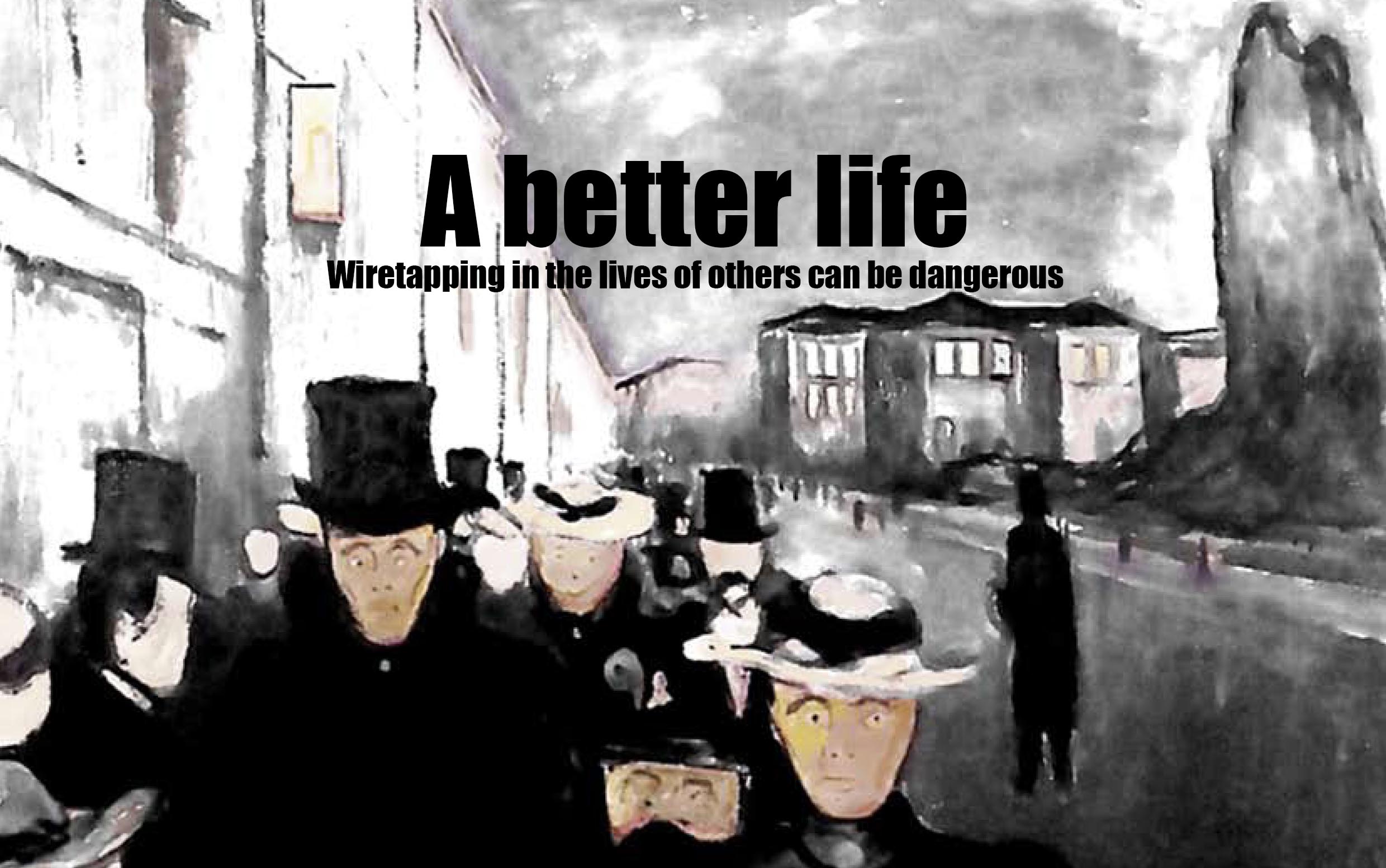
Drama, thriller, by Fabio Del Greco, Italy, 2007.
Rome: Andrea Casadei is a young investigator specializing in audio wiretapping who conducts investigations commissioned by husbands betrayed by their wives, or by parents worried about what their children are doing outside the home. But what interests him most is understanding the human soul, listening to casual conversations in the streets, knowing what people think. He often meets in Piazza Navona with his friend Gigi, a frustrated street artist obsessed with success at all costs, with whom he shares a passion for wiretapping. Shocked by the mystery of the disappearance of Ciccio Simpatia, another street artist common friend, Andrea decides to abandon the commissioned works to seek a better life and reflect on his own and others' existence. He will meet the actress Marina and with a bug he will slowly enter her life until he discovers her most unthinkable secrets. The film deals with an important theme of contemporary Western society: the lack of love. The mysterious and tormented figure of Marina is reflected in a gloomy and soulless Rome.
Director Fabio Del Greco declared about his film: "Perhaps this film is a reflection on the art of observing, of listening, in short, of what one does when one leaves the real world to tell about it. Perhaps he wants to talk about the subtle relationship between the mirages of success touted by today's society, power and the most authentic human relationships.A 'dark cloud' hangs over the city: it is engulfing everyone in a sort of indistinct, uniform mass, where everyone thinks the same things, where everyone they are more alone. Where is the truest part that makes us unique? Maybe you can try to intercept it only secretly."
LANGUAGE: Italian
SUBTITLES: English, Spanish, French, German, Portuguese, Dutch.
Plato’s Ladder and the Violence of Idealism
You have stood in front of someone you loved and felt, without being able to name it, that the person in front of you was somehow not enough — not enough for what you were feeling, not enough for the size of the longing you carried. The ache was real. But so was the suspicion that what you actually wanted was something the other person could not deliver, something they were merely pointing toward, like a signpost you had mistaken for a destination.
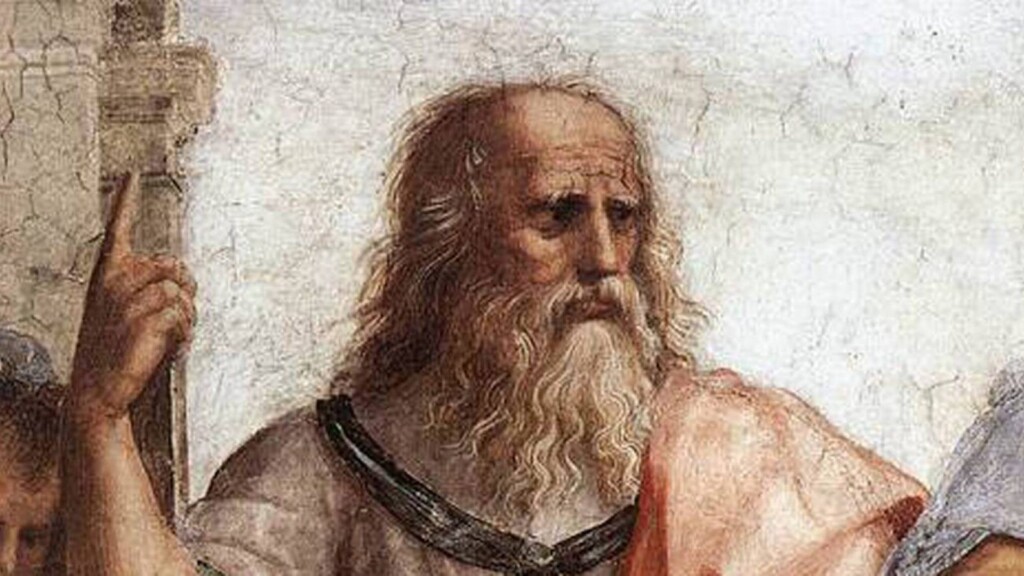
That suspicion has a genealogy. It begins, with unusual precision, in a speech put into the mouth of a woman named Diotima in Plato’s Symposium, written around 385 BCE. Socrates claims she taught him everything he knows about love, and what she teaches is this: desire for a beautiful body is only the first rung of a ladder. The lover who is paying attention will move from one beautiful body to all beautiful bodies, then to beautiful souls, then to beautiful practices and laws, then to knowledge itself, and finally — the ladder’s apex — to Beauty as such, eternal, unmixed, divine. The particular person you desire is not the point. They are, in Diotima’s own framing, a step to be used and then abandoned.
The structure seems elegant until you recognize what it does to the body standing in front of you. It transforms them into a pedagogical instrument. Their function is to produce in you a movement upward, and once that movement is initiated, their individual existence — the specific weight of their voice, the texture of their particular history — becomes philosophically irrelevant. Plato encoded into the Western tradition a love that uses its object as a springboard and calls that use transcendence.
This was not politically innocent. The Symposium was written inside a society where eros between an older man and a younger man was a recognized cultural form, and the ladder Diotima describes maps almost perfectly onto the social asymmetry of that relationship. The erastes, the lover, ascends toward wisdom. The eromenos, the beloved, is the beautiful rung that enables the ascent. The person loved does not travel the ladder. They are the ladder. Plato aestheticized a power structure and called it philosophy.
What the 20th century inherited from this is subtler and therefore more dangerous. By the time idealized love filtered through Neoplatonism, through the troubadour tradition of the 12th century, through Petrarch’s sonnets addressed to a Laura he saw perhaps twice, through Romantic poetry’s obsession with the beloved who must die to remain perfect — by that point, the Platonic architecture had become invisible. People stopped knowing they were following a Greek philosopher’s instructions and started believing they were following their hearts. The compulsion to transform the person you love into a symbol of something larger than themselves felt like depth, felt like the soul recognizing its proper hunger, when it was in fact a very old and very specific idea about what love is for.
Erich Fromm, writing in The Art of Loving in 1956, identified the damage without locating its deepest root: that modern people experience love as something that happens to them, a seizure, a fall, a state of being struck — and that this passivity disguises a refusal to love any actual human being on their own terms. What Fromm called the illusion of falling was partly a Platonic inheritance the tradition had forgotten to name. The ladder was still being climbed. People were still using their partners as rungs. The only difference was that nobody remembered building the ladder or deciding it pointed toward the sky.
The cruelest part is not the idealism itself but its aftereffect: the moment the beloved fails to be infinite — when they are tired, or frightened, or ordinary in the specific way that living bodies are always ordinary — the lover feels obscurely cheated, as though a promise has been broken that nobody remembers making.

Aristotle’s Correction and What We Ignored
You are sitting across from someone you have known for eleven years, and you realize, mid-sentence, that you would not trade this for anything — not for passion, not for revelation, not for the vertigo of new desire. The feeling is quiet enough that most people never bother to name it. Aristotle named it.
In the Nicomachean Ethics, written in the fourth century BCE, Aristotle constructed a theory of philia that has no clean equivalent in modern languages precisely because modern languages were shaped by traditions that had already discarded what he was trying to say. Philia is often translated as friendship, which makes it sound minor, recreational, a supplement to the serious business of romantic love. But Aristotle placed it at the center of the good life, not as decoration but as its structural condition. He argued that human beings are political animals — zoa politika — meaning that they are constitutively relational, that they cannot become fully themselves in isolation, and that the quality of their bonds with others directly determines the quality of their moral character. This was not sentiment. It was architecture.
Aristotle divided bonds into three types: those based on utility, those based on pleasure, and those grounded in virtue. The first two he considered fragile, contingent on the persistence of what each party could extract from the arrangement. The third — the philia of good people who admire and challenge each other’s character over time — he considered the only love worth calling complete. Crucially, it required reciprocity and duration. It could not be accomplished in a single transcendent moment. It accumulated through shared meals, disagreements, decisions made together during difficult years. The philosopher Giorgio Agamben, reading this tradition much later, noted that for Aristotle, to love a friend was to perceive one’s own existence through theirs — not to merge with them, not to ascend toward them, but to experience one’s own life as liveable because another has witnessed it.
What happened to this model is not a mystery so much as a pattern. The Platonic version — love as ascent, love as longing for something beyond the body, love as a ladder toward the divine — proved far more compatible with Christian theology, which needed love to reach upward rather than settle horizontally between peers. When Augustine in the fifth century and Aquinas in the thirteenth absorbed Greek philosophy into Christian doctrine, they found Plato useful and Aristotle awkward. Aristotle’s insistence on the body, on habit, on the ordinary texture of shared daily life, resisted translation into the language of the soul’s journey toward God. So the ecclesiastical tradition quietly emphasized the erotic and mystical strands of love, the vertical ones, and let the horizontal model of philia become something lesser, something you did before the real thing arrived.
The Romantic movement of the late eighteenth and early nineteenth centuries then completed what theology had started. When Rousseau, Goethe, and the German Idealists reconstructed love as the site of the self’s most intense becoming, they drew on Platonic longing without knowing they were doing it, or knowing and not caring. Passion became the proof of authenticity. Friendship became the consolation prize. By the time the novel had matured as a cultural form, its dominant engine was desire frustrated and desire consummated, never the slow, reciprocal, virtue-based bond that Aristotle had spent several chapters of his most important ethical work trying to describe.
The cost is not abstract. Psychological research published in the Journal of Social and Personal Relationships in the early 2000s found that people consistently ranked their close friendships as central to their wellbeing, yet reported investing dramatically less time and cultural validation in those bonds than in romantic partnerships. Aristotle would not have been surprised. He would have recognized the shape of the confusion immediately — not the failure to love, but the failure to recognize which love had already been sustaining you.
The Christianization of Longing
You are sitting in a church you stopped believing in years ago, attending someone else’s wedding, and something in the liturgy catches you off guard — not the theology but the texture of the longing inside it, the way the words assume that love is fundamentally a reaching toward something you do not deserve and cannot fully hold. You recognize that feeling. You have carried it into bedrooms that had nothing to do with God.
Augustine of Hippo, writing his Confessions around 397 CE, did something philosophically violent that has never fully healed. He took the Platonic architecture of Eros — the soul’s ascent toward the Beautiful, the yearning that pulls the lover upward through imperfect forms toward the one perfect Form — and he bent it entirely toward a personal God who was also a judge. What had been, in Plato’s Symposium, a ladder of increasingly refined desire became in Augustine a wound. “Our heart is restless,” he wrote in the opening pages, “until it repose in Thee.” That sentence has been metabolized by Western civilization so completely that most people feel its logic without having read a word of it. Restlessness as the proof of love. Incompleteness as the sign that you are loving something real.
The consequences were not abstract. If the deepest human longing is structurally oriented toward the divine and the divine is by definition infinite, then no finite person can satisfy it. Every human love becomes, by theological definition, a partial love — a placeholder, a symptom, a distraction or a foretaste, but never the destination. Augustine was explicit about this: his grief at the death of a close friend in his youth struck him as idolatrous precisely because it was too intense, because he had loved a mortal as though the mortal were sufficient. The lesson he drew was not that grief was natural but that it was a disorder of priority. You had loved wrongly by loving too completely.
This is where the guilt entered the architecture of secular desire, and it entered through a door most people cannot see because they stopped looking at it centuries ago. By the time Reformation theology in the sixteenth century began dismantling ecclesiastical mediation and throwing the individual soul into direct, unmediated confrontation with divine judgment, the emotional grammar was already set: you love, you fall short, you are aware of your falling short, and that awareness is inseparable from the act of loving itself. Martin Luther‘s tortured relationship with worthiness — his compulsive confession before the Reformation break, his reported physical collapse under the weight of his own perceived inadequacy — was not a personal neurology. It was the medieval theological inheritance reaching its logical breaking point in a single body.
The secular Enlightenment did not dissolve this structure. It displaced it. By the eighteenth century, God had been moved offstage in many educated European circles, but the emotional architecture he occupied did not go empty. It was filled with the Romantic ideal of the beloved — a figure now required to carry the entire weight of transcendence that theology had previously handled. What Rousseau gestured toward in his Julie, or the New Heloise in 1761, and what the Romantic poets then amplified into a cultural religion, was a lover who was expected to be simultaneously human and infinite, present and beyond reach, satisfying and perpetually elusive. The beloved became the secular God, and all the emotional protocols of divine love — unworthiness, yearning, the impossibility of full union — transferred intact.
What transferred with them, invisibly, was the conviction that love which does not hurt is not serious love. That satisfaction is somehow a betrayal of depth. That the person who claims to be content in love has simply not loved hard enough to understand what love actually demands. You recognize this conviction. You may have ended relationships because they felt too easy, too mutual, too resolved — because somewhere in your emotional grammar, resolution looked like the absence of love rather than its fulfillment.
Romanticism’s Manufactured Fever
You have been taught, without anyone ever saying it plainly, that the most beautiful love is the one that hurts. Not just that love can hurt — that its hurt is its proof of authenticity. When desire meets no resistance, you grow suspicious of it. When it flows easily, you call it comfortable, then boring, then not quite love at all. This feeling is not a private discovery. It was engineered.
Denis de Rougemont, writing in 1940 in Love in the Western World, traced a genealogy that most people would find offensive to their sense of romantic originality. He argued that what Europeans — and by cultural inheritance, most of the modern world — experience as the innermost trembling of erotic life was in fact a literary technology. The troubadours of twelfth-century Occitania constructed a poetic convention called courtly love, or fin’amor, in which desire was structurally inseparable from obstruction. The beloved had to be unattainable: already married, socially forbidden, geographically distant. The suffering of the lover was not a side effect of the situation — it was the purpose. Remove the obstacle and the desire collapsed. The system ran on frustration the way an engine runs on combustion.
What de Rougemont saw that most literary historians before him had not fully absorbed was that this convention did not remain a convention. It migrated. It moved from the song into the psyche, from the performance hall into the nervous system. By the time the Tristan and Iseult legend had been retold across dozens of versions throughout the twelfth and thirteenth centuries, the equation between love and fatal longing had been rehearsed so many thousands of times that it stopped reading as a literary choice and started reading as a description of reality. The couple who could not be together became the paradigm of the couple who truly loved. Consummation, in this architecture, was almost always either deferred or lethal.
Hegel had argued in the Phenomenology of Spirit that consciousness recognizes itself only through negation, only through encountering what it is not. The troubadour tradition did something structurally similar to desire: it taught the self to recognize love only when love was denied. This is not a metaphor. It is a conditioning with measurable consequences. When sociologists studying modern romantic dissolution — including Frank Tallis’s clinical work on love as a neurological state, published across the 2000s — found that the emotional intensity people report at the beginning of relationships is often highest precisely when uncertainty and intermittent rejection are present, they were measuring the legacy of a twelfth-century literary program, not some biological constant.
She has been with him for four years when a colleague of hers — technically unavailable, professionally inadvisable — begins looking at her in a way her partner stopped looking years ago. She does not act on it. But she spends three months barely sleeping, rewriting their five-minute conversations in her memory, constructing elaborate futures that will never occur. The unavailable man consumes her entirely. The available man, who loves her consistently and without theatrics, registers in her nervous system as background noise. She would describe this disparity, if asked, as evidence that the feeling for the colleague is more real. De Rougemont would describe it as proof that she has internalized her culture’s deepest instruction.
What is disturbing is not that people make this error. What is disturbing is that the error has an author and a date. The emotional template was issued in a specific historical moment, by poets working within specific theological and political tensions — the relationship between Cathar mysticism and the Catholic Church, the social structures of feudal obligation, the sublimation of a spirituality the Church had declared heretical into a language of secular yearning. These are not the private conditions of anyone’s heart. They are geopolitical coordinates that somehow ended up feeling like personal destiny.
A vision curated by a filmmaker, not an algorithm
In this video I explain our vision
Freud’s Architecture of Desire

You meet someone and within three conversations you are certain. Not hopeful — certain. There is a quality of recognition so complete it feels less like discovery than like remembering, as though this person was already assembled somewhere inside you before you ever encountered them in the world. You call this love at first sight, or chemistry, or fate, depending on your tolerance for mysticism. Sigmund Freud would call it something considerably less romantic: the return of an old object.
In 1905, Freud published Three Essays on the Theory of Sexuality, a text so clinically precise and culturally explosive that it functionally dismantled the idea that adult desire is a fresh and autonomous event. His argument, built across those three dense essays, was that sexuality does not begin at puberty — it has a prehistory, a developmental arc stretching back to infancy, and the emotional patterns installed in that earliest period never fully dissolve. They go underground. They wait. What Freud identified as object-choice — the selection of a person to love — is not, in his framework, a free act of the mature self. It is the unconscious executing a template it drafted decades before the beloved ever walked into the room.
This is the mechanism he would later elaborate as transference, first observed in clinical settings when patients began responding to him not as a physician but as a figure from their emotional past — a father, a rival, a lost protector. The analyst becomes a screen onto which the patient projects a pre-existing relational drama. What disturbed Freud, and what should disturb anyone who sits with it honestly, is that transference does not belong only to the consulting room. It is the ordinary condition of love. The person you believe you have chosen is partly a structural position — a slot in an architecture built from early attachments — filled by whoever arrives with the right combination of resemblances, conscious and unconscious, to the original figures who shaped your emotional world.
The implications are genuinely vertiginous. If the beloved is partly a projection, then the passion you feel for them is passion for a composite — part the actual person in front of you, part a ghost summoned from childhood, part a fantasy of what the original figure should have been and never was. Psychologist John Bowlby, writing decades after Freud in his 1969 Attachment and Loss, would give this architecture a biological scaffolding, arguing that the attachment system formed in infancy creates internal working models — essentially relational scripts — that govern how adults seek proximity, respond to perceived abandonment, and regulate the fear of loss. By the time Bowlby published his research, the data from studies of separated children and bereaved adults made the abstract Freudian claim viscerally observable: people do not simply choose partners, they enact patterns.
What neither Freud nor Bowlby could fully resolve is the question of whether knowing the mechanism provides any exit from it. Freud was notoriously ambivalent about cure; the best psychoanalysis could promise, he suggested, was the transformation of hysterical misery into common unhappiness — a formulation that has always read as either ruthlessly honest or quietly despairing, depending on where you stand. The insight that your desire is partly inherited, partly constructed from wounds you did not choose to receive, does not automatically free you from the structure. You can map the prison and still be inside it.
This is where the philosophical provocation becomes unbearable for the romantic tradition. If love is not freely chosen but unconsciously recruited — if the beloved is, in some structural sense, a stand-in — then the entire architecture of Western love poetry, from the troubadours through the Romantics, is built on a fiction about sovereignty that the subject never actually possessed. The question of whether anything genuine survives this diagnosis is not rhetorical.
Fromm’s Indictment of the Feeling
You already know how to fall. You have done it before — that specific collapse of attention toward another person, the way the world reorganizes itself around a single gravitational point, the sleeplessness that feels like proof. And because you have felt this, you have called it love. This is precisely the confusion Erich Fromm spent his career dismantling, with a precision that should feel insulting to anyone who has ever confused intensity with depth.
In The Art of Loving, published in 1956, Fromm opens with what he calls the most fundamental error in how Western culture frames the problem: people believe the central question is how to be loved, not how to love. They invest in becoming attractive, interesting, successful — optimizing the self as a product for the emotional marketplace. The architecture of modern romance is essentially a transaction dressed in the language of fate. Two people assess each other’s exchange value and, when the rates align, call the result chemistry. Fromm is not being cynical here. He is being diagnostic.
The distinction he draws — and it is the structural spine of his entire argument — is between love as a state and love as an act. A state is something that happens to you and, by definition, can stop happening. You fall in, you fall out. The grammar of falling already concedes the passivity. An act, by contrast, requires will, requires return, requires the daily renegotiation of attention. Fromm aligns love with what he calls productive orientation, a concept he develops across his earlier work in Man for Himself from 1947 — the capacity to engage the world generatively rather than receptively, to give rather than to consume. Love, in this framework, is not the reward you receive when you find the right person. It is a faculty you either develop or you don’t.
What makes this uncomfortable is the implication it carries for personal history. If love is a discipline, then every relationship that failed was not primarily a story about incompatibility — it was a story about skill. Fromm identifies four elements that constitute mature love: care, responsibility, respect, and knowledge. Not knowledge in the romantic sense of intimate revelation, but disciplined attention to who another person actually is, separate from who you need them to be. Most relationships collapse not under the weight of external pressure but under the weight of projection — people loving an image they constructed and calling the image by the other person’s name.
Fromm was writing in 1956, inside a postwar American culture that had industrialized romance through Hollywood, advertising, and the suburban domesticity that followed World War Two. The marriage rate in the United States peaked in the early 1950s; the divorce rate was already climbing. The culture was saturating itself with the imagery of love while producing less and less of the actual practice. Fromm recognized that a society organized around consumption would inevitably consume its relationships the same way it consumed everything else — with initial excitement, rapid habituation, and eventual disposal. The feeling fades; you conclude the love is gone; you look for a new source of the feeling. The wheel turns.
There is something structurally violent about this argument because it removes the alibi of circumstance. You cannot blame the wrong person if love is a capacity rather than a response. You cannot wait for the right conditions. Fromm quotes the Talmudic tradition to suggest that genuine love produces the beloved — not discovers them pre-formed, but actively constitutes their flourishing through sustained, willed attention. This is not a comforting idea. It places the failure of love not in the stars, not in bad timing, not in the cruelty of the person who left, but in the practitioner. In you. In the specific, accountable, unchosen fact that most people want to be loved far more than they have ever seriously learned to love.
The Market Model and the Self That Sells Itself
You are assembling yourself before the date even begins. Not your clothes, not your words — yourself, the version of you most likely to convert. You audit the smile, calibrate the disclosure, decide in advance how much vulnerability reads as depth rather than damage. This is not nervousness. This is labor.
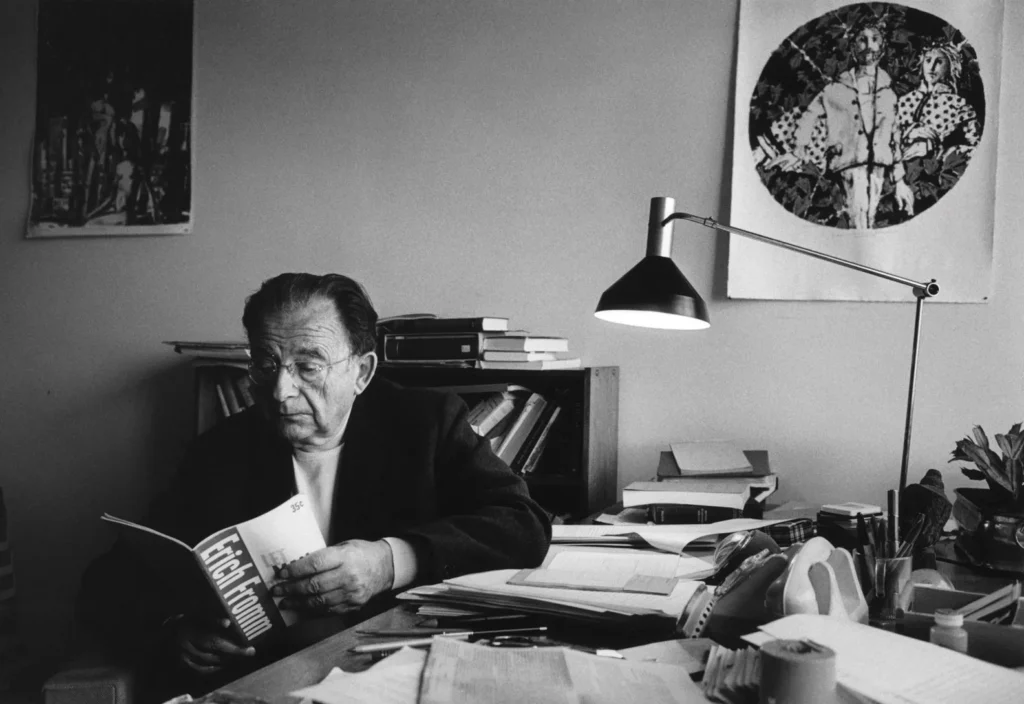
Erich Fromm saw the architecture of this long before the algorithm made it literal. In The Art of Loving, published in 1956, he argued that modern society had produced a character type defined not by what it desires but by how successfully it packages itself for exchange. The marketing character does not ask what it loves; it asks what it can get someone to want. The self becomes inventory. And the tragedy Fromm identified was not that people were cynical — most were not — but that they had internalized the logic of the market so completely that they experienced it as authenticity. The performance felt like presence.
What no sociologist of the 1950s could have anticipated was the degree to which this internalization would eventually find a literal interface. The dating profile is not a representation of a person; it is a pitch deck. It follows the same logic as a consumer product positioned for a target demographic: lead with the strongest asset, obscure the liabilities, optimize for first impression. Research published in journals of communication and behavioral science has documented that users on major platforms spend an average of seven seconds deciding whether to engage with a profile — a figure that does not scandalize us the way it should, because we have already accepted that attention is a currency and that people are content. The optimization is not a distortion of how dating works. It has become the definition of how dating works.
What makes this philosophically vertiginous rather than merely depressing is what it does to interiority itself. When you are trained — by feedback loops, by match rates, by the subtle reinforcement of which photographs generate responses — to present a curated self, the question of which self is the real one stops being rhetorical. Identity does not precede its presentation and then get distorted by it; identity is partially constituted through repeated performance. The sociologist Erving Goffman argued this in The Presentation of Self in Everyday Life in 1959, not as critique but as description: we are always performing, always managing impressions, and the backstage self we imagine to be authentic is simply another costume worn in a different room. The platform did not invent the mask. It gave the mask analytics.
There is something specifically modern about suffering this with full awareness. Earlier generations could fall in love without knowing they were enacting scripts written by class anxiety or religious convention. They experienced the feeling as unmediated. The contemporary subject knows the mechanism — has read the think pieces, done the therapy, maybe even read Fromm — and falls in love anyway, watching themselves fall from a slight remove, wondering whether the feeling is real or performed, whether the hunger is genuine or optimized. Self-awareness here does not liberate. It adds a spectator to the room who never leaves.
And yet the feeling arrives anyway. Something happens across a table or a screen that exceeds the categories used to explain it. A person becomes, suddenly, irreplaceable — not because they scored highest on a compatibility metric but because something unaccountable passed between two people and rewrote their private geometries. This is either evidence that love is more durable than its commodification, or it is the most sophisticated trap the market ever laid: the feeling of transcendence as the final product, sold back to you at the moment you were most certain you had escaped the selling.
Whether that distinction is philosophically meaningful, or whether it matters at all once the feeling has arrived, is a question that no theory of love has yet managed to answer without flinching.
🌀 Paths Through the Labyrinth of Love & Meaning
Philosophy and literature have long explored love as one of humanity’s most elusive yet defining forces. From ancient allegories to modern existential inquiry, the search for connection mirrors the wandering soul lost in an infinite maze. These articles trace the intellectual corridors that lead us closer to understanding desire, identity, and the human condition.
Jorge Luis Borges and the Labyrinth of Identity
Borges constructed labyrinths not merely as physical puzzles but as mirrors of the self seeking meaning in an indifferent universe — a journey that resonates deeply with philosophical meditations on love. Like Plato’s allegory of the cave or Fromm’s notion of the ‘art of loving,’ Borges suggests that identity is never fixed but endlessly rediscovered. His work challenges us to embrace the maze as the very condition of being human.
GO TO THE SELECTION: Jorge Luis Borges and the Labyrinth of Identity
Jorge Luis Borges: Life and Works
Borges spent a lifetime mapping the infinite corridors of human thought, weaving philosophy, myth, and literature into a singular and labyrinthine body of work. His fascination with infinite regress, doubled selves, and hidden passages aligns strikingly with philosophical traditions that view love as a form of ontological searching. Understanding his biography illuminates why his fiction remains one of literature’s most profound explorations of longing and connection.
GO TO THE SELECTION: Jorge Luis Borges: Life and Works
Homer and the Odyssey: Nostos and the Archetype of Return
Homer’s Odyssey frames love not as a simple emotion but as the gravitational force that drives an entire epic journey across perilous seas and impossible obstacles. The concept of nostos — the longing return to one’s beloved homeland and companion — prefigures Plato’s idea of love as a yearning for one’s lost other half. This archetypal return echoes through centuries of philosophical thought, from Eros in the Symposium to Fromm’s vision of love as active reunion.
GO TO THE SELECTION: Homer and the Odyssey: Nostos and the Archetype of Return
The Journey as Metaphor in Literature
The journey as literary metaphor perfectly encapsulates the philosophical understanding of love: a transformative path without guaranteed destination, demanding courage, self-knowledge, and surrender. Plato’s lovers ascend toward the ideal Form of Beauty, while Fromm insists love is a practice requiring daily discipline rather than a passive destination. Exploring this metaphor across world literature reveals how deeply the experience of loving and the experience of traveling the unknown share the same existential architecture.
GO TO THE SELECTION: The Journey as Metaphor in Literature
Discover More Hidden Paths on Indiecinema
The maze of human emotion, philosophy, and storytelling continues beyond the written word. On Indiecinema, independent filmmakers explore love, identity, and meaning with the same daring depth found in Plato, Fromm, and Borges. Stream our curated selection of independent films and let cinema guide you further into the labyrinth.
👉 EXPLORE THE CATALOG: Watch Indie Films in Streaming
A vision curated by a filmmaker, not an algorithm
In this video I explain our vision

