
The Editor Who Believed He Was Neutral
You are holding a proof sheet in the lamplight, and the ink is still wet. The year is 1878, and outside the offices of the Bombay Gazette the monsoon is turning the streets to rust-colored rivers, but in here everything smells of turpentine and certainty. You are the editor. You have been the editor for six years, and in those six years you have told yourself, with genuine conviction, that you print what is true and suppress what is inflammatory. The distinction seems obvious to you. It feels like a matter of professional ethics, of craft, of the civilizational duty that educated men owe to the public they serve. What you do not see — cannot see, because the architecture of your assumptions prevents it — is that the line between “inflammatory” and “true” is not a journalistic category. It is a political one, drawn precisely where the empire needs it drawn.

The liberal British press in colonial India was not the propaganda arm of the Raj in any crude sense. That is precisely what makes it worth examining without mercy. Men like Robert Knight, who founded the Times of India in its modern form in 1861, genuinely believed in press freedom, in representative governance, in the reforming instincts of liberalism. Knight himself clashed repeatedly with the colonial administration and published criticism of official policy that landed him in professional danger more than once. His liberalism was not performance. And yet the framework within which he operated — the framework of who constituted a reasonable interlocutor, whose grievances qualified as legitimate political speech, whose anger read as evidence of intellectual maturity versus communal passion — reproduced the hierarchy it claimed to transcend.
This is the particular cruelty of liberal neutrality: it does not announce itself as power. John Stuart Mill, whose influence saturated educated British opinion in the 1860s and 1870s, had written in Considerations on Representative Government in 1861 that despotism was a legitimate form of government for dealing with barbarians, provided the end was improvement and the means justified by actually effecting that end. Mill was not a reactionary. He was the presiding philosopher of progressive British thought. And the editors who shaped colonial newspapers had absorbed his logic so completely that it no longer appeared to them as ideology. It appeared to them as realism.
What this meant in practice was a calibration so fine-grained it barely registered as censorship. Bal Gangadhar Tilak could be quoted, but the quotation would be preceded by a sentence establishing his reputation for extremism. A petition from the Indian National Congress, founded in 1885, might be reported accurately while the framing paragraph described its signatories as a narrow educated elite unlikely to represent the broader native population — a description that was simultaneously a sociological observation and a political verdict. The moderate voices, those who accepted the grammar of petition and deference, received coverage that dignified them as statesmen. Those who did not accept that grammar were covered as problems to be explained.
The historian Sanjay Joshi, in Fractured Modernity published in 2001, traced how the vernacular and English-language presses in colonial India served entirely different political ecosystems, and how the English liberal press functioned as a gatekeeper to the world of legitimized opinion. To be legible in that world required adopting its syntax. The Indian voices that appeared regularly in papers like the Bombay Gazette or the Statesman were not necessarily the most representative or the most intellectually serious. They were the most translatable into a discourse that British editors recognized as rational. And what that discourse systematically excluded was not irrationality. It was rage, which is a different thing entirely — and which carries information that politeness is specifically designed to suppress.
Thirsty
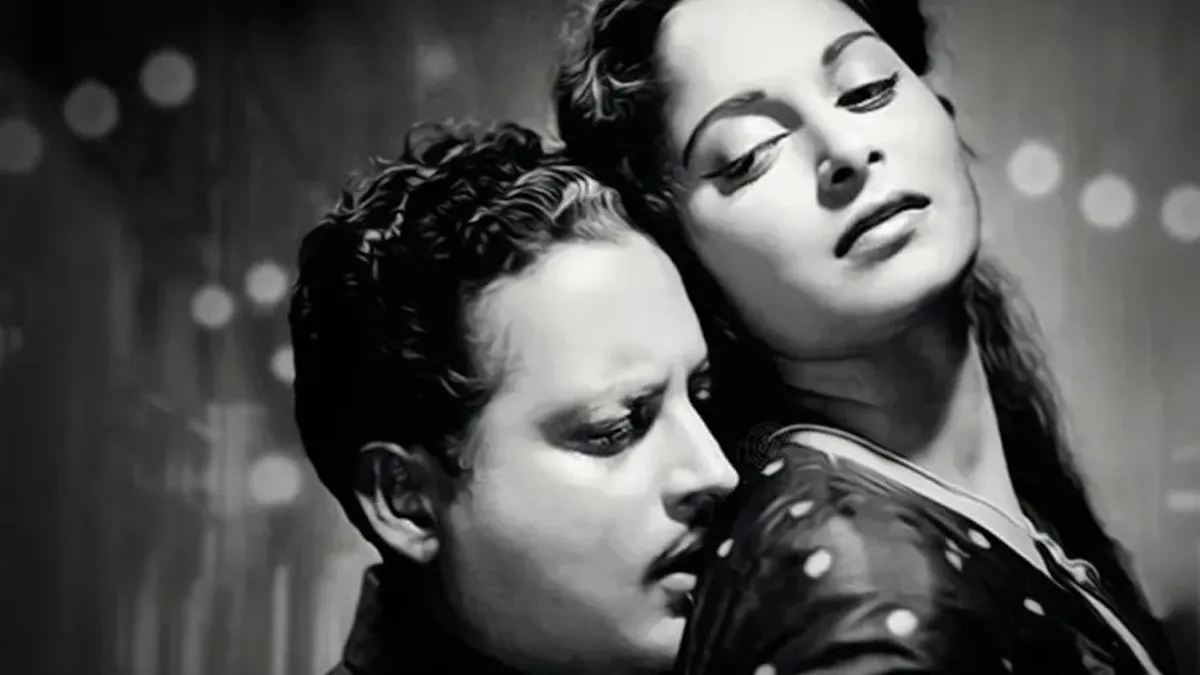
Drama, musical, by Guru Dutt, India, 1957
Thirsty is the heartbreaking story of Vijay, a young poet living in Calcutta who dreams of giving voice to the suffering and injustice of the world through his verses. Idealistic and sensitive, Vijay clashes with a society that despises his art because it is not profitable and does not cater to the tastes of the public. His brothers consider him a failure, the woman he loves leaves him for a marriage of convenience, and his poems are ignored by publishers. Only Gulabo, a prostitute with a pure heart, recognizes the beauty and truth of his words. When a misunderstanding leads everyone to believe Vijay is dead, his name and poetry suddenly become famous, exposing the hypocrisy of those who had previously rejected him.
Watching Thirsty means immersing oneself in a work that goes beyond melodrama, blending poetry, music, and imagery into a profound reflection on the human soul and the value of art. Guru Dutt, director and protagonist, creates one of the most intense and poetic films in world cinema, where black-and-white cinematography, expressive framing, and evocative lyrics produce an atmosphere of poignant melancholy. It is a film about the misunderstanding of the artist, pure love, and society’s hypocrisy, but also a universal critique of materialism and opportunism. Even today, Thirsty moves and provokes thought because it sincerely tells the story of the need to remain true to oneself in a world that measures people’s worth solely by their success.
LANGUAGE: Hindi
SUBTITLES: English, Spanish, French, German, Portuguese
Liberalism as a Grammar of Permission
You are handed a doctrine that claims to free you and you believe it, at first, because its vocabulary is generous. Rights, progress, civilization, potential — these are words that open like doors, and you walk through them before noticing that every room leads to a waiting area.
James Mill had never visited India when he published his History of British India in 1817, a fact he considered irrelevant. Direct experience, he argued, introduced bias; distance produced clarity. What this extraordinary epistemological move accomplished was to transform colonial ignorance into methodological virtue, and from that position he constructed a ranking of civilizations so precise it could tell you, with the confidence of a surveyor, exactly how far any given people stood from the threshold of self-governance. India stood very far. Not permanently — Mill was too good a utilitarian for permanent verdicts — but far enough that the question of when was always answered with not yet.
This is the hinge on which nineteenth-century liberal imperialism turned, and it is worth pressing on it until it gives. The utilitarian framework was not hostile to Indian political capacity in the way that racial science was hostile. It was something more durable: it was conditional. John Stuart Mill, who spent thirty-five years at the East India Company and defended its administrative function in his Considerations on Representative Government in 1861, was explicit that despotism was a legitimate form of government for dealing with what he called barbarians, provided the despotism was exercised in their interest and with the object of improving them. The word improving is doing enormous work in that sentence. It installs a permanent asymmetry: the governed must demonstrate readiness, the governors determine when readiness has been demonstrated, and no external mechanism exists to adjudicate the gap between the two.
The liberal press that carried these ideas into wider circulation was not engaged in simple propaganda. The Spectator, the Westminster Review, the Edinburgh Review — these journals ran genuine debates, published dissenting voices, worried in print about the corruptions of empire. But the structural assumption beneath all disagreement was that the question of Indian self-determination was a question of timing, not of right. When the Ilbert Bill controversy erupted in 1883 over whether Indian magistrates could try British subjects, the liberal British press largely framed its discomfort not as racist panic but as concern about premature institutional extension. The grammar was always the same: in principle, yes; in practice, not yet; come back when the preparation is complete.
What made this framework so effective was that it absorbed its critics. An Indian writer who argued for immediate self-rule could be told that his very ability to make the argument in English constitutional terms was evidence of the civilizing process working correctly — and therefore of the need to let it continue working. Protest became proof of progress, and proof of progress became justification for patience. The logic was airtight in the way that only circular reasoning can be airtight, because it had placed the exit door on the inside of the room it claimed you were free to leave.
G. O. Trevelyan’s Letters from a Competition Wallah, published in 1864, captured the texture of this liberal self-image with uncomfortable precision: young British administrators who genuinely believed they were building something for India’s future, who read their Mill and their Macaulay, who felt morally superior to the crude racism of older colonial hands, and who nonetheless exercised a power that required no Indian consent and consulted no Indian voice at any structural level. The sincerity was not incidental — it was load-bearing. A cynical empire can be resisted in cynical terms. An empire that genuinely believes in its own benevolence requires a different kind of resistance, one that must first dismantle the language of benevolence itself before it can reach the power that language is protecting.

The Press as Colonial Infrastructure
You pick up a copy of The Times of India in 1880 and feel, briefly, that you are holding liberalism itself — the clean font, the measured editorials, the careful sympathy for Indian grievances expressed within precise and inviolable boundaries. What you are actually holding is a commercial instrument owned by British proprietors, printed on machinery imported from London, and sustained almost entirely by advertising revenue drawn from European trading houses, railway contractors, and the administrative apparatus of the Raj itself.
The economic skeleton of the Anglo-Indian liberal press was never hidden, merely unremarked. The Bombay Gazette, founded in 1791 and operating through the first three quarters of the nineteenth century, drew its financial lifeblood from mercantile advertisers whose prosperity was structurally inseparable from colonial trade regimes. The Statesman, established in Calcutta in 1875 through the merger of The Friend of India and The Statesman, was British-owned and British-edited for virtually the entirety of its formative decades. These were not neutral conduits through which Indian political consciousness could flow freely — they were architectures with load-bearing walls, and certain arguments, if pursued far enough, would bring the structure down.
What this produced was a very specific grammar of permissible Indian ambition. A paper could advocate for Indian representation in municipal bodies. It could deplore the Ilbert Bill controversy of 1883 with elegant outrage, positioning itself as a friend of Indian dignity while simultaneously reassuring its European readership that the social order was not genuinely threatened. It could publish Dadabhai Naoroji’s early articulations of economic drain theory — Naoroji presented his systematic analysis of capital extraction to the East India Association in 1867 — but only so long as the argument remained within the register of loyal petition rather than structural indictment. The moment a political analysis began to implicate not merely administrative corruption but the foundational economic relationship between colony and metropole, the editorial calculus shifted. Readability, in the commercial sense, had a political ceiling.
The readership demographics enforced this ceiling from the demand side with no need for explicit censorship. The educated Indian reader who could access English-language newspapers in the 1870s and 1880s was predominantly the bhadralok of Bengal, the Parsi mercantile class of Bombay, the administrative professionals of Madras — groups whose social position was itself partly constituted by the colonial order they were attempting to reform from within. When Benedict Anderson argued in Imagined Communities in 1983 that print capitalism created the conditions for national consciousness by producing a shared, simultaneous readership, he was describing a mechanism that in the colonial context also produced shared, simultaneous exclusions. The vernacular press — Bal Gangadhar Tilak’s Kesari, founded in 1881, or Jyotiba Phule’s Deenbandhu — operated in entirely different circuits of social imagination, reaching constituencies whose nationalism did not require the validation of Fleet Street’s colonial outpost on the Hooghly.
The advertising dependency was perhaps the most quietly decisive force, precisely because it operated below the level of conscious editorial decision. A paper like The Times of India, which passed into the ownership of the British printing firm Bennett, Coleman and Company in 1892, could not afford to publish sustained analysis of how railway contracts systematically transferred Indian capital to British engineering firms, because the firms purchasing quarter-page advertisements at the back of the paper were often subsidiaries or partners of those same interests. This was not conspiracy — it was infrastructure. The paper was not suppressing radical nationalism through malice; it was metabolically incapable of hosting it, the way a body cannot house an organ it has no circulatory system to feed.
The nationalism that the liberal Anglo-Indian press could reproduce was therefore a nationalism of procedure — demanding faster promotion for Indian civil servants, fairer tariffs, more consultative governance — a politics structured around access to existing institutions rather than interrogation of why those institutions existed in their particular form.
What Bal Gangadhar Tilak Cost the Page
You are reading a newspaper in Poona in the summer of 1897, and the word swaraj sits on the page in front of you like a lit fuse. You know, before you finish the sentence, that someone will pay for this.
Bal Gangadhar Tilak had been writing in Kesari since 1881, and by the time colonial authorities arrested him in July 1897 under Section 124A of the Indian Penal Code — the sedition provision Macaulay had engineered in 1837 precisely to silence this kind of voice — he had already built a readership that the English-language liberal press could not match in reach or in rage. The charge turned on two editorials in which Tilak had invoked the Maratha warrior Shivaji and suggested, with a historical indirection that fooled no one, that resistance to oppression carried its own moral legitimacy. The prosecution was transparent in its mechanics: it was not punishing violence but punishing the grammar of defiance, the act of naming the structure aloud.
What followed from the liberal English-language press was not solidarity. The Bombay Gazette, which had spent years positioning itself as the conscience of colonial modernity, treated the trial with the clinical detachment of an institution that had already decided where its loyalties resided. The framing was not that a man was being imprisoned for his opinions, but that his opinions had been irresponsible — a word doing enormous ideological labor, quietly replacing the question of justice with the question of tone. Responsibility, in this configuration, meant legibility to the colonizer, acceptability within the parameters the colonizer had set for political speech. Any vocabulary that exceeded those parameters was not courageous; it was reckless, inflammatory, a provocation that invited its own punishment.
This is where the category of responsible journalism reveals its hidden architecture. It was never a neutral professional standard. In 1897 and again during Tilak’s second sedition prosecution in 1908 — when he received a six-year sentence for editorials responding to the partition of Bengal and the climate of mass agitation — the term functioned as a cordon sanitaire around colonial epistemology. To be responsible was to accept, implicitly, that colonial governance was a legitimate framework within which one could negotiate, petition, and remonstrate, but never fundamentally challenge. The liberal press had internalized this boundary so thoroughly that it no longer experienced it as a constraint; it experienced it as professional integrity.
John Stuart Mill had argued in On Liberty in 1859 that the peculiar danger of authority lay not in its violence but in its capacity to set the terms of permissible thought, and what the liberal press performed in its coverage of Tilak was precisely this softer tyranny — the tyranny of the acceptable sentence. The editors who condemned Tilak were not, for the most part, agents of empire in any crude sense. Many genuinely believed in press freedom. But they believed in a press freedom that had already silently excluded the freedom to delegitimize the system that guaranteed their own position within it.
By 1908, the numbers made the contradiction harder to ignore. Tilak’s Kesari had a circulation that dwarfed most English-language papers in the presidency. The trial drew crowds. The conviction provoked a six-day strike in Bombay that paralyzed the textile mills — a political convulsion that the liberal press largely attributed to mob emotion rather than to the political education Tilak had spent three decades conducting. That attribution was not an accident of analysis. It was a refusal, structurally necessary, to credit the colonized with the kind of deliberate political consciousness that would have required the liberal press to examine what its own moderation had actually been protecting.
The sedition law was never primarily about preventing violence. Between 1870 and 1910, the Indian press was prosecuted not for inciting riots but for printing arguments the administration could not answer.
The Bengali Intellectual and the Broken Mirror
You are handed a mirror and told it will show you your true face, but the mirror was ground by someone else’s hands, beveled to their proportions, and what you see when you look into it is already a translation. This is not a metaphor for alienation in the vague therapeutic sense — it is the precise structural condition under which Bankimchandra Chattopadhyay wrote Anandamath in 1882, producing a text that would become the foundational scripture of Hindu nationalist feeling and, simultaneously, a document that could only have been written by someone who had absorbed Walter Scott, Herder, and the entire grammar of European Romantic nationalism at the level of reflex rather than imitation.
The Bengal Renaissance was not a movement of mimicry, and calling it that flattens something far more vertiginous. It was a generation of thinkers — Rammohan Roy, Derozio, later Vivekananda — who had been educated inside a colonial apparatus explicitly designed to produce, as Macaulay’s 1835 Minute on Education notoriously put it, “a class of persons, Indian in blood and colour, but English in taste, in opinions, in morals, and in intellect.” The cruelty embedded in that sentence is not merely its contempt but its functionality: it describes a machine for producing people who would think in borrowed categories and then be told that borrowed categories are all they have ever possessed. What Macaulay could not anticipate was that the machine would produce readers who would read Herder on the organic unity of the Volk, read Fichte on national awakening, and recognize — not with admiration but with furious recognition — a rhetorical structure they could turn against the empire that had handed it to them.
Anandamath is that turning, and it is also its own trap. The novel’s central conceit — a secret brotherhood of ascetic warriors fighting for the motherland, their devotion fused with the famous hymn Vande Mataram — draws on exactly the Romantic nationalist formula of recovered primordial essence, the sleeping nation that must be roused, the sacred landscape as the body of the people. These were not indigenous Bengali narrative structures. The tradition of devotional literature in Bengal, the Vaishnava poetry of Chandidas or Jayadeva’s Gitagovinda, operated through entirely different logics of time, embodiment, and political community. Bankim knew this. His earlier novels, including Durgeshnandini and Bishabriksha, moved in registers far more entangled with the actual textures of zamindar society, colonial law, and domestic constraint. The choice to write in the Romantic mode in 1882 was not a failure of originality — it was a calculated bid for legibility inside a discursive economy where only certain narrative forms were recognized as properly political.
The liberal press of London and Calcutta, from the Spectator to the Indian Mirror, had established what counted as a legitimate nationalist aspiration: it required a coherent territorial imaginary, a unified cultural essence, a founding myth, and a hero capable of representative suffering. Without these ingredients, political writing from the subcontinent was classified as communal grievance, religious fanaticism, or primitive sedition rather than nationalism proper. Bankim supplied every ingredient, and the reward was precisely what the trap promised: The liberal press could now acknowledge the text as a form of nationalism while simultaneously diagnosing it as derivative, as proof that Indian political consciousness had not generated its own forms but had borrowed European ones — a move that rendered the entire project epistemically dependent. The derivativeness was not an accidental by-product of the critical response; it was the structural outcome of a system that refused to grant legibility to forms it had not itself pre-authorized.
What this means for the concept of influence — who shapes whom, under what conditions of asymmetric power — is that the Bengal Renaissance thinkers were not influenced by European Romanticism in the way one writer is influenced by another across a level field. The field was not level. It was a field in which certain forms of thought arrived pre-authorized as universal, and the act of adopting them was simultaneously the only available route to political legibility and the mechanism by which one’s own political consciousness was declared secondhand.
A vision curated by a filmmaker, not an algorithm
In this video I explain our vision
Subaltern Speech and the Threshold of Printability

You are reading a newspaper from Calcutta, 1857, and the words on the page are perfectly grammatical, perfectly measured, perfectly useless for understanding what is actually happening in the countryside forty miles away. The columns are full of argument. What they are empty of is the sound a village makes when it burns its own records.
Ranajit Guha, writing in Elementary Aspects of Peasant Insurgency in Colonial India in 1983, identified something that most historians of the period had treated as a silence — the near-total absence of peasant insurgent consciousness from the documentary record — and reread it as a structural production. The archive did not fail to capture this consciousness. It was built precisely to exclude it. What Guha excavated was not missing evidence but the logic by which certain forms of collective action were consistently translated, by colonial administrators and their sympathetic liberal commentators alike, into the vocabulary of riot, disturbance, and disorder — categories that, by definition, fell below the threshold of political legibility. A crowd that destroys a moneylender’s ledgers is not making an argument in any register the liberal press could recognize. It is committing a crime. That the destruction of the ledger was itself a form of speech, a refusal of a particular kind of written power over the body, did not survive the translation into print.
The threshold of printability was not primarily a matter of editorial cowardice or colonial loyalty, though both were present in abundance. It was an epistemic condition. The liberal press of the nineteenth century operated within a framework inherited from Enlightenment political theory in which legitimate political agency required the articulation of grievances in propositional form: a claim, a demand, an address to an authority, a named subject speaking on behalf of an identifiable constituency. The 1855 Santali uprising, the Indigo Revolts of 1859 and 1860, the repeated cycles of agrarian insurgency across Bengal and Bihar — these events entered newspaper columns only at the moment they could be framed as responses to identifiable abuses by identifiable actors, preferably European planters or local zamindars whose excesses even a liberal readership could deplore. What could not enter the columns was the insurgency itself as a form of knowing, as a mode of collective reasoning about land, sovereignty, and the body that did not require the form of the petition.
This meant that the liberal press, even at its most sympathetic, was performing a kind of epistemological triage on the materials of Indian political life. The educated Bengali reformer writing a letter to the editor in fluent English about the condition of the ryot was printable. The ryot himself, acting in the idiom of rural insurgency — burning, uprooting, assembling at night, refusing to sow — was not printable as a political actor. He could appear as a victim requiring advocacy, never as an agent producing meaning. The distinction was not merely rhetorical. It determined which forms of resistance could accumulate into a recognizable nationalist demand and which would remain perpetually in the register of the primitive, the spontaneous, the pre-political.
What this produced, over decades, was a nationalist imagination with a structural hole at its center. The press that shaped early nationalist consciousness was the same press that had spent a generation filtering out the cognitive content of subaltern action. When figures like Bal Gangadhar Tilak in the 1890s began mobilizing popular religious festivals as political instruments, the liberal press responded with precisely the anxiety one would expect from institutions whose entire architecture depended on the separation of rational argument from collective affect. The nervousness was not cynical. It was sincere, and that sincerity is the more troubling fact — because it reveals how thoroughly the editors had internalized a definition of the political that made mass participation not merely difficult to accommodate but structurally unthinkable within their own terms of intelligibility.
The Sympathy That Consumes
Picture a man in Calcutta, 1883, bent over a draft he has been writing for three weeks. He is not unknown — his name has appeared in the pages of a London quarterly before, a footnote to someone else’s argument, a politely cited native voice confirming what an Englishman had already concluded. This time he is making a claim of his own: that the famine relief policies of the preceding decade were not failures of logistics but expressions of deliberate administrative indifference, a position he supports with district mortality figures and with the testimony of collectors who had themselves written, in internal correspondence, of grain exports continuing through starvation. He posts the manuscript to an editor who has, in letters, called himself a friend to India, a man who publishes Bright and Spencer and considers himself an heir to the Cobdenite tradition of principled anti-imperialism.
The manuscript returns with annotations in a generous hand. The editor has not rejected it. He has improved it. The mortality figures remain but are recontextualized as products of a system in need of reform rather than of a policy in the service of extraction. The word deliberate has been removed throughout. The collector testimonies survive in condensed form, stripped of the names that would have made them verifiable and therefore dangerous. A new opening paragraph has been supplied, one that acknowledges the genuine difficulty of governing a subcontinent of such complexity, and a closing line has been added suggesting that the solution lies in a more enlightened application of free trade principles. The article, published two months later, is praised in three other journals as a significant native contribution to the reform debate. Its author reads the praise in silence.
What was performed here was not censorship in any form the editor would have recognized in himself. It was translation — the conversion of a political indictment into a policy recommendation, the replacement of agency with pathos, the domestication of an argument that had arrived at the door of liberal discourse speaking a language the tradition had no grammar to process. Ranajit Guha, in his foundational work on the historiography of colonial India developed through the Subaltern Studies project from 1982 onward, identified the systematic way in which the prose of counter-insurgency absorbed the language of native grievance and neutralized it by narrating it within frameworks of legibility already owned by the colonizer. The editor in London was performing an identical operation at the level of the sentence, converting the native’s analysis into data available for a debate the native had not been invited to adjudicate.
The liberal press had constructed around itself an elaborate infrastructure of sympathy — letters columns, special supplements on Indian affairs, the occasional native contributor held up as proof of open doors — and this infrastructure functioned precisely because it was sincere. John Stuart Mill, who spent thirty-five years employed by the East India Company and who wrote his Considerations on Representative Government in 1861 with an explicit argument that some peoples were not yet ready for self-governance, was not being hypocritical when he expressed concern for Indian welfare. He was being consistent within a framework that made concern and control inseparable, that located the capacity for political judgment exclusively in the tradition doing the judging. The sympathy was real. That is exactly what made it so structurally efficient as a mechanism of enclosure.
An outright refusal would have taught the writer in Calcutta something about the walls. What he received instead was the sensation of having been heard, the disfigured echo of his own argument returned to him wearing the face of inclusion, a document he could not fully disown because his name was still attached to it, and could not fully claim because the claim had been quietly removed.
Nationalism Without a Nation, Press Without a Public
You are reading about Indian nationalism right now, but the Indian nationalist is not in the room.
That absence is not accidental, and it is not a gap that more careful archiving could repair. The liberal press of the nineteenth century generated an extraordinary volume of material on the subject of Indian political consciousness — dispatches, editorials, parliamentary summaries, correspondence columns, ethnographic profiles, and what editors liked to call “native opinion,” a phrase that smuggled the diminutive into the very gesture of inclusion. The Bombay Gazette, the Calcutta Englishman, the Times of India in its earlier incarnations as a colonial broadsheet — these papers produced, between roughly 1835 and 1905, a documentary record dense enough to fill research libraries, and scholars have spent careers inside it. What that record captures, with an almost clinical precision it never intended, is the mechanism by which a subject is constituted through the act of being spoken about rather than spoken with.
John Stuart Mill, whose Considerations on Representative Government appeared in 1861, argued with elegant consistency that certain peoples were simply not yet ready for political self-determination — that representative institutions required a stage of civilizational preparation that India had not completed. The argument was framed as patience, even as generosity, but its structural function was to defer indefinitely the moment at which the colonized voice would need to be heard on its own terms. The liberal press absorbed this framework so thoroughly that it ceased to register as ideology and began to operate as editorial instinct: every articulate Indian political thinker who appeared in those pages was framed as a promising exception, a sign of progress, living evidence that the civilizing project was working — which meant that his articulacy was credited to the system that had educated him rather than to the political tradition from which he spoke.
Bal Gangadhar Tilak, whose newspaper Kesari was founded in 1881 and conducted in Marathi, understood something that the English-language liberal press could not structurally afford to acknowledge: that a press addressed to the people it claimed to represent was a different instrument entirely from a press that reported on them. Kesari’s circulation during the 1890s reached populations that no English-language paper could have touched, not because those populations were illiterate but because the language of their political life was not English, and the questions that mattered to them were not the questions the Raj’s journalistic apparatus had decided were worth asking. The liberal press in London and Calcutta could cover Tilak’s sedition trial in 1897 with great procedural thoroughness and still miss entirely what the trial meant to the hundred thousand people who read about it in a language that carried their own history inside it.
What accumulated over this period was therefore not simply a biased archive but something stranger and more intractable: a record that is exhaustive about the colonial gaze and almost silent about the inner life of the movement it claimed to document. The voices are not absent because they were never raised. They are absent because the instruments of preservation were calibrated to a frequency they could not register. Subaltern studies as a scholarly project, launched by Ranajit Guha with his foundational essay collection beginning in 1982, was in part an attempt to read this archive against its own grain — to find in the silences, the prosecutorial records, the reports of uprisings described only through the language of disorder, some trace of a political consciousness the press had recorded only in the act of suppressing it. But even that recovery work operates inside a paradox: the sources it must use are the very sources structured to deny what the scholar is trying to find.
The nineteenth-century liberal press did not lie about Indian nationalism. It documented it obsessively, anxiously, with genuine intellectual effort in many cases. It simply could not imagine that documentation and representation were not the same thing, and that archive — vast, meticulous, and profoundly deaf — is the monument that distinction left behind.
🗞️ Press, Resistance, and the Birth of Modern India
Indian nationalism emerged not only on the streets but in the columns of courageous newspapers and journals that dared to challenge colonial authority. The liberal press of the nineteenth century became a battlefield where ideas of freedom, identity, and reform were forged. These related articles trace the deeper cultural and intellectual roots of that transformative era.
Swami Vivekananda: Life and Works
Swami Vivekananda stands as one of the most eloquent voices in the awakening of Indian national consciousness, blending spiritual pride with a call for social reform. His speeches and writings gave the emerging nationalist movement a philosophical backbone rooted in Vedanta and universal humanism. Understanding his thought is essential to grasping how culture and politics intertwined in nineteenth-century India.
GO TO THE SELECTION: Swami Vivekananda: Life and Works
Rabindranath Tagore: Life and Works
Rabindranath Tagore was not only a poet but a thinker deeply engaged with questions of colonial modernity, cultural identity, and the meaning of freedom for his people. His critiques of blind nationalism and his vision of a humane, pluralist India offered a counterpoint to more militant strands of the independence movement. His work circulated widely through the Bengali press, making him inseparable from the intellectual landscape of the era.
GO TO THE SELECTION: Rabindranath Tagore: Life and Works
Sri Aurobindo: Life and Works
Sri Aurobindo began his public life as a firebrand journalist and nationalist agitator before his spiritual transformation, and his early writings in papers like Yugantar remain landmarks of anti-colonial rhetoric. He understood the press as a weapon of consciousness, capable of awakening millions to the injustice of imperial rule. His trajectory from political editor to mystic philosopher mirrors the complex soul of Indian nationalism itself.
GO TO THE SELECTION: Sri Aurobindo: Life and Works
Poetry as Revolt: Voices That Power Did Not Want to Hear
Across many cultures and centuries, poetry has served as one of the most subversive forms of resistance against power, and nineteenth-century India was no exception. Poets writing in Bengali, Urdu, and Marathi used verse to ignite national pride and expose colonial exploitation in ways that prose journalism sometimes could not. This article explores how literary voices became inseparable from the broader struggle for dignity and self-determination.
GO TO THE SELECTION: Poetry as Revolt: Voices That Power Did Not Want to Hear
Discover the Cinema of Ideas on Indiecinema
If these stories of resistance, intellectual courage, and cultural identity move you, Indiecinema streaming is where cinema continues that conversation. Our curated selection of independent and world films brings to the screen the voices that power would rather silence. Join us and explore cinema as a form of living thought.
👉 EXPLORE THE CATALOG: Watch Indie Films in Streaming
A vision curated by a filmmaker, not an algorithm
In this video I explain our vision

