
The Altar in the Living Room
You arrange them carefully, the way you arrange things that matter. The small bronze Buddha sits on the left, its weight satisfying in the hand before you set it down. The hamsa hangs above the window, blue eye catching the afternoon light. The crucifix your grandmother left you leans against the wall because you haven’t decided yet whether to nail it or let it rest there informally, which somehow feels more honest. You do not think of this arrangement as a statement. You think of it as a home.

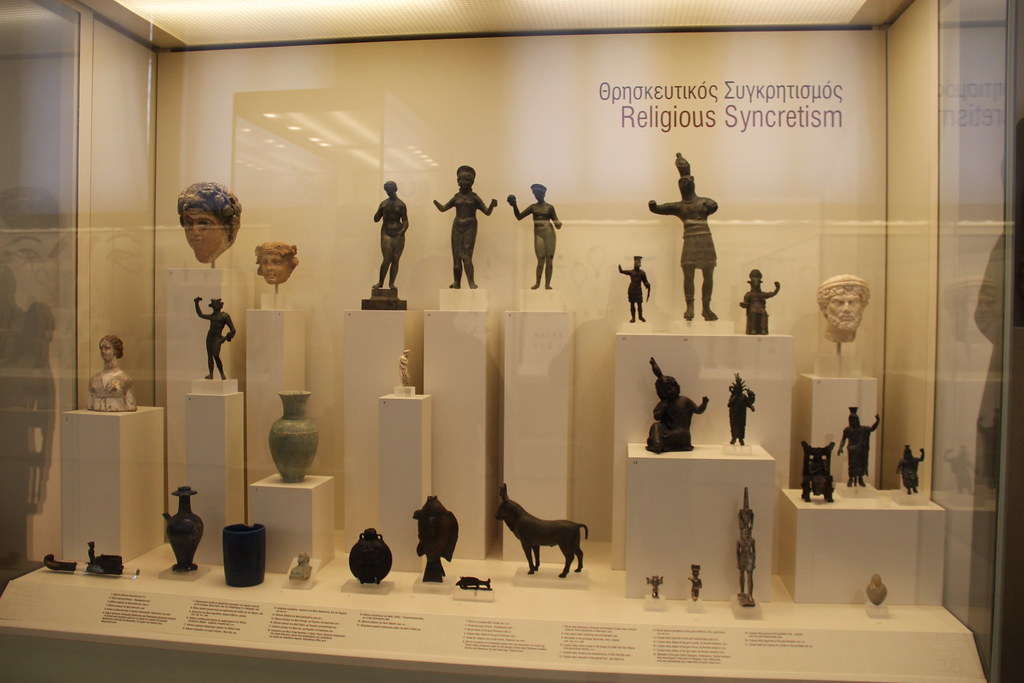
What you have built without noticing is one of the defining spiritual postures of the contemporary world — not confusion, not cynicism, not the lazy eclecticism that religious traditionalists love to diagnose in the secular age. Something older and stranger is operating here. The human impulse to gather sacred objects across boundary lines predates every institution that would later forbid it. The Egyptian port city of Alexandria in the third century BCE housed temples to Serapis, a deity the Ptolemaic rulers had deliberately engineered by fusing Osiris with the Greek Apis bull, dressing the hybrid in Hellenistic aesthetic clothing to speak simultaneously to Egyptian and Greek populations. The god was manufactured, its syncretism was administrative, and it was worshipped with genuine devotion for centuries. The line between authentic faith and constructed symbolism was never as clean as any orthodoxy needed it to be.
What orthodoxy required, above all, was the fiction of purity. The Catholic Church spent enormous institutional energy in the sixteenth and seventeenth centuries attempting to suppress what missionaries in Latin America called idolatría — the persistent habit of indigenous converts to place Christian saints in structural and emotional relationships with older sacred entities, to read the Virgin Mary through the lens of Tonantzin, to find in the liturgical calendar echoes of the agricultural ritual cycle that had organized life for centuries before any Spanish ship appeared on the horizon. The Church’s campaign of extirpation, documented exhaustively in Kenneth Mills’s 1997 study of colonial Peru, failed not because the converts were resistant but because the synthesis was not a compromise. It was a way of thinking about the sacred that simply did not recognize the categorical walls the Church was trying to enforce.
That failure is instructive in a way that tends to make institutional religion uncomfortable. It suggests that the impulse toward synthesis is not a degraded form of belief, a falling-away from some original doctrinal clarity. It suggests, rather, that the doctrinal clarity came second — that systematized, bounded, mutually exclusive religious identities are the historical anomaly, not the norm. The scholar Ramsay MacMullen, writing in Paganism in the Roman Empire in 1981, documented how ordinary worshippers in the ancient Mediterranean moved between cults, shrines, and deities with a pragmatism that made the concept of exclusive religious identity almost untranslatable into their frame of reference. You prayed where prayer seemed to work. You added a new deity to your household when circumstances changed, when you moved, when a child was sick, when a business was failing. The sacred was not a system of correct belief. It was a set of relationships.
The object on your shelf carries that history without announcing it. The Buddha was made in a factory in Shenzhen, the hamsa design passed through centuries of North African Jewish and later Arab Muslim usage before becoming a global wellness commodity, and the crucifix holds the compressed weight of everything your grandmother believed and everything she never said. None of these objects asked to coexist. You made that decision, and you made it the way people have always made decisions about what to keep near them in uncertain times — by reaching for what seemed, in some register below argument, to hold something real.
The Choice to Stay

Documentary, by Mattia Mura, Italy, 2020.
Damanhur is a community of spiritual seekers located in Valchiusella, Piedmont. The people of Damanhur, who live in the largest ecovillage in Italy, consider themselves to belong to a micronation, although it is not recognized by the Italian state. The community, active since the mid-seventies, secretly built an underground temple recognized today by the Guinness Book of Records as the largest underground religious structure in the world. Through the eyes of Celastrina, a Swedish girl who arrived in the community to shoot a documentary and who instead chose to stay and live inside, the film tells the story of lights and shadows of the spiritual community, amidst the accusation of being a sect and the creation of a possible alternative society.
Damanhur constantly appears to the director in a series of coincidences, as if there were a calling, a mission. So Mattia Mura proposed the project to Fabrica who rejected it because it was "not in line with his editorial choice". But Mattia believes in his intuition and manages to carry out the project on his own, independently. It was a long journey, but the documentary was finally made.
LANGUAGE: Italian, English
SUBTITLES: English, Spanish, French, German, Portuguese
Syncretism Before the Word Existed
You are standing in a temple built to a god who did not exist fifty years ago, listening to priests chant in a language that is not quite Greek and not quite Egyptian, watching incense curl toward a ceiling painted with symbols belonging to three separate cosmologies. Nobody in the room thinks anything unusual is happening. Nobody has coined a word for what they are doing. The absence of vocabulary is not confusion — it is confidence. The mixing is so total, so ordinary, that it requires no justification and invites no anxiety.
The god in that temple is Serapis, and his invention around 300 BCE under Ptolemy I Soter is one of the most nakedly political acts in religious history. Ptolemy needed a deity who could bind his Greek administrators and his Egyptian subjects into a single imperial body without demanding that either group publicly abandon its own tradition. The solution was not compromise but fabrication: a god assembled from Osiris, Apis, Zeus, and Hades, given a Hellenistic face with a grain basket on his head, installed at Alexandria with a cult apparatus that satisfied multiple theological grammars simultaneously. Within a century, Serapis had spread across the Mediterranean world. He was not experienced as artificial. He was experienced as ancient, as inevitable, as the kind of god who must have always been there.
What Ptolemy understood intuitively, and what the entire subsequent history of Roman religious administration confirmed, is that conquered peoples do not abandon their gods — they negotiate them. Rome did not suppress the deities of absorbed territories; it enrolled them. The process the Romans called interpretatio romana was less translation than annexation: a local god was identified with a Roman equivalent, given Roman rites alongside indigenous ones, and gradually absorbed into an imperial theological ecosystem that was deliberately porous. When Roman soldiers encountered Mercury in Gaul, they found him already merged with Lugus. When they built temples to Jupiter in Syria, local worshippers recognized Baal. The empire functioned in part because its theology had no fixed borders.
The philosopher Plutarch, writing in the first century CE, was already theorizing what had been practiced for generations. In his treatise on Isis and Osiris, he proposed that different nations were simply giving different names to the same divine principles — a claim that sounds like generous pluralism but functions as intellectual imperialism, dissolving local particularity into a universal grammar that happened to be Greek. His framework made syncretism philosophically respectable precisely by making it invisible as syncretism, rendering it instead as the natural recognition of eternal truths across cultural noise.
What this reveals is that the anxiety about religious mixing is not ancient — it is modern. The pre-Christian Mediterranean world had no operative concept of heresy in the sense of a contaminating deviation from a fixed original. Purity was not the standard against which religious practice was measured, because no single authority possessed the infrastructure to enforce it. The emergence of that infrastructure — first in certain currents of Second Temple Judaism, then far more systematically in early Christianity, then with bureaucratic completeness in the medieval Catholic Church — is what made syncretism visible as a problem rather than a condition. Before the institution that required purity existed, there was nothing to be impure against.
The historian Peter Brown, in his work on late antiquity, traced how the fourth century CE represents a genuine rupture in this regard — not because religious mixing accelerated, but because for the first time an imperial religion began demanding exclusive loyalty as a theological and legal category simultaneously. The Edict of Thessalonica in 380 CE did not end syncretism; it created the conditions under which syncretism could be named as a failure, a falling away, a thing requiring correction rather than simply the ordinary metabolism of living faith encountering other living faith across time.

The Purity Myth and Its Inventors
You have been taught that your religion, whatever it is, descends from something original. A source. A founding revelation uncontaminated by the noise of neighboring cultures, transmitted with fidelity across centuries until it reached you, still intact. This feeling of inheritance is not innocent — it was manufactured, and the factory had a very specific address.
Jonathan Z. Smith spent decades demonstrating that canons are not discovered but made, and that the act of making them always involves violence against the material being organized. In his 1982 collection Imagining Religion, he argued that there is no data for religion — there is only the scholar’s act of selection, framing, and exclusion. What gets called “original” in any tradition is the residue of someone’s editorial decision, not the archaeology of a pure past. The sacred text that feels eternal was assembled by a committee with political pressures, rivalries, and something to prove. The margin between what made it in and what was cut is not spiritual — it is institutional.
The nineteenth century industrialized this process. When Friedrich Max Müller edited the fifty-volume Sacred Books of the East between 1879 and 1910, he was not merely translating — he was constituting objects. The Vedas, the Avesta, the Pali Canon: each was extracted from a living, entangled, contradictory practice and reframed as the pure expression of a discrete civilization. Müller’s 1856 lectures at the Royal Institution, later published as Comparative Mythology, introduced the idea that religions could be sorted the way languages were sorted — into families, with identifiable roots and measurable degrees of corruption from the original. The metaphor was linguistic, but the logic was colonial. A tradition that could be shown to have a traceable, uncontaminated origin was a tradition worth cataloguing. A tradition that could not was merely superstition, or syncretism — which in that vocabulary amounted to the same thing.
The populations being catalogued had no say in what counted as their original faith. Hindu reform movements of the late nineteenth century, particularly those clustered around figures shaped by British education, began reading their own traditions through Müller’s framework and producing a streamlined, text-centered, philosophically respectable Hinduism that bore more resemblance to Protestant Christianity than to the ritual complexity of village practice. The irony is precise: colonized people internalized the colonizer’s need for purity and applied it to themselves. What had been fluid, local, contested, and syncretic for centuries was suddenly measured against a standard invented in Oxford.
This dynamic was not unique to South Asia. The construction of “traditional African religions” as a unified category followed the same logic, imposed by anthropologists who needed coherent objects of study and administrators who needed legible populations to govern. Practices that crossed ethnic lines, borrowed freely from Islam or Christianity, or varied village by village were flattened into monolithic entities. The purity being described had never existed — it was the projection of a classificatory need onto people whose actual religious lives were far messier and more interesting than the category could hold.
What makes this history uncomfortable is not that scholars lied. Many believed entirely in what they were doing. The discomfort lies in recognizing that the belief in religious purity is structurally self-reinforcing: once you accept that there is an original form, every departure from it becomes degradation, and every mixture becomes contamination. The framework produces the evidence for its own premise. A community that has always blended practices begins to see its own history as a fall from grace rather than as a form of creative survival. It begins to police its borders, purge its margins, and call the result authenticity.
The people doing the purging rarely notice that the standard they are enforcing was set by someone else, for reasons that had nothing to do with the sacred.
What the Body Remembers When the Doctrine Forgets
You light a candle at the foot of a statue and you do not know why you chose that particular color, or why your hands moved the way they did, or why the gesture felt older than anything you were taught in a classroom. You only know that your grandmother did the same thing, and her mother before her, and somewhere in the chain of repetition the meaning dissolved but the motion survived — which is precisely the point.
Pierre Nora argued in his 1984 Les Lieux de Mémoire that certain sites, objects, and practices become repositories of collective memory precisely when living memory has been severed from its original context. The candle, the procession, the specific arrangement of flowers on a specific calendar date — these are not symbols pointing toward theological content. They are the content itself, crystallized into gesture, surviving inside the body long after the doctrine that once condemned their origins has declared them safely absorbed. The absorption was never complete. It was a negotiated coexistence dressed as a victory.
Take the feast of Corpus Christi as it has been performed in the Andean highlands since the seventeenth century. On the surface it is an unambiguous Catholic celebration of the Eucharist. Beneath the surface — or rather, woven directly into its fabric — the procession routes in cities like Cusco trace the same sacred geography that Inca ritual once activated during the Inti Raymi solar festival. The same streets. The same turning points. The same approximate timing relative to the solstice. Colonial authorities in the 1570s under Viceroy Toledo believed they had suppressed indigenous cosmology by replacing its calendar with the liturgical one. What they had actually done was provide indigenous communities with a legitimate public occasion to continue doing what they had always done, wearing different names over the same bones.
This is what the anthropologist Paul Connerton documented in How Societies Remember, published in 1989 — that the body is an archive that operates below the threshold of conscious belief. You do not need to know what a gesture means in order to reproduce it with precision across generations. Habitual memory is stored in muscle, in posture, in the sequencing of actions, and it is far more resistant to theological revision than any spoken creed. A priest can change the words of a Mass; he cannot reach inside the kneeling body and reroute the neural pathways that connect the act of kneeling to something that predates Christianity by two thousand years.
In southern Portugal and coastal Andalusia, the Holy Week processions that draw enormous crowds every spring contain within their choreography unmistakable traces of pre-Roman mourning rites associated with the death of vegetation gods. The particular pitch of the saeta, the improvised lament sung to the passing float bearing the suffering Christ, carries a vocal texture that ethnomusicologists have traced to North African ceremonial forms that arrived long before the Reconquista finished its official work. The Church did not compose this sound. It inherited it, then forgot it had inherited it, and now defends the tradition as authentically Christian with a conviction that is itself a historical artifact of forgetting.
What makes syncretic practice so difficult to extinguish is precisely that it does not require belief in order to perpetuate itself. Orthodoxy depends on assent — you must believe the correct propositions, internalize the correct explanations. Ritual habit requires only repetition. A child who watches a grandmother move her hands a certain way over a bowl of water on a Thursday in late winter will reproduce that movement forty years later without being able to name where it comes from, because the body was never asked to understand, only to remember. And the body is ruthlessly loyal to what it has been given, indifferent to the doctrinal wars conducted above it.
The Market Logic of Spiritual Bricolage
You are standing in a bookstore — the kind with candles near the register and a section labeled “Spirituality” wedged between Self-Help and Alternative Health. You pick up a volume on Zen minimalism, another on Kabbalistic numerology, a third promising shamanic breathwork for corporate burnout. Nothing about this feels strange to you. That is precisely the problem.
Claude Lévi-Strauss introduced the figure of the bricoleur in “The Savage Mind” in 1962 — the thinker who builds systems not from first principles but from whatever materials happen to be at hand, repurposing fragments whose original function has been abandoned or forgotten. He contrasted this with the engineer, who designs tools for specific ends. Lévi-Strauss meant the distinction as a structural observation about mythical thought, not a moral judgment. But when his bricoleur moves from the village to the marketplace, something shifts in the logic entirely. The fragments being reassembled were not simply lying around waiting to be recombined. They were extracted — from living communities, from embodied lineages, from cosmologies that required initiation and context to function as meaning at all.
Zygmunt Bauman spent the last two decades of his intellectual life mapping what he called liquid modernity, a condition in which institutions, identities, and commitments dissolve faster than they can solidify. His 2000 book “Liquid Modernity” and the later “Liquid Times” from 2006 both argued that flexibility had stopped being a temporary adaptation and become a permanent demand. The person who commits fully to a single tradition — who gives years to a practice, who submits to authority structures they did not design — is no longer admired for depth. They are quietly suspected of rigidity, of failure to optimize. The spiritual consumer, by contrast, moves laterally across traditions with the same ease they move across streaming platforms, and the culture rewards this as open-mindedness, which is a remarkably convenient misidentification.
The architecture of the contemporary spiritual marketplace actively discourages the conditions under which any tradition actually produces what it promises. Tibetan Buddhist practice, for instance, was historically embedded in a relationship between student and teacher that could span decades and involved substantial surrender of personal interpretive authority. The insight traditions of Vedanta required sustained immersion in Sanskrit texts within communities designed to hold the practitioner accountable over years. These were not arbitrary gatekeeping mechanisms — they were the delivery system. When a weekend retreat extracts the meditation technique and sells it as a stress-reduction tool for three hundred dollars, what is being sold is the vocabulary of the tradition without its grammar. The words are there. The sentence cannot be formed.
What makes this structurally invisible is that consumer choice and spiritual autonomy have become nearly synonymous in contemporary Western self-understanding. The freedom to construct your own path feels like emancipation from religious coercion, and in some direct historical sense it is — the memory of forced confessionalism, of communities expelled or imprisoned for heterodox belief, is not imaginary. But freedom-from and freedom-for are not the same condition, and collapsing them serves a specific economic interest. A practitioner loyal to a single tradition that demands long-term commitment, communal accountability, and resistance to lifestyle branding is a poor consumer. A spiritual seeker who identifies as “eclectic” and “still exploring” is a revenue stream with no natural terminus.
The sociologist Jeremy Carrette and theologian Richard King documented this dynamic with unusual precision in their 2005 book “Selling Spirituality,” showing how the language of inner transformation was systematically colonized by corporate wellness culture through the 1980s and 1990s. Their argument was not that meditation or contemplative practice is fraudulent, but that the institutional framework into which these practices were inserted — individualist, market-driven, therapeutically oriented — quietly replaced the original framework while retaining enough of its imagery to feel continuous with it.
What gets lost in that replacement is harder to name than what gets gained, which is part of why the loss goes unnoticed for so long.
A vision curated by a filmmaker, not an algorithm
In this video I explain our vision
Power Asymmetries in the Mixing Bowl

You are sitting in a wellness studio in a city you can afford to live in, eyes closed, breathing into a rhythm someone is calling sacred. The instructor uses words like axé and orixá without pause, without genealogy, without apparent awareness that the legal system of the country that produced those words spent most of the twentieth century treating the people who first spoke them in that spiritual register as criminals.
Candomblé, the Afro-Brazilian tradition woven from Yoruba, Fon, and Bantu religious threads carried across the Atlantic in the holds of slave ships, was formally criminalized in Brazil under the Penal Code of 1890, just two years after abolition. Police routinely raided terreiros — the ritual houses where practitioners gathered — confiscating drums, sacred objects, and ceremonial clothing, sometimes as late as the 1970s in certain Brazilian states, long after the official apparatus had softened. The terreiros survived through concealment, through the strategic layering of Catholic saints over Yoruba deities, through a kind of spiritual counter-intelligence that looked like syncretism to the outside world but was, from the inside, a survival technology. What the Brazilian state called disorder, practitioners understood as cosmological precision.
The sociologist Roger Bastide spent years inside those communities before publishing The African Religions of Brazil in 1960, and what he identified was not fusion in any comfortable sense but rather a structured preservation under hostile conditions. The mixing was not mutual. One party held the legal power to criminalize the other’s drums. The other party had no reciprocal power over anything the dominant culture considered sacred. That asymmetry is not a historical footnote; it is the structural condition that makes the subsequent aesthetic absorption so precise an injustice. Brazilian carnival aesthetics, popular music, the visual language of what the world now recognizes as distinctly Brazilian — all of it metabolized Candomblé’s imagery, its rhythms, its colors, its iconography, while the tradition itself remained legally suspect. The culture ate what the law persecuted.
This is not a dynamic confined to one country or one century. The anthropologist Vine Deloria Jr. made the same observation about Native American spiritual practices in Custer Died for Your Sins, published in 1969, the same decade that saw the American Indian Religious Freedom Act still nine years away from passage. Ceremonies were suppressed; the aesthetic residue of those ceremonies — the imagery, the vocabulary of harmony with nature, the ritual objects reduced to decor — circulated freely in the dominant culture that had suppressed them. The pattern repeats with such consistency that it begins to look less like a series of unfortunate oversights and more like a structural feature of how cultural power operates: consume the symbol, criminalize the source.
What this reveals is a specific mechanism by which spiritual authenticity gets re-assigned. When the state decides which practices constitute dangerous superstition and which constitute legitimate religion, it is also deciding who holds the authority to define the sacred. The communities whose traditions were raided, jailed, and confiscated do not thereby lose the authority — but the dominant culture behaves as though the authority was never theirs to begin with. When those same aesthetics later become fashionable, aspirational, or commercially legible, the historical dispossession is not undone; it is aesthetically laundered. The borrowed element arrives in a new context stripped of the political history that made its survival extraordinary.
Pierre Bourdieu‘s concept of symbolic capital — developed across Distinction in 1979 and later elaborated in The Logic of Practice — offers a framework for this: cultural forms accumulate value, but the conditions of that accumulation are almost always obscured at the moment of transaction. What looks like a free exchange of spiritual ideas across cultures is often a transfer of symbolic capital from a position of vulnerability to a position of safety, with no acknowledgment of the differential risk each party carried to get the tradition to the table.
The Psychological Function of Theological Inconsistency
You hold two beliefs that contradict each other, and you have never once sat down to resolve the contradiction. You believe in something like karma and something like grace simultaneously — the first demands that you earn your outcomes, the second insists they are freely given — and yet this double faith does not collapse your inner life. It sustains it.
William James noticed this before the twentieth century had even begun to make its mess. In his 1902 lectures collected as “The Varieties of Religious Experience,” he argued that the test of a religious idea is not its logical coherence but its fruit — what it actually produces in the texture of a human life. James was a trained physician watching patients, not a theologian constructing doctrines, and what he observed was that people whose beliefs were internally inconsistent often demonstrated greater psychological resilience than those whose faith was systemically airtight. The inconsistency, he suggested, was doing something. It was not a hole in the structure. It was load-bearing.
What it bears is the weight of irresolvable existential tension. Every human being operates under the pressure of at least two incompatible fears simultaneously: the fear of meaninglessness and the fear of total determinism. If nothing means anything, the self dissolves into noise. If everything means something predetermined, the self is a puppet with no genuine skin in the game. A belief system that answers only one of these fears, answers it too completely, and leaves the other exposed, becomes unlivable. The mind does not abandon such a system through philosophy. It smuggles in a contradictory element through the back door and calls it personal spirituality.
Robert Bellah and his collaborators gave this smuggling operation a name in 1985, in “Habits of the Heart.” They interviewed a nurse named Sheila Larson who described her faith as “Sheilaism” — her own little voice, her private religion assembled from whatever resonated. Bellah’s team treated this as sociologically significant rather than merely eccentric, because Sheila was not an outlier. She was a pattern. The individualization of belief in American middle-class life had reached a point where the institutional container had become optional, and the contents were being poured into a shape molded by personal emotional necessity rather than inherited doctrine. Critics read Sheilaism as narcissism or as the death of genuine communal religion. What they missed is that Sheila’s theological inconsistency was not a confusion about the truth. It was a precision instrument calibrated to her specific psychic survival.
Cognitive dissonance theory, as Leon Festinger formulated it after observing a doomsday cult in the 1950s, predicts that the mind will move to resolve incompatible beliefs. But religious belief does not always obey this prediction, and the failure is revealing. Research in the psychology of religion from the late 1990s onward — including work by Kenneth Pargament on religious coping — consistently shows that people who maintain what researchers carefully call “theological complexity,” meaning holding beliefs that do not fully resolve into one another, demonstrate measurably lower rates of existential anxiety in the face of terminal illness, grief, and social rupture. The inconsistency is not failing to protect them. It is protecting them precisely because it has not been resolved.
This is because a resolved belief system is a closed one. It has edges. It can be falsified in ways that an internally plural system cannot, because a plural system can absorb contradiction from reality without shattering — one of its components simply yields while another holds. The self that prays to a personal God on Tuesday and consults its own inner light on Thursday is not confused. It is practicing a form of theological redundancy, maintaining backup systems against the particular catastrophe that any single framework, followed to its logical end, would produce.
What monotheism historically demanded — and what every totalizing ideological system has demanded in its secular translations — was the foreclosure of this redundancy.
Meaning Without Origin, Belief Without Coherence
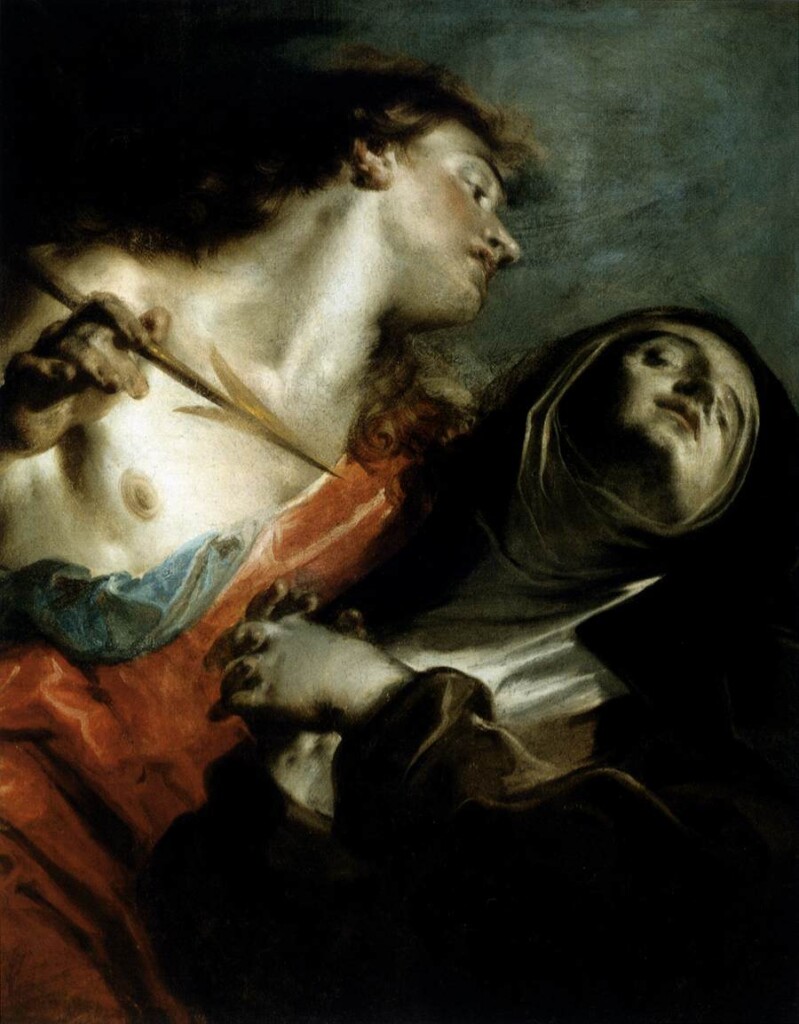
You are lighting a candle you bought at a discount store, placing it next to a small statue of the Buddha you found at a flea market, and somewhere at the edge of your awareness you understand that none of this belongs together — and you do it anyway, because something in the arrangement feels true.
The philosophical tradition that has most directly confronted this strange adequacy is hermeneutics, and Hans-Georg Gadamer’s concept of the fusion of horizons, developed in Truth and Method in 1960, offers the most uncomfortable explanation for why syncretic experience can be genuinely meaningful without being doctrinally grounded. For Gadamer, understanding never occurs as a retrieval of original intent — it occurs as an event in which the horizon of the interpreter and the horizon of the text collapse into something neither originally contained. The implication, which Gadamer himself did not fully press, is that religious meaning produced in moments of hybridized practice may be as epistemically legitimate as the most orthodox devotion, not because it recovers some ancient source, but precisely because it does not. The fusion is not contamination. It is, structurally, how meaning happens at all.
This is where the scholarly insistence on lineage becomes not just insufficient but philosophically naive. The assumption underlying most critiques of syncretism — that authentic religious experience must be traceable to a coherent doctrinal origin — imports into the study of belief a model of truth that even the traditions themselves could not consistently sustain. Christianity absorbed Neoplatonism so thoroughly in its first three centuries that Augustine’s Confessions, written around 397 CE, reads as a document in which the two are no longer distinguishable. Islam metabolized Aristotelian logic through figures like Al-Farabi and Ibn Rushd in ways that permanently restructured Islamic theology, producing something no early Meccan community would have recognized. The demand for purity is itself a historical artifact, and a recent one — largely a product of nineteenth-century nationalism and the Romantic obsession with organic cultural identity, not a feature of how living traditions have actually moved through time.
What makes this harder to dismiss is that neuroscience has begun to map what theologians have always known intuitively: the felt sense of the sacred does not sort itself by denomination. Andrew Newberg’s neuroimaging studies at Thomas Jefferson University, carried out across the early 2000s, showed that the neural signatures of deep religious experience — reduced activity in the parietal lobe, the dissolution of self-other boundaries, the overwhelming sense of presence — appear consistently across Franciscan nuns, Tibetan Buddhist monks, and Pentecostal practitioners speaking in tongues. The brain does not enforce doctrinal coherence. It responds to practice, to attention, to surrender, regardless of the symbolic framework that frames them.
And yet there is a destabilization hidden inside this finding that neither the neuroscientist nor the enthusiastic syncretist is usually willing to follow all the way through. If meaning in religious experience is genuinely independent of its symbolic source, then authenticity — the quality most fiercely claimed by both traditionalists and spiritual seekers — is not a precondition of experience but a story told afterward to make the experience legible. You do not light the candle because you believe in what the candle means. You light it, and then you construct what it meant. The narrative of coherence is retrofitted onto the moment of contact. This is not a criticism. It is a description of how human beings have always built meaning — retrospectively, confabulatorily, with a confidence that feels like memory but functions like invention.
What syncretism exposes, then, is not the corruption of religion but the mechanism that was always running underneath it: the human capacity to generate the experience of meaning in excess of any system designed to contain or explain it.
🌍 Where Faiths Merge and Meanings Transform
Religious syncretism is one of humanity’s most enduring impulses: the desire to weave together different spiritual traditions into a living whole. These articles explore the philosophical, cultural, and historical dimensions of that impulse, tracing how beliefs migrate, blend, and give birth to new meanings across centuries and continents.
Mexican Religious Syncretism: History and Meaning
Mexican religious syncretism offers one of the world’s most vivid examples of how indigenous cosmologies and Catholic Christianity fused into a distinctly new spiritual culture. From the Day of the Dead to the veneration of the Virgin of Guadalupe, this article traces the historical pressures and creative negotiations that shaped a faith both ancient and colonial. Understanding Mexico’s syncretic heritage illuminates the broader human capacity to transform spiritual conquest into cultural survival.
GO TO THE SELECTION: Mexican Religious Syncretism: History and Meaning
Eliade’s The Sacred and the Profane: Analysis
Mircea Eliade‘s foundational work on the sacred and the profane provides an essential theoretical lens for understanding how syncretism operates at a structural level. By identifying the universal patterns through which humans experience the sacred, Eliade reveals why different religious traditions so readily find common ground in myth, ritual, and symbol. His analysis remains indispensable for anyone seeking to understand the deep grammar shared across syncretic religious movements.
GO TO THE SELECTION: Eliade’s The Sacred and the Profane: Analysis
The Theosophical Society: History, Principles and Influence on Western Culture
The Theosophical Society represents one of the most deliberate and historically influential attempts to synthesize Eastern and Western spiritual traditions into a unified esoteric worldview. Founded in the nineteenth century, it drew from Hinduism, Buddhism, Neoplatonism, and Western occultism to construct a philosophy of universal brotherhood and hidden cosmic knowledge. Its legacy shaped the New Age movement and continues to echo in contemporary spiritual culture worldwide.
GO TO THE SELECTION: The Theosophical Society: History, Principles and Influence on Western Culture
Vedanta and the West: History and Influences
The encounter between Vedanta and Western thought is one of the most consequential chapters in the history of religious syncretism, reshaping both Eastern and Western spiritual identities. Through figures like Swami Vivekananda, Vedantic philosophy entered Western consciousness and found fertile ground among seekers disillusioned with institutional religion. This article explores how that cross-cultural dialogue transformed ideas about consciousness, self, and the nature of the divine on both sides of the exchange.
GO TO THE SELECTION: Vedanta and the West: History and Influences
Explore the Sacred and the Unknown on Indiecinema
If these explorations of faith, meaning, and spiritual transformation have stirred your curiosity, Indiecinema streaming is the place to continue the journey. Our curated catalog features independent and world cinema that dares to ask the deepest questions about belief, identity, and the sacred. Discover films that no algorithm would recommend — only a genuine passion for meaningful cinema could uncover.
👉 EXPLORE THE CATALOG: Watch Indie Films in Streaming
A vision curated by a filmmaker, not an algorithm
In this video I explain our vision

