
The Workshop as Threshold: Baldung Grien's Visual Language of Transgression
You are standing in front of a woodcut made in 1510, and something is wrong with it in a way you cannot immediately name. The women in it are naked, yes, but nakedness is not what unsettles you. It is the direction everything moves — smoke rising where fire should fall, flesh arranged with the precision of theological argument, a cat suspended at the margin of the composition as if waiting for permission to enter the world. Hans Baldung Grien did not stumble into this image. He constructed it the way a lawyer constructs a case: with deliberate choices at every level, each one deniable, each one exact.

He had learned precision from the best available source. Between approximately 1503 and 1507, Baldung worked in Albrecht Dürer‘s Nuremberg workshop, absorbing the master’s command of line, proportion, and the controlled rhetoric of the printed image. Dürer had spent years systematizing beauty, measuring the human body against classical ideals, producing the Four Books on Human Proportion as a kind of secular scripture for the visible world. What Baldung took from that education was not the ideology but the instrument: the knowledge that a woodcut or engraving was not a record of the visible but a set of arguments about what the visible meant. He then carried that instrument to Strasbourg, where he settled by 1509, and applied it to material that Dürer, for all his fascination with the demonic, never fully entered.
Strasbourg in the early sixteenth century was not a provincial backwater absorbing ideas from elsewhere. It was a city dense with legal, theological, and humanist activity, a place where Sebastian Brant had published the Narrenschiff in 1494 with its grotesque catalog of human folly, where the printer Johannes Grüninger ran one of the most commercially aggressive and intellectually ambitious publishing operations in the German-speaking world. The Malleus Maleficarum, first printed in 1487, had by Baldung’s arrival already passed through multiple editions and installed in educated European consciousness a highly specific grammar of witch behavior: the nocturnal assembly, the animal familiar, the inversion of sacramental logic. Baldung did not illustrate that grammar. He interrogated it, which is a different and more dangerous activity.
The printmaking choices themselves are the first level of interrogation. Baldung’s witch images circulated as single-sheet woodcuts, meaning they existed outside the protective frame of a narrative or devotional context. A reader encountering an image of the Annunciation in a Book of Hours understood the container that gave the image its meaning. A woodcut of naked women boiling unspecified substances in an overturned vessel, purchased at a print stall and taken home, had no such container. It arrived in the domestic space raw, asking to be interpreted by whoever held it, which meant it could be read as moral warning, as erotic spectacle, as learned joke, as genuine menace, simultaneously and without resolution. This ambiguity was not a failure of intention. It was the intention.
The visual language Baldung developed for these images borrows from three traditions that do not normally speak to each other: the classical representation of the female nude inherited from Italian sources Dürer had transmitted to him, the grotesque body vocabulary of German carnival culture with its emphasis on distortion and inversion, and the precise symbolism of devotional iconography turned systematically inside out. A pitchfork appears where a staff of authority would stand. Hair flies loose in configurations that mirror the flames of the Holy Spirit in Pentecost imagery. The body that should be modest is instead the source and center of power in the composition, generating rather than receiving force.
The Witches of Mount Sciliar
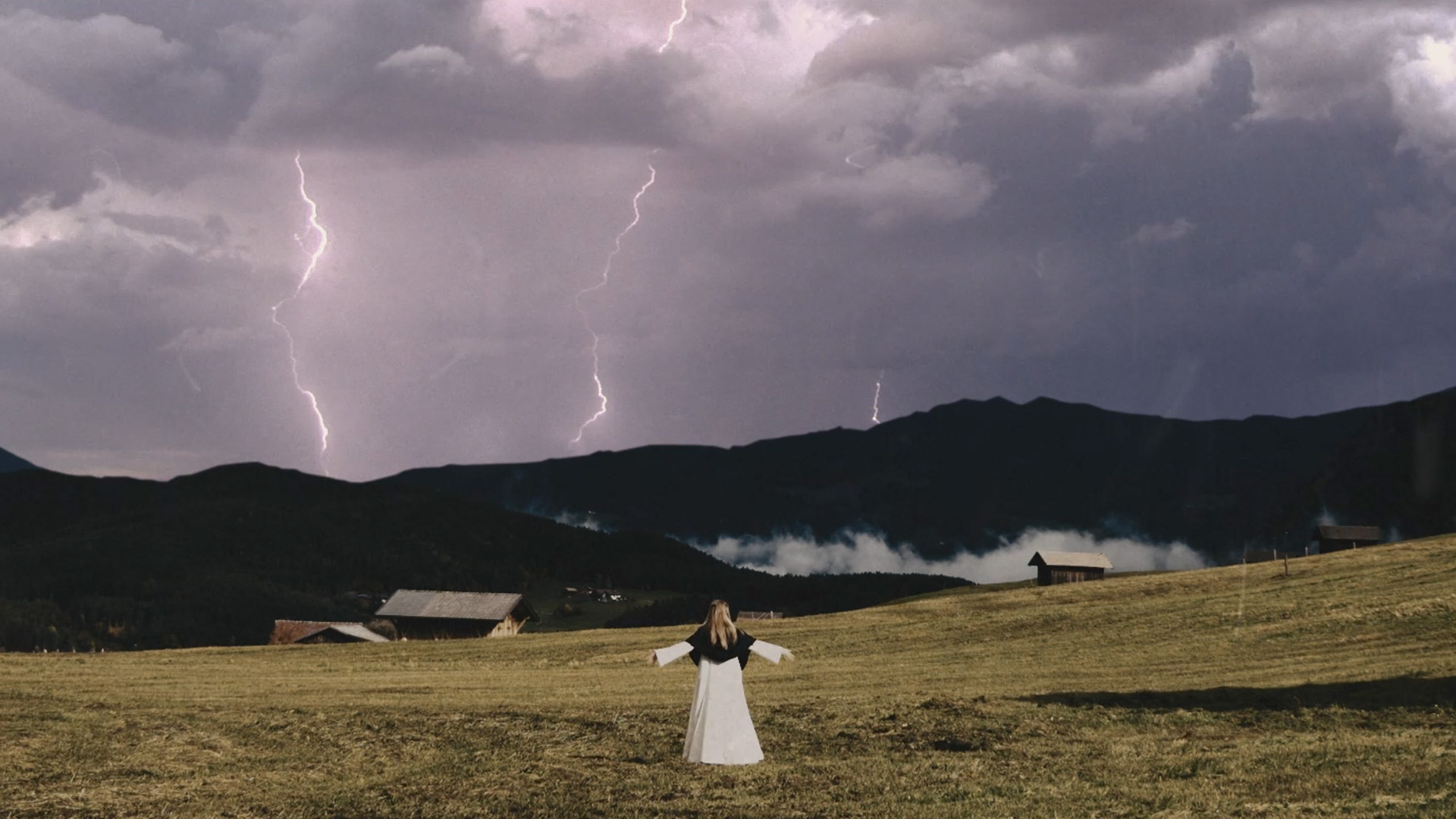
Docufiction, by Andrea Dalfino, 2022, Italy.
The Witches of Scillar is a documentary that delves deeply into the trials that took place in Alto Adige, in Castel Presule and surrounding areas at the beginning of the 16th century, following which more than 10 were condemned to the stake on charges of witchcraft, becoming the real and precursors of the infamous Witch Hunt. Starting from the analysis of the historical context and intertwining local legends with actual events and analyzing the locations of the events with the help and guidance of experts, this film offers a new historical perspective on what happened, culminating with the exposition of what remains of the witches in South Tyrol today and how the crimes of the inquisition are judged in retrospect today.
Alto Adige is a land full of mystery, where history and legend are intertwined, with its magical and fascinating scenarios that push the mind and imagination to wander, investigate, discover. Here is the Sciliar, a suggestive mountain massif located in the natural park of the same name against the backdrop of the Dolomites, and no other mountain is so full of myths and legends as this one, on which it is said that fairy creatures and spirits of all sorts live , and in the Middle Ages it was held up as a meeting place for witches and devils. Here, during the time of the Inquisition, 10 women accused of witchcraft were tried and killed. Director Andrea Dalfino made the documentary The Witches of the Sciliar, enriching the film with fictional scenes that retrace the intricate events of the Fiè trial.
LANGUAGE: Italian
SUBTITLES: English, Spanish, French, German, Portuguese
Sabbath Topography: What the Ritual Space Reveals About Juridical Fear
You are standing at the edge of a forest that has no name, in a darkness that Baldung did not paint so much as architect. The trees do not recede into background — they press forward, closing the frame, collapsing the horizon into something airless and without exit. This is not nature as setting. This is geometry organized to produce dread, and the organizing principle is inversion: every spatial logic that a German parish church would have encoded into its nave, its altar orientation, its luminous east-facing apse, has been reversed and made to function as its own negative.
The witches’ sabbath in Baldung’s woodcuts and drawings from the first decade of the sixteenth century arranges its figures around a central void — usually a cauldron, elevated slightly, steaming, drawing the eye the way a monstrance draws the eye during elevation of the host. Liturgical space in late medieval Central Europe was structured around the doctrine of real presence, which meant that spatial composition itself became theological argument: the altar occupied the privileged axis, the priest’s body became an intermediary, and the congregation oriented themselves geometrically toward a fixed sacred point. Baldung takes that entire grammar and displaces it outward, into the open air, under no vault, under no consecrated roof, where the steam rising from the vessel performs the same vertical movement as incense, but rises toward nothing sanctioned, toward a sky that grants no confirmation.
The Malleus Maleficarum, published in 1487 by Heinrich Kramer and Jacob Sprenger under the explicit endorsement of Pope Innocent VIII’s bull Summis desiderantes affectibus, was not primarily a theological document — it was a procedural one. Its sustained argument concerned jurisdiction: who had the legal standing to try, convict, and execute a witch, and how evidence obtained under torture could be rendered epistemologically valid. Between 1487 and 1520, witch-trial procedure was institutionalized across the Holy Roman Empire through a series of imperial and ecclesiastical mandates that transformed what had been sporadic local violence into a bureaucratic apparatus with standardized testimony categories, standard lists of confessed acts, and standard spatial coordinates for those acts — the sabbath, the crossroads, the blasted field. The horror that Baldung was painting was, in this precise sense, already a legal document before it was a visual one.
What the Malleus needed, and what it constructed through thousands of extracted confessions, was a stable counter-geography — a mirror world where every sacred institution had its profane double. This is why sabbath accounts from trial records across Alsace, the Rhineland, and the Swiss Confederation describe the gathering space in terms that are almost architectural: a flat clearing, a central fire, a presiding figure at a defined position, a choreography of approach and departure. The confessions, coerced through sleep deprivation and strappado, were not random — they converged on a spatial template because the interrogators who extracted them were working from a template, shaping testimony toward a picture that the Malleus had already drawn in prose. Baldung was illustrating a juridical hallucination that had already, by his time, killed people.
The nocturnal setting is the element that collapses this most completely. Night in Baldung’s compositions is not atmospheric — it is juridical. The choice of darkness was encoded in trial procedure as evidence of guilt: gatherings that occurred at night, beyond the reach of parish bells and communal witness, were by definition gatherings organized to evade Christian time itself. When Baldung places his figures under a sky that shows no moon, he is rendering visible what the Malleus described as the witch’s fundamental crime — the refusal of temporal order, of the canonical hours, of the diurnal rhythm that structured Christian society from matins to compline.

The Female Body as Contested Epistemology
You have seen her before — not in a painting, but in a room you were not supposed to enter, where an older woman moved with a certainty that required no permission and consulted no authority outside her own hands and memory.
What Baldung put on panel and paper between roughly 1510 and 1523 was not a fantasy of evil. It was a juridical argument rendered in pigment. The nakedness of his witches is not erotic decoration, and any reading that stops at titillation has already lost the thread. These women are unclothed in precisely the way a body is unclothed when it is being examined, categorized, and condemned — stripped of the garments that signal social belonging, returned to raw flesh so that the flesh itself can be indicted. The aged body among them is not incidental. It is the thesis. A woman past childbearing, past the utility that patriarchal agrarian society assigned to female existence, and still moving through the world with appetite and competence, was already a conceptual problem before Baldung ever touched a brush.
Silvia Federici, writing in Caliban and the Witch in 2004, traced the witch trials not as an eruption of medieval superstition but as a calculated assault on a specific stratum of female social power — the midwives, healers, and herbalists who controlled reproductive knowledge in communities across Europe before and during the enclosures that privatized common land and reorganized labor along capitalist lines. The sabbath image arrives precisely at this hinge. Between 1450 and 1550, the period that brackets Baldung’s active career, Europe executed an estimated forty to sixty thousand people as witches, the overwhelming majority of them women, and the charges clustered with suspicious consistency around practices of bodily autonomy: contraception, abortion, the management of birth and death outside ecclesiastical and eventually medical supervision. What was being criminalized was not a religion. It was a competing epistemology — a way of knowing the body that did not require the authorization of a university, a church, or a guild.
Baldung’s figures carry this knowledge visibly. Their gestures toward cauldrons and unguents are not stage props for diabolism; they are the gestures of pharmacological expertise, of women who knew what plants did to human tissue and were not asking anyone’s permission to act on that knowledge. The church and the emerging secular courts could not simply prohibit competence. They had to corrupt it ontologically — to reframe it as power received from below rather than knowledge accumulated from within. The sabbath becomes the mechanism of this reframing. It insists that what these women know, they did not learn. It was given to them in exchange for something stolen from the legitimate order: their souls, their sexual continence, their reproductive function redirected toward the devil’s service rather than the husband’s household.
The sexual autonomy visible in Baldung’s images — women touching each other, bodies arranged without male oversight, desire apparently self-organizing — is not a concession to voyeurism. It is the accusation made pictorial. A woman whose sexuality answers to her own appetite rather than to a contract of marriage and inheritance is, within the logic of early modern property law, a saboteur. She breaks the chain by which legitimate heirs are produced and land is transferred. The theological language of the sabbath translates a legal and economic anxiety into a supernatural one, making it available to a population that could not have followed the argument in its raw form but could feel the image of autonomous female flesh as transgression.
What the image ultimately stages is the moment before a form of knowledge becomes illegal — the knowledge itself still visible, still performing, but already framed by the border of the panel as something that must not survive the century.
Circulation, Patronage, and the Complicity of the Viewer

You are looking at a woodcut that cost roughly the same as a day’s bread, and you are a man with a library.
That is the transaction that matters. Baldung’s witch prints did not circulate in churches or courtrooms as doctrinal instruments. They moved through the hands of Strasbourg’s educated merchant class, its humanist networks, its legal professionals — men who owned Erasmus and corresponded with Wimpfeling and could, when pressed, quote Pliny on natural anomalies. Sebastian Brant, whose 1494 Narrenschiff had already demonstrated that moral satire and popular appetite could be made to reinforce each other commercially, was part of the cultural atmosphere in which Baldung’s prints found their earliest audiences. These were not credulous peasants. They were precisely the men who administered the courts that sent women to the stake, and they purchased images of those women naked and triumphant with what the records suggest was enthusiasm.
The print market of early sixteenth-century upper Rhineland operated on a logic that has since been politely forgotten: that the distance between demonological evidence and erotic commodity was not a contradiction to be resolved but a feature to be enjoyed. Heinrich Kramer’s Malleus Maleficarum, published in 1486 and reprinted at least fourteen times before 1520, had already established the witch as a figure whose danger was inseparable from her sexuality — the text spends extraordinary energy on the witch’s capacity to steal men’s sexual organs, to corrupt masculine reason through carnal means, to invert the hierarchy of will and flesh. What Baldung did was render that textual anxiety into visual pleasure without resolving the tension. The viewer could consume the image as evidence of genuine threat and simultaneously as stimulation, and the coexistence of those responses was precisely what made the image valuable. It required a sophisticated consumer to hold both registers at once without collapsing into either pure belief or pure pornography.
Albrecht Dürer, in whose Nuremberg workshop Baldung trained around 1503 to 1507, had already demonstrated that printmaking could function as a vehicle for humanist self-positioning — that a craftsman could become an intellectual figure through the calculated deployment of allegorical complexity. Baldung absorbed this lesson and pushed it somewhere Dürer did not follow. Where Dürer’s images of demonic or mythological excess retained a quality of moral legibility, Baldung’s witch scenes refuse resolution. The 1510 chiaroscuro woodcut of witches preparing for flight offers no stabilizing perspective from which the viewer can safely condemn what he sees. The compositional energy pulls toward the figures, not away from them. The gaze the image solicits is participatory.
This is where class mechanics become visible. The men who commissioned or purchased these prints were the same men who, in their professional capacity, were constructing the legal architecture of witch persecution — writing opinions, serving on councils, ratifying sentences. The print allowed them to aestheticize the object of their institutional violence, to eroticize what they also authorized destroying. That double movement is not incidental. It is structurally identical to the way ruling classes in many periods have managed the gap between their stated moral framework and their actual appetites: by creating cultural objects that hold the contradiction in suspension, objects sophisticated enough to be enjoyed without confession.
What no one in that transaction was required to say aloud was that the woman in the image was usually poor, usually old, usually without the social connections that might have protected her, and that her real danger to the men who bought these prints was precisely her powerlessness rather than her power — that the fantasy of the witch’s sovereignty over nature was the inverted image of her actual condition, and that the image was pleasurable in direct proportion to how completely it performed that inversion.
Iconographic Inheritance and the Persistence of the Template
You are standing in the Prado, and the wall in front of you is enormous, and the goat is enormous, and the women gathered around it in the dark are not screaming — they are attentive, leaning in, as if listening to a sermon. Goya painted his black paintings directly onto the plaster of his own dining room walls between 1819 and 1823, which means he ate his meals facing this scene for years. The sabbath was not, for him, a theological proposition. It was furniture.
The line running backward from that dining room wall to Baldung’s Freiburg workshop is not a line of belief. The scholars who tried to trace iconographic transmission through shared doctrinal conviction — through the assumption that artists repeated these images because they subscribed to the demonological systems behind them — consistently arrived at contradictions they could not resolve. Goya was a rationalist, a supporter of Enlightenment reform, a man who produced the Caprichos in part as satire of superstition. And yet his sabbath women are more disturbing than almost anything produced in the century of the witch trials, precisely because the template had by then been stripped of its theological scaffolding and left to stand on its own visual grammar. What remained when the doctrine was gone was the structure itself: the circle, the animal presiding, the women’s bodies arranged in postures of submission and ecstasy, the darkness that is not absence of light but a positive substance.
The earlier Lombard tradition, particularly the woodcut illustrations circulating through the printed editions of Bernardino of Siena’s sermons in the 1470s and the visual marginalia accompanying manuscript copies of Johannes Nider’s Formicarius — completed around 1437 and one of the first texts to describe the sabbath in systematic detail — had already established an iconographic grammar before Baldung was born. These were not illustrations of witnessed events. They were diagrams of a social anxiety, drawn in the visual language of carnival and inversion, borrowing from the imagery of pagan festival precisely because the accusation required recognizable wrongness, something the viewer could identify as the mirror-image of legitimate order. The Flemish tradition absorbed this and pushed it toward the grotesque, toward the body as site of transgression, toward the specifically female form as the terrain on which theological and sexual terror were simultaneously mapped.
What Baldung did, with a technical mastery that the earlier illustrators lacked, was saturate this inherited grammar with aesthetic intensity so concentrated that the images became self-sufficient. They no longer required the demonological text to authorize them. This is the mechanism by which iconographic templates survive their originating contexts: they accumulate affective charge until they can sustain themselves on that charge alone, independent of the belief system that generated them. The image teaches the next artist not what to think but what to feel when constructing this kind of scene — what distribution of bodies produces unease, what posture signals submission, what quality of light makes flesh look simultaneously vulnerable and dangerous.
By the time the template reached the nineteenth century it had passed through Dürer’s marginal demons, through Dutch genre painting’s domesticated witchcraft scenes, through the theatrical set designs for operatic productions of Faust, accumulating layers of ironic distance that paradoxically intensified rather than diminished its force. The sabbath survived as an image because it had been engineered, by successive hands across three centuries, into a machine for producing a particular complex of feelings — feelings about female autonomy, about bodies gathered outside sanctioned spaces, about what communities imagine happening in the dark just beyond their perimeter — and that machine continued to run long after anyone had forgotten who built it or why.
A vision curated by a filmmaker, not an algorithm
In this video I explain our vision
🔮 Magic, Witchcraft, and the Occult Imagination
Hans Baldung Grien’s haunting depictions of witches’ sabbaths place him at the crossroads of Renaissance art, esoteric symbolism, and the cultural anxieties of early modern Europe. To fully understand his iconography, one must explore the broader traditions of occultism, hermeticism, and the visual language of the forbidden that surrounded him.
Eliphas Lévi and Modern Occultism
Eliphas Lévi stands as one of the most influential figures in the codification of modern Western occultism, synthesizing Kabbalah, ceremonial magic, and symbolic imagery into a coherent esoteric system. His work deeply shaped how later generations visualized magical ritual and diabolical iconography. Understanding Lévi illuminates the symbolic grammar that artists like Baldung Grien drew upon when staging scenes of nocturnal transgression and supernatural power.
GO TO THE SELECTION: Eliphas Lévi and Modern Occultism
Giordano Bruno and the Hermetic Tradition
Giordano Bruno’s engagement with the Hermetic tradition offers a crucial intellectual context for understanding the Renaissance fascination with magic, nature, and forbidden knowledge. Bruno saw the cosmos as animated by occult forces that the initiated could learn to manipulate, a worldview that haunted the cultural imagination of Baldung Grien’s era. His tragic fate at the hands of the Inquisition underscores how dangerously charged the territory of esoteric imagery truly was.
GO TO THE SELECTION: Giordano Bruno and the Hermetic Tradition
Paracelsus: Life and Alchemical Thought
Paracelsus, the visionary physician and alchemist, inhabited the same sixteenth-century German-speaking world as Hans Baldung Grien, and his theories about elemental spirits, sulfurous forces, and the hidden powers of nature directly informed popular conceptions of witchcraft. His radical blending of natural philosophy and occult speculation helped shape the cultural milieu in which sabbath iconography flourished. Exploring Paracelsus reveals how medicine, magic, and demonology were inseparably entangled in the Renaissance mind.
GO TO THE SELECTION: Paracelsus: Life and Alchemical Thought
Erwin Panofsky: Life and Iconology
Erwin Panofsky’s foundational work on iconology provides the essential methodological tools for decoding the layered symbolic content of Baldung Grien’s witch imagery. Panofsky taught art historians to read beyond surface appearance and into the deeper strata of cultural, theological, and esoteric meaning embedded in Renaissance visual programs. Applying his iconological approach to the witches’ sabbath reveals a dense web of inversion, transgression, and hidden theological commentary.
GO TO THE SELECTION: Erwin Panofsky: Life and Iconology
Discover the Cinema of Mystery and the Hidden Arts
If these dark currents of occult history and esoteric symbolism stir something in you, Indiecinema offers a carefully curated selection of independent and visionary films that explore magic, transgression, and the hidden dimensions of human experience. Step beyond the mainstream and let independent cinema take you deeper into the shadows.
👉 EXPLORE THE CATALOG: Watch Indie Films in Streaming
A vision curated by a filmmaker, not an algorithm
In this video I explain our vision

