
The Melancholic Gaze as Occult Instrument
You are standing in front of a copper engraving that is roughly the size of a hardcover book, and something is wrong with you before you understand why. The winged figure at its center is not looking at you. She is not looking at anything in particular — her gaze aims slightly downward and to the left, past the edge of the composition, into a space the image refuses to show you. Around her, objects accumulate with the particular density of a dream that means something: a polyhedron whose geometry refuses to resolve into familiar shape, a magic square in which every row and column sums to thirty-four, a sphere, a compass, a sleeping dog, a bat carrying a banner with a single word. You scan for narrative logic and find none. The image does not tell a story. It presents a condition.

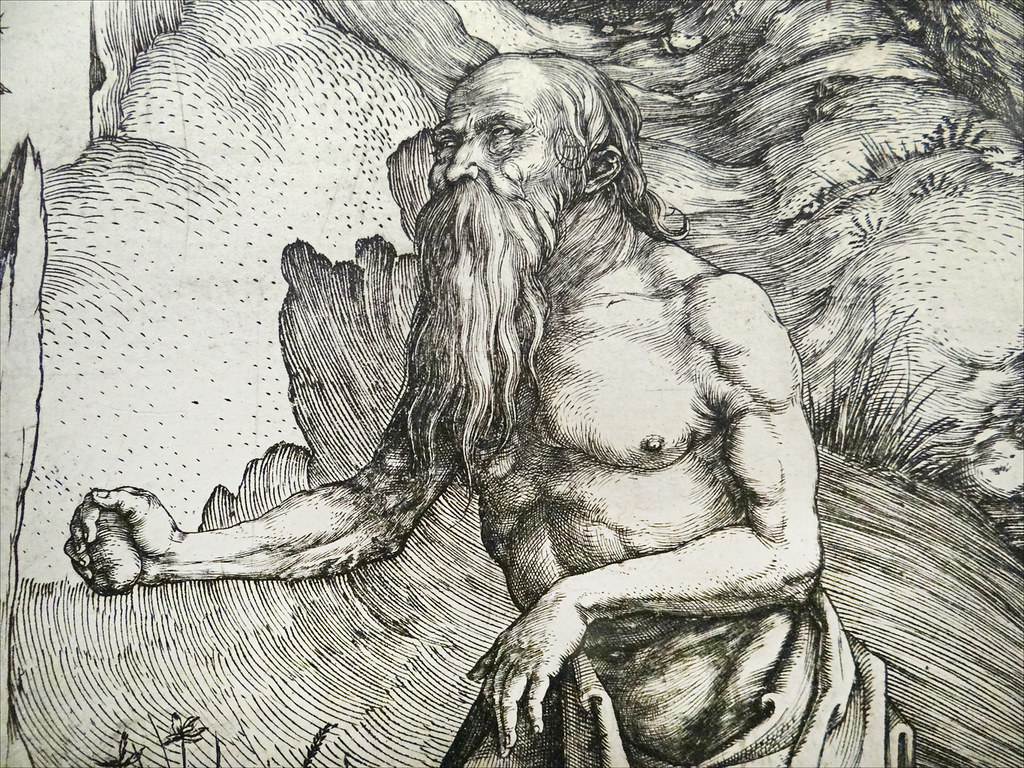
Albrecht Dürer completed Melencolia I in 1514, the same year he produced two other master engravings — Saint Jerome in His Study and Knight, Death and the Devil — in what scholars have called the Meisterstiche, a deliberate triptych of intellectual and moral states. But Melencolia I operates in an entirely different register from its companions. Saint Jerome is serene; the Knight is resolute; the winged figure is neither. She holds a compass and does nothing with it. Every instrument of measurement and construction surrounds her, and she measures nothing. She sits among the tools of ratio and proportion with her fist pressed against her cheek in the gesture the ancient world called melancholia, and she cannot move. What Dürer encoded in that paralysis is not a lament about artistic frustration, as a sentimental reading might suggest. It is a precise map of a specific epistemological crisis, and the map was drawn using a symbolic language that institutional Christianity in 1514 could not publicly endorse.
The framework Dürer was working within came largely from Marsilio Ficino, the Florentine philosopher who in 1489 published De vita libri tres — Three Books on Life — a text that walked the edge of heresy so carefully it survived censure by making medical argument its alibi. Ficino’s central claim was that Saturn, the planet governing melancholy, was also the planet governing philosophical and creative genius. To be born under Saturn was to exist in a permanent state of tension between the lowest and highest registers of human experience — torpor and transcendence, dullness and illumination — with no stable floor between them. The melancholic temperament, in Ficino’s system, was the temperament most capable of apprehending hidden structures in the world, precisely because it could not be satisfied by surface appearances. This was not consolation for depression. It was a theory of perception organized around the idea that ordinary cognition is a kind of blindness, and that the disturbance we call melancholy is what happens when a mind begins to see past it.
What made this dangerous was not the Saturnine astrology itself, which educated Europeans had tolerated as learned discourse for centuries. The danger lay in what the theory implied about knowledge: that there existed modes of understanding inaccessible to scholastic method, to ecclesiastical authority, and to the rational procedures that theology used to confirm its own conclusions. Ficino’s melancholic genius did not arrive at truth through Aquinas’s logical architecture. He arrived there through a kind of receptive suffering — through the body’s own permeability to planetary influence, through the symbolic language encoded in matter itself. This was occult epistemology in its precise technical sense: a claim that reality conceals a layer of meaning that can only be accessed through methods the official institutions of knowledge cannot authorize without undoing themselves.
Dürer understood this not as a metaphor but as a working condition. The polyhedron in Melencolia I is not decorative geometry.
The Witches of Mount Sciliar

Docufiction, by Andrea Dalfino, 2022, Italy.
The Witches of Scillar is a documentary that delves deeply into the trials that took place in Alto Adige, in Castel Presule and surrounding areas at the beginning of the 16th century, following which more than 10 were condemned to the stake on charges of witchcraft, becoming the real and precursors of the infamous Witch Hunt. Starting from the analysis of the historical context and intertwining local legends with actual events and analyzing the locations of the events with the help and guidance of experts, this film offers a new historical perspective on what happened, culminating with the exposition of what remains of the witches in South Tyrol today and how the crimes of the inquisition are judged in retrospect today.
Alto Adige is a land full of mystery, where history and legend are intertwined, with its magical and fascinating scenarios that push the mind and imagination to wander, investigate, discover. Here is the Sciliar, a suggestive mountain massif located in the natural park of the same name against the backdrop of the Dolomites, and no other mountain is so full of myths and legends as this one, on which it is said that fairy creatures and spirits of all sorts live , and in the Middle Ages it was held up as a meeting place for witches and devils. Here, during the time of the Inquisition, 10 women accused of witchcraft were tried and killed. Director Andrea Dalfino made the documentary The Witches of the Sciliar, enriching the film with fictional scenes that retrace the intricate events of the Fiè trial.
LANGUAGE: Italian
SUBTITLES: English, Spanish, French, German, Portuguese
Heinrich Cornelius Agrippa and the Architecture of Hidden Knowledge
You are sitting with a book that has been banned, copied in secret, and passed between hands that understood the danger of possessing it. The manuscript circulating through Nuremberg’s intellectual circles in the 1510s was Heinrich Cornelius Agrippa’s De Occulta Philosophia, a work that would not reach full publication until 1531 but whose ideas moved through the German humanist network long before any printer touched them. Agrippa had dedicated portions of his thinking to Johannes Trithemius, the abbot of Sponheim and one of the most influential esoteric minds of the age, and Dürer moved in the same web of correspondences, the same culture of learned men who treated the invisible world as a legitimate field of inquiry.
Agrippa’s architecture was precise and hierarchical. He divided occult reality into three ascending registers: the elemental world governed by natural magic, the celestial world governed by mathematical and astrological forces, and the intellectual world accessed through ceremonial and divine operations. This was not mysticism in the popular sense — it was a taxonomy, a grammar of causality that attempted to explain how the lower planes of existence were continuously shaped by the higher ones. What mattered to a painter or an engraver reading this framework was not whether spirits were literally present in copper or stone, but that every visible thing was understood as the residue of an invisible force pressing downward through the tiers. The material world, in this reading, was always already encoded.
Dürer’s working notebooks and theoretical writings reveal a mind obsessed with proportion, geometry, and the hidden ratios that govern beauty. His Vier Bücher von menschlicher Proportion, published in 1528 but developed across decades of study, is usually read as a manual of artistic craft. What this reading misses is the cosmological ambition underneath the measurement. Dürer was not simply trying to draw bodies correctly. He was attempting to locate the divine mathematical signature embedded in the human form, the celestial imprint that Agrippa’s second tier of reality insisted was there, distributed through planetary influence into flesh and bone. The book is an act of decoding, not description.
This distinction matters enormously, because it repositions what an image is supposed to do. If every proportion corresponds to a planetary ratio, and every planetary ratio carries specific psychic and spiritual weight, then a correctly proportioned figure is not merely beautiful — it is operative. It acts on the viewer through channels the viewer cannot consciously perceive. Agrippa argued in the second book of De Occulta Philosophia that music, number, and geometric form could bind celestial forces and redirect them. Dürer did not need to perform rituals to participate in this logic. He only needed to construct forms with sufficient mathematical precision that the celestial grammar was preserved intact inside the image.
The woodcut and engraving as media are significant here in ways that tend to be overlooked. Unlike fresco or oil painting, printmaking reproduces identically. Every impression pulled from Dürer’s copper plate carries the exact same configuration of lines, the same angles, the same spatial ratios. If the original engraving encoded something — a proportion, a symbolic constellation, a numerological structure — every copy propagated that encoding without degradation. For a mind shaped by Agrippa’s framework, this was not a technical footnote. It was a mechanism for distributing occult form at scale, sending the same structural imprint into hundreds of hands across Europe simultaneously.
What emerges from this proximity is not the portrait of an artist who believed in magic in any naive sense, but one who understood symbolic structure as a technology. Agrippa’s three-tiered cosmology gave Dürer a vertical axis — earth, stars, intellect — along which meaning could travel upward and downward through the right formal containers. The image becomes a kind of valve in that system, a controlled aperture between what the eye receives and what the unseen architecture of reality is doing at every moment to the world the eye thinks it already knows.

Saturn, Temperament, and the Demonization of Genius
You have felt it without naming it — that particular weight that arrives not with catastrophe but with clarity, the sensation of seeing too much and being unable to unsee it, of standing slightly outside the room where everyone else seems comfortable. Renaissance physicians would have diagnosed you on the spot. The excess of black bile in your system, the dominion of the coldest and most distant planet over your nativity, the mark of Saturn pressed into your constitution like a brand — you would have been simultaneously pitied and feared, because the culture that produced that diagnosis also understood, with uncomfortable precision, that the people it described were not simply sick.
Marsilio Ficino spent decades building the theoretical architecture that made this paradox livable. His De Vita, published in 1489 as a kind of medical manual for intellectuals, argued something that should have been obvious but was still radical: that Saturn, the planet of constriction and dread, of lead and cold and slowness, was also the planet of contemplation, of the deepest philosophical penetration, of the creative mind that could not stop working even when it wanted to. Ficino himself was Saturnine by his own reckoning, and the text reads at moments less like theory and more like a man explaining himself to a world that found him unsettling. The Florentine humanist circle that surrounded the Medici had discovered in ancient Neoplatonism a way to reframe what the Church had for centuries treated as spiritual danger — the excessive inward turn, the brooding isolation, the obsessive return to impossible questions — and call it instead a form of divine proximity. To be ruled by Saturn was to be close to the outermost sphere, the boundary between the cosmos and whatever lay beyond it.
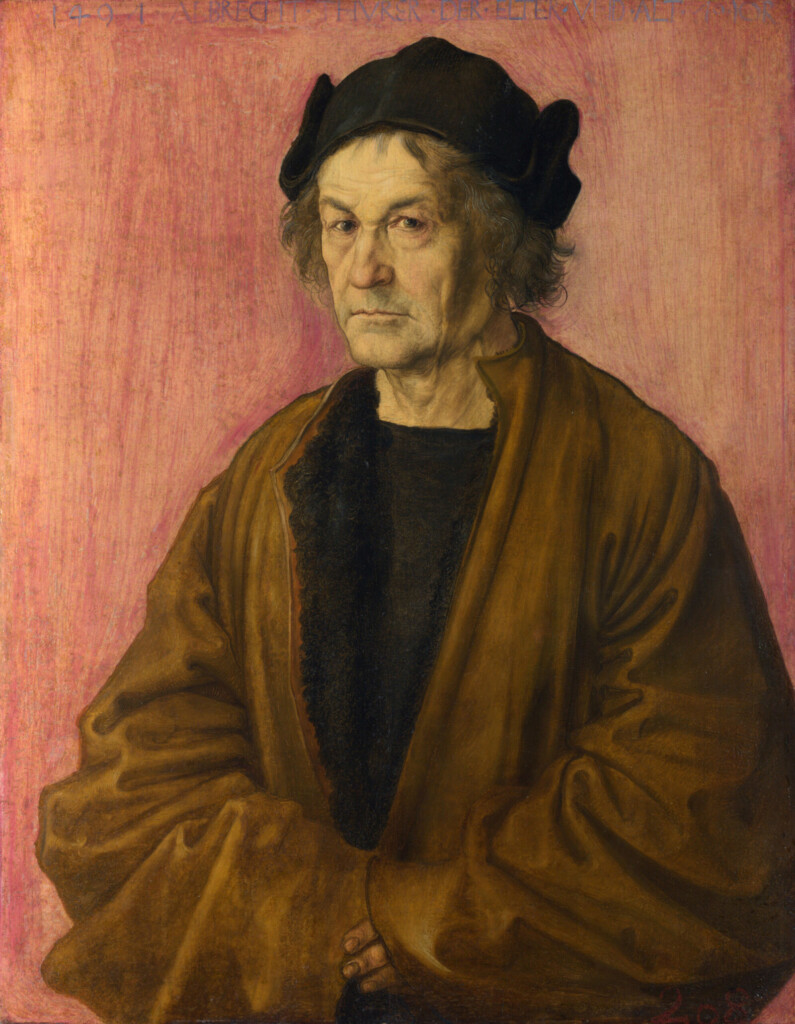
Dürer absorbed this not as intellectual fashion but as personal recognition. He was born in 1471 in Nuremberg, trained as a goldsmith before his father redirected him toward painting, and by his thirties had become the most technically accomplished Northern European artist of his generation — a man who could render human anatomy with scientific precision, who had traveled to Italy twice specifically to understand what Italian masters knew that German ones did not, and who kept notebooks that reveal a mind in permanent agitation, questioning the foundations of everything he practiced. His self-portraits from the 1490s through 1500 show a man who is not simply confident but consumed — the gaze direct to the point of confrontation, the composition borrowed from devotional imagery of Christ, the whole presentation an implicit claim that the artist’s act of seeing is itself a sacred function. This was not vanity in any conventional sense. It was a statement about what kind of being an artist was, and what kind of danger that being posed to ordinary social arrangements.
The danger was genuine because the Saturnine temperament, as Ficino framed it and as Dürer embodied it, was incompatible with deference. The melancholic mind did not accept inherited conclusions. It returned to first principles compulsively, it doubted institutions, it found conventional pieties hollow in the face of what it actually perceived. The Church had a word for this disposition when it turned toward theological questions: heresy. The guilds had a different anxiety about it when it turned toward artistic practice: an artist who believed his vision was divinely sanctioned could not easily be managed, could not be kept within the decorative and devotional functions that made art socially useful rather than socially threatening. Dürer’s insistence on the intellectual dignity of painting, his campaign across multiple written texts to establish that the visual artist was a thinker and not a craftsman, was inseparable from this Saturnine self-understanding — because only a being marked by that particular excess could justify the claim that making images was a form of knowledge rather than a form of labor.
The Magic Square and Numerical Theology
You are staring at a grid of sixteen numbers carved into stone, and you do not yet know that what you are looking at is a machine.
The square embedded in the lower right of Melencolia I arranges the integers 1 through 16 into four rows and four columns such that every row, every column, and both main diagonals produce the identical sum of 34. Dürer placed the numerals 15 and 14 side by side in the bottom row’s central cells — a quiet, almost smug inscription of the year 1514, the year he carved the plate, the year his mother died. But this biographical timestamp is a surface effect. The deeper architecture of the square answers to a logic that Dürer did not invent and did not pretend to invent. He was citing, with the precision of a legal document, the Jupiter square published by Heinrich Cornelius Agrippa von Nettesheim in De Occulta Philosophia, a text Agrippa had circulated in manuscript by 1510, four years before the engraving appeared. Agrippa’s system assigned to each of the seven classical planets a numerical square of corresponding order: Saturn governed a three-by-three grid, Jupiter a four-by-four, Mars a five-by-five, and so on outward to the Moon’s nine-by-nine. The Jupiter square summed to 34 in every direction. Its total sum across all cells was 136. These were not decorative coincidences. They were the planet’s signature, its resonant frequency in the language of number.
What made this anything other than arithmetic is the doctrine of sympathetic correspondence that saturated Renaissance natural philosophy. Marsilio Ficino, writing in De Vita Coelitus Comparanda in 1489, had already theorized that the scholar’s body was constitutively Saturnine — cold, dry, prone to the black bile that produced both genius and paralysis — and that this condition could be corrected not through medicine alone but through the deliberate attraction of Jovian influence, which was warm, expansive, socially generous, and favorable to worldly success. Ficino’s remedies were strikingly literal: wear yellow, eat foods associated with Jupiter, listen to music in the Dorian mode, and, crucially, inscribe the Jupiter talisman. The magic square was a talisman in the full technical sense of the word — an object constructed at an astrologically propitious moment to concentrate and hold a planetary force the way a lens holds light.
This means Dürer’s grid is not an ornament placed inside a melancholy scene. It is the proposed solution to that scene’s problem, embedded inside the image the way a prescription is embedded inside a diagnosis. The winged figure surrounded by abandoned instruments and unscaled heights does not need to be told she is stuck; she knows. What Dürer offers, or what the image offers through him, is a counter-inscription — a Jovian sigil placed within a Saturnine field, the numerical antidote pressed into the same copper plate as the disease it is meant to treat.
The philosophical tradition making this gesture coherent ran deeper than Agrippa or Ficino. The Pythagorean conviction that number was not merely descriptive but constitutive — that the cosmos was literally organized by numerical ratios rather than merely expressible in them — had passed through Neoplatonism into Islamic mathematics and re-entered European thought through the translation movements of the twelfth century. By the time Dürer picked up his burin, the distinction between calculating a square’s properties and invoking a planetary power through that calculation was not a distinction most serious thinkers were making. Luca Pacioli, whose Divina Proportione Dürer almost certainly read after meeting him in Italy around 1494, treated geometric form as simultaneously mathematical truth and theological participation. Number was where the human mind touched the structure of creation, and to manipulate number deliberately was to intervene in that structure.
Dürer had spent years absorbing Italian perspective theory and its implicit claim that the visible world could be entirely captured by geometry, and something in that claim must have disturbed him — because a world fully legible in geometry was also, in principle, a world fully available to manipulation.
Dürer’s Italian Journey and the Transmission of Hermetic Thought
You board a ship at Nuremberg’s southern trade routes sometime in the autumn of 1494, your sketchbooks already heavy with northern Gothic line, and Venice arrives not as a city but as a system — a living argument that beauty is geometry made flesh, that proportion is not a craftsman’s tool but a theology.
Dürer made that crossing twice, first between 1494 and 1495 and again from 1505 to 1507, and each visit absorbed him into an intellectual atmosphere that northern Europe could only approximate from a distance. Venice in those years was not merely a commercial republic but a clearinghouse for ideas that the Roman Church had not yet decided whether to prosecute or ignore. Giovanni Pico della Mirandola had died in 1494, the very year of Dürer’s first arrival, but his Oration on the Dignity of Man — completed around 1486 and circulating in manuscript and early print — had seeded the Veneto with a specific heresy dressed as philosophy: that the human being was not a fixed creature in a divine hierarchy but a self-transforming entity capable of ascending through knowledge toward union with the divine intellect. This was Neoplatonism filtered through Arabic astrology, Hebrew Kabbalah, and Hermetic texts falsely attributed to an ancient Egyptian sage named Hermes Trismegistus, texts that Marsilio Ficino had translated into Latin by 1471 under the title Corpus Hermeticum and which the Medici had treated as proof that Christianity was merely the final revelation of a perennial wisdom tradition.
What makes Dürer’s absorption of this current unusual is that he entered it not through an academy or a court but through the workshop system — through the grinding, contractual, technically obsessive world of guild production. The northern European craft guild enforced secrecy as a matter of economic survival. Trade secrets, compositional formulas, pigment recipes, and proportional canons were protected not by copyright but by oath, by initiation into graded levels of mastery, by the social theater of apprenticeship. When Dürer entered Venetian studios and encountered the Italian academies forming around humanist patrons, he found a different but structurally analogous secrecy: the esoteric knowledge circulating through Ficino’s circle at Careggi, through the Venetian patrician networks, through scholars like Giorgio Valla, whose encyclopedic De expetendis et fugiendis rebus appeared in Venice in 1501, was also graded, also transmitted through personal relationship rather than public text, also protected by the social fact that its full meaning was legible only to those who had been prepared to receive it. Two parallel secrecy systems, one artisanal and one philosophical, recognized each other across the Alps and created a channel that moved ideas in both directions.
The practical evidence lives in the proportion studies Dürer brought back and eventually elaborated into his Four Books on Human Proportion, published posthumously in 1528. The project took him nearly three decades to complete, which tells you something about the weight of what he was attempting to synthesize: not simply a technical manual but a cosmological argument, a demonstration that the human body encoded the same harmonic ratios that Pythagorean-Neoplatonic tradition identified with the structure of the heavens. His Dresden Sketchbook, dating from around 1519 but drawing on notes accumulated across his Italian visits, shows him working through Vitruvian proportional schemes and then departing from them, testing variants, as though the canonical body were a cipher he was trying to decode rather than a template he was copying.
The transfer of Hermetic thought across this transnational network was never a clean transmission. It was contaminated at every node by the translator’s own preoccupations, by the receiving culture’s existing frameworks, by the simple friction of moving ideas across languages and media. What arrived in Nuremberg from Venice was already a hybrid, already a negotiation between what the Italian academies believed they were preserving and what a German craftsman could recognize as consonant with the sacred geometry encoded in Gothic cathedral construction.
A vision curated by a filmmaker, not an algorithm
In this video I explain our vision
The Body as Cosmological Map in the Proportionality Studies

You have been told, at some point in your life, that the human body is beautiful because evolution made it functional — that the curve of a hip or the span of a hand carries no meaning beyond survival. Dürer spent the last years of his life proving that this explanation, wherever it comes from, is a kind of deliberate forgetting.
The Four Books on Human Proportion, published in Nuremberg in 1528, the year of his death, is routinely shelved beside Vesalius and Leonardo as a monument of Renaissance empiricism. That shelving is a lie of categorization. The text contains over two hundred woodcut figures measuring the body in exhaustive ratios, but the governing logic is not anatomical — it is cosmological. Dürer was not trying to describe what the body is. He was trying to locate where it sits in a hierarchy of forms that descends, without interruption, from celestial geometry down into flesh.
The conceptual architecture behind this comes directly from the Corpus Hermeticum, the collection of Greek texts attributed to Hermes Trismegistus that Marsilio Ficino translated into Latin in Florence between 1463 and 1471. The Hermetic doctrine of the human being as microcosm — a condensed mirror of the cosmos — was not, for Ficino or for those who absorbed him, a metaphor. It was a structural claim about reality. The proportions governing planetary orbits and those governing the bones of the hand were understood to be instantiations of the same underlying ratio, the same divine emanation pressed into different materials. When Dürer calculates the precise relationship between the length of the foot and the total height of the body, he is performing the same operation an astronomer performs when mapping the spacing of spheres — locating a fixed harmonic interval within a cascade of nested ratios that originates above and terminates below.
This is why Dürer offers not one ideal body but a range of types, each with its own internal proportional logic. A body with broad shoulders and short legs obeys different ratios than a tall narrow one, but both are internally coherent, and internal coherence is the only criterion of perfection. This destroys the common assumption that he was searching for a single Platonic ideal and failing to find it. He was mapping a terrain in which multiple valid proportional harmonics could exist simultaneously, the way different musical keys are all legitimate expressions of the same underlying tonal mathematics. The body is not an approximation of something better. It is a channel — and different channels carry different frequencies of the same divine signal.
What makes this deeply strange to modern eyes is that Dürer’s methodology looks scientific and his conclusions are not. He uses calipers, he documents, he quantifies — and then the numbers he arrives at are intended not to classify specimens but to activate something. The Renaissance understood perfect proportion not as an aesthetic category but as a functional one. A body constructed in precise harmonic ratios was literally more open to the influx of celestial intelligence, the way a tuned string vibrates in response to a note that an out-of-tune string cannot hear. Heinrich Cornelius Agrippa, writing in De Occulta Philosophia in 1531 — three years after Dürer’s death, drawing from the same Hermetic reservoir — makes this explicit: the adept who knows the true proportions of things can work with the sympathetic currents that flow between the human and the celestial, not through superstition but through structural alignment.
Dürer’s four books, then, are not a study of what the body looks like. They are a manual for understanding what the body is made of — and what it is made of is not carbon and calcium but ratio, interval, the frozen music of a cosmos that never stopped singing into matter.
Censorship, Self-Censorship, and the Grammar of Concealment
You are reading a painting in a church you were taken to as a child, and you notice for the first time that the angel in the corner is not looking at the Virgin. It is looking at you. The painter placed it there with full intention, and the priest who blessed the finished work never saw it, or chose not to, which amounts to the same institutional silence.
Dürer operated inside a surveillance architecture that was not metaphorical but procedural. The Inquisition had established formal mechanisms for image review by the early sixteenth century, and the Index Librorum Prohibitorum, codified under Paul IV in 1559, represented the bureaucratic endpoint of a process already decades in motion during Dürer’s active years. Guild structures in Nuremberg exercised their own lateral pressure — not theological in origin but economically aligned with orthodoxy, since patrons who feared ecclesiastical censure would not commission work that made them targets. Then came Luther, whose iconoclasm was not simply a spiritual position but a political reorganization of what images were permitted to mean. Dürer admired Luther and corresponded with Melanchthon; he also continued producing works saturated with Neoplatonic and Agrippan cosmological content. That contradiction was not hypocrisy. It was the grammar of survival.
Heinrich Cornelius Agrippa published De Occulta Philosophia in full in 1531, after years of suppressed manuscript circulation. Dürer had likely encountered its ideas through the same informal networks — humanist correspondence, itinerant scholars, the intellectual underground of the German courts — before that publication date. What Agrippa made explicit, Dürer encoded. The angelic hierarchies, the planetary squares, the doctrine of signatures linking the human body to celestial influence: none of this required a label to be understood by readers who already spoke the language. The learned viewer of Melencolia I in 1514 would have recognized the magic square not as decoration but as a Jupiter talisman, a specific apotropaic device described in precisely the tradition Agrippa later systematized. The uneducated viewer saw an angel brooding beside mathematical instruments. Both readings were structurally available. Neither cancelled the other.
This double-coding was not a compromise. It was, in its formal precision, a method of intellectual defiance more durable than open argument. Open argument could be answered, refuted, burned. An image that said two things simultaneously could not be fully prosecuted without the authority admitting it understood the occult register — which would mean confessing familiarity with forbidden knowledge. The Inquisitor who condemned a painting for its hidden planetary symbolism would have to explain, in the record of the proceedings, how he knew what the symbolism meant. Concealment protected the artist precisely because exposure implicated the censor.
Erwin Panofsky, whose 1943 study of Dürer remains the most architecturally rigorous account of his iconographic methods, identified layers of symbolic meaning in the prints without always pressing on the question of why those layers existed as layers rather than as surfaces. The answer is not primarily aesthetic. The stratification of meaning in Dürer’s work is a response to an environment in which certain ideas had to travel in disguise or not travel at all. Frances Yates demonstrated in Giordano Bruno and the Hermetic Tradition, published in 1964, that the entire philosophical project of Renaissance hermeticism depended on the mobility of encoded forms — ideas that could pass through hostile territory by wearing the costume of acceptable imagery. Dürer’s prints are not illustrations of occult philosophy. They are occult philosophy in the only form it could safely assume.
What this means for how we receive the images now is genuinely uncomfortable. The transparency we bring to a museum, the assumption that what we see is what was meant to be publicly visible, is precisely the condition the images were designed to exploit.
The Woodcut Medium as Occult Replication
You are holding a piece of paper that cost almost nothing, printed by a man you will never meet, carrying an image that the Church, the guild, and the court all separately wished had never circulated — and yet here it is, in your hands, in a city three hundred miles from where it was pressed.
This is what Dürer understood before anyone had language for it. The woodcut and the engraving were not merely artistic formats; they were delivery mechanisms operating beneath the threshold of institutional surveillance. A painting could be seized, a manuscript could be burned in a single afternoon, a fresco could be whitewashed. But a matrix carved into pear wood or bitten into copper could produce hundreds of identical impressions, each one dispersing into a different pair of hands, a different saddlebag, a different merchant’s chest crossing a different border. By the time any authority identified the image as dangerous, the image had already multiplied past the point of containment. Dürer grasped this structural fact not as a side effect of his medium but as one of its essential properties, and he exploited it with a precision that would not be theorized until centuries later.
The peculiar genius of Renaissance occult transmission was that it required exactly this kind of distribution without centralization. Hermetic philosophy, Neoplatonic number theory, Kabbalistic emanation diagrams, alchemical symbolism — none of these bodies of knowledge survived in any single institution. They survived precisely because they were nomadic, embedded in objects that moved, copied into forms that resisted erasure. Heinrich Cornelius Agrippa published his De Occulta Philosophia in 1531 only after decades of manuscript circulation that had already rendered any suppression of the printed edition largely ceremonial. The knowledge had traveled faster than the permission to disseminate it. Dürer’s prints operated by the same logic, encoding within publicly available images a density of symbolic content that functioned on two registers simultaneously — a surface comprehensible to any literate viewer, and a substrate readable only to someone already initiated into the relevant interpretive frameworks.
The question of readership is where the medium becomes most subversive. Print democratized the image without democratizing its meaning. Anyone could own a copy of Melencolia I after 1514; the plate produced enough impressions to reach printers, apothecaries, scholars, and traveling merchants across the Holy Roman Empire. But the magic square in its upper right corner — a four-by-four arrangement of integers summing to thirty-four in every row, column, diagonal, and quadrant — was not a decorative flourish. It was a talisman of Jupiter lifted almost directly from Agrippa’s manuscript calculations, designed to counteract saturnine influence. The image circulated openly while its most operative layer remained protected by the simple fact that most viewers lacked the code. Censorship assumes a single dangerous object; Dürer had invented a dangerous object that looked like something else.
What this produced, across decades of Dürer’s output, was something closer to a distributed archive than a body of artwork. The prints collectively encoded a vision of human knowledge — mathematical, astrological, theological, alchemical — that no single institution commissioned and no single institution could therefore revoke. The 1498 Apocalypse series moved fifteen woodcuts simultaneously through the book trade under Dürer’s own imprint, making him the first artist to self-publish at scale, bypassing patron and Church alike as editorial authorities. He held the copyright, an almost unprecedented act, which meant the images belonged to their own logic of dissemination rather than to any sponsoring ideology.
Walter Benjamin would write in 1935 that mechanical reproduction strips the artwork of its aura, its rootedness in a singular time and place. But Dürer had understood the inverse possibility four centuries earlier: that multiplication could be the aura, that an image gaining presence in a thousand locations simultaneously acquires a kind of authority no original could ever concentrate, spreading not loss but a strange, unstoppable abundance of meaning into the world.
🔮 Shadows, Symbols and the Hidden Knowledge of Art
Albrecht Dürer’s enigmatic masterpiece Melencolia I is a gateway into a world where art and occult knowledge intersect in Renaissance Europe. The symbolic density of his work invites us to explore the broader traditions of Hermeticism, alchemy, and esoteric thought that shaped an entire epoch. These related articles deepen the labyrinth of meanings that surround Dürer and his mysterious universe.
Eliphas Lévi and Modern Occultism
Eliphas Lévi stands as one of the foundational architects of modern Western occultism, synthesizing Kabbalah, Tarot, and ceremonial magic into a coherent esoteric system. His influence reverberates across the very Renaissance traditions that nourished Dürer’s symbolic imagination, connecting the visual language of alchemy and astrology to a living magical philosophy. Understanding Lévi helps illuminate how occult knowledge was transmitted and transformed across centuries of European culture.
GO TO THE SELECTION: Eliphas Lévi and Modern Occultism
Giordano Bruno and the Hermetic Tradition
Giordano Bruno was one of the most radical Hermetic thinkers of the Renaissance, weaving together Neoplatonism, magical memory arts, and cosmological speculation into a visionary and dangerous synthesis. His thought belongs to the same intellectual climate that made Dürer’s Melencolia I possible, a world saturated with astrological symbols, divine proportion, and hidden correspondences. Bruno’s tragic fate as a martyr of free thought underscores the existential stakes of esoteric inquiry in the Renaissance.
GO TO THE SELECTION: Giordano Bruno and the Hermetic Tradition
What Is Alchemy: History and Origins
Alchemy, far from being mere proto-chemistry, was a profoundly symbolic and spiritual practice that permeated Renaissance art, philosophy, and science. Dürer himself was steeped in the alchemical worldview, and figures like Saturn, the melancholic planet of Melencolia I, carried precise alchemical and astrological meanings understood by educated contemporaries. This article traces the deep historical roots of alchemy and its essential role in shaping Renaissance intellectual culture.
GO TO THE SELECTION: What Is Alchemy: History and Origins
John Dee: Alchemy Angel Magic and Enochian Language
John Dee, the Elizabethan mathematician, astrologer, and angel magician, represents the culmination of the Renaissance occult tradition that Dürer inhabited from its earlier phase. His obsession with angelic communication, Enochian language, and divine knowledge mirrors the same hunger for hidden wisdom visible in Dürer’s symbolic engravings. Exploring Dee’s world offers a vivid portrait of how Renaissance men of learning navigated the border between science, art, and the supernatural.
GO TO THE SELECTION: John Dee: Alchemy Angel Magic and Enochian Language
Discover the Cinema That Dares to Look Beyond the Visible
If these hidden worlds of symbol, knowledge, and mystery fascinate you, Indiecinema streaming is your portal to independent films that explore esotericism, art history, and the deeper layers of human consciousness. From visionary documentaries to bold auteur cinema, Indiecinema gathers the films that mainstream platforms leave in the shadows. Come and explore a cinema that, like Dürer himself, dares to ask what lies beyond the surface of things.
👉 EXPLORE THE CATALOG: Watch Indie Films in Streaming
A vision curated by a filmmaker, not an algorithm
In this video I explain our vision

