
The Visceral Invention of the Immortal Self
You are standing over a body that was, this morning, a person. The hands are the same hands. The face has not collapsed into something unrecognizable. And yet the thing in front of you is categorically not what it was six hours ago, and every cell in your nervous system knows it before your mind has assembled a single coherent sentence. This is the founding moment — not of grief, not of religion, not of philosophy — but of a cognitive emergency so severe that the human mind has been solving it, badly and brilliantly, for at least a hundred thousand years.

The emergency is precise: the body is here, but whatever animated it has ceased to animate it. Something was operating this machinery and now it is not. The mind, confronted with this gap, does not accept absence. It cannot. The neuroscientist Antonio Damasio, in his 1994 work Descartes’ Error, demonstrated that human reasoning is not a cold logical process running above the body but is constitutively entangled with somatic signals — with the body’s continuous feedback to the brain about its own states. What this means, extrapolated into the context of death, is that the mind quite literally lacks the biological architecture to model a full cessation of self. It can model sleep, unconsciousness, absence. It cannot model nothing. So it manufactures something.
That manufactured something is what every tradition on earth has called the soul. Not discovered in a vision, not revealed by a deity, but extruded from the unbearable pressure of a mind that cannot hold the equation of a vanished presence against a present body. The anthropologist Pascal Boyer, in his 2001 study Religion Explained, documented cross-cultural evidence that the idea of a persistent agent — something that continues after biological death — appears spontaneously in children before any formal religious instruction, emerging from what cognitive scientists call the hyperactive agency detection system, a mental tendency that attributes intention and presence even where none objectively exists. The soul, in this reading, is a side effect of a survival mechanism that worked too well.
What is destabilizing about this is not the reductionism — it is the timing. The soul did not arrive as a theological refinement after centuries of philosophy. It arrived in the dirt, beside a fire, when someone who could not yet read watched someone they recognized become something they could not recognize. The oldest known burial sites, at Skhul Cave in Israel dated to approximately 130,000 BCE and at Qafzeh around the same period, show evidence of intentional internment with objects placed beside the body — ochre, shells, animal bones. These were not decorative. They were practical. They were packing for a journey that no one had ever witnessed but that the living required to exist.
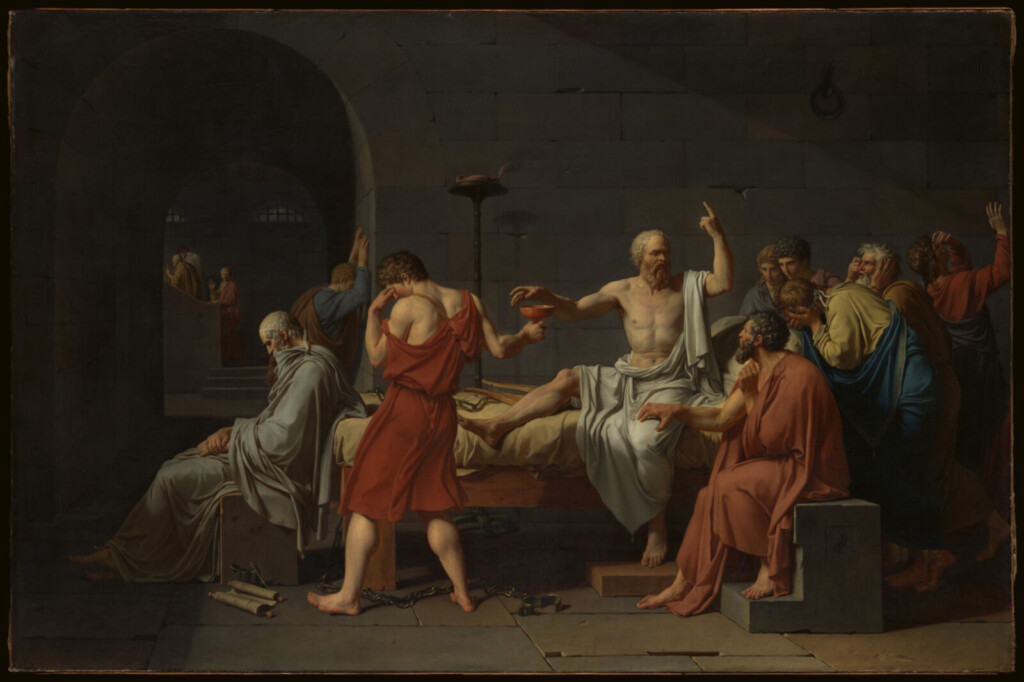
The philosophical traditions that came later — Greek, Indian, Chinese, Abrahamic — did not create the soul. They inherited an already ancient piece of cognitive hardware and began, with enormous sophistication, to rationalize it. Plato’s Phaedo, written around 360 BCE, stages the death of Socrates as an argument — a man spending his final hours constructing logical proofs that he will not cease to exist. The drama of that text is not the philosophy. The drama is that one of the most rigorous minds in Western history needed, in the face of hemlock, to run the same cognitive operation as an anonymous Homo sapiens packing shells into a grave in a Levantine hillside a hundred thousand years earlier. The machinery underneath the argument is identical.
What changes across history is not the need but the vocabulary constructed to make the need invisible — to transform terror into metaphysics, refusal into theology, cognitive emergency into spiritual certainty. Every tradition will insist that its version of the soul is what the others were groping toward. What none of them can afford to admit is that all of them began in the same place: not with revelation, but with a body that would not stop being present after it had stopped being alive.
Plato's Geometry of Escape
You are sitting with someone who is dying, and the room smells of the body — its heat, its labor, its refusal to behave like an idea. Plato never quite forgave matter for this. The Phaedo, written around 380 BCE as a staged recollection of Socrates’ final hours, is routinely taught as a meditation on death, but its deeper project is an act of philosophical quarantine. The body is framed from the opening arguments not as the site of life but as the site of contamination — a weight, a distraction, a source of error that keeps the soul from perceiving truth clearly. Socrates tells his companions that the philosopher has spent his entire life practicing dying, rehearsing the separation of intellect from flesh. This is presented as wisdom. What it actually is is a political instruction manual wearing the costume of metaphysics.
The argument Plato constructs is seductive because it appears to describe experience while actually prescribing it. He offers four distinct proofs of the soul’s immortality in the Phaedo — the cyclical argument, the recollection argument, the affinity argument, the final argument from Forms — and each one depends on the same foundational move: defining the soul as the opposite of whatever the body is. The soul is invisible, the body is visible. The soul is unchanging, the body decays. The soul resembles the eternal Forms, the body resembles the world of becoming. This is not phenomenology. It is geometry. Plato constructs the soul by triangulation, always as the negation of matter, never as something encountered directly. The consequence is that the soul becomes philosophically unfalsifiable because it is defined not by what it is but by what it refuses to be.
What makes this ideologically dangerous rather than merely intellectually convenient is what Plato does with the same soul in the Republic, written roughly contemporaneously. There, the soul is tripartite — reason, spirit, appetite — and each part maps with eerie precision onto a class of citizens. Reason governs and belongs to the philosopher-kings. Spirit supports and belongs to the guardian class. Appetite labors and belongs to the producers, the workers, the people who make things with their hands and live closest to matter. The hierarchy is not presented as a social arrangement but as a natural order, grounded in the very structure of the soul itself. Immortality, in this schema, is unevenly distributed by design. Those whose souls are most rational, most divorced from appetite and bodily need, are closest to the divine and most deserving of rule. The workers, whose lives are organized around physical production, are constitutively closer to what must be escaped.
Georges Sorel noted in 1908 that ideological systems survive by presenting contingent power arrangements as cosmic necessities, and Plato’s architecture of the soul is perhaps the most successful instance of this in Western intellectual history. The tripartite soul did not describe the Greek social order — it justified it. By the time Neoplatonism carried these ideas into early Christian theology through figures like Origen and Plotinus in the third century CE, the apparatus was already ancient enough to feel like bedrock. The soul’s immortality arrived in Christian doctrine not as revelation but as inherited Greek furniture, rearranged slightly but structurally intact.
What gets lost in tracing this inheritance is the sheer strangeness of the original claim. Plato was not reporting on death. He had no access to it. He was constructing a story about what the self essentially is, and that story required the body to be the enemy. Every person who has ever been told that their physical suffering is spiritually purifying, that their material deprivation brings them closer to God, that the flesh is a prison from which the true self must be freed — they are living inside an argument Plato made to justify why some men should think and others should dig.

The Abrahamic Hijack of Greek Metaphysics
You are sitting with a word you have used your entire life — “soul” — and you do not yet know that it belongs to a civilization you were never part of, translated into a theology that originally had no use for it.
The Hebrew nefesh, which appears over seven hundred times in the Old Testament, did not mean what centuries of Christian doctrine later insisted it meant. It meant breath. It meant throat. It meant the living pulse of a body in motion, something that could be hungry, that could grieve, that could be cut off. When Genesis 2:7 describes God breathing into Adam’s nostrils and Adam becoming a nefesh chayah, the text is not announcing the arrival of an immortal essence imprisoned in clay — it is describing animation, the bare fact of being alive rather than dead. The ancient Semitic imagination had no interest in a substance that could survive the body’s dissolution. Death in the Hebrew Bible is largely final, a descent into Sheol where the shades exist in a condition so diminished it barely qualifies as existence at all.
What happened between that world and the one that produced Augustine’s Confessions, written around 397 CE, is one of the most consequential acts of philosophical ventriloquism in Western history. The early Christian thinkers, operating in a Greek-speaking Mediterranean saturated with Platonic and Neoplatonic vocabulary, needed a conceptual architecture capable of sustaining resurrection, judgment, and eternal life. They found it not in the Torah but in Plato’s Phaedo, composed around 360 BCE, where Socrates argues on the day of his execution that the soul is simple, uncompounded, and therefore incapable of dissolution. The argument was elegant and the need was urgent, and the grafting began.
Origen of Alexandria, writing in the third century, pushed this synthesis to its most radical edge. In his De Principiis, he proposed that souls preexisted their bodies, that they had fallen into matter through some primordial cooling of spiritual ardor, and that the entire cosmos was a vast pedagogical theater designed to return them to God. This was not a reading of scripture — it was Platonism wearing a baptismal robe. The Church eventually condemned his positions, but the structural logic he introduced, the soul as a metaphysical entity with a career independent of its fleshly host, proved too useful to abandon entirely.
Thomas Aquinas, working in the thirteenth century with the newly recovered Aristotle rather than Plato as his philosophical instrument, attempted a more disciplined synthesis in the Summa Theologica. He defined the soul as the form of the body, borrowing Aristotle’s hylomorphic framework, which meant the soul was not a separate substance floating inside flesh but the organizing principle that made the body the kind of thing it was. This should have made immortality philosophically impossible — a form without its matter is like a shape without a surface. Aquinas knew this, and the intellectual acrobatics he performed to preserve personal survival after death while holding an Aristotelian ontology represent some of the most strained reasoning in the entire history of philosophy. He argued that the human soul alone, among all natural forms, had an operation that exceeded its material substrate — intellectual thought — and that this operation proved the soul’s capacity to subsist independently. The argument saved the doctrine but required the doctrine to save the argument.
What neither Origen nor Aquinas could undo was the original violence of the translation. A tradition built on covenant, on the body’s sanctity, on the resurrection of flesh rather than the escape from it, had been quietly colonized by a metaphysics that viewed matter with suspicion and the body as an obstacle. The Christian who today speaks of the soul departing at death is not reciting scripture — they are reciting Plato, filtered through centuries of theological necessity, wearing the costume of revelation.
Karma as Social Architecture
You are born low because you lived wrong. That sentence, delivered not as an accusation but as a cosmological fact, is perhaps the most efficient instrument of social control ever devised — not because it threatens punishment, but because it makes punishment invisible by relocating it into a past no one can audit and a future no one can verify.
The Manusmriti, composed somewhere between the second century BCE and the third century CE, did not invent the caste hierarchy so much as it gave that hierarchy a metaphysical skeleton. What had been a social arrangement became a moral verdict. A person born into the Shudra caste was not merely occupying a lower rung of an economic ladder — they were serving the residue of their own previous choices, carrying the weight of karma accumulated across lifetimes they could no longer remember. The text specifies with remarkable administrative clarity which births correspond to which violations: a Brahmin who drinks wine may be reborn as a worm, a woman who betrays her husband as a jackal. The precision is not incidental. Precision forecloses negotiation. When suffering has an exact metaphysical cause, the sufferer’s grievance dissolves into self-diagnosis.
What makes this architecture so durable is not coercion but consent. The Brahmin class did not simply impose the doctrine on the lower castes — the doctrine was internalized at the level where belief lives, which is to say below argument. B.R. Ambedkar, who in 1936 wrote Annihilation of Caste with the fury of someone who had studied the mechanism too closely to mistake it for anything other than what it was, understood that the most devastating feature of caste was not that it imposed hierarchy but that it made hierarchy feel like nature. When suffering appears to be the consequence of one’s own soul’s trajectory, resistance becomes cosmically incoherent. You do not protest a debt you owe yourself.
Buddhism arrived as a philosophical disruption of exactly this architecture, and yet the karma doctrine it retained carried a structural ambiguity it never fully resolved. The Buddha, teaching in the fifth century BCE, dismantled the metaphysical permanence of the self — anatta, the doctrine of non-self, made the very entity that was supposed to accumulate and carry karma philosophically unstable. What exactly travels between lives if there is no fixed soul? The tradition answered with the concept of a karmic stream, a causal continuity without a substance, which is intellectually elegant and socially catastrophic in the same gesture. Because while the philosophical problem of the transmigrating self became vastly more sophisticated, the popular function of karma as a moral ledger remained intact. A peasant in fifth-century Magadha did not meditate on the paradox of causality without substance. He understood that his poverty was earned, that his landlord’s prosperity was deserved, and that patience in this life improved the terms of the next contract.
The promise of a better next life is not a comfort in the ordinary sense. Ordinary comfort dulls pain in the present. This mechanism is more surgical: it transforms the present into an investment vehicle. Suffering becomes productive. Endurance accumulates credit. The sociologist Max Weber, writing in 1916 in The Religion of India, identified this as the primary function of theodicy in South Asian religious systems — not to explain why suffering exists, but to make suffering mean something that discourages its elimination. A doctrine that explains your misery as cosmic justice and promises its reversal only across the threshold of death has effectively immunized the social order against the one thing that might actually change it, which is the collective decision that the misery was never deserved in the first place.
The language of liberation, moksha, nirvana, the escape from the cycle entirely, was always available, but it was a specialist’s exit, requiring renunciation, monastic discipline, and usually the leisure that poverty structurally prohibits.
The Psychological Economy of Posthumous Identity
You are sitting in a waiting room, and someone hands you a form asking you to write two paragraphs about what will happen to your body after you die. You do not know this is an experiment. You fill it out, you hand it back, and twenty minutes later you find yourself judging a prostitute’s bail amount far more harshly than the control group seated next door, who wrote about dental pain. This is not a metaphor. This is the actual design of one of the most replicated experimental paradigms in social psychology, and what it reveals is not a quirk of laboratory conditions but the operating system running beneath ordinary moral life.
Ernest Becker argued in 1973, in the book that won him the Pulitzer Prize weeks after his death from cancer, that the entirety of human civilization is a defense mechanism. Not metaphorically — structurally. Every symbolic system, every cultural achievement, every ideology that promises the individual a role in something larger and more durable than a body is, at its functional core, a device for managing the terror of annihilation. Becker drew heavily on Otto Rank‘s notion of immortality projects, the architectures of meaning through which a self that knows it will die tries to matter beyond its biological expiration date. Religion was not, in his reading, a cognitive error or a primitive misunderstanding of natural causation. It was the most sophisticated anxiety-regulation technology our species has produced, and it worked precisely because it was never interrogated as such.
Jeff Greenberg, Sheldon Solomon, and Tom Pyszczynski took Becker’s clinical and philosophical scaffolding into the laboratory across the 1980s and 1990s and built what they called terror management theory. The mechanism they identified is elegant and brutal in equal measure: when awareness of mortality is activated, even briefly and unconsciously, human beings do not respond by facing death with equanimity or by deepening their appreciation for finite life. They respond by clinging harder to whatever cultural worldview they already inhabit, and by punishing, psychologically or literally, anyone whose existence threatens the coherence of that worldview. Mortality salience, as the researchers named it, increased in-group favoritism, escalated hostility toward people perceived as culturally deviant, and raised the dollar amounts that mock judges assigned to criminal sentences. The soul does not have to be explicitly invoked for the effect to operate. The mere proximity of death activates the entire symbolic apparatus that the soul, as concept, anchors.
What this produces at scale is not comfort but a kind of armored certainty that functions socially like aggression. The person who believes most fervently in posthumous identity is not, statistically, the most serene about mortality — they are among the most hostile toward difference. Robert Lifton’s 1979 work on symbolic immortality maps the same territory from the outside: the soldier who believes he dies for something eternal, the martyr who exchanges biological continuity for narrative permanence, the nationalist whose individual death is absorbed into the deathlessness of a people — these are not fringe cases of fanaticism but normalized expressions of the same psychological logic that fills churches and cemeteries alike with identical grammar.
The soul, then, is not primarily a metaphysical proposition. It is an identity-preserving technology that allows a creature aware of its own finitude to act as though its values, its judgments, its affiliations will outlast its breath. This is why challenges to soul-belief are experienced not as intellectual disagreements but as existential attacks. Telling someone their sense of continuous selfhood dissolves at death is not correcting a factual error — it is dismantling the structure that makes their daily moral investments feel worth making. The experiment in the waiting room is not measuring superstition. It is measuring the load-bearing wall of the human psychological architecture, and what trembles when you touch it is not faith in God but the entire apparatus of meaning that makes punishment feel just, belonging feel sacred, and death feel like something that happens to other people.
A vision curated by a filmmaker, not an algorithm
In this video I explain our vision
Neuroscience as the New Theology

You are lying on a scanner bed, perfectly still, while a machine reads the electrical weather of your interior life. The technician tells you the image will show your brain “at rest,” as though rest were a condition the mind ever truly achieves, as though the luminous bloom of activity on the screen were not already a kind of argument about what you are. Nobody in the room uses the word soul. They do not need to. The question they are trying to answer is exactly the same one.
Antonio Damasio’s somatic marker hypothesis, developed with precision across Descartes’ Error in 1994 and The Feeling of What Happens in 1999, proposed that consciousness is not a sovereign faculty issuing commands from above but an emergent conversation between body states and neural representation. The self, in this account, is not a stable entity residing somewhere behind the eyes — it is a process, a narrative the organism constructs about itself moment to moment, rooted in the felt condition of the flesh. This was offered as a correction to centuries of Cartesian dualism, a materialist reckoning with the ghost in the machine. What it actually produced was a new vocabulary for an ancient longing: if the self is a narrative, the question immediately becomes who or what is doing the narrating, and whether that narrator can survive the collapse of the body that sustains it.
Christof Koch spent decades working alongside Francis Crick on the project of locating the neural correlates of consciousness — specific, identifiable patterns of brain activity that accompany and perhaps constitute subjective experience. By the time Koch published The Feeling of Life Itself in 2019, the search had grown both more refined and more philosophically treacherous. Identifying the correlates does not explain why there is experience at all, why the firing of neurons should produce anything felt rather than nothing. This is precisely the “hard problem” that David Chalmers named in 1995, and the naming itself is instructive: calling it hard is a way of acknowledging that the empirical tools available are somehow insufficient to the task, that something about consciousness exceeds the third-person methodology designed to capture it. The language of difficulty here functions as theology once functioned — as a formal acknowledgment that the phenomenon resists full domestication by the reigning explanatory framework.
What is remarkable is not the persistence of the question but the preservation of its emotional architecture. When neuroscientists debate whether personal identity is continuous across time, whether the self that wakes is the same self that slept, they are rehearsing a problem that Locke framed in the Essay Concerning Human Understanding in 1689 and that Buddhist metaphysicians had already been dismantling for two millennia before that. The specific anxiety beneath the question — am I the same being across time, and what does it mean if I am not — is indistinguishable from the anxiety that drove the construction of doctrines about the soul’s immateriality in the first place. The empirical frame changes the stakes in some ways and leaves them entirely unchanged in others.
There is a particular kind of intellectual honesty required to notice that the structure of devotion can survive the death of its explicit objects. When a researcher speaks of continuity of identity, they are not simply describing a cognitive phenomenon — they are protecting something, guarding against an implication that the self as they know it is contingent, dissolvable, subject to erosion by time and damage and sleep. The protection is not irrational. It is human. But calling it science rather than theology does not alter the shape of the need driving it, and the question that has never been answered by either tradition is whether the need itself points toward something real or only toward the unbearable weight of being conscious of one’s own impermanence.
What Secular Immortality Looks Like
You have already made your peace with mortality, or so you tell yourself. You recycle, you vote, you eat less meat — each act a small deposit into a future you will never withdraw from, a future that somehow keeps your name on the deed even after you have vacated the premises. This is not cynicism. It is the structural logic of how secular culture handles the oldest intolerable fact.
Ray Kurzweil published The Singularity Is Near in 2005 and by 2029 had refined his prediction into a hard deadline: machines would achieve human-level intelligence, consciousness would become uploadable, and death would graduate from inevitability to design flaw. The 2045 Initiative, bankrolled by Russian entrepreneur Dmitry Itskov, went further, funding a roadmap for transferring human personality onto non-biological substrates — avatar bodies, holographic presence, indefinite continuation. The language is emphatically scientific. The architecture is emphatically not. What is being proposed is the persistence of an individual identity across the threshold of physical dissolution, which is precisely what every doctrinal tradition promising paradise or reincarnation has always proposed. The substrate changes — silicon instead of divine breath — but the terror being answered is unchanged.
Legacy culture operates by a softer mechanism but an identical grammar. The artist who works to be remembered, the philanthropist whose name is carved into the hospital wing, the parent who treats their child as a vessel for values that must outlast them — each is performing what Ernest Becker diagnosed in The Denial of Death in 1973 as an “immortality project,” the conversion of biological anxiety into a symbolic structure capable of outliving the body. Becker was drawing on Otto Rank’s earlier insight that culture itself is a collective immortality system, a vast shared hallucination that transforms mortal creatures into bearers of permanent meaning. What secular modernity did was not dismantle that system but rebrand it, stripping the metaphysical vocabulary while preserving every functional component.
Genetic continuation is perhaps the most intimate version of this refusal. The idea that something essential persists through offspring — not merely DNA as biochemical code but selfhood, intention, significance — smuggles in a theory of distributed immortality that no evolutionary biologist has ever endorsed. Richard Dawkins spent The Selfish Gene, published in 1976, demonstrating that genes replicate without caring about the organism they pass through, let alone its sense of personal continuity. The gene does not carry your story. It carries a chemical instruction. The feeling that your children are your afterlife is a consolation narrative, not a biological fact, and yet it organizes major life decisions with the same compelling authority as a medieval peasant’s belief in purgatory.
What connects these secular projects — technological, reputational, genetic — is not naivety. The people designing consciousness-uploading architectures are not stupid. What connects them is the philosophical move that precedes the project: the assumption that a self which matters temporarily is somehow a self that does not fully matter. This assumption has never been argued for. It has only been inherited, from theological frameworks that made eternal significance the criterion of real significance, and it has survived the collapse of those frameworks by migrating into secular containers. The philosopher Bernard Williams argued in Problems of the Self in 1973 that immortality, even if achieved, would eventually become intolerable — that a genuinely continuous identity would exhaust every reason to continue, rendering eternal life a form of madness rather than triumph. The secular immortality projects have not engaged this argument. They have not needed to, because the engine driving them is not philosophical curiosity about what endless existence would feel like but existential panic about what an ended existence would mean.
There is something worth sitting with in the precision of that panic — not its irrationality, but the specific shape of what it refuses to accept, which turns out to be less about death itself than about the prospect that the universe might not be organized around keeping track of you.
The Cultures That Did Not Need the Soul to Survive
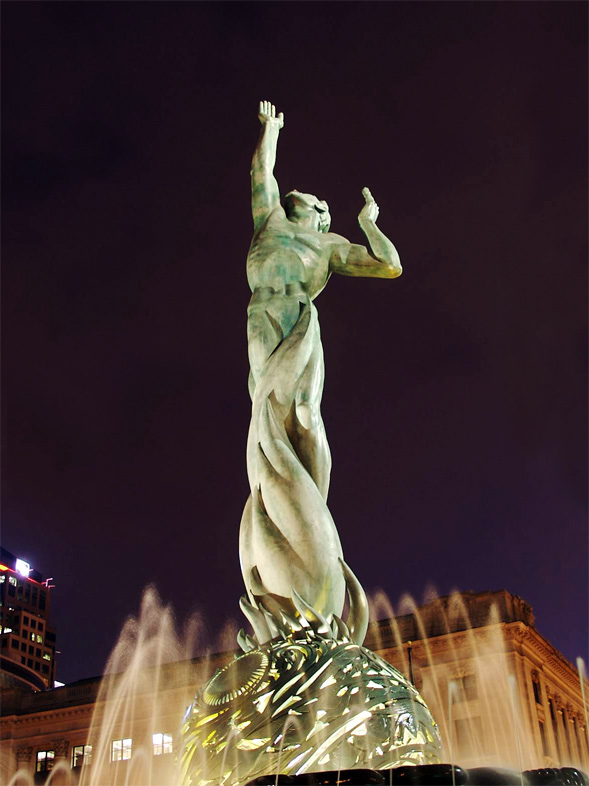
You have rehearsed your own death before breakfast. Not dramatically, not with dread — just the plain Stoic exercise: hold the thought that today could be the last, let it sit in the body for a moment, and then return to the task at hand. Marcus Aurelius practiced this daily, not to torment himself but to clarify what actually mattered when the fiction of infinite time was stripped away. The Meditations, written in the second century CE as private notes never intended for publication, are saturated with this discipline — what he and others in the tradition called melete thanatou, the rehearsal of death — and the remarkable thing is how little grief the text contains. What it contains instead is precision: what is worth doing if this is the only afternoon you will have.
Epicurus dismantled the fear of death with an argument so clean it has never been refuted, only ignored. If death is the complete dissolution of the self, then there is no subject remaining to experience loss or absence. The famous formulation from his Letter to Menoeceus, written around 300 BCE, states it without ornamentation: where death is, I am not; where I am, death is not. What the argument destroys is not death itself but the theater around it — the anticipatory suffering, the bargaining with invisible continuities, the willingness to sacrifice the texture of actual life for the promise of a life elsewhere. Epicurean communities, which included women and enslaved people in a radical departure from Athenian social norms, organized themselves around friendship, modest pleasure, and philosophical conversation precisely because nothing was being saved for later. The ethical urgency of the present was not diminished by mortality; it was produced by it.
Certain lineages within Zen Buddhism arrived at a structurally parallel position through entirely different means. The doctrine of anatta — the absence of a fixed, continuous self — does not merely delay the question of what survives death; it dissolves the entity that would need to survive. Dogen Zenji, writing in thirteenth-century Japan in texts collected as the Shobogenzo, described practice not as a preparation for some future liberation but as the complete expression of reality in each moment of sitting. The self that fears annihilation is, on this account, already a misconception — and the ethical life that follows from releasing that misconception is not passive or nihilistic but extraordinarily demanding, because it cannot defer its obligations to another existence, another incarnation, another reckoning.
What these traditions share is not pessimism but a particular kind of structural honesty about what the immortality premise actually costs. When a culture organizes its ethics around personal survival after death, it systematically undervalues what cannot be redeemed in that economy: the unrepeatable specificity of a single life, the bonds that have no currency in eternity, the pleasures that are pleasures precisely because they are temporary. Sociology has documented how cultures with strong afterlife beliefs tend to tolerate present suffering more readily — not because they are cruel, but because the accounting is simply deferred. The Spanish Inquisition, the logic of martyrdom, the willingness to accept poverty as a passage — none of these require individual malice. They require only the conviction that the real ledger is kept elsewhere.
The person who has genuinely abandoned the immortality premise is not liberated into hedonism or despair. They are left holding something more uncomfortable: the full weight of a life that will not be corrected in a sequel, the knowledge that what is owed to others cannot be repaid in a currency not yet minted, and the strange, clarifying freedom that comes from understanding that the only moment in which anything can actually be done is the one that is already, irreversibly, here.
🌿 Between Soul, Death, and Eternal Life
The questions of soul and immortality have haunted philosophy and religion across every civilization and century. From ancient mystics to modern thinkers, humanity has never stopped asking whether consciousness survives death — and what that survival might mean. These articles explore the deepest currents of that endless inquiry.
Reincarnation: history and beliefs across world cultures
Carl Gustav Jung‘s concept of synchronicity opens a window onto a universe where meaning is not imposed by the rational mind but discovered at the intersection of inner and outer events. These meaningful coincidences suggest a hidden order beneath the surface of reality, one that many religious traditions have long called divine providence or cosmic law. Exploring Jung’s ideas here enriches any reflection on the soul’s place within a larger, purposeful cosmos.
GO TO THE SELECTION: Reincarnation: history and beliefs across world cultures
Past life regression: history and practices
The practice of past life regression sits at the crossroads of therapeutic psychology, esoteric spirituality, and ancient religious belief in metempsychosis. By guiding subjects back through apparent memories of previous existences, practitioners claim to heal present-life wounds and offer experiential evidence for the soul’s continuity beyond death. This history of the practice illuminates how the idea of the immortal soul has migrated from temple to therapy room.
GO TO THE SELECTION: Past life regression: history and practices
Brian Weiss and healing through the memory of the soul
Brian Weiss, a Harvard-trained psychiatrist, became one of the most influential contemporary voices on the soul’s journey across multiple lifetimes after a patient’s hypnotic regression unexpectedly surfaced what he interpreted as past-life memories. His work bridges clinical psychology and spiritual philosophy, proposing that the soul carries wounds, lessons, and unfinished bonds from one incarnation to the next. His approach offers a fascinating case study in how scientific and religious frameworks collide and sometimes merge around questions of immortality.
GO TO THE SELECTION: Brian Weiss and healing through the memory of the soul
Soulmates: myth, philosophy and psychology
The concept of soulmates draws simultaneously from Platonic philosophy, with its myth of the original divided being, and from religious traditions that speak of destined unions written before birth. Psychology adds its own layer, examining how the longing for a perfect spiritual complement reflects deeper needs for wholeness and transcendence. Understanding soulmates means understanding how the soul is imagined — as a fragment seeking completion, a divine spark, or an evolving consciousness.
GO TO THE SELECTION: Soulmates: myth, philosophy and psychology
Discover Cinema That Asks the Unanswerable
If these reflections on the soul and immortality have stirred something in you, Indiecinema streaming is the place to follow that feeling further. Our catalog of independent and auteur films explores consciousness, transcendence, and the mystery of existence with the depth and courage that only independent cinema dares. Come and watch.
👉 EXPLORE THE CATALOG: Watch Indie Films in Streaming
A vision curated by a filmmaker, not an algorithm
In this video I explain our vision

