
The Weight of a Name You Did Not Choose
There is a moment, sometime in your early twenties, when you realize that the life you have been living was designed by people who were already dead before you arrived. The profession your family steered you toward, the religion you practiced before you could question it, the neighborhood that shaped your vowels and your silences, the name itself — carried like an heirloom you never chose and cannot easily set down. You did not consent to any of it. No one asked. And the strangest part is not the inheritance itself but the discovery, arriving always slightly too late, that you had mistaken it for your own desire.

This is not a modern problem. It is not even primarily a psychological one, though Bourdieu spent a career mapping its mechanisms, showing in works like The Logic of Practice how what we call personal choice is almost always a reproduction of the field into which we were born, a habitus so deeply internalized that it feels like instinct. The problem is older and more ruthless than sociology. It begins, sometimes, with a castle.
In 1225, in the fortress of Roccasecca perched in the highlands between the Kingdom of Sicily and the Papal States, a child entered the world already encoded. His father, Landulf of Aquino, was a knight of minor nobility with significant ambitions, a man positioned precisely at the fault line between two enormous powers — the Holy Roman Emperor Frederick II and the papacy — and therefore a man who understood that children were instruments of political equilibrium as much as they were heirs of blood. His mother, Theodora of Chieti, came from Norman and Lombard stock, which meant the boy inherited not one identity but several layered ones, each carrying its own set of obligations. The name they gave him — Thomas — was not accidental. Nothing in that world was accidental. A name was a contract.
What they had planned for him was legible from the first years of his life. At five years old, he was sent to the Benedictine abbey of Monte Cassino, the great monastery founded by Benedict of Nursia in the sixth century, one of the most powerful religious institutions in medieval Europe. This was not piety. Or rather, it was piety instrumentalized. The family’s calculation was precise: a Aquino boy installed as abbot of Monte Cassino would give the lineage enormous ecclesiastical and economic influence in a region where the church and the feudal nobility were permanently negotiating territory. Thomas was not sent there to find God. He was sent there to become a strategic asset.
You recognize this. Not necessarily in its medieval architecture, but in its structure. The father who assumes you will enter the family business. The mother whose own unlived ambitions migrate quietly into your choices. The community that hands you a role — caretaker, achiever, rebel, heir — before you have the vocabulary to refuse it. Erikson wrote about identity formation as a crisis, a genuine rupture, but what he perhaps underestimated is how many people never reach that crisis at all, because the inherited identity is comfortable enough, or the cost of abandoning it is simply too high to bear in plain daylight.
The child at Monte Cassino could not yet know what he was being prepared for. He learned grammar and music and scripture inside walls that were already eight centuries old, in a silence that was not chosen but assigned. And somewhere in that silence, something began to move that the family had not planned for — a quality of attention, an insistence on understanding rather than merely accepting, a mind that would eventually refuse to be a dynastic piece on anyone’s board. But that refusal was still years away. First, he had to understand exactly what he had been given.
The Monastery as Desertion and the Family as Prison
You leave one morning before the others wake. Not dramatically, not with a speech or a slammed door. You simply go, the way a person goes when they have understood that staying would cost them something that cannot be recovered. Thomas was nineteen when he walked away from Monte Cassino, the great Benedictine abbey where his family had placed him with the calculated precision of an investment — a younger son made useful, his intellect converted into prestige, his vocation shaped to serve the dynasty rather than the divine. He walked toward Naples, toward the Dominicans, toward a mendicant order that owned nothing and moved constantly, which was precisely the point. To choose poverty as a structure of existence, to choose mobility over the fixed stone of inherited power, was not merely a religious decision. It was a declaration of independence so complete that his family read it as a form of violence against themselves.
They responded accordingly. His brothers, acting under the implicit authorization of his mother Theodora, intercepted him on the road near Aquapendente in 1244 and brought him back by force to Roccasecca, the family castle. He was held there for more than a year, possibly closer to two, depending on which sources you trust. The confinement was presented as concern. The kidnapping was narrated as love. This is how the private sphere has always operated its cruelties — by wrapping coercion in the language of care, by making the one who resists appear as the one causing harm.
Hannah Arendt, in The Human Condition published in 1958, drew a distinction that cuts directly to this moment: the private realm, she argued, is the realm of necessity, of biological and familial compulsion, the domain from which the ancient Greeks believed a person had to escape in order to become fully human and politically free. The public realm — the realm of action, of appearance, of genuine speech — could only be entered by those who had first broken the gravitational pull of the household. The private sphere does not only shelter. It also traps. And it traps most efficiently those it claims to love most completely.
What makes Roccasecca particularly sharp as an image is the particular weapon the family chose to break Thomas’s resolve. According to the account passed down through his early biographers, Bartolomeo di Capua and William of Tocco, his brothers introduced a young woman into his chamber, presumably beautiful, presumably willing, the logic being that the body would accomplish what argument could not. The story continues that Thomas drove her from the room with a burning brand taken from the fireplace and then traced a cross on the wall with the charred wood and fell to his knees. Whether this happened exactly as described is less important than what the story reveals about the mechanism being attempted: the reduction of a philosophical and spiritual commitment to a problem of appetite, the assumption that a man could be returned to his assigned life if only the right hunger were activated. It is an assumption that contains, compressed within it, an entire theory of what a person is — purely corporeal, purely susceptible, ownable by those who understand the levers.
Thomas remained. He spent the months of his confinement not in despair but in reading, in conversation with a sister who smuggled books to him, in the kind of interior deepening that only enforced stillness can produce. Arendt’s concept of natality — the idea that every human being carries within them the capacity to begin something genuinely new, to insert an unprecedented act into the world — does not require freedom as its precondition. Sometimes it ignites precisely inside the locked room, fed by the refusal of the walls to contain what the mind is doing.

Thinking as a Physical Act
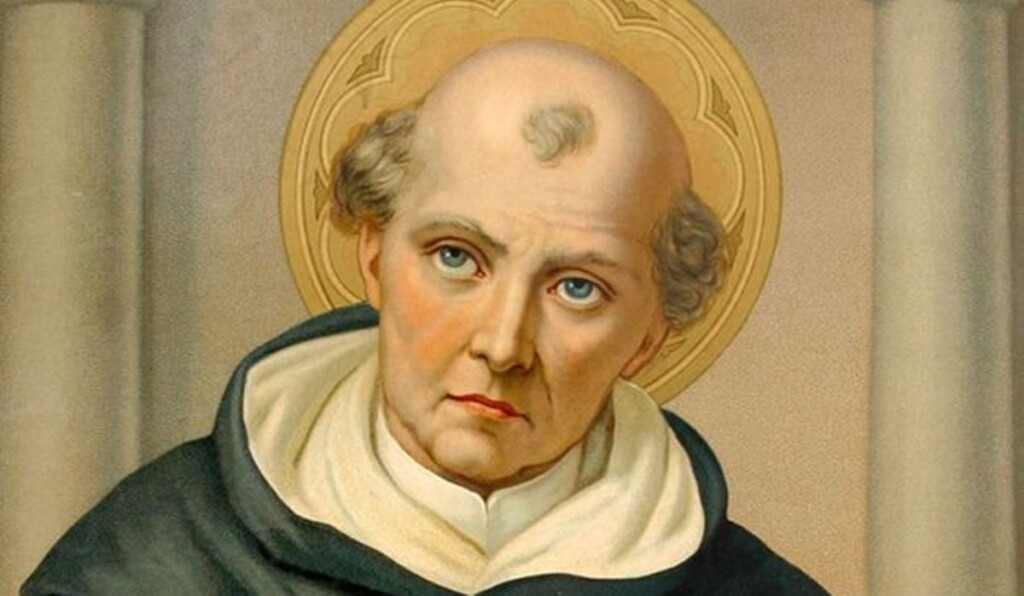
There is a man standing in a corridor. Everyone else is moving — students carrying books, professors adjusting their robes, servants hauling firewood through side doors — and he is simply there, occupying space without justifying it, his eyes fixed on some middle distance that has no location in the physical room. People move around him the way water moves around a stone, and what they feel is not curiosity but a vague irritation, the kind you feel toward something that does not perform its own existence for your benefit. He is thinking. But thinking, when it is real, is invisible. And invisibility, in any institution ever built by human beings, reads as vacancy.
This was the young Thomas in Naples, and then in Paris, and then in Cologne, sitting in the lecture halls of Albertus Magnus while other students filled the air with confident questions and sharp responses that demonstrated, above all else, that they were present and engaged and worthy of recognition. Thomas barely spoke. He was large and slow-moving, and his silences were so profound that his classmates gave him a nickname with the casual cruelty that academic environments have always specialized in: the dumb ox. The word dumb carries both meanings in Latin too — mute and stupid — and both were intended. What they saw was a body that did not produce the expected signals of intelligence. And because the signals were absent, they concluded that the intelligence was too.
Pierre Bourdieu spent considerable parts of his career — from Distinction in 1979 through The State Nobility in 1989 — mapping the mechanics of exactly this misreading, showing how academic fields develop what he called specific forms of capital that have nothing inherently to do with the quality of thought and everything to do with the performance of belonging. The student who speaks fluently, who references the right names at the right moments, who displays ease within the institution’s rituals, accumulates symbolic capital that then gets mistaken for intellectual substance. The student who sits in silence, who processes slowly because he is processing completely, who will not reduce a complex problem to a quick answer just to fill the social silence — that student loses ground every single day, not because he thinks less but because he refuses to perform thinking as theater. Bourdieu called this the misrecognition at the heart of educational legitimacy: we do not reward intelligence. We reward the ability to make intelligence legible to the people who are already inside the room.
Albertus Magnus was one of the few people in the history of that institution who could see through the performance to the engine underneath. According to the accounts that have survived, he listened to Thomas in the moments Thomas did choose to speak, and what he heard was not a student catching up. What he heard was a mind that had been somewhere the other students had not been and had come back changed by it. His response to the nickname has become one of those statements that sounds like legend precisely because it is too accurate to have been invented: you call this man a dumb ox, he reportedly said, but the bellowing of this ox will one day fill the world.
What Albertus understood is something that runs against every instinct institutional life develops in the people who survive it: that silence is not the absence of thought, it is sometimes its most intense form. The mind that will not be rushed into articulation, that refuses to speak before it is ready to mean something, is not the mind falling behind. It is the mind that has understood, at some level below conscious strategy, that thinking is a physical act — it requires time, it requires stillness, it requires the willingness to appear slow in front of people who have mistaken quickness for depth.
And the world never stops punishing that willingness.
God as a Philosophical Problem, Not a Comfort
There is a moment, sometime in the middle of an ordinary life, when you realize that the God you were handed as a child cannot survive the first serious question. Not a crisis of faith exactly — something quieter and more unsettling than that. A gap opens between what you were told to believe and what your mind, left to its own motion, keeps arriving at. Most people seal that gap with ceremony, with repetition, with the comfort of community. Thomas Aquinas tore it wide open and climbed inside.
The Five Ways he constructs in the Summa Theologiae between 1265 and 1274 are not arguments designed to reassure the faithful. They are something colder and stranger than that: they are the work of a mind that simply could not stop asking why anything exists at all, and that refused to accept the answer “because God said so” as philosophically sufficient. He begins from what is most obvious — things move, things change, things are caused, things could either exist or not exist — and follows the logic wherever it leads with a kind of relentless, almost impersonal patience. The first mover. The uncaused cause. The necessary being. These are not images you can pray to. They are conclusions.
Blaise Pascal, writing his Mémorial in 1654, sewed into the lining of his coat the distinction that mattered most to him: “God of Abraham, God of Isaac, God of Jacob — not of the philosophers and scholars.” He was right to name the difference so sharply. The God Pascal wanted was alive, personal, felt in fire at half past ten on a Monday night. The God Aquinas arrives at through his five arguments is nothing like that. It is an ontological anchor, the formal ground of contingent existence, a being whose essence is its existence — what he calls the actus purus, pure act, the only entity for whom not-being is logically impossible. You cannot weep before that entity. You cannot beg it for anything. It does not hear.
What Aquinas was actually doing — and this is the thing the Church understood only partially, and feared even as it deployed his name as armour — was dragging the God of scripture into the same arena where Aristotle’s Unmoved Mover stood, and forcing them to occupy the same conceptual space. This was not piety. It was philosophical aggression of the highest order. Étienne Gilson, who spent decades mapping the architecture of medieval thought, argued in his 1948 work Being and Some Philosophers that the entire Thomistic project is built on an act of metaphysical audacity: the claim that being itself, esse, is the proper name of God, not merely a property God possesses. The implications of this are vertiginous. God is not a person who happens to exist. God is existence, the sheer fact of there being something rather than nothing.
A man walks into a room where his father has just died. The body is still warm. Every religious instinct he has reaches for a presence, a somewhere the person has gone, a face that still exists on the other side of that silence. None of what Aquinas wrote speaks to that moment. The Five Ways offer him a necessary being in whom all contingent existence is grounded. They offer him the logical impossibility of pure nothingness. They offer him nothing, in the ordinary human sense of the word.
The Dominican order that shaped Aquinas produced a thinker who stripped their own consolations down to the structural skeleton. The Church canonized him in 1323, fifty years after his death, and made his system the official framework of Catholic theology at the Council of Trent in the sixteenth century — precisely because his arguments were too powerful to abandon and too dangerous to let run free without institutional containment. That tension was never resolved. It was merely institutionalized.
Aristotle as Contraband
Imagine carrying a manuscript across a border at night, tucked beneath ordinary goods, knowing that what you hold in your hands describes the world in a way that makes the official version of the world suddenly untenable. You are not a revolutionary by temperament. You believe in order, in legitimate authority, in the slow movement of institutions. And yet you are moving in darkness with something that, if it lands in the right minds, will make the old maps useless.
This is roughly the situation of Aristotelian philosophy as it entered medieval Europe, though the drama unfolded over decades rather than a single night. The texts had never entirely disappeared, but the full body of Aristotle’s natural philosophy, his physics, his metaphysics, his treatises on the soul and on generation and corruption, arrived in the Latin West largely through Arabic intermediaries. Scholars in Toledo and Palermo bent over manuscripts that were translations of translations, Greek rendered into Syriac, Syriac into Arabic, Arabic into Latin, each pass introducing new pressures, new resonances. The great interpreters who accompanied these texts were not decorative footnotes. Ibn Rushd, known to the Latin world as Averroes, had written commentaries so thorough and so philosophically daring that he became simply “the Commentator,” as if no other commentary on Aristotle could exist. Ibn Sina, Avicenna, had already built an entire philosophical architecture around Aristotelian foundations, inflecting it toward a vision of the intellect that would disturb Christian theologians for generations. These were not neutral deliveries. The cargo came with its own gravitational field.
The institutional panic was genuine and historically measurable. In 1210, the provincial council of Paris prohibited the reading of Aristotle’s natural philosophy in university lectures. The prohibition was renewed in 1215 and again, with modifications, in 1231, when Gregory IX commissioned a committee to purge the texts of errors before permitting their circulation. The committee never finished its work. The texts spread anyway, because ideas that explain something real cannot be administratively contained. By the time Aquinas arrived in Paris to study under Albert the Great in the 1240s, Aristotle was everywhere in the intellectual atmosphere, officially suspect and practically unavoidable.
What Aquinas did with this situation was not simply brave, though courage was involved. It was something more structurally audacious: he decided that the danger was not in Aristotle but in the refusal to think Aristotle through to his proper conclusions. The smuggler’s instinct is to hide what he carries. Aquinas did the opposite. He placed it on the table in full daylight and argued that it belonged there. His Summa Contra Gentiles, composed across roughly six years beginning in 1259, was not written for the already converted. It was addressed explicitly to those outside the faith, to the philosophically sophisticated, to anyone who might accept rational demonstration as a standard of truth. This was not apologetics dressed as philosophy. It was philosophy that refused to pretend that reason and revelation were strangers who had never met.
The synthesis he constructed required him to distinguish carefully between what reason could reach on its own and what it could not reach without revelation, not because reason was weak but because some objects of knowledge exceeded its natural range. This distinction, which might appear like a defensive retreat, was actually the move that made everything else possible. It meant that Aristotle’s account of nature, causality, substance, motion, and the intellect could be incorporated fully and without mutilation, because they operated in a domain where reason was sovereign and revelation had not been given to contradict but to extend.
The man carrying the manuscript at night does not know exactly what it will do once it lands. He knows only that the world described inside it is more accurate than the world the authorities prefer. That accuracy has a weight. It pulls.
A vision curated by a filmmaker, not an algorithm
In this video I explain our vision
The Body That the Church Forgot It Had
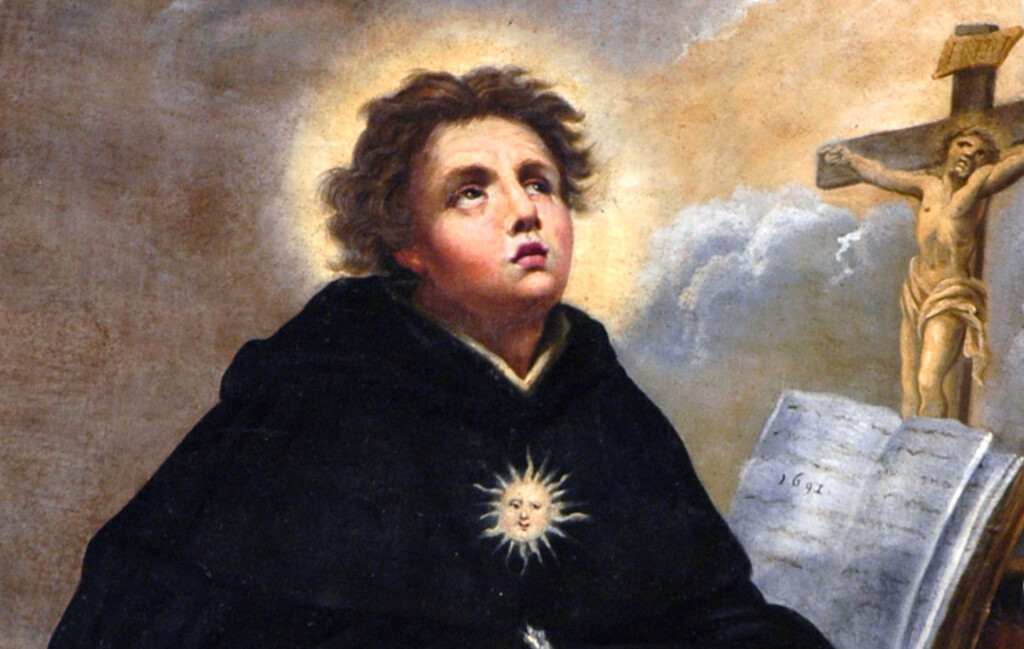
You stand in front of the mirror and something goes wrong. Not in the glass — the glass is accurate enough. What goes wrong is the translation between what you see and what you have been taught to feel about it. The flesh looking back at you has been pre-interpreted. Before you ever arrived at this particular morning, at this particular light, someone else had already decided what your body means. And what it means, in the long sediment of Western Christian culture, is trouble. Appetite. Temptation. The thing that drags the soul downward.
This is not what Thomas Aquinas taught. It is almost the precise opposite.
Aquinas inherited from Aristotle the doctrine known as hylomorphism — the philosophical position that form and matter are not two competing realities but a single, irreducible composite. The soul, for Aquinas, is not imprisoned in the body the way a pilot sits inside a ship, looking out through the porthole of the eyes. It is the substantial form of the body, the very principle by which flesh is alive, organized, oriented toward the world. Without the body, the soul is not liberated — it is incomplete. Aquinas said this with a precision that bordered on the uncomfortable: the soul separated from the body is not a person. A corpse is not a person. And neither, in the full sense, is a disembodied spirit waiting in some luminous anteroom for the resurrection to make it whole again.
He meant this literally. He built it into the architecture of his theology with the same care he brought to everything else. The resurrection of the body was not a concession to popular piety for Aquinas — it was a philosophical necessity. If you take his hylomorphism seriously, there is no beatitude without flesh, because there is no you without flesh. The Summa Theologiae returns to this repeatedly, insisting that the intellect itself, in this life, cannot operate without the phantasms produced by sensory experience. Thinking, for Aquinas, is not the soul escaping the body. Thinking is the soul doing what it does precisely through the body’s encounter with the world.
And then the Church, in the centuries that followed, largely forgot this.
What replaced it was something closer to Plato — the idea that the body is a tomb, that the senses deceive, that desire is a symptom of the fall rather than a feature of creation. Michel Foucault, in Discipline and Punish, published in 1975, traced with forensic precision how institutions — not just prisons, but schools, hospitals, armies, monasteries — developed systematic techniques for managing, subduing, and reshaping bodies. The body, in this framework, is not a subject but an object to be corrected. Foucault called this the political technology of the body, the set of practices by which power writes itself into flesh before the mind has any chance to object.
What he was describing, without naming it as such, was the long institutional triumph of the Platonic tendency over the Thomistic one. The Christianity that shaped Western bodies — that gave you the sensation of wrongness in front of the mirror — was not the Christianity of the Summa. It was something older and stranger, grafted onto Aquinas even as he argued against it, persisting in the guilt that outlives the theology that produced it.
Someone stands in a confessional and describes their body’s hunger as though describing a crime. Someone fasts until the fast becomes its own form of desire, indistinguishable from what it was meant to suppress. Someone learns, early and thoroughly, that holiness looks like distance from the physical — from pleasure, from appetite, from the ordinary animal fact of having skin.
Aquinas would have recognized none of this as his own. The body he described was not a problem to be solved but a condition of being human at all.
The Silence Before the End
There is a morning you wake up and find that the words you built your entire life around no longer hold. Not because they were wrong. Because they were not enough. Something in the night shifted, or something in you did, and you reach for the familiar architecture of your own thinking — the distinctions you sharpened over decades, the arguments you refined until they cut clean — and you find them sitting there, perfectly intact, completely hollow.
This is what happened on December 6, 1273, though to call it simply “what happened” is already to diminish it past recognition.
He was celebrating Mass at the chapel of Saint Nicholas in Naples. He had done this hundreds, perhaps thousands of times. The body moves through ritual as water moves through a familiar channel. And then something occurred — the sources are careful and vague in exactly the same breath, which is itself a kind of honesty — and Thomas Aquinas stopped. Not paused. Stopped. He set down his pen and never picked it up again. When Reginald of Piperno, his secretary and companion of years, pressed him to continue the Summa Theologiae, which remained unfinished, Aquinas said something that no amount of theological sophistication has ever fully absorbed: everything he had written seemed to him like straw compared to what he had seen.
The temptation is to make this beautiful. Centuries of hagiography have done exactly that, transforming the silence into a crown, the rupture into a reward. But sit with the actual texture of it for a moment, without the gilding. A man who had written more than eight million words — a number that defies comprehension when you consider it was all done by hand, dictated to multiple secretaries simultaneously, produced across a life of almost constant physical movement between Paris, Cologne, Naples, Rome, Orvieto — that man suddenly found his entire life’s work not transcended but negated. Not surpassed. Reduced. The Latin word he reportedly used, palea, means chaff, the worthless husk you discard when you want the grain. He was not saying the Summa was a stepping stone. He was saying it was waste.
This is not mystical fulfillment. This is a man colliding with the outer wall of his own system at full speed.
Ludwig Wittgenstein, writing at the end of the Tractatus Logico-Philosophicus in 1921, arrived at his own version of this collision through an entirely different road: whereof one cannot speak, thereof one must be silent. The proposition is famous enough to have become a kind of intellectual decoration, quoted in contexts that safely drain it of its original violence. What Wittgenstein meant — and what Aquinas enacted, bodily, six centuries earlier — is that the boundary of language is not a door you open to something richer. It is a wall. And when you hit it, you do not speak. You cannot. The silence is not chosen. It is the only remaining honest response.
Aquinas died on March 7, 1274, three months after he stopped writing. He was forty-nine years old. The Summa Theologiae, the most systematically ambitious theological work in Western history, ends mid-sentence, mid-question, in the treatise on penance. The architecture simply stops, like a cathedral whose builders walked away one morning and never returned.
What do you do with a silence that is not peace? What do you do with a man who spent his entire intellectual life insisting that reason could approach, even if never fully reach, the divine — and who then discovered something that made the entire approach seem, by his own reckoning, worthless? You cannot rescue him from that. You cannot reinterpret his way back to comfort. The straw is still straw. The silence is still the silence. And somewhere inside it, unfinished and unanswerable, the question he spent his life building toward remains exactly as open as it ever was.
What Remains When the Cathedral Falls
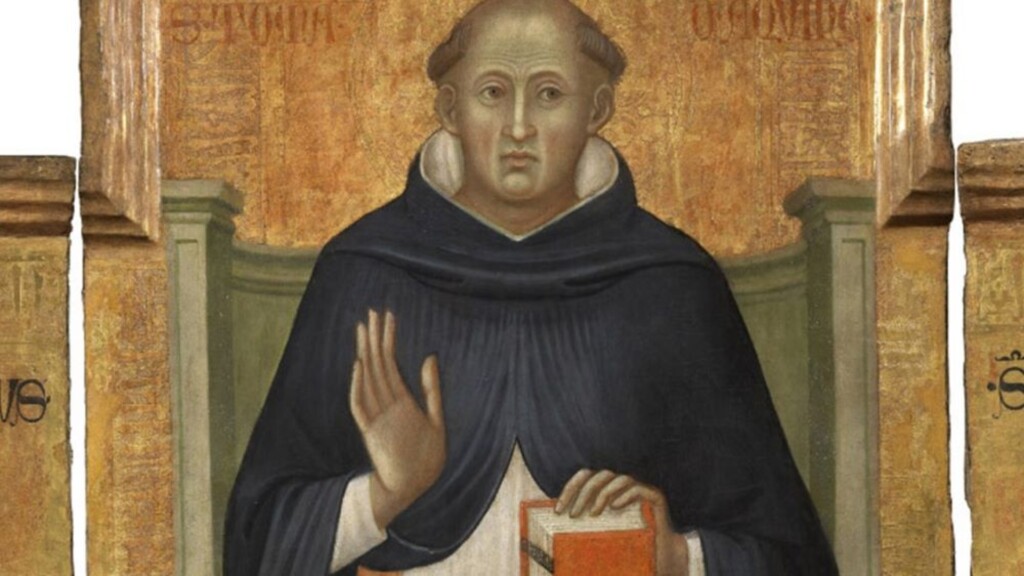
Three years after he died, his propositions were condemned. The Bishop of Paris, Étienne Tempier, in 1277 drew up a list of 219 errors threatening the faith — and several of them were unmistakably Thomistic. The man who had spent his life attempting to reconcile reason with revelation, who had believed with something close to physical urgency that truth could not contradict truth, was declared, posthumously, to have gotten things dangerously wrong. He was not alive to defend himself, to clarify, to suffer the indignity in person. The condemnation landed on a corpse and on the students who had loved him.
Then, forty-six years later, he was canonized. Then, in 1567, declared a Doctor of the Church. Then, in 1879, Leo XIII issued Aeterni Patris and effectively made Thomism the mandatory philosophical framework for all Catholic intellectual formation — a decree that would shape seminaries, universities, and the education of priests well into the twentieth century. The same body of thought, moving through centuries like a vessel being refilled with different liquids. Condemned, rehabilitated, elevated, institutionalized. What changed was never the philosophy. What changed was the institutional need.
Walter Benjamin wrote, in his theses on the philosophy of history composed in 1940, that every document of civilization is simultaneously a document of barbarism — and that history is always narrated by those who have won. He was thinking about the dead, about how they are conscripted into the present, made to serve causes they could not have anticipated and might have refused. The victors, he understood, do not only win wars. They win the past. They decide which ruins are sacred and which are merely rubble, which condemned propositions were actually prophetic and which canonized ideas were always orthodox.
Aquinas never intended to become a system. He died having left the Summa Theologiae unfinished, reportedly saying, after an experience near the end of his life, that everything he had written seemed to him like straw. Whether that was mystical exhaustion or something closer to doubt, we cannot know. But the remark has an uncomfortable weight. The man who built one of the most architecturally ambitious intellectual structures in Western history stepped back from it at the end and called it straw. The institution that inherited his work did not have the luxury of that humility. It needed a cathedral, not a man’s honest uncertainty.
This is the fate of all thinking that survives long enough to become useful. Nietzsche becomes a Nazi text. Marx becomes Soviet dogma. Freud becomes a justification for bourgeois self-examination. The thought does not change — it is the same words, the same arguments — but it is placed in a new frame, lit from a different angle, and suddenly it illuminates whatever those holding it need illuminated. Hannah Arendt described this as the danger of thinking itself: that once thought is completed, once it leaves the mind and becomes a text, it enters history, which is to say it enters the hands of people with agendas.
What Aquinas actually believed, in the privacy of his own intellectual struggle, is perhaps permanently inaccessible. What we have is the archive — the commentaries, the Summa, the disputed questions, millions of words — and the centuries of interpretation that have encrusted around them like sediment. The real question is not whether his synthesis of Aristotle and Christian theology was correct, or useful, or beautiful, though it was certainly all three in different measures. The real question is whether any thought, once it has been made official, once it has been handed a institutional title and pressed into the service of a structure larger than itself, retains any living connection to the mind that first thought it.
🧭 The Great Medieval Thinkers and Their Living Legacy
Thomas Aquinas did not emerge from a vacuum: his thought was shaped by a rich intellectual and spiritual tradition that stretched across centuries of medieval Europe. Exploring the minds of those who came before and alongside him illuminates the depth and originality of Scholastic philosophy. These related articles trace the constellation of ideas that defined the age of faith and reason.
Bernard of Clairvaux: Life and Mystical Thought
Bernard of Clairvaux was one of the most influential religious figures of the twelfth century, shaping the spiritual landscape that would eventually frame Aquinas’s theological project. His mystical theology, centered on love and contemplation, offers a striking counterpoint to the rational synthesis pursued by Aquinas. Understanding Bernard deepens our appreciation of the tension between affective mysticism and intellectual theology in the medieval world.
GO TO THE SELECTION: Bernard of Clairvaux: Life and Mystical Thought
Meister Eckhart: Life and Mystical Philosophy
Meister Eckhart represents the bold flowering of mystical thought that grew, in part, from the Scholastic tradition Aquinas helped establish. His speculative mysticism pushed the boundaries of Dominican theology, taking the language of being and essence into territories Aquinas himself had carefully navigated. Reading Eckhart alongside Aquinas reveals how a single philosophical tradition can branch into radically different spiritual visions.
GO TO THE SELECTION: Meister Eckhart: Life and Mystical Philosophy
Albertus Magnus: Alchemy and Natural Philosophy
Albertus Magnus was the direct teacher of Thomas Aquinas and the first great Scholastic to systematically engage with Aristotle’s natural philosophy. His encyclopedic approach to knowledge, bridging theology, alchemy, and natural science, created the intellectual foundations upon which Aquinas would build his monumental synthesis. No figure is more essential to understanding the formation of Aquinas’s thought than the great Magnus himself.
GO TO THE SELECTION: Albertus Magnus: Alchemy and Natural Philosophy
Medieval Abbeys and Monasteries: History and Architecture
Medieval abbeys and monasteries were not merely places of prayer but the primary centers of intellectual life during the era of Thomas Aquinas. These architectural and spiritual communities housed the libraries, scriptoria, and schools where Scholastic philosophy was debated, copied, and transmitted across Europe. Exploring their history and architecture provides an indispensable material context for understanding how Aquinas’s ideas were born and preserved.
GO TO THE SELECTION: Medieval Abbeys and Monasteries: History and Architecture
Discover Philosophy Through the Lens of Cinema
If the ideas of Thomas Aquinas and the great medieval thinkers have stirred something in you, cinema offers another doorway into the deepest questions of existence, meaning, and transcendence. On Indiecinema, our curated streaming platform, you will find a world of independent and art-house films that explore philosophy, spirituality, and the human condition with rare courage and beauty. Join us and let the screen become your next philosophical journey.
👉 EXPLORE THE CATALOG: Watch Indie Films in Streaming
A vision curated by a filmmaker, not an algorithm
In this video I explain our vision

