
The Myth of the Undiscovered South
You arrive in Alberobello a little after four in the afternoon, and the woman handing you the keys apologizes for the air conditioning unit bolted to the whitewashed stone, as if the small gray box were an intrusion you hadn’t already anticipated, hadn’t already, in some sense, paid for. The trullo has been restored with care: the conical roof retiled in local limestone, the interior gutted and rebuilt around a queen bed and a espresso machine, the original hearth preserved behind glass like a relic that has stopped being useful and started being meaningful. You take a photograph before you’ve even set down your bag. This is not incidental. This is, in fact, the entire transaction.

What you are purchasing, when you book a night in a trullo through a listing that describes it as a “genuine 17th-century dry-stone dwelling,” is not shelter. Shelter you could find in a hundred anonymous hotels along the coast at half the price. What you are purchasing is a feeling, curated and delivered on schedule, that you have escaped something. The brochures for Puglia, the glossy inserts in Sunday travel sections, the influencers arranged just so against olive trees that are, in some cases, genuinely two thousand years old, all traffic in the same promise: that here, unlike everywhere else you have been, the modern world has not yet finished its work of flattening. Puglia is sold as the region time forgot, the heel of Italy that Tuscany’s money and Amalfi’s crowds have somehow overlooked, a place where nonne still make orecchiette by hand on wooden boards set outside on the street, where the pace of life obeys the sun rather than the clock.
The sociologist Dean MacCannell, writing in 1976 in The Tourist: A New Theory of the Leisure Class, gave this phenomenon a name that has aged better than most academic coinages: staged authenticity. His argument was not that tourist experiences are fake in some simple sense, but that modern tourism operates through a structured performance of backstage access, a choreography that allows the visitor to feel they have penetrated beyond the merely touristic into something real, when in fact the “backstage” they’ve reached is itself a front, built and maintained precisely for that penetration to occur. The kitchen you’re invited to peek into, the fisherman mending nets who has been mending the same nets for the cameras since 2011, the grandmother rolling pasta who does this twice a day for paying guests and then eats dinner from a box. MacCannell was writing about Balinese dance performances staged for Western visitors, about historic districts in California, but he could have been writing about the Valle d’Itria, where entire villages of trulli, structures originally built by peasant farmers who could dismantle them overnight to avoid a Neapolitan tax on permanent dwellings, now function as a kind of open-air stage set for the fantasy of unmediated Italian life.
There is no conspiracy in this. No single agency sat down and decided to package Puglia as the last authentic frontier of Italy. It happened the way these things happen, through the accumulated weight of ten thousand individual choices: a photographer who found the light better here, a chef who moved south and opened a restaurant serving only what grows within twenty kilometers, a regional tourism board that noticed, sometime in the early 2000s, that visitor numbers to Bari and Lecce were climbing while Florence groaned under its own popularity. Puglia became legible as a destination precisely at the moment other destinations became illegible through overuse, through the particular exhaustion that sets in when a place has been photographed so many times that the photograph arrives before the traveler does. The Amalfi Coast, the argument goes, has been ruined by being seen. Puglia has not yet been ruined because it has not yet been seen enough. But this logic contains its own extinction inside it, because the very telling of this story, the very insistence that Puglia is undiscovered, is the mechanism by which it stops being so.
Stone Memory: The Architecture of Necessity
You stand in front of a trullo in Alberobello and someone will inevitably tell you it looks like a fairy tale, a Smurf village, something Disney would have invented if Disney had thought of it first. This description, endlessly repeated by guidebooks and Instagram captions, is exactly the kind of aesthetic laundering that erases what these buildings actually are: a technology of evasion, engineered by people with no other weapon against a tax system designed to crush them.
The stones themselves tell you nothing about beauty. They tell you about the Counts of Conversano, the Acquaviva family, who ruled this stretch of the Itria Valley from the fourteenth century onward under a feudal arrangement that made the Kingdom of Naples one of the most extractive polities in early modern Europe. Under Pragmatic Sanctions issued by the Neapolitan crown, particularly the fiscal codes formalized in the sixteenth century, any new agricultural settlement had to be registered and taxed, a process that required, crucially, permanent mortar. Buildings fixed with mortar became fiscal objects. Buildings assembled dry, stone laid on stone without binding agent, could be classified as temporary structures, agricultural shelters, and thus fall outside the assessor’s ledger.
The Acquaviva counts understood this loophole as well as their peasants did, which is precisely why the arrangement survived for centuries as a kind of unspoken pact of mutual convenience. The count wanted settlers to clear and cultivate land that otherwise produced nothing. The peasants wanted to avoid the crushing weight of the onerous tax burden imposed by Naples on registered settlements. So the trulli were built to be dismantled. Historical records, including reports compiled during the eighteenth-century administration of Count Giangirolamo II, describe instructions given to residents to pull the roof cone down, stone by stone, whenever royal inspectors were rumored to be approaching, then reassemble it once the danger passed. Alberobello, whose name itself derives from the Latin arboris belli or silva arboris belli, meaning forest of war, or possibly a corruption referencing the dense oak woodland cleared to make way for these settlements, existed for generations in this state of engineered impermanence, a village perpetually pretending not to be a village.
The corbelled dome that makes the trullo so photogenic is not ornamental logic, it is structural necessity married to disposability. Each ring of limestone slabs, called chiancarelle, narrows incrementally toward the apex without any keystone, distributing weight outward and downward through friction and gravity alone. This is the same corbelling principle found in Mycenaean tholos tombs and in nuraghi across Sardinia, a technique so ancient it predates written law by millennia, yet in Puglia it was pressed into service against a very specific, very recent legal apparatus. The whitewash on the walls, often assumed to be a charming aesthetic choice, served the practical function of reflecting heat in a landscape where summer temperatures made the alternative unbearable, and the whitewash was frequently reapplied at intervals tied to religious feast days, blending necessity with devotion in a way that made the labor itself a form of communal ritual.
The masserie scattered across the same countryside tell a related but distinct story, one of fortification against banditry and Ottoman raids that plagued the Adriatic coastline from the fifteenth through seventeenth centuries. These fortified farmhouses, with their thick walls, watchtowers, and internal courtyards designed for defensible isolation, represent landowners consolidating power in the same feudal system that pushed peasants toward the disposable architecture of the trulli. The dry-stone walls that still lattice the entire region, kilometers upon kilometers of loose limestone stacked without mortar, performed the same dual function as everything else built here: they cleared arable land of debris while marking boundaries that had to remain legally ambiguous enough to escape formal cadastral registration, since a wall without mortar could always be argued into nonexistence when the tax collector arrived asking who owned what.

Crossroads of Empires
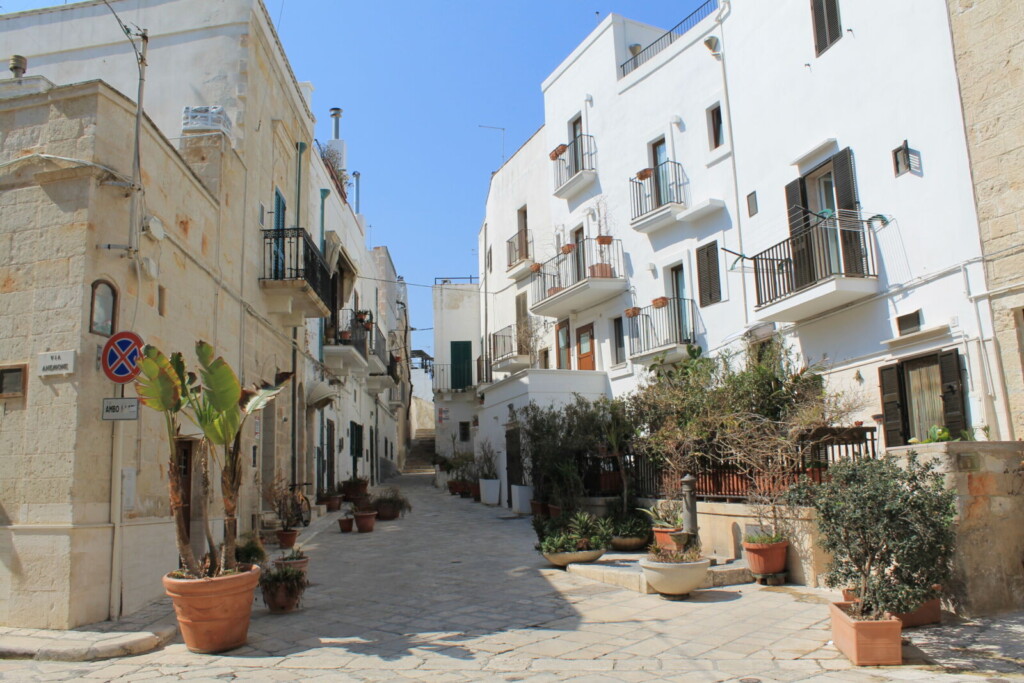
Stand on the ramparts of Otranto at dusk and you will notice something the guidebooks rarely mention: the walls beneath your feet are not one wall but four, each built by a different hand to keep out a different enemy, each layer plastered over the last as if the stones themselves were trying to forget. This is not a metaphor for Puglia. It is the literal geology of the place. Scrape at any surface here, a church façade, a dialect word, a recipe for orecchiette, and you will find sediment, not origin. The people who ask “what is truly Pugliese” are asking the wrong question of a land that has never once belonged only to itself.
The Greeks arrived first among those who left written trace, planting Taranto in the eighth century before Christ as a colony of Sparta, and with it came the olive, the vine, and a political vocabulary that would outlast the language spoken it. Magna Graecia was not decoration on an existing Italian identity; it was foundational, a transplant so total that Pythagoras taught in Crotone and the Ionian coast spoke Greek centuries before Rome had finished conquering its own peninsula. When Roman legions finally absorbed the region, they did not erase this Greek substrate so much as build atop it, laying the Via Appia and then the Via Traiana straight through Puglia’s flatlands toward Brindisi, because Brindisi was the door to the East, the last Italian harbor before the Adriatic opened onto empire. Roads are never neutral. A road built for legions is also a road built for merchants, for plague, for the slow leakage of one culture into another, and Puglia sat exactly at that leakage point, a funnel rather than a destination.
Fernand Braudel, writing La Méditerranée et le monde méditerranéen à l’époque de Philippe II in 1949, insisted that the true protagonist of Mediterranean history was never a nation but the sea itself, a geographic pressure that forced disparate peoples into repeated, involuntary intimacy. Puglia is Braudel’s thesis made into landscape. Its heel does not point toward Rome; it points toward Greece, toward Albania, toward the Ottoman world, and for centuries its fate was decided less in Italian councils than in the shifting balance of naval powers across water that Braudel called a unity but which functioned, for the people living on its shores, as a permanent exposure. When the Western Roman Empire dissolved, Puglia did not fall into some dark, undefined interlude; it fell under Byzantium, and stayed there, administratively and spiritually, for half a millennium, longer than most of Italy remained under any single subsequent power. Greek liturgy persisted in villages like Calimera and Sternatia into the twentieth century, an afterimage that modern nationalism found faintly embarrassing precisely because it refused to resolve into a tidy Italian past.
Then came the Normans, mercenaries turned kings, who by the eleventh century had carved out a kingdom that fused Latin, Greek, and Arab administrative practice with a casualness that later centuries of nationalist historiography found difficult to forgive. Roger II’s court in nearby Palermo employed Greek and Arabic alongside Latin as working languages of state, and Puglia’s cathedrals, Trani’s rose window facing the sea, Bari’s Basilica di San Nicola built to house relics stolen from Byzantine Myra in 1087, are Norman constructions wearing Byzantine and Islamic ornamental logic like a second skin. The Swabians under Frederick II followed, then the Angevins, then the Aragonese, and by the sixteenth century Puglia had become a Spanish viceroyalty, taxed from Naples, garrisoned against Ottoman raids that periodically still reached the coast, as Otranto’s massacre of 1480 brutally demonstrated when Ottoman forces put much of the town’s population to the sword. Each regime left administrative scaffolding, agricultural technique, saints’ cults, surnames. None of them asked whether they were building an identity. They were extracting value, defending a frontier, or both, and identity was simply the residue left behind when the armies moved on, which is a less flattering story than the one usually told, but a truer one.
The Silence of the Latifundio
You stand at the edge of a wheat field near Cerignola in late July, and the first thing you notice is not the gold of the stalks but the flatness of the horizon, uninterrupted for kilometers, broken only by a single farmhouse crumbling under a sky too bright to look at directly. Nobody is working the land you see. There is no shade, no tree, no human figure bent between rows, only the geometry of ownership drawn across the Tavoliere delle Puglie as if by a ruler, and you understand before anyone tells you that this emptiness was designed, that the absence of people here is not a natural condition but the result of a system built precisely to extract maximum yield from minimum presence.
The latifondo was never simply a farm. It was a jurisdiction, a miniature state within the state, where a handful of absentee landowners controlled tens of thousands of hectares while the men and women who broke the soil owned nothing, not even the tools they carried to the fields before dawn. In Puglia this arrangement persisted with a stubbornness that outlived feudalism itself, surviving the unification of Italy in 1861 and metastasizing under new legal disguises well into the twentieth century. The braccianti, the day laborers who made up the overwhelming majority of the rural population, were hired by the day, sometimes by the hour, gathered at dawn in the piazzas of towns like Cerignola or Andria in a ritual of humiliation known as the piazza della miseria, where overseers chose bodies the way one selects livestock, and those left unchosen went home to families who would not eat.
Antonio Gramsci, writing from prison between 1929 and 1935 in what would become the Quaderni del carcere, understood this arrangement as something more than an economic anomaly. In his 1926 essay Alcuni temi sulla quistione meridionale, left unfinished at his arrest, he argued that the Italian South had been reduced to a semi-colonial reservoir of labor and votes for the industrial North, its peasantry systematically excluded from political consciousness by a Church, a landowning class, and eventually a state apparatus that all had an interest in keeping the contadini fragmented, superstitious, and suspicious of collective action. Gramsci saw the intellectuals of the South, the lawyers and priests and minor bureaucrats, as a class that had betrayed the peasantry by aligning itself with Rome and Turin rather than articulating the interests of the land they came from. He was writing about Sardinia and Calabria as much as Puglia, but the mechanism he described, a subaltern class kept subaltern through the manufactured consent of its own mediators, mapped onto the Tavoliere with brutal precision.
The numbers alone testify to the violence of this arrangement. By the 1930s a handful of families in the province of Foggia controlled estates exceeding a thousand hectares each, while the average bracciante family survived on daily wages that barely covered bread and oil, and infant mortality in some agrarian towns exceeded twenty percent through the early twentieth century. The socialist agitation that erupted across the Tavoliere in the 1900s, and again after the First World War during the biennio rosso, was met not with reform but with the blackshirts of the nascent fascist squads, who found in the landowners of Puglia some of their earliest and most enthusiastic financiers, precisely because Mussolini’s movement promised to crush the leagues of laborers who had begun, for the first time, to organize.
The agrarian reform of 1950, the Legge Stralcio, redistributed land to thousands of southern families and built new borghi rurali meant to transform braccianti into smallholders, but it arrived a century too late to undo the psychological architecture Gramsci had diagnosed, and much of Puglia’s rural population had already begun the great migration north, to Turin’s Fiat factories and to Germany and Switzerland, carrying with them an internalized sense of belonging to a land considered by the rest of the nation, and often by themselves, as backward.
Ritual, Trance and the Body: Pizzica and Tarantismo
A woman lies on the floor of a farmhouse in the province of Lecce, her back arching, her hands clawing at the air as if pulling something invisible out of her own chest. It is 1959, and Ernesto de Martino is standing in the doorway with a notebook, watching what generations before him had watched and called by the same name: tarantismo, the bite of the spider, the affliction that only music and dance could cure. The musicians around her do not hesitate. They know the rhythm she needs, and they find it through trial, moving from one tempo to another until her body answers, until the convulsions organize themselves into something that looks, unmistakably, like a dance.
De Martino did not go to Puglia to confirm a legend. He went as a historian of religions trained in the school of Benedetto Croce, already suspicious of any explanation that treated peasant ritual as mere superstition to be corrected by modern medicine. What he found, and what he published in 1961 as La terra del rimorso, was not a story about spiders at all. The bite of the tarantula was a diagnosis available to women who had no other language for their condition, a symbolic wound that let them name an unbearable psychic pressure without naming its actual source, which was almost always domestic: a marriage forced, a desire denied, a loss unmourned, an authority that had crushed them into silence. The spider was never really the point. The spider was the alibi.
What makes de Martino’s work unsettling rather than merely descriptive is his insistence that this was not primitive irrationality waiting to be dissolved by progress, but a functioning cultural technology, elaborate and internally consistent, built over centuries to do something psychiatry in that period was not doing for these women at all. There was no talk therapy available to a landless laborer’s wife in the Salento countryside. There was, instead, an entire community that recognized her crisis, assembled musicians, and gave her days, sometimes an entire cycle tied to the feast of Saints Peter and Paul, in which her body was permitted to do violently what her voice was never permitted to say. The tarantata did not dance because she was possessed by joy. She danced because the alternative was to carry the unspeakable alone.
The instruments used were not incidental. The tambourine, driven hard and fast, functioned less as accompaniment than as a kind of pacing device, a way of externalizing a rhythm that the body could then follow out of its own disorder. Colors mattered too. Historically, tarantate would respond to specific colored ribbons or cloths, red or green, each supposedly tied to the type of spider that had bitten them, though what the color scheme actually did was let the ritual specialists calibrate the treatment to the individual crisis, tailoring the performance the way a physician today might adjust a dosage. This was medicine, if we allow the word to mean something broader than pharmacology, medicine performed through sound and motion instead of chemistry.
De Martino was careful never to romanticize what he saw. He was clear that the women who danced tarantismo were, almost without exception, at the bottom of every hierarchy that mattered in that world: poor, rural, illiterate, female, often unmarried past the age when unmarried became suspicious, or married into households where they held no power at all. The ritual did not liberate them from that position. It gave them, once a year, a controlled and socially sanctioned eruption, a pressure valve built directly into the culture, and then it returned them, exhausted, to the same conditions that had produced the crisis in the first place. This is the detail that keeps his account from becoming folklore nostalgia: he refused to let the dance be beautiful without also insisting that it was a symptom.
By the late twentieth century, actual documented cases of the phenomenon he studied had all but disappeared, even as the music that had once accompanied them was rediscovered, amplified, and turned into something people now attend in piazzas with a very different kind of hunger.
A vision curated by a filmmaker, not an algorithm
In this video I explain our vision
Baroque as Excess and Compensation

You stand in front of the Basilica di Santa Croce in Lecce and the stone will not let your eye rest. Griffins twist into acanthus leaves, cherubs sag under the weight of garlands, columns swarm with vegetal ornament that seems to breed as you watch, and somewhere in that riot of carved limestone a rose window opens like an eye that has stopped blinking. Nothing here is bare. Nothing is allowed to simply be a wall. The local stone, pietra leccese, is soft enough to cut like wood and hardens with exposure to air, which meant that seventeenth-century sculptors could chase decoration into every available surface with an obsessiveness that has no real equivalent elsewhere in Italy, not even in Rome, where baroque excess at least occasionally pauses for structural breath.
This is not simply exuberance. Art historians have a term for the compulsion to fill every inch of available space, horror vacui, fear of the void, and while the phrase is often used loosely, in Lecce it earns its clinical weight. The Counter-Reformation, launched at the Council of Trent between 1545 and 1563, demanded that the Catholic Church answer Protestant austerity not with argument but with sensory overwhelm. Bare Lutheran chapels stripped the divine down to text and silence; Rome’s answer, articulated through Jesuit patronage and later systematized by theorists like Giovanni Pietro Bellori, was to drown the worshipper in gold, movement, and light until doubt had no room to surface. Lecce, a provincial capital far from Roman oversight, took this logic and pushed it past persuasion into something closer to panic. The facades do not invite contemplation. They assault it.
What gets compensated for is rarely named directly, which is precisely the point of compensation as a psychological mechanism. Puglia in the seventeenth century was a periphery of a periphery, nominally under Spanish Habsburg rule as part of the Kingdom of Naples, taxed heavily, plagued by banditry, and repeatedly devastated by malaria in the coastal marshlands. The local aristocracy and clergy who commissioned these facades were not simply expressing piety; they were building proof of relevance in a place that Madrid and Rome mostly ignored except when collecting revenue. Giuseppe Zimbalo, the architect most associated with the Lecce style, worked for decades on Santa Croce’s facade, and the building’s excess reads less as confidence than as insistence, a shout aimed at a center that was not listening.
There is a pattern here that repeats far beyond Puglia and far beyond the seventeenth century: ornament as the visual language of those who suspect they are not being taken seriously. Compare it to the way baroque theatricality flourished in Naples under Spanish viceroys who needed to project imperial legitimacy they did not fully possess, or how provincial cathedrals throughout the Catholic world competed in scale and decoration precisely because they lacked the political weight of Rome itself. The anthropologist Ernesto de Martino, writing about southern Italian ritual in Sud e magia in 1959, described a culture perpetually negotiating with forces it could not control, substituting elaborate symbolic gesture for material power it did not hold. Lecce’s stonework belongs to that same negotiation, translated into limestone instead of ritual lament.
What the beauty conceals, then, is not absence exactly but insecurity dressed as triumph. Every cherub straining under its garland is doing labor, holding up not just a cornice but a claim to significance. The eye that cannot rest in front of Santa Croce is the same eye that was never meant to rest, because rest would mean noticing what lies underneath the ornament: a poor, malarial, frequently starving region on the empire’s forgotten heel, insisting through sheer carved density that it mattered. Walk close enough to the facade and you can still see the tool marks where the soft stone was pushed past reasonable limit, past what any liturgical program actually required, into something closer to a fever the local imagination could not stop having.
The Sea That Divides and Sells
In August of 1991, a cargo ship called the Vlora arrived in the port of Bari carrying more than twenty thousand people who had climbed aboard in Durrës with the improvised faith of those who have decided that anywhere else is better than here. Italian television crews filmed the hull swarming with bodies as if it were a single organism, a thing washed ashore rather than a fleet of individual lives, and the image that resulted became one of the defining pictures of postwar Italian memory precisely because nobody quite knew what to do with it. The Vlora had originally been requisitioned to bring sugar back from Cuba; it returned instead as an accidental ark, and Bari’s stadium became a holding pen where thousands were kept for days under a sun that did not care about the diplomatic incoherence unfolding beneath it. What followed was not hospitality. Most were repatriated within weeks, some by force, and the episode entered Italian political memory less as a humanitarian reckoning than as a rehearsal for every subsequent panic about who is allowed to touch this coastline uninvited.
The sea that received them is the same sea that, thirty years later, is sold by the meter to tourists from Milan and Munich and Manchester, its coves ranked and photographed and hash-tagged, Polignano a Mare’s cliffs turned into a backdrop for dives that exist primarily to be filmed rather than experienced. Nobody standing on those rocks with a phone raised is asked to justify their arrival. Nobody checks whether their crossing was legal. The sea, in this configuration, is pure amenity, a natural resource monetized through Instagram geotags and beach clubs that charge thirty euros for a sunbed within sight of the same water that, in 1991, was a wall to be scaled rather than a surface to be admired.
This is not a paradox so much as a design. Zygmunt Bauman wrote, in his late work on liquid modernity and later specifically on the refugee crisis in Strangers at Our Door, published in 2016, that mobility has become the most unevenly distributed resource of the contemporary world, available as leisure to some and criminalized as desperation in others. The water itself does not change its chemical composition depending on who enters it, but the meaning assigned to the crossing is entirely a function of the passport, the visa, the bank account waiting on the other side. A Norwegian retiree who sails into Otranto’s harbor on a private yacht is a tourist. A Kurdish family arriving in a rubber dinghy near the same coastline, as has happened with increasing frequency along Puglia’s Adriatic edge since the 2010s, is a crisis, a statistic, a line in an interior ministry report. The sea does not discriminate. The apparatus built around it does, meticulously, with the full cooperation of the same postcard industry that sells the sea’s beauty as though beauty and border were unrelated facts.
Salento’s Ionian coast, the one that markets itself hardest, the one with the whitest sand and the most curated turquoise, sits geographically closer to Albania and the Balkan corridor than most vacationers realize, close enough that the same currents that make the water clear for swimming carried, in living memory, people who were not swimming for pleasure. The region’s tourism boards do not advertise this proximity because proximity, in this framing, is only romantic when it points toward Greece or toward the idea of Greece, never toward the more recent and more inconvenient traffic. Puglia’s coastline has become skilled at this selective memory, the way a person learns to mention some ancestors at dinner parties and bury others, not because the buried ones are less real but because they complicate the story being sold to guests. The sea remembers none of this, obviously, being water, being indifferent, but the towns along it have built entire economies on the art of remembering selectively, and the tourist drinking a spritz at sunset in Gallipoli is rarely handed the version of the coastline that includes the stadium in Bari, the ship’s hull crowded with faces, the summer that made an entire nation ask, briefly and then not for long enough, what its water was actually for.
Olive Trees, Disease and the Economics of Loss
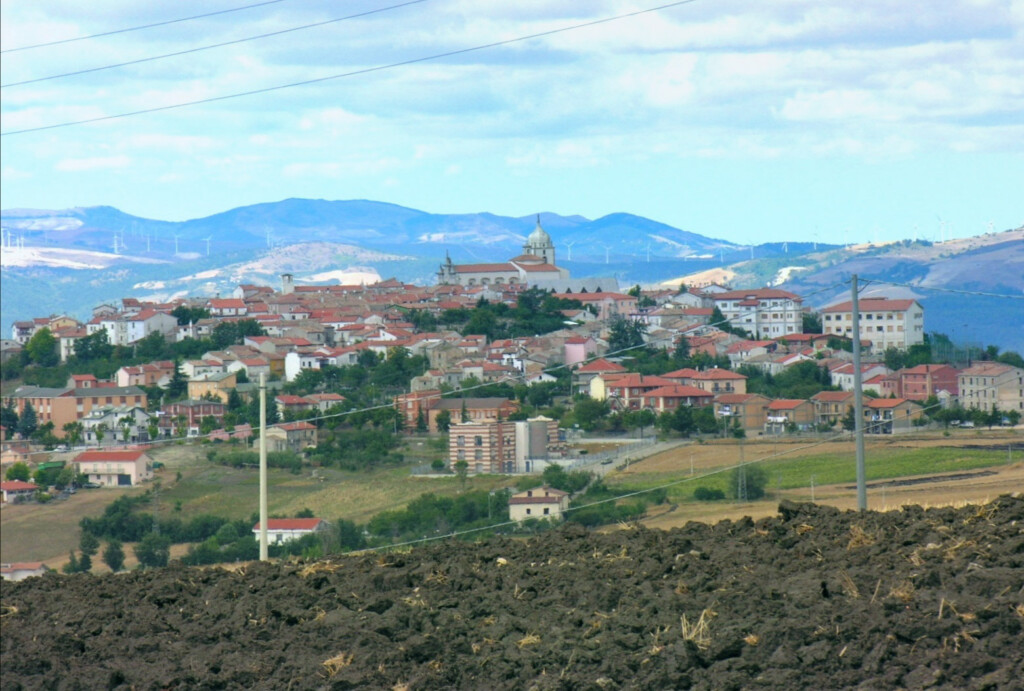
You stand in a grove near Gallipoli where the trees look like something out of a nightmare painted by a careful hand: gray, skeletal, their canopies reduced to brittle fingers clawing at a sky that no longer owes them anything. Some of these trunks are eight hundred years old, wider than a man can wrap his arms around, twisted into shapes that look deliberate, sculptural, though no sculptor ever worked this slowly. Locals call the oldest specimens monumentali, and some of them were already ancient when Puglia’s ports were sending oil to Byzantium. Now they are dead, or dying, and the killer is a bacterium most people outside Salento had never heard of before 2013, when Xylella fastidiosa was first confirmed in Italian soil. It clogs the xylem, starves the tree of water from the inside, and there is no cure, only containment, and containment has meant, in the eyes of European regulators, the mass felling of infected trees before the insects that carry the bacterium can spread it further north.
The economics of this are almost too clean, in the way that economics likes things clean. A tree that produces a modest, unpredictable yield of olives, that cannot be patented, cannot be accelerated, cannot be made more efficient through better financing or clever branding, is worth less, in the ledgers that matter to policy, than the land it occupies once that land is cleared and replanted with young, disease-resistant cultivars bred for density and speed. The European Union’s response, funneled through phytosanitary regulations, has often meant bulldozers where there were once cathedrals of bark. Farmers have chained themselves to trunks. Court cases have dragged on for years, some plaintiffs arguing the science was rushed, others arguing it was too slow, and in the middle of all this argument the trees kept dying anyway, because bacteria do not wait for court dates.
There is a way of describing this that stays within the vocabulary of agricultural crisis, and there is another way that admits something stranger is happening, which is that an entire civilization built on somewhat cyclical, somewhat patient time has run headlong into an economic logic that treats anything slower than a fiscal quarter as an inefficiency to be corrected. The olive tree is, among cultivated things, one of the slowest to reward its keeper. It can take fifteen years before a newly planted tree bears significant fruit, and it reaches its real productive maturity across decades, sometimes centuries, outliving the person who planted it by generations. This was always, historically, the point. You planted for your grandchildren. The tree was a message sent forward through time to people you would never meet, and the message was: this land will still feed you.
What capitalism does with such messages is worth sitting with, because it does not reject them outright, it monetizes their sentimental residue while liquidating their material substance. The dead monumentali have become, in death, objects of a certain aesthetic tourism, photographed by people who drive out from resort towns to look at the wreckage the way one might visit a battlefield. Meanwhile the actual economic response, the one written into subsidy structures and replanting mandates, favors intensive groves of Arbequina and Arbosana cultivars, planted in dense rows, harvested by machine, designed for a fifteen-year commercial lifespan before replacement rather than an eight-hundred-year defiance of replacement altogether. This is not a conspiracy. It is simply what happens when the underlying grammar of value is throughput, not endurance.
The grief involved is not metaphorical, though it gets treated as if it were, filed under heritage loss or landscape change, categories that let policymakers nod solemnly before returning to the spreadsheet. People who inherited these trees from parents who inherited them from parents further back are watching something die that was never supposed to be a possession in the ordinary sense, something more like a covenant, and there is no line item, no algorithm, no insurance payout structure that has ever known what to do with a covenant, because a covenant, unlike a crop, refuses to be priced.
🌾 Southern Italy: Roots, Identity and Memory
Puglia’s rich heritage is best understood alongside the broader tapestry of Southern Italian culture, where history, tradition and landscape intertwine with identity and belonging. These related pieces explore neighboring regions and the deeper cultural threads that connect Italy’s southern soul.
The Sannio: History, Culture and Traditions
The Sannio region offers a fascinating parallel to Puglia’s layered history, revealing how Southern Italy’s inland territories preserved ancient traditions through centuries of change. This exploration of Samnite heritage and rural customs illuminates the shared cultural DNA running through the Mezzogiorno.
GO TO THE SELECTION: The Sannio: History, Culture and Traditions
Torre del Greco: History and Cultural Identity
Torre del Greco‘s story of resilience against Vesuvius and its deep-rooted maritime culture echoes the same themes of endurance and identity found throughout Puglia’s coastal towns. This article examines how a single community’s history reflects the broader Southern Italian experience of adapting to a demanding yet beautiful landscape.
GO TO THE SELECTION: Torre del Greco: History and Cultural Identity
San Marco dei Cavoti: History and Curiosities
San Marco dei Cavoti represents the kind of small-town Italian heritage that mirrors Puglia’s own network of historic villages, each holding curious legends and traditions worth preserving. This piece captures the charm and cultural texture that define Italy’s lesser-known but deeply storied communities.
GO TO THE SELECTION: San Marco dei Cavoti: History and Curiosities
Southern Identity in Italian Culture
This exploration of Southern Italian identity provides essential context for understanding Puglia’s place within the broader cultural and historical narrative of the Mezzogiorno. It traces how shared history, dialect, and tradition forge a distinct Southern consciousness that Puglia embodies fully.
GO TO THE SELECTION: Southern Identity in Italian Culture
🎬 Discover More on Indiecinema
If these stories of landscape, heritage and Southern identity have captivated you, dive deeper into independent cinema that captures the authentic soul of Italy and beyond. Stream thoughtful, character-driven films on Indiecinema and discover the hidden gems of world cinema.
👉 EXPLORE THE CATALOG: Watch Indie Films in Streaming
A vision curated by a filmmaker, not an algorithm
In this video I explain our vision

