
The Weight of the Sun
You come back in August, which is the only time anyone ever comes back, and the town receives you the way it always has — with heat so dense it feels structural, like the air itself has been compressed into something you have to move through rather than breathe. The street from the station is the same street it has always been. The bar on the corner, the same three men outside it, or men so similar to the three men you remember that the difference is not worth measuring. You carry your bag up the hill and something in your body, something older than your opinions, recognizes the rhythm of it. Then your grandmother’s sister looks at you from the doorway — not unkindly, never unkindly — and in the half-second before she speaks, you feel it. The assessment. Not of what you have achieved or where you live now or how much you earn. Something older and less negotiable than any of that. She is measuring whether you are still legible. Whether you still belong to the code.

No one wrote the code down. That is the first thing to understand about it. Southern Italian identity operates through an almost entirely oral and gestural transmission, a dense network of expectations, obligations, and readings of character that have been accumulating for centuries without ever requiring documentation. The researcher Gabriella Gribaudi, in her 1987 ethnographic study of Neapolitan social structures, described this as a culture in which the community functions as a continuous archive, one where reputation is not something you build once and store but something that is recalibrated daily, publicly, through the quality of your silences as much as your speech. Your grandmother’s sister is not judging you. She is updating the file.
The south of Italy — the Mezzogiorno, a word that means literally the midday, the hour of maximum sun, the moment when shadows disappear and everything is exposed — carries within its very name the logic of what it demands from people. Visibility. Readability. The inability to hide. The geographer and social historian Robert Putnam, in his 1993 work comparing regional governments across Italy, documented what he called the dramatic civic divergence between the north and the south that had been accumulating since the Norman kingdom of Sicily in the twelfth century. His data showed that by the late twentieth century, the institutional trust in southern regions remained among the lowest in the industrialized world, not because southerners were incapable of trust, but because historically, formal institutions — the state, the law, the contract — had so consistently failed or exploited them that trust had migrated inward, into the family, the village, the face-to-face network. What looks from the outside like insularity is, from the inside, a precision instrument built for survival.
And survival is the word that detonates everything else. The south of Italy has been administered, extracted from, romanticized, invaded, and theorized about by nearly every major European power over the last thousand years. The Normans, the Swabians, the Angevins, the Spanish crown, the Bourbons, and then, after 1861, the unified Italian state, which in its first decade sent more troops to suppress southern resistance than it had deployed in the entire Risorgimento campaign. The historian Lucy Riall, writing on the construction of Italian nationhood, has shown how the south was absorbed not as a partner but as a problem — simultaneously idealized in Romantic literature as a land of ancient passion and classified in the new state’s administrative discourse as backward, criminal, biologically inferior. The psychiatrist and criminologist Cesare Lombroso published measurements in the 1870s claiming that southern Italians were anatomically closer to African populations, and these measurements circulated through official policy. The code your grandmother’s sister carries in her gaze has this inside it, compressed and unremarked, the way a tree carries the record of every drought it has survived.
The Smartphone Woman
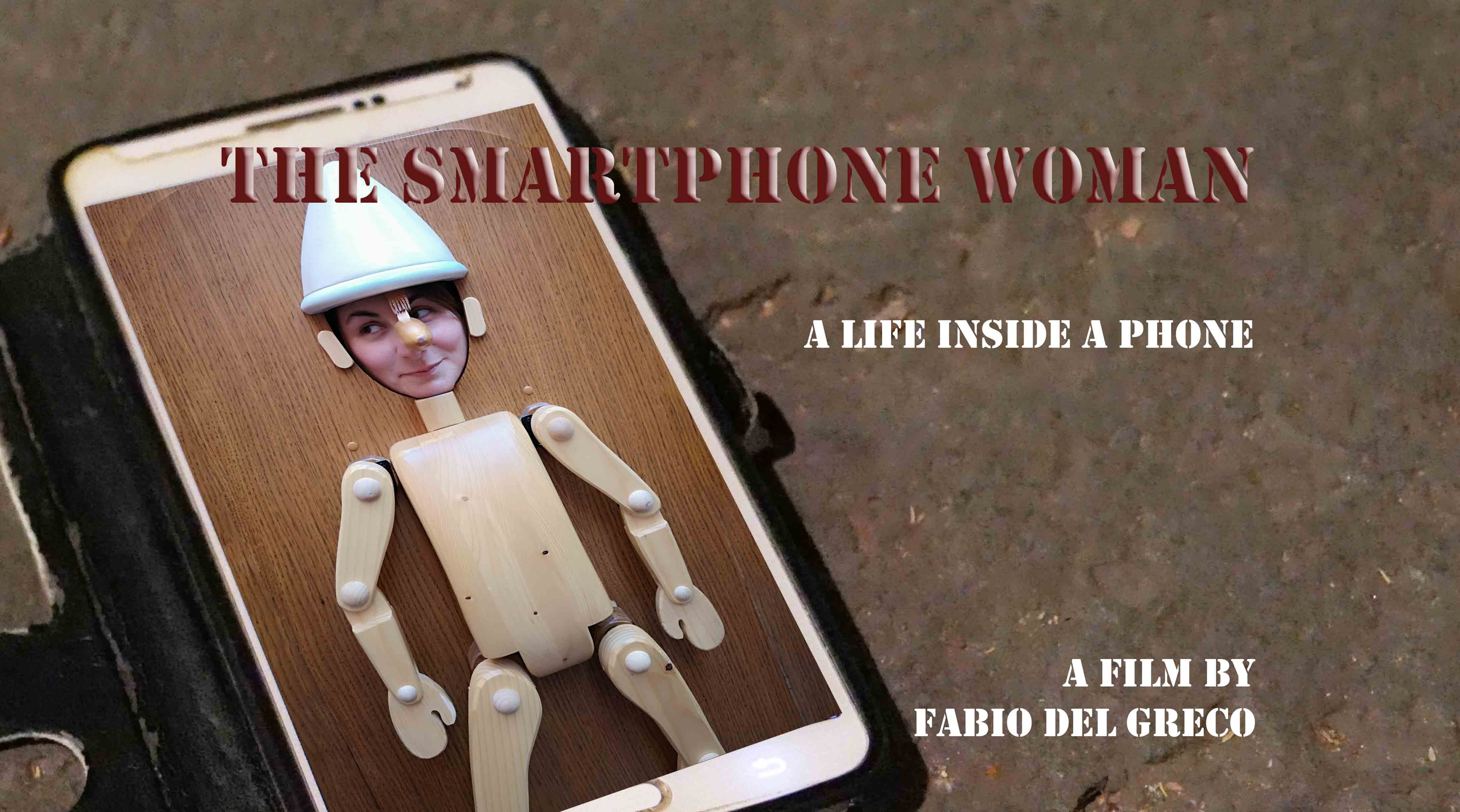
Drama, thriller, dark comedy, by Fabio Del Greco, Italy 2020.
On a bridge over the Tiber River, an elderly and severely ill man has decided to end his life, but an unusual discovery changes his mind: he comes across a lost smartphone. Intrigued, he decides to return home and watch the videos contained within it. On the screen, a series of videos unfold, telling the story of a woman who has emigrated from southern Italy to Rome to work as a teacher in schools and her struggles with integration in a social reality she cannot fully grasp.
"The Smartphone Woman" is a realistic tale of a woman's life and her complex relationship with an "infernal" city. It portrays the challenges she faces, her connection to her origins, the social discomfort she discovers in the outskirts, and the eerie presence of the ghosts of ancient Roman empire. Fabio Del Greco employs a fragmented style, using pieces of "real life" shot with the smartphone, to construct a narrative that ambiguously oscillates between fiction and truth. This creates a captivating exploration of the discomfort and alienation within the bustling city, contrasting with the peaceful village life from which the protagonist hails. The film is constructed with a variety of heterogeneous characters and situations, an emotional kaleidoscope, weaving between evenings of exploration in the Eternal City and daily struggles. Realistic smartphone-shot videos are alternated with a narrative thread reminiscent of film noir and, ultimately, surrealism in the finale. On screen, a succession of grotesque characters unfolds, representing the director's vision of a tumultuous humanity. The film's potency lies in the emotion it manages to convey and in the protagonist's naive perspective. "The Smartphone Woman" is a must-see for enthusiasts of independent and experimental cinema.
LANGUAGE: italian
SUBTITLES: English, French, German, Portuguese, Spanish
A Nation Built on a Wound
You probably learned, at some point, that Italy was unified in 1861 as an act of liberation. The word used was Risorgimento — resurgence, a rising again — and it carried the grammar of a gift. The north extending its civilization southward, stitching together a fragmented peninsula into a single, modern nation. What the textbooks tended to omit, and what the celebratory monuments never carved into stone, is that the architects of that unification spoke about the South with a revulsion they did not always bother to conceal. Camillo di Cavour, the Piedmontese statesman who more than anyone else engineered the new Italian state, described the Mezzogiorno in private correspondence as a territory so corrupted by centuries of misgovernance that it resembled Africa more than Europe. He did not mean this geographically. He meant it as a verdict.
The wound opened there, in that comparison, and it has never fully closed. What followed unification was not integration but extraction. The new Italian state imposed on the South a fiscal burden calculated in Turin and paid in Palermo and Naples: grain taxes, conscription quotas, land seizures dressed as modernization. Between 1861 and 1865, the military campaign against what the northern press called brigandage — and what southern historians have since documented as organized resistance to occupation — killed more Italians than all the wars of the Risorgimento combined. The numbers are not metaphorical. Estimates place the dead in the tens of thousands. The briganti were peasants, discharged Bourbon soldiers, and landless laborers who understood, with the clarity that hunger produces, that the new state had rearranged the furniture of power without disturbing its foundations.
Antonio Gramsci understood this with the precision of someone who had lived inside the contradiction. Born in Ales, Sardinia, in 1891, he came from the periphery of the periphery, and by the time he was writing his prison notebooks between 1929 and 1935 — incarcerated under Mussolini’s regime, his health collapsing one season at a time — he had developed a framework for the Southern Question that was as much anatomy as politics. Gramsci’s central argument was that the South was not underdeveloped by accident or by some innate cultural deficiency, but by design: it functioned as an internal colony, its agricultural surplus siphoned northward to finance industrial capitalism in Lombardy and Piedmont, its peasantry kept fragmented and pre-political by a bloc of landlords, intellectuals, and clergy whose interests aligned perfectly with those of the northern bourgeoisie. The term he used — blocco agrario — named a social architecture, not a conspiracy. It described how a system reproduces itself through the diffusion of ideology, through what he called hegemony: the capacity of a dominant class to make its particular interests appear as universal common sense.
What made Gramsci’s analysis so uncomfortable, then and now, is that it implicated not just the northern industrialists but the southern intellectuals who served as brokers of that hegemony — the lawyers, the priests, the minor functionaries who translated the logic of domination into the local vernacular and called it tradition. The Questione Meridionale, as it had been debated since the 1870s by economists and parliamentarians, was typically framed as a problem of the South: its backwardness, its fatalism, its resistance to progress. Gramsci inverted the frame entirely. The question was not what was wrong with the South, but what the construction of the South as backward accomplished for the national narrative. It accomplished a great deal. It provided the new Italian state with an internal frontier, a zone of permanent exception where the rules of citizenship could be suspended in the name of civilization, and where economic underdevelopment could be narrated as a natural condition rather than a political result.
That narration did not stay in the nineteenth century. It metabolized into culture, into jokes, into the unremarkable contempt that a northern child absorbs before they are old enough to question where it came from.

The Ethnography of Shame
You know the feeling. Someone asks where you are from, and before the words leave your mouth, something else happens first — a small interior calculation, a half-second of weighing, a decision about how much of yourself to present and in what order. For southern Italians, this pause has lasted roughly a century and a half.
Erving Goffman, writing in 1963 in Stigma: Notes on the Management of Spoiled Identity, described a process so precise it reads less like sociology and more like an autopsy. The stigmatized subject, he argued, does not simply suffer the gaze of the dominant group from the outside. They internalize it, adopt it as their own instrument of self-assessment, and begin to see themselves through the very lens constructed to diminish them. The spoiled identity is not imposed like a chain you can see and resist. It is absorbed like language, quietly, in childhood, through the texture of how adults lower their voices or straighten their posture when certain words are spoken.
What Goffman understood, and what makes his framework devastating when applied here, is that the stigmatized group rarely has access to an alternative archive of self-description that is equally prestigious, equally institutionalized, equally distributed. The Northern narrative about the South came equipped with the full apparatus of the modern state: census data, legal classifications, military reports, literary realism. The southern counter-narrative existed in dialect, in oral tradition, in the memory of communities that had been systematically excluded from the very institutions that produce legitimacy. This is not a symmetrical struggle between two competing stories. It is closer to a man arguing his innocence in a courtroom where only the prosecution is permitted to submit documents.
The result was not simply that southerners were seen as backward. The deeper wound was that many began to see themselves that way, not uniformly, not without resistance, but enough to alter the grammar of self-presentation across generations. A family that emigrates from Sicily to Turin in 1955 teaches its children to soften the accent, to avoid certain foods in public, to answer the question of origins with a vague gesture toward “the center of Italy.” This is not vanity or cowardice. This is the rational behavior of a group that has learned, empirically, that visibility carries a cost. Goffman called this practice “passing,” and he noted its particular cruelty: the energy spent managing a concealed identity is energy permanently unavailable for anything else.
There is a scene that many people who grew up in the Italian South, or in its diaspora, will recognize without being told its name. A grandfather sits at a table in a northern city. Someone makes a joke about southerners, not a vicious joke, just the habitual kind, the kind that assumes shared contempt. The grandfather laughs. Not from agreement, exactly, but from something older than agreement. From a reflex trained so early it no longer feels like a choice. From a place where shame and survival have become, over decades of practice, almost indistinguishable.
Folklore as Resistance and as Cage
There is a moment, at a southern Italian table, when the food stops being food. The hands that knead the dough, the specific ratio of semolina to water, the shape pressed with a thumb that produces a precise hollow — these are not culinary decisions. They are a form of speech. The woman doing the pressing learned it from a woman who learned it from another, and the transmission was never written down because writing was never the point. The point was continuity itself, the fact of continuing, which in certain historical conditions becomes the most radical political act available to a people.
Ernesto De Martino understood this with an urgency that was almost clinical. His 1961 fieldwork in Lucania, gathered and theorized in La Terra del Rimorso, brought him into contact with communities where the tarantella was not a folk performance but a therapeutic ritual of genuine desperation. Women, predominantly, would enter states of crisis — convulsive, dissociative, socially disruptive — and the community would respond not with medicine but with rhythm. Musicians played for days. The afflicted danced until something in them resolved, or at least quieted. De Martino called what these women were experiencing a crisi della presenza, a crisis of presence: the terrifying sensation of losing one’s own coherent self, of dissolving at the edges of identity until there is no stable ground from which to act in the world. His argument was not that these women were primitive or hysterical. His argument was that they were experiencing, in an acute and visible form, what the structural conditions of southern life produced chronically in everyone — the constant threat of annihilation by poverty, by historical abandonment, by the impossibility of projecting oneself into any reliable future. The ritual did not cure the condition. It managed it. It gave symbolic form to a suffering that had no other language.
This is where preservation becomes its own kind of trap. When a culture is consistently denied access to political power, economic mobility, and institutional legitimacy, it retreats into what it can control: the interior spaces of dialect, ceremony, food, song, and sacred practice. These become the containers of dignity. The Neapolitan dialect, for instance, carries inside it an entire cosmology of irony, resignation, and survival intelligence that Standard Italian cannot translate — not because the words are untranslatable but because Standard Italian was itself a political instrument, a tool of national unification imposed on populations who had other idioms for reality. To speak dialect was to preserve a self. But it also marked that self as provincial, as backward, as belonging to the category that the new national project defined as the problem to be solved.
The tarantella follows the same double logic. As De Martino’s work makes clear, it was a genuine technology of psychological survival, a way of metabolizing unbearable conditions through communal symbolic action. But once it became recognized — first by northern ethnographers, then by the tourism industry, then by a broader Italian cultural nostalgia — it transformed into spectacle. The crisis of presence it once processed became the performance of a picturesque suffering, consumable and therefore safe. The ritual preserved the form while the function evaporated. What remains is a dance at a summer festival, photographed, applauded, and utterly severed from the three days of continuous playing that once kept someone from disappearing entirely into herself.
Folk Catholicism operates along exactly this same edge. The cult of the local saint, the procession through village streets, the ex-voto offerings left in dim chapels — these were never simply religious acts. They were negotiations with a universe experienced as fundamentally indifferent, attempts to establish reciprocity where none was structurally guaranteed. And they encoded, in their specific forms, a refusal to be absorbed into the more abstract, centralized, and Rome-administered version of faith that the Church hierarchy preferred. To pray to San Rocco in dialect, in a particular church, on a particular day, was also to insist on the particularity of one’s existence against every force that sought to generalize it away.
The Migration and the Double Disappearance
There is a particular kind of silence that falls over a family dinner when someone asks where you are from, and the person being asked hesitates — not because they don’t know, but because the answer has too many layers to fit inside a polite conversation. That hesitation is not confusion. It is the residue of two massive ruptures that remade the southern Italian body across two separate centuries, stripping it of its geography and then, quietly, of its name.
The first rupture crossed an ocean. Between 1900 and 1915, approximately four million people left the southern regions of Italy — Calabria, Sicily, Campania, Basilicata, Abruzzo — and arrived on the eastern seaboard of the United States, in the port of Buenos Aires, in the industrial quarters of São Paulo. This was not migration in the romantic sense of departure and arrival. It was, as the historian Donna Gabaccia documented in her 1994 study “From the Other Side,” a demographic hemorrhage triggered by the post-unification tax structures that had systematically extracted wealth from the southern peasantry to fund northern industrialization. The people who left were not adventurers. They were people who had been made economically impossible in their own land. And when they arrived elsewhere, they discovered that the category “Italian” — the identity the unified state had theoretically granted them — meant almost nothing in the receiving country, while the category “southern” meant something actively shameful. The word “terroni,” which had already circulated in the north as a slur, followed them across the Atlantic in distorted form, absorbed into new hierarchies that placed Sicilians and Calabrians below northern European immigrants and far outside the social contract extended to the native-born. What this produced, over one or two generations, was not assimilation in the optimistic sense. It was erasure. Children were pushed to abandon dialect, to anglicize surnames, to perform a generic Italianness that had been constructed in the north and exported as the official face of the nation. The specific southern identity — its oral traditions, its particular relationship to land and grief and memory — dissolved into a hyphenated identity that preserved the name while emptying the content.
What both migrations share — and what makes them a single continuous story rather than two separate demographic events — is the production of a generation suspended between worlds, belonging fully to neither. The sociologist Vito Teti, writing about Calabrian identity across the twentieth century, described this condition as “la malinconia del ritorno,” the melancholy of return: the discovery, when you go back, that the place you left has continued to exist without you and no longer contains a version of you that fits. The double disappearance is not metaphorical. It names something precise — the moment when a person stops being from somewhere specific and becomes, instead, the absence of a place they can no longer fully claim.
A vision curated by a filmmaker, not an algorithm
In this video I explain our vision
When the South Became an Aesthetic
There is a particular kind of violence that arrives dressed as a compliment. You have watched it happen at dinner tables in Milan or Turin, when someone from the north leans across the wine and says, with genuine warmth, that the South is the most beautiful place in Italy, that the food is extraordinary, that people there still know how to live. The southerner sitting across from them smiles, because what else do you do with praise that has quietly removed you from the category of citizen and placed you in the category of landscape.
The repackaging began in earnest through the 1990s, accelerated by tourism campaigns, television food programs, and a new cultural economy hungry for authenticity at the precise moment that globalization was making authenticity scarce everywhere else. The South became legible to mainstream Italian culture — and to foreign audiences — as a reservoir of the preindustrial, a place where time had not quite arrived and where this delay was now, suddenly, a selling point. Gramsci had spent the 1920s and 1930s arguing that the South was not backward but systematically underdeveloped, that its condition was the product of political choices rather than cultural destiny. By the 1990s, that structural reading had been almost entirely displaced by a pastoral one. What was once diagnosed as a wound was now marketed as a feature.
This is what the French sociologist Guy Debord called the spectacle in its most insidious form: not the imposition of an alien image, but the conversion of real social conditions into images that the subjects themselves eventually adopt and perform. When a region’s poverty of infrastructure becomes “slowness” as a lifestyle virtue, when its food culture — born from scarcity, from the cucina povera that fed people through centuries of extraction — becomes a premium export commodity, when its landscapes are reproduced on olive oil bottles in specialty shops in London and New York, something has been completed that pure stigma could not accomplish on its own. Stigma at least preserves conflict. Aestheticization dissolves it.
The political subject that Gramsci tried to theorize — the southern peasant, the meridionale as a historical actor with interests, grievances, and the capacity to form alliances with the northern working class — became, through this process, a picturesque object. The meridionale stopped being someone who had been dispossessed and became someone who possessed something enviable: authenticity, warmth, a relationship with food and family and the land that the industrialized north had traded away and now wished to recover vicariously, through tourism and television and artisanal products. Edward Said, writing about Orientalism in 1978, described how the colonial gaze does not simply demean the other but also romanticizes it, producing an image so complete and so seductive that it crowds out any more complicated account. The South was not colonized in the strict imperial sense, but the structure of the gaze is recognizable. To be seen as timeless is to be removed from history. To be seen as authentic is to be frozen.
What the media acceleration of the early 2000s added was scale and speed. A southerner appearing on a national cooking program in 2003 was not representing a region with a structural unemployment rate that peaked above twenty percent in those same years. He was representing a cuisine. The suffering that produced the recipe was not part of the frame. The nonna rolling pasta in a stone farmhouse carried no memory of emigration, no echo of the land reforms that came too late and changed too little, no trace of the postwar development plans that concentrated industry in the triangle of Milan, Turin, and Genoa while the Mezzogiorno received highways that led nowhere and factories that closed within a decade. She carried a rolling pin and she was beautiful and the camera loved her and the political question her existence implied was never asked, because the aesthetic had already answered it by pretending it did not exist.
The Meridian Mind
You learn to read time differently when you have watched promises expire across generations. Not the dramatic disillusionment of a single broken contract, but something quieter and more corrosive: the slow accumulation of deferred arrivals, of development always located just beyond the next administrative reform, the next five-year plan, the next national government that would finally, genuinely, turn its attention south. A man in his sixties in Basilicata who tells you that his grandfather said the same things about Rome that he says now is not being cynical. He is being precise.
Carlo Levi arrived in the villages of Lucania in 1935 as an exile, sentenced there by the Fascist regime for his antifascist activities. What he wrote about that experience, published in 1945 as Cristo si è fermato a Eboli, was not a sociological study. It was a testimony to a different civilization of time. The peasants he lived among did not experience history as a forward-moving current they were somehow failing to catch. They experienced it as something that happened elsewhere, to other kinds of people, in a register of existence that had never quite touched them. His famous formulation — that Christ stopped at Eboli, that the Christian world of history and progress and moral accountability simply did not extend into these hills — was not a lament for backwardness. It was a description of a structurally produced relationship to modernity. These were people to whom the state had never arrived except as conscription, taxation, and punishment. Their relationship to official time, to the time of progress and nation-building, was one of radical exteriority. They had not been left behind. They had been positioned outside, deliberately, by the logic of a unification that needed their labor and their land but not their subjectivity.
What Levi intuited in narrative terms, Franco Cassano would articulate philosophically half a century later. In his 1996 work Il pensiero meridiano, Cassano refused the assumption that the South’s only legitimate ambition was to accelerate toward northern modernity. He proposed instead that the South had developed, through necessity and through long historical experience, a different epistemological posture — one that did not worship speed, that understood limits not as failures but as conditions of life, that held memory and slowness as cognitive tools rather than obstacles. He called this pensiero meridiano, Southern Thought, and he positioned it not as romantic nostalgia for rural poverty but as a counter-epistemology capable of challenging the universal pretensions of a northern developmental model that was, by 1996, beginning to show its own catastrophic costs. Cassano was writing against both the self-contempt of the modernizing South and the global ideology of frictionless growth. He was arguing that a civilization shaped by deferral, by the discipline of waiting without dissolution, had produced forms of attention and relation that the triumphant north had traded away.
The philosophical dimension here is not consolation. Fatalism, which outsiders persistently misread as passivity or defeat, is better understood as a epistemology of structural honesty. When Gramsci, writing from a Fascist prison in the 1930s in what would become the Quaderni del carcere, described the Southern peasant as someone whose practical consciousness was fractured between received folklore and the imposed ideology of the state, he was identifying a form of double consciousness produced not by personal confusion but by historical engineering. The southern mind learned to hold two temporal registers simultaneously: the official time of national progress, which required constant performance of aspiration, and the experiential time of perpetual exclusion, which knew that aspiration and arrival were not the same thing.
What does it do to a collective psyche to live in that gap, across not one generation but five or six? The question is not rhetorical. Psychologists working in the tradition of Maurice Halbwachs, whose 1925 work Les cadres sociaux de la mémoire established that memory is always a social and structural phenomenon rather than a private one, would recognize in southern Italian communities a form of collective memory organized not around triumph or even coherent trauma, but around the practiced knowledge that the calendar of official promise and the calendar of lived experience have never once aligned.
What the Mirror Does Not Show
There is a particular kind of silence that falls when you return. Not the silence of peace, but the silence of something that no longer fits — the way a key that once opened a door now turns without catching. You walk through streets you memorized before you knew what memorizing meant, and the sunlight is exactly as you described it to everyone who would listen in the gray cities of the north, and yet something in you stands at a slight remove, watching yourself be home, unable to simply be it. This is not estrangement in the clinical sense. It is something more intimate and more cruel: the recognition that the identity you defended most fiercely was constructed precisely in the distance that now makes it impossible to inhabit.
Because the myth does work. It insulates. It gives shape to a self that would otherwise have to negotiate its smallness in an economy and a culture that has never stopped measuring it. The sociologist Fortunata Piselli, studying southern kinship networks and their transplantation into northern industrial contexts, documented how the maintenance of origin identity functioned as a genuine social technology — a way of preserving trust, reciprocity, and human scale inside systems designed to dissolve them. The myth is not purely ideology. It carries real warmth. The problem is that warmth and truth are not the same thing, and the person suspended between them — fluent in the critique, still breathing the affect — cannot simply choose one without amputating something live.
What the mirror does not show is not ugliness. It shows the seam. The place where the person you had to become in order to survive the distance was stitched onto the person who left. You can feel it most clearly in the moment someone from the north says something reductive about the south and your body responds before your mind does — that heat, that readiness, that absolute refusal. It is not nostalgia. It is not false consciousness. It is the last remaining place where the distance has not yet won, and you defend it because you no longer know what you would be if you let it go.
🌿 Roots, Land, and the Soul of the South
Southern Italian identity is a complex weaving of memory, landscape, and resistance — shaped by centuries of marginalization, myth, and cultural pride. These articles explore the voices, thinkers, and narratives that illuminate what it means to belong to a place defined by its contradictions.
Antonio Gramsci: vita e pensiero politico
Antonio Gramsci, born in Sardinia and imprisoned by Mussolini’s regime, developed one of the most incisive analyses of the ‘Southern Question’ in Italian history. His concept of cultural hegemony explains how northern economic and political dominance shaped the identity — and the self-perception — of southern Italians for generations. Reading Gramsci is essential to understanding why southern identity remains a contested and deeply political terrain.
GO TO THE SELECTION: Antonio Gramsci: vita e pensiero politico
Pier Paolo Pasolini and Poetry: Language and Identity
Pier Paolo Pasolini was among the most passionate defenders of southern Italian dialects and subaltern cultures, seeing in them a living resistance to the homogenizing forces of capitalist modernity. His poetry engaged directly with the linguistic and existential reality of those living on the margins of Italian society, particularly in the rural and peripheral south. For Pasolini, language was never merely aesthetic — it was the very body of cultural identity.
GO TO THE SELECTION: Pier Paolo Pasolini and Poetry: Language and Identity
Sardinian Culture: History Traditions and Identity
Sardinian culture offers a striking parallel to broader questions of southern Italian identity, with its ancient language, pastoral traditions, and historical sense of isolation from mainland power. This article explores how Sardinia has preserved a distinctive identity rooted in oral tradition, communal memory, and a fierce attachment to land. The island stands as a microcosm of the tensions between regional pride and national integration that define the Italian south.
GO TO THE SELECTION: Sardinian Culture: History Traditions and Identity
Grazia Deledda: Life and Works
Grazia Deledda, the first Italian woman to win the Nobel Prize in Literature, gave literary voice to the Sardinian and southern world with an unflinching portrayal of fate, guilt, and redemption set against rugged Mediterranean landscapes. Her works reveal how southern identity is inseparable from a mythic relationship with the land, the community, and an ancient moral code. Deledda transforms regional particularity into universal human drama, making her one of the essential authors for understanding southern Italian culture.
GO TO THE SELECTION: Grazia Deledda: Life and Works
Discover Independent Cinema on Indiecinema
Southern identities, buried histories, and the poetry of marginal places come alive not only in books and essays, but in the most powerful independent films. On Indiecinema streaming, you can explore a curated selection of films that give voice to forgotten cultures, peripheral worlds, and the complex beauty of belonging — far from the mainstream.
👉 EXPLORE THE CATALOG: Watch Indie Films in Streaming
A vision curated by a filmmaker, not an algorithm
In this video I explain our vision

