
The Volcano as Covenant
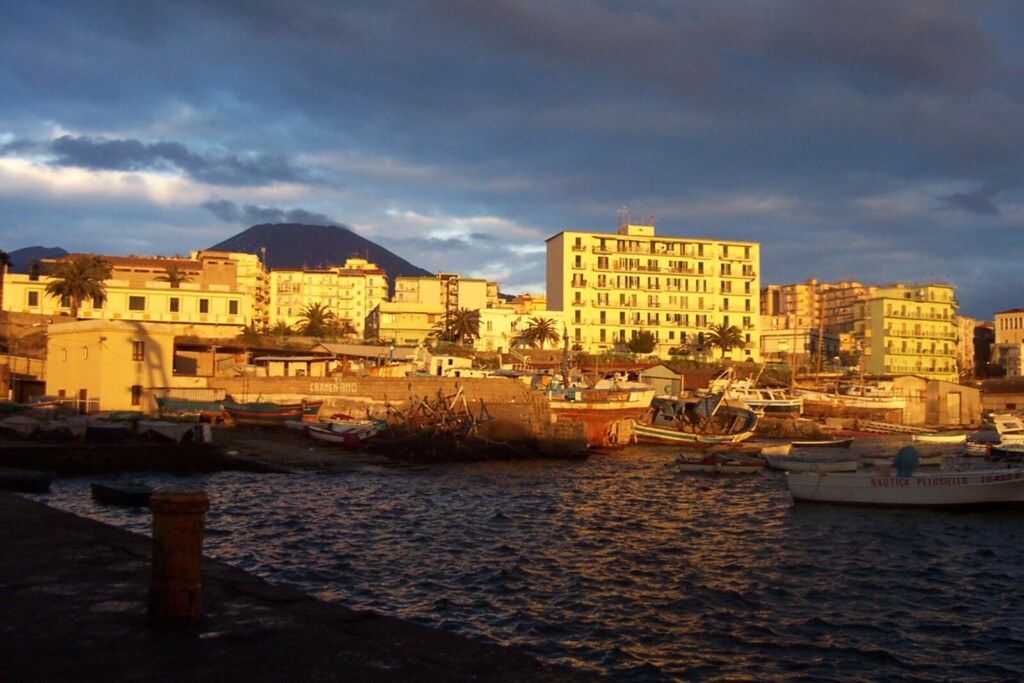
You stand on the black stone of the port and someone tells you, without drama, the way you’d mention a relative’s chronic illness, that the ground beneath your feet is compacted lava from a night in 1794 when the mountain opened its side and walked into the sea. Nobody in Torre del Greco says this like it’s remarkable. They say it while selling you coral jewelry, while parking a scooter, while hanging laundry between buildings whose foundations are, quite literally, cooled magma. This is the first thing to understand about the town: catastrophe here is not memory, it is substrate.

Vesuvius has erupted with lethal consequence at least three times in the historical record that matters to this town’s identity, but two dates recur with the insistence of liturgy: 1631, when the volcano reawakened after roughly five hundred years of dormancy and killed somewhere between three and six thousand people, burying settlements under pyroclastic flow, and 1794, when an eruption sent lava directly through the town’s streets, destroying much of it and forcing thousands into the sea in boats, fleeing a wall of fire that moved faster than they could run. Torre del Greco was, in both cases, largely annihilated. And in both cases, within a generation, it was rebuilt on the identical footprint.
This is the part that resists easy explanation, the part that psychology and sociology have spent decades trying to metabolize without quite succeeding. The geographer Gilbert White, working in the mid-twentieth century on floodplain settlement in the United States, coined what became known as the levee effect: the observation that protective measures against disaster, or even simple survival of a disaster, paradoxically increase future settlement in the danger zone, because survival itself gets misread as safety. People don’t calculate the probability of the next event. They calculate the fact that the last one is over. The volcano becomes, perversely, proof of its own harmlessness the moment it stops erupting.
Risk perception researchers, notably Paul Slovic in his work throughout the 1980s on the psychometric paradigm, demonstrated that humans are catastrophically bad at weighing low-frequency, high-magnitude events against the daily, tangible pull of home, work, kinship, and land. A volcano that erupts destructively every few generations does not compute as danger in the nervous system the way a car crash or a kitchen fire does, because dread requires proximity in time, not just in space. Vesuvius, dormant for stretches of decades, recedes from the register of threat and becomes scenery. It becomes, in fact, beautiful — the postcard silhouette behind the Bay of Naples, the thing tourists photograph rather than the thing that erased a town twice.
There is a term for this that emerged from disaster sociology, particularly through the work of scholars studying Bhopal, Chernobyl, and later the normalization framework Diane Vaughan built around the Challenger shuttle disaster in 1986: normalized deviance, the process by which a community or organization absorbs an anomaly, survives it, and thereby reclassifies it as an acceptable baseline rather than a warning. Torre del Greco did this at civilizational scale. Each eruption, instead of teaching the lesson that this ground is unlivable, taught the opposite lesson: that this ground can be survived, and therefore inhabited, and therefore loved. The catastrophe was metabolized into a kind of covenant, an unspoken contract between the population and the mountain that says: you will take houses and sometimes lives, and we will keep coming back, and this exchange is not tragedy but terms.
What looks from the outside like irrational persistence looks from inside like fidelity. The soil is rich because the volcano makes it rich. The port exists because the coastline invites it. The coral industry that would come to define the town’s economic identity grew from waters warmed and enriched by the same geology that periodically tries to erase it. You cannot subtract the danger from the gift without losing both.
Coral, Labor, and the Body as Instrument
A man descends without tanks, without gauges, wearing only a weighted rope and a knife, into water that will not forgive a miscalculated ascent. He is looking for a branch of red calcium carbonate that will be worth, once carved, more than his boat, his house, sometimes more than his life turns out to be worth to the people who send him down. This was the coral diver of the Torrese coast through the nineteenth century and well into the twentieth, a figure whose labor was never metaphorical. The body went into the sea and sometimes did not come back up, and the town built its entire self-understanding on top of that fact without ever quite saying it aloud.
Coral fishing off Torre del Greco predates industrial memory, but it was the eighteenth and nineteenth centuries that turned a coastal trade into an economic monoculture, and eventually into an identity so total that the town’s name became, in commercial catalogs from Paris to New York, synonymous with the material itself. By the 1875 founding of the Regia Scuola di Incisione al Corallo, the town had already exported its craftsmen’s cameos to European courts for generations, and the school’s creation was less an innovation than an admission: the skill had outgrown informal transmission and needed institutional armor, needed to be certified, protected, taxed. What had been a body’s private negotiation with risk became a civic asset.
The workbench inherited the sea’s violence in quieter form. Coral cutters and cameo carvers bent for twelve, fourteen hours over small wheels and blades, and the damage accumulated not in a single catastrophic dive but in the slow architecture of the spine, in eyes ruined by decades of squinting at millimetric detail, in lungs that took in stone dust the way the divers’ lungs had taken in the failure of oxygen. Richard Sennett, in The Craftsman, published in 2008, argues that skill is sedimented in the body through repetition, that the hand achieves an intelligence separate from and prior to verbal explanation, and Torre del Greco offers this thesis an unusually literal proof. A carver’s fingers knew the give of a shell before the carver could have described it. But Sennett’s craftsman is usually a figure of quiet dignity, workshop pride, the well-made object as its own reward, and this is where the town’s history complicates the philosophy rather than illustrating it.
Because underneath the pride there was extraction, and the extraction had a name. The families who owned the workshops and the merchants who exported to Livorno and Marseille built fortunes on labor that was romanticized precisely in proportion to how poorly it was paid. The nineteenth-century bourgeois traveler who purchased a cameo brooch in Naples was buying, without knowing it, a fragment of somebody’s ruined eyesight, and the mythology of the humble artisan, content with his craft, uninterested in wealth, served the buyers far better than it served the sellers. This is the trap that the sociologist Pierre Bourdieu would later map with more general tools, in Distinction, published in 1979, where he shows how taste and cultural capital launder economic hierarchy into aesthetic appreciation. The cameo became elegant. The carver remained poor. Nobody found this contradictory at the time, because dignified poverty was not yet recognized as an ideological construction; it was simply how the working world explained itself to itself.
What makes Torre del Greco specific rather than a generic case study in artisanal exploitation is the doubled physical toll, sea and bench, danger and repetition, acute risk followed by chronic wear, as if the town had organized two separate systems for consuming the same bodies. The coral itself does not care that it was harvested by drowning men and shaped by men going slowly blind. It sits in museum vitrines and private collections with a provenance label that says Torre del Greco, a place name doing the work that no individual name ever could, because the individual names were never recorded with the same permanence as the objects they made.

The Sea as Divider and Definer
A man leaves his house at four in the morning, walks down streets still wet from the night, and does not look at the volcano behind him. He looks at the water. For centuries this has been the actual orientation of Torre del Greco, a town that technically sits in the shadow of Vesuvius but that has always kept its back turned to the mountain, facing instead toward Tunisia, toward Sardinia, toward the Sicilian channel and further still, toward waters that had nothing to do with Campania at all. The coral banks off North Africa, off Sciacca, off the coasts of Corsica, were closer in the daily imagination of a Torrese fisherman than the streets of Naples twenty kilometers away. This is not a metaphor. It is a matter of economic record. By the middle of the nineteenth century, Torre del Greco had become the single most important center for coral fishing and working in the Mediterranean, sending out fleets that could number in the hundreds of vessels in a single season, manned by crews who might be gone for months at a stretch, chasing red gold along coastlines that most of their landlocked countrymen would never see.
The coral trade did something that ordinary fishing economies rarely do: it created a town oriented entirely around a substance almost nobody in it would ever wear. Coral harvested by Torrese divers was destined for workshops that carved it into rosaries, cameos, and jewelry sold in Paris, in Vienna, in markets as far as India, where red coral held particular ritual and ornamental value. The town became simultaneously hyper-local and radically international, a place where the men vanished for the season into distant waters while the women and the elderly ran a domestic economy built on waiting, and where the finished product of all that labor left immediately for elsewhere. Nothing stayed. The wealth was real, but it was transient, passing through Torrese hands on its way to adorn people who would never set foot in the Bay of Naples.
This structure had a psychological cost that the historical record only gestures toward but that the town’s own folklore preserves more honestly, in songs and superstitions about the sea taking husbands and sons, in the elaborate maritime cults that grew up around local devotions, in the specific dread attached to certain months of departure. A maritime economy of this intensity does not simply provide income; it reorganizes kinship, reorganizes time, reorganizes the emotional calendar of an entire community around absence and return. The sociologist would recognize in this the classic profile of what used to be called, in less careful language, a fishing culture, but the term flattens what was actually a hybrid: Torre del Greco produced not just fishermen but master craftsmen, cameo carvers whose workshops rivaled those of any decorative arts center in Europe, an entire guild-like structure of coral and shell working that turned a raw extraction economy into a refined artisanal one, all while the extraction itself kept the town’s men perpetually elsewhere.
The consequence was a strange doubled relationship to Naples, the regional capital that should have been the obvious cultural and administrative center of gravity for any town on this coast. Naples was close enough to dominate the region’s politics, its church hierarchy, its aristocratic patronage networks, yet Torre del Greco’s economic lifeblood ran through channels Naples barely touched. The Torrese did not need Neapolitan intermediaries to sell coral to a merchant in Livorno or Marseille; they had their own consular-style representatives, their own trade routes, their own maritime law disputes to settle in ports that had nothing to do with the Bourbon administration sitting in the capital. A town can be inside a kingdom’s borders and still function like a small autonomous republic of the sea, answerable to tides and foreign buyers before it answers to inland authority, and this is closer to what Torre del Greco actually was for the better part of three centuries.
Devotion, Ritual, and the Uses of Faith

You are standing in the crowd on a July night, sweat gluing your shirt to your back, watching grown men weep as a wooden statue of the Madonna is carried past on the shoulders of forty strangers, and you notice that nobody around you finds this strange. The lights along Via Roma have been arranged for weeks. Someone has spent money the family does not have on a new lace mantle for the statue, and no one questions why. You feel the pull of it too, an undertow beneath the noise, and you cannot tell if what moves you is faith or something older and less nameable, something that has simply borrowed faith’s clothing because it needed a vessel.
The Festa di Santa Maria del Popolo di Torre del Greco did not arrive as pure theology. It arrived, like most Mediterranean Marian cults, as a negotiated settlement between a population and a landscape that kept trying to kill it. Émile Durkheim, writing in 1912 in The Elementary Forms of Religious Life, argued that what a community worships is, structurally, itself, projected outward and given a face it can love without shame. Torre del Greco’s face is a woman who does not erupt, does not liquefy stone, does not bury vineyards under seven meters of ash the way Vesuvius did in 1794 and again in 1861. The devotion, examined coldly, looks less like communion with the divine and more like a psychological technology for metabolizing an unlivable amount of fear.
This is not cynicism, or not only cynicism. Anthropologist Ernesto de Martino, working in southern Italy through the 1950s, documented in Sud e magia how peasant communities under chronic threat developed ritual systems that functioned as what he called a crisi della presenza, a crisis of simply being present in the world, resolved through symbolic action that restored a sense of agency nobody actually possessed. You cannot negotiate with a volcano. You can process through the streets that the volcano might destroy tomorrow. The distinction between prayer and coping mechanism collapses under scrutiny, and maybe it was never meant to hold.
Consider the specific choreography of the Torre del Greco processions, which move deliberately toward the sea rather than toward the mountain. The statue faces outward, toward the water and the coral boats and the memory of men who did not come back from African diving expeditions in the nineteenth century, rather than toward Vesuvius itself, as though the town has collectively agreed not to look directly at the thing that could end it. This is not incidental staging. Sigmund Freud, in Civilization and Its Discontents, published in 1930, described how societies displace unbearable anxieties onto substitute objects that can be approached, managed, ritually contained. The sea, unpredictable but not annihilating, becomes the acceptable face of danger. Vesuvius remains offstage, worshipped by omission.
What complicates the reading, though, is that the economic function of the festival is not hidden or denied by the people who sustain it. Coral merchants, cameo carvers, restaurant owners, all understand that August devotion generates measurable revenue, that pilgrimage and commerce were never separate categories in Catholic Mediterranean life the way northern European Protestant sensibility insists they should be. Max Weber‘s account, in The Protestant Ethic and the Spirit of Capitalism from 1905, of a disenchanted, ascetic relationship to labor never took root here, and its absence is not a failure of modernization but a different architecture entirely, one in which the sacred and the transactional share the same street, the same night, the same procession route without contradiction.
The question of authenticity, then, may be the wrong question, a northern import that assumes ritual must be either sincere belief or manipulated performance, when the lived experience of the people walking behind the statue refuses that binary entirely. They know the volcano is real. They know the statue is wood and paint. They walk anyway, and the walking itself, repeated across generations, has become the thing that is true, regardless of what any individual participant privately believes about intercession, miracle, or the mechanics of grace.
Inherited Identity and the Weight of Place
A boy of fourteen in Torre del Greco can carve a cameo shell with a burin his grandfather held, can recite the year Vesuvius buried the town in 1794 and again in 1861 and again in 1906, and can tell you, almost bored, that his family has always lived under the mountain. He says “always” the way people say it when they have never tested the word against an archive. This is the peculiar inheritance of a place like this one: identity arrives pre-assembled, handed over like a shell already carved, and the question of whether he chose it, or merely wears it, rarely gets asked because the coral workshops are still open and the tourists still photograph the lava-stone streets and everyone, including him, needs the story to hold.
The sociologist Maurice Halbwachs argued in La mémoire collective, published posthumously in 1950, that memory is never a private possession but a social scaffolding, built and maintained by groups who need a shared past to justify a shared present. Torre del Greco offers a near-laboratory case of this claim, because its past was so frequently annihilated that the town had to reinvent the technique of remembering itself almost every generation. What gets passed down is not a continuous lived experience but a curated selection: the eruptions that make good narrative, the coral-diving expeditions to Torre Annunziata and the Sicilian coast that flatter craftsmanship over the more mundane centuries of fishing poverty, the papal and Bourbon patronage that dignifies the cameo trade while quietly dropping the labor exploitation that sustained it. The town does not lie about its history so much as it edits it, the way every community edits, because a livable identity cannot carry the full weight of everything that actually happened.
What complicates Torre del Greco specifically is that its economy now depends on the editing being convincing. Coral and cameo exports, concentrated through the Museo del Corallo and the workshops clustered near Piazza Palomba, generate revenue precisely because buyers in Tokyo or New York want an object soaked in continuity, want to believe their cameo connects to a lineage of danger and devotion rather than to a globalized supply chain where raw coral now arrives largely from Sardinia, Sciacca, or aquaculture farms in the Pacific because the Mediterranean beds were exhausted by the very industry the town romanticizes. The authenticity being sold is not false, exactly, but it is produced, in the sense that the philosopher Walter Benjamin gestured toward when he distinguished the aura of an original from its endless reproducibility in his 1935 essay on mechanical reproduction. A hand-carved cameo still carries labor and skill, but the story wrapped around it, the implication of unbroken tradition, is a narrative product manufactured alongside the object itself.
This does not make the identity false. It makes it functional, which is a different and more uncomfortable category. The anthropologist Eric Hobsbawm, writing with Terence Ranger in The Invention of Tradition in 1983, showed how apparently ancient customs are frequently recent constructions serving present political needs, assembled from fragments and presented as timeless because timelessness confers legitimacy that mere utility cannot. Torre del Greco’s residents are not cynically performing a script; most feel the pull of the volcano and the sea as something close to biological fact. But feeling something as ancient and it being ancient are not the same event, and the gap between them is where most inherited identities actually live, whether in a Neapolitan coastal town or in any family that tells itself it has always valued the same things.
The boy will grow up, perhaps leave for Naples or Milan, perhaps carve cameos for a living or perhaps never touch a burin again, and either way he will carry a version of this place that is neither pure invention nor unmediated truth, but something closer to a shell itself: layered, secreted slowly, hardened around an irritant it no longer remembers, worn by someone who did not make it but cannot easily set it down.
A vision curated by a filmmaker, not an algorithm
In this video I explain our vision
🏛️ Roots, Memory and Southern Identity
Torre del Greco’s layered identity, shaped by the sea, Vesuvius and centuries of craftsmanship, resonates with broader reflections on southern Italian culture, collective memory and the forces that preserve or erode local heritage. These related pieces explore the historical and psychological threads connecting a community to its past.
Southern Identity in Italian Culture
Southern Italian identity is a complex tapestry of pride, hardship and resilience, much like the story of Torre del Greco itself. This article examines how the Mezzogiorno’s cultural distinctiveness has been shaped by geography, history and social struggle. It offers valuable context for understanding towns whose identity is inseparable from their land and sea.
GO TO THE SELECTION: Southern Identity in Italian Culture
UNESCO Cultural Heritage: History and Meaning
UNESCO’s recognition of cultural heritage sites highlights the importance of preserving towns like Torre del Greco, whose artisanal traditions and historical fabric deserve protection. This piece traces the history and meaning behind international heritage frameworks. It underscores why safeguarding local identity matters on a global scale.
GO TO THE SELECTION: UNESCO Cultural Heritage: History and Meaning
The concept of generational legacy and the duty of bearing witness
The concept of generational legacy speaks directly to how coastal communities like Torre del Greco pass down craft, memory and identity across generations. This article explores the duty of bearing witness to one’s roots and traditions. It resonates with the town’s deep relationship between past and present.
GO TO THE SELECTION: The concept of generational legacy and the duty of bearing witness
The indissoluble link between historical memory and collective consciousness
Historical memory and collective consciousness are central to understanding how a place like Torre del Greco constructs its cultural identity over centuries. This piece explores the indissoluble bond between remembering the past and shaping a community’s present values. It offers a philosophical lens for appreciating local histories often overshadowed by larger narratives.
GO TO THE SELECTION: The indissoluble link between historical memory and collective consciousness
🎬 Discover More Stories on Indiecinema
If the history and cultural identity of Torre del Greco intrigued you, explore Indiecinema’s collection of independent films that celebrate forgotten places, local traditions and the quiet resilience of communities. Stream stories that dig beneath the surface of Italian identity and beyond.
👉 EXPLORE THE CATALOG: Watch Indie Films in Streaming
A vision curated by a filmmaker, not an algorithm
In this video I explain our vision

