
The Classroom as a Scene of Controlled Discomfort
You are sitting in the third row when the professor turns and looks directly at you. Not around you, not past you — at you, with the particular stillness of someone who has already decided what is about to happen. The question comes out slowly, almost gently, which makes it worse: “What do you think justice is?” You have read the material. You were paying attention. And yet the moment the question lands in the air between you, something in your chest folds inward, because you sense, without being able to name it yet, that any answer you give is going to be taken apart in front of everyone.

You answer anyway. You say something reasonable, something you half-believe, something that felt solid when you were alone with the text the night before. The professor nods — not in agreement, but in the way a surgeon nods before making the incision — and asks the next question. It is not an objection. It is something quieter and more disorienting than that. It is a question that assumes your answer was true and then pulls one thread until the whole structure begins to tremble. Within four exchanges, you are no longer defending the thing you said. You are defending the right to have said anything at all.
What is happening in that room is not primarily pedagogical. It is ontological. The student being questioned is not losing information; they are losing the comfortable distance between what they believe and what they can actually justify. That distance, it turns out, is enormous — and most of us spend our entire lives never measuring it, because no one ever makes us stand inside it under pressure and in public. The classroom in this mode becomes a space where social performance and genuine thought are forced to separate, often painfully, and the student discovers that they have been confusing fluency with understanding for years, possibly decades.
Socrates himself was not a teacher in any institutional sense. He held no chair, collected no salary, and founded no school during his lifetime. What he did, relentlessly, in the agora of fifth-century Athens, was stop people who seemed confident and ask them to explain themselves. The targets were not students — they were generals, poets, craftsmen, politicians, men who had every social reason to expect their authority to go unexamined. The method was not designed for a curriculum. It was designed to expose the gap between reputation and knowledge, and it was so effective at doing so that it eventually got its author executed. In 399 BCE, a jury of five hundred Athenian citizens voted to put Socrates to death for impiety and corrupting the youth. The method had a body count before it ever had a pedagogy.
The discomfort in that third row is therefore not incidental. It is not a side effect of poor teaching or an unfortunate byproduct of high standards. It is structurally built into any honest application of the approach, because the approach was designed from the beginning to do exactly one thing: make the person being questioned unable to continue pretending. The Greek word elenchus, which names the cross-examination technique Plato documented across dozens of dialogues — in the Meno, the Republic, the Theaetetus — translates most directly as refutation, but it carries an older connotation of shame, of being shown to yourself in a light you had been carefully avoiding.
Modern educational systems adopted the label while largely discarding the mechanism. What is called Socratic questioning in most contemporary classrooms is a managed conversation in which the teacher already knows the answer and uses questions to lead students toward it. That is not elenchus. That is theater with an educational costume, and the student in the third row, if they are perceptive enough, can feel the difference — because in the real version, the teacher does not know where it ends either.
Athens, 399 BCE: What Socrates Actually Did and Why It Got Him Killed
You are sitting across from someone who seems genuinely curious about your opinion. They ask you a simple question — what is justice, perhaps, or whether the city’s laws are truly fair — and within four exchanges you realize you no longer know what you thought you knew. You feel slightly humiliated. You feel, also, strangely awake.
This is what it meant to encounter Socrates in the agora, not in a classroom, not in a seminar room with assigned readings and a grade at the end, but in a public square where your reputation was visible to neighbors, to rivals, to the young men who trailed after this barefoot stonecutter’s son as though he were a prophet. The agora was not a neutral space. It was the civic heart of Athens, the place where commerce, politics, and social hierarchy converged in a single geography, and Socrates chose it deliberately. He did not wait to be consulted. He approached generals, poets, craftsmen, and politicians — the people who held power — and asked them to justify the foundations of that power in their own words. The humiliation was structural, not incidental.
By 399 BCE, Athens had just emerged from the catastrophe of the Peloponnesian War and the brutal oligarchic coup known as the Thirty Tyrants. The democracy had been restored, but it was a democracy operating under the specific trauma of betrayal from within its own intellectual class. Critias, the most violent of the oligarchs, had been a member of Socrates’ circle. Alcibiades, whose reckless ambition had partly destroyed the Athenian naval expedition to Sicily in 415 BCE — a campaign that cost the city somewhere between ten and forty thousand lives depending on the estimate — had also been conspicuously close to Socrates. When Meletus, Anytus, and Lycon brought their indictment, the formal charges were impiety and corrupting the youth, but the political subtext was legible to every Athenian in the courtroom: this man teaches people to question authority, and the last generation that learned to question authority burned the city down.
What the prosecution understood, and what the subsequent tradition has worked very hard to obscure, is that Socratic questioning was never separable from its political consequences. To ask a general whether he truly understands courage is to delegitimize him in front of his own soldiers. To ask a democratic politician whether he can define the good of the city is to expose the possibility that democratic process and genuine knowledge are not the same thing. Plato records in the Apology that Socrates compared himself to a gadfly, the insect that prevents a sluggish horse from falling asleep — but gadflies do not improve the horse’s performance, they cause it pain, and the horse eventually swats them dead. The metaphor was not optimistic. It was a description of an organism choosing discomfort over complacency, knowing the outcome.
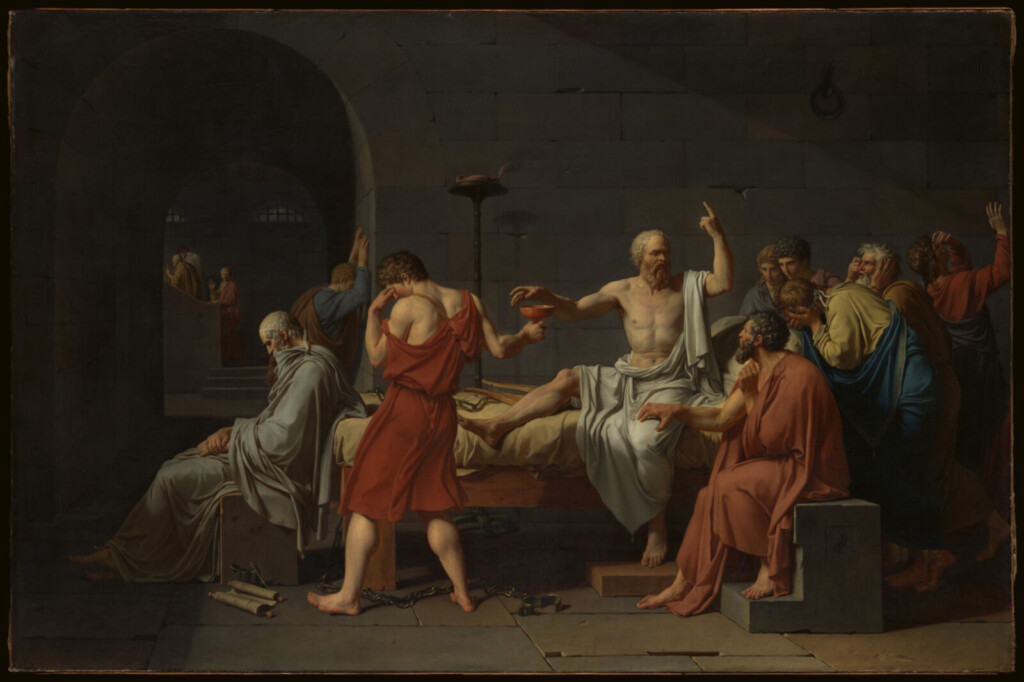
The jury of 501 Athenian citizens voted 280 to 221 to convict. When Socrates was given the opportunity to propose his own penalty, he suggested the city should pay him a stipend and provide him free meals at the Prytaneum, the honor typically reserved for Olympic champions. This was not irony in the literary sense. It was a demonstration of the method itself — a refusal to accept the premise that the verdict was legitimate, enacted in public, at the cost of his life. He drank the hemlock in 399 BCE and left behind no written text of his own, only the philosophical emergency that others would spend centuries trying to contain and classify.
Every curriculum that teaches the Socratic method as a questioning technique, as a way to stimulate critical thinking within institutional walls already endorsed by the state, is performing a kind of retroactive acquittal — declaring that what Socrates did was acceptable after all, provided it happens in a room with a door that closes at three in the afternoon.

The Paradox of the Teacher Who Claims Not to Teach
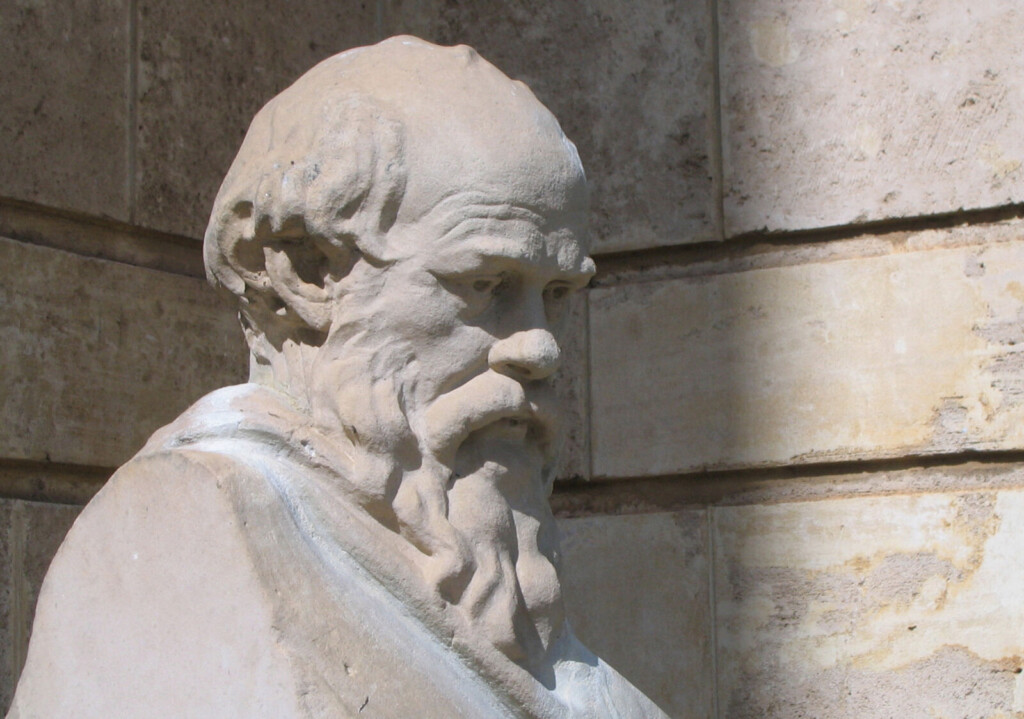
You are sitting across from someone who keeps telling you they know nothing, and yet somehow, every question they ask corners you more precisely than the last. There is no escape route they have not already closed off, no definition you offer that they have not already prepared a dismantling for. You are not in a conversation. You are in a procedure.
The figure Plato constructs in the early dialogues is not a humble man confused about virtue. He is something far more unsettling: a man who has weaponized the performance of ignorance so thoroughly that his interlocutors cannot distinguish between being helped and being hunted. In the Meno, written around 385 BCE, Socrates famously leads a slave boy through a geometric proof by asking questions alone, never stating answers. The demonstration is supposed to prove that knowledge is recollection, that learning is not transmission but excavation of what the soul already contains. What it actually demonstrates is the extraordinary control one person can exercise over another when they control the sequence of questions while pretending to control nothing at all.
The concept scholars call Socratic irony — eironeia in the Greek, meaning a kind of deliberate dissembling — was not a pedagogical accident. Gregory Vlastos, in his 1991 study Socrates: Ironist and Moral Philosopher, makes the distinction between what he calls complex irony and simple irony in Plato’s construction of this figure, arguing that Socrates simultaneously means and does not mean what he says. But Vlastos’s framework, however useful philosophically, sanitizes the social function of that dissembling. When a man of Socrates’s reputation, a man Athenians feared enough to execute in 399 BCE on charges that were partly pretextual, walks into a conversation claiming to know nothing, the claim does not level the playing field. It tilts it catastrophically in his favor. His interlocutors arrive carrying the burden of proving something. He arrives carrying only questions. The asymmetry is structural, not accidental.
The Apology sharpens this to a point most readers prefer not to touch. Standing before the jury that will sentence him, Socrates describes his mission as exposing the ignorance of those who believed themselves wise, politicians, poets, craftsmen, one by one revealed to know less than they claimed. He presents this as a divine service, a painful gift to Athens. Yet the Apology is also a rhetorical masterwork delivered to an audience of five hundred people, a performance of humility so precisely calibrated to its occasion that it produced one of the most enduring self-portraits in Western intellectual history. A man who genuinely believed he possessed no special knowledge would have had no reason to be so architecturally precise in demonstrating that belief.
What this exposes is a pattern that the history of education has never fully absorbed: the teacher who refuses the title of teacher retains all the power of instruction while evading all accountability for it. If the student reaches a wrong conclusion, the method is protected, because the teacher never told them anything. If the student reaches a right conclusion, the method is validated, because the teacher drew it out without imposing it. The structure is hermetically closed against critique from the inside. Paulo Freire, writing in Pedagogy of the Oppressed in 1968, identified the banking model of education as the dominant mechanism of intellectual control, the teacher depositing knowledge into the passive student. What Freire did not fully account for was the inverse trap: the teacher who performs emptiness, who deposits nothing, but who arranges the questions so that the student can only arrive at the destination the teacher has already chosen.
The slave boy in the Meno does not discover geometry. He is guided, step by carefully orchestrated step, to confirm a theorem Socrates already knows, by a man who will never admit to knowing it.
How Harvard Law Turned a Subversive Tool Into a Sorting Mechanism
You walk into a room of two hundred people who have been told, since childhood, that they are exceptional. The professor does not begin with a lecture. He opens a folder, scans the room with the particular patience of someone who already knows the answer, and calls a name. Not a volunteer. A name. The student stands — some schools still require this — and the questioning begins. Not to inform. To expose.
Christopher Columbus Langdell became dean of Harvard Law School in 1870 and introduced what he called the case method, a pedagogical revolution built on the premise that law was a science and its principles could be extracted through systematic interrogation of appellate decisions. His 1871 casebook on contracts was not merely a teaching tool; it was an epistemological claim — that truth emerges under pressure, through the friction of question and counter-question, and that the classroom was a laboratory where minds either clarified or collapsed. Langdell genuinely believed this. The problem is what institutions do with genuine beliefs once they discover that the same mechanism produces something far more useful than knowledge: it produces rank.
By the early twentieth century, the Socratic method at American law schools had drifted from its function as an engine of inquiry and settled comfortably into its secondary purpose as a filter. The cold-call dynamic — random, public, unannounced — creates a specific cognitive environment that psychologists now recognize as threat-based learning. A 2006 study published in the Journal of Legal Education documented measurable spikes in cortisol levels among first-year law students during cold-call sessions, stress responses physiologically indistinguishable from those triggered by physical threat. The body does not distinguish between a predator and a professor who knows you have not done the reading.
What this environment selects for is not intellectual courage. It selects for the performance of intellectual courage under conditions of social surveillance, which is an entirely different skill, and one that correlates strongly with prior class exposure to formal argumentation, debate culture, and the particular confidence that comes from never having been told your voice was inappropriate for a room. Pierre Bourdieu spent much of his career documenting this mechanism — most precisely in “The State Nobility” published in 1989 — showing how elite educational institutions convert inherited cultural capital into apparently meritocratic distinctions. The student who performs best under Socratic interrogation is rarely the student who thinks best. They are the student who was already rehearsed for exactly this theater.
Attrition data from the Langdell era is difficult to recover in its granularity, but the structural intent was visible: Harvard Law enrolled far more students than it graduated, treating the gap not as institutional failure but as proof of rigor. Between 1870 and 1895, the school’s attrition rate hovered around forty percent in the first year alone. This was not incidental. It was the mechanism. And what it sorted was not only competence but composure under a very specific form of public humiliation — a composure distributed unequally across lines of gender, race, and economic origin that the institution never officially acknowledged because the method itself appeared neutral.
The neutrality of a question is one of the most durable fictions in educational history. A question asked in front of two hundred people, by someone with the power to fail you, about material assigned forty-eight hours ago, is not a question in any Socratic sense. Socrates questioned in the agora, without grades, without transcripts, without the power to deny anyone a future career. He was also eventually killed for it, which suggests that genuine questioning has consequences — but not the bureaucratic, cumulative, quietly catastrophic consequences of a GPA that closes doors before you knew they existed.
The method survived its own distortion by becoming invisible inside it, mistaken for tradition when it had already become something closer to audition.
What Pierre Bourdieu Saw That Plato Did Not Name
You are sitting in a seminar room, third seat from the window, and the professor has just turned the question back on you. Not with hostility — with that particular brand of pedagogical warmth that expects you to perform. The room is quiet in the way rooms go quiet when everyone is relieved it isn’t them. You know something. You feel it somewhere below the level of language. But the words that would satisfy this moment, the cadence, the register, the conceptual vocabulary that signals belonging — none of it arrives. So you say nothing, and the silence is read, by everyone including you, as ignorance.
Pierre Bourdieu spent decades anatomizing exactly this moment, though he located its violence not in the professor’s intention but in the structure that makes the exchange seem natural. In Reproduction in Education, Society and Culture, written with Jean-Claude Passeron and published in 1970, he argued that educational institutions do not transmit knowledge neutrally — they reproduce the social conditions that made certain forms of knowledge prestigious in the first place. The concept he developed to describe this process, symbolic violence, refers to a domination exercised not through force but through the tacit consent of those who do not recognize themselves as dominated. The student who goes silent is not simply unprepared. The student has been taught, through ten thousand prior encounters with institutional authority, to experience their own dispossession as personal failure.
What makes this damaging for any practice styled after Socratic dialogue is that the method arrives pretending to be egalitarian. The claim is ancient and appealing: the teacher does not lecture, the teacher asks, and in asking creates a space where any mind can reason its way toward truth. What Bourdieu’s framework reveals is that this space is never empty. It is pre-structured by what he called cultural capital — the dispositions, linguistic habits, and frameworks of reference that children absorb not in school but at home, in their earliest socialization, long before any teacher ever poses a question. A student raised in an environment saturated with intellectual discourse, argumentation, and the comfortable handling of abstraction does not merely know more. That student has internalized a habitus — Bourdieu’s term for the durable system of acquired dispositions — that makes the Socratic environment feel like home. The performance of uncertainty, the willingness to think aloud, the ability to treat one’s own ignorance as an interesting problem rather than a shameful exposure: these are learned behaviors, and they are not learned equally.
The irony reaches backward into antiquity itself. When Socrates questioned the artisans and politicians of Athens, he was operating in a city where citizenship, literacy, and the leisure required for philosophical conversation were already distributed along lines of gender, class, and enslaved labor. The men who could afford to stand in the agora and be questioned were already a filtered sample of humanity. The method that claimed to expose the universality of ignorance was practiced exclusively among those whose social position allowed ignorance to be a philosophical stance rather than a social risk. Plato recorded this without apparently registering it as a structural condition worth naming.
The contemporary seminar room inherits this unexamined architecture. When a student from a working-class household, or a non-native speaker, or someone whose cultural background trained them toward deference rather than disputation falls silent under Socratic pressure, that silence is not the productive aporia Plato described in the Meno — that fertile confusion that precedes genuine inquiry. It is something closer to what Erving Goffman, in Stigma published in 1963, called a spoiled identity: the moment when a person’s failure to perform according to the dominant code becomes readable as a deficiency of the self rather than a mismatch of conventions. The method that was meant to dissolve false certainties ends up manufacturing a new one — the certainty that some minds are simply more naturally suited to thinking.
A vision curated by a filmmaker, not an algorithm
In this video I explain our vision
The Cognitive Science of Being Put on the Spot

You are sitting in a classroom when the teacher’s eyes stop moving and land on you. Not because you raised your hand. Because she decided it was your turn. Your pulse does something before your mind does — a small seismic event, a narrowing, the body rerouting blood toward the limbs and away from the prefrontal cortex, which is precisely the region you need to think. What happens next is not philosophy. It is neuroscience. And it makes a mockery of everything the Socratic ideal was supposed to produce.
The threat response — what neuroscientists call the fight-or-flight activation of the sympathetic nervous system — does not distinguish between a predator and a teacher armed with a question. What the amygdala registers is social exposure, the possibility of humiliation, the sudden awareness of being evaluated. In that state, the working memory available for complex reasoning contracts sharply. John Sweller’s cognitive load theory, developed through research in the 1980s and refined through studies published in journals like Educational Psychology Review, demonstrated that the human mind can hold only a finite number of novel elements in active processing at once. When anxiety floods the system, it does not add a new burden — it consumes the entire bandwidth. A student who might reason carefully in private becomes cognitively impoverished the moment she feels watched and assessed. The irony is precise and almost painful: the pedagogical tool designed to ignite thought is delivered in exactly the social conditions most likely to extinguish it.
Lev Vygotsky spent much of the 1920s and early 1930s, before his death from tuberculosis in 1934 at thirty-seven, trying to articulate what genuine intellectual development actually requires. His concept of the zone of proximal development — the cognitive gap between what a learner can do alone and what she can do with the right kind of support — is often quoted in education faculties and almost never applied. What Vygotsky understood, and what contemporary neuroscience has since confirmed with imaging data, is that the scaffold matters as much as the challenge. Development happens at the edge of competence, but only when the learner feels safe enough to reach. An environment structured around judgment, performance, and the constant possibility of visible failure does not create that edge. It collapses it.
What modern schools call the Socratic method is often something closer to interrogation with better intentions. The teacher already knows the answer. The questions move toward a predetermined destination. The student’s job is not to genuinely inquire but to decode what the authority figure wants to hear — a cognitive task that has nothing to do with reasoning and everything to do with social pattern recognition. When psychologist Ellen Langer, in her work on mindful learning published in 1997, described the way conditional framing unlocks genuine inquiry while absolute framing shuts it down, she was pointing at something schools almost never address: the epistemological posture of the room itself. A classroom where the teacher holds the truth and the student is measured against it is not a space for philosophy. It is a space for compliance dressed as curiosity.
The particular cruelty of this arrangement is that it misidentifies its own failures. When a student goes silent, stumbles, gives the wrong answer, or deflects with a shrug, the institution reads this as a deficit in the student — a lack of preparation, engagement, or intellectual courage. It almost never reads it as the predictable neurological result of asking a developing mind to perform open inquiry under conditions of social threat and institutional authority. The brain is not being difficult. It is doing exactly what brains do when they calculate, correctly, that the cost of being wrong in public is higher than the reward of being accidentally right.
The Question That Is Not a Question
You are sitting in a classroom where the teacher has just asked you what you think. The pause that follows feels like freedom, but the ceiling of acceptable answers was installed before you walked in. You can feel it without being able to name it — a gravitational field shaped like openness, pulling every response back toward the answer already written in the lesson plan.
The structural distinction here is not subtle, even if it is almost universally ignored in teacher training. A question designed to destabilize certainty has no predetermined destination. It is genuinely dangerous to the person asking it because it could produce an answer the questioner cannot immediately absorb or counter. A question designed to elicit a predetermined answer is a corridor with a single exit, dressed up with the furniture of dialogue. Neil Postman, in his 1969 work with Charles Weingartner, Teaching as a Subversive Activity, identified this distinction with surgical precision: he called the authentic inquiry-driven teacher a “crap detector,” someone who treats their own subject matter as a field of active suspicion rather than settled transmission. The phrase was borrowed from Ernest Hemingway, but the diagnosis was entirely Postman’s own. What he saw in American classrooms was not dialogue but a sophisticated pantomime of it, where students learned to perform curiosity in exchange for approval, and teachers learned to perform openness in exchange for institutional legitimacy.
Empirical research on classroom discourse has repeatedly confirmed what Postman named theoretically. Studies conducted by British educational researcher Douglas Barnes throughout the 1970s, particularly the observations documented in From Communication to Curriculum published in 1976, revealed that the overwhelming majority of teacher questions in secondary classrooms fell into a category Barnes called “closed” — questions to which the teacher already held the answer and evaluated student responses against it. What appeared to be discussion was, structurally, a recitation in disguise. The student who ventured an answer outside the invisible boundary was not engaged further; they were redirected. The correction was rarely stated as a correction. It came dressed as a follow-up question, nudging the student back toward the corridor’s single exit.
This is precisely where the misappropriation of Socratic method becomes not merely pedagogically inert but actively deceptive. Because the theatrical form of the Socratic exchange — the teacher questioning, the student answering, the class witnessing — is preserved, both parties leave the room believing that genuine inquiry has occurred. The student has been trained to confuse the sensation of participation with the experience of thinking. This is a different kind of damage than simple rote memorization, which at least announces its own nature. The pseudo-Socratic classroom produces graduates who are fluent in the register of critical thought without having practiced its substance, people who know how to ask questions that sound open while scanning rapidly for which answer the room will reward.
Postman understood that the problem was not individual teachers failing to execute good technique but an institutional architecture that made authentic destabilizing questions structurally irrational. A teacher whose questions genuinely undermined the curriculum’s foundational assumptions would create a classroom that could not be assessed, ranked, or reported to an administrator on a standardized form. The system does not forbid real Socratic inquiry through any explicit rule. It makes real Socratic inquiry professionally costly in ways too diffuse and incremental to point to clearly, which is a far more efficient method of suppression than prohibition.
What remains is a ritual that protects everyone involved from the one thing the original method was designed to do: produce genuine aporia, the lived experience of not knowing what you thought you knew. Socrates was executed in 399 BCE not for teaching the wrong answers but for making people feel, irreversibly, that their most confident beliefs had no foundation beneath them. No school board has ever budgeted for that outcome.
Dissent as the Only Authentic Inheritance
You are sitting in a literacy circle in northeastern Brazil, sometime around 1963, and the educator across from you is not teaching you to read — he is asking you what a well means to your village, what a plow means to your hands, what the word “land” means when someone else owns it. Paulo Freire’s circles were not classrooms in any recognizable sense. They were epistemological disruptions. His 1968 work Pedagogy of the Oppressed described what he called the “banking model” of education — the teacher deposits, the student receives — and the circles were its precise inversion: the learner’s lived reality became the curriculum, and the question was never ornamental. It was the engine. Literacy rates in the regions where these circles operated rose with a speed that alarmed the Brazilian military government enough to exile Freire in 1964, which is perhaps the most honest institutional review any educational method has ever received.
What made that possible was not a philosophy but a set of structural conditions so specific they border on unrepeatable. Freire was working outside the state apparatus, with communities whose epistemic exclusion was total and whose stakes were mortal. The question genuinely belonged to the learner because no institution had a prior interest in the answer. This is the condition that virtually every subsequent attempt to import his method into formal schooling has failed to replicate, not from bad faith, but because the moment a curriculum board ratifies the method, it owns the questions again.
The Sudbury Valley School in Massachusetts, founded in 1968, attempted something structurally adjacent. Students aged four through nineteen shared full democratic governance of the institution, including staff hiring and budget allocation. No compulsory classes existed. The assumption was that epistemic agency could not be taught — it had to be exercised, daily, in decisions with real consequences. Longitudinal studies tracking graduates into the 1990s found unusually high rates of self-directed professional lives, but the sample remained small, the population self-selected by families already disposed toward institutional nonconformity, and the model never scaled without immediately softening its most radical commitments.
Maria Montessori’s original Casa dei Bambini, opened in Rome in 1907, operated under a similar structural logic: the prepared environment replaced direct instruction, and the child’s choice of material was treated as data about their developmental readiness rather than a deviation to be corrected. What survives in contemporary Montessori franchises is the furniture and the nomenclature. The prepared environment has largely become a branded aesthetic, and the child’s choice is now gently guided toward the choices the educator has already decided are appropriate, which is indistinguishable from the system Montessori was critiquing.
The pattern is consistent enough to suggest something beyond institutional cowardice. Genuine transfer of epistemic agency appears to require that the student’s question produce real uncertainty in the educator — not performed uncertainty, not the Socratic feint of a teacher who already holds the answer, but actual not-knowing. This is extraordinarily difficult to sustain inside institutions whose social function is precisely to certify that knowledge has been transmitted correctly. The teacher who says “I don’t know, and your question has changed how I think about this” is threatening the credential that justifies their presence in the room.
What Freire, Sudbury, and the original Montessori experiments share is not a method but a willingness to absorb that threat structurally — to build an institution around the educator’s genuine vulnerability to the student’s thought. Every attempt to domesticate that vulnerability, to make it safe, to schedule it into a fifty-minute block with measurable outcomes, has produced something that looks like questioning and functions like compliance, which may mean that the authentic inheritance of Socratic dissent is not a pedagogy at all, but a political decision about who is allowed to not already know the answer.
🧠 The Art of Questioning: Philosophy Meets Education
The Socratic Method is more than a teaching technique — it is a philosophy of mind, a discipline of dialogue, and a practice of intellectual humility. These related articles explore the deep roots and living branches of philosophical inquiry, from ancient wisdom to modern pedagogy.
Epicurus: Life and Philosophy
Epicurus founded a school of philosophy built on dialogue, community, and the pursuit of a meaningful life — values that resonate deeply with Socratic ideals. Understanding Epicurus means understanding how ancient thinkers transformed conversation into a method of liberation from ignorance and fear. His garden became a living classroom long before modern education theorized such spaces.
GO TO THE SELECTION: Epicurus: Life and Philosophy
Jean-Jacques Rousseau: Life and Works
Jean-Jacques Rousseau revolutionized educational philosophy by insisting that learning must emerge from within the individual rather than being imposed from without — a conviction that echoes the Socratic belief in drawing knowledge out through questioning. His ideas on natural education and the social contract shaped centuries of pedagogical reform. Rousseau’s work remains a foundational reference for anyone exploring the history of how we think about teaching and knowing.
GO TO THE SELECTION: Jean-Jacques Rousseau: Life and Works
Søren Kierkegaard and the agony of moral choices
Søren Kierkegaard was deeply influenced by Socrates, whom he considered the greatest practitioner of indirect communication and existential awakening. For Kierkegaard, the Socratic method was not merely a logical tool but a deeply ethical act — forcing the individual to confront the weight of their own choices. His philosophy transforms the classroom dialogue into an arena of genuine moral and existential transformation.
GO TO THE SELECTION: Søren Kierkegaard and the agony of moral choices
Hadot’s Philosophy as a Way of Life: Analysis
Pierre Hadot‘s philosophy of life as practice finds a natural companion in the Socratic tradition, which always insisted that wisdom is not merely known but lived. Hadot argued that ancient philosophy was fundamentally a set of spiritual exercises aimed at transforming the self — a vision perfectly aligned with Socrates’ mission to awaken his fellow citizens. Reading Hadot alongside Socrates illuminates why the examined life remains the most radical educational ideal.
GO TO THE SELECTION: Hadot’s Philosophy as a Way of Life: Analysis
Discover Philosophy in Motion on Indiecinema
If these ideas about dialogue, knowledge, and transformation inspire you, Indiecinema’s streaming platform offers a curated selection of independent and art-house films that bring philosophical thought to life on screen. Explore documentaries and narrative films that ask the questions no textbook dares to pose.
👉 EXPLORE THE CATALOG: Watch Indie Films in Streaming
A vision curated by a filmmaker, not an algorithm
In this video I explain our vision

