
The Morning Mirror and the Missing Half
You are standing in front of the bathroom mirror twenty minutes before you have to leave, and something is wrong. Not your face. Not the clothes. Something behind the reflection, something structural, as if the person looking back at you were assembled from two halves that were never quite pressed together at the seam. You tilt your head and the feeling shifts but does not disappear. You have felt this before. Most people have, though few would know how to name it without immediately reaching for the wrong vocabulary — depression, insecurity, social anxiety, the usual pharmaceutical catalogue of modern incompleteness. But none of those names fit what you are actually seeing. What you are seeing is a gap. A constitutional absence that has nothing to do with mood and everything to do with architecture.

This is not a psychological problem. It is a historical one.
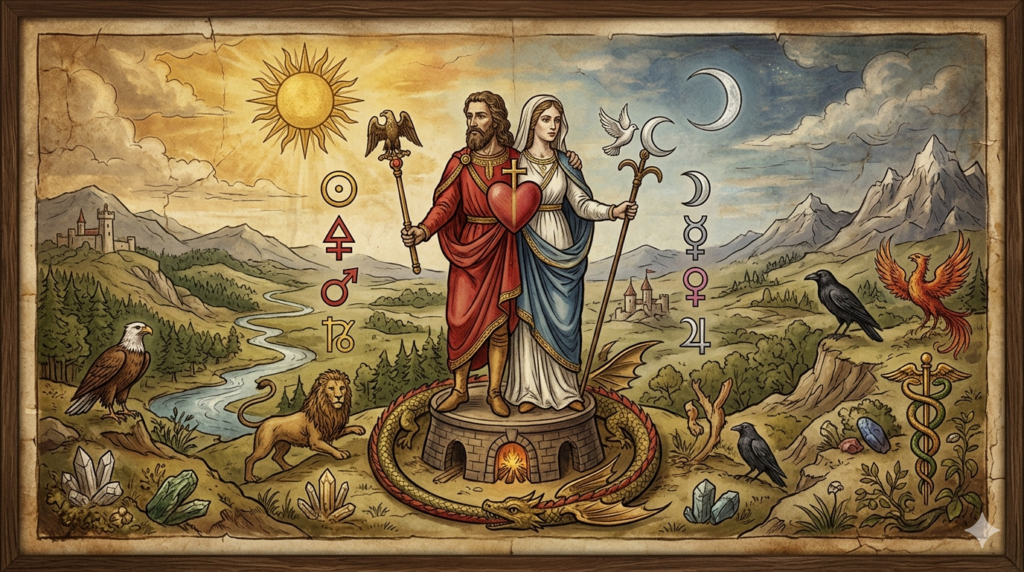
The alchemical tradition called it the Rebis — from the Latin res bina, the double thing — a single body bearing both solar and lunar principles, the masculine and feminine fused not as compromise but as completion. The woodcuts of the sixteenth century show it standing on a dragon, crowned, holding the tools of both cosmic forces simultaneously, and the expression on its single face is not triumph but simple recognition. As though it had always been whole and was merely allowing itself to be seen. The alchemists were not describing a fantasy. They were remembering something that the slow administrative violence of Western modernity had already begun to dismantle in their own lifetimes, and which would be nearly finished by ours.
Carl Gustav Jung, who spent the better part of four decades mapping the symbolic residue of alchemical thought onto the architecture of the human psyche, understood the Rebis not as a historical curiosity but as an image of what he called individuation — the process by which a person becomes genuinely themselves rather than a socially legible approximation of a self. In Mysterium Coniunctionis, published in 1956, the final major work of his life, Jung argued that the conjunction of opposites was not metaphor but psychic fact. The split between what culture designates as masculine and what it designates as feminine is not a discovery about human nature. It is an imposition upon it. And the cost of that imposition is precisely what you feel in the mirror twenty minutes before you have to leave — that wordless structural wrongness, that sense of walking out of your own house incomplete.
What modernity did, with extraordinary efficiency, was to take a spectrum and cut it in half, then hand each half to a different category of person and insist the cut was natural. The philosopher Judith Butler, in Gender Trouble published in 1990, demonstrated with clinical precision that the binary categories of masculine and feminine are not expressions of some prior biological truth but are themselves produced through repetition — through acts, gestures, performances accumulated over time until they calcify into what feels like essence. The binary is not found. It is made. And once made, it is enforced with a thoroughness that makes the original making nearly invisible.
What the mirror shows you, in that suspended moment before the social world reasserts its demands, is the enforcement. Not the freedom, not the wholeness, not the Rebis with its calm doubled gaze — but the seam where something was cut away and the wound was told to call itself a feature. The incompleteness you feel is not yours. It was installed. And it is very, very old.
Mystery of an Employee
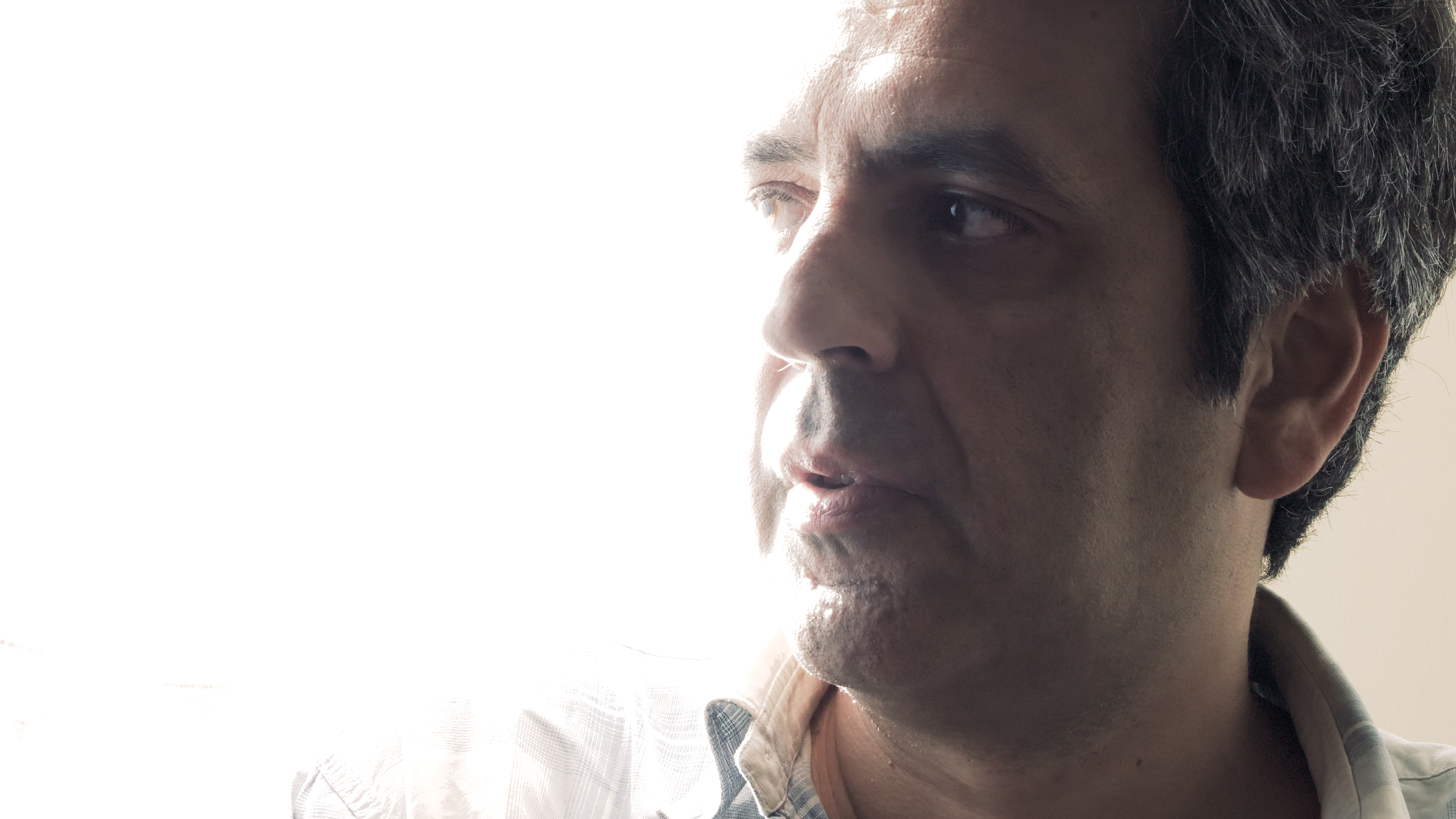
Drama, thriller, by Fabio Del Greco, Italy, 2019.
Someone wants to control the life of the employee Giuseppe Russo: the products he buys, his political and religious faith, his private life, even his dreams. But he will do anything to escape control and find his true self. Giuseppe is a man of around 45, married, with a stable job and a home of his own. His life flows seemingly peacefully when he meets a mysterious tramp who gives him some old VHS video cassettes. Giuseppe begins to see video tapes in which he is filmed in some moments of his life since he was a child, then as a teenager and as a young man. Who shot those videos that he remembers nothing about? Giuseppe has the strange sensation of being constantly observed and begins to investigate what is happening. Through his investigation of him, he begins to rediscover his true identity and become aware of who he truly is.
Employee's Mystery is a film that highlights the danger of social control and shows a society where everyone is constantly monitored and conditioned in their deepest selves. The film is also an analysis of human nature and identity. Fabio Del Greco, who plays Giuseppe, gives an engaging performance. Equally good is Chiara Pavoni, in the role of Giada Rubin and Roberto Pensa in the role of the tramp. Employee's Mystery is a film that addresses important themes in an original way, a psychological thriller that keeps the viewer glued to the screen until the end: a metaphor for contemporary society, in which people are increasingly monitored and conditioned by the media and technologies . It is a courageous and provocative work, which addresses important themes in an original way.
LANGUAGE: Italian
SUBTITLES: English, Spanish, French, German, Portuguese
Before the Cut: Androgyny as Cosmological Origin
There is a moment most people can locate if they press hard enough into the early architecture of memory — not a specific day, not a scene with clear edges, but a texture. A feeling of moving through the world as something whole, unclassified, before the sorting began. Before someone said: this part of you, yes; that part of you, no. Before the inventory.
In the alchemical tradition, this memory is not private. It is cosmological. The Rebis — from the Latin res bina, the double thing — is the figure that appears at the culmination of the Great Work: a single body bearing two faces, two natures, the solar and the lunar fused into one form. But what the alchemists grasped, and what tends to get buried under the mystical spectacle of the image, is that the Rebis is not the endpoint of a strange experiment. It is a return. A recovery of something that existed before the division was imposed.
Aristophanes understood this. In Plato’s Symposium, somewhere around 189c, he offers what is framed as a comic myth but lands with the weight of something older and more serious: the original human beings were spherical, double-faced, four-armed creatures who moved by rolling across the earth. They were of three kinds — male-male, female-female, and the androgynous, who contained both. The gods, threatened by their completeness, cut them in half. What we call desire, what we call love, is the severed creature’s search for the other half. But notice the implication that gets swallowed by the romantic reading: before the cut, there was no lack. The wound is not original. It was administered.
The Hermetic corpus, assembled in the first centuries of the common era but drawing from sources considerably older, presents Anthropos — the primordial human — as a being of dual nature who descends into matter and becomes divided into male and female only upon contact with the lower world. The Gnostic texts discovered at Nag Hammadi in 1945 extend this further. In the Gospel of Philip, the separation of Eve from Adam is described not as a biological fact but as a catastrophe: death entered the world through this division, and the work of salvation is explicitly framed as their reunion. Across texts from radically different theological lineages, the grammar is identical. Unity came first. Division is a fall.
Carl Jung spent decades trying to understand why this image kept returning, across cultures that had no documented contact with each other, in dreams, in alchemy, in mythology. His Mysterium Coniunctionis, published in 1956, is in many ways his most exhausting and most honest book — the one where he admits that the coniunctio oppositorum, the union of opposites, is not a metaphor for psychological health but a compulsion, a gravitational pull at the center of the psyche. The self, he argued, does not naturally tend toward division. Division is learned. The self tends toward integration, and when integration is blocked, it finds its way into fantasy, into obsession, into the symbolic language of alchemy precisely because that language was built to carry what ordinary discourse cannot.
The character who remembers — in fractured light, in the sensation rather than the image — moving through the world before the categories arrived. Before being told that tenderness was weakness, or that strength had a specific shape, or that curiosity about one’s own edges was a problem requiring correction. There is a before. Not an idealized before, not a paradise, but a state of undifferentiated possibility that existed prior to the moment someone handed you the scissors and said: here, start cutting.
That moment was not innocent. It was an instruction. And the instruction, once internalized, becomes invisible — which is precisely when it does its deepest work.

The Sword That Named Us: How the Binary Was Legislated into Flesh
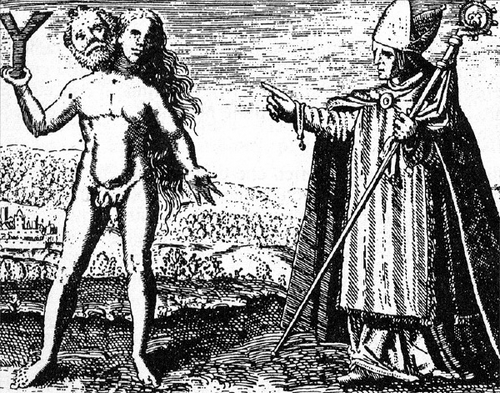
Someone is getting dressed in the morning. Not choosing clothes — performing a calculation. Which shoes say competent without saying threatening. Which shirt says approachable without saying weak. The hands move through the wardrobe with the practiced efficiency of someone who learned this choreography so early they no longer remember the rehearsal period. By the time they reach the street, the costume is so perfectly fitted to the body that neither the wearer nor anyone watching can locate exactly where the person ends and the performance begins. This is not vanity. This is survival mathematics, learned before language.
What most people do not know — what has been carefully kept from becoming common knowledge — is that this exhausting daily theater was not always necessary. Not because some golden age of freedom preceded it, but because the very conceptual architecture that makes the performance mandatory is younger than we assume, and was built for reasons that had nothing to do with truth.
Thomas Laqueur’s Making Sex, published in 1990, documents something that should have destabilized every medical school curriculum and every theology department it touched: for most of Western history, from antiquity through the early modern period, European medicine operated on a one-sex model. Women were understood as men with their genitalia inverted inward — lesser, colder, incomplete, but not categorically different. The binary we now treat as biological bedrock, the sharp legislative wall between masculine and feminine as two distinct and opposite natures, did not emerge from new anatomical discovery. It emerged around 1800, when Enlightenment rationalism needed a natural justification for political arrangements that were becoming increasingly difficult to defend on purely theological grounds. The two-sex model was not discovered. It was commissioned.
This is the sword that named us. Not God’s word, not nature’s blueprint — a set of ideological requirements that needed a biological signature, and found physicians willing to provide one. Once the body was divided into two clearly opposing territories, everything built on top of that division — law, inheritance, labor, education, desire itself — could claim the unassailable authority of anatomy. The map was drawn first. The territory was declared to match it afterward.
What Judith Butler would later call performativity is not, as its detractors insist, a claim that gender is merely pretend, something one could shrug off like a coat. It is something far more unsettling: the recognition that gender becomes real precisely through its repetition, that the performance is so continuous and so collectively enforced that it produces the very interiority it claims to express. The person at the wardrobe is not hiding a true self beneath the costume. They are, through the act of dressing, constituting a self that will then feel original, private, essential. The prison is built from the inside out, by the prisoner, who has been given no other architectural plan.
The nineteeth century added a medical layer to the theological and juridical ones already in place. Androgyny, which had circulated for millennia as a symbol of wholeness, divine completion, the philosopher’s promised resolution, was reclassified as pathology. Inversion. Degeneration. A literature of case studies accumulated, each one a small act of enforcement dressed in the language of diagnosis. The hermaphrodite, who had once appeared on Roman coins and alchemical engravings as an emblem of cosmic totality, was now a problem requiring surgical correction, psychiatric management, legal clarification.
What the Rebis had encoded as aspiration — the integration of opposing forces into a unified, generative whole — the modern state could not afford to permit as lived reality. A person who embodied both could not be taxed, conscripted, married, or disinherited according to rules written for only two kinds of bodies. The symbol had to be killed before the body expressing it could be disciplined into legibility.
The Opus and the Wound: Alchemy as Psychological Surgery
There is a man sitting in a car in a parking garage, engine off, unable to move. A piece of music came through the radio — something orchestral, something he could not name — and it hit him in a place he has no language for. He is not sad about anything specific. He has not lost anyone recently. His life is, by most measures, functional. And yet he is weeping with a force that frightens him, weeping the way people weep when they finally say the thing they have been holding for twenty years. He will tell no one about this. He will sit until it passes, then walk into whatever building he was heading toward, and the episode will be filed under inexplicable, under embarrassing, under nothing.
What happened to him in that parking garage was not a malfunction. It was a visit from the part of himself that was surgically removed so long ago he cannot remember the operation.
Mircea Eliade, writing in The Forge and the Crucible in 1956, argued that the alchemical tradition was never essentially about chemistry or even about spiritual elevation in the conventional sense. It was about restoration. The metals in the furnace were not being improved — they were being returned to a state of wholeness that preceded their differentiation. The prima materia, that formless and degraded substance with which every alchemical work begins, is not raw material waiting to become something better. It is the original unity in its fallen, fragmented condition. The work of alchemy is the work of remembering what was whole before it was divided.
The nigredo — the blackening, the first stage — is not depression as pathology. It is the moment when the divisions the psyche has maintained through enormous effort begin to crack. The man in the parking garage is in nigredo. Something in him has stopped holding. The albedo that follows is not peace — it is the terrifying clarity that comes when you see what you amputated and why. A woman in her late thirties, in the middle of an ordinary argument, discovers a rage so pure and structural that it does not feel like anger at the person in front of her. It feels like anger at an entire architecture. She was never permitted to own this feeling. Fury was not in her permitted repertoire — it was coded as unfeminine, as dangerous, as a symptom of something wrong with her rather than a response to something wrong with the world. The rage, suppressed for decades, did not disappear. It calcified. It became posture, became apology, became the chronic smallness she mistook for her personality.
James Hillman, in Re-Visioning Psychology published in 1975, made an argument that should have reorganized the entire field and largely did not: the soul is inherently multiple. It does not have a singular, unified nature that therapy should help it achieve. It is populated, layered, internally contradictory, and this is not a problem to be solved but a condition to be inhabited. To force the psyche into a singular gender identity — into one prescribed emotional range, one permitted set of desires and vulnerabilities — is not socialization. It is amputation. And amputees, Hillman understood, feel the missing limb for the rest of their lives. The phantom pain is not imaginary. It is the nervous system’s faithful record of what was there.
There is a moment that sometimes happens between two people who have each done enough of this work to be dangerous in each other’s presence. They are talking about something ordinary and then they are not talking about something ordinary at all, and they each see in the other’s face the specific quality of recognition that only comes from mutual excavation. Not attraction exactly, or not only. Something older. The rubedo — the reddening, the final stage — is not completion. It is the moment the severed halves begin to remember each other’s heat.
The Figure That Cannot Be Filed: Living as Rebis in a Binary World
The form arrives in the mail and there are two boxes. There have always been two boxes. You stand at the kitchen counter with a pen in your hand and the fluorescent light doing what fluorescent lights do, and you understand in your body before you understand in your mind that the form was not designed for you. It was designed for a category, and you are not a category. You are a person. The distinction, in bureaucratic terms, is irrelevant.
Anne Fausto-Sterling documented in Sexing the Body in 2000 that intersex conditions — chromosomal, gonadal, hormonal, anatomical variations that do not fit the standard definitions of male or female — occur in approximately 1.7% of live births. That is not a rounding error. That is a population. It is larger than the population of New Zealand, larger than the number of people who share a dozen minority characteristics that societies have learned, however imperfectly, to accommodate. And yet the form still has two boxes. The hospital still has two wards. The school still has two changing rooms. The social infrastructure was not built around what is true. It was built around what is convenient to administer.
There is a scene that belongs to many lives simultaneously. A person sits across from a doctor who is kind, genuinely kind, and the doctor explains that the recommended course of action is surgical, that it is better to resolve these ambiguities early, that children adapt. The word ambiguity is used as though it names a problem rather than a condition of reality. The surgery happens. The adaptation is demanded. What is lost in the resolution is never catalogued because it was never officially acknowledged to have existed. You cannot grieve what the record says was never there.
Non-binary gender identities are not a contemporary invention. The Hijra of South Asia have a documented history spanning millennia, recognized in the Kama Sutra and in Mughal court records. The Bissu of the Bugis people of Sulawesi represent a fifth gender category with specific ceremonial and social functions. The Two-Spirit traditions of numerous Indigenous North American nations were recorded by European colonizers in the sixteenth and seventeenth centuries, usually with revulsion, occasionally with bafflement, always with the certainty that what they were witnessing was deviance rather than cosmology. Every continent, every era, every civilization that looked carefully enough found the same thing: the binary was a simplification, not a description.
Carl Jung spent decades trying to articulate what he called the syzygy, the paired opposites within the psyche, and concluded in Aion in 1951 that the self could not be whole while it remained divided against its own complexity. The alchemical Rebis he studied was not a curiosity from medieval manuscripts. It was a map of something the psyche already knows and social life keeps trying to unlearn. The philosopher Paul Ricoeur argued that narrative identity — the story we tell about who we are — is always under construction, never finished, always incorporating what resists easy integration. To live at the threshold is not to be incomplete. It is to be honest about what completion actually costs.
The person with the pen at the kitchen counter eventually checks a box. Not because the box is true, but because the form requires it, because the insurance requires the form, because the hospital requires the insurance, because survival requires the hospital. The Rebis was never a paradise lost, some hermaphroditic Eden before the fall into gender. It was always the permanent condition of consciousness itself — fluid, doubled, irresolvable — and civilization has spent its entire recorded history building bureaucracies to paper over the fact that the cut it keeps trying to make never fully heals.
A vision curated by a filmmaker, not an algorithm
In this video I explain our vision
⚗️ The Sacred Union: Alchemy and the Mystery of Opposites
The Alchemical Rebis — the divine hermaphrodite born from the union of Sol and Luna — stands at the very heart of the Great Work. To understand this primordial androgyne is to journey through the deepest symbols of transformation, gender, and spiritual wholeness. The articles below trace the living roots of this mystery across philosophy, psychology, and esoteric tradition.
Magnus Opus: nigredo albedo rubedo
The Magnum Opus unfolds through three sacred stages — nigredo, albedo, and rubedo — each mirroring the death and resurrection that the Rebis embodies. The blackening, the whitening, and the reddening are not mere chemical operations but initiatory passages of the soul. Understanding these phases illuminates why the androgyne appears only at the culmination of the alchemical process, as the perfected synthesis of all opposites.
GO TO THE SELECTION: Magnus Opus: nigredo albedo rubedo
Jungian Alchemy: Jung and Alchemical Psychology
Carl Gustav Jung recognized in the Rebis one of the most powerful symbols of the unconscious — the coniunctio oppositorum, or union of opposites, which he saw as the true goal of individuation. His lifelong engagement with alchemical imagery revealed that the hermaphroditic figure was not a curiosity of medieval chemistry but a map of psychic wholeness. Jungian alchemy remains one of the most illuminating lenses through which the Rebis can be understood in the modern world.
GO TO THE SELECTION: Jungian Alchemy: Jung and Alchemical Psychology
Robert Fludd: Macrocosm Microcosm and Alchemy
Robert Fludd‘s magnificent cosmological diagrams placed the harmony of macrocosm and microcosm at the center of alchemical thought, providing a visual and philosophical framework in which the Rebis naturally dwells. His Utriusque Cosmi Historia depicted the human being as a mirror of the universe, male and female principles woven into the very fabric of creation. Fludd’s work offers an indispensable context for grasping why the primordial androgyne was considered the living image of divine totality.
GO TO THE SELECTION: Robert Fludd: Macrocosm Microcosm and Alchemy
Spiritual Alchemy: Inner Transformation and Symbolism
Spiritual alchemy transforms the outer language of metals and furnaces into an inner vocabulary of purification, death, and rebirth — the same vocabulary that gives the Rebis its deepest meaning. The androgyne is above all a symbol of the soul that has reconciled its divided nature and returned to its original, undivided state. This article illuminates the symbolic architecture that makes the Rebis not merely an alchemical curiosity but a timeless icon of human spiritual aspiration.
GO TO THE SELECTION: Spiritual Alchemy: Inner Transformation and Symbolism
Discover the Alchemy of Independent Cinema
The search for wholeness — the very quest embodied by the Rebis — resonates through the greatest works of independent and visionary cinema. On Indiecinema streaming you will find films that dare to explore transformation, mystery, and the hidden depths of the human soul. Step beyond the ordinary and let independent cinema be your own Great Work.
👉 EXPLORE THE CATALOG: Watch Indie Films in Streaming
A vision curated by a filmmaker, not an algorithm
In this video I explain our vision

