
The Alchemist’s Mirror: When the Universe Looked Back
You catch yourself in the glass somewhere around eleven at night, the kitchen dark behind you, the window turned mirror by the absence of light outside. For a moment — just a moment — you do not recognize what you are looking at. The face floats there, partially transparent, superimposed over the black garden, the distant streetlamp, the smear of cloud across whatever stars are visible tonight. You are inside and outside simultaneously. You are the room and the night. The reflection holds you with an odd gravity, as though something in the glass is trying to tell you something it has been trying to tell you for a very long time.

This is not a mystical experience. This is Tuesday. This is the ordinary vertigo of being a body in a world too large to comprehend and too intimate to escape.
Robert Fludd understood this vertigo not as a symptom of confusion but as the most precise form of knowledge available to a human being. Born in Bearsted, Kent, in 1574, he spent the better part of his intellectual life — which was considerable, stretching across medicine, music theory, theology, natural philosophy, and what his contemporaries called occult science — insisting on something that the modern mind has trained itself to dismiss as metaphor: that the human body is not merely similar to the cosmos but is structurally identical to it. Not analogous. Identical. The same ratios, the same tensions, the same hierarchies of force operating at every scale from the circulation of blood to the rotation of celestial spheres.
He was a physician by profession, trained at Oxford, where he received his Bachelor of Arts in 1596 before spending six years travelling through France, Spain, Italy, and Germany, absorbing the Paracelsian and Neoplatonic currents that were reshaping European natural philosophy from within. He returned to England, completed his medical doctorate at Christ Church in 1605, and eventually became a fellow of the College of Physicians — a position that gave him just enough institutional respectability to spend the rest of his life producing works that made his colleagues profoundly uncomfortable. His major opus, the Utriusque Cosmi Historia, begun in 1617 and never fully completed, runs to thousands of pages across multiple volumes and amounts to a single sustained argument: look at yourself long enough and you will see the universe looking back.
What Fludd was drawing on was not invention but inheritance. The correspondence between macrocosm and microcosm had roots reaching back through Paracelsus, through Pico della Mirandola’s Oration on the Dignity of Man from 1486, through the Neoplatonist Marsilio Ficino and his translations of the Hermetic corpus commissioned by Cosimo de’ Medici in 1463, all the way to the ancient claim embedded in the Emerald Tablet that what is above is like what is below. But Fludd was doing something more than repeating tradition. He was insisting that this correspondence was not poetic decoration. It was medical fact. It was the operating principle of the universe, and any physician who ignored it was practicing in the dark.
The philosopher Ernst Cassirer, writing in The Individual and the Cosmos in Renaissance Philosophy, identified this period as one in which the boundary between symbolic thought and empirical investigation had not yet been enforced — not because Renaissance thinkers were naive, but because they were working from a different premise about what counted as evidence. For Fludd, the fact that the human heart occupied the same structural position in the body that the sun occupied in the Ptolemaic cosmos was not a coincidence requiring explanation. It was the explanation. The pattern was the proof.
Stand again at that dark window. The face looking back at you is not simply your face. According to the system Fludd spent his life elaborating, it is a compressed diagram of everything that exists — the tides, the mineral strata, the angelic hierarchies, the elemental warfare between fire and water that produces weather, digestion, desire, and disease. The reflection is accurate. The problem is only that we have forgotten how to read it.
Robert Fludd and the Architecture of Everything
There is a kind of mind that arrives precisely at the wrong historical moment, or perhaps the only possible one. Robert Fludd was born in 1574 in Bearsted, Kent, into a family of sufficient means to educate him thoroughly and send him across Europe for six years of travel and study that would leave permanent marks on everything he later wrote. He returned to England, took his medical degree at Oxford, and began practicing as a physician, eventually becoming a fellow of the College of Physicians in London. From the outside, a respectable career. From the inside, something else entirely: a man systematically attempting to hold the entire universe together with his bare hands before it could fall into the pieces that would become modernity.
The project he launched in 1617 under the title Utriusque Cosmi Historia — the History of the Two Worlds — was nothing less than a total encyclopedic vision, a structured account of both the macrocosm and the microcosm, the great universe and the human being, and of every possible correspondence threading between them. The publication continued through 1621, sprawling across volumes dense with elaborate engravings, geometric diagrams, musical theory, medicine, astrology, and sacred geometry. It was not a compendium in the modern sense, the kind of thing that gathers facts and files them. It was an argument — that everything is continuous, that the world forms a single living body whose organs correspond to one another across every scale of existence, and that to understand any part of it you must understand the whole.
This was not an eccentric position in 1617. It was the last coherent expression of a tradition stretching through Paracelsus, through Ficino, through Pico della Mirandola’s nine hundred theses, through the Hermetic texts that Cosimo de’ Medici had prioritized for translation over Plato himself because he believed them more urgently necessary. Fludd was the last great systematic voice of a worldview that had organized European intellectual life for at least two centuries. But he was making his argument precisely as the foundations were being pulled out from beneath it.
Johannes Kepler, whose laws of planetary motion were being formulated at roughly the same time, engaged Fludd in direct and sometimes contemptuous polemic. Their exchange, published in the appendix to Kepler’s Harmonices Mundi in 1619, is one of the defining confrontations of the period — not simply a disagreement between two men, but a collision between two entire ways of knowing. Kepler wanted number as measurement, as mathematical law governing physical reality. Fludd wanted number as symbol, as resonance, as the living signature of divine proportion embedded in matter. Neither man was entirely wrong. Neither man could understand what the other meant.
Marin Mersenne, the French theologian and natural philosopher who was simultaneously in correspondence with virtually every major scientific mind in Europe, attacked Fludd sharply, accusing him of magic, of substituting mystical analogy for rigorous demonstration. Mersenne represented the emerging consensus that would become the scientific revolution: that explanation must be mechanistic, that causes must be proximate and physical, that the universe does not mean anything beyond what it does. Fludd’s universe, saturated with meaning at every level, was precisely what this new sensibility needed to expel in order to constitute itself.
The Rosicrucian question complicated everything further. When the Fama Fraternitatis and the Confessio appeared in 1614 and 1615, announcing the existence of a secret brotherhood of universal reformers, Fludd was among the most prominent figures to respond sympathetically and publicly. Whether he was ever in contact with any actual Rosicrucian circle, whether such a circle even existed in any organized form, remains genuinely unresolved. What matters is the position it placed him in: publicly aligned with a movement that promised the integration of spiritual and natural knowledge at the very moment when European intellectual culture was deciding that such integration was either impossible or dangerous.
He was not a marginal figure muttering at the edges of real thought. He was standing directly at the fracture line, watching it open.

The Body as Universe, the Universe as Body
There is a moment — and almost everyone has experienced it at least once — when you look at your own hand and it stops being yours. The fingers become strange instruments, the skin an unfamiliar membrane, the blue lines beneath it a system of rivers belonging to some other geography entirely. It lasts only a second or two before the mind reasserts ownership and closes the gap. But in that second, something true passes through you.
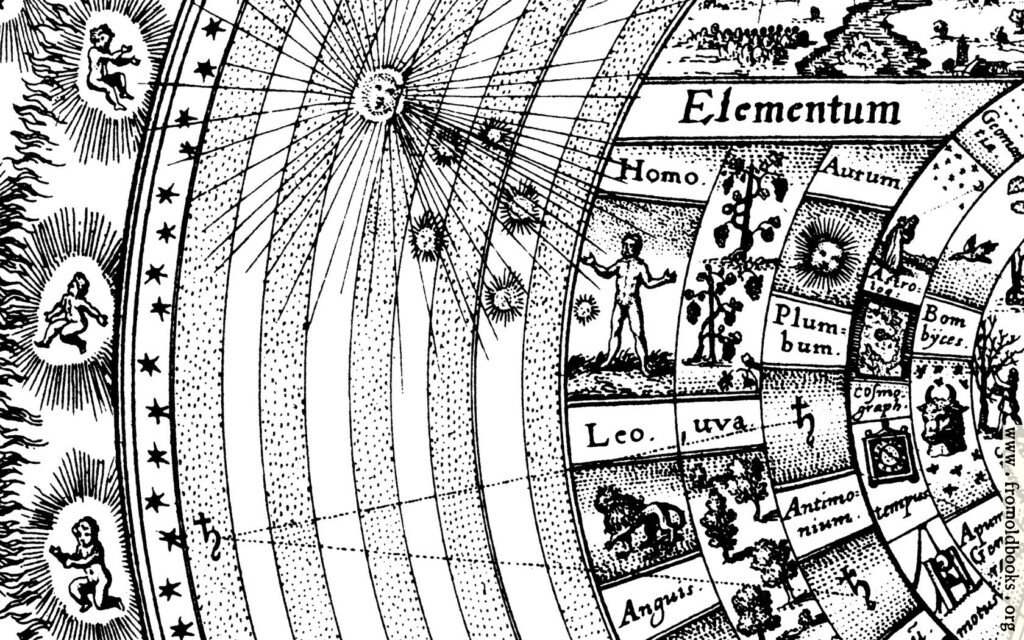
Robert Fludd spent his entire intellectual life in that second. His great cosmological treatise, the Utriusque Cosmi Historia, published between 1617 and 1621 in Oppenheim, contains engravings that are among the most astonishing objects European thought has ever produced — images in which the human body is stretched across the cosmos like a tuning fork suspended between two infinite poles. In one of the most famous, a man stands at the center of concentric rings representing the planetary spheres, elemental zones, and celestial hierarchies, his arms extended, his body serving not as the measure of things but as their literal medium. He is not standing in the universe. He is the universe, looking at itself from the inside.
This was not metaphor for Fludd. It was anatomy. The correspondence between macrocosm and microcosm that Frances Yates traced so carefully through the Hermetic tradition in her 1964 study Giordano Bruno and the Hermetic Tradition was, for practitioners like Fludd, a precise technical claim: the structures governing the heavens were identical in kind to the structures governing the human body, and the physician who understood one was reading the other. Paracelsus had already pushed this doctrine to its operational extreme, insisting that every organ had its celestial counterpart, that the liver answered to Jupiter and the brain to the moon, and that illness was a disruption in the correspondence between inner and outer harmonics rather than a failure of bodily mechanism. Fludd inherited this framework and systematized it with an almost obsessive rigor.
What makes his anatomical diagrams so disturbing, even now, is precisely their literalism. In one sequence, the human pulse is mapped against a musical staff, each beat assigned a position within a scalar system that ascends toward the divine. Fludd was not speaking loosely when he described the heartbeat as music. He believed the pulse was the body’s participation in a cosmic rhythm, a local vibration of the same harmonic law that moved the planets in their orbits and produced what Kepler — his great contemporary and adversary — was calculating mathematically at almost the same moment. The disagreement between them is instructive: Kepler wanted to strip the harmony of the spheres down to pure mathematical ratio, excising the symbolic and the occult. Fludd wanted to preserve the whole living body of the analogy, in which number was never merely number but always also substance, spirit, and resonance.
A man sits in a hospital corridor, waiting for results, and at some point the fluorescent light above him catches the skin of his forearm at a particular angle, and suddenly the arm is not an arm but a landscape — hills of tendon, rivers of vein, valleys between the knuckles that could be mapped, named, inhabited by something other than himself. The wrongness of the body, its foreignness, its insistence on operating without him — this is what Fludd was drawing. Not alienation in the modern therapeutic sense, but something older and stranger: the recognition that the body is a country with its own climate, its own seasons, its own obedience to laws that predate the individual life living inside it.
Yates understood that the Hermetic tradition was not a deviation from the Western intellectual project but one of its central rivers, flowing underground through centuries of official rationalism. Fludd surfaced it entirely, built his entire cosmology on the premise that to understand the body was to understand creation, and that the distance between a heartbeat and a planetary orbit was not a distance at all but a scale — one frequency heard at different amplitudes, the same law breathing at different speeds.
Alchemy as the Grammar of Transformation
There is a moment when a person realizes they are no longer who they were, and the realization does not come with relief or ceremony. It comes the way water comes through a cracked ceiling: slowly, then all at once, staining everything it touches. You wake up inside a life that still has your name on it, your furniture in it, your face in the mirror, but something irreversible has already occurred, somewhere beneath the surface, in a darkness you did not choose and cannot fully account for.
This is precisely the territory Robert Fludd was mapping when he wrote about alchemy, though he would never have described it so plainly, because plainness was not the instrument available to him. The language he used was sulphur and mercury, calcination and putrefaction, the blackening of matter before its renewal. But what he was tracking, with extraordinary precision, was the grammar of change itself: the rules by which one thing becomes another, the syntax of dissolution, the punctuation of rebirth that no one asked for.
Carl Gustav Jung spent years among the alchemical manuscripts, producing in 1944 a work that remains one of the most unsettling acts of intellectual translation in modern psychology. In Psychology and Alchemy, he argued that the alchemists were not failed chemists. They were projecting the unconscious onto matter, conducting in their laboratories an involuntary autobiography. The three great stages, nigredo, albedo, rubedo, were not merely procedural descriptions of what happened to lead in a crucible. They were the phenomenology of transformation itself: the blackening that is disorientation and grief and the collapse of what was previously ordered; the whitening that is not happiness but clarity, the cold light that remains after everything false has burned away; the reddening that is not restoration but something new, something that cannot pretend to be what came before.
Fludd understood this architecture intuitively. In his Utriusque Cosmi Historia, the alchemical processes are embedded within the larger framework of macrocosm and microcosm precisely because transformation is not an isolated event. It is structural. When something changes in the depths, the entire edifice shifts. The human being who undergoes nigredo is not simply sad or confused. They are participating in a cosmic process, enacting at the level of flesh and psyche what the universe performs at the level of stars and elements. The scale changes. The grammar does not.
Consider a man who has spent decades building an identity around a single certainty, a vocation, a belief, a relationship, and who one day finds that certainty simply gone, not refuted, not destroyed, but evaporated, the way a substance vanishes in heat, leaving only a residue he does not recognize as himself. He does not feel enlightened. He feels annihilated. He moves through familiar rooms like a stranger reading the placard at a museum exhibit, noting that someone once lived here, that these objects meant something. This is nigredo. Not metaphorically. Structurally. The blackening has occurred, and the alchemical manuscripts would have recognized it immediately, would have named it, would have said: this is not an ending, this is a phase, this is the grammar requiring you to be dissolved before you can be reconstituted into something that has not lied about what it is.
What makes this doubly tragic and doubly precise is that Fludd was writing in the very decades when alchemy was being expelled from legitimate knowledge. The early seventeenth century was the period when the boundaries of what counted as science were being violently redrawn. Francis Bacon‘s Novum Organum appeared in 1620, the same year Fludd’s second volume was circulating. The language of transformation, of correspondences, of interior meaning embedded in matter, was being reclassified as superstition. Alchemy itself was undergoing its own nigredo, its own institutional blackening, being pushed into the margins of the respectable, surviving only in laboratories hidden from the new academies, in manuscripts passed between men who knew they were already becoming anachronistic.
Fludd did not surrender. He wrote as someone who understood that the expulsion of a vocabulary does not eliminate the experiences that vocabulary was built to describe.
The War Against Wholeness: Fludd vs. the New Science
There is a particular kind of argument that looks, on its surface, like a disagreement between two men but is actually a civilization arguing with itself. You recognize it when you watch two colleagues in a meeting, one insisting on measurable outcomes and the other gesturing at something harder to name, something like atmosphere, or morale, or the feeling a space produces in the people who inhabit it. The first person wins every time. They win because their vocabulary has already been accepted as the only legitimate vocabulary. The second person loses not because they are wrong but because the conversation has been structured in advance to exclude what they are trying to say.
In the years between 1619 and 1622, Johannes Kepler and Robert Fludd exchanged a series of texts that constitute one of the most consequential quarrels in intellectual history, not because either man destroyed the other’s argument, but because the quarrel itself indexed something irreversible happening to European thought. Kepler accused Fludd of dealing in hieroglyphs rather than mathematics, of dressing intuition in the costume of knowledge. Fludd responded that Kepler’s mathematics, however elegant, were the skeleton of a corpse, precise measurements of a universe from which the animating principle had been deliberately removed. They were both right. That is what makes it unbearable.
Kepler had already given the cosmos extraordinary gifts: the three laws of planetary motion, the elliptical orbit, the mathematical harmonics of the spheres rendered in ratios a student could calculate. But Fludd heard in those ratios something missing, the way you can read a perfect transcription of music and know, with absolute certainty, that the score is not the song. He insisted that the macrocosmic architecture he had spent his life mapping was not metaphor but structure, that the correspondence between the human body and the celestial order was not poetic convenience but ontological fact. Kepler found this embarrassing. He wanted to inherit Copernicus and Galileo’s rigorous world. Fludd, to him, was pulling the curtain back toward darkness.
Carolyn Merchant, writing in The Death of Nature in 1980, named this moment with surgical precision. The Scientific Revolution did not simply discover new facts about the world. It replaced one metaphor with another, exchanging the organism for the machine. The older metaphor, which Fludd inhabited completely, understood nature as alive, gendered, purposive, responsive to human action in moral terms. The newer metaphor, which Kepler was helping install, understood nature as mechanism, indifferent, lawful, available for analysis and manipulation without ethical remainder. Merchant’s point is not nostalgic. She is not asking us to return to Fludd’s cosmos. She is asking us to notice what was lost in the transaction, and to stop pretending the loss was costless.
Theodor Adorno, in Dialectic of Enlightenment, written with Max Horkheimer in 1944, pursued the same rupture from a different angle. Instrumental reason, the rationality that evaluates everything by its utility and measurability, does not simply disenchant the world. It systematically destroys the capacity to ask certain questions, specifically the questions that cannot be answered in the language of function and efficiency. What is this for? becomes the only permissible question. What does this mean? becomes, over time, literally unintelligible.
A man inherits a business his grandfather built. He applies every rational metric available and discovers that the least profitable division is the one his grandfather cared about most, the one that employed people from the neighborhood, that made something people actually needed, that ran on relationships rather than contracts. He closes it. The numbers improve. Something else happens that the numbers cannot record, something in the quality of his own attention, in what he finds himself able to think about before sleep. He notices it for a while. Then he stops noticing. This is not tragedy in the classical sense. It is something quieter and harder to name, which is precisely why Fludd, writing against Kepler with increasing urgency across those three years, kept reaching for language that his opponent had already agreed to dismiss as unscientific.
The quarrel was never really about Fludd’s diagrams.
A vision curated by a filmmaker, not an algorithm
In this video I explain our vision
What the Diagram Cannot Hold

There is a moment that arrives unbidden, usually in the small hours when the mind is too tired to maintain its usual defenses, when the pattern you have been studying begins to look back at you. Not metaphorically. The symmetries you have been tracing — in a system, in a text, in the geometry of a diagram drawn four centuries ago — suddenly feel less like objects of contemplation and more like mirrors in which something recognizes itself. You cannot say whether you found the pattern or whether the pattern found you. This is not mysticism. This is a very specific and vertiginous cognitive experience, and anyone who has spent long enough with Fludd’s Utriusque Cosmi Historia knows exactly what I am describing.
Fludd’s diagrams — those extraordinary engravings of monochords stretching from earth to heaven, of spheres nested within spheres, of the human figure standing at the crossroads of every cosmic force — are not decorative. They are not illustrations of ideas already explained in prose. They are the ideas. They function the way certain mandalas function, which is to say they are structured to produce a particular quality of attention in whoever looks long enough. Not belief. Not intellectual assent. A reorganization of perception. This is what makes them genuinely dangerous in a way that has nothing to do with heresy or occultism, and everything to do with what happens to a self that takes the correspondence seriously as a lived practice rather than a theoretical proposition.
Consider the man who cannot enter a room without immediately sensing the emotional weather of everyone inside it — who reads the angle of a shoulder, the particular stillness of a hand, the velocity of a glance, and knows, before a word is spoken, what tension is being managed, what grief is being suppressed, what fear is dressed as boredom. He would tell you he has simply learned to pay attention. But what he has actually done is make himself porous. He has dissolved, in some functional sense, the membrane between inside and outside, between what he feels and what the room feels. Gregory Bateson, writing in Steps to an Ecology of Mind in 1972, argued that the boundary of the self is not the skin — that mind is not located inside the skull but distributed across the system of organism and environment. Fludd would have recognized this immediately. He would have called it participation. He would have drawn it as a diagram.
And here is where the unbearable suspicion begins to crystallize. If the macrocosm and the microcosm are genuinely structured by the same principles — if the proportions that govern music also govern the circulation of the blood, if the light that falls on the eye is the same light that holds the planets in their paths — then attention directed inward and attention directed outward are not two different activities. They are the same gesture. The Paracelsian tradition that shaped Fludd understood this not as poetry but as operational fact. Know thyself, in this framework, is not a psychological injunction. It is cosmological instruction.
There is a woman who, after years of working with a particular body of esoteric material, begins to notice that the symbols she has been studying appear in her dreams not as symbols but as events. The geometry is alive. The correspondence is not between two separate things — the self and the cosmos — but is the single substance of which both are made. She cannot explain whether she has discovered something that was always there or whether sustained attention has carved new grooves in her nervous system that now generate their own meaning. James Hillman, in The Dream and the Underworld, published in 1979, refused to answer this question, because he understood that the question itself assumes a separation that may not exist.
What Fludd’s system ultimately asks — not from the credulous, but from the genuinely attentive — is whether you are willing to inhabit a world in which you are not the observer of a pattern but its latest iteration, whether that constitutes a form of understanding or a form of dissolution, and whether, at the point where those two things become indistinguishable, the difference still matters at all.
🜂 The Secret Architecture of Western Esotericism
Robert Fludd’s vision of macrocosm and microcosm did not arise in a vacuum — it was the culmination of centuries of hermetic, alchemical, and Neoplatonic thought. These related articles trace the living current of ideas that shaped and surrounded Fludd’s cosmic philosophy, from the foundational texts of alchemy to the luminous figures who dedicated their lives to the Great Work.
What Is Alchemy: History and Origins
To understand Fludd’s alchemical cosmology, one must first grasp the ancient soil from which alchemy itself grew. This article explores the origins of alchemy as both a material and spiritual discipline, revealing how the transformation of metals was always an allegory for the transformation of the soul. It is an essential starting point for anyone entering the labyrinth of Western esoteric thought.
GO TO THE SELECTION: What Is Alchemy: History and Origins
Tabula Smaragdina: Text Meaning and Interpretation
The Emerald Tablet — Tabula Smaragdina — is perhaps the single most influential text in the entire alchemical tradition, and Fludd knew it intimately. Its legendary maxim ‘as above, so below’ is the philosophical cornerstone of the macrocosm-microcosm doctrine that Fludd developed into an elaborate cosmological system. This article decodes its cryptic verses and traces their profound impact across centuries of esoteric interpretation.
GO TO THE SELECTION: Tabula Smaragdina: Text Meaning and Interpretation
Paracelsus: Life and Alchemical Thought
Paracelsus, the Swiss physician-alchemist, was one of the most direct intellectual predecessors of Robert Fludd, sharing his conviction that the human body mirrored the structure of the universe. His fusion of alchemy, medicine, and mystical philosophy set the stage for the Rosicrucian currents with which Fludd would later become associated. Exploring Paracelsus illuminates the medical and alchemical dimensions of Fludd’s own vast encyclopedic project.
GO TO THE SELECTION: Paracelsus: Life and Alchemical Thought
Giordano Bruno and the Hermetic Tradition
Giordano Bruno, burned at the stake in 1600, represented the radical edge of the same Hermetic Renaissance that nourished Robert Fludd’s imagination. Bruno’s infinite universe, his memory systems, and his devotion to the Hermetic tradition were living provocations to both Church and Academy, much like Fludd’s own controversial cosmological diagrams. Understanding Bruno’s hermetic universe deepens our appreciation of the dangerous intellectual climate in which Fludd chose to write and publish.
GO TO THE SELECTION: Giordano Bruno and the Hermetic Tradition
Discover the Inner Universe on Indiecinema
The ideas explored in Fludd’s macrocosmic philosophy — transformation, hidden correspondences, and the search for the divine within matter — have always found a natural home in the language of cinema. On Indiecinema, our independent streaming platform, you will find a curated selection of films that dare to explore these same depths: visionary, unconventional, and spiritually alive. Join us and let independent cinema become your own alchemical mirror.
👉 EXPLORE THE CATALOG: Watch Indie Films in Streaming
A vision curated by a filmmaker, not an algorithm
In this video I explain our vision

