
Berlin, 1929: The Republic as a State of Permission
You walk into the Romanisches Café on a Tuesday evening in November 1929 and nobody asks who you are. That is the first thing you notice — not the smoke, not the noise, not the two women sharing a cigarette at the marble table near the window with the unhurried ease of people who have decided the old rules no longer apply to them. What you notice is the absence of a question. The door opens and the city receives you without condition, and for a moment that feels like the most radical political act you have ever witnessed. You order a coffee. At the next table, a painter argues with a journalist about whether George Grosz has already said everything worth saying about the German bourgeoisie, or whether the bourgeoisie still has a few more humiliations left to offer. Nobody lowers their voice. Nobody looks over their shoulder.

This was the texture of Weimar Berlin at its strange, compressed apex — a city that had decided, collectively and almost violently, that permission was the same thing as freedom. The cabarets on Friedrichstrasse ran until four in the morning. The Eldorado on Motzstrasse drew its crowd in sequins and ambiguity, and the police, who had spent the previous decade cracking skulls in the street over rather more serious disagreements, largely left it alone. Magnus Hirschfeld’s Institut für Sexualwissenschaft, founded in 1919, was cataloguing the full spectrum of human desire with the clinical seriousness of a natural history museum, as though the body itself were a newly discovered continent requiring taxonomy. Something had cracked open in the culture, and what poured through was not exactly freedom — it was relief, which is freedom’s more intoxicated cousin.
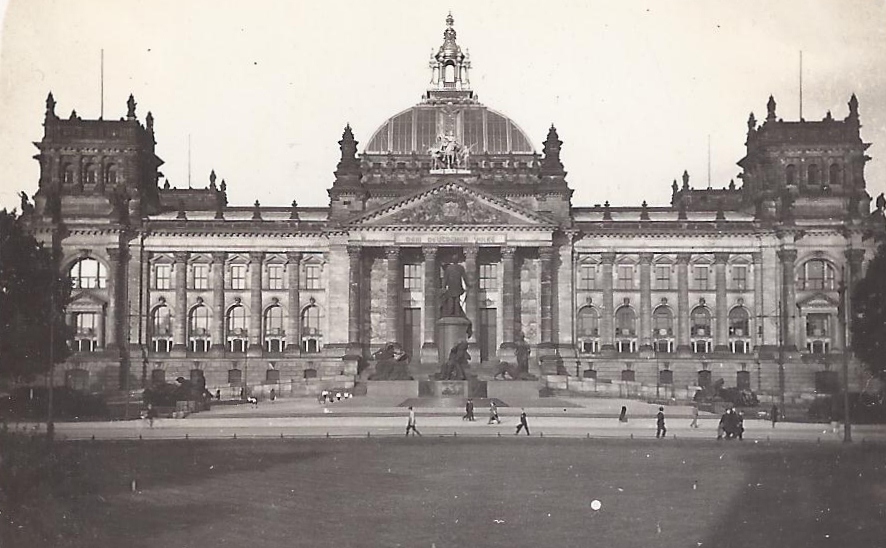
The republic itself was only eleven years old, and it had been born not from revolution but from exhaustion. The abdication of Wilhelm II in November 1918 was less a political triumph than a moment of institutional collapse, and the men who drafted the Weimar Constitution in 1919 were writing in the full knowledge that the army had never actually been defeated on the battlefield — or so the generals and their admirers would insist for the next fourteen years. The constitution they produced was a genuinely extraordinary document, granting universal suffrage including women, protecting civil liberties with unusual specificity, and containing in Article 48 the emergency powers clause that would eventually serve as the skeleton key for its own destruction. It was a republic designed by people who believed in it surrounded by people who did not, and that structural contradiction saturated everything, including the culture.
What the cabarets expressed was not merely licentiousness — the tendency to read Weimar culture as pure decadence is a habit with a long history and a political agenda attached to it. What they expressed was the sudden, dizzying awareness that the old architecture of German social life — the hierarchy, the deference, the Wilhelmine certainty that every person had a fixed place beneath a fixed God beneath a fixed Kaiser — had been removed without replacement. The jazz coming through the club walls was American, which meant it carried with it the implication that modernity itself was being imported, that Germany was not producing its own future but borrowing someone else’s at interest. Kurt Weill understood this. The Threepenny Opera, which opened in Berlin in August 1928 and ran for four hundred performances, was not a celebration of transgression — it was a portrait of a society that had confused the removal of moral architecture with the arrival of something better.
The confusion was entirely understandable. When the infrastructure of shame is dismantled, the first sensation is exhilaration. The second sensation, which arrives more quietly and is much harder to name, is the realization that shame had been doing structural work all along.
The Constitutional Fiction and Its Structural Fractures
You have held a document in your hands before — a lease, a contract, a letter of guarantee — and felt the specific cold of realizing the entity that signed it no longer exists, or never had the power to honor it in the first place. The paper is real. The ink is dry. The promise is structurally void.
The Weimar Constitution, ratified on August 11, 1919, was among the most progressive legal instruments produced by any modern state up to that point. It guaranteed freedom of speech, freedom of assembly, equality before the law, and — in Article 151 — the right to a dignified economic existence. These were not rhetorical flourishes. They were enforceable claims, written with the precision of jurists who believed that a sufficiently detailed legal architecture could substitute for the political will that the moment clearly lacked. Hugo Preuss, the liberal constitutional scholar who drafted the document, designed a republic on paper for a society that had not yet decided whether it wanted to be one.
Hannah Arendt, writing three decades later in The Origins of Totalitarianism, identified the precise flaw embedded in this logic. Rights that exist only as legal declarations depend entirely on a sovereign power willing and able to enforce them. When that sovereign is fragile, contested, or internally divided, the rights do not diminish gradually — they become suddenly and completely fictitious. The stateless persons Arendt watched being stripped of nationality across Europe were not losing rights because laws had changed. They were discovering that rights had never been real in the way they imagined, that legality and protection are not the same thing, and that the gap between them is where history does its worst work.
The Weimar Republic did not simply face this gap. It was built across it. The constitution preserved the imperial judiciary almost intact. Judges appointed under the Kaiser continued to adjudicate the new republic’s laws, and their verdicts revealed exactly where their loyalties rested. When right-wing paramilitaries murdered Rosa Luxemburg and Karl Liebknecht in January 1919, the officers responsible received sentences that ranged from negligible to nonexistent. When Hitler staged an armed putsch in Munich in November 1923, he was tried for treason and sentenced to five years, served less than nine months in comfortable confinement, and used his imprisonment to dictate a political manifesto. The courts were not corrupted. They were the same courts. The republic had simply assumed them without transforming them.
Article 48 is the wound that does not appear on the surface. It granted the Reich President the power to rule by emergency decree, bypassing parliament whenever public order was deemed threatened. By 1930, parliamentary governance had effectively ceased. Heinrich Brüning governed by decree. So did Franz von Papen. So did Kurt von Schleicher. The emergency provision designed to protect the republic from chaos became the mechanism through which democracy administered its own suspension. Carl Schmitt, the political theorist who would later align himself with the regime that finished the republic off, had already argued in 1921 that sovereignty is defined not by ordinary law but by the decision in the state of exception. What Schmitt described as theory, Weimar enacted as calendar.
The structural fractures extended into the military. The Reichswehr, formally subordinate to the civilian government, operated under a doctrine formulated by Hans von Seeckt that positioned the army as a state within the state — loyal to Germany as a historical and ethnic entity rather than to the constitutional order that governed it. Von Seeckt wrote explicitly that the army should remain above party politics, which in practice meant above the republic itself. An institution that exempts itself from the political order it is supposed to serve does not protect that order when the moment of pressure arrives.
What Preuss and his colleagues built in 1919 was a legal cathedral erected on a foundation that had not been poured. The walls were precise. The arches were elegant. The ground beneath them belonged to someone else entirely.

Inflation as Epistemology: When Money Stopped Meaning Anything
You carry a suitcase full of banknotes to the bakery and come back with a single loaf of bread, and on the walk home you pass a man burning stacks of Reichsmarks in a metal drum because the paper is cheaper than the firewood it replaces. This is not metaphor. By November 1923, a single American dollar was worth 4.2 trillion marks. The German population had not merely lost savings — they had lost the cognitive architecture that savings represent, the quiet assumption that effort accumulates, that yesterday’s labor retains meaning tomorrow.
Economists still tend to frame the Weimar hyperinflation as a technical failure: the Reichsbank printing money to cover war reparations imposed by the Treaty of Versailles, supply outrunning demand for currency, a feedback loop spiraling into collapse. But this framing, precise as it is, misses the phenomenological wound. What hyperinflation destroyed was not primarily purchasing power but the relationship between sign and referent. Money is not valuable because it is paper — everyone always knew that. It is valuable because an entire society agrees, silently and continuously, to behave as though it is. When that agreement disintegrates, something more fundamental than economics breaks: the shared fiction that holds social reality together, the thing Émile Durkheim in 1912 described in “The Elementary Forms of Religious Life” as collective effervescence — the binding belief that makes social cohesion feel natural rather than constructed. Once the binding belief is exposed as a construction, it cannot simply be rebuilt by technocratic adjustment.
The middle class was annihilated with particular cruelty. Industrial workers had unions bargaining in real time. The very wealthy held assets — land, factories, gold — that retained value precisely because they were not denominated in the disintegrating currency. But teachers, civil servants, small shopkeepers, the families who had saved carefully in government bonds through the war years, found their entire accumulated prudence reduced to the purchasing power of a handful of hours. Hans Fallada documented this psychic wound with uncomfortable precision decades later, but the wound itself was cut in those three years between 1921 and 1923, and it did not close. A generation learned that virtue — thrift, patience, deferred gratification — had been made structurally irrelevant by forces utterly beyond individual control.
What followed was not the nihilism one might logically predict from such an experience. Nihilism is a philosophical position that requires a certain stability to inhabit — it requires, paradoxically, enough security to afford meaninglessness. What the German middle class produced instead was a ferocious hunger for restored certainty, not even for prosperity, but for the prior condition of prosperity: a world in which signs meant things again, in which effort corresponded to outcome, in which the future could be anticipated. This is the epistemological trap that no economic recovery can fully address, because the wound was not economic in origin — it was ontological.
The stabilization of November 1923, when the Rentenmark replaced the worthless Reichsmark at a ratio of one trillion to one, restored currency without restoring trust. The body had stopped bleeding, but the nervous system had been permanently altered. Viktor Klemperer, whose diaries from this period remain among the most granular records of lived Weimar experience, noted not jubilation at the stabilization but a kind of hollow vigilance — people behaving as though the floor might vanish again without warning. What that vigilance created was not a population of skeptics who had learned to question authority. It created a population primed for transference, ready to surrender the exhausting work of maintaining personal epistemological frameworks to any figure who could project absolute, unambiguous certainty with sufficient force.
The structural logic of authoritarianism rarely travels on the back of despair alone. It travels on the back of people who have been genuinely, materially educated by history that their own judgment cannot be trusted to protect them.
The Bauhaus Experiment and the Politics of Form
You are handed a chair. It is made of steel tubing, bent into continuous curves, the seat suspended in woven canvas. Nothing about it resembles the chairs your grandparents owned, the heavy carved wood, the upholstered dignity of objects that announced their own permanence. This chair does not announce anything. It simply holds you, efficiently, without ceremony, and something about that efficiency feels like an argument.
Walter Gropius founded the Bauhaus in Weimar in 1919 with a conviction that would have seemed delusional if it had not been so precisely reasoned: that the shape of everyday objects determines the shape of consciousness. Not metaphorically. Literally. His 1919 manifesto declared that the ultimate aim of all creative activity was building, and that art and craft had to be reunited because their divorce — the aesthetic on one side, the functional on the other — had produced a society of people who lived inside contradictions without recognizing them. The idea drew directly on William Morris and the earlier Arts and Crafts movement, but Gropius stripped away the nostalgia. Morris had wanted to return to the medieval guild. Gropius wanted to industrialize the medieval guild’s ethics. The machine was not the enemy; sentimentality about the pre-industrial was.
What followed was one of the most concentrated pedagogical experiments in modern history. Between 1919 and 1933, the school passed through three cities and six directors, was raided by police in 1932, and was finally shuttered by its own faculty under Nazi pressure before the regime could close it more violently. Its teachers included Paul Klee, Wassily Kandinsky, László Moholy-Nagy, and Marcel Breuer — the man who designed that steel-tube chair, the Wassily, in 1925. The curriculum required every student to work simultaneously with a master craftsman and a master of form, collapsing the hierarchy that had kept the fine artist elevated above the carpenter. A painter had to understand a lathe. A weaver had to understand load-bearing geometry. The assumption embedded in this structure was radical: that no human being should be educated into incompleteness.
The political right understood this before the liberal center did. By 1924, nationalist politicians in Thuringia were demanding the school’s closure on the grounds that it harbored cultural Bolshevism — a phrase that tells you everything about how form becomes ideology when a society is frightened. The accusation was not really about furniture or typography. It was about the dissolution of hierarchy encoded into the objects themselves. A chair that refused ornamentation, a typeface that abandoned capital letters, a building whose facade offered no classical references — these were not neutral aesthetic choices. They were denials of a particular social grammar, the visual language through which stratification had always made itself legible. When Gropius eliminated the distinction between fine art and applied craft, he was also eliminating the distinction between the educated gentleman who appreciated beauty and the laborer who merely produced it.
Georg Simmel had written in 1903, in his essay on the metropolis, about the individual’s defense against overstimulation — the blasé attitude as a form of psychological survival in modernity. What the Bauhaus did was take that same overwhelmed modern subject and propose not detachment but redesign. Not numbness as the response to industrial chaos, but a reengineered environment that made the chaos habitable, even humanizing. This was not escapism. It was a bet placed against history, the bet that aesthetic rationality could outrun political irrationality.
The bet lost, but its losing was not the refutation of its premise. When the Nazis came to power and immediately identified flat roofs and sans-serif typefaces as symptoms of racial degeneration, they were confirming what Gropius had always claimed: that form is never innocent, that every designed surface is a position taken, and that a society willing to legislate the pitch of a roof is a society that has understood, correctly, how deeply architecture colonizes the imagination.
Sexuality, Gender Disruption, and the Backlash Economy
You are sitting in a Berlin bar in 1928, and the person across from you defies every category you were handed at birth. Not performatively, not as provocation — simply as a fact of their existence, unremarkable to them, catastrophic to the architecture of everything you were taught to take for granted about bodies, roles, and the meaning of a life.
Magnus Hirschfeld opened the Institut für Sexualwissenschaft in Berlin in 1919, and what he built was not merely a clinic or an archive but an epistemological rupture. By the mid-1920s the institute housed over 35,000 photographs, 40,000 biographical letters, and a library of approximately 20,000 volumes dedicated to the scientific study of human sexuality in its full range. Hirschfeld himself coined the term “transvestite” in 1910 and spent decades cataloguing what he called the “sexual intermediaries” — the vast population of human beings who did not fit the binary the nineteenth century had declared biologically inevitable. His 1914 work Die Homosexualität des Mannes und des Weibes presented data on over 10,000 individuals at a moment when most of Europe still treated their existence as a criminal pathology. This was not liberation as metaphor. It was liberation as filing cabinet, as case study, as documented proof that the norm had always been a fiction enforced by violence.
The queer nightlife that flourished alongside this institutional work operated on a different frequency — not scientific but carnal, immediate, ungovernable by taxonomy. By 1929, Berlin had over a hundred bars and clubs serving gay and lesbian clientele, several of which published their own magazines, including Die Freundin, a lesbian periodical with a readership that modern historians estimate in the tens of thousands. These were not underground operations. They appeared in tourist guides. They were visited by foreign journalists who wrote about them with a mixture of fascination and disgust that itself tells you everything about what was actually at stake. When visibility becomes ordinary, the invisible framework that organized society around enforced ignorance begins to shake.
Wilhelm Reich understood this shaking not as freedom but as trigger. His 1933 work Massenpsychologie des Faschismus — written in the same years that the Nazi movement was absorbing the anxieties Weimar had so efficiently generated — argued that authoritarian politics did not arise despite sexual repression but because of it. The character structure forged by a society that punishes erotic life in childhood, that routes desire through shame and guilt, produces adults who cannot tolerate the sight of others living outside that structure. Sexual liberation does not pacify this character; it enrages it. The person who has surrendered their own body to the demands of order experiences the liberated body of another not as irrelevant but as an accusation. What looks like a culture war is, in Reich’s framework, a somatic war — fought in the nervous system before it ever reaches the street.
Women entering professional and political life accelerated this dynamic with the same structural logic. The Weimar constitution of 1919 granted women full suffrage and formal equality, and by the late 1920s women comprised nearly 36 percent of the German labor force. The New Woman — the Neue Frau — appeared on magazine covers with short hair and cigarettes, coded as modern, independent, sexually self-determining. She was also, for a significant portion of the male population experiencing economic humiliation in the wake of hyperinflation and mass unemployment, a symbol of a disorder that felt cosmic in scale. When the material world collapses and the symbolic world refuses to hold still simultaneously, the psychic pressure does not distribute evenly. It concentrates. It finds a face.
The error is to read the backlash as a response to excess. It was a response to evidence — evidence that the categories through which millions of people had organized their sense of self, their superiority, their place in a legible universe, were not natural laws but contingent agreements that could be withdrawn.
A vision curated by a filmmaker, not an algorithm
In this video I explain our vision
The Intellectual Class and Its Complicity in Spectacle

You are at a gallery opening in Berlin, 1923, and the man next to you is laughing at a painting of a fat general devouring a child. The laughter is sharp, knowing, the laughter of someone who believes that seeing a thing clearly is the same as refusing it.
George Grosz had spent years perfecting that laughter. His Ecce Homo portfolio, published that same year, assembled over a hundred images of Weimar Germany’s ruling class rendered as bloated predators, syphilitic officers, clergymen fondling currency. The draftsmanship was savage and precise. The Prussian military censors who prosecuted him for obscenity understood something the gallery audience did not: that the images threatened public morality far more credibly than they threatened public power. The prosecution made Grosz famous. The generals remained generals.
Ernst Toller had arrived at a similar impasse through a different door. His expressionist plays, written partly while he was imprisoned after the failed Bavarian Soviet Republic of 1919, burned with revolutionary sincerity. Masses and Man, performed in 1921, staged the conflict between individual conscience and collective violence with a formal intensity that left audiences electrified and then, crucially, seated. The play ended. People went home. Toller had converted political catastrophe into aesthetic experience so successfully that the experience became sufficient in itself, a substitute for the thing it depicted rather than a demand made upon it.
Walter Benjamin named this mechanism with the precision of a surgeon. In his 1935 essay “The Work of Art in the Age of Mechanical Reproduction,” he identified the aestheticization of politics as the signature move of fascism — the substitution of beautiful form for material transformation, the mobilization of feeling that produces not action but absorption. What he saw in the Nazi spectacle of Nuremberg was structurally related to something already present in the critical art of the republic: the assumption that making suffering visible was itself a political act. It was not. Visibility without structural consequence is décor.
The intellectual class of Weimar operated largely within institutions — theaters, publishing houses, the Ullstein press empire, the Kroll Opera — that were themselves products of the bourgeois order they claimed to critique. The Volksbühne movement, which had built a mass working-class theater audience by the early 1920s, found itself by decade’s end staging formally radical productions for an audience that had already decided what it believed. The theater became a place where the left confirmed itself to itself, applauding its own diagnosis while the patient deteriorated in the next room.
This is not a moral accusation. The artists were not cowards or cynics, most of them. Toller would end his life in exile in New York in 1939, having watched everything he loved be destroyed. Grosz left for America in January 1933, two days before Hitler was appointed chancellor, with the particular prescience of someone who had always known the laughter could not hold. The point is not that they failed personally but that the cultural framework they inhabited structurally rewarded articulation over intervention. A brilliant painting of a corrupt system generates cultural capital. It does not generate a different system.
The philosopher Georg Simmel had observed decades earlier, in his 1903 essay “The Metropolis and Mental Life,” that modern urban consciousness develops a blasé attitude as a defense against overstimulation — a flattening of affect that makes everything equally interesting and therefore equally inert. Weimar’s critical art, at its most sophisticated, reproduced this condition from the inside: it aestheticized outrage so fluently that outrage became a genre, a recognizable style, something you could purchase in a portfolio of lithographs and hang above your writing desk in Charlottenburg. The republic was collapsing and the intellectual class was producing extraordinary work about the collapse, and these two facts were not unrelated.
Decadence as a Narrative Weapon, Not a Historical Fact
You have seen the photographs from the 1937 Munich exhibition — crowds pressing through narrow corridors, canvases hung deliberately crooked, captions scrawled beside them in the mocking register of a show trial. The curators did not arrange those works to condemn ugliness. They arranged them to condemn freedom, and they needed a word capacious enough to make that condemnation feel like taste rather than terror. The word they reached for was decadence, and the reach was not spontaneous. It had been practiced for decades before the first storm trooper ever walked through those doors.
The intellectual genealogy of that word in its political usage runs through figures who were perfectly explicit about what they were doing with it. Max Nordau’s Degeneration, published in 1892, applied a pseudo-clinical language borrowed from Cesare Lombroso to the entire field of modern art, arguing that aesthetic experimentation was literally a symptom of neurological decay in the population producing it. Nordau named Ibsen, Zola, Verlaine, and Wagner as clinical cases, not critics. His book sold through eight German-language editions before the Weimar Republic even existed. The National Socialist deployment of the word in 1937 was not an invention; it was an inheritance, a rhetorical infrastructure already laid by a generation of culture warriors who needed biological anxiety to do the work that aesthetic argument could not.
What the Entartete Kunst exhibition actually documented, beneath its own intentions, was the vitality of what it attacked. The works selected for condemnation included pieces by Emil Nolde, Ernst Ludwig Kirchner, Paul Klee, Wassily Kandinsky, Max Ernst, and Otto Dix — a concentration of creative intelligence in a single room that no subsequent European decade has matched. The curators chose those works because they were powerful, because they had moved people, because they had opened perceptual and moral possibilities that a totalitarian state found genuinely dangerous. Decadence was the word applied to exactly the art that required the most effort to suppress.
The structure of that suppression reveals something about the republic itself that the decadence narrative permanently obscures. The Weimar Constitution of 1919, drafted under Hugo Preuss, contained provisions that were not weaknesses but rather unprotected strengths. Article 48, which permitted emergency governance by presidential decree, was not a concession to authoritarianism — it was a provision designed for genuine crisis that became the mechanism of permanent constitutional bypass when political will to defend republican norms collapsed entirely. The freedoms the republic extended to artists, to political parties, to publishers, and to citizens were real, but they were extended without the institutional armor that transforms a formal right into an actually livable condition.
Karl Popper would articulate the conceptual problem a decade later in 1945, writing in The Open Society and Its Enemies about the paradox of tolerating those who would use tolerance to dismantle it — but the Weimar legislators faced the living version of that paradox in real time, without the philosophical distance to name it clearly. The Communist Party and the National Socialist Party both operated legally under Weimar protections, both built paramilitary organizations, and both treated the republic’s openness as a staging ground for its elimination. Freedom without structural defense is not freedom in practice; it is an open invitation written on paper that burns.
What the word decadence accomplished, and continues to accomplish in retrospective accounts of the period, is the substitution of a moral verdict for a structural analysis. It allows the collapse to be read as punishment — as if Berlin’s cabarets and the Bauhaus workshops and Magnus Hirschfeld’s Institute for Sexual Science somehow summoned the violence that destroyed them. This is not history. It is a theology of retribution wearing history’s clothing, and it serves the same function in the present that it served in 1937: to make the suppression of freedom feel like the correction of an excess rather than the annihilation of a possibility that had barely begun to exist.
What the Weimar Mirror Reflects Back at the Present
You are living in a moment that feels like too much. Not too much suffering necessarily, though there is that — more like too much signal, too much permission, too much irony available at every frequency simultaneously. The galleries are full, the feeds are full, the discourse is nutritionally dense and somehow starving. You have more access to transgression, to beauty, to radical thought, than any previous generation by almost any measurable standard, and yet the sensation is not liberation. It is a kind of weightlessness that keeps getting mistaken for freedom.
What Georg Simmel observed in 1903, writing about the metropolitan mind in “The Metropolis and Mental Life,” was that overstimulation produces not heightened sensitivity but its opposite — a blunting, a blasé detachment that functions as psychological armor. The urbanized mind learns to process everything at the same emotional register to avoid being torn apart by the volume of experience. What this produces, decades before anyone had a word for it, is scroll behavior. The gesture of moving past atrocity and advertisement and intimacy and comedy with the same flick of the same muscle, not because you are cruel but because your nervous system learned to survive.
When institutions begin to hollow out — not collapse dramatically, but quietly lose their capacity to be believed — something interesting happens to aesthetics. The energy that once organized itself around civic faith migrates. It moves into style, into spectacle, into the body itself as a political surface. Klaus Theweleit’s 1977 study “Male Fantasies” tracked this migration through the psychic architecture of men who joined paramilitary movements in Germany after 1918 — not primarily motivated by ideology in any intellectual sense, but by the sensation of belonging to something that had physical coherence, that moved in formation, that made the self feel bounded and real again in the wake of institutional collapse. The politics was the aesthetic experience.
What never gets examined carefully enough is the economic substrate beneath cultural eruption. The hyperinflation of 1923 did not merely destroy savings — it destroyed the psychological category of deferred reward. When the mark lost ninety-nine percent of its value in under a year, the entire moral architecture of prudence, patience, and earned futurity was exposed as a confidence trick. What replaced it was not nihilism exactly but a radical presentism — a conviction that only the immediate was real, that planning was for people who still believed the floor would hold. The cabarets were not escapism from this reality; they were its most honest expression.
A society that has lost faith in the floor expresses that loss everywhere except in its official language. Officially, the frameworks hold. The speeches continue. The elections occur. But in the texture of cultural life, in what gets made and consumed and celebrated, the actual emotional consensus is written — and it reads differently than the official transcript. Hannah Arendt understood that totalitarianism’s first victory is not political but perceptual: it makes people stop trusting their own experience as evidence of anything real, so that when catastrophe arrives it finds a population already trained in dissociation.
The question that opens at the bottom of all this is not whether history repeats — that formulation is itself a kind of sedative, implying that pattern recognition is the same as comprehension. The real question is whether a culture can look at its own aesthetics honestly enough to read what they are saying beneath what they are performing, whether the irony can be briefly suspended, whether the blasé armor Simmel described can come off long enough for something to land with actual weight — and whether, by the time anyone is asking that question seriously, the answer still has anywhere useful to go.
🎭 Art, Crisis and the Soul of a Republic
The Weimar Republic was one of history’s most explosive laboratories of art and culture, where political instability and radical freedom collided to produce extraordinary creative ferment. From Expressionism to cabaret, from decadent aesthetics to social critique, the era raised questions about identity, power, and the limits of beauty that still resonate today. These articles illuminate the deeper currents flowing beneath that turbulent cultural moment.
The Aesthetics of Decadentism: When Beauty Became Illness
The aesthetics of Decadentism offer a crucial lens through which to understand the Weimar cultural climate, where beauty was inseparable from crisis and excess. This article explores how an entire artistic movement transformed illness, fragility, and moral ambiguity into refined aesthetic ideals. Understanding Decadentism helps illuminate why Weimar art felt so simultaneously intoxicating and doomed.
GO TO THE SELECTION: The Aesthetics of Decadentism: When Beauty Became Illness
Thomas Mann and the Devil’s Pact: Doctor Faustus
Thomas Mann‘s Doctor Faustus stages the very soul of Weimar Germany through the figure of a composer who bargains with the devil for creative genius, mirroring a nation seduced by its own brilliance. Mann wrote the novel as a direct reckoning with German cultural identity and its catastrophic unraveling. This article traces the literary and historical threads that make the novel one of the most devastating portraits of an era in collapse.
GO TO THE SELECTION: Thomas Mann and the Devil’s Pact: Doctor Faustus
Light and Shadow in Cinema: From Chiaroscuro to Expressionism
The interplay of light and shadow in Expressionist cinema was not merely a stylistic choice but a philosophical statement about a fractured modern world. This article examines how chiaroscuro techniques, born in the cabarets and studios of Weimar Germany, became a cinematic language for anxiety, power, and the uncanny. From The Cabinet of Dr. Caligari onward, visual darkness became the truest mirror of a republic living on the edge.
GO TO THE SELECTION: Light and Shadow in Cinema: From Chiaroscuro to Expressionism
William Faulkner and the Decadent American South
William Faulkner‘s meditation on a decadent American South offers a striking parallel to the Weimar condition: a civilization clinging to its own mythology while rotting from within. This article explores how decadence functions not merely as aesthetic excess but as a symptom of civilizations refusing to confront their own dissolution. Reading Faulkner alongside Weimar culture reveals the universal grammar of cultural twilight.
GO TO THE SELECTION: William Faulkner and the Decadent American South
Discover the Cinema of Crisis and Beauty on Indiecinema
If the Weimar Republic teaches us anything, it is that the most daring art is born at the edge of catastrophe. On Indiecinema you will find a curated selection of independent films that carry that same restless spirit — works that challenge, disturb, and illuminate the human condition with uncompromising vision. Dive into our streaming catalog and let independent cinema take you where mainstream culture does not dare to go.
👉 EXPLORE THE CATALOG: Watch Indie Films in Streaming
A vision curated by a filmmaker, not an algorithm
In this video I explain our vision

