
The Shelf of Light
You have seen this shelf before. Maybe it was in a wellness center, tucked between a diffuser and a stack of cards printed with affirmations, or in a friend’s apartment where the books are arranged not by author but by color, their spines forming a gradient from white to violet that is itself a kind of theology. You have seen it in the corner of a yoga studio, behind the reception desk, or in the back room of a shop that sells crystals by weight. The titles change but the vocabulary does not. Ascension. The Plan. The Hierarchy of Light. Masters of Wisdom. The Fifth Dimension. The New Paradigm. You read these words the way you read street signs — absorbing direction without asking who built the road.

Most people who use this language could not tell you where it comes from. They received it the way one receives an accent, through proximity and repetition, from teachers who received it from their teachers, from books that cite other books, from podcasts that draw on workshops that distilled seminars that were themselves summaries of ideas already several generations old. The vocabulary feels self-evident, almost pre-linguistic, as if it were simply the name for something that was always there but had not yet been properly named. This is precisely how the deepest cultural transmissions work. They arrive without a return address.
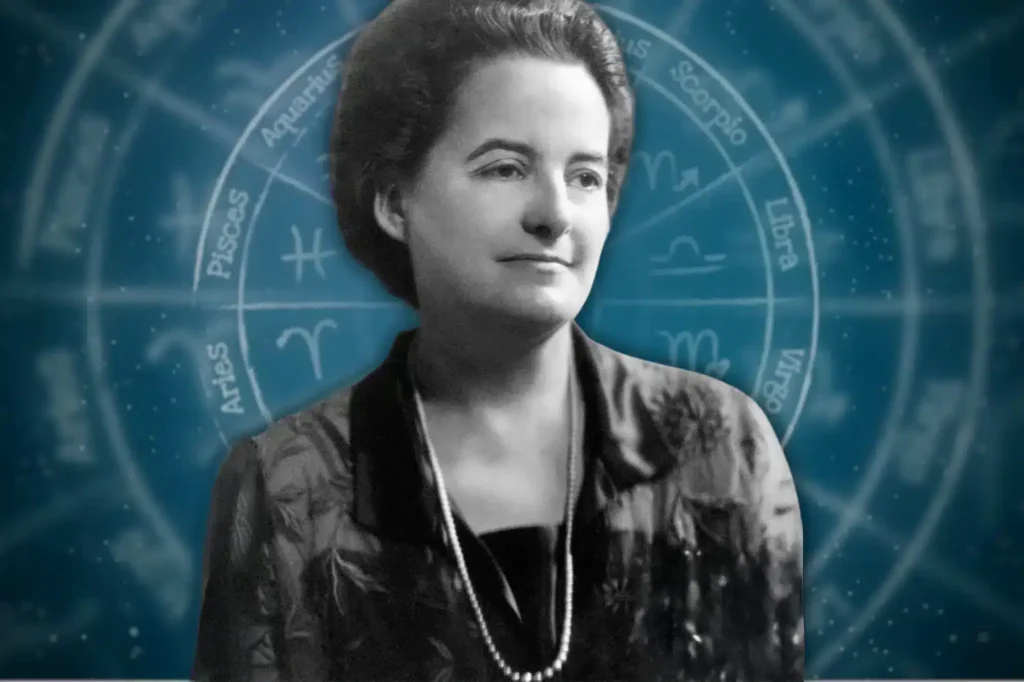
There is a woman behind most of this language, and almost no one who uses it knows her name. She wrote twenty-four books between 1919 and 1949, some running to more than a thousand pages. She founded an organization in New York in 1923 that still operates today, with branches on six continents. She introduced into the Western spiritual bloodstream a specific set of concepts — a graduated hierarchy of spiritual beings guiding humanity’s evolution, a great Plan being implemented across centuries, a coming world teacher, a New Group of World Servers, a distinction between exoteric religion and esoteric truth — that would migrate, mutate, fragment, and recombine until they became the connective tissue of what we now call, without much precision, the New Age. Her name was Alice A. Bailey, and she was almost certainly the most influential spiritual writer of the twentieth century whose influence has been almost entirely absorbed without attribution.
This is not an accident. It is, in a certain sense, the fulfillment of her own design. Bailey believed that esoteric ideas should permeate culture gradually, through individuals rather than through institutions, spreading like light through a membrane until the membrane itself becomes luminous. She wrote explicitly about the need for these ideas to enter mainstream consciousness without triggering the defensive reactions that a more visible movement would provoke. She was describing a strategy of cultural diffusion that any modern communications theorist would recognize as sophisticated, and she was describing it in the 1930s.
What is remarkable is not that her ideas spread. Ideas spread; that is what they do. What is remarkable is the completeness of the forgetting. The shelf you have seen, in the yoga studio or the friend’s apartment, contains books written by authors who believe themselves to be channeling original wisdom, drawing on ancient sources, recovering lost knowledge. Some of them are, in their own way, sincere. But the framework they use to make sense of what they are channeling, the categories, the hierarchies, the evolutionary teleology, the vocabulary of planes and rays and initiations — that framework was assembled by a woman from Manchester who moved to New York and spent thirty years dictating texts she claimed came from a Tibetan master named Djwhal Khul. The shelf glows with borrowed light, and the source has been so thoroughly forgotten that the forgetting now feels like originality.
This is where the story begins. Not with Bailey herself, not yet, but with the strange invisibility of her presence in a culture she did more than almost anyone to shape.
Cathnafola - A Paranormal Investigation
Documentary, horror, by Jason Figgis, USA, 2014.
In "Cathnafola", everything begins when renowned paranormal investigator Chris Halton of Haunted Earth UK receives footage filmed by three teenagers at the ruins of Cathnafola House in Ireland. Determined to unearth the truth behind the location’s bloody past, Halton embarks on a nighttime exploration of the infamous ruins—and soon uncovers terrifying and disturbing revelations.
LANGUAGE: English
SUBTITLES: Spanish, French, German, Portuguese
Alice Bailey and the Architecture of the Invisible
There is a particular kind of person who leaves an institution not because they have lost faith, but because they have too much of it — too much certainty, too much vision, too much architecture already forming in their mind to remain comfortable inside someone else’s walls. Alice Ann Bailey was that kind of person. Born in Manchester in 1880 into a family of the English upper class, raised in the Anglican tradition with all its inherited certainties, she arrived at Theosophy in her thirties already carrying the specific gravity of someone who had been searching for a very long time and had finally found something — only to discover, soon enough, that what she had found was too small for what she intended to build.
She joined the Theosophical Society in 1915, in the California branch, and for a few years she moved within its structures, taught in its schools, absorbed its doctrine. But the relationship fractured, as such relationships between strong architectures inevitably do, over questions of authority and revelation. The Society’s leadership, by then consolidated around Annie Besant and Charles Leadbeater, did not accommodate independent channels of esoteric communication particularly well. And Bailey, by 1919, had begun receiving what she described as telepathic dictation from a discarnate Tibetan Master known as Djwhal Khul — an intelligence she would refer to throughout her life simply as “the Tibetan,” with the particular restraint of someone who understands that naming a thing too loudly diminishes it.
The break with the Theosophical Society came formally around 1920. What followed was not withdrawal but construction. With her second husband Foster Bailey, whom she married in 1921, she founded the Lucis Trust in 1922 — an organization whose original name, the Lucifer Publishing Company, was changed after two years, though not, as critics would later argue, to disguise its intentions, but because the name had become an unnecessary obstacle to the work. The work was the thing. The work was always the thing. And the work was immense: nineteen volumes of esoteric teaching, the majority of them attributed not to Bailey herself but to Djwhal Khul, produced across three decades in a sustained act of collaborative dictation that defies easy categorization. These were not pamphlets or devotional texts. They were systematic, dense, architecturally ambitious — covering cosmology, the nature of consciousness, the evolution of the human soul, the structure of the planetary Hierarchy, the coming of a World Teacher, the mechanics of initiation. A Treatise on Cosmic Fire, published in 1925, runs to over eleven hundred pages. Esoteric Psychology, appearing in two volumes between 1936 and 1942, attempts nothing less than a complete reimagining of the human psychological apparatus through the lens of esoteric ray theory.
In 1923, one year after the Lucis Trust, Bailey founded the Arcane School — a correspondence-based program of esoteric training that attracted students across multiple continents and continues to operate today. This was not a salon or a reading circle. It was an institution, with curricula, with levels of advancement, with a deliberate intention to prepare what Bailey called “world servers” for a coming planetary transformation. The sociologist Wouter Hanegraaff, in his landmark 1996 study New Age Religion and Western Culture, identifies Bailey’s system as one of the most structurally coherent and organizationally consequential bodies of thought to emerge from the Western esoteric tradition in the twentieth century — not a fringe curiosity but a genuine attempt at systematic theology with measurable institutional reach.
What made Bailey different from the occultists who preceded her was precisely this: she was not interested in secrets for their own sake. She was interested in organization. In dissemination. In the slow, patient building of a worldwide network of people who shared a particular understanding of history, of spiritual evolution, of humanity’s collective destiny. The Tibetan’s teachings were not meant to be held privately. They were meant to change the world. And the mechanism for changing it was not charisma or prophecy. It was structure.

Blavatsky’s Skeleton, Bailey’s Flesh
There is a particular kind of work that happens in silence, at a desk, in the hours before anyone else is awake. A figure leans over a manuscript, not to copy it faithfully but to translate it into a language the present moment will accept. Words are crossed out. Names are changed. The architecture of the original thought remains — its columns, its load-bearing walls — but the facade is renovated so completely that a casual observer would never recognize what stands beneath. This is not forgery. It is something more ambitious and more philosophically interesting than forgery. It is reengineering.
Helena Petrovna Blavatsky had built the foundational structure in the 1880s. “The Secret Doctrine,” published in 1888, proposed a cosmology of staggering ambition: seven root races unfolding across geological epochs, each governed by Masters of Wisdom operating from hidden redoubts in Tibet, the whole driven by a teleological engine she called the evolution of consciousness. The racial taxonomy she employed was not peripheral decoration but structural load-bearing material. The Aryan race, in her framework, was the fifth root race, currently dominant, eventually to be superseded. The Great White Brotherhood — white in the sense of spiritual light, she insisted, though the ambiguity was never quite resolved — was the invisible government of this process. Wouter Hanegraaff, in “New Age Religion and Western Culture” published in 1996, describes Blavatsky’s synthesis as a “secularized esotericism,” a deliberate translation of occult tradition into the idiom of nineteenth-century scientific naturalism, complete with evolutionary theory borrowed from Darwin and redeployed for metaphysical ends. The borrowing was aggressive and transformative, but it left visible seams.
Bailey found those seams and sewed over them. Working through the 1920s and 1930s, she preserved the skeletal architecture while replacing almost every surface element. The root races were retained but pushed toward the background, their most explicitly racial implications quietly muted. The Great White Brotherhood became the Spiritual Hierarchy, its membership less ethnically coded, its authority more explicitly aligned with a Christianized cosmology centered on the Christ figure she placed at the apex of the hierarchical structure — not the historical Jesus, she was careful to note, but a cosmic principle that had previously incarnated through him. This move was not accidental. It was, as Olav Hammer has argued in his work on epistemic strategies in esoteric discourse, a calculated legitimation strategy: anchoring novel cosmological claims in the most culturally authoritative symbol available to a Western audience while simultaneously universalizing that symbol until it could absorb any tradition without appearing to contradict it.
What Bailey produced was neither Blavatsky warmed over nor an independent revelation. It was a deliberate act of editorial theology. The manuscripts piling up on her desk — eventually running to twenty-four volumes attributed to the Tibetan Master Djwhal Khul — bore the same relationship to Blavatsky’s system that a modern building code bears to a nineteenth-century architectural manual. The underlying engineering principles were preserved, translated, and made administratively useful for a different century. Hanegraaff’s framework is precise here: Bailey represents not a break in the tradition of Western esotericism but what he calls its “psychologization,” the gradual internalization of spiritual cosmology into the language of psychological development, a process that would reach full expression in the human potential movements of the 1960s and 1970s.
But there is a cost to this kind of renovation. When you change the names and update the idiom, you also change what can be questioned. Blavatsky’s racial cosmology was crude enough to be visible and therefore contestable. Bailey’s hierarchical teleology is smooth enough to feel self-evident, its assumptions embedded so deeply in its vocabulary that to challenge them requires first excavating them, and most readers never get that far. The figure at the desk, crossing out one name and writing another, understands this perfectly. The revision is not just aesthetic. It is epistemological. It determines what the next generation will be able to see.
The Plan and the Politics of Spiritual Order

There is a moment, recognizable to anyone who has ever stood at the threshold of a closed room and been invited in, when the air itself seems to change quality. Someone hands you a document, or speaks your name with unusual deliberateness, or simply looks at you with the particular steadiness of a person who has already decided something about you. You feel chosen before you understand for what. The elevation arrives before the obligation, which is precisely how it must work. The obligation, once felt, would be refused. But the elevation — the sense of finally being seen at the correct altitude — that is very nearly impossible to decline.
Alice Bailey’s architecture of spiritual governance depends on this precise psychological mechanism. At its center sits what she called the Hierarchical Plan: the idea that a Brotherhood of Masters, evolved beings operating from subtle planes of existence, consciously directs human history toward a coming New Age of group consciousness, spiritual synthesis, and what she variously describes as right human relations. This is not metaphor in Bailey’s system. It is administrative reality. The Masters have departments. They have a Director. The being she named Maitreya occupies the position of World Teacher, assisted by figures she designates with titles borrowed from Theosophy and redeployed with bureaucratic specificity. And critically, human beings — prepared, sensitized, spiritually adequate human beings — are consciously enlisted as agents of this Plan. Disciples, in her terminology. Instruments. The word is exact and intentional.
Hannah Arendt, writing in The Origins of Totalitarianism in 1951, identified what she called the peculiar logic of hierarchical systems that claim transcendent justification: they do not simply organize power, they naturalize it. When hierarchy is presented as cosmic rather than constructed, as the shape of spiritual law rather than of human arrangement, it becomes nearly impossible to critique from within. The person who questions the structure is already, by the structure’s own internal logic, demonstrating their inadequacy to understand it. Bailey’s system operates with this same immunizing circularity. Those who resist or doubt the Plan are, within its framework, simply not yet evolved enough to perceive its necessity. Skepticism becomes evidence of spiritual deficiency. This is not an accident of doctrine. It is the doctrine.
Carl Jung, who spent considerable intellectual energy examining gnostic systems and their psychological signatures, described what he called inflation: the dangerous expansion of the ego that occurs when an individual identifies not merely with their personal self but with an archetypal or cosmic role. The individual who believes themselves an instrument of divine or universal governance does not experience this as grandiosity. They experience it as humility — as having been emptied out to become a vessel for something larger. Jung understood this as one of the most seductive and dangerous of psychological conditions precisely because it wears the face of self-abnegation while enacting a profound self-aggrandizement. The more thoroughly one is bound to the Plan, the more meaningfully one seems to exist.
What Bailey constructed, across twenty-four volumes produced between 1919 and 1949, is a complete system for producing this condition at scale. The Lucis Trust, established in 1922 — originally called the Lucifer Publishing Company before the name was quietly changed — disseminated her teachings globally, eventually achieving consultative status with the United Nations Economic and Social Council, a detail that is neither trivial nor coincidental. The institutional ambition was always present. The Plan was never merely personal or spiritual. It was social. It was political in the precise sense that it imagined a reorganization of collective human life under the guidance of initiated knowledge.
And here is where the induction ceremony — that moment of being handed a document, of being looked at with unusual steadiness — reveals its full weight. Because what is offered in that room is not merely belonging. It is metaphysical authorization. The new disciple does not just join a group. They become legible to history. Their actions acquire cosmic significance. Their sacrifices serve something larger than any individual life could contain.
Which is, of course, the oldest promise there is. And also the most dangerous one.
From Bailey to the New Age Supermarket
There is a room — fluorescent lights, folding chairs arranged in a circle, a whiteboard that still has someone else’s diagram half-erased on it. A facilitator speaks about “collective emergence,” about “aligning personal intention with planetary purpose,” about how certain individuals are called to guide the transition toward a new paradigm. The participants nod. Some take notes. Nobody in that room has read Alice Bailey. Most could not place her name. And yet the architecture of the room, the logic of who speaks and who listens, the assumption that evolution has a direction and that the sufficiently awakened can accelerate it — all of it was built by her, or through her, decades before anyone in that circle was born.
The transmission did not happen through confession. It happened through institutional patience and strategic translation.
In 1922, Bailey founded the Lucis Trust, originally registered under a name — Lucifer Publishing Company — that lasted barely two years before the branding problem became obvious. The organization survived the rename with its theological content intact. By the late twentieth century, the Lucis Trust held formal consultative status with the United Nations Economic and Social Council as a recognized non-governmental organization, and its subsidiary, World Goodwill, operated as a recognized NGO in its own right, circulating literature, sponsoring forums, and maintaining meditation groups inside the United Nations building in New York. These are not metaphors or accusations. They are institutional facts, verifiable through the UN’s own records. The language of World Goodwill’s publications — “service,” “goodwill,” “right human relations,” “the emerging civilization” — is Bailey’s vocabulary laundered through bureaucratic neutrality until it sounds like consensus rather than doctrine.
The Human Potential Movement of the 1960s and 1970s performed the next translation. What had been the Hierarchy became the facilitator. What had been initiation became the workshop. Abraham Maslow’s hierarchy of needs, which he published in Psychological Review in 1943 and elaborated throughout the 1950s and 1960s, provided a scientific-looking scaffold for the same ascent narrative — from base survival to self-actualization to, in his later work, the transpersonal. Maslow himself was more careful and empirical than his popularizers, but the architecture was irresistible: some humans are further along, some are capable of glimpsing what others cannot yet see, and the role of institutions is to accelerate the movement upward. Esalen Institute, founded in 1962 in Big Sur, became the laboratory where this translation was perfected, mixing Gestalt therapy, Eastern spirituality, and evolutionary optimism into a format that felt therapeutic rather than theological.
Then came Marilyn Ferguson’s 1980 book, and something shifted at scale. The Aquarian Conspiracy was not a fringe document. It sold millions of copies, was translated into dozens of languages, and was read seriously by politicians, executives, and educators across the Western world. Ferguson’s argument was essentially Bailey’s argument with the occult metaphysics removed and replaced with systems theory and neuroscience citations: a network of awakened individuals was already quietly transforming every institution — education, medicine, politics, economics — from within, guided not by a visible organization but by a shared consciousness shift. The word “conspiracy” was used affectionately, almost playfully. The hierarchical logic was intact, just rendered invisible beneath the language of emergence and network.
What the 1990s and 2000s added was market segmentation. You could receive the same hierarchical architecture through angel cards or corporate leadership seminars, through the films of a certain era about consciousness and quantum reality, through life coaching certifications and organizational transformation consultants. A man sits in a seminar in Frankfurt in 2003 learning about his “soul purpose.” A woman attends a channeling session in Sedona in 1997 and hears about her role in the planetary shift. Neither knows they are inside a cosmology assembled in the 1920s by a former theosophist in a rented house in New York, taking dictation from a being she called the Tibetan.
Bailey’s name was erased precisely because the architecture was strong enough to stand without it.
A vision curated by a filmmaker, not an algorithm
In this video I explain our vision
The Seduction of the Map
There is a particular kind of person who arrives at these systems not in crisis but in a moment of strange calm — the calm that follows a long period of not knowing where they stand. They have tried the secular explanations and found them accurate but cold, the way a medical diagnosis is accurate but tells you nothing about what it means to be the one who has it. So they come to the map. They unfold it carefully, and for the first time in years, there is a place marked with something resembling their coordinates.
This is not stupidity. It is not gullibility in any simple sense. It is the response of a consciousness that has correctly identified a genuine absence and then reached, with entirely understandable urgency, for the first thing that fills it.
Umberto Eco spent considerable energy analyzing what he called the “logic of the secret” — the peculiar epistemological architecture of esoteric thought, which he described not as error but as a distinct cognitive style. In his 1988 novel and in the essays collected around that period, he observed that the esoteric mind does not reason toward conclusions the way empirical inquiry does. Instead, it begins with the conviction that everything is connected, that surface appearances conceal deeper significances, and that the person who perceives these connections belongs, by virtue of that perception, to a different order of knower. The content of the secret matters less than the structure of having one. Bailey’s system is a near-perfect instantiation of this architecture: planes of existence nested within planes, Hierarchies behind Hierarchies, Masters overseeing Masters, with the human seeker always positioned just one initiation away from the threshold of genuine comprehension. The map is always almost complete.
What Eco identified as cognitive style, Ernst Bloch had already named as existential necessity. In “The Principle of Hope,” published across three volumes between 1954 and 1959, Bloch wrote extensively about what he called “wishful landscapes” — the imaginative territories that human consciousness constructs in response to what is unbearable about the present. These are not delusions in the pejorative sense. They are, Bloch insisted, evidence of a forward-directed surplus in human experience, a constitutive reaching toward something not yet present. The tragedy he diagnosed was not that people dream such landscapes but that the wrong forces so reliably capture those dreams and fold them into structures of passivity or submission.
Bailey’s Hierarchical Plan is a wishful landscape of extraordinary sophistication. It tells you that your suffering has a place in a design. That history, however violent, is moving through necessary stages toward a predetermined culmination. That the confusion you feel is not evidence of a world without meaning but of a consciousness not yet calibrated to perceive the meaning that was always already there. This is immensely seductive not because it is false in every particular but because it answers a real hunger with a meal that has been, quietly, poisoned. The questioning it appears to license — of ordinary reality, of conventional religion, of materialist assumptions — terminates precisely at the boundary of the system itself. One is encouraged to doubt everything except the map.
A woman stands at the entrance to a city she has never visited, holding directions written by someone who described it from memory, or from imagination, or from other directions they once received. The streets do not match. The landmarks are present but in the wrong order. She adjusts her reading of the map rather than her trust in it, because the alternative — that the map was drawn from nowhere, by someone who needed to believe they had been somewhere — is not a conclusion the map permits her to reach. She knows this, somewhere beneath her certainty. The knowledge lives in her hands as a faint trembling she has learned to interpret as spiritual sensitivity. She steps forward. The map tells her this is the threshold of something. And she is, in that moment, entirely right, though not in the way she means, and not in any way the map could ever show her.
🌀 The Invisible Architecture of Esoteric Thought
Alice Bailey’s vision of a Hierarchical Plan did not emerge in a vacuum — it grew from a rich soil of Theosophical ideas, occult personalities, and spiritual movements that reshaped Western esotericism in the twentieth century. The articles below trace the interconnected web of influences that gave rise to Bailey’s teachings and the broader New Age worldview she helped define.
Helena Blavatsky and Theosophy: the Woman Who Revolutionized Esoteric Thought
Helena Petrovna Blavatsky is the unavoidable origin point for understanding Alice Bailey’s hierarchical cosmology. Her foundational synthesis of Eastern philosophy, Western occultism, and esoteric Christianity laid the conceptual groundwork that Bailey would later expand into a detailed map of Masters, planes, and cosmic evolution. Without Blavatsky’s revolutionary reframing of spiritual reality, Bailey’s Ageless Wisdom teachings would be unthinkable.
GO TO THE SELECTION: Helena Blavatsky and Theosophy: the Woman Who Revolutionized Esoteric Thought
The Theosophical Society: History, Principles and Influence on Western Culture
The Theosophical Society was the institutional cradle in which Bailey’s ideas were first nurtured before she eventually parted ways with it to found her own Arcane School. Understanding the Society’s history, its founding principles, and its extraordinary influence on Western spiritual culture is essential for grasping why Bailey’s synthesis found such fertile ground. The Society effectively created the audience and the vocabulary that made the New Age movement possible.
GO TO THE SELECTION: The Theosophical Society: History, Principles and Influence on Western Culture
Annie Besant: From Socialist Activism to Theosophical Leadership
Annie Besant‘s trajectory from radical socialist politics to the presidency of the Theosophical Society illustrates the remarkable breadth of the movement Bailey inherited and transformed. Besant’s administrative leadership and her co-development of Liberal Catholic and Theosophical doctrine directly shaped the organizational and doctrinal context in which Bailey’s channeled teachings gained authority. Her story reveals how spiritual and political radicalism were deeply entangled in the esoteric milieu of the early twentieth century.
GO TO THE SELECTION: Annie Besant: From Socialist Activism to Theosophical Leadership
Universal Consciousness
The concept of Universal Consciousness sits at the very heart of Alice Bailey’s Hierarchical Plan, which posits a great chain of evolving beings all participating in a single cosmic intelligence. Bailey’s teachings drew heavily on the idea that human minds are nodes within a vast spiritual network directed by Ascended Masters toward collective enlightenment. Exploring this notion of universal mind offers a philosophical lens through which Bailey’s otherwise complex cosmology becomes strikingly coherent.
GO TO THE SELECTION: Universal Consciousness
Explore the Depths of Spiritual Cinema on Indiecinema
If these themes of hidden hierarchies, cosmic plans, and the evolution of consciousness resonate with you, Indiecinema is the streaming destination where cinema meets the deepest questions of existence. Discover a curated selection of independent, esoteric, and visionary films that dare to explore the invisible architectures of reality. Join the Indiecinema community and let independent cinema guide you further into the maze.
👉 EXPLORE THE CATALOG: Watch Indie Films in Streaming
A vision curated by a filmmaker, not an algorithm
In this video I explain our vision

