
The Man Who Saw What You Cannot
There is a moment most people have experienced and almost no one talks about. You are lying in the dark beside someone you love, or think you love, or once loved, and they are asleep, and you are watching them breathe. The room is quiet. The city outside has reduced itself to a low hum. And you realize, with a clarity that feels almost violent, that you have absolutely no idea what is happening inside that person. Not the dreams moving through them like weather. Not the anxieties they carry into sleep like stones in a coat pocket. Not the residue of the day — who they thought about, what they felt when they looked at you across the dinner table, whether the happiness they performed was felt or constructed. You are twelve inches away from another human being and you are standing at the absolute limit of what you can know. The body breathes. The interior remains sealed.

This is one of the oldest and most unsettling features of being human, and philosophers have circled it with the kind of obsessive precision that suggests genuine dread. Thomas Nagel’s 1974 essay “What Is It Like to Be a Bat?” is ostensibly about animal consciousness, but what it really maps is the unbridgeable distance between any two centers of experience. His argument is not merely that we cannot know what it is like to be a bat. It is that there is something it is like to be any conscious entity, and that something is structurally inaccessible to everyone else. The philosopher standing in the dark beside the sleeping body is not being neurotic. He is being accurate.
Most of us learn to live with this limitation by pretending it is not a limitation at all. We read faces. We interpret tones. We construct elaborate internal models of other people and then mistake the model for the person. The psychologist Nicholas Humphrey, writing in “A History of the Mind” in 1992, described this as humanity’s great compensatory trick — the ability to simulate other minds with enough fidelity that we can navigate social reality without constantly collapsing into solipsistic paralysis. We are, in his framing, natural-born theorists of consciousness, running constant background simulations of the people around us. The simulations are imperfect. We know this. We proceed anyway.
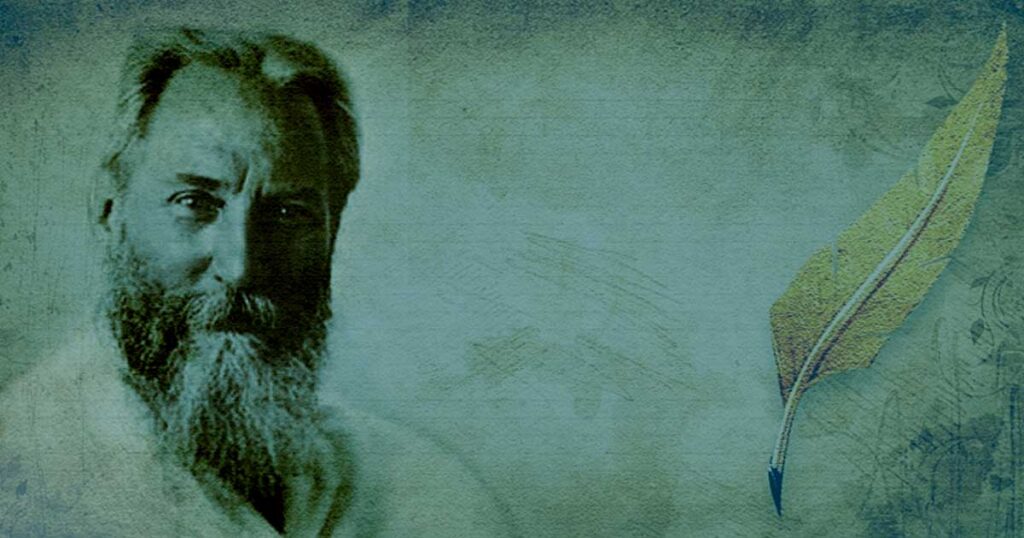
And then there appeared a man who said the simulations were unnecessary. Who said that the interior of another human being was not sealed at all, but luminous, legible, radiant with visible information — if only you had trained your perception correctly. His name was Charles Webster Leadbeater, and he arrived in the last decades of the nineteenth century with a claim so total, so systematically elaborated, and so serenely delivered that it has never entirely lost its grip on certain kinds of minds.
Leadbeater said he could see the human aura. Not metaphorically. Not as a poetic shorthand for intuition or emotional attunement. Literally see it — a layered, colored, dynamic field of energy surrounding every living body, carrying in its structure the precise contents of a person’s emotional life, their spiritual development, their past experiences, their present fears, their moral condition. He described this field with the confidence of a surveyor reading a map. He gave it dimensions. He catalogued its colors and their meanings. He tracked its changes in real time as subjects moved through emotional states. In books that accumulated across four decades of prolific writing — “The Astral Plane” in 1895, “Thought-Forms” co-authored with Annie Besant in 1901, “The Chakras” in 1927 — he built what amounted to a complete perceptual science of the invisible.
The disturbing thing is not that he was almost certainly wrong. The disturbing thing is the structure of the claim itself. Because when someone tells you they can see what you cannot, they are not merely offering information. They are installing themselves in a position of permanent, unverifiable authority over reality. And you, standing in the dark beside the sleeping body, already aching with the desire to know what is happening inside — you are precisely the audience they were made for.
The Architecture of the Invisible: What Leadbeater Actually Claimed
Someone sits across from him in a drawing room in Adyar, the ceiling fans turning slowly in the humid Chennai air, and he tells her that her grief is the color of grey-brown, a muddy arterial smear across the left side of her chest, that it has been there since her mother died, that it has begun to harden into something denser, something he names without hesitation as resentment. She has not told him about her mother. She has not told him anything. He is looking slightly past her, the way a person looks when they are reading something written just behind your shoulder, and she feels, in that particular way that cannot be argued with, that she has been seen.
This is the architecture Leadbeater spent forty years constructing with the precision of a surveyor and the confidence of a man who has never once doubted his instruments. Beginning with The Astral Plane in 1895, he laid the foundations of a cosmological system so internally coherent, so dense with specific detail, that it read less like spiritual speculation and more like a report filed by someone who had actually been there. The astral plane was not a metaphor. It had geography. It had population. It was stratified into seven distinct sub-planes, each vibrating at a different rate, each inhabited by beings at various stages of post-mortem existence. He described the terrain the way a colonial cartographer describes a coastline, noting the features, the densities, the dangers for the uninitiated traveler.
The Theosophical Society within which all of this unfolded had been founded in New York in 1875 by Helena Petrovna Blavatsky and Henry Steel Olcott, two figures whose appetite for synthetic cosmology was matched only by their gift for institutional ambition. By the time Leadbeater arrived at the Society’s headquarters in Adyar in the 1880s, it had already spread across three continents, and by the early twentieth century it would count branches in over forty countries, drawing in tens of thousands of members who were precisely the kind of educated, spiritually restless, post-Christian seekers who found both orthodox religion and materialist science insufficient containers for their experience of being alive.
Into this hunger Leadbeater poured an extraordinary torrent of specificity. In 1901, working with Annie Besant, who had inherited the Society’s leadership after Blavatsky’s death, he co-authored Thought-Forms, a book that attempted to do something almost hallucinatory in its ambition: to render visible the shapes that human emotions take in the subtle body. Anger was not merely a feeling but a form, jagged and red-orange, projecting outward like a thrown object. Devotion rose upward in soft blue arches. Jealousy was dark, olivine, with a poisonous iridescence. The book was illustrated with paintings, produced under Leadbeater’s direction, that look today like early abstract expressionism and were then presented as documentary evidence. They were, he insisted, accurate reproductions of what clairvoyant sight actually observed in the aura surrounding a human body.
By The Inner Life in 1910, the system had expanded into something approaching a complete phenomenology of consciousness. By The Chakras in 1927, he had produced what would become, improbably, one of the most influential texts in the development of twentieth-century New Age thinking, a detailed mapping of seven psychic centers along the spine, each associated with specific colors, functions, developmental stages, and pathological distortions. This framework, which he presented as the direct result of clairvoyant investigation rather than the synthesis of existing Hindu and Buddhist sources, would eventually migrate out of Theosophy and into yoga studios, therapeutic practices, and popular psychology manuals on a scale he could not have anticipated, losing along the way any acknowledgment of its origin.
The epistemological stakes of all this are not small. William James, writing in The Varieties of Religious Experience in 1902, had argued that mystical states carry their own form of noetic authority, that they feel, to the person experiencing them, like genuine knowledge rather than mere sensation. Leadbeater’s project went one step further than James’s careful phenomenology would allow. He was not describing how these states felt from the inside. He was claiming to report, with the neutrality of an observer, what actually exists on the other side of ordinary perception.

The Seduction of the Map: Why Humans Hunger for Invisible Architectures

There is a particular kind of relief that comes when someone hands you a map of something you cannot see. You have been standing in a room that feels too large, too dark, too architecturally unstable, and then someone produces a diagram — here are the planes, here are the hierarchies, here is exactly where you are standing in relation to everything else — and the relief is almost physical. Your shoulders drop. Your breathing changes. It does not matter, in that moment, whether the map is accurate. What matters is that someone drew it with confidence.
William James understood this before most people had the vocabulary to name it. In 1902, delivering what would become the foundational text of the psychology of religion, he identified something he called the noetic quality of mystical states: the sense, inseparable from the experience itself, that what one is apprehending is not emotion but knowledge. Real knowledge. The kind that lands in the body before it reaches the mind. James was careful, almost surgically careful, not to validate the content of these states, but he refused to dismiss the quality of conviction they produced. The person who returns from a mystical encounter does not feel that they have had a dream. They feel that they have seen something that was always there, waiting to be seen. Leadbeater’s entire apparatus ran on this fuel.
A woman spends years studying an elaborate cosmological system she received from a teacher she trusted absolutely. She memorized the planes, the densities, the color-coded vibrations of consciousness ascending through seven distinct bodies toward a perfection that was always just slightly out of reach. She built her life around it. Then, slowly, she begins to notice the shape of the system itself — not its content but its architecture. The way it placed the teacher at the center of all significant transmission. The way it made her own ordinary perceptions insufficient, always in need of correction by someone with finer sight. The way the hierarchy, no matter how many times she advanced within it, kept producing a new ceiling above her. What she eventually understands, with the kind of cold clarity that feels like grief, is that she has been living inside someone else’s interior landscape. The map was never of the cosmos. It was of the mapmaker’s psychology, transcribed in the language of revelation and passed off as cartography of the real.
Jung would have recognized this immediately. His concept of projection — the unconscious mechanism by which the psyche externalizes its own contents onto the world — is not simply a clinical observation about neurosis. It is a description of how culture works, how religion works, how any system of invisible architecture works. The collective unconscious, that stratum of shared symbolic inheritance Jung spent his life excavating in works from Psychology of the Unconscious in 1912 through Aion in 1951, is not a map of the universe. It is a map of what the human mind, under sufficient pressure, will inevitably invent. Archetypes are not residents of some higher plane. They are the shapes the psyche makes when it is trying to tell itself something it cannot say directly.
The late Victorian mind was under pressure that is difficult to overstate. The industrial revolution had remade the texture of daily experience within a single lifetime. The publication of Darwin’s On the Origin of Species in 1859 had not merely challenged religious orthodoxy — it had removed from the cosmos the quality of intention. The universe, suddenly, did not care. Empire guilt, operating largely below the threshold of acknowledged consciousness, produced in the educated classes a need for spiritual justification that conventional Christianity, already weakened by biblical criticism and geological discovery, could no longer reliably supply. The death of God that Nietzsche announced in 1882 was not a philosophical proposition for most people. It was a felt vacancy, an architectural collapse, a room with a ceiling that had been removed.
Into that vacancy, Leadbeater drew ceilings. He drew them in extraordinary detail, populated them with beings, assigned them colors and temperatures and hierarchies and names. The hunger that received those drawings was not stupidity. It was a civilization trying to survive the loss of its cosmological roof.
The Scandal Beneath the Vision: Power, Children, and the Ethics of the Seer
There is a particular kind of devastation that arrives not with noise but with retrospective clarity. You are sorting through old letters, or sitting across from someone who finally says a thing they have held for years, and suddenly a whole architecture of meaning collapses — not because something new has entered the picture, but because you have finally seen what was already there. The kindness that felt like recognition was not recognition. The attention that felt like spiritual insight was attention of a different order entirely. What you took to be someone reading your soul was someone reading something far more specific, and far more consumable.
In 1906, complaints were brought before the Theosophical Society’s leadership alleging that Charles Leadbeater had given inappropriate sexual advice to boys in his spiritual care — advising them, he admitted, on the practice of masturbation as a means of managing their energies. He did not deny the substance of the accusations. He resigned from the Society. Annie Besant, his closest intellectual ally, initially accepted his departure. Then, with a speed that alarmed many and satisfied almost none, she reversed course. By 1908 he had been reinstated. The Society fractured along the lines this produced, and the fracture never fully healed. Some members left permanently. Others stayed and found ways to rearrange the episode in their minds until it became something they could live beside.
Michel Foucault argued in the first volume of The History of Sexuality, published in 1976, that confession is never a neutral act. It is a technology of power. The person who receives another’s intimate disclosure — the priest, the analyst, the spiritual director — occupies a structurally superior position precisely because of that intimacy. Knowledge given in confession does not flow symmetrically. It flows upward, toward the one who listens and interprets. The confessor accumulates. The confessed is, in a sense, spent. What Foucault was mapping was not a corruption of a pure system but the system’s actual operating logic: that the production of truth about the inner life has always been inseparable from the exercise of authority over it.
Leadbeater’s entire pedagogy was built on this structure, and built on it with unusual intensity. He did not merely receive the confessions of his students. He claimed to perceive what they could not — their past lives, their astral compositions, the karmic debts written into their subtle bodies. He was not waiting for them to speak. He already knew. Or so the framework insisted. The spiritual directee who faces an ordinary confessor at least retains the power of silence, the capacity to withhold, the ability to doubt the exchange. Leadbeater’s students were offered no such ground to stand on. He had already seen. Their interiority had been read without their participation, and what he returned to them was not their own reflection but his interpretation, dressed as cosmic fact.
This is where the seer’s authority becomes something qualitatively different from other forms of pastoral power, and qualitatively more dangerous. Ordinary authority must at least wait to be spoken to. Clairvoyant authority precedes speech. It renders the other transparent, available, already disclosed. And the boys in Leadbeater’s circle were, by almost every social measure, the most available: young, seeking, removed in many cases from family oversight, brought into an international spiritual household in which Leadbeater’s word was treated as something closer to revelation than opinion.
Besant’s defense of him rested, finally, on a version of this same logic. She had trusted his perception of her own past lives, her own spiritual progress. To dismantle her confidence in him was to dismantle a significant portion of the architecture she had built her later life upon. That is not a simple moral failure. It is what happens when institutional knowledge and intimate belief become so entangled that defending one requires defending the other, whatever the cost to those harmed.
The question that remains is not whether someone can possess genuine perception and simultaneously cause harm through the structures that perception creates. The question is whether those two things can ever be separated — whether the vision and the violence were always, from the beginning, one system.
The Legacy That Refused to Die: From Theosophy to the New Age Nervous System
She nods slowly, eyes half-closed, while the instructor’s fingers hover two inches above her collarbone. The throat chakra, she is told, is blocked. There is tension here, a resistance to authentic expression, a fear of being truly heard. She breathes into the blockage as instructed. She has paid four hundred dollars for the weekend retreat, and she does not question the map being used to navigate her body, because the map feels ancient, authoritative, and somehow already familiar — as though it were describing something she always suspected was true but lacked the vocabulary to name. She does not know the vocabulary was invented, assembled, systematized, and published in a series of books between 1895 and 1927 by a former Anglican deacon in London and Adyar who claimed to read the human energy field the way a radiologist reads an X-ray. The knowledge feels immemorial precisely because it has been stripped of its author.
This is how inheritance works when it is too successful. It disappears into assumption.
Leadbeater’s chakra system, his description of the aura’s layered sheaths, his hierarchies of subtle bodies and their corresponding emotional and spiritual functions, did not simply persist into the twenty-first century. They metastasized into the operating system of an entire cultural economy. The global wellness industry, valued at over four and a half trillion dollars by 2019 according to the Global Wellness Institute’s own figures, runs in significant part on conceptual infrastructure that traces directly back to his typewritten manuscripts and hand-colored diagrams. The chakra wheel reproduced on every yoga studio wall, on every wellness app loading screen, on the covers of a thousand books published between San Francisco and Singapore, is structurally identical to the system Leadbeater elaborated in The Chakras in 1927, itself drawing on his earlier work in The Inner Life and clairvoyant investigations conducted with Annie Besant across the previous three decades. The colors, the correspondences, the emotional and psychological attributions — blocked expression in the throat, unresolved trauma lodged in the sacral center, grounding issues in the root — are his vocabulary, laundered through decades of repetition until they feel like neutral description rather than specific metaphysical claim.
Sociologist Colin Campbell, writing in 1972 in what remains one of the more forensically useful analyses of how heterodox spiritual knowledge reproduces itself, described what he called the cultic milieu — a permanently available reservoir of rejected and deviant knowledge systems that persists beneath the surface of mainstream culture, cross-pollinating, recombining, feeding each new wave of spiritual seeking with material from the last. The milieu is not organized. It has no headquarters, no hierarchy, no official doctrine. What it has is structural hospitality to ideas that official culture has refused, and a permanent population of seekers for whom that refusal is itself a form of endorsement. Leadbeater’s system entered this milieu in the early twentieth century, was carried through the Theosophical networks into the American counterculture of the 1960s, absorbed into the human potential movement, translated into the language of psychology and bodywork by figures like Wilhelm Reich and his successors, and emerged on the other side of the century rebranded as wellness science. Each translation removed one more layer of attribution.
By the time chakra language began appearing in nursing education curricula, in hospital chaplaincy training, in the intake questionnaires of licensed therapists asking clients which energy centers feel most activated, the genealogical line had become effectively invisible. A man who believed he could see the causal body of an arhat was now, without anyone quite deciding it, providing the diagnostic framework for a significant portion of Western therapeutic culture. The irony is almost architectural: the more his ideas spread, the more completely he himself was erased from them. Not suppressed, not refuted — simply dissolved into the background radiation of contemporary spiritual life, where they hum at a frequency no longer distinguishable from common sense.
The woman at the retreat breathes into her throat. Something releases, or seems to. The instructor smiles. The map holds.
A vision curated by a filmmaker, not an algorithm
In this video I explain our vision
What It Means to See: The Question Leadbeater Forces Us to Hold
There is a person sitting in a room at three in the morning, not quite asleep and not quite awake, listening to another person breathe in the dark beside them. They are thinking: I do not know what is happening inside you. I have never known. The body there, the warmth, the rhythm of the lungs — all of it is evidence, not access. And no amount of closeness, no accumulation of years or shared meals or confessions, has ever truly closed that gap. The other remains, in some final and irrevocable sense, a sealed room.
Thomas Nagel, writing in 1974 in one of the most quietly devastating papers in the history of philosophy, asked what it is like to be a bat. Not what bats do, not how their sonar functions, not what we can observe of their behaviour — but what it is like, from the inside, to navigate the world through echolocation. His answer, argued with precise and merciless logic, was that we cannot know. Not because we lack data, but because subjective experience is constitutively inaccessible from the outside. Consciousness, Nagel suggested, has an irreducible first-person character that no third-person description can capture. You can map the entire neural architecture of another mind and still not be standing inside it. The hard problem of other minds is not a puzzle waiting for a better instrument. It is a structural feature of what it means to exist as a separate being.
This is the ache that produced Leadbeater. Not pathology. Archetype. The hunger to see what cannot be seen — to pierce the membrane between one interiority and another, to know not merely the surface behaviour of a person but the luminous weather of their inner life — is not a symptom of delusion. It is the oldest human hunger there is. It predates Leadbeater by everything. What he did was give it a system, a cartography, a vocabulary ornate enough to feel like proof. The aura was not a fantasy of one eccentric Victorian. It was the fantasy of every person who has ever sat beside another human being and felt the unbearable opacity of them.
A woman spends decades dismantling the maps she was handed. She takes apart the chakra charts and the astral planes and the colour-coded fields of force, and she is thorough, and she is honest, and she does not flinch. She removes each layer with the care of someone unwrapping something they were told was precious. And when she is finished, when the last diagram has been folded away, she finds herself standing in a darkness that is identical to the one she began in. Same room. Same three in the morning. Same breathing body beside her that she cannot enter. But something has changed, and it takes her a long time to name it. The darkness is no longer a problem she is in the process of solving. It is not a corridor with a door at the end. It is simply where she is. The map was not wrong because it described the wrong territory. The map was wrong because it promised that the territory was mappable, that the sealed room had a key, that the other could be known if only the instruments were fine enough and the seer gifted enough and the system complete enough.
Leadbeater built the most elaborate key the nineteenth century could imagine. He walked through walls of consciousness with the confidence of a man who had never seriously entertained the possibility that walls exist for a reason. And people followed him because the alternative — that the other is genuinely other, that interiority is genuinely private, that love does not grant sight — is not a comfortable thing to hold in the dark at three in the morning.
But if the maps are false, the question that remains is not whether Leadbeater was a fraud. The question is what we are left with when the last diagram is gone. Not whether the territory disappears. Whether we can bear to stand in it — honestly, without instruments, without the consolation of a system that promises, just ahead, around the next corner of initiation, the thing we have always most wanted: to finally, completely, see.
🔮 Invisible Worlds and the Visionaries Who Mapped Them
Charles Leadbeater dedicated his life to charting the hidden dimensions of reality, from the astral plane to the inner structure of the human soul. His work did not emerge in isolation — it was deeply rooted in the Theosophical tradition and flourished alongside other great explorers of the invisible. Dive into these related articles to better understand the world that shaped his extraordinary vision.
The Astral Plane and the Subtle Bodies: the Theosophical Map of Human Being
The Theosophical map of the human being is perhaps the most direct companion to Leadbeater’s clairvoyant explorations. This article examines the subtle bodies — etheric, astral, mental — that Leadbeater himself claimed to perceive and describe with scientific precision. Understanding this framework is essential to grasping the full scope of his investigative work on the invisible planes.
GO TO THE SELECTION: The Astral Plane and the Subtle Bodies: the Theosophical Map of Human Being
Annie Besant: From Socialist Activism to Theosophical Leadership
Annie Besant was not only Leadbeater’s closest collaborator but also the co-author of some of his most daring investigations into occult chemistry and clairvoyant research. This article traces her remarkable journey from radical socialist activism to becoming one of the most influential leaders of the Theosophical Society. Her partnership with Leadbeater defined an entire era of esoteric exploration.
GO TO THE SELECTION: Annie Besant: From Socialist Activism to Theosophical Leadership
The Theosophical Society: History, Principles and Influence on Western Culture
To fully appreciate Leadbeater’s contributions, one must understand the institution that gave him both a platform and a purpose. This article offers a thorough overview of the Theosophical Society — its founding, its guiding principles, and its lasting influence on Western esoteric culture. Leadbeater’s visionary writings were inseparable from the organization’s mission to explore the hidden laws of nature and the latent powers of the human spirit.
GO TO THE SELECTION: The Theosophical Society: History, Principles and Influence on Western Culture
Helena Blavatsky and Theosophy: the Woman Who Revolutionized Esoteric Thought
Helena Blavatsky was the towering figure who laid the metaphysical foundations upon which Leadbeater would later build. This article explores the life and thought of the woman who single-handedly revolutionized esoteric thought in the modern West, introducing concepts of cosmic evolution, root races, and the Masters of Wisdom. Without Blavatsky’s audacious framework, Leadbeater’s clairvoyant cartography of the invisible worlds would have had no map to complete.
GO TO THE SELECTION: Helena Blavatsky and Theosophy: the Woman Who Revolutionized Esoteric Thought
Explore the Unseen Through Independent Cinema
The invisible worlds that Leadbeater mapped with his mind’s eye have also been explored through the lens of independent filmmakers who dare to look beyond the surface of reality. On Indiecinema, you will find a rich selection of films that navigate consciousness, mysticism, and the deeper dimensions of human experience — stories that no mainstream platform will tell you. Join us and let independent cinema be your guide to the unknown.
👉 EXPLORE THE CATALOG: Watch Indie Films in Streaming
A vision curated by a filmmaker, not an algorithm
In this video I explain our vision

