
The Kitchen at Three in the Morning
There is a particular quality of silence that exists only at three in the morning in a kitchen, when the rest of the house is breathing steadily in sleep and you are standing barefoot on cold tile, not hungry, not thirsty, not quite sure what drew you out of bed and into this room. You stand there. And after a moment, almost without deciding to, your eyes find the small blue flame of the pilot light on the stove, that tiny persistent mouth of fire that burns whether anyone is watching or not, that has been burning while you slept and will keep burning long after you go back to try again at sleep. You watch it. You cannot explain why. There is something about its steadiness that feels like a reproach and a comfort simultaneously, a small demonstration of constancy in the middle of a night that has refused to let you rest.

Most people have stood in that kitchen. Not everyone will admit it, but the three o’clock rising is one of the most universal and least spoken-about experiences of adult life, that particular wakefulness which is not insomnia exactly but something more like the body’s refusal to let consciousness dissolve entirely, as if some part of the organism knows that sleep right now would mean missing something, though it cannot name what. The psychologist Carl Gustav Jung wrote extensively about what he called the “night sea journey,” that descent into an interior darkness which precedes any genuine transformation, and he understood it not as pathology but as necessity. You cannot become something other than what you are without first enduring a period of dissolution, of formlessness, of standing in the dark not knowing what you are waiting for. The kitchen at three in the morning is, it turns out, a perfectly accurate physical metaphor for an ancient spiritual and psychological process that human beings have been trying to name for at least two thousand years.
The small blue flame does not know it is a metaphor. That is part of its authority. It burns at roughly 1,500 degrees Celsius at its hottest point, a temperature sufficient to melt certain metals, to crack organic compounds into their constituent elements, to render irreversible changes in the structure of matter. And yet it sits there in the dark kitchen looking almost decorative, almost gentle, a pilot light, a guide flame, something that exists only to be ready when it is needed. The alchemists of the medieval and early modern periods, those strange and serious figures whom later centuries made the mistake of dismissing as frauds or fantasists, would have understood immediately what you are looking at. They had a word for the furnace in which transformation occurred, the controlled and sustained heat that made the impossible rearrangements of matter possible. They called it the athanor.
The word comes from the Arabic al-tannur, meaning oven or furnace, and it carried into European alchemical practice a concept that was never merely technical. The athanor was not just a piece of equipment. It was the condition of transformation itself, the sustained and regulated application of heat over time, the maintenance of a precise internal environment within which substances could be broken down, purified, recombined into forms that had not previously existed. The alchemist’s central task was not to find the philosopher’s stone but to maintain the athanor, to keep the fire at the right temperature, to resist the temptation to increase the heat too quickly or let it drop too low. Transformation, the old practitioners understood with a precision that modern psychology is only now catching up to, is not an event. It is a duration.
You stand in your kitchen and watch the small blue flame. You have been standing here longer than you realized.
The Sands

Science fiction, by Noah Paganotto, Argentina, 2022.
In an undetermined location on planet Earth, in an unknown time, Zoilo lives with his family in a wasteland surrounded by ruins. They live uprooted, without mothers, knowing that pregnancy for women is synonymous with death. For them there is only one collective routine; keep the fire alive. Only Zoilo escapes this logic, observing, intrigued, details that others do not see and therefore do not appreciate. Zoilo's personal search for answers will increase the differences with his relatives, increasingly revealing an empty world of interiority.
Avant-garde film that burns slowly in the first part and then reveals in the second the profound conflicts of a family prisoner of archaic beliefs. It is a dystopian and visionary work, with wonderful photography and images of rare power that allow us to grasp the depth of the story and its poetic potential. The faces of the actors, especially the protagonist boy, are perfect. The Sands metaphorically represents the world we live in: an alienated society, where what keeps us alive is demonized and blamed for death. In opposition to the fast pace of the typical mainstream film, The Sands is a meditative journey into the depths of images. The film was shot in natural environments in the city of Necochea, Buenos Aires province, Argentina.
LANGUAGE: Spanish
SUBTITLES: English, Spanish, French, German, Portuguese
What the Alchemists Actually Built
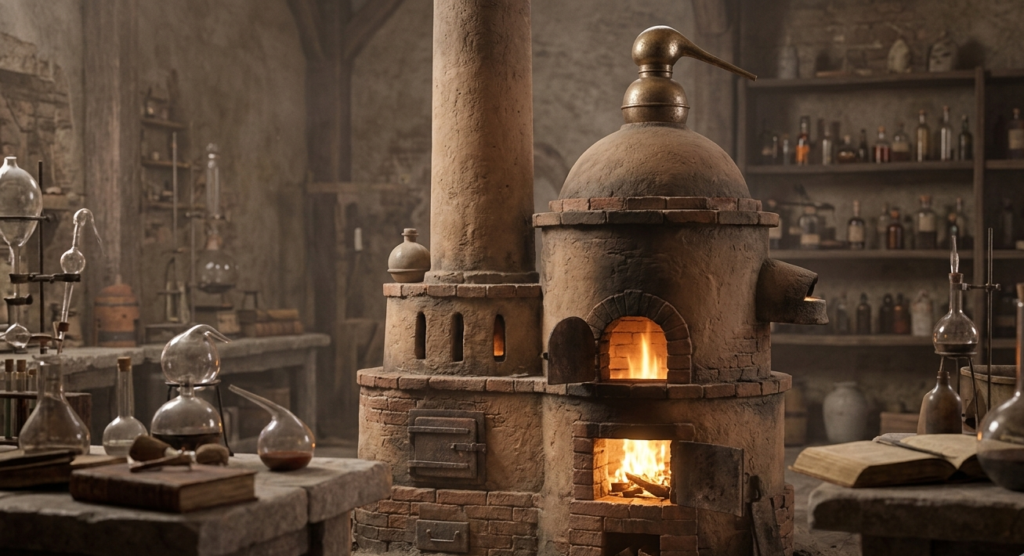
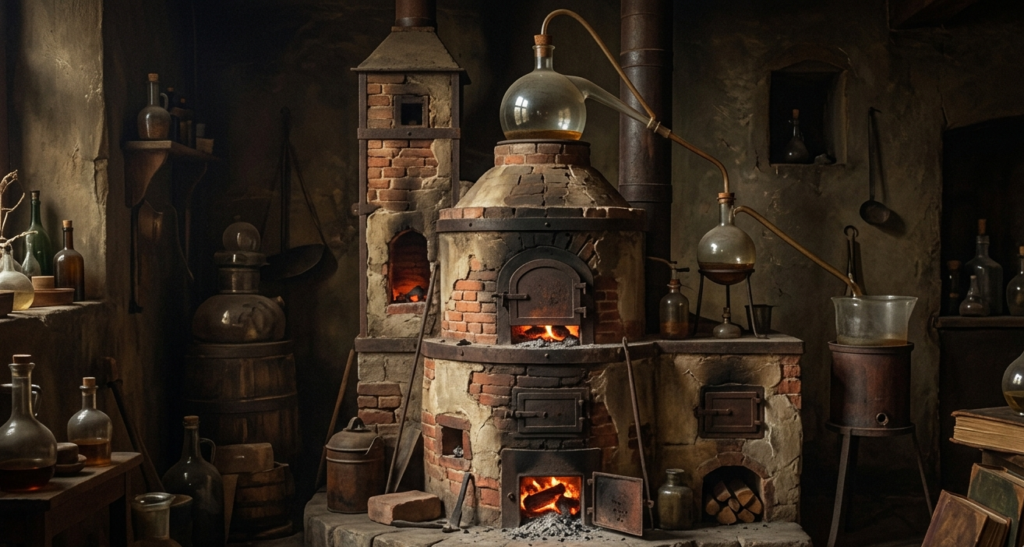
There is a kind of architecture that exists only to slow time down. Not to stop it, not to reverse it — simply to hold it at a particular temperature long enough for something invisible to become visible. The athanor was exactly this: a furnace built not for speed but for duration, a clay cylinder standing roughly four feet tall, wider at its base where an ash-pit collected the slow exhale of burning wood or charcoal, narrower at its upper chamber where the vessel containing the work rested in sustained, self-regulating heat. The design was almost embarrassingly practical. As the fuel burned downward through successive layers, the ash itself acted as insulation and governor, preventing the temperature from spiking, keeping the interior warmth steady across days and sometimes weeks without any human intervention required. You could, in theory, walk away. The furnace would continue thinking.
This is not metaphor. This is engineering. Jabir ibn Hayyan, working in eighth-century Kufa under the Abbasid caliphate, described the principles of sustained combustion with a precision that would not embarrass a modern materials scientist. His corpus — spanning somewhere between two and three thousand texts, though scholars debate how many can be directly attributed to him — treated the regulation of heat as the central problem of transformation. Not the substance inside the vessel, not the prayers offered over it, but the heat itself: its constancy, its patience, its refusal to rush. Jabir understood that most failures in the laboratory were failures of temperature management. Things were destroyed not by the wrong ingredient but by the wrong moment. Heat applied too fast collapses the structure you are trying to reveal. The athanor was his answer to human impatience — a device that removed the human hand from the equation at precisely the point where the human hand does the most damage.
By the time Paracelsus was overturning European medicine in the early sixteenth century, the athanor had migrated from the Islamic world through the translated manuscripts of Toledo and Palermo into the workshops tucked beneath the newer universities of Basel, Wittenberg, Prague. Paracelsus was a furious, difficult man, a physician who burned the works of Galen and Avicenna in a public bonfire in 1527 to announce that medicine needed rebuilding from its foundations, and he worked with furnaces as readily as with pharmacopeia. For him the athanor represented something specific: the separation of pure from impure required controlled environment over extended time. You could not rush the calcination of a substance any more than you could rush the healing of bone. The body itself, he argued, was a kind of furnace, digesting and transforming, and a physician who did not understand transformation at the material level understood nothing worth knowing.
The workshops themselves were remarkable places. Stone floors worn smooth by foot traffic. Dozens of vessels at different stages of a process that might span months. The smell of sulfur and mercury vapor, of heated clay and slow-burning oak. These were not mystical sanctuaries — they were laboratories in the oldest sense, places where labor was the point, where the willingness to wait was itself a form of knowledge. The gold that alchemists supposedly sought was largely a later projection, a retrospective narrative imposed by critics who needed alchemy to be fraudulent in order to dismiss it entirely. What the serious practitioners were actually after was harder to name and harder to discredit: a reliable method for inducing change without destroying the thing being changed.
The athanor encoded that method into its very structure. You built patience into the clay. You built it into the proportions of the ash-pit, into the diameter of the upper chamber, into the choice of fuel and the spacing of the air vents. The architecture was the argument. And the argument was that certain transformations cannot be forced.

The Man Who Refused to Leave the Crucible
There is a man who has not left his workshop in eleven years. Not literally — he eats, he sleeps, occasionally he appears at the table where his family has learned to speak without expecting him to respond — but in every meaningful sense his body has simply become an extension of the room where he works. The notebooks stacked against the far wall date back to a period when his daughter was still learning to walk. She is now taller than her mother. He does not work on the notebooks anymore. He works on something else, something that grew out of the notebooks the way a river grows out of rain: not a continuation but a transformation, a deepening that the original form could no longer contain. His wife has stopped asking when it will be finished. His brother, who visits twice a year and always leaves with the same expression of polite bewilderment, once asked him very gently whether he had considered that perhaps nothing was going to come of it. The man listened, nodded, and returned to the table.
What the brother cannot see, and what no one around this man can quite articulate, is that the work itself is the event. Not the product. Not the recognition. The process — its resistance, its slow yielding, its continual demand that the operator return and return again — constitutes something that has no adequate name in a language built around outcomes. We have words for obsession, for dedication, for madness. We do not have a word for the state in which a person has become genuinely indistinguishable from their material.
Carl Jung understood this. In Psychology and Alchemy, published in 1944, he argued with careful and sometimes startling precision that the alchemists of the medieval and Renaissance traditions had never really been doing what they claimed to be doing. The gold was a red herring — a necessary one, because the psyche cannot work directly on itself, it requires an external object onto which it can project its deepest operations. The furnace, the retort, the slow calcination of matter: these were not metaphors for psychological transformation. They were the psychological transformation, conducted at one remove, in the only language available to people who had no concept of the unconscious but who were, nonetheless, engaged in its most serious business. What happened to the metal happened to the man. The two processes were not parallel. They were the same process, split across two registers of reality.
This is what the brother misses entirely. He sees a man wasting himself on something that will never be completed, never be recognized, never be converted into the currencies that make a life legible to others. What he is actually watching is a man in the middle of an operation whose subject is himself. The work is not being done on the notebooks, or on the object the notebooks gave rise to, or on whatever form that object has taken after eleven years of sustained heat. The work is being done on the worker. And it cannot be rushed, because the alchemical tradition was absolutely clear on this point: the opus requires its full time. Paracelsus wrote in the sixteenth century that the physician who does not understand transformation understands nothing of healing. The furnace had to be maintained at a constant temperature — not too high, which would destroy what was forming, and not too low, which would allow it to collapse back into inert matter. The heat had to be exact, and it had to be sustained, and it had to be tended by someone willing to stand there through the long silence between one stage and the next.
The man in the workshop is tending the fire. Everyone watching him thinks he is burning his life down.
The Social Punishment of Incompleteness
There is a particular kind of silence that falls over a dinner table when someone answers the question “how is the project going?” with something less than a completed thing. Not hostility, exactly. Something more ambient and therefore more corrosive — a slight shift in posture, a redirect toward safer subjects, the conversational body language of a group that has collectively decided to stop holding space for something that is taking too long.
Hartmut Rosa spent years mapping this precise mechanism. In his 2013 work on social acceleration, he argued that modern societies do not merely move faster — they restructure their entire architecture of value around the speed of completion. What accelerates is not just technology or communication but the tempo of legitimacy itself. A process that cannot show returns within a culturally acceptable window does not simply appear slow. It appears suspect. The person inside it appears either deluded or self-indulgent, and often both.
She had been building something for three years. Not a business exactly, not a book exactly — one of those threshold projects that does not fit cleanly into a category, which already marks it as vulnerable. In the first year people asked with genuine curiosity. In the second year they asked with a patience that had begun to thin at the edges. By the third year the questions had stopped, which was its own kind of verdict. She noticed that she had started explaining herself preemptively — at dinners, in messages, in the way she framed her days — as if she owed everyone a justification for the continued existence of something unfinished. The athanor requires isolation. What she got instead was the slow withdrawal of social permission to remain inside the fire.
This is what Rosa’s acceleration thesis makes visible: the compression is not only economic but social and psychological. Project timelines shrink not because the work requires less time but because the tolerance for invisible progress has collapsed. Platforms algorithmically reward the finished and the polished — the product over the process, the arrival over the journey. Content that shows workings, doubt, the middle passage, performs poorly against content that displays outcomes. The infrastructure of visibility is calibrated to celebrate completion, which means it structurally penalizes the kind of sustained, low-visibility incubation that transformation actually requires.
The athanor was by design an instrument of enclosure. Its thick walls were not incidental — they were the technology. Heat had to be contained, sealed off from the ambient temperature of the outside world, because any leak disrupted the process. Medieval alchemists understood that the work inside the vessel required a microclimate radically different from ordinary conditions. What they could not have named, but clearly intuited, is that the social world operates as an ambient temperature of its own. And that ambient temperature, in the accelerated present, runs cold for anything that refuses to resolve quickly.
She eventually dismantled what she had been building. Not in one decision but in the gradual way that people stop tending something — missing a day, then a week, then finding that the absence has hardened into a new normal. She told herself it was a practical choice. There is a particular grief in that kind of abandonment because it carries no drama, no clear breaking point, only the quiet capitulation to a consensus that was never formally announced but was always already in the room. The project did not fail. It was cooled from the outside, degree by degree, until the heat could no longer sustain itself.
Rosa would say this is not an individual failure but a structural one — that acceleration does not simply inconvenience slow processes, it actively pathologizes them, assigns them the grammar of dysfunction. To be in the middle of something long is to exist in a register the culture can barely read. The furnace asks for a patience that the surrounding world has decided it can no longer afford to extend.
Heat Without Burning: The Regulation of Intensity

There is a particular kind of attention that looks, from the outside, like doing nothing. A man sits beside a bed where someone is recovering — not from surgery, not from anything dramatic, just from the long wearing-down of something unnameable — and he is simply there. He adjusts the blanket. He opens a window a half-inch, then closes it. He brings water that is neither cold nor warm. Anyone walking past the doorway would see stillness, patience, almost vacancy. What they would not see is the precision of it, the extraordinary calibration required to give exactly that much and no more, to be present without pressing, to warm without scalding.
The athanor was built for this. Its entire design — the insulated tower, the self-feeding fuel chamber, the vented dome — existed not to generate maximum heat but to prevent heat from becoming its own violence. The metallurgists and alchemists who relied on it understood something that the forge-masters with their bellows and their roaring fires did not: that certain transformations cannot be forced. They can only be sustained. The difference between those two operations is not merely technical. It is philosophical. It concerns the nature of change itself, and what we believe about the relationship between intensity and depth.
Gaston Bachelard, writing in 1938 in The Psychoanalysis of Fire, made an observation so precise it has the quality of something unearthed rather than composed. He argued that Western civilization had fundamentally misread fire — had taken its explosive, visible, dramatic manifestations as its essence, when in truth fire’s deepest power operates quietly, slowly, beneath the threshold of spectacle. We are drawn to flames, he wrote, because they move and we are creatures of movement, creatures who confuse motion with progress. But the fire that changes things most profoundly is the fire you barely see: the ember, the constant warmth, the heat that does not announce itself. Drama, Bachelard understood, is often fire’s disguise — the performance of transformation rather than transformation itself.
This distinction has a way of pressing against almost every assumption we hold about how change happens. The cultural mythology of breakthrough — the sudden insight, the rupture, the before and after — is essentially a mythology of the forge: high heat, immediate result, visible scar. We distrust slow processes because they resemble inaction. We mistake threshold for transformation, and so we keep raising the temperature, believing that more intensity will accelerate what only duration can accomplish.
The man tending convalescence in that room knows this, not intellectually but in his hands. He knows that if he spoke too urgently about recovery, about the future, about what needs to happen next, something would close. He has learned — through failure, almost certainly, through the particular grief of watching something fragile shatter under the pressure of good intentions — that there is a heat the body and the relationship and the healing process can absorb, and beyond that threshold lies not acceleration but damage. The alchemist called this the regimen: not a recipe but a discipline of restraint, an ongoing reading of the material’s tolerance, a willingness to hold steady when every instinct says to push.
What makes this so difficult is that restraint looks like indifference. Duration looks like delay. The person lying in the bed might even resent it, might demand the drama of decisive action, because we are all, in our worst moments, forge-minded. We want the high heat. We want to feel something happening. The athanor offered no such satisfaction. It offered only the slow, invisible work of sustained warmth — the kind that does not announce its results until one morning, almost without warning, something that was fixed becomes fluid again, something that was sealed begins, quietly, to open.
A vision curated by a filmmaker, not an algorithm
In this video I explain our vision
What Gets Burned Away
Calcination begins before you recognize it as such. You are standing in a room you have lived in for years, looking at an object — a photograph, a shelf of books arranged in a particular order, a coffee mug with someone else’s name on it — and something shifts. Not dramatically. Not with the violence you later tell people it had. The shift is quieter than that, more like a foundation settling than a wall collapsing, and what you feel first is not grief but a strange, suspended disorientation, as though the coordinates you have been using to navigate your own life have been recalibrated by an agency you were never consulted about.
The alchemists called this calcination. They placed their base matter in the athanor and subjected it to sustained, ferocious heat until everything reducible to ash became ash. What remained was not nothing. It was the incombustible residue, the salt, the mineral skeleton of the substance — everything that had merely been clinging to the form, all the accumulated volatility and pretension of the material, burned away. The calcinated matter was not destroyed. It was rendered honest. It could receive.
There is a man who loses everything in a sequence so compressed it feels almost satirical — his position, his certainty, the entire architecture of professional identity he has been building for decades. He does not collapse immediately. This is the part no one talks about: the strange composure of the early days, the way the psyche enacts a kind of quarantine, holding the catastrophe at a distance while the organism continues to function. He eats breakfast. He makes appointments. He speaks in complete sentences. And then, weeks later, in a moment of complete mundaneness — washing his hands, say, or reading a menu — the calcination reaches him, and he understands that the person who had all those things is no longer available. Not dead. Simply no longer there as a continuous narrative.
Simone Weil called this decreation, and she meant it with a precision that her contemporaries found uncomfortable. In her notebooks, collected after her death in 1943, she wrote that what passes for the self is largely an act of occupation — a colonization of reality by ego that prevents anything genuinely other from being received. Decreation was not self-destruction in the nihilistic sense. It was the willing withdrawal of the self from the center of experience, a kind of spiritual kenosis, an emptying that created the conditions for something true to enter. Weil was insistent that this was not a metaphor. The self must actually become less, must surrender the stories it tells about its own necessity, before it can be genuinely open to truth, to another person, to anything that is not simply its own reflection bounced back from the world.
What makes this unbearable, practically speaking, is that the stories we surrender are not the ones we know to be false. Those are easy to release. What calcination burns away are the stories we believed were identical with ourselves — the conviction that we are the kind of person who does not fail in this particular way, the certainty that we have already done the difficult work and need not do it again, the quiet assumption that understanding a thing is the same as having been changed by it. These are the volatile compounds, and they burn at high temperature.
The man washing his hands does not know he is at the beginning of anything. He knows only the ash quality of the moment, the way his own reflection in the mirror above the sink seems to belong to someone he is still in the process of meeting. The athanor does not announce its purpose. It simply maintains its heat.
The Operator and the Operated Upon
There is a particular kind of exhaustion that does not come from doing too little. It comes from doing everything correctly — from tracking the sleep, adjusting the macros, scheduling the reflection, measuring the output — and still arriving, somehow, at a place of profound depletion that no optimization protocol had predicted or prepared for. The person who experiences this rarely understands what has happened to them. They followed the system. They were diligent operators. They kept the fire at exactly the right temperature. And yet something inside them has burned down to ash.
The alchemical tradition understood something about this that our productivity culture has aggressively forgotten. The athanor was not a neutral instrument. It was not a machine that processed material while the alchemist stood safely at the workbench, clipboard in hand, monitoring outcomes. The furnace was understood to operate on everything within its proximity — including, and perhaps especially, the one who had built it. To tend the athanor was to be tended by it. The heat that slowly transformed the prima materia was the same heat that slowly transformed the operator. There was no position of safe remove. There was no management without exposure.
Byung-Chul Han, writing in The Burnout Society in 2010, identifies with extraordinary precision the psychological architecture of the contemporary subject who has internalized the logic of the workshop without understanding what the workshop actually does. Han calls this figure the achievement-subject: someone who has replaced external compulsion with self-compulsion, who no longer needs a master because they have become their own master and their own slave simultaneously. The achievement-subject does not recognize limits because limits come from outside, and there is no outside anymore. There is only the relentless interior demand to perform, to improve, to optimize. Han observes that this subject does not collapse from oppression. They collapse from excess positivity — from too much possibility, too much initiative, too much self-directed effort. The burnout is not the failure of the system. It is the system working exactly as designed, until the material it runs on is consumed.
What the alchemist knew, and what the achievement-subject has catastrophically forgotten, is that the furnace does not optimize. It does not produce a better version of what you put inside it while leaving the structure intact. It dissolves. The categories break down. The boundaries between the one who transforms and the one being transformed are not maintained by the heat — they are among the first things the heat destroys.
A man sits at his kitchen table in the early hours of the morning, surrounded by the evidence of his own systematic self-improvement: journals filled with goals and retrospectives, a habit tracker that has turned green for ninety-three consecutive days, a reading list that has been methodically conquered. He cannot explain why he feels more hollow now than when he started. He built the furnace correctly. He calibrated everything. The problem is that he assumed the entire time he was standing outside it, that the engineer and the material were separate things, that he could burn away the unwanted parts and retain the self that was doing the burning. The athanor does not honor that distinction. It never did.
The Spanish mystic John of the Cross, writing in the sixteenth century his Dark Night of the Soul, described transformation not as refinement but as demolition — a process so total and disorienting that the person undergoing it cannot recognize themselves, cannot access what they previously knew, cannot locate the familiar coordinates of identity. He was not describing failure. He was describing what genuine transformation actually feels like from the inside, which is nothing like improvement and everything like annihilation. The athanor does not make you a better version of yourself. It makes you someone you do not yet have words for.
The Flame That Has No Witness
The athanor burned alone. No one checked on it hourly. No one documented the color of the flame or posted a photograph of the crucible at dawn. The alchemist would descend to the cellar, adjust the fuel, observe the matter inside the vessel, and leave again. Days passed. Sometimes weeks. The transformation occurring inside that sealed chamber had no audience, and this was not a flaw in the process — it was the condition of the process. Witness would have interrupted it. The gaze itself would have changed what was forming.
There is a woman who spent three years barely leaving her apartment. Not from fear, not from illness in any diagnosable sense, but from something slower and stranger — a dissolution she could not name while it was happening. She had stopped recognizing the logic by which she had previously organized her life. Old ambitions felt like clothes belonging to someone else. Relationships she had maintained for a decade suddenly asked of her a performance she could no longer produce. She was not depressed, or not only that. She was cooking at a temperature no one could see, and the matter inside her was losing its previous form entirely.
What made it almost unbearable was not the dissolution itself. It was the silence around it. The world outside moved at its ordinary velocity, generating shareable moments, legible narratives, evidence of progress. She had none of these. She could not photograph what was happening. She could not caption it. When people asked how she was, she said fine, because the truth — that she was in the middle of something that had no beginning she could locate and no end she could predict — was not a sentence that fit into any available social slot. She had changed profoundly by the end of those three years, but she could not explain the change to anyone, including herself, in terms that would be recognized as change. She had no before-and-after. She had only an after, standing in a room, holding a version of herself she had never planned.
William James, in The Varieties of Religious Experience published in 1902, wrote about what he called the twice-born soul — not someone who undergoes a single dramatic conversion but someone who passes through a genuine dissolution and reconstitution of the self, a process he described as frequently invisible, frequently painful, and almost never legible from the outside at the moment it is occurring. James was not speaking mystically. He was speaking structurally: some transformations require the death of the previous organizing center before the new one can form, and during that interval, the person cannot be read by ordinary instruments.
The alchemist knew this. The athanor was built precisely to protect a process that could not survive observation. The sealed vessel, the slow heat, the weeks of darkness — these were not obstacles to the work. They were the work. The substance inside had to be held away from the world long enough to become something the world had no category for yet.
What we have lost is not the capacity for this kind of change. The capacity is still there, firing in cellars we rarely acknowledge. What we have lost is the cultural permission to trust it. To say: something is happening in me that I cannot report, cannot demonstrate, cannot make available for social processing, and it is nonetheless real — perhaps more real than anything I have posted in three years. We have built an entire infrastructure of verification that runs on visibility, and into that infrastructure the athanor fits nowhere. Its heat is too slow. Its darkness too complete. Its results arrive without metadata, without timestamp, without the narrative arc that makes transformation legible to others.
And the question that remains, the one the old furnace asks in its silence, is whether we have forgotten how to trust what cannot be seen while it is still becoming.
🔥 The Sacred Fire: Alchemy and Transformation
The Athanor, the alchemist’s furnace, stands at the heart of the Great Work as the vessel where raw matter is purified into gold — both literal and spiritual. To truly understand its role, one must explore the vast symbolic universe that surrounds alchemical practice, from its foundational texts to its inner psychological dimensions. These articles open the hidden doors of the furnace.
Magnus Opus: nigredo albedo rubedo
The Magnum Opus unfolds through three sacred stages — nigredo, albedo, and rubedo — which mirror precisely the transformations occurring within the Athanor’s controlled heat. Each phase dissolves and reconstitutes matter, just as the furnace must be carefully tended to guide the alchemical substance through death, purification, and rebirth. Understanding these stages is essential to grasping why the Athanor is far more than a mere laboratory instrument.
GO TO THE SELECTION: Magnus Opus: nigredo albedo rubedo
Paracelsus: Life and Alchemical Thought
Paracelsus revolutionized alchemical thought by insisting that the true purpose of alchemy was not the production of gold but the preparation of medicines capable of healing the human body and soul. His practical understanding of the Athanor as a tool for transformation — chemical, biological, and spiritual — redefined how generations of alchemists approached their furnaces. Exploring his life and philosophy illuminates the dual nature of the alchemical fire as both destroyer and healer.
GO TO THE SELECTION: Paracelsus: Life and Alchemical Thought
Spiritual Alchemy: Inner Transformation and Symbolism
Spiritual alchemy reframes the entire apparatus of the laboratory — including the Athanor — as a symbolic map of inner transformation and psychological rebirth. The furnace becomes a metaphor for the sustained inner heat required to transmute the leaden aspects of the self into luminous gold. This article explores how alchemical symbolism has endured as one of the most powerful languages of inner work across centuries.
GO TO THE SELECTION: Spiritual Alchemy: Inner Transformation and Symbolism
Jungian Alchemy: Jung and Alchemical Psychology
Carl Gustav Jung devoted decades of his life to decoding the symbolic language of alchemy, recognizing in its imagery a precise map of the individuation process. For Jung, the Athanor represented the psyche itself — the contained, heated space in which unconscious material is slowly transformed into conscious gold. This article traces how Jungian psychology and alchemical tradition illuminate each other in profound and unexpected ways.
GO TO THE SELECTION: Jungian Alchemy: Jung and Alchemical Psychology
Discover the Flame in Independent Cinema
The fire of transformation burns just as brightly on screen as it does in the alchemist’s furnace. On Indiecinema streaming, you will find a curated selection of independent films that explore inner metamorphosis, esoteric knowledge, and the hidden dimensions of reality — films that dare to ask the deepest questions. Step inside the Athanor of independent cinema and let the Great Work begin.
👉 EXPLORE THE CATALOG: Watch Indie Films in Streaming
A vision curated by a filmmaker, not an algorithm
In this video I explain our vision

