
The Laboratory Nobody Watched
The summer corn stands taller than a person’s shoulders, and you are alone in it. Not alone the way a scientist is alone in a quiet office, but alone the way a voice is alone when it speaks into a room where no one has ears for what it is saying. It is the 1940s, the decade when physics is consuming the world’s best minds with the elegance of splitting atoms, when the double helix is still years away from being anyone’s obsession, when genetics means Mendel’s peas arranged in tidy ratios that satisfy the need for order. And here, in a field at Cold Spring Harbor, Long Island, a small woman with dirt on her hands moves between rows of maize with a magnifying glass, reading the kernels the way others read scripture — not for confirmation, but for what they cannot yet stop themselves from saying.

Barbara McClintock is not waiting to be discovered. She is discovering. That distinction matters more than it appears to.
What she is finding, in those spotted and streaked kernels, in the irregular pigmentation that other scientists have catalogued as noise and moved past, is that genes move. They jump. They relocate themselves within a chromosome, they silence other genes, they respond to the organism’s stress as if the genome were not a fixed library but a living argument the cell is constantly having with itself. She calls these elements transposons, though the name will take decades to stick, because first the concept has to become thinkable, and in the 1940s it is not. The architecture of heredity was supposed to be stable, transmitted across generations with the faithful rigidity of a blueprint. What McClintock was seeing in those kernels suggested the blueprint was annotating itself in real time. This was not a small revision. This was a different theory of what life does with its own instructions.
She presented her findings to the genetics community in 1951, at a Cold Spring Harbor symposium. The room did not erupt in debate. It went quiet in the particular way rooms go quiet when they have no language for what has just been said. A few colleagues approached her afterward with the careful kindness reserved for people who have said something embarrassing. Most simply moved on. The papers she published through the early 1950s were read the way unclassifiable things are read — politely, without retention. The grants dried. The invitations thinned. The field continued without her at its center, which is where, by any honest reckoning of the evidence she was producing, she belonged.
The philosopher of science Thomas Kuhn argued in The Structure of Scientific Revolutions, published in 1962, that normal science does not simply accumulate knowledge — it actively suppresses observations that cannot be accommodated within the reigning paradigm. Scientists, he wrote, are trained to solve puzzles within a framework, not to question the framework itself. An anomaly that cannot be explained is not celebrated as a mystery worth pursuing. It is set aside, reclassified, or attributed to experimental error. McClintock’s maize was producing anomalies on an industrial scale, and the scientific consensus of her era had a name for that: it was called sloppy data. What it actually was, as she would receive the Nobel Prize in Physiology or Medicine in 1983 — more than thirty years after those presentations — was a paradigm the century was not yet ready to enter.
But here is what stays with you, when you stand in the place she stood, or try to imagine it: she kept going. Not because she expected vindication. Not because she had institutional support or collaborative networks or the warm friction of peers who understood her. She kept going because the corn kept telling her something true, and she did not have the kind of mind that can unknow a true thing simply because the room has gone quiet.
Eve of the Irises
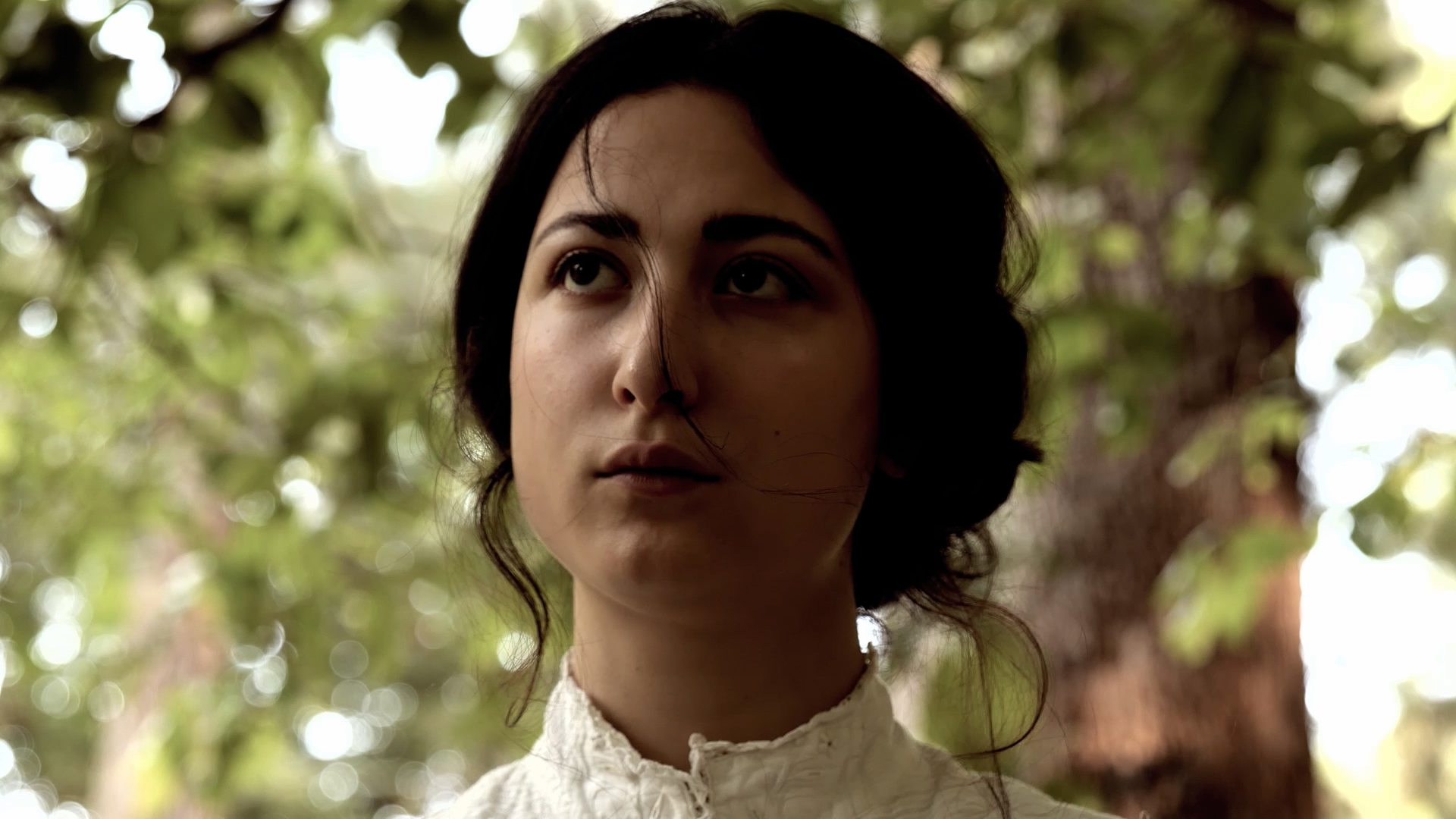
Documentary, by Isabel Russinova, Rodolfo Martinelli Carraresi, Italy, 2026
Eva of the Irises is a historical biographical docu-film about the scientist Eva Mameli Calvino, a botanist and pioneer of environmentalism in Italy, mother of the writer Italo, born in Sassari in 1886. The film, based on a multidisciplinary approach that combines several genres—such as theatre, documentary, cinema, and research—moves between memories, reflections on life, as well as the goals and missions the scholar still wished to achieve.
The multifaceted artistic sensibility of Isabel Russinova is expressed across many fields, from writing to acting, from directing to civic engagement, and finds one of its highest expressions in the docu-film Eva of the Irises, created with Rodolfo Martinelli Carraresi. The film blends scientific rigor and poetic refinement to portray the extraordinary figure of the botanist Eva Mameli Calvino, mother of Italo Calvino but above all an independent protagonist of 20th-century scientific culture. It is told through a combination of archival materials, interviews, and evocative staging capable of elegantly and profoundly conveying her intense human and professional story.
LANGUAGE: Italian
SUBTITLES: English, Spanish, French, Portuguese
What Institutions Do to Inconvenient Truths
There is a particular kind of silence that follows a presentation when the audience has understood nothing but does not know it. Not the silence of incomprehension — that at least carries unease, a fidgeting, an averted glance. This is the silence of polite closure, of men who have already begun composing their lunch plans, who applaud with the correct rhythm and move toward the coffee table with the measured relief of people who have fulfilled a social obligation. You have probably sat in that room. You may even have been the one presenting.
In the summer of 1951, at Cold Spring Harbor, she stood before a gathering of the most eminent geneticists of the era and described, with meticulous and exhaustive evidence, something that should have rewritten the foundational assumptions of the entire discipline. She had spent years tracing the behavior of maize chromosomes, watching patterns that defied every stable model then in circulation. She had found that genetic material moved, that it transposed, that the genome was not a fixed library but something closer to a living argument with itself. The data was not ambiguous. The methodology was not flawed. The presentation was precise to the point of severity. And the room listened, and nodded, and understood nothing.
Thomas Kuhn, writing eleven years later in The Structure of Scientific Revolutions, would offer the most honest diagnosis of what actually happened in that room. Normal science, he argued, does not advance by accumulating truths. It advances by protecting a paradigm — a shared framework of assumptions so deep they function not as beliefs but as the invisible grammar of perception itself. What cannot be stated in that grammar does not appear as wrong. It appears as noise. And this is the crucial, devastating distinction: the geneticists of 1951 were not rejecting her findings. They were genuinely incapable of receiving them. This is what Kuhn called paradigm incommensurability — the condition in which two scientific frameworks are not simply in disagreement but are operating in languages so structurally different that translation is not merely difficult but impossible.
The genome, in 1951, was conceptualized as stable, hierarchical, and essentially passive. Genes sat in fixed positions on chromosomes and issued instructions downward. This was not merely a scientific model. It was a metaphysical commitment, and like all metaphysical commitments, it was largely invisible to those who held it. To accept what she was showing them would have required not an adjustment of the model but the demolition of the entire epistemological structure within which their careers, their methodologies, their professional identities had been built. Kuhn was precise about the cost of this: paradigm shifts, he wrote, are not won by argument. They are won by the deaths of those who cannot accept them and the formation of a new generation unburdened by the old allegiances.
What makes the scene at Cold Spring Harbor so precise in its cruelty is exactly the courtesy. Hostility would have been a kind of recognition. An argument requires an opponent who has actually heard you. What she received instead was the most efficient form of institutional erasure: acknowledgment without comprehension, a polite absorption of her years of work into a register where it simply could not resonate. She was thanked. She sat down. The conversation moved elsewhere.
Hannah Arendt, in The Origins of Totalitarianism, described a related mechanism in political life — the way institutions do not need to actively suppress inconvenient truths because the structure of ordinary discourse accomplishes this without violence, without even intent. The suppression is embedded in the architecture of how meaning is organized and exchanged. What has no place in that architecture does not get fought. It gets forgotten in plain sight.
She returned to her corn, and continued.

Transposition and the Grammar of Living Systems
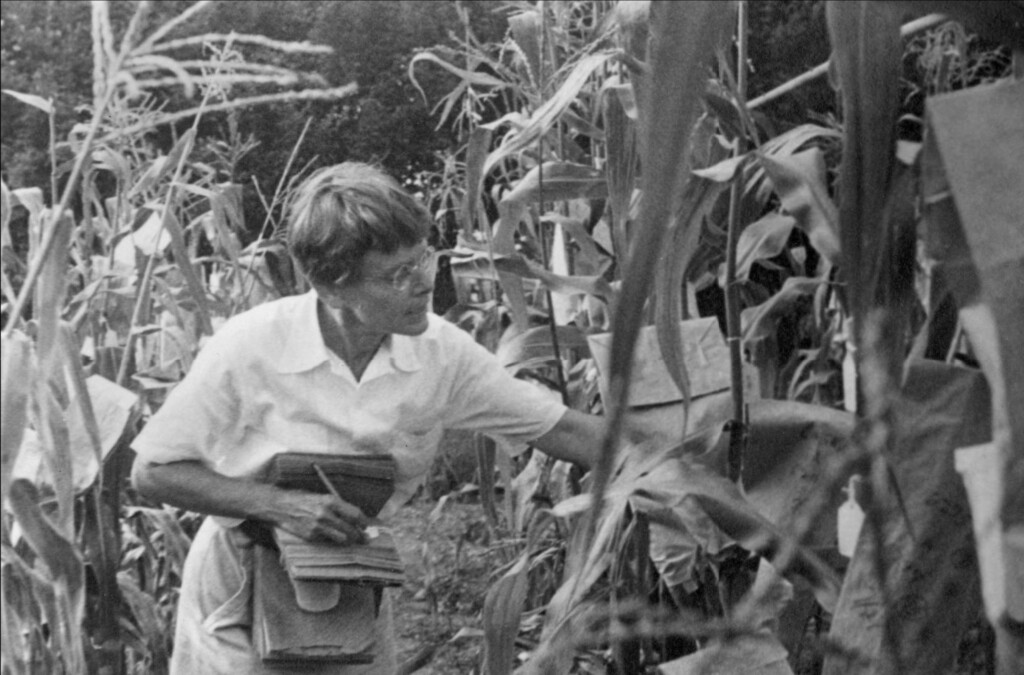
There is a moment when the corn plant, under enough stress, begins to do something no one in the 1940s believed possible. It rewrites itself. Not metaphorically, not through mutation in the slow Darwinian sense of random error accumulating across generations, but actively, structurally, in real time — segments of its own chromosomal material detaching, migrating, reinserting elsewhere in the genome, changing the instructions being read, altering what gets expressed and when. McClintock watched this happen in the kernels. The colors told her. Patches of pigment appearing where they should not, disappearing where they should, in patterns too ordered to be noise, too dynamic to be fixed inheritance.
The experimental foundation had been laid through years of meticulous cytogenetics. In the early 1940s, working with maize strains she had carefully cultivated and crossed at Cold Spring Harbor, McClintock documented what she called the breakage-fusion-bridge cycle — a chromosomal phenomenon in which a broken chromosome end would fuse with another broken end, then, during cell division, the two centromeres pulling toward opposite poles would stretch the fused chromosome into a bridge that snapped again, creating new broken ends, perpetuating the cycle. What interested her was not the breakage itself but what the breakage revealed: that certain genetic loci were behaving inconsistently across generations, as if something was moving through the genome and landing in different positions each time. By 1948 she had identified two controlling elements in maize she named Dissociation and Activator, demonstrating that Dissociation could cause chromosome breakage at a specific site, but only when Activator was present, and that both elements could change their chromosomal location. The gene, in her model, was not a fixed address. It was a movable instruction.
This finding was not merely unconventional. It was, within the dominant framework of molecular genetics, structurally unintelligible. The classical model, consolidated through the work running from Thomas Hunt Morgan’s chromosome theory in the 1910s through to the early triumphs of molecular biology, treated the genome as a linear sequence of stable, discrete units. The gene occupied a locus. The locus was permanent. Variation came from outside the gene, from copying errors, from radiation damage, from external chemical agents — never from the genome reorganizing its own architecture in response to internal conditions. When James Watson and Francis Crick published the double helix structure in 1953, the cultural momentum of molecular biology accelerated into something close to metaphysical certainty: life was code, code was stable, and stability was the prerequisite of inheritance.
McClintock’s transposable elements did not fit inside that certainty. They implied something that the reigning paradigm had no conceptual room for — that the genome is not a static library but a responsive system, capable of editing itself under duress. When her 1951 Cold Spring Harbor lecture introduced these findings to a room of molecular biologists, the response was not hostility so much as incomprehension. The language she was using had no translation in the vocabulary they carried. Evelyn Fox Keller, in her 1983 biography A Feeling for the Organism, describes the reception with painful clarity: not dismissal through argument, but dismissal through silence, through the absence of the apparatus needed to even formulate a refutation.
What does it mean that the genome rewrites itself under stress? The question is not rhetorical. Barbara McClintock was asking it as a biological question, but it radiates outward in ways that biology alone cannot contain. If the stress is real enough, the organism does not simply endure it. It reorganizes the instructions. The living system, pushed far enough, begins to revise what it means to be itself. Philosopher Hans Jonas, writing in The Phenomenon of Life in 1966, argued that what distinguishes living matter from mere mechanism is precisely this: the capacity for self-referential response, the ability to act back upon one’s own conditions of existence. McClintock’s maize was not evolving in the abstract. It was answering.
The Gaze That Sees Too Much
There is a particular kind of attention that makes people uncomfortable. Not the attention of the obsessive, which is frantic and self-consuming, but the attention of someone who simply will not stop looking until the thing reveals itself completely. You have probably met this quality in someone, felt faintly unsettled by it without knowing why, as if their seeing imposed an obligation on you to see as well, and you were not prepared for that.
McClintock had this quality to a degree that her colleagues consistently described in the language of excess. Too detailed. Too patient. Too certain of things she could not yet prove. The scientific establishment of mid-century America had a precise tolerance for how much reality a single researcher was supposed to perceive, and she consistently exceeded it. What she was doing with maize chromosomes through the 1940s and into the 1950s was not simply observational work in any conventional sense. She was building an interior model of genetic behavior so granular, so alive to the individuality of each organism, that the framework required to hold it had no institutional name yet. She called it “a feeling for the organism,” a phrase that sounded, to many of her peers, dangerously close to mysticism.
Simone de Beauvoir, writing in 1949 in The Second Sex, identified something that clarifies McClintock’s situation with uncomfortable precision. De Beauvoir argued that women who refuse to trim their intellectual vision to institutional expectations are not merely ignored — they are repositioned. Their excess of perception becomes reframed as a deficit of rigor. What they see too clearly gets reclassified as what they have imagined. The mechanism is almost elegant in its efficiency: the institution does not need to engage with the vision if it can successfully pathologize the visionary. McClintock was not dismissed as wrong so much as she was dismissed as eccentric, which is a more effective form of erasure because it leaves the question of rightness permanently unaddressed.
Think of a woman in a closed room, surrounded by years of notes and hand-drawn diagrams that no one has asked to see. Not chaotic papers, but an ordered universe. Photographs of corn kernels catalogued with a precision that implies intimacy. Observations recorded not because a grant demanded them or a committee was waiting, but because the act of recording was itself a form of contact with something real. She is not desperate. That is what strikes you most, imagining her there. There is nothing frantic in the posture, nothing that begs for witness. She is ferociously present, in the way that certain people are present when they have found the exact activity their nervous system was built for. The seeing is not a means to an end. It is, for the duration, the end itself.
This is not a romantic portrait of solitude. It is something more uncomfortable than that. What she is doing in that room is a refusal — not a dramatic, manifesto-issuing refusal, but the quieter and more destabilizing kind, the refusal to wait for permission to perceive. The philosopher Iris Murdoch wrote in The Sovereignty of Good, published in 1970, that “the ability to see clearly is one of the basic moral achievements,” and that this clarity requires a kind of unselfing, a deliberate dissolution of the ego’s desire to impose its own narrative on what is observed. McClintock’s decades of work were precisely this: an extended act of unselfing before the organism, a willingness to let the maize speak in its own terms rather than in the terms that would have made her findings legible to a 1950s genetics conference.
The cost of that willingness was not invisible to her. She understood, with the particular lucidity of someone who has been sidelined not once but structurally, that the gaze which sees too much is rarely thanked in real time.
Decades in the Desert: Solitude as Method
There is a particular kind of disappearance that is not absence. You stop sending letters not because you have nothing to say but because you have learned, with the precision of a scientist, that the mailbox on the other end has been sealed shut. McClintock’s withdrawal from mainstream publication after the early 1950s looked, from the outside, like defeat. It was read as the sulking retreat of someone who could not bear rejection, a temperamental woman folding inward after the genetics community failed to recognize what she was offering. The story the institution told about her silence was the story institutions always tell: that those who stop speaking have nothing left to say.
She had simply stopped expecting an audience. There is a difference — a difference Hannah Arendt mapped with surgical care in “The Life of the Mind” (1978) — between solitude and loneliness. Loneliness is the condition of someone who needs others to confirm that they exist and finds the confirmation withheld. It is, Arendt wrote, the experience of being abandoned even by oneself, a kind of inner desertion that mirrors the outer one. Solitude, by contrast, is the condition in which you are alone with yourself in the most productive sense: the two-in-one of thought, where the mind speaks to itself and the dialogue is genuine and unperformed. Loneliness collapses when company arrives. Solitude deepens regardless.
McClintock lived in solitude. Every planting season at Cold Spring Harbor, for more than four decades without interruption, she walked into her maize fields and continued the work. Not as an act of stubborn defiance, though it became that too, but because the corn didn’t care whether molecular biologists in the 1960s had decided that transposable elements were irrelevant. The plants kept transposing. The kernels kept producing their mosaics of color, their irregular inheritances, their chromosomal surprises. She kept reading them. The work was its own conversation, and it required no external ratification to proceed.
What the institution was attempting to produce in her was loneliness. The mechanisms are always recognizable in retrospect: her papers went uncited, her lectures were politely tolerated and then forgotten, younger researchers in the ascendant field of molecular biology moved along paths that treated her findings as a dead end or, worse, as a curiosity from a less rigorous era. When James Watson and Francis Crick published their double helix model in 1953, the cultural and scientific center of gravity shifted so decisively toward molecular structure that the behavioral, observational, whole-organism tradition McClintock embodied began to seem not merely old-fashioned but almost philosophically naïve. She was watching corn grow. They were decoding the molecule of life. The comparison was not made kindly.
And yet the loneliness the institution was engineering never fully took hold, because she had done something that Arendt recognized as the precondition of genuine intellectual life: she had learned to be good company for herself. Her correspondence from this period, what survives of it, is not the correspondence of a bitter or broken person. It is the correspondence of someone genuinely absorbed. She wrote about what the chromosomes were doing. She wrote about the behavior of the maize with the same quality of attention she had brought to it in the 1930s, when people were still listening. The attention did not require the audience.
This is not to romanticize isolation or suggest that recognition is irrelevant to a scientific life. The absence of dialogue costs something real. Ideas that cannot be tested against other minds calcify in ways that even the most rigorous self-examination cannot prevent. But McClintock’s particular form of solitude was not the isolation of someone cut off from thought. It was the condition of someone whose thinking had outrun the available interlocutors, and who had made a kind of peace with the gap — not by surrendering the ideas, but by carrying them forward alone into the next season, and the next.
A vision curated by a filmmaker, not an algorithm
In this video I explain our vision
The Return of the Repressed: Science Catches Up

There is a particular kind of silence that settles over a person when they watch a room full of people celebrate the discovery of something they found alone, years earlier, in a place no one thought to look. Not bitterness, exactly. Something more disorienting than that. The feeling of watching your own past life staged as someone else’s present triumph, all the language different, all the faces unfamiliar, the conclusion identical. You do not rush forward to claim it. You stand very still, because the moment has its own momentum now and it belongs to them in the way that only novelty can belong to its discoverers.
This is roughly what the 1970s looked like from McClintock’s position at Cold Spring Harbor, where she had continued working with quiet discipline through decades of institutional indifference.
By the early 1970s, molecular biologists armed with restriction enzymes, gel electrophoresis, and the first blunt instruments of recombinant DNA technology began finding something strange inside bacterial genomes. Elements that moved. Sequences that inserted themselves into genes, disrupted them, then relocated again. They called them insertion sequences. Then transposons. They published breathlessly. Some of them, it would later emerge, had never read McClintock’s papers. The rediscovery was genuinely innocent of its own archaeology.
François Jacob and Jacques Monod had already won the Nobel Prize in 1965 for their work on gene regulation in bacteria, work that gestured toward the idea that genes could be switched on and off by molecular signals. But the physical mobility of genetic material, the literal jumping from site to site within and between chromosomes, that required the new toolbox. Peter Starlinger and Heinz Saedler in Germany, working on bacterial insertion sequences in 1972, were mapping a terrain that McClintock had surveyed in maize twenty-five years earlier with nothing but a microscope and an almost terrifying attentiveness to pattern. James Shapiro, working independently in the same period, described what he called transposable elements in bacteria, then discovered, upon reading the literature more carefully, that the conceptual architecture had already been built.
The strangeness of this moment is not simply one of delayed credit, though that dimension is real and worth dwelling on. It is something more epistemological. McClintock’s work did not triumph in the 1970s because science finally understood it. It was retroactively absorbed into a new paradigm that could, for the first time, hold it. The tools created a new consensus reality, and within that reality, her older findings suddenly became legible. Thomas Kuhn had argued in The Structure of Scientific Revolutions in 1962 that normal science does not gradually approach truth but instead lurches between incommensurable frameworks, with anomalies suppressed until the accumulated weight of the wrong forces a break. What happened with McClintock is not quite Kuhn’s model either, because there was no dramatic rupture, no crisis in the classical sense. There was simply a slow seepage of molecular evidence until the dam of consensus absorbed it without acknowledging what had been waiting on the other side for decades.
Evelyn Fox Keller, whose 1983 biography A Feeling for the Organism first brought McClintock’s full story to wide attention, described her subject’s situation with precise sympathy: the scientific community was not equipped to evaluate her claims because the claims required a different conception of the genome than the one that had already calcified into doctrine. The genome was supposed to be stable, hierarchical, a blueprint rather than a living argument the cell was continuously having with itself.
McClintock had known it was an argument. She had watched the corn plants have it, generation by generation, in the cold fields of Long Island. And now, in laboratories across two continents, molecular biologists were transcribing the minutes of a meeting that had already taken place, without knowing the stenographer’s name.
The Nobel and the Question It Cannot Answer
There is a particular kind of silence that falls over a room when the person being honored does not seem to need the honor. Not the silence of indifference, and not the silence of false modesty, but something more unsettling — the silence of a woman who has already made peace with the work itself, decades before anyone thought to celebrate it, and who now stands at the podium with a composure that the audience cannot quite decode. She is eighty-one years old. The prize is thirty-two years late, by any honest accounting. And she receives it with a tranquility that makes the ceremony feel, somehow, like it is for everyone else in the room.
The Nobel Committee announced in October 1983 that Barbara McClintock would receive the Prize in Physiology or Medicine — unshared, which is itself a rarity — for her discovery of genetic transposition, work she had completed and presented at Cold Spring Harbor in the early 1950s. The gap between the discovery and its recognition is not incidental. It is the actual subject, the thing that the prize, by its very existence, tries to paper over. Pierre Bourdieu understood this mechanism with surgical precision. In his analysis of how cultural and scientific fields distribute authority, he described symbolic capital as the accumulated recognition that institutions grant to agents — but crucially, he argued that such gestures of legitimation serve above all to reproduce the legitimacy of the legitimating institution itself. The Nobel Prize does not simply honor McClintock in 1983. It uses McClintock to demonstrate that the system works, that outsiders are eventually seen, that patience is rewarded, that science is self-correcting. The prize restores faith in the prize.
What it cannot do is answer the question of what those thirty-two years cost. Not McClintock personally — she continued working, she found her own equilibrium, she was not broken by the dismissal — but the field. How many hypotheses were delayed? How many graduate students learned, implicitly, that the genome was a fixed and orderly text rather than a dynamic and responsive one? The cost of ignored discovery is never only borne by the discoverer. It spreads outward, silently, into the shape of questions that were never asked.
She had lived long enough to become what Bourdieu would recognize as a paradox: an agent who had accumulated enormous scientific capital — the actual epistemic kind, the kind that turned out to be correct — while holding nearly zero institutional symbolic capital for most of her career. No major university position after the 1940s, no sustained funding, no chorus of citations during the decades when her ideas were most radical. And then, suddenly, everything. The cloning of transposable elements in the late 1970s and early 1980s proved her right in the language the field had decided to speak, and the machinery of recognition lurched into motion. She had not changed. The tools had changed. The audience had, finally, become literate in what she had always been saying.
There is something in the image of her at that podium — calm, clear-eyed, slightly amused — that is not quite triumph and not quite irony, but something in between that has no clean name. You watch a person who learned, somewhere in the long middle of her life, that the need for external validation is itself a kind of trap, and who stepped out of that trap so completely that its belated offer of reward lands on her like weather — acknowledged, not resisted, but not required. The crowd applauds someone who no longer needs applause, and in that gap between what the ceremony offers and what she actually requires, the whole architecture of scientific recognition becomes briefly, uncomfortably visible for what it is.
Feeling for the Organism
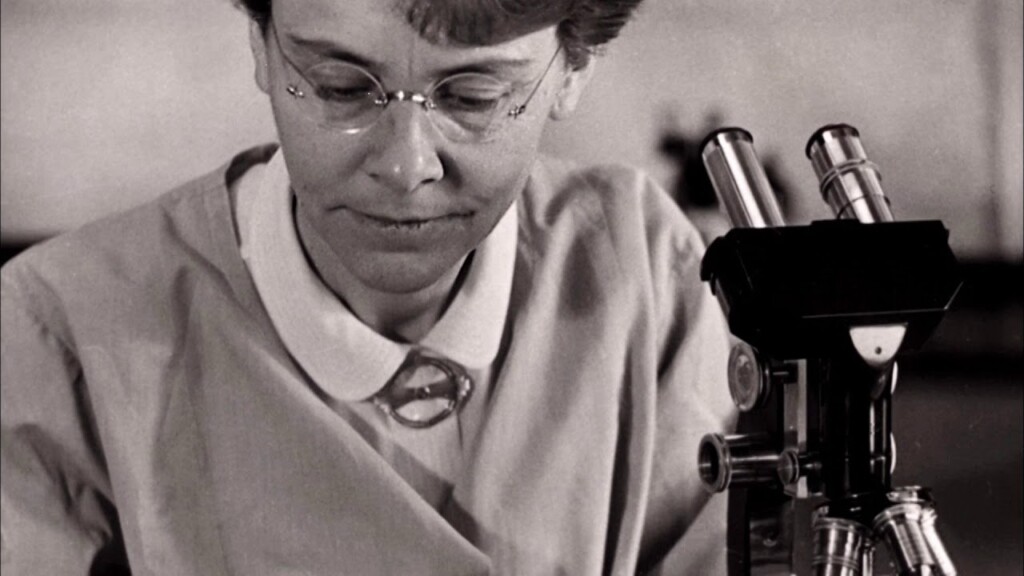
She is in the cornfield again before the light has fully settled over the rows, moving between the stalks the way someone moves through a room they have lived in for decades — not looking, exactly, but attending. Her hands touch the leaves without thinking. She knows which plants are struggling before any instrument confirms it. She knows them the way you know a person’s mood from the way they hold their shoulders, the way a mother knows her child’s cry before it has fully formed. This is not metaphor. This is method.
Barbara McClintock called it a feeling for the organism, and she meant it with the precision of someone who had spent fifty years watching science use the word precision to mean its opposite. What she was describing was not sentiment. It was a mode of attention so sustained, so genuinely receptive, that the boundary between observer and observed became something more like a dialogue than a wall. She had learned to let the maize speak in its own terms. Not to impose a question and extract a number, but to wait, to notice, to allow the plant’s own logic to surface before naming it.
Evelyn Fox Keller, in her 1983 biography built around and toward this exact phrase, argues that what McClintock practiced was not a failure of scientific distance but a different architecture of objectivity altogether. The standard model, which Keller traces through its philosophical and institutional roots, demands that the knower remain separate from the known, that emotion and intimacy contaminate the data, that rigor means removal. McClintock’s science looked, from inside that model, like something dangerously close to mysticism. Keller’s argument is that this appearance reveals less about McClintock’s methods than about the poverty of the model doing the judging.
There is a scene that stays with you: a woman sits alone in a darkened room with a stack of photographs taken through a microscope, images of chromosomes that no one else can read with any confidence, and she moves through them with the ease of someone reading a language they learned in childhood. She sees arrangements that others see as noise. She sees pattern where the institution sees aberration. She is not guessing. She has spent years in that level of closeness, that quality of looking, and what it has produced is a form of knowledge that the epistemological furniture of her field has no drawer for.
Keller’s deeper claim, drawing on her own background in physics and her turn toward feminist philosophy of science, is that the demand for distance is not neutral. It carries a history. The association of objectivity with detachment, and detachment with masculinity, and closeness with emotion, and emotion with unreliability, is not a logical sequence. It is a cultural construction that has been doing quiet damage to the scope of what science permits itself to know. When McClintock said she could hear the chromosomes, she was not speaking loosely. She was reporting a real epistemological condition: that prolonged, loving attention produces access. That knowing is not always extraction.
What falls outside the frame of legitimate inquiry is not random. It follows the shape of what the institution decided, at specific historical moments, did not count as knowing. Thomas Kuhn, writing in 1962, described how scientific communities protect their paradigms not through logic alone but through the social mechanics of credibility, publication, and recognition. The mechanisms that kept McClintock’s work unrecognized for thirty years were those same mechanics — not stupidity, not malice, but a structure that could not accommodate what she was doing because her way of doing it did not resemble what the structure recognized as science.
And so the question that her life leaves open is not really about her. It is about what is still out there, in someone’s field, in someone’s notebooks, being produced by a mind that attends to its subject with a closeness the institution will not yet call knowledge.
🌿 Pioneers of Science and the Living World
Barbara McClintock’s revolutionary discoveries in genetics place her alongside a constellation of scientists who transformed our understanding of life. These related articles explore the lives and works of researchers who, like McClintock, challenged prevailing paradigms and reshaped the boundaries of biology and natural science.
Gregor Mendel: Life and Works
Gregor Mendel laid the foundations of modern genetics through his meticulous experiments with pea plants in a monastery garden, uncovering the laws of hereditary transmission that would only be fully appreciated decades after his death. His story is one of quiet, persistent genius working at the margins of the scientific establishment. Mendel’s legacy directly shaped the field that McClintock would later revolutionize with her discovery of transposable elements.
GO TO THE SELECTION: Gregor Mendel: Life and Works
Rosalind Franklin: Life and Discoveries
Rosalind Franklin‘s crystallographic images of DNA proved essential to unraveling the double helix structure, yet her contribution was long overshadowed by her male colleagues. Her life is a compelling testament to scientific rigor and professional resilience in the face of institutional bias. Franklin and McClintock share a remarkable parallel: both women produced landmark discoveries that were initially undervalued or misunderstood by the broader scientific community.
GO TO THE SELECTION: Rosalind Franklin: Life and Discoveries
Rachel Carson: Life and Works
Rachel Carson brought the science of ecology into public consciousness with the same intellectual courage that McClintock brought to genetics, challenging powerful institutions with evidence and integrity. Her meticulous research into the devastating effects of pesticides on ecosystems gave rise to the modern environmental movement. Carson’s life exemplifies how rigorous science, when communicated with passion, can permanently alter the course of history.
GO TO THE SELECTION: Rachel Carson: Life and Works
Charles Darwin: Life and Works
Charles Darwin‘s theory of evolution by natural selection created the theoretical framework within which all subsequent discoveries in genetics—including McClintock’s mobile genetic elements—would eventually find their meaning. His journey from curious naturalist to revolutionary thinker mirrors the long, patient observation that defined McClintock’s own scientific method. Understanding Darwin’s work is essential context for appreciating how deeply McClintock’s findings reshaped evolutionary biology.
GO TO THE SELECTION: Charles Darwin: Life and Works
Discover Science, Nature and Independent Vision on Indiecinema
If the lives of these visionary scientists inspire you, Indiecinema offers a rich selection of independent documentaries and films that explore the frontiers of science, the philosophy of nature, and the stories of those who dared to think differently. Join us on Indiecinema streaming and let independent cinema expand your world.
👉 EXPLORE THE CATALOG: Watch Indie Films in Streaming
A vision curated by a filmmaker, not an algorithm
In this video I explain our vision

