
Weimar, 1919: A School Born from Catastrophe
You are standing in a city that smells of wet ash and old blood. The year is 1919, and Germany is not recovering — it is hallucinating recovery, performing the gestures of a nation that still believes it has a future while its currency dissolves, its veterans beg at train stations, and the political street is a continuous riot of ideologies so desperate they have become indistinguishable from religions. The Kaiser is gone. The empire that took four years and seventeen million lives to destroy has left behind not a vacuum but something worse: a people who have been told they lost a war they were never honestly told they were losing. The humiliation is not political. It is metabolic. It lives in the body.

Into this, Walter Gropius walks with a manifesto. He is thirty-five years old, a veteran of the Western Front, a man who has watched industrial civilization send its finest craftsmen into trenches dug by machines, to be killed by machines, in defense of borders drawn by bureaucrats. He has come to understand something that the peace negotiators at Versailles categorically refused to consider: that the catastrophe was not a deviation from modern civilization but its logical product. The factories, the assembly lines, the rigid hierarchies of production that separated the designer from the maker and the maker from the user — these were not innocent economic arrangements. They were a way of organizing human beings that made violence inevitable, because they first made meaning impossible.
The school he founds in Weimar on April 12, 1919 — the Staatliches Bauhaus — is not named after a movement or a style. It is named after the medieval German concept of the Bauhütte, the lodge of builders who raised cathedrals by integrating every craft into a single collaborative act. Gropius reaches backward across five centuries not out of nostalgia but out of structural diagnosis: somewhere between the guild workshop and the industrial factory, Western culture had severed a connection between thinking and making that it had never consciously decided to sever. The Bauhaus was his attempt to suture it.
The founding manifesto, written by Gropius himself and illustrated with a woodcut by Lyonel Feininger showing a cathedral crowned by stars, declares that “the ultimate aim of all creative activity is building.” This sentence has been quoted so often it has been smoothed into a slogan, but read it again in its original context and it is a provocation of the first order. It does not say the ultimate aim is beauty, or profit, or self-expression. It says building — the collective, material act of constructing something that will outlast the individual body and serve the collective life. At a moment when Europe’s actual buildings were rubble, this was not an aesthetic preference. It was a civilizational wager.
What Gropius understood, and what the school’s early critics could not process, was that the separation of fine art from applied craft was not a neutral division of labor. It was a class system encoded in pedagogy. Since the Renaissance, Western academies had systematically elevated painting and sculpture above weaving, pottery, metalwork, and carpentry — the so-called minor arts — assigning the former to genius and the latter to labor. By 1919, this hierarchy had produced a culture in which the people who designed objects had no knowledge of materials, and the people who made objects had no authority over design. Gropius demolished this distinction on principle: every student at the Bauhaus would be trained simultaneously by a master of form and a master of craft, because the belief that one could exist without the other was precisely the kind of lie that sent a generation into a war it could not understand, fought with weapons it could not imagine, toward ends it was never permitted to question.
The Craft Myth and the Machine Age Contradiction
You are sitting in a workshop in Weimar, 1921, running your hands across a wooden loom frame still warm from the joiner’s plane, and somewhere down the corridor a man is sketching typographic grids that will eventually appear on ten million printed pages. Both of you believe you are doing the same thing.
Walter Gropius had written it plainly into the founding manifesto of 1919: the ultimate aim of all creative activity is building, and the old arrogant barrier between craftsman and artist must be torn down. The Bauhaus was conceived as a medieval guild reborn, where the hand and the mind would reunite after centuries of Academic divorce. Masters of Form and Masters of Craft were paired in every workshop, a double-headed pedagogy that assumed both authorities were genuinely equal. They were not. The fine artists — Klee, Kandinsky, Itten — held the institutional prestige, and the craft masters were gradually phased out as the school evolved, replaced by a single Meister figure once journeymen began producing work that embarrassed the hierarchy in its technical sophistication.
The contradiction was not accidental. It was structural, embedded in the very economic conditions that allowed the Bauhaus to survive at all. State funding in the Weimar Republic was never stable — the school was politically embattled from its first year, accused alternately of Bolshevism and aesthetic decadence by Thuringian conservative factions who saw no reason to subsidize what they called a circus of foreigners. To justify its existence financially, the school needed to license its designs to manufacturers, and by 1923 Gropius had already pivoted the institution’s public identity toward the slogan “Art and Technology — A New Unity,” quietly burying the craft-guild romanticism that had animated the 1919 founding document. The loom and the joiner’s plane were now raw material for the prototype, not ends in themselves.
This was not hypocrisy in any simple sense. Gropius genuinely believed that designing for industrial reproduction was the most socially responsible act an artist could perform, that beautiful, affordable objects streaming off assembly lines would constitute a kind of democratic aesthetics unavailable to previous centuries. What he could not reconcile was the fact that the machine does not merely reproduce an object — it disciplines the object before reproduction begins. The tolerances of industrial manufacture impose their own formal logic, and the designer who works toward that logic is not freely expressing a unified hand-and-mind; they are pre-emptively obeying constraints set by engineers, material costs, and market demand. Siegfried Giedion observed this absorption process acutely in Mechanization Takes Command, published in 1948, arguing that mechanization does not enter human life neutrally but transforms the gestures and perceptions of everyone who works within its orbit. The Bauhaus students were not free craftsmen channeling industrial potential; they were people being quietly retrained to think like machines.
The fractures this produced were genuine and sometimes violent in their creative intensity. Johannes Itten, who ran the famous preliminary course in the early years, built his pedagogy around breath, bodily sensation, intuition, and the Mazdaznan spiritual practice he followed with evangelical seriousness — a mystical counterweight to rationalism so extreme that Gropius eventually forced him out in 1923, the same year of the pivotal exhibition that reoriented the school toward industry. What left with Itten was not merely an eccentric personality but an entire theory of how design knowledge is held in the body rather than extracted from the body and placed on paper. László Moholy-Nagy, who replaced him, was brilliant and genuinely radical, but his brilliance was oriented toward transparency, reproducibility, and light — toward things that cameras and printing presses could capture and disseminate. The body became a receiver of visual information rather than a generator of formal knowledge.
What the weaver at her loom actually knew — the resistance of the weft, the memory stored in the tension of her wrists — could not be serialized.

The Master System and the Pedagogy of Rupture
You are handed a loom on your first day. Not a sketchbook, not a canvas — a loom. Nobody explains why. The explanation, you will eventually understand, is the loom itself.
This was the operational logic that made the Bauhaus structurally alien to every institution of art education that preceded it. The 19th-century academy had been built on a clean division between conception and execution, between the artist who imagines and the craftsman who produces. That division was not merely organizational; it was ideological, encoding a hierarchy in which manual labor occupied a lower register than intellectual vision. Walter Gropius understood that you could not dismantle this hierarchy by arguing against it in a manifesto. You had to redesign the conditions under which learning occurred, and then watch the ideology collapse from lack of structural support.
The mechanism he invented was the dual-master system. Every workshop at the Bauhaus was simultaneously led by two figures: a Formmeister, responsible for aesthetic and theoretical development, and a Werkmeister, a master craftsman responsible for material and technical instruction. The student stood between these two authorities, forced to synthesize what no prior institution had ever asked anyone to synthesize. As early as 1919, this pairing was operational, and its practical effect was to make the gap between thinking and making not just uncomfortable but educationally productive. The discomfort was the pedagogy.
Paul Klee, who joined the faculty in 1921 and stayed until 1931, approached his role as Formmeister in the weaving and then the stained glass workshops with a precision that his published lectures — gathered posthumously in the Pedagogical Sketchbook of 1925 — make almost unnervingly rigorous. Klee did not teach students how to be Paul Klee. He systematized the logic of visual perception itself: how rhythm operates in line before it operates in composition, how color carries temperature before it carries meaning. His notebooks from the Bauhaus period contain diagrams that resemble engineering schematics more than artist’s notes. He was not transmitting a style; he was attempting to construct a grammar that a student could then use in any material, with any tool, for any purpose.
Wassily Kandinsky, who arrived in 1922, pressed further into abstraction as a teachable system. His 1926 treatise Point and Line to Plane, developed directly from his Bauhaus courses, argued that the basic elements of visual composition obeyed structural laws as verifiable as those governing acoustics. What sounds radical in theory was devastatingly practical in the classroom: if a line has quantifiable tension, if a point has measurable psychological weight, then design decisions cease to be a matter of taste and become a matter of analysis. The student who could not feel their way toward beauty could still reason their way toward structure. Kandinsky was not democratizing genius; he was dissolving the category entirely.
László Moholy-Nagy, who joined in 1923 and took over the preliminary course from Johannes Itten, introduced something neither Klee nor Kandinsky had fully addressed: the machine as a co-author. Where Itten had led students through meditative exercises rooted in expressionist spirituality, Moholy-Nagy replaced intuition with experiment. He had students construct spatial assemblages from industrial materials, asking them to account for light as an active element rather than ambient condition. His 1947 book Vision in Motion, written after the Bauhaus had been shuttered by Nazi pressure in 1933, reads as a continuation of a pedagogical argument that political force had interrupted but not concluded.
What none of these figures were doing, though the word appears everywhere in retrospective accounts, was being innovative. Innovation implies improvement on an existing model. What Klee, Kandinsky, and Moholy-Nagy were doing was far stranger: they were making the existing model legible as a model for the first time, and in the act of naming its assumptions, they made those assumptions impossible to take seriously.
Politics as Architecture: Dessau, Totalitarianism, and the Displacement of Utopia
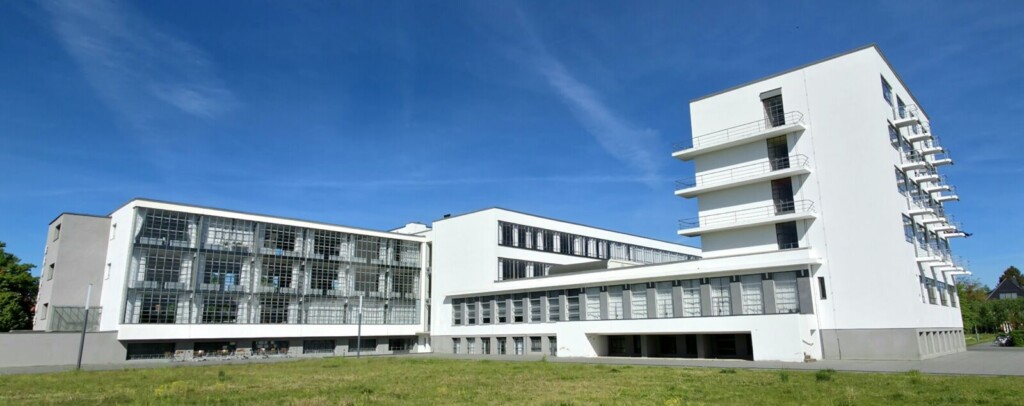
You are standing in a building that was designed to make ideology visible. The Dessau Bauhaus, completed in 1926 to Walter Gropius’s own blueprints, was not merely a new address — it was an argument rendered in glass curtain walls and asymmetrical wings, a statement that the institution had survived its first political eviction and emerged, apparently, stronger. The transparency of the facade was not accidental. Glass that lets you see in from the outside was meant to signal openness, accountability, the refusal of secrecy. What nobody said aloud was that glass also makes the inhabitants permanently exposed.
The departure from Weimar in 1925 had been framed as a liberation, and in some registers it was. The Thuringian state government, under mounting pressure from nationalist factions who regarded the school as a nest of Bolshevist aesthetics and sexual permissiveness, had cut funding so savagely that continuation was impossible. Dessau’s Social Democratic municipal government offered sanctuary and resources. But a school that requires political rescue has already altered its relationship to power — it now owes something, is beholden to a patron whose generosity is conditional, whose tolerance has a shape. The move was not a triumph. It was a transaction.
What the Dessau years produced in aesthetic terms was extraordinary: László Moholy-Nagy’s light-space experiments, Marcel Breuer’s tubular steel furniture, the typography workshop under Herbert Bayer that essentially invented the visual grammar of the twentieth century. Between 1925 and 1928, the school operated at a density of invention that has rarely been matched in any educational institution before or since. Yet this productivity existed inside an increasingly tightening political pressure chamber. The very success of the Bauhaus made it a more visible target. Notoriety and vulnerability moved in the same direction.
Hannes Meyer, who replaced Gropius as director in 1928, understood the institution’s social mission with a rigor that made the school’s bourgeois supporters profoundly uncomfortable. His insistence that design was irreducibly political, that architecture served collective need rather than individual expression, was theoretically coherent and institutionally fatal. The Dessau city council dismissed him in 1930, accusing him — with accusations that were partly fabricated and partly irrelevant — of communist sympathies. His successor, Ludwig Mies van der Rohe, inherited an institution that had already learned to negotiate with its own liquidation. Mies brought discipline and formal severity; he also brought a willingness to depoliticize the school that represented its deepest structural concession.
The final relocation to Berlin in 1932, after the National Socialists gained control of the Dessau municipal government and voted to close the school, was an act of institutional self-deception masquerading as resilience. Operating as a private school in a rented telephone factory in the Steglitz district, the Bauhaus had stripped away nearly everything that had once defined it beyond the name. The student body was smaller, the curriculum compressed, the faculty depleted. What remained was a brand without the radicalism that had given the brand its meaning. When the Gestapo searched the building in April 1933, less than four months after Hitler’s appointment as Chancellor, the faculty voted to dissolve the institution themselves — an act they framed as defiance, because self-dissolution denied the state the theater of a forced closure. The distinction mattered to the people inside that room. It is less clear that it mattered to history.
There is a particular cruelty in the way political pressure works on institutions that were founded on idealism: it does not usually destroy them in a single blow. It asks for one small adjustment, then another, each concession framed as a temporary pragmatism that will preserve the core until better conditions arrive. The core is what gets consumed first.
The Diaspora That Colonized Modernity
You walk into a hospital built in 1962 — the floors are pale linoleum, the corridors stretch in pure orthogonal lines, the signage uses a sans-serif typeface that tells you where to go without asking how you feel about it. Nothing in that building was designed to move you. Everything in it was designed to process you. You have been inside the Bauhaus without knowing it, and so has every person who has ever passed through an American airport, opened a corporate annual report, or sat in a molded plastic chair in a waiting room that smells faintly of institutional soap.
When the National Socialists shuttered the school in Dessau in 1932 and again in Berlin in 1933, they imagined they were extinguishing something. Instead they detonated it. The faculty scattered across a world already hungry for the kind of rationalized beauty the school had spent fourteen years systematizing, and each figure carried with him not just a portfolio but a complete epistemology of form — a set of convictions about what visual order should do to a human being and how institutions should look when they are serious about themselves. László Moholy-Nagy arrived in Chicago in 1937 and within a year had founded what would become the Institute of Design, embedding the Bauhaus preliminary course — Vorkurs, the foundational semester of material experiments and perceptual training — directly into American art education. His 1947 book Vision in Motion laid out a theory of integrated perception that still structures how graphic design programs teach students to see, though most of those students have never heard his name.
What exile does to an idea is rarely discussed with precision. It strips the idea of its local friction. In Weimar and Dessau, the Bauhaus was embedded in political controversy, in arguments about German identity, in the very specific texture of Weimar Republic cultural life. It was contested. When Mies van der Rohe accepted the directorship of the architecture department at the Illinois Institute of Technology in 1938, the arguments dissolved and only the conclusions remained — the steel frame, the curtain wall, the campus plan that turned a corner of Chicago’s South Side into a demonstration of structural logic applied to every surface. By the time the Seagram Building rose on Park Avenue in 1958, what had once been a radical position about the relationship between industrial production and human shelter had become the default language of corporate ambition. Power chose this aesthetic not because it was revolutionary but because it had been emptied of revolution and retained only the authority.
Herbert Bayer’s trajectory is perhaps the most unsettling of all. The man who redesigned the Bauhaus’s visual communication, who developed the Universal typeface in 1925 based on the premise that a rationalized alphabet could serve a democratic public, ended up working for the Container Corporation of America and advising the Aspen Institute, helping to build the visual infrastructure of postwar American consumer capitalism. The tools forged for clarity became tools for persuasion. This is not hypocrisy — it is something more structurally interesting. The aesthetic of neutrality, of the grid, of the sans-serif, of white space, does not actually belong to any politics. It is available. And availability, in a market economy, is the same thing as vulnerability.
By 1960, the visual language that had originated in a school with fewer than 1,300 students across its entire existence had become the dominant register of institutional seriousness across the Western world. Corporate identity, public signage, modernist housing blocks, university buildings, pharmaceutical packaging — all of it spoke the same inherited dialect. The International Style, which was partly a Bauhaus export and partly an independent Swiss development that cross-pollinated with the exile generation, did not win because it was beautiful or because it was true. It won because it arrived at precisely the moment when postwar institutions needed to look as if they had transcended history, as if their authority rested on geometry rather than on force.
A vision curated by a filmmaker, not an algorithm
In this video I explain our vision
Functionalism as Ideology, Not Neutral Form

You have sat in that chair without choosing it. The seat height, the angle of the backrest, the distance between armrests — all of it was decided for you, decades before you were born, by men who believed they were solving a universal problem. They were not solving a universal problem. They were encoding a particular body, a particular posture, a particular relationship between the human frame and productive labor, and calling that encoding neutral.
The phrase “form follows function” originates not with the Bauhaus but with the American architect Louis Sullivan, who wrote it in 1896 in his essay “The Tall Office Building Artistically Considered.” By the time Walter Gropius and his colleagues absorbed it into their pedagogical framework, the phrase had already shed its original context — Sullivan was speaking about organic growth, about the way a bird’s wing or a pine tree achieves form through living purpose. What the Bauhaus did, consciously or not, was launder the phrase through the rhetoric of social progress until it sounded like physics. Until it sounded like something that could not be argued with, because arguing with function felt like arguing with gravity.
The assumption buried inside functionalism is that function itself is legible, stable, and agreed upon. But function is always a political question. Whose function? Efficient for whom, toward what end, measured by which clock? When Marcel Breuer designed the Wassily Chair in 1925–1926 — tubular steel frame, aircraft-weight reduction, industrial reproducibility — he was solving the problem of how to furnish a modern interior cheaply and at scale. That is a specific problem belonging to a specific economic moment. The chair does not sit comfortably for long periods, which anyone who has spent more than an hour in one discovers immediately. It was never designed for comfort. It was designed for the visual grammar of modernity, which is a different ambition entirely, dressed in the clothes of practicality.
What the postwar corporate world recognized in Bauhaus aesthetics was not their emancipatory potential but their administrative usefulness. The open-plan office, the modular workstation, the stackable chair, the standardized desk — all of these descended directly from Bauhaus principles of serialization and universal form, and all of them arrived in the mid-twentieth century boardroom not to liberate the worker but to make the worker legible, interchangeable, and manageable. The sociologist Henri Lefebvre argued in “The Production of Space,” published in 1974, that abstract space — rational, geometric, measurable — is never innocent of power. It produces particular kinds of subjects. The Bauhaus, in giving that abstract space its aesthetic vocabulary, also gave it its moral alibi.
The universalism encoded in Bauhaus design made a specific claim about the human body that was never examined. The body it imagined was male, European, able, and oriented toward industrial productivity. The ergonomic standards derived from this period — workspace heights, reach distances, tool grip dimensions — were calibrated to a statistical composite that excluded women almost entirely. A 1970 NASA study, “Anthropometric Source Book,” documented what engineers had quietly known for decades: that design standards built on male body data produced environments that systematically disadvantaged everyone outside that norm. The Bauhaus produced beauty, sometimes. It also produced the conditions for this invisibility.
There is a particular cruelty in ideologies that arrive wearing the face of reason. They do not ask for your agreement because they have already framed disagreement as irrationality. Functionalism performed this move with extraordinary success: to question whether a design was truly functional was to sound like someone who preferred ornamentation to honesty, sentiment to clarity. The accusation of nostalgia became the primary weapon against any critique of modernist form, and that weapon was sharpened at Dessau, in workshops that believed they were hammering out the future for everyone equally, while they were in fact hammering out a very specific future for a very specific kind of person who would never have to wonder whether the chair was made for a body like theirs.
The Commodification of the Revolutionary Object
You own the chair. Maybe you paid for a reproduction, or maybe you found the original at an auction where the bidding started at a number that would have made Marcel Breuer visibly ill. You set it in your living room and something in you feels, without quite naming it, that you have made a cultured choice — that the object radiates a kind of intelligence, a philosophical seriousness that your other furniture lacks. What you are actually feeling is the successful completion of a century-long process by which a revolutionary gesture was converted into a status signal, stripped of its original aggression, and sold back to exactly the social class it was designed to displace.
Breuer conceived the Wassily chair in 1925 not as an aesthetic object but as a proof of concept: that industrial tubular steel, mass-producible and cheap, could furnish the homes of ordinary workers with the same formal dignity previously reserved for bourgeois upholstery. The word “mass” was not decorative — it was the entire argument. László Moholy-Nagy, writing in Vision in Motion published in 1947, insisted that design’s moral task was the dissolution of privilege through material culture, that the well-made object distributed at scale was a form of social leveling. The Bauhaus workshop system produced prototypes explicitly intended for industrial replication, for the kind of volume that would make ownership unremarkable. What happened instead is that the prototypes became the product. The rarity the school’s founders architecturally opposed became the precise source of value the market assigned to their work.
This is not a story about irony. Irony would suggest an accidental reversal, a twist of fate nobody foresaw. What actually occurred was a structural inevitability that Theodor Adorno had already begun mapping in Aesthetic Theory, completed before his death in 1969: the culture industry absorbs the critical object not by destroying it but by preserving it perfectly, encasing its form while evacuating its function. The Bauhaus lamp that was meant to light a worker’s table now sits in a museum vitrine illuminating nothing, or on a designer’s desk illuminating only the designer’s taste. The object has been conserved with extraordinary care and total fidelity to its original dimensions. Only its meaning has been replaced.
The numbers make this concrete in a way that theory cannot. A certified reproduction of the Wassily chair currently retails between twelve hundred and four thousand dollars depending on leather grade and manufacturer. An authenticated original from the Dessau period sells at major auction houses for figures that begin in the tens of thousands. The Bauhaus-Archiv in Berlin, which holds the largest collection of the school’s work, receives hundreds of thousands of visitors annually who pay an entrance fee to contemplate objects that were explicitly designed to need no contemplating — objects that were supposed to be used, worn, replaced, and forgotten in the ordinary rhythm of daily life. The museum has done to Bauhaus what Bauhaus feared most: made it sacred.
Typography suffered a different but equally complete transformation. Herbert Bayer’s universal typeface, developed in 1925 to eliminate the class associations embedded in German blackletter script, circulates today as a premium design asset, licensed by corporations to communicate sophistication and forward-thinking values to consumers who pay a premium for exactly those associations. The democratic impulse became a branding strategy. The attempt to make letterforms class-neutral produced letterforms that now signal a very specific class — the educated, globally mobile, culturally literate consumer that every luxury brand in the world is currently addressing.
What the market understood, and what the Bauhaus never fully reckoned with, is that radical formal clarity does not protect an object from symbolic capture. Beauty, precision, and legibility are not revolutionary in themselves — they are qualities that accumulate prestige the moment they become scarce, and scarcity is something the market produces automatically, without effort, as a byproduct of its ordinary functioning.
Design as Power: What the Bauhaus Left Unasked
You are standing in a museum somewhere in Europe — Berlin, perhaps, or Chicago — looking at a chair. It is beautiful in the way that mathematics is beautiful: clean, resolved, nothing wasted. The placard tells you it changed everything. You believe it, almost.
The Bauhaus trained its students to solve problems. Between 1919 and 1933, it produced an extraordinary density of formal intelligence — László Moholy-Nagy’s investigations into light and transparency, Marcel Breuer’s tubular steel furniture, Herbert Bayer’s Universal typeface that stripped away the ornamental noise of centuries. The school understood that form was never neutral, that every curve and joint carried an argument about how human beings deserved to live. What it could not see, or chose not to see, was the other argument embedded in every object it sent into the world: the argument about who would own the machines that made it.
Walter Gropius believed, with genuine conviction, that industrial reproduction would democratize beauty — that the Stuhl designed in Dessau would eventually reach the worker in Leipzig. He was echoing a strain of thought that ran through William Morris and the Arts and Crafts movement, though he had inverted its terms: where Morris rejected the machine in horror at what capitalism had done to the craftsman’s dignity, Gropius embraced the machine as the very instrument of liberation. But neither man paused long enough on the noun that sat quietly between designer and consumer, absorbing all the value in transit: the manufacturer. The factory owner. The investor who decided what got made, in what quantities, distributed to which markets, priced beyond which thresholds.
Antonio Gramsci, writing in his prison notebooks between 1929 and 1935 — the same years the Bauhaus was collapsing under Nazi pressure — described the way that dominant classes do not merely control armies and laws but colonize the aesthetic terrain, making their preferences feel like universal reason. The Bauhaus, for all its radicalism, was producing exactly this kind of hegemonic object: the universal form that was, in practice, affordable only to the professional classes who could appreciate its restraint. Breuer’s Wassily Chair, named in tribute to Kandinsky, retailed in editions that no factory worker in Weimar Germany would ever own. The democratization of design remained a prospectus, not a delivery.
This is not a charge of hypocrisy. The harder accusation is structural. Design, as the Bauhaus conceived it, was a discipline of shaping the interface between human beings and their material world. But it accepted as given the deeper layer: who holds title to that material world and on what terms. When Hannes Meyer arrived as director in 1928 and pushed the school explicitly toward collective housing and workers’ needs, he was dismissed within two years, partly under political pressure and partly because his insistence on use-value over formal elegance threatened the school’s carefully maintained relationships with industrial partners. The institution could tolerate almost any formal experiment. It could not tolerate the question of ownership.
What survived the Bauhaus was therefore a magnificent fragment. The visual grammar it invented is now everywhere: in the phone in your pocket, in the chair beneath you, in the sans-serif typeface that delivers this sentence to your eye. Entire economies of attention have been organized around its principles of clarity and function. Apple’s design philosophy, the IKEA catalog, the flat-design revolution of the 2010s — all of them are downstream of a school that existed for fourteen years in three German cities before being shuttered by fascists who understood, at least, that beauty is never politically innocent. But the inheritance was selectively curated, and what got stripped away in transmission was not the aesthetic vocabulary but the unresolved political question that Meyer had tried to force into the open: design without control of production is always, in the end, styling for someone else’s world.
🏛️ Art, Form, and the Revolution of Design
The Bauhaus was more than a school — it was a radical reimagining of the relationship between art, craft, and modern life. To fully grasp its legacy, one must situate it within the broader currents of aesthetic, political, and cultural transformation that defined the early twentieth century. These related articles illuminate the world from which the Bauhaus emerged and the ideas it helped set in motion.
The Weimar republic: art, culture and decadence
The Weimar Republic was the turbulent political and cultural crucible in which the Bauhaus was born and ultimately destroyed. Its atmosphere of intellectual ferment, artistic experimentation, and democratic fragility shaped the very conditions that made a school like the Bauhaus both possible and necessary. Understanding Weimar is inseparable from understanding why Bauhaus design carried such urgent political and social meaning.
GO TO THE SELECTION: The Weimar republic: art, culture and decadence
Fluxus: When Art Becomes Performance and Everyday Life
Fluxus, like the Bauhaus before it, challenged the boundaries between art, life, and everyday objects, insisting that creativity belonged to everyone and not just to elite institutions. Born in the 1960s, this international movement of performance and anti-art drew directly on the legacy of radical art schools and workshops that dared to merge aesthetics with lived experience. Tracing Fluxus is a way of following the long, restless afterlife of the Bauhaus spirit.
GO TO THE SELECTION: Fluxus: When Art Becomes Performance and Everyday Life
Conceptual Art: History and Protagonists
Conceptual Art transformed the art world by privileging ideas over materials, a philosophical shift that owes much to the functionalist and anti-decorative ethos pioneered at the Bauhaus. By stripping art down to its conceptual core, these artists continued a conversation about what art is for and who it serves that Walter Gropius and his colleagues had opened decades earlier. The history of Conceptual Art is in many ways a history of what happened after the Bauhaus was forced to close.
GO TO THE SELECTION: Conceptual Art: History and Protagonists
Art as a Political and Social Tool
The Bauhaus was always animated by the conviction that art could and should serve social and political ends, transforming not just objects but the conditions of human life. This article explores how art has functioned as a tool of protest, education, and collective emancipation across the twentieth century and beyond. Reading it alongside the history of the Bauhaus reveals a continuous tradition of artists who refused to separate beauty from justice.
GO TO THE SELECTION: Art as a Political and Social Tool
Discover the Cinema of Ideas on Indiecinema
If these currents of art, design, and radical thought stir something in you, Indiecinema is your next destination. Our streaming platform brings together independent and avant-garde films that carry the same spirit of creative rebellion the Bauhaus once embodied — cinema that dares to think, feel, and reimagine the world. Explore our catalog and let independent cinema open new doors of perception.
👉 EXPLORE THE CATALOG: Watch Indie Films in Streaming
A vision curated by a filmmaker, not an algorithm
In this video I explain our vision

