
The Object Refuses Its Function
You walk into a gallery and stop. Not because something has caught your eye, but because nothing has — and yet you feel, with uncomfortable precision, that you are being watched by the absence in front of you. On a white plinth, at approximately waist height, sits nothing. Or rather, what sits there is a typed index card, framed under glass, certifying that the space above it contains an invisible sculpture, that the work exists, that it was made, that it belongs to someone. Your eyes move from the card to the empty air above it, then back to the card, then to the other visitors who are doing exactly what you are doing, which is performing the act of looking without knowing what looking is supposed to accomplish here. You are not confused because you lack education. You are confused because the object is doing something objects are not supposed to do: it is refusing you.

This refusal is the hinge on which an entire century of artistic practice turns, and it was not accidental. When Yoko Ono published her Grapefruit in 1964 — a small book of instruction pieces that told readers to imagine a painting, to listen to the sound of the earth turning, to light a canvas and watch it burn — she was not being whimsical. She was making a structural argument about where art actually lives, and the argument was devastating: if the work can exist as a set of instructions, then the material object was never the art. It was always just the delivery mechanism, and delivery mechanisms can be discarded.
What makes this hard to sit with is that Western aesthetics had spent roughly four centuries building an entire theology around the object. From Alberti’s fifteenth-century theorization of the picture plane as a window onto a constructed world, through Kant’s 1790 insistence in the Critique of Judgment that aesthetic experience required a specific, disinterested attention directed at a specific, present thing, to Clement Greenberg’s mid-twentieth-century formalism — which argued that painting’s greatness lay in its fidelity to its own material conditions, its flatness, its pigment, its frame — the assumption was constant: the thing must be there. You had to stand in front of it. Presence was not incidental; presence was the condition of meaning.
Conceptual art arrived not to argue with this theology but to expose it as a social agreement that had been mistaken for a natural law. Sol LeWitt, in his 1967 “Paragraphs on Conceptual Art” published in Artforum, stated it with the flatness of a legal document: the idea itself, whether or not it is made visual, is as much a work of art as any finished product. LeWitt was not making a claim about beauty or experience. He was making a claim about ontology — about what a work of art fundamentally is — and once that claim is taken seriously, the plinth, the gallery wall, the gilded frame, all become exposed as stage furniture.
The disorientation you feel in front of that empty plinth is therefore not a failure of comprehension. It is the work functioning exactly as designed. The confusion is the content. When Robert Barry, in 1969, declared as his contribution to an exhibition that all the wire drawn from a one-pound spool of 0.01-inch diameter wire had been installed throughout the forest, with the photograph serving merely as documentation of something that may no longer exist, he was engineering a specific kind of vertigo: the vertigo of an audience trained to consume objects suddenly finding itself with nothing to consume. The hunger is real. The absence of its object is deliberate. And somewhere in the gap between those two facts, the question opens that conceptual art has been refusing to close for more than sixty years — not what is beautiful, but what, precisely, counts as real.
Duchamp's Silence and the Institutional Complicity It Required
You place an ordinary object on a pedestal and walk away. The act looks like rebellion, feels like provocation, and gets taught in every art history survey as the moment someone finally said no to the academy. But the pedestal was always already there, and without it, the object is a urinal in a bathroom and nothing more.
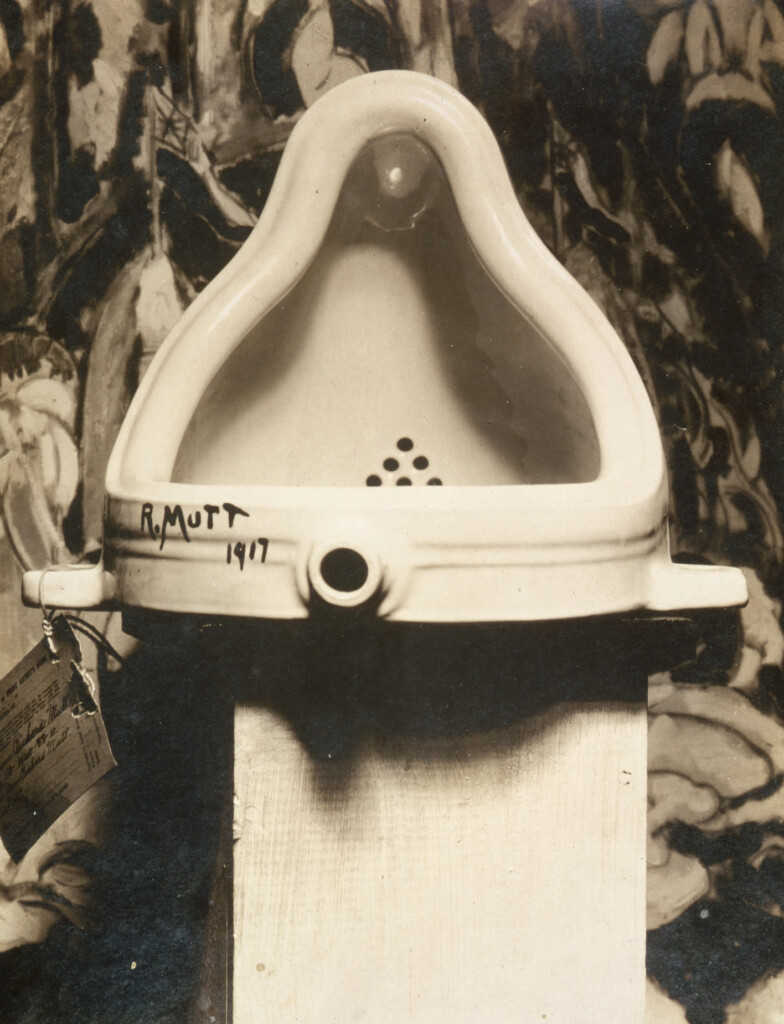
Marcel Duchamp began selecting manufactured objects as early as 1913, when a bicycle wheel mounted on a kitchen stool sat in his Paris studio not as a sculpture but, by his own account, as something to watch spin when he was bored. By 1915 he had brought the practice to New York, and by 1917 he had submitted a porcelain urinal, signed with the pseudonym R. Mutt and titled Fountain, to the Society of Independent Artists exhibition — an organization that had publicly pledged to accept any work from any artist who paid the six-dollar entry fee. The board, which included Duchamp himself as a founding director, rejected it. The object was turned to face a wall, then disappeared. What survived was a photograph taken by Alfred Stieglitz and published in the short-lived journal The Blind Man, accompanied by an unsigned editorial arguing that whether Mr. Mutt made the fountain with his own hands or not was irrelevant, that he had chosen it, thought it anew, and created a new thought for that object.
What that editorial did not say, and what the subsequent century of interpretation has largely obscured, is that the argument depended entirely on the prior existence of an institution capable of being scandalized. Arthur Danto, writing in 1964 in his essay “The Artworld,” introduced the concept of the artworld as a theory-laden atmosphere without which nothing could be seen as art at all — not because of any intrinsic property of the object, but because of a web of historical and institutional positioning that conferred that status. Danto was thinking partly of Duchamp, and what he mapped was not a liberation but an ecology: Fountain required the Society of Independent Artists to reject it, required Stieglitz’s gallery on 291 Fifth Avenue to lend the act photographic dignity, required the little magazine to frame it rhetorically, and required Duchamp’s own social position as an insider with enough cultural capital to make the gesture legible as gesture rather than mistake.
The silence Duchamp cultivated around his intentions was not the silence of refusal. It was the silence of someone who understood that ambiguity, when aimed at the right institution, generates more interpretive labor than any explicit statement could. George Dickie formalized this into what he called the institutional theory of art in his 1974 book Art and the Aesthetic, arguing that an artifact becomes art when a person acting on behalf of the artworld confers that status upon it. The theory was meant to be descriptive rather than evaluative, but what it quietly revealed was that every act of apparent rupture from institutional authority was, at its structural core, a bid for institutional ratification.
This is not a minor irony. Roughly sixty years after Fountain’s rejection, the Art Loss Register and major auction records showed Duchamp’s readymades — or rather their authorized replicas, since most originals were lost or destroyed — fetching prices that placed them among the most institutionally valorized objects in Western art history. The original urinal, never recovered, exists now as pure conceptual residue, which is perhaps the most complete institutional absorption imaginable: the object dissolved entirely into its documentation, its theory, and its market value, leaving nothing that could ever again be placed outside a frame.
What the mythology of the readymade suppresses is the figure of the person who paid the six dollars and still got rejected — the artist without Duchamp’s connections, without Stieglitz, without The Blind Man, who submitted something strange and simply had it turned to face a wall forever.

Language as the Work Itself: Kosuth and the Tautology Trap
You are sitting with a chair. Not the experience of sitting, not the memory of comfort or fatigue, but the chair as a fractured proposition: the physical object bolted to a gallery wall, beside it a black-and-white photograph of that same object, beside that a dictionary definition of the word “chair” mounted and framed. Joseph Kosuth installed this arrangement in 1965, and the installation did not ask you to feel anything. It asked you to notice that what you call a chair is already three different claims about reality pretending to be one thing.
The move was philosophically precise and rhetorically devastating. Kosuth had been reading A.J. Ayer and the logical positivists, men who argued in the 1930s and 1940s that meaningful statements were either empirically verifiable or analytically true by definition. A chair is wood and legs — verifiable. “A chair is a chair” — true by definition, empty of information, a tautology. Kosuth’s genius, or his trap depending on where you stand, was to turn that epistemological dead-end into a program for art. If a painting that depicted something beautiful was merely an empirical claim dressed in pigment, then real art — serious, legitimate, philosophically adult art — had to be tautological. It had to be about its own status as art, and nothing else could elevate it.
His 1969 essay Art After Philosophy published in Studio International made this explicit with an aggression that still reads as slightly unhinged. Kosuth declared that all art after Marcel Duchamp was conceptual, that the only interesting question left was the one Duchamp posed with his readymades: what makes something art at all? Form, skill, beauty, representation — all demoted to mere decoration, to what Kosuth called “morphological” concerns, meaning shape without meaning. Art had become, in his formulation, purely propositional. An artwork was a definition of art, and any definition of art was an artwork. The circle was airtight. It was also, structurally, a monopoly.
What Kosuth quietly accomplished was to install analytic philosophy as the gatekeeper of artistic legitimacy — a philosophy that was itself already beginning to lose its dominance in academic departments across the English-speaking world by the time Wittgenstein’s Philosophical Investigations, published posthumously in 1953, dismantled the idea that language operates through precise definitions at all. Wittgenstein’s later work showed that meaning is not a fixed relationship between word and concept but a family resemblance, a use, a practice embedded in social life. A chair is a chair not because of a dictionary entry but because of everything human beings do around chairs. Kosuth borrowed the authority of Ayer’s positivism at precisely the historical moment when philosophy had moved past it, which means the philosophical foundation of conceptual art’s most rigorous manifesto was already an artifact when the manifesto was written.
This matters not because it exposes a personal error but because it reveals a structural one. The claim that art had become pure proposition was itself not a proposition but a performance — it required a gallery, a wall, a viewer, institutional recognition, and a particular cultural moment in New York when the art market’s expansion made the anti-commodity gesture newly legible as commodity. Art After Philosophy appeared in a magazine with advertisers. One and Three Chairs sold. The tautology had a price tag, which is not a cynical observation but a precise one: the declaration that art is only about the concept of art is itself dependent on a material context that the concept cannot acknowledge without collapsing.
There is a kind of intelligence that reaches for the highest level of abstraction available in its moment and mistakes altitude for truth. The higher you climb, the more the ground disappears, and what looks like transcendence from up there looks from below like a very expensive way of losing your footing entirely.
Sol LeWitt's Instructions and the Disappearance of the Artist's Hand
You receive a card in the mail. On it, in clean typographic script, are seventeen sentences describing how to draw lines across a wall — their angle, their spacing, their color, their length. The card tells you nothing about what the finished surface should look like. It only tells you what to do. And somewhere, the man who wrote those seventeen sentences is waiting to be called the author of whatever you make.
Sol LeWitt began producing wall drawings in 1968, the same year that Roland Barthes published “The Death of the Author” in the French journal Manteia — a coincidence so neat it almost embarrasses both of them. LeWitt’s instructions were not sketches or preparatory notes; they were the work itself, legally and philosophically. Trained draftsmen, gallery assistants, even museum volunteers could execute them, follow them, deviate within their tolerances, and the result remained a LeWitt. The physical marks on the wall were explicitly understood as ephemeral — the drawings were routinely painted over at the end of exhibitions and could be reinstalled anywhere, by anyone, indefinitely. What persisted was the certificate of instructions, which could be bought and sold like a deed to land that exists only on paper.
This is where the rhetoric of dematerialization begins to develop a fault line. When critics celebrated LeWitt’s practice as a dissolution of the artist’s privileged hand, they were technically correct about the hand. But the hand was never what the market was paying for — it was always the mind, the originating intelligence, the certified source. What LeWitt’s system actually achieved was not the erasure of authorship but its purification. By removing the physical trace of his own execution, he left only the concept standing, and the concept turned out to be the most durable commodity of all. A painting can be forged. An instruction set authenticated by the artist’s estate cannot be meaningfully counterfeited, because the instruction set is the authentication. The system built its own inviolability into its own logic.
The philosopher Nelson Goodman, writing in “Languages of Art” in 1968, drew a distinction between autographic works — where forgery is possible because the original physical object matters — and allographic works, like musical scores, where a correct performance is the work regardless of who performs it. LeWitt’s wall drawings appear to belong to the allographic category. But Goodman’s framework assumed that the score and the performance were separable in value, that no single performance outranked another if both followed the instructions correctly. The art market refused this premise entirely. A wall drawing executed under LeWitt’s supervision during his lifetime carries a provenance premium that no posthumous execution can replicate, which means the hand crept back in through the door left open by documentation, presence, and the biographical mystique that institutional art history reliably manufactures around living bodies.
What is stranger still is how this mystique intensified precisely because the body was withheld. The more LeWitt insisted the instructions were sufficient, the more collectors and curators became preoccupied with the question of what he had intended, what tolerances he would have accepted, how close a given execution came to the artist’s vision — a vision he had theoretically surrendered by writing the instructions in the first place. His 1967 essay “Paragraphs on Conceptual Art,” published in Artforum, stated that the idea itself, once conceived, was the work and that its execution was perfunctory. The word “perfunctory” did a tremendous amount of work in that sentence, because it implied a standard of correctness against which execution could still be judged insufficient. Perfunctory means done as a matter of form, but form always has a master, and someone has to decide when the form has been adequately honored.
The disappearance of the artist’s hand, it turned out, produced not freedom from the artist but an intensified dependency on the artist’s ghost — a ghost that could be consulted, that left written testimony, that could authorize or invalidate any surface in the world.
Fluxus, Performance, and the Politics of Ephemerality
You are handed a card. It reads: “Draw a line. Erase it. Hang the erasing.” You stand there, card in hand, wondering whether you have just been given a piece of art or a mild insult, and the discomfort of not being able to distinguish between the two is precisely where Yoko Ono wanted you to live.
Her Instruction Paintings, collected in the 1964 volume Grapefruit, operated through radical incompleteness. They refused to be objects. They existed only in the gap between the written command and whatever the reader chose — or refused — to do with it. This was not aesthetic laziness. It was a calculated attack on the logic that had governed the art market since at least the seventeenth century Dutch trade in portable panel paintings: the assumption that art must be a transferable, bounded thing with a price attached to its edges. Ono understood that if you could not hand it over, you could not sell it, and if you could not sell it, you had severed the umbilical cord connecting the artist’s imagination to the collector’s vault.
George Maciunas, the Lithuanian-American architect who founded Fluxus in 1961 and spent the following decade producing his furious manifestos and cheap, deliberately ugly Fluxkits, pursued the same demolition by different means. Where Ono worked through poetic economy, Maciunas worked through aggressive quantity and ugliness. He wanted art to be cheap, reproducible, interchangeable with life — not elevated above it. His 1963 manifesto explicitly called for the purging of “professional art,” targeting the entire infrastructure of galleries, critics, and auction estimates as a parasitic overlay on human experience. He believed that dematerialization was not simply a formal experiment but a form of class warfare conducted inside culture’s most exclusive rooms.
What neither Ono nor Maciunas could fully anticipate was the mechanism by which radical ephemerality generates its own inverse. When an object disappears, what remains is the document of its disappearance: the instruction card, the manifesto, the photograph of the performance, the letter exchanged between artists. These residues, which were produced precisely as anti-commodities, eventually become the most desirable commodities of all because they carry the aura of the vanished gesture without the inconvenience of the gesture itself. A 2017 Sotheby’s auction sold a single instruction piece from Grapefruit for over six hundred thousand dollars. The card had not changed. The instruction still could not be hung on a wall. The price tag had simply migrated from the object to the concept of objectlessness.
This is not a paradox unique to Fluxus. It is the structural fate of any avant-garde movement that attempts to destroy exchange value by making itself worthless — because worthlessness, once declared and documented, becomes a historical fact, and historical facts have precisely the rarity and provenance that auction houses require. The sociologist Pierre Bourdieu mapped this dynamic with clinical precision in his 1993 study The Field of Cultural Production, demonstrating how the refusal of the market functions as the most sophisticated market strategy available to artists who cannot afford to compete on commercial terms. The gesture of contempt for money produces symbolic capital, and symbolic capital eventually converts back into money with interest.
What Fluxus performances actually did — in the bodies of the people who attended them, who sat in uncomfortable chairs waiting for something to happen that never arrived in the expected form — was manufacture a specific kind of social disorientation that no document can preserve. Dick Higgins standing before an audience and producing a sound piece built from audience coughs. Nam June Paik dragging a cello across a floor. These were acts designed to happen once and leave no retrievable residue, to produce an experience in which the witness could not later claim ownership even of the memory, because the memory had no stable content to hold.
A vision curated by a filmmaker, not an algorithm
In this video I explain our vision
The Dematerialization Thesis and Its Contradictions

You are standing in a white room at Christie’s, looking at a typed certificate in a thin frame. The paper is yellowing slightly at the edges. It states, in language both bureaucratic and solemn, that the bearer is the owner of an immaterial zone of pictorial sensibility — a volume of empty air, a conceptual transfer of experience that by definition cannot be hung, stored, or insured. The hammer falls at four hundred thousand dollars.
Lucy Lippard and John Chandler published their essay in Art International in January 1968, arguing that art was undergoing a fundamental evacuation of its material substrate. Ultra-conceptual art, they wrote, was approaching the condition of pure idea — work that exists primarily as information, instruction, or linguistic proposition, resistant by design to the logic of commodity exchange. The argument was not merely descriptive. It was a wager, a political bet placed against the gallery system and the collector class, against the whole apparatus of aesthetic capitalism that converted sensation into portable wealth. Within two decades, Sotheby’s and Christie’s had opened dedicated departments to handle exactly the documentation, certificates, correspondence, and instructions that were supposed to have made the art market obsolete.
This is not a simple irony. It is a structural revelation about what markets actually trade in. The fetish has never been the object itself — it has always been the authority that certifies the object’s meaning. What conceptualism stripped away was paint, canvas, bronze, the material occasion for that authority. What it left entirely intact, and in many cases intensified, was the authority itself: the artist’s signature, the artist’s declaration, the artist’s name underwriting a claim about what counts as significant experience. Sol LeWitt’s wall drawings cannot be transported, but his certificates of instruction can be, and they are. The work dissolves; the credential persists; the market migrates to the credential and prices it accordingly.
Lawrence Weiner stated in 1968 that his work need not be built, that the decision as to condition rests with the receiver at the time of receivership. This is a genuinely radical proposition about authorship and materiality, a dismantling of the romantic idea that the artist’s hand is the irreplaceable locus of value. But the market, confronted with this proposition, did not collapse — it simply identified Weiner’s statement as the rare thing, the scarce thing, the thing whose scarcity could be monetized. By 2020, typed artist statements, exhibition announcements, and artist-approved reproductions of language works were trading at prices that would have funded years of institutional critique.
The deeper contradiction is that dematerialization required documentation to survive at all. Yoko Ono’s instruction pieces exist because they were gathered into Grapefruit in 1964, a physical book, printed and distributed through conventional publishing channels. Hans Haacke’s real-time systems — temperature gauges, grass growing in gallery soil, condensation cycles — survived as photographs, as typed descriptions, as institutional records. The attempt to create art that could not be archived produced, paradoxically, one of the most meticulously archived movements in modern cultural history. The Seth Siegelaub archives, the papers at the Getty Research Institute, the Fluxus collections at MoMA — these are monuments to a practice that declared monumentality irrelevant.
What Lippard and Chandler could not fully anticipate in 1968 was that the market does not require materiality to function. It requires scarcity, provenance, and authenticated origin — conditions that conceptual art not only preserved but sometimes made more explicit and formalized than traditional object-making ever had. A painting’s authenticity must be inferred from physical evidence, contested by experts, tested against pigment analysis and provenance chains. A certificate of authenticity signed by the artist is, by definition, its own proof. Conceptualism did not weaken the commodity structure of art. It clarified it, stripped it to its logical core, and handed the market a cleaner instrument than it had ever previously possessed.
Institutional Critique as Institutional Investment
You are standing in a gallery that has decided to hang a picture of the knife it once used to cut you, framed in oak, lit from above, labeled with a small card that reads “critical practice, circa 1971.” The wound is not visible. The knife is pristine. The institution smiles.
Hans Haacke submitted to the Guggenheim a work that was never shown there. Shapolsky et al. Manhattan Real Estate Holdings, a Real-Time Social System, as of May 1, 1971 assembled 142 photographs of tenement buildings in Harlem and the Lower East Side, paired with documents tracing ownership through a web of shell corporations back to a single slumlord network. It was not painting. It was not sculpture. It was evidence, the kind that belongs in a courtroom or an investigative journalist’s filing cabinet, and Thomas Messer, the museum’s director, canceled the exhibition six weeks before opening, citing the work’s intrusion into “matters not within the museum’s area of concern.” That phrase deserves to be read slowly. A museum declaring that the ownership of decaying buildings where human beings lived and died fell outside its area of concern was not a bureaucratic statement. It was a confession about what the institution had always been protecting.
What happened next is the part the art world finds harder to narrate cleanly. Haacke was not silenced. He became celebrated. By the 1980s and 1990s, the very museums that would have suppressed the Shapolsky project were acquiring his work, exhibiting his retrospectives, publishing monographs that praised his unflinching critique of corporate power. The Guggenheim itself eventually revisited its relationship to his practice with something approaching institutional pride. This is not hypocrisy in the ordinary sense. It is a more sophisticated operation: the transformation of critique into credential, of dissent into collection category.
Michael Asher worked differently, almost invisibly. His interventions removed walls, displaced objects, rerouted ventilation systems, forced visitors to confront the physical and economic architecture that ordinarily hides behind the neutral white cube. At the Claire Copley Gallery in Los Angeles in 1974, he simply removed the partition between the exhibition space and the back office, exposing the commercial mechanics of the art market to anyone who walked in. The gesture lasted the duration of the show, and then the wall went back up. What Asher understood, and what made his work genuinely difficult to absorb, was that the institution’s tolerance of critique is itself a form of power. To permit the exposure of your own wall is to demonstrate that you control whether the wall exists at all.
The critic Benjamin Buchloh, writing in October in the 1990s, identified this absorption mechanism with the term “the aestheticization of administration,” suggesting that institutional critique had become a genre with its own conventions, its own market value, its own place in the canonical story that art schools teach and auction houses price accordingly. A practice born from refusal had acquired the grammar of acceptance. Graduate students learning about Haacke and Asher were not learning how to threaten institutions. They were learning the approved vocabulary for performing threat within them.
This is not a failure unique to these artists. It is a structural feature of how liberal cultural institutions metabolize opposition. The museum needs critique the way a nation-state needs a loyal opposition: not to be changed by it, but to prove, through its very existence, that the system is open enough to contain it. The 2019 protests at the Whitney over trustee Warren Kanders’s ownership of a company manufacturing tear gas used against asylum seekers produced resignations, statements, a temporary atmosphere of crisis — and then the Whitney continued, somewhat chastened, fundamentally unaltered, having demonstrated once again its capacity to survive the conversation about itself.
What institutional critique could never fully solve is the question of where else the critical artist was supposed to go.
Conceptualism Beyond the Western Canon
You walk into a room where the floor is covered in gravel, and someone hands you a transparent plastic bag filled with nothing but air sealed from a different city. There is no label, no pedestal, no explanatory card. The instruction, passed quietly from person to person, is to hold it and breathe near it. This is not a gallery game. This is a survival protocol for people living under a government that monitors gatherings, censors mail, and disappears artists who speak too directly.
The standard account of conceptual art places its birth somewhere between New York and London in the mid-1960s, crediting Sol LeWitt’s 1967 “Paragraphs on Conceptual Art” in Artforum as a kind of founding scripture. That account is not wrong so much as it is catastrophically incomplete, because it mistakes the loudest archive for the only one. The dematerialization of the art object — Lawrence Alloway’s term, later refined by Lucy Lippard and John Chandler in their 1968 essay — carried one set of stakes inside wealthy art markets where the gesture was primarily economic and institutional critique. It carried an entirely different set of stakes when it emerged under regimes that could imprison you for holding an unauthorized meeting.
The Centro de Arte y Comunicación in Buenos Aires, founded in 1968 by Jorge Glusberg, operated under precisely that pressure. The CAYC group produced work that superficially resembled the dematerialized practices circulating in New York, but the resemblance was a surface over a completely different interior logic. When Luis Camnitzer created text-based works that displaced the viewer’s body into bureaucratic language, he was not critiquing the commodity structure of the gallery system from a position of relative safety. He was encoding dissent inside a form that could plausibly claim innocence. The aesthetic strategy and the survival strategy were the same gesture.
Lygia Clark had already understood something more radical than dematerialization years before the term existed in critical vocabulary. Her Bichos series, begun in 1960, were hinged metal structures designed to be reconfigured only through touch, refusing to exist as fixed objects at all. By 1964, she had abandoned art objects entirely in favor of what she called relational propositions — sensory exercises conducted between bodies, requiring no institution, no wall, no object to survive. This was not dematerialization as critique of the market. This was the dissolution of the artwork into the social and somatic relationship itself, a move that Brazilian Neoconcretism arrived at through a completely different philosophical genealogy than anything happening in Manhattan, drawing on Merleau-Ponty’s phenomenology of embodied perception rather than Anglo-American analytic philosophy’s interest in tautology and definition.
Hélio Oiticica went further still, building his Parangolés — capes, banners, and tents made from layers of cloth and netting, designed to be worn and danced in — directly inside the favela communities of Rio de Janeiro, with participants from the Mangueira samba school. The work existed only in movement, only in community, only outside the white cube. When the Museum of Modern Art in Rio refused to allow the Mangueira dancers inside for a 1965 exhibition, Oiticica moved the entire event to the museum steps. The institution’s border became the artwork’s argument.
In Taiwan, the Ton Fan group and later the Third Wednesday Society were navigating a different configuration of the same pressure: a postcolonial modernity that had passed through Japanese occupation and then Kuomintang martial law, producing artists who used abstraction and dematerialized form not as rejection of tradition but as a way of refusing both the colonial inheritance and the nationalist instrumentalization of culture. The political stakes of refusing the object were shaped by which object, in which place, a government had already decided to weaponize.
What this history forces into the open is that the Western canon’s version of conceptualism was always already one regionalism among several — it simply had the institutional infrastructure to name itself universal and be believed.
🎨 When Art Breaks Every Rule and Reinvents Itself
Conceptual art did not emerge in a vacuum: it grew from a long tradition of artistic rebellion, philosophical questioning, and radical reinterpretation of what an artwork can be. To fully understand its history and protagonists, it helps to explore the broader cultural currents that fed this revolutionary movement, from avant-garde aesthetics to the sociology of creative communities.
Contemporary Sculpture: History and Protagonists
Contemporary sculpture shares with conceptual art a persistent questioning of the object itself: what gives form meaning, and why does matter matter at all? This article traces the evolution of three-dimensional art from traditional craft toward installations and ephemeral gestures that challenge every received idea of sculpture. Understanding this lineage is essential to grasping how conceptual practice redefined the very borders of visual art.
GO TO THE SELECTION: Contemporary Sculpture: History and Protagonists
The Artistic Community: History and Sociology of Collective Creativity
No artistic revolution happens in isolation, and the history of collective creativity reveals how groups, workshops, and communities have always shaped the meaning of individual works. This article explores the sociology behind artistic communities, examining how shared spaces and shared values produce aesthetic movements that no single genius could generate alone. Conceptual art, born from collectives and manifestos, is a perfect case study in this dynamic.
GO TO THE SELECTION: The Artistic Community: History and Sociology of Collective Creativity
Pierre Bourdieu and the Artistic Field
Pierre Bourdieu‘s analysis of the artistic field offers an indispensable lens for understanding how conceptual art conquered institutional legitimacy despite — or because of — its deliberate rejection of traditional aesthetic criteria. His theory of cultural capital explains why the most dematerialized gestures could become the most celebrated objects in the art market. Reading Bourdieu alongside conceptual art history exposes the paradox at the heart of every artistic avant-garde.
GO TO THE SELECTION: Pierre Bourdieu and the Artistic Field
Craftsmanship as Art Form: History and Philosophy
The rise of conceptual art was in many ways a direct provocation aimed at the age-old prestige of craftsmanship, declaring that skill and material execution were no longer sufficient — or even necessary — to define art. This article explores the philosophy of making as an art form, tracing how manual intelligence and bodily knowledge have been valorized and contested across centuries. The tension between craft and concept remains one of the most generative fault lines in contemporary aesthetics.
GO TO THE SELECTION: Craftsmanship as Art Form: History and Philosophy
Discover the Art of Independent Cinema on Indiecinema
If the history of conceptual art has ignited your curiosity about creative boundaries and radical visions, Indiecinema is the streaming platform where that same spirit lives on screen. Explore a curated selection of independent and avant-garde films that challenge, provoke, and transform the way you see the world. Join Indiecinema and let the most daring cinematic imaginations take you somewhere unexpected.
👉 EXPLORE THE CATALOG: Watch Indie Films in Streaming
A vision curated by a filmmaker, not an algorithm
In this video I explain our vision

