
The Dissolution of the Frame: Fluxus and the Abolition of Aesthetic Distance
You are standing in a gallery, and you know you are standing in a gallery, and that knowledge is doing more work than any object on the walls. It is holding you at a precise, calibrated distance from everything you see — teaching your body to move slowly, to lower your voice, to suspend the ordinary hunger of your hands. The white walls are not neutral. They are a technology of separation, and you have internalized that technology so completely that you experience it as taste, as sensitivity, as culture.

George Maciunas understood this in 1962 with a ferocity that most of his contemporaries mistook for provocation. When he issued the first Fluxus manifesto and organized the Festum Fluxorum in Wiesbaden that September, he was not staging happenings for an art-world audience hungry for novelty. He was making a diagnostic claim: that the entire apparatus of aesthetic reception — the museum, the concert hall, the framed canvas, the ticketed performance — was a machine for producing passivity, and that passivity had a politics. The frame around an artwork does not merely organize visual experience. It suspends ethical and social judgment. Inside the frame, anything can be contemplated. Outside it, the same gesture might demand a response.
Allan Kaprow had arrived at a related but distinct position through a different route. Writing in 1958, the year after he staged his first large-scale happening in a New York gallery, Kaprow argued that art needed to become lifelike — not realistic in the representational sense, but structurally entangled with the conditions of ordinary time and ordinary attention. His eighteen Happenings in 6 Parts that year asked audiences to move between rooms, to follow instructions on cards, to become unsure whether they were watching or participating. The discomfort people reported was not aesthetic discomfort. It was the discomfort of losing a role they had not known they were performing.
What Fluxus added to this was a harder philosophical edge and a contempt for the art market that Kaprow never quite shared. Maciunas wanted to abolish the professional artist as a category — not democratize art in the soft, inclusive sense that arts education now promotes, but actively destroy the social function that separates the person who makes from the person who receives. Nam June Paik‘s early Fluxus scores asked performers to cut off their own tie, to drag a violin across a stage floor until it fell apart, to do nothing for a specified duration in a specified posture. These were not metaphors for destruction. They were acts that left no remainder that could be sold, collected, or insured. The disappearance of the commodity was the work.
This is where the provocation bites deeper than most accounts acknowledge. When Fluxus collapsed the boundary between art and everyday life, it was not offering liberation. It was exposing what the boundary protects — not the artwork from contamination, but the viewer from responsibility. The aesthetic frame grants permission to feel without acting, to recognize without changing, to be moved without being implicated. It is an extraordinary social invention, and like most extraordinary social inventions, it serves power by appearing to serve sensitivity. The museum teaches you that the appropriate response to suffering rendered in paint is attention and perhaps a donation to the gift shop on the way out.
Yoko Ono‘s Instruction Paintings, first exhibited in Tokyo in 1961 and collected in her 1964 book Grapefruit, operated precisely at this threshold. Instructions like “Draw a map to get lost” or “Imagine the clouds dripping” were not quite language poetry and not quite scores for performance. They were objects that could only be completed by the reader’s willingness to act, to imagine with commitment, to treat the instruction as a genuine demand rather than a decorative prompt. The question they embedded was not aesthetic but ethical: what would it mean to actually do this, and why won’t you?
Institutional Gravity and the White Cube as Ideology
You walk into a gallery and something happens to your body before anything happens to your mind. Your voice drops, your pace slows, your hands retreat behind your back as though the air itself has issued a prohibition. Nothing on the walls has asked this of you. The room has.
Brian O’Doherty understood this with unsettling precision when he published his essays in Artforum in 1976, later gathered under the title Inside the White Cube. What he identified was not merely an aesthetic preference for neutral walls and controlled lighting but a full ideological operation: the gallery space does not display art so much as it produces it, conferring sanctity on whatever survives the threshold. The white cube is not a container. It is a sentence, already written, that tells you what the object inside it means before you have looked at it for a single second. Remove the object and the sentence remains, waiting for the next noun.
This is why attacking the art object itself — melting it, mass-producing it, replacing it with a concept — always risked becoming a gesture absorbed and redeemed by the very architecture surrounding it. Marcel Duchamp placed a urinal on a plinth in 1917 and demonstrated something scandalous; by the 1960s, institutions had learned to frame that scandal as tradition, to light it from above, to sell postcards of it at the exit. The radical act had been retroactively enrolled into the canon it was designed to rupture. The white cube is a digestion system of extraordinary efficiency. It has never once failed to convert its attackers into its exhibits.
Fluxus artists recognized something that most avant-garde movements before them had not fully confronted: the problem was architectural before it was aesthetic. George Maciunas, who functioned as the movement’s self-appointed theorist and organizer, was explicit in his manifestos about the need to dissolve the boundary between art and life not as a metaphor but as a structural fact. His Fluxus publications, beginning seriously around 1962 in Wiesbaden, were designed to be sold cheaply, mailed to strangers, placed in contexts where no curator had jurisdiction. The postal system, the street corner, the kitchen table — these were not merely alternative venues. They were a counter-architecture, built to deprive the white cube of its monopoly on meaning-making.
What the gallery system actually sells is not objects but thresholds. The admission ticket, the velvet rope, the hushed docent — these are the real products, because they enforce the distinction between legitimate experience and common life. Pierre Bourdieu spent much of his sociological career demonstrating that cultural capital functions precisely this way, that aesthetic distance is a class posture maintained through institutional infrastructure. His 1979 work Distinction mapped how the capacity to appreciate high art was inseparable from the social conditions that trained you to stand in a certain kind of room and feel a certain kind of reverence. The white cube does not welcome everyone equally; it merely pretends to universal access while practicing highly specific exclusions.
The Fluxus response to this was not to demand entry into those rooms but to make the rooms irrelevant. When Alison Knowles published her 1962 piece Make a Salad — a score instructing anyone, anywhere, to prepare and serve a large salad as an artistic act — the gesture was precise in its refusal. A salad cannot be preserved behind glass. It cannot be owned in any stable way. It feeds people and then it is gone, leaving no object for the institution to redeem, no residue the market can price. The ephemeral was not chosen because it was romantic or countercultural in a general sense. It was chosen because it was the one category of human action the white cube had no existing apparatus to process.
And yet even this was not a final answer, because institutions are patient in ways that individual artists cannot be, and patience, in the long game of legitimacy, turns out to be the most devastating weapon of all.

George Maciunas, the Manifesto, and the Politics of Uselessness
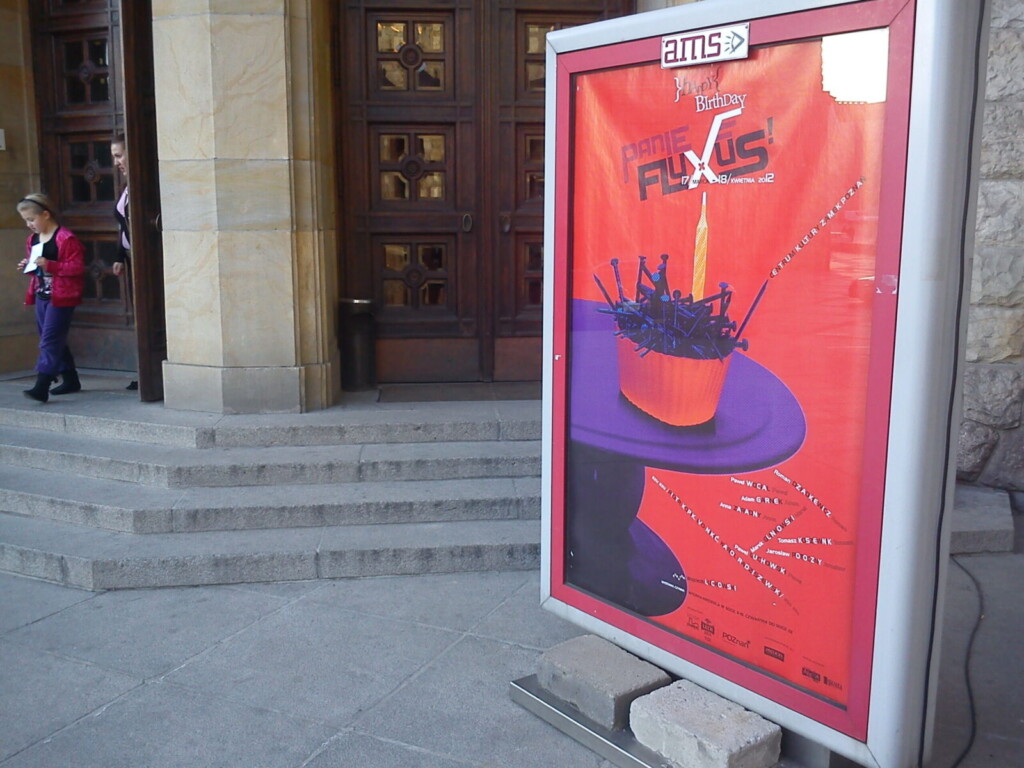
You are handed a mimeographed sheet at the door of a loft on Canal Street, sometime in the winter of 1963, and the paper smells of ink still warm from the machine. The text on it declares, in capital letters, that art must be purged — purged of its Europeanness, its intellectualism, its pretension to immortality, its debt to the market, its seriousness, its skill. You read it twice because it sounds like an insult addressed to you personally, and the man who wrote it is standing near the window watching people read it, wearing the expression of someone who has already won an argument no one else realized had started.
George Maciunas arrived in the United States from Lithuania as a displaced person in 1948, carrying with him the particular alertness of someone who has watched an entire cultural order collapse from close range. He studied architecture at the Carnegie Institute of Technology and art history at New York University’s Institute of Fine Arts, which means he did not reject the canon from ignorance but from deep familiarity — the way you can only refuse a language you have first mastered. By 1962, working from a gallery on Madison Avenue that failed commercially almost immediately, he had begun assembling around himself a loose coalition of composers, visual artists, and performers who shared a suspicion that the art world’s machinery of prestige was not incidental to its function but constitutive of it. The Fluxus Manifesto of 1963 was his crystallization of that suspicion into something sharp enough to cut.
The manifesto demanded what Maciunas called the “fusion of Spike Jones, vaudeville, gag, children’s games, and Duchamp.” The reference to Marcel Duchamp was precise: Duchamp had introduced the readymade in 1913, submitting a urinal to an exhibition under the pseudonym R. Mutt, and in doing so had asked whether the institution that frames an object as art was more constitutive of its status than any property the object itself possessed. Maciunas took that question and radicalized it by removing the museum entirely from the equation. The gesture was not to put a urinal inside the white cube, but to insist that the white cube was itself the disease, that cultural capital — in the precise sense Pierre Bourdieu would theorize in Distinction a decade and a half later — was a mechanism for reproducing class hierarchy under the guise of aesthetic judgment. The bourgeois concert hall, the gallery opening, the limited-edition artist’s book: these were not vessels for art but fortifications against it.
What makes Maciunas’s position structurally strange is that the call to uselessness was prosecuted with extraordinary organizational energy. He designed hundreds of Fluxus publications, event scores, and Fluxkits with the obsessive precision of someone who believes that the form of a thing is never neutral. The famous Fluxus boxes — small multiples sold cheaply and mass-produced, deliberately undercutting the art market’s logic of scarcity — were the practical application of the manifesto’s theory. They were useless in the high-cultural sense, meaning they did nothing that a painting does, created no auratic object for contemplation, generated no occasion for the connoisseur’s discriminating gaze. They were, deliberately, the aesthetic equivalent of a hardware-store receipt.
The philosopher’s wager buried inside this gesture belongs to a tradition that runs from Friedrich Schiller‘s 1795 Letters on the Aesthetic Education of Man, which argued that play — not work, not utility, not moral instruction — was the condition of human wholeness, through to Herbert Marcuse‘s Eros and Civilization of 1955, which read the repression of play as inseparable from the repression required by capitalist productivity. Maciunas was not citing these texts at his Canal Street loft, but he was living inside the problem they named: that a society organized around the serious business of production cannot tolerate an art that refuses to produce anything, and that this intolerance reveals exactly what the society is protecting.
John Cage's Silence and the Colonization of Attention
You sit in the concert hall in August 1952, Woodstock, New York, and the pianist walks to the bench, lifts the lid of the keys, and then does nothing. You wait. You assume the silence is preparation, that the real event is still arriving. Four minutes and thirty-three seconds later, you understand — with a cold, disorienting lurch — that what you just dismissed as the absence of music was, in fact, the entire performance.
What David Tudor actually performed that evening was not silence. The hall breathed. Rain struck the roof in the first movement. Wind moved through the second. Audience members shifted, coughed, whispered to each other in bewilderment or irritation, and those sounds — the ones no one had authorized, the ones embarrassed bodies produce when they are waiting for permission to exist — those were the composition. John Cage had spent years inside Zen Buddhist study and had encountered the anechoic chamber at Harvard in 1951, a room so acoustically sealed that he heard two sounds instead of silence: one high, one low, which the engineers told him were his own nervous system and his own blood in circulation. The revelation was not mystical. It was neurological. There is no silence. There is only what you have been trained not to hear.
The training begins early and is almost never named as training. Western concert culture developed, across the eighteenth and nineteenth centuries, a rigid behavioral grammar: the audience is passive, immobile, quiet; the performer is active, authorized, framed. This grammar was not natural to musical experience — it was imposed, gradually and deliberately, as bourgeois culture sought to distinguish its relationship to art from that of lower social classes, who had historically attended performances as a participatory social event. The musicologist William Weber traced this shift in detailed archival research, showing that the enforcement of audience silence in European concert halls became a class marker before it became an aesthetic principle. You were taught to receive art through a particular posture of submission not because it made the art better, but because it marked you as the kind of person who knew how to receive art properly.
Cage’s four minutes and thirty-three seconds detonated that posture. But the deeper damage it did — the damage that made certain audience members furious rather than curious — was to expose the cognitive dependency the posture had created. When the frame of the authorized event is removed, most people do not experience liberation. They experience anxiety. The psychologist Mihaly Csikszentmihalyi spent decades studying how human attention is structured, and his research on what he called the “psychic entropy” of unstructured time reveals something uncomfortable: people consistently report higher anxiety during leisure and unstructured moments than during work, because without an external structure to organize attention, the mind defaults to rumination, self-criticism, and a low-grade dread that has no specific object. The concert hall in 1952 became a laboratory for that dread. The audience had been given time and sound and told it was art, and most of them could not locate the experience inside any category they trusted.
This is not merely an aesthetic problem. The colonization of attention by sanctioned channels — the concert, the film, the news broadcast, the curated feed — produces a subject who can only receive experience that has been pre-framed as worth receiving. Everything outside the frame registers as noise, interruption, failure. You walk through a city and your nervous system processes approximately eleven million bits of information per second, of which conscious awareness captures roughly forty. The selection is not neutral. It has been shaped by decades of cultural conditioning that taught you which forty bits deserve to be experienced as real. The bus exhaust, the stranger’s half-sentence, the specific quality of light on a wet pavement — these do not arrive pre-labeled as art, and so they pass through you without landing.
What Cage understood, and what made his gesture irreversible rather than merely provocative, is that the boundary between art and non-art is not a formal distinction.
Yoko Ono's Instructions and the Violence of Participation
You walk into a room and someone hands you a card. On it, a single sentence: “Hammer a nail into a mirror.” Nothing else. No artist hovering to explain, no wall label contextualizing the gesture, no museum guard to tell you what the correct response looks like. The card is the entirety of the event. And you realize, standing there with a hammer you did not ask to hold, that the discomfort arriving in your chest has nothing to do with the mirror.
Yoko Ono published Grapefruit in 1964, a slim book of what she called “instruction paintings” — directives that read like haiku crossed with legal notices. “Burn this map.” “Watch the sun until it becomes square.” “Imagine a painting so large it covers the entire sky.” The instructions are not descriptions of art objects; they are the transfer of authorship itself, pressed into the reader’s hands like a hot coal. Most people who encounter them feel a faint vertigo, and then reach, almost reflexively, for an interpretive framework — some critical vocabulary, some art-historical container — that will allow them to observe the instructions from a safe distance rather than execute them. That reaching is the most honest thing they do.
The word “participation” has been laundered through decades of institutional rhetoric until it sounds like generosity — democratization, inclusion, the leveling of hierarchies between artist and audience. But what Ono’s instructions actually produce, in the body of the person holding them, is closer to what the psychoanalyst D.W. Winnicott described in 1953 when he theorized the transitional object: the blanket, the stuffed animal, the intermediate thing that mediates between the self and an overwhelming world. Every conventional artwork functions as a transitional object. It is there, between you and the artist’s intention, absorbing the encounter, allowing you to respond without fully arriving. Ono removes it. There is no canvas. There is no object to stand in front of, to tilt your head at, to read a plaque about. There is only you and the instruction and whatever happens next.
What happens next, for most people, is paralysis followed by deflection. In 1966, at the Indica Gallery in London, Ono installed a white ladder leading to the ceiling, where a magnifying glass hung on a chain. Climbing the ladder and looking through the glass at a tiny word written on the ceiling — “YES” — required genuine physical commitment from a stranger in a gallery. John Lennon climbed it. He later said the word shocked him with something he could only describe as relief. But Lennon was unusual. The majority of visitors to participatory works do not participate. They watch others participate, which reconstitutes the very hierarchy the work was designed to dissolve, repositioning the active participant as performer and themselves as audience.
This is the trap that Claire Bishop identified in Artificial Hells in 2012, where she argued that participatory art frequently reproduces social antagonism rather than resolving it — that the fantasy of collective authorship conceals a new kind of power, the power of the artist who designs the rules of engagement and then withdraws, leaving participants to negotiate them without guidance. Ono’s instructions are not democratic. They are ruthlessly asymmetrical. She decides what the task is. You decide only whether to submit to it. The asymmetry is the point, because it mirrors the asymmetry of every social contract you have ever signed without reading.
What the instruction format exposes is not your creativity but your tolerance for unwitnessed action — for doing something that may mean nothing, in front of no authority capable of conferring value on the gesture. Most people cannot bear it. They laugh, or they photograph the instruction card instead of following it, converting the confrontation back into an object, something holdable, something they can post and caption and domesticate. The photograph of the hammer is not the hammer.
A vision curated by a filmmaker, not an algorithm
In this video I explain our vision
The Score as Anti-Monument: Fluxus, Ephemerality, and Market Resistance

You receive a card. It is the size of a playing card, printed in plain type, and it reads: “Smile. Smile. Smile.” That is the entire work. No canvas, no plinth, no certificate of authenticity — just an instruction that dissolves the moment you decide whether or not to obey it.
This was the logic of the Fluxus event score, and it was a calculated affront to every mechanism by which Western culture had learned to convert aesthetic experience into property. George Maciunas, the Lithuanian-American architect who functioned as Fluxus’s self-appointed impresario and ideological enforcer, was explicit about the economic dimension of the project. He described Fluxus’s goal as the elimination of the “artist’s professional, parasitic, and elite status in society” — a formulation that sounds utopian until you realize it was also a structural diagnosis. The art market does not simply sell objects; it sells scarcity, and scarcity requires that the thing sold be singular, stable, and reproducible only under controlled conditions. An instruction printed on a card and handed to a stranger on a street corner in New York in 1963 could be copied by anyone, executed by anyone, owned by no one. It was designed to be economically indigestible.
Theodor Adorno, writing with Max Horkheimer in Dialectic of Enlightenment in 1944, had already mapped the terrain that Fluxus was trying to abandon. The culture industry, they argued, does not simply produce commodities — it produces the desire for commodities by standardizing experience while maintaining the illusion of individual choice. What Adorno could not fully anticipate was the system’s extraordinary capacity to metabolize even its own critique. He understood that authentic art preserved its truth by resisting easy consumption, by remaining difficult, by refusing to deliver the satisfactions the market promised. What Fluxus added to this analysis was a tactical move: if the object is what the market needs, eliminate the object entirely. Make the work so radically temporary, so physically insubstantial, that there is nothing left to sell.
The problem is that markets are not defeated by disappearance. They are defeated only by conditions they cannot name, and the art market proved entirely capable of naming ephemerality. By the 1980s, Fluxus scores — those tiny printed cards, those mimeographed instruction sheets — were being sold at auction. The George Maciunas Estate, the Gilbert and Lila Silverman Fluxus Collection, which was eventually acquired by the Museum of Modern Art in New York in 2008 for a sum reported in the millions of dollars, demonstrated with uncomfortable precision that documentation of the undocumentable is still documentation. A photograph of a performance, a typed score, a flyer announcing an event that lasted eleven minutes in a Wiesbaden concert hall in September 1962 — all of it became archive, and archive became inventory.
What this reveals is not hypocrisy but something more structurally interesting: the market does not require the thing itself. It requires the trace of the thing, the proof that something happened, the certificate that someone was there. Nam June Paik‘s performances existed in time and then ceased to exist in time, but the films, the objects incidentally created, the institutional memory of participation — these constituted a secondary economy of residue that the primary gesture had not managed to destroy. Yoko Ono’s Grapefruit, first published in a limited edition of 500 copies in Tokyo in 1964 and reissued commercially by Simon and Schuster in 1970, became a collectible in the very moment it circulated widely enough to escape control.
The score itself, that anti-monument, turns out to contain its own monument in the act of writing. To fix an instruction in language is already to preserve it, and preservation is the first motion of the archive, which is the first motion of the institution, which is the first motion of the market asking what something is worth.
Everyday Life as Raw Material: Lefebvre, Boredom, and the Revolutionary Mundane
You are standing in your kitchen at 7 a.m., filling a kettle. The sound of water hitting metal. The weight of the handle. The slight resistance of the tap. You have performed this action perhaps ten thousand times and experienced it precisely zero times, because somewhere between the second and third repetition your nervous system decided it was not worth registering — filed it under “background,” which is another word for “not real.”
Henri Lefebvre published his Critique of Everyday Life in 1947, and the book was largely ignored, which is itself a Fluxus-worthy event. His central provocation was not that capitalism oppresses workers through dramatic violence but that it colonizes them through rhythm — through the grinding, numbing repetition of days that feel structurally identical, days that manufacture the subjective experience of time passing without anything happening. The genius of the system, he argued, is that people collaborate enthusiastically in their own anaesthesia. They develop elaborate psychological technologies for not being present to what they are doing, because full presence to the mundane would require confronting how much of a human life consists of acts performed on autopilot, in service of structures one did not choose and cannot easily name.
Fluxus artists in the early 1960s were reading this same atmosphere, even when they had not read the text. George Brecht‘s event scores — instructions so minimal they could fit on a calling card — were not artistic provocations in the conventional sense. They were phenomenological ambushes. “Drip Music,” a 1959 score, instructs a single source of dripping water. That is the entire work. What this does to an audience is not entertain them or instruct them but force them into an attention they normally suppress: the recognition that sound exists before it is organized into music, that duration exists before it is organized into narrative, that experience is happening continuously whether or not consciousness chooses to ratify it.
The deeper threat in this gesture is not aesthetic but existential, and this is what most critical accounts of Fluxus underestimate. When Alison Knowles performed “Make a Salad” in 1962 — literally preparing and distributing a salad as a public event — she was not being ironic. She was refusing the implicit hierarchy that assigns meaning to some acts and evacuates it from others. The conventional psychological economy requires that hierarchy. People tolerate the emptiness of routine by believing that meaning is concentrated elsewhere: in the weekend, the vacation, the promotion, the artwork on the wall of the gallery they will visit once a year. Remove the hierarchy and the compensation mechanism collapses. You are left with the terrible freedom of a present moment that is entirely available and has always been entirely available, and which you have spent considerable energy avoiding.
Boredom is not the absence of stimulation. It is the presence of a self that does not know what to do with its own existence when external structure fails to organize it. Fluxus events systematically removed that structure and then waited. The discomfort audiences reported was not about the work being bad or confusing — it was the discomfort of suddenly having to be somewhere, in a body, in a room, with no approved response queued up and no aesthetic framework to hide behind.
Nam June Paik understood that modern media had intensified this problem rather than solved it. Television, which by 1963 had penetrated roughly 90 percent of American households, offered the illusion of aliveness — images, voices, movement — while requiring nothing from the viewer except passive reception. His early video works broke the signal deliberately, inserting noise into transmission, because an interrupted broadcast forces the viewer to notice the screen as an object rather than disappear into its content. The moment you see the apparatus, you are returned to the room, to the chair, to the body sitting in it.
What Fluxus was doing, in its most honest moments, was refusing to let the room disappear.
The Performer Without a Stage: Identity, Labor, and the Unwitnessed Act
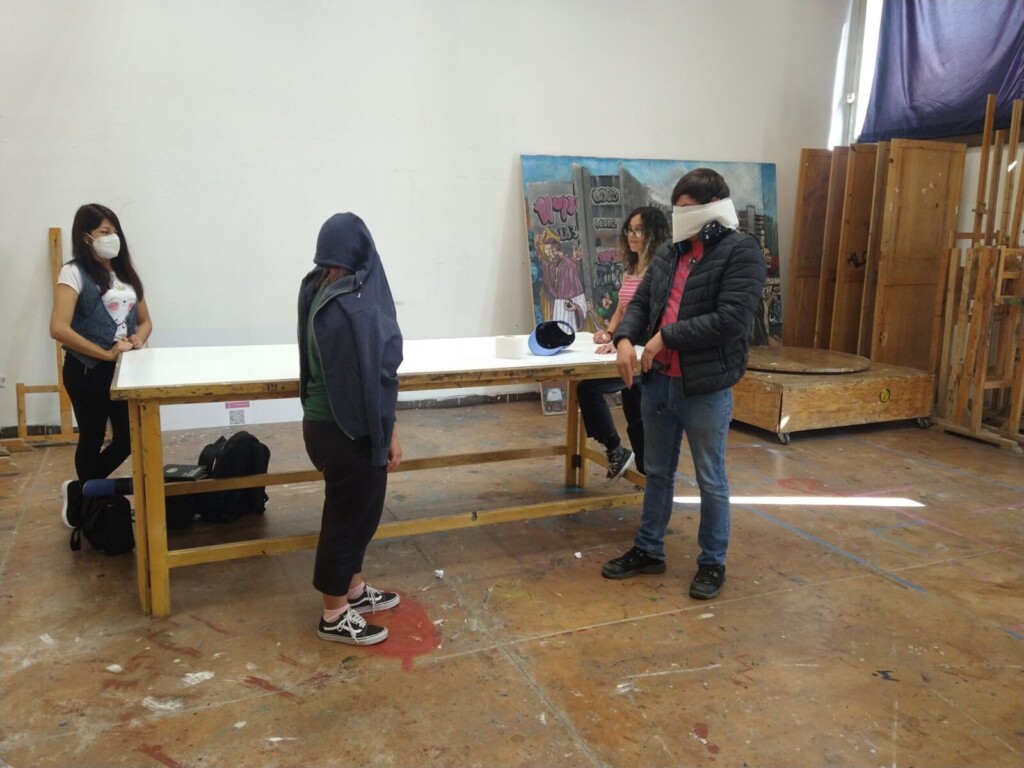
You are alone in a room, and you do something deliberate — you arrange three objects on a table in a specific order, you strike a piano string once and let the sound dissolve completely into silence, you tear a page not in anger but as a considered act. No one sees it. The question that follows is not whether it happened, but whether it mattered, and the deeper embarrassment hidden inside that question is that you already know the answer you want, and you want it to involve a witness.
Nam June Paik understood this discomfort before most people had language for it. His early actions in the late 1950s and early 1960s — before the televisions, before the global celebrity — were often private to the point of being almost anti-events, gestures directed at no particular reception. When he dragged a violin along a street in 1961, the action was complete in itself, indifferent to applause, structurally incapable of being framed by an audience’s validation because it refused the architecture of the stage entirely. What Paik was doing, though he might not have used this phrasing, was attempting to locate agency in the act rather than in its recognition — a distinction that sounds philosophical until you realize how much of ordinary modern life is organized around the opposite principle.
Wolf Vostell‘s Décollage events operated from a different angle but arrived at a neighboring problem. Décollage — the act of tearing away, of peeling back layers of accumulated image and advertisement — was not merely a technique applied to posters on Berlin or Paris walls in the early 1960s. It was a theory of identity disguised as a destruction of surface. Vostell recognized that the human subject in consumer modernity is itself a kind of pasted-over surface, a layered accumulation of performed roles and sanctioned self-presentations, and that removal is a more honest act than addition. His 1958 concept of the décollage as both method and aesthetic principle suggested that the self, like the billboard, is always already an overwritten text — and that authenticity, if it exists at all, lives somewhere in the tear rather than the image beneath it.
The sociologist Erving Goffman published The Presentation of Self in Everyday Life in 1959, and his argument — that social life is structured as a performance in which individuals manage impressions across front and back stages — reads now less like sociology and more like prophecy. Goffman was describing something that was already true, but what neither he nor Fluxus could fully anticipate was the degree to which the back stage would eventually be colonized as a performance space of its own. The private moment, the unwitnessed act, the spontaneous gesture — each of these has since acquired its own genre conventions, its own aesthetic vocabulary, its own audience metrics.
This is the blade that Fluxus left embedded in culture without quite knowing it. When George Maciunas drafted his Fluxus manifestos in 1963, calling for art that merged with the quotidian, that abolished the boundary between the made object and the lived moment, he was reaching toward liberation — toward a world in which nobody needed the museum, the critic, or the ticket stub to confirm that experience had occurred. What he inadvertently sketched, with unsettling precision, was the emotional logic of a platform-mediated existence in which every meal, every walk, every private arrangement of objects on a table becomes potential content, and the failure to document feels like a failure of existence itself.
The Fluxus performer without a stage was trying to escape the tyranny of reception. The contemporary self without a platform feels incomplete in ways that are almost physiological, a phantom-limb sensation where the audience used to be. Whether that hollowness represents a corruption of the Fluxus impulse or its most honest and damning fulfillment is a question that remains genuinely open, because the answer depends entirely on whether you believe freedom was ever really the point.
🎭 When Art Dissolves Into Life and Action
Fluxus challenged every boundary between art, performance, and daily existence, turning the ordinary into a radical gesture. To fully understand this movement, it helps to explore the broader currents of thought and practice that shaped its world — from avant-garde aesthetics to the philosophy of the everyday.
The Artistic Community: History and Sociology of Collective Creativity
Artistic communities have always been laboratories where individual creativity transforms into collective experiment, much as Fluxus turned a loose network of provocateurs into a global movement. This article explores the sociology and history of collective creativity, examining how groups of artists forge shared visions and shared provocations. Understanding these dynamics illuminates why Fluxus could simultaneously emerge in New York, Cologne, and Tokyo.
GO TO THE SELECTION: The Artistic Community: History and Sociology of Collective Creativity
Antonin Artaud: Life and Thought
Antonin Artaud‘s Theater of Cruelty is one of the great ancestors of Fluxus, insisting that performance must assault the senses and shatter the comfort of passive spectatorship. This article examines how Artaud conceived of theater not as representation but as lived event, a direct transmission of energy between performer and audience. His legacy runs as a live wire through every Fluxus happening and event score.
GO TO THE SELECTION: Antonin Artaud: Life and Thought
Michel de Certeau: Life and The Practice of Everyday Life
Michel de Certeau‘s philosophy of everyday life argues that ordinary people constantly subvert dominant culture through small, creative acts of resistance — a vision strikingly close to the Fluxus ethos of finding art in brushing teeth or boiling water. This article explores de Certeau’s landmark work and its implications for understanding how life itself can become a form of practice and invention. Reading de Certeau alongside Fluxus reveals the deep political charge hidden inside even the most playful event scores.
GO TO THE SELECTION: Michel de Certeau: Life and The Practice of Everyday Life
Guy Debord and the Spectacle: Life as Performance
Guy Debord and the Situationist International declared that modern life had been colonized by the spectacle, transforming authentic experience into passive consumption — a diagnosis that Fluxus answered with radical participatory action. This article examines Debord’s foundational theory and the strategies of détournement and dérive developed to reclaim lived experience from the image-world. The parallels and tensions between Situationism and Fluxus map the contested terrain of avant-garde politics in postwar culture.
GO TO THE SELECTION: Guy Debord and the Spectacle: Life as Performance
Discover the Cinema That Breaks All the Rules
If these ideas about art, performance, and everyday life spark something in you, Indiecinema is the streaming platform where that spark becomes a flame. Explore a curated selection of avant-garde, experimental, and independent films that carry the Fluxus spirit into moving images. Join the community of curious minds who believe that cinema, like life, is always a work in progress.
👉 EXPLORE THE CATALOG: Watch Indie Films in Streaming
A vision curated by a filmmaker, not an algorithm
In this video I explain our vision

