
The Stage as a Trap
You are sitting in a theatre in Berlin, 1927, and something is wrong. The lights have not dimmed in the way you expected. The actors keep doing something unforgivable — they look at you. Not the starstruck, accidentally intimate glance of a performer momentarily broken from their spell, but a deliberate, sustained, almost prosecutorial look that says: you are here, you know you are here, and we both know what you came for. You came to disappear. You came to hand your nervous system over to someone else’s grief for two hours and walk out feeling cleansed, as if suffering were a spa treatment available by ticket. The stage in front of you is refusing that transaction.

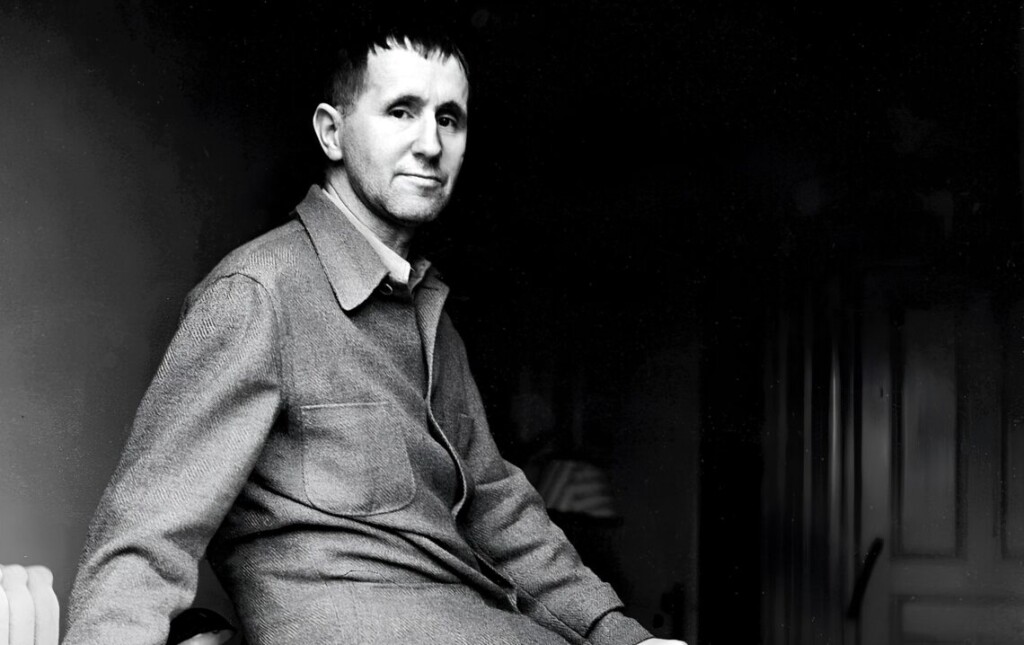
This refusal was not accidental. It was the result of one man spending years thinking with cold fury about what theatres actually do to people, and deciding that the whole architecture of emotional seduction built into Western drama since Aristotle was not an art form but a mechanism of pacification. Bertolt Brecht, born in Augsburg in 1898, had watched the German bourgeoisie weep at tragedies while voting for parties that would grind the poor into gravel. He had noticed something damning: that the capacity to feel, in a darkened room, for fictional characters appeared to have no relationship whatsoever to the capacity to act, in daylight, for actual human beings. Catharsis, that ancient promise of purgation and renewal, was functioning less like liberation and more like a pressure valve — releasing just enough tension to make continued passivity bearable.
His early work announced this diagnosis with the subtlety of a slap. Baal, written in 1918 when Brecht was twenty years old, threw an asocial, sexually voracious, completely unredeemable poet onto the page as an answer to the sentimental expressionism surrounding him. The play refuses to ask for your sympathy and punishes you slightly for offering it anyway. Then came Drums in the Night in 1922, which won him the Kleist Prize and baffled critics who could not locate its moral center, followed by In the Jungle of Cities in 1923, a work so deliberately resistant to psychological coherence that audiences were structurally prevented from projecting themselves into its characters. Each piece was, in its own way, a small experiment in making the stage uncomfortable to inhabit as a spectator.
What Brecht understood, and what took the theoretical establishment considerably longer to catch up with, was that the conventions of naturalist theatre were not neutral aesthetic choices. They were an ideology with a box office. The darkened auditorium, the fourth wall, the seamless psychological interiority of characters, the musical swell at the moment of revelation — these were not simply techniques for telling stories. They were a training program in a specific relationship to reality: one of passive reception, emotional identification, and the comfortable belief that human suffering is the product of individual fate rather than arrangeable social conditions. Henrik Ibsen and August Strindberg had done extraordinary things within that convention, had pushed psychology to its limits, but they had left the fundamental contract between audience and stage entirely intact. Brecht wanted to renegotiate it from the ground up.
The remarkable thing is not that he had this idea. Radical ideas about theatre were circulating everywhere in Weimar Germany, a republic born from military collapse and revolution in November 1918, perpetually convulsed by inflation, street violence, and the competing ferocities of communist and fascist movements. Erwin Piscator was already doing politically explosive work in Berlin. The Russian constructivists had been dismantling theatrical illusion since before the decade began. What made Brecht different was the precision of his diagnosis — not just that theatre was political, but that its very grammar of feeling was where the politics hid.
Crazy World

Drama, thriller, by Fabio Del Greco, Italy, 2010.
Luca is poor and works, precariously, as a waiter. He lives a problematic relationship with his girlfriend, and his life is full of doubts. One day Luca meets Chiara, a friend who had studied philosophy with him at university. She has realized her dream of opening a night and is now well-off. Luca leaves everything behind and starts a relationship with Chiara. He manages the nightclub with her and, thanks to the cocaine and call girls sold to politicians, he gets out of his hard economic situation. But Chiara does not manage to obtain the contract for an old furnace, so she blackmails Saverio, a member of the Parliament. Chiara owns a video in which Saverio has sexual intercourse with a transsexual.
LANGUAGE: Italian
SUBTITLES: English, French, Spanish, German, Dutch, Portuguese.
Born Into the Machinery
You are sixteen years old and you are watching men arrive at the hospital in pieces. Not metaphorically. Limbs missing, faces reconstructed by shrapnel into something that no longer reads as human. You do not have a theory about this. You have a mop, an orderly’s uniform, and a slowly collapsing assumption that the world is ordered by reasonable people toward reasonable ends.
Eugen Berthold Friedrich Brecht was born on February 10, 1898, in Augsburg, Bavaria, a prosperous textile and manufacturing city that wore its bourgeois comfort the way a merchant wears a well-cut coat — not with pride exactly, but with the quiet confidence of someone who has never seriously doubted his right to it. His father managed a paper mill. The family had servants. There were piano lessons and a solid secondary education at the Königliches Realgymnasium, where the young Brecht was already writing poems and short prose pieces with a facility that charmed his teachers just enough to make them nervous. Augsburg was not a city of revolutionaries. It was a city of ledgers, of Lutheran propriety, of smokestacks that were considered signs of progress rather than symptoms of something terrible.
What the bourgeoisie has always been extraordinarily skilled at is producing children who are given just enough education to see the machinery clearly, and just not enough insulation to stop seeing it. Brecht received the first gift in full. The second was stripped from him in 1916, when, still a student, he began volunteering as a medical orderly at the military reserve hospital in Augsburg during the First World War. The war was well into its industrial logic by then — the Somme had already happened, a battle that consumed over one million casualties between July and November of that year alone, a number so large it functions less as a statistic and more as a failure of the imagination. What Brecht encountered in those hospital wards was not the abstraction of that number but its texture: the smell, the sound, the specific weight of a body that had been processed by modern industrial warfare and returned to civilian space as wreckage.
This is not a minor biographical detail. Georg Büchner, whose fragmentary 1837 play Woyzeck Brecht would later teach, read, and metabolize, had already understood something essential: that the state does not oppress through grand theatrical evil but through the slow, bureaucratic, almost bored destruction of people who never had the conceptual vocabulary to resist it. What Brecht saw in the hospital was Büchner’s Woyzeck multiplied by an industrial coefficient. The poor were not simply suffering. They were being fed into a machine that the people who owned the machine publicly mourned while privately requiring.
His early poem “The Legend of the Dead Soldier,” written in 1918, which would later appear in his Hauspostille collection of 1927, captures this with a savagery that is almost too precise to be called angry. In it, a dead soldier is exhumed, declared fit for service, and sent back to the front. The poem does not explain its metaphor. It does not need to. Brecht had not read Marx carefully yet at this point — his serious engagement with Marxist theory would come in the mid-1920s when he began deliberate study in Berlin — and this matters enormously, because it means the poem is not ideological. It is observational. It is the report of someone who watched the machinery work and wrote down what he saw before he had words for the mechanism.
The ideology came later. The wound came first. And the wound, unlike the ideology, could never be revised, updated, or abandoned when political circumstances changed. It stayed exactly where it was placed, in a hospital in Augsburg, in a boy who was still theoretically a child, watching the twentieth century explain itself without apology.

Weimar’s Controlled Chaos
You are handed a program at the door, a small printed sheet that tells you what you are about to see, and somewhere in the fog of cigarette smoke and cheap perfume you realize that the theater itself is the lie — not the play, not the actors, but the building, the seat, the expectation that you came to be moved rather than implicated. Berlin in the 1920s understood this before anyone had the language for it. The city had lost a war, swallowed a revolution, printed money until the paper weighed more than the bread it could not buy, and then somehow decided to throw a party so violent and so beautiful that the whole world leaned in to watch.
This was not decadence as escape. It was decadence as diagnosis. The inflation of 1923 had already taught ordinary Germans something that no economics textbook had the courage to state plainly: value is a performance, money is theater, and the state is the worst actor in the room. By the time the Weimar Republic stabilized under the short-lived Dawes Plan and American loans began flooding into German industry, the culture had already internalized a fundamental lesson about the relationship between money and meaning. The cabarets of the Kurfürstendamm did not mock this lesson — they monetized it. They sold tickets to watch the rich be humiliated, charged admission for outrage, and turned political fury into an entertainment industry. Brecht saw the mechanism clearly.
His collaboration with the composer Kurt Weill was not a meeting of artistic temperaments so much as a collision of two precise and ruthless intelligences. Weill had studied under Ferruccio Busoni, had absorbed the formal rigors of late Romanticism, and then deliberately dismantled them in favor of something that sounded like a jazz band playing a funeral march. When the two men began working together in the late 1920s, what emerged was a form that refused the emotional contract of conventional opera — it did not want your tears, it wanted your discomfort, your recognition, your laugh catching in your throat before you understood why it tasted wrong.
The Threepenny Opera opened on the thirty-first of August, 1928, at the Theater am Schiffbauerdamm, and it became the kind of success that embarrasses its own argument. Based loosely on John Gay‘s 1728 The Beggar’s Opera, it took the criminal underworld as its subject precisely because the criminal underworld and the business world had become indistinguishable. Macheath — Mack the Knife — runs his operation with the administrative efficiency of a bank manager, and the police chief Tiger Brown maintains the whole arrangement through the simple logic of shared profit. The audience laughed. They laughed because they recognized it, and their laughter was itself the trap: to find it funny was to confess that you already lived inside it.
Within a year the production had been staged in over fifty cities across Europe. The irony that a work designed to expose the commodification of art had become one of the most commercially successful theatrical productions of the decade was not lost on Brecht, and it sharpened rather than softened his thinking. He was not disillusioned — disillusionment requires prior innocence, and Brecht had never carried that particular weight. What the success confirmed was something Georg Lukács would later theorize in his 1923 History and Class Consciousness as the problem of reification: the tendency of capitalist culture to absorb critique and sell it back as product. The system does not fear its own image; it frames it, hangs it on the wall, and charges for the viewing.
What Berlin gave Brecht was not freedom but pressure — the specific pressure of a society that had stopped pretending its contradictions could be resolved, and had instead decided to perform them nightly, for a cover charge, in rooms that smelled of desperation dressed up as pleasure.
The Technique of Estrangement
You are watching a man confess his crimes to a jury, and just as you lean forward in your seat, prepared to judge him, an actor turns to face the house lights and reads from a placard explaining that this scene has already happened three times tonight in three different cities. The spell does not break — it detonates. What you thought was a window turns out to have been a mirror all along, and the mirror has just been shattered.
Brecht called this the Verfremdungseffekt, a word that translates poorly into English because “estrangement” sounds too gentle, too literary, too much like the melancholy of a Sunday afternoon. What he meant was closer to violence — the deliberate rupture of the spectator’s most dangerous habit, which is the habit of recognition. Human beings are extraordinarily efficient at making the unfamiliar familiar, at absorbing shock and filing it into existing categories. Theatre, as it existed before Brecht, was a machine purpose-built to serve that efficiency. It asked you to identify, to empathize, to dissolve yourself into the suffering of a character so completely that you emerged two hours later feeling that you had experienced something profound without having thought a single new thought.
Walter Benjamin, writing in 1939 in his essay “What Is Epic Theatre?”, understood that Brecht’s technique was not an aesthetic experiment but an epistemological one. Benjamin argued that Brecht had discovered something about the nature of habit itself: that once a gesture, a social arrangement, or a human relationship becomes familiar, it becomes invisible, and once invisible, it becomes natural, and once natural, it becomes permanent. The Verfremdungseffekt was the instrument designed to reverse that process at every stage simultaneously. By making a familiar thing strange — a mother selling her children’s loyalty, a soldier negotiating the price of his own execution — Brecht forced the audience to see it again for the first time, which meant seeing it as contingent, constructed, and therefore changeable.
The philosophical ambition here is almost vertiginous. Most political art operates by pointing at something wrong and generating emotion about it — outrage, pity, solidarity. Brecht was not interested in emotion as a political instrument because he understood, decades before behavioural economists began measuring it, that emotional response and intellectual passivity tend to travel together. When you weep for Anna Fierling in Mother Courage and Her Children, first performed in Zurich in 1941, you have been given a release valve. You have felt something, and feeling something is one of the most effective ways of doing nothing. Brecht’s stage deliberately withholds that release. It keeps the pressure inside the body of the spectator, where it has no choice but to become thought.
This is why the technique was so deeply misunderstood, and why it remains misunderstood by people who claim to admire it. Directors have reproduced the surface features — the placards, the visible lighting rigs, the actors stepping outside their roles — while stripping out the philosophical core, which is that estrangement only functions when it is aimed at something the audience actually believes. Making strange a proposition that no one in the room accepts is just theatricality. Making strange a proposition that everyone in the room has internalized as common sense is an act of aggression. Brecht was not trying to entertain an audience with its own sophistication. He was trying to make ordinary people feel the weight of the ordinary, which is the one weight we spend our entire lives learning not to feel.
There is a reason the technique feels uncomfortable even now, even in productions that have been sanitized into respectability. Because what it ultimately estranges is not the characters on stage but the person sitting in the dark, watching, and quietly certain that what is happening up there has nothing to do with the choices
Exile and the Collapse of Ground
You are sitting in a house that is not yours, in a country whose language bends strangely in your mouth, and the manuscripts you carry are the only proof that you existed somewhere else. Brecht crossed the German border in February 1933, the morning after the Reichstag fire, with a small suitcase and the particular clarity that comes when a man understands his government has just announced his death. He was thirty-five years old.
What followed was not a single exile but a sequence of provisional addresses that accumulated like evidence of a world unwilling to hold still. Copenhagen first, then Svendborg on the Danish island of Funen, where he would remain for five years and produce some of the densest theoretical and dramatic work of the twentieth century. Sweden, then Finland, then the grotesque bureaucratic ordeal of waiting in Helsinki for an American visa while Europe finished its business of destroying itself. The American consul in Helsinki issued him a visa in 1941. He arrived in Los Angeles that summer, and the Pacific coastline, indifferent and bright, must have looked like a stage set designed by someone who had never heard of history.
Statelessness does something precise to a writer. It removes the last illusion that the ground beneath ideas is stable. Brecht had already theorized the estrangement effect before the exile, but displacement made it something he lived rather than proposed. When you have no nation, every nation becomes visible as a construction, every language as a system of agreed-upon fictions, every social arrangement as a rehearsed performance that could, under different pressures, be rehearsed differently. The Marxist framework he carried was not sentimental in his hands. He did not believe in rescue. He believed in analysis, which is a colder and more useful thing.
Mother Courage and Her Children was written in three weeks in the autumn of 1939, immediately after the German invasion of Poland made it undeniable that the war Brecht had been warning about for a decade had finally materialized. The play is set in the Thirty Years War of the seventeenth century, a conflict that killed roughly a third of the German-speaking population and lasted long enough to become a way of life rather than an interruption to one. Anna Fierling, the canteen woman who follows armies with her cart and her three children, is not a victim in any comfortable sense. She profits from the war that kills her children. She mourns each one and then reaches for the harness. The play ends with her pulling the cart alone, and the stage direction offers no resolution because there is none. Brecht wrote it as a warning, expecting audiences to recoil from Courage’s accommodations and recognize the logic that produces them. Instead, audiences tended to find her moving, to weep for her endurance. This response horrified him, and he kept revising the production notes for the rest of his life, sharpening the moments of her complicity, trying to prevent sympathy from sliding into identification. He never fully succeeded, which may mean the play is more honest than his theory allowed.
The Scandinavian years also produced Life of Galileo, which Brecht began in 1938 and would revise twice more before he died, once after Hiroshima changed the question of what science owes to conscience. He wrote The Good Person of Szechwan in Finland, and Puntila and His Man Matti, and dozens of poems that circulated in exile networks and reached Germany in ways the Gestapo could not fully intercept. The productivity was not heroic in any romantic sense. It was functional, the way staying warm is functional. A man without a country still needs somewhere to put his thinking, and the page is the most portable address there is.
By the time the American visa materialized, Brecht had been stateless for eight years and had written work that will outlast every government that expelled him.
A vision curated by a filmmaker, not an algorithm
In this video I explain our vision
Hollywood and the Machinery of Illusion

You are handed a contract and told it is freedom. That is how Hollywood worked in 1941, when Brecht arrived in Los Angeles with almost nothing — a refugee’s suitcase, a German accent, and a theatrical intelligence that had no natural habitat in a city built entirely on the willing suspension of disbelief. The studios were not opposed to difficult art on principle; they were opposed to art that asked the audience to remain awake, because an awake audience is a restless consumer, and restlessness is bad for the concession stand.
The dominant logic of the American film industry in those years was what Siegfried Kracauer, writing from his own exile in New York, would analyze in his 1947 study of German cinema as a collective psychological architecture — images designed not to challenge but to absorb, to replace the viewer’s own interiority with a manufactured one. Hollywood had perfected this mechanism at industrial scale. A film was not an event you witnessed; it was a climate you inhabited for ninety minutes and then carried home without knowing it. Brecht had spent twenty years building precisely the opposite machine, one that kept jamming, that refused to run smoothly, that left splinters in the hand. He could not simply retool himself.
He tried. He co-wrote scripts, collaborated on projects, sat in rooms where men in good suits discussed narrative arcs with the technical vocabulary of plumbers. One collaboration produced a thriller released in 1943, a film about Reinhard Heydrich and the Nazi occupation of Czechoslovakia, which went through so many revisions and producer interventions that Brecht ultimately refused to recognize the finished film as his work. His name appeared anyway. That is the specific cruelty of industrial authorship: your signature is property, detachable from your intention, applicable wherever commerce requires it.
What made him unemployable was not his politics in the abstract but his refusal to treat form as neutral. He believed, with a consistency that exhausted people around him, that the shape of a story was already an argument — that a plot structured around individual redemption quietly taught audiences to locate all social problems inside the individual, where they could be solved by character rather than by changing the conditions that produce character. This was not a marginal theoretical position. It was a direct challenge to the entire grammar of American popular narrative, which by 1944 had become so internalized that most screenwriters could not have recognized it as a choice.
The FBI certainly recognized something. J. Edgar Hoover’s bureau had been monitoring Brecht since at least 1943, accumulating a file that would eventually run to over a thousand pages. The surveillance was itself a kind of theatre — agents attending readings, reporting on conversations, transcribing the titles of books observed on shelves. What the file documents, beneath its bureaucratic paranoia, is the profound illegibility of Brecht to the American security apparatus. They could not quite locate his danger because his danger was formal, not programmatic. He was not passing secrets. He was teaching people to notice the frame around the picture.
In October 1947, the House Un-American Activities Committee called him to testify. He appeared in a dark suit, answered questions through an interpreter he did not strictly need, and performed a kind of perfect counter-theatre: cooperative in surface, opaque in substance, agreeing with the committee’s premises in formulations that subtly emptied those premises of meaning. He told them he had never applied for membership in the Communist Party, which was technically true. The committee, accustomed to witnesses who either broke or defied, found him bewildering and released him. He left the country the following day. What had happened in that hearing room was not an escape — it was a demonstration that when two theatres of power meet, the one that controls its own dramaturgy does not always lose.
The Berliner Ensemble and the Problem of Institutionalization
You are sitting in the stalls of the Theater am Schiffbauerdamm in 1951, watching a rehearsal that has already run six hours. The actors are doing the same scene for the fourteenth time, not because they are getting it wrong but because Brecht believes that repetition in rehearsal is the only honest way to strip a gesture of its unconscious sentimentality. The light is bad. Someone has brought sausages wrapped in paper. A functionary from the Ministry of Culture is seated three rows behind you, taking notes.
That functionary is the problem, and not in the obvious way. He is not there to censor. He is there because the East German state has decided that Brecht’s theatre is a national asset, which is a form of suffocation so gentle it can be mistaken for support. The Berliner Ensemble was founded in 1949 with genuine state backing — subsidies, a permanent home, a company of actors Brecht handpicked with the obsessive patience of a watchmaker. What the state offered in resources, it quietly reclaimed in symbolic ownership, and the process by which a living act of resistance becomes an institution with a logo and a budget is one of the most reliable mechanisms in the history of culture.
Hannah Arendt, writing in The Human Condition in 1958, drew a line that cuts directly through this history: the distinction between action, which is irreducible, plural, and inherently unstable, and the process that follows when institutions attempt to freeze action into reproducible form. For Arendt, the tragedy is not that institutions are malicious but that they are structural. The moment you build a house around a fire to protect it from the wind, you have also begun to control the oxygen. Brecht understood theatre as action in precisely Arendt’s sense — something that only exists in the charged space between performers and audience, something that cannot be stored or replicated without becoming its own corpse. The Berliner Ensemble was his attempt to institutionalize the conditions for that action rather than the action itself, and the distinction, though philosophically clear, proved administratively impossible to maintain.
The productions that emerged between 1949 and Brecht’s death in 1956 remain among the most documented in twentieth-century theatre: the Mother Courage with Helene Weigel whose silent scream at the end of scene three became a landmark of modern performance, the 1954 Caucasian Chalk Circle that toured internationally and redefined European ideas about epic staging. These were not works produced in spite of the institutional apparatus but, at least initially, through a productive friction with it. The state wanted monuments. Brecht wanted machines that made audiences feel the ground shift beneath their certainties. For a brief period, the monument and the machine occupied the same building.
The friction became harder to sustain after 1953. When workers rose in East Berlin in June of that year and Soviet tanks suppressed the uprising, Brecht’s response was a letter to the Socialist Unity Party that has been read, depending on the reader’s generosity, as either careful political navigation or capitulation. He expressed solidarity with the party’s historical project while, in a poem he chose not to publish, suggesting that if the government had lost the trust of the people, perhaps the simplest solution was to dissolve the people and elect another. The poem circulated in typescript. The letter was printed in the official press. The gap between those two documents is not hypocrisy in any simple sense — it is the exact shape of the trap that institutionalization sets for the artist who depends on it for survival.
What dies first in that trap is not courage but speed. The institution cannot move at the pace of thought. By the time a genuinely disruptive idea has passed through subsidy committees, party liaisons, and the accumulated expectations of an audience that has begun to treat your theatre as a cultural heritage site rather than a provocation, the idea has aged into something manageable.
What the Work Leaves Unresolved

You are sitting in the East Berlin apartment of a man who has spent thirty years teaching audiences to see through illusions, and on the desk in front of you is a bank statement from a Zurich institution, neatly filed, in the name of Bertolt Brecht.
This is not a gotcha. The Swiss account, the Austrian passport he quietly obtained in 1950 while publicly celebrating the German Democratic Republic, the West German copyright arrangements that ensured his royalties flowed freely across the ideological border he claimed to have chosen — none of these constitute a refutation of his work. They constitute something more interesting and more disturbing: proof that the systems a mind can anatomize with surgical precision are not systems that mind can simply exit by naming them. Georg Lukács understood this failure differently, insisting in his 1938 essays collected in “The Historical Novel” that the truly committed artist must dissolve into the historical forces he depicts. Brecht never dissolved. He watched. He kept the exit open.
The women in his plays hold a kind of knowledge his male characters rarely reach. Courage does not learn, but she survives through a ferocious intelligence the men around her cannot sustain. Shen Te, in “The Good Woman of Setzuan,” splits herself in two because the world will not allow goodness and survival to occupy the same body simultaneously — a diagnosis so precise about the gendered economy of virtue that feminist scholars from Marianne Kesting onward have found it inexhaustible. Yet Ruth Berlau, who collaborated on productions and loved him for decades, described in her memoir a dynamic in which her creative contributions were absorbed into his name with the casual thoroughness of a tide taking sand. Elisabeth Hauptmann, who wrote substantial portions of “The Threepenny Opera” including most of its songs’ structural foundations, received a percentage and an acknowledgment that history kept losing. The gap between what Brecht saw in his female characters and what he practiced with the women around him was not personal hypocrisy in the ordinary sense. It was the specific blindness that comes from theorizing a cage from the inside of the position that benefits from the cage existing.
His final years in East Berlin, between his return in 1949 and his death from a coronary infarction in August 1956, were years of managed compromise. The Berliner Ensemble became the most rigorously realized theatrical laboratory of the postwar European stage, and simultaneously a negotiation with a state apparatus that censored, surveilled, and occasionally threatened. After the workers’ uprising of June 17, 1953, when East German laborers rose against the very socialist government Brecht had allied himself with, his public response was a carefully parsed letter to the Socialist Unity Party that expressed solidarity with the party while the unpublished stanzas of the poem he wrote that week said something the party would never have permitted in print: that if the government had lost the people’s confidence, perhaps it should dissolve the people and elect another. He published the safe version. He kept the sharp one in a drawer. Whether that was cowardice or strategic patience is a question his work itself refuses to settle — and this refusal is not a weakness in the legacy but its most honest feature.
What Brecht could not resolve was the same thing no one resolves: the distance between the clarity of analysis and the murk of living inside the conditions being analyzed. He gave audiences the tools to see mechanisms of power, exploitation, and consent — tools drawn from Marx’s base-superstructure model, from Piscator’s epic staging, from the Noh theatre’s deliberate artificiality — and then he lived, as everyone lives, partially caught inside the mechanisms he described. The work remains because it does not pretend this distance can be closed by good intentions, correct theory, or revolutionary loyalty, but insists instead that seeing it clearly, naming it without flinching, is already an act that changes what is possible.
🎭 Theater, Politics, and the Art of Resistance
Bertolt Brecht’s life and works sit at the crossroads of radical aesthetics and political commitment, where theater becomes a weapon against complacency. The articles below explore the broader landscape of ideas, movements, and figures that shaped or resonated with Brecht’s world — from the culture of rebellion to the philosophy of alienation and dissent.
Antonin Artaud: Life and Thought
Antonin Artaud, like Brecht, sought to shatter the conventions of bourgeois theater and force audiences into a state of raw, uncomfortable awareness. His Theater of Cruelty envisioned performance as a visceral assault on the senses, a direct confrontation with the unconscious. Though radically different in method from Brecht’s epic theater, Artaud shares with him the refusal to let theater remain a passive entertainment.
GO TO THE SELECTION: Antonin Artaud: Life and Thought
Antonin Artaud’s Theater of Cruelty
Artaud’s Theater of Cruelty is one of the most provocative manifestos in the history of dramatic theory, proposing that theater must abandon text-centered tradition in favor of a total spectacle that overwhelms the spectator. This vision stands in productive tension with Brecht’s own rejection of illusionist theater, offering a contrasting but equally radical alternative to naturalistic staging. Together, Brecht and Artaud define the two great poles of twentieth-century theatrical revolution.
GO TO THE SELECTION: Antonin Artaud’s Theater of Cruelty
Karl Marx and Alienation: Economic and Philosophical Manuscripts
Karl Marx’s theory of alienation, developed in the Economic and Philosophical Manuscripts, is the philosophical bedrock upon which much of Brecht’s dramaturgy is constructed. Brecht’s Verfremdungseffekt — the famous alienation effect — is not merely a theatrical technique but a direct application of Marxist critique to the stage, designed to reveal the social mechanisms that oppress and dehumanize. Understanding Marx’s concept of estrangement is essential to grasping why Brecht wanted audiences to think rather than simply feel.
GO TO THE SELECTION: Karl Marx and Alienation: Economic and Philosophical Manuscripts
Masterpieces of Rebellion and Counterculture Cinema
The long tradition of rebellion and counterculture in cinema owes a profound debt to Brechtian aesthetics, from Godard’s jump cuts to the political films of the New German Cinema. Many of the filmmakers who defined countercultural cinema absorbed Brecht’s lessons about distancing, self-reflexivity, and the political function of art. This article traces the cinematic lineage that connects theatrical avant-garde to the screen, mapping the masterpieces that dared to challenge the spectator’s complacency.
GO TO THE SELECTION: Masterpieces of Rebellion and Counterculture Cinema
Discover Independent Cinema on Indiecinema
If Brecht’s legacy has inspired you to seek art that challenges, provokes, and transforms, Indiecinema is your next destination. Our streaming platform gathers the boldest voices in independent and avant-garde cinema, films that carry the Brechtian spirit of critical engagement into the twenty-first century. Explore the catalog and let independent cinema change the way you see the world.
👉 EXPLORE THE CATALOG: Watch Indie Films in Streaming
A vision curated by a filmmaker, not an algorithm
In this video I explain our vision

