
The Audience Applauds Its Own Corruption
You are laughing. The man on stage has just ordered a murder with the same casual tone one uses to request a second glass of wine, and you are laughing, and the person sitting next to you is laughing, and somewhere in the third row someone is actually applauding. The lights are warm. The music is clever. The criminal is charming in a way that makes charm itself feel like a moral position, and you have decided, somewhere in the soft machinery of your enjoyment, that you are watching a satire — which means you are safe, which means the stage is over there and you are over here, which means the laughter is analytical and not complicit. This is the first lie Brecht wants you to tell yourself, because he built the entire architecture of the evening around the precise moment you would tell it.

The Threepenny Opera premiered on August 31, 1928, at the Theater am Schiffbauerdamm in Berlin, and it became one of the most commercially successful theatrical productions of the Weimar Republic — a fact so perfectly ironic it might have been scripted. A play about the relationship between crime and capital, written by Bertolt Brecht with music by Kurt Weill and a libretto loosely adapted from John Gay‘s 1728 The Beggar’s Opera, ran for hundreds of performances before audiences who paid handsomely to watch a story arguing, with considerable wit, that paying handsomely for things is the central mechanism of modern exploitation. The bourgeoisie bought tickets to their own diagnosis and gave it a standing ovation.
Brecht did not stumble into this paradox accidentally. His theoretical framework, which he was developing through the late 1920s and would continue refining until his death in 1956, rested on a concept he called Verfremdungseffekt — the alienation effect, the deliberate disruption of theatrical illusion designed to prevent the audience from sinking into passive identification. Actors would step outside their characters. Songs would interrupt scenes at precisely the moment when emotional absorption was becoming total. Signs would descend from the flies announcing what was about to happen, destroying suspense in order to redirect attention from what happens to why it happens. The technique was an act of intellectual aggression disguised as theatrical innovation, and it was aimed directly at the comfortable habit of watching a story the way one watches a fire — warmly, from a safe distance, without responsibility.
What is remarkable, and what Brecht himself acknowledged with a mixture of amusement and something darker, is that The Threepenny Opera was almost immediately absorbed into the very cultural machinery it was designed to corrode. Audiences loved Mack the Knife. They whistled the Moritat on the way home. The song, a ballad cataloguing Macheath’s murders with the cheerful meter of a folk tune, became genuinely popular in the way that popular songs become popular — unthinkingly, pleasurably, stripped of context by the simple act of enjoyment. Louis Armstrong recorded a version. Bobby Darin‘s 1959 recording sold millions. The critique had been metabolized into entertainment so efficiently that the entertainment no longer carried any trace of the critique, like a poison diluted past the point of effect.
This is the specific trap Brecht set, and it is still sprung every night in every production. The play does not work by making you feel guilty. It works by making you feel delighted, and then, if you are paying the right kind of attention, leaving you alone with the question of what your delight has just revealed about you. Macheath is not a monster the audience recoils from. He is a businessman the audience recognizes — his violence organized, his transactions polite, his relationships structured by exactly the exchange logic that organizes every comfortable life in the stalls. The laughter is not distance. The laughter is confession.
Crazy World
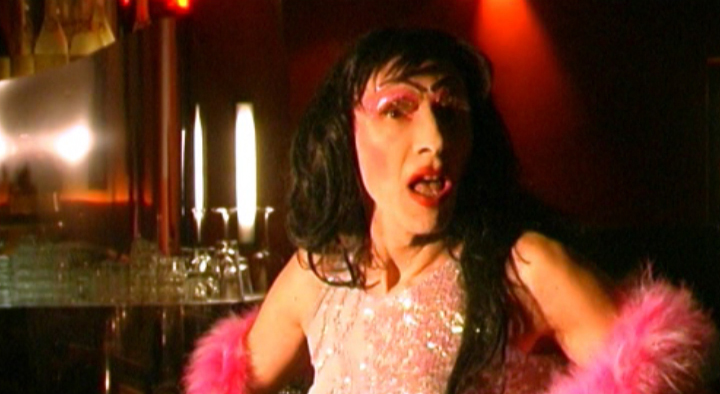
Drama, thriller, by Fabio Del Greco, Italy, 2010.
Luca is poor and works, precariously, as a waiter. He lives a problematic relationship with his girlfriend, and his life is full of doubts. One day Luca meets Chiara, a friend who had studied philosophy with him at university. She has realized her dream of opening a night and is now well-off. Luca leaves everything behind and starts a relationship with Chiara. He manages the nightclub with her and, thanks to the cocaine and call girls sold to politicians, he gets out of his hard economic situation. But Chiara does not manage to obtain the contract for an old furnace, so she blackmails Saverio, a member of the Parliament. Chiara owns a video in which Saverio has sexual intercourse with a transsexual.
LANGUAGE: Italian
SUBTITLES: English, French, Spanish, German, Dutch, Portuguese.
Weimar Germany and the Theater of Comfortable Scandal
You are sitting in a velvet seat at the Theater am Schiffbauerdamm on the night of August 31, 1928, and you are laughing. The music is sharp and insinuating, the costumes grotesque enough to be safe, and the man on stage is a criminal who talks about money the way your banker does. You laugh because the distance feels guaranteed. The footlights are on. This is theater.
What Berlin’s middle class did not fully register that night — could not register, structurally — was that their laughter was the content of the performance. Brecht had not written a play about criminals for bourgeois audiences to enjoy at a remove. He had engineered a mechanism by which the act of enjoyment would indict the audience in real time, without their consent and without their noticing. The applause at the end of that premiere, which was thunderous, was the sound of a trap closing.
The Weimar Republic in 1928 was not the catastrophe it would become, but it was already the catastrophe it had always been structurally. The hyperinflation of 1923 had been stabilized, the Dawes Plan had injected American capital, and a surface prosperity had settled over Germany like a coat of paint over a cracked wall. Unemployment was beginning to rise again. The National Socialist party had received only 2.6 percent of the vote in May of that year, which everyone took as evidence of their irrelevance. The republic’s constitution, drafted in Weimar in 1919, was formally one of the most democratic documents in European history — and it contained, in Article 48, the provision for emergency executive decrees that would eventually be used to dismantle it. The architecture of the catastrophe was already present; only the occupants had not yet arrived.
Into this specific moment Brecht inserted a work constructed from borrowed parts. The source material was John Gay’s 1728 Beggar’s Opera, itself a satire of English high society that had run for sixty-two consecutive performances in London, which was then the record. Kurt Weill’s score dragged that two-hundred-year-old cynicism into the sonic vocabulary of Berlin cabaret and American jazz, genres the German middle class associated simultaneously with modernity, excitement, and a vague racial anxiety they would not have named as such. The combination produced something that felt transgressive and yet somehow familiar, dangerous and yet somehow purchasable. A ticket cost between two and twelve marks. The production was a commercial hit.
This is precisely where the historical trap becomes visible. The scandal of The Threepenny Opera was marketed as its content — thieves, prostitutes, corrupt police, a justice system for sale — when the actual scandal was the audience’s comfort with all of it rendered as entertainment. Georg Lukács had argued in his 1923 History and Class Consciousness that the bourgeoisie’s defining epistemological condition was the inability to perceive totality, to see the whole system rather than its fragments. What Brecht staged in 1928 was a laboratory demonstration of that thesis: a society watching its own contradictions performed as cabaret and responding with enthusiastic ticket sales.
The specific tensions he was weaponizing were not metaphorical. The police in the play operate as a criminal enterprise because the Berlin police under the republic were widely understood to function with profound selectivity, brutally suppressing left-wing demonstrations while treating right-wing violence with notable administrative patience. The figure of the corrupt chief who is also an intimate of the criminal underworld was not a comic exaggeration for a 1928 Berlin audience. It was closer to a portrait. Brecht’s genius was to coat it in enough theatrical varnish that the audience could choose to read it as fantasy, and then to structure the entire evening so that the choice to read it as fantasy was itself the political act he was cataloguing.
What the comfortable classes purchased that night was the sensation of critique without its consequences.

The Ballad as Knife Disguised as Song
You are sitting in the theater and something is happening to you that you cannot immediately name. A character you have begun, despite yourself, to follow — to lean toward, to track with the small animal attention of sympathy — opens his mouth, and what comes out is not the next line of dialogue. It is a song. But not the kind of song that carries the emotion forward, that lifts feeling into melody and returns you to the story enlarged. The music arrives like a slap administered with a velvet glove, dissonant, angular, almost cheerful in its refusal to be beautiful in the way you expected beauty.
Kurt Weill constructed the score for The Threepenny Opera in 1928 with precisely this intention lodged in the architecture. His harmonies do not resolve. They lurch sideways into jazz idioms lifted from American popular music and then dragged through a European cabaret sensibility that had already been corroded by the First World War. The result is music that sounds familiar enough to seduce and strange enough to disturb, a combination that functions not as emotional intensification but as a kind of aesthetic cold water thrown over the audience’s forming feelings. The moment you begin to feel something for Macheath, the song intervenes not to confirm the feeling but to estrange it, to hold it up to the light at an angle where you can see how it was manufactured.
Walter Benjamin, writing in 1931 in “The Author as Producer,” argued that the politically transformative artwork does not simply carry radical content delivered through conventional forms. It must transform the apparatus of production itself, the formal means by which meaning reaches the audience. A work that uses emotional identification as its primary vehicle — that recruits the audience’s feelings as a delivery mechanism for its ideas — leaves the audience passive, moved but not changed, sympathetic but structurally undisturbed. What Benjamin recognized, and what the collaboration between Brecht and Weill achieved with something close to surgical precision, was that defamiliarization is not merely an aesthetic effect. It is a political act performed on the nervous system of the spectator.
The ballad in this context becomes a weapon that hides inside the body of entertainment. When Polly Peachum sings “Pirate Jenny,” the character disappears into something stranger and more frightening than herself — a fantasy of annihilating revenge delivered in a music-hall lilt that makes the content almost unbearable by the measure of its form. The violence of the song’s imagination and the lightness of its melody create a dissonance that cannot be resolved emotionally, only thought through. The audience cannot feel its way past the contradiction. They must think.
This is the trap that conventional theater does not set. Conventional dramatic music — the swelling orchestra, the aria that rises to confirm what the actor’s face has already told you — functions as a kind of emotional permission structure. It tells you when to feel and how much. Weill’s score denies this permission systematically. The famous “Moritat,” the street-ballad that opens the play and catalogs Mack the Knife’s crimes in a tone of almost cheerful reportage, sets the entire mechanism in motion from the first note. The audience laughs. And then, a second later, cannot account for why it laughed, which is precisely the moment the play wants them in.
Brecht called the effect Verfremdungseffekt — the estrangement effect — but the word in German carries a meaning closer to making-foreign, to rendering strange what has been accepted as natural. Music was his sharpest instrument for this operation because music is the art form most deeply implicated in the production of unconscious emotional consent. To weaponize it against that consent, to turn the orchestra pit into a site of critical interruption rather than emotional amplification, was to attack the audience’s passivity at the exact point where they felt most safely surrendered to pleasure.
Macheath Is Not the Villain You Were Promised
You have probably spent your entire life being told that the criminal is the one who takes what isn’t his. That conviction is so deeply embedded it feels less like a belief and more like anatomy — something you would find if you cut yourself open. Brecht counted on that feeling. He built his most famous character on top of it, precisely so he could use it against you.
Macheath runs an organization. He delegates. He maintains records. He enforces loyalty through a structure of rank and reward, and when that structure is violated, he pursues legal remedy — or its criminal equivalent, which functions identically. His men are not a mob; they are a workforce with expectations, hierarchies, and informal contracts. When Polly Peachum marries him against her father’s commercial interests, the conflict that erupts is not romantic at all. It is a dispute between two enterprises over the allocation of a productive asset. Jonathan Jeremiah Peachum, who has industrialized the performance of poverty into a licensing operation, understands this with complete clarity. He is not outraged by Macheath’s violence. He is outraged by Macheath’s independence.
Marx argued in Capital, published in 1867, that what we call legitimate accumulation and what we call primitive theft are not morally distinct categories — they are the same process observed at different historical distances. The enclosure of common land in sixteenth-century England, the seizure of colonial territories, the legal frameworks constructed retroactively to protect what had been taken by force: these were not exceptions to the rule of property. They were its foundation. What separates the respectable businessman from the bandit is not method but timing — the bandit operates before the law has been written to cover him, the businessman after. Brecht translates this structural observation into flesh and costume. Macheath wears a frock coat. He carries gloves. He is particular about his food. The props are not satirical decoration; they are the argument itself made visible from the stage.
The more unsettling mechanism is the one Brecht refuses to explain. He does not editorialise. He does not insert a character who names what is happening. Instead, he constructs Macheath with such recognisable commercial logic that the audience’s discomfort arrives without a guide. A gang that receives wages, observes a chain of command, and punishes defection is simply a firm operating beneath the threshold of state recognition. The violence is real, but violence is not absent from legitimate enterprise — it is merely outsourced to courts, bailiffs, and the slow administrative suffocation of those who cannot pay. What Brecht isolates is not cruelty. It is the discovery that cruelty has always been part of the arrangement, and that its current forms have simply acquired better paperwork.
There is a woman in a rented room somewhere in this city right now, watching her landlord begin eviction proceedings through a solicitor, through notices, through the measured and entirely legal application of economic pressure that will leave her with nowhere to go before winter. Nothing about that process is described as theft. It moves through channels. It has forms. And somewhere, at a different elevation of the same city, a man who has never once thought of himself as Macheath is reviewing a quarterly report and feeling the clean satisfaction of someone who plays by the rules.
Brecht’s deepest provocation is not that he makes a criminal sympathetic. Sympathy is cheap; theatre manufactures it constantly. The provocation is that he makes the criminal recognisable not as an outsider to bourgeois society but as its clearest expression — the version that has not yet completed the paperwork, that has not yet waited long enough for accumulation to crystallise into respectability. The question the play lodges in you, and does not remove, is at what precise moment in that process the thief became the owner, and whether anyone was in the room to notice.
Polly, Jenny, and the Economy of Women’s Loyalty
You have rehearsed the fantasy so many times it no longer feels like a fantasy: the woman who stays is loyal, the woman who leaves is treacherous, and somewhere between those two poles the entire moral architecture of romantic love quietly holds itself together. Brecht dismantles this with the precision of someone who has watched the architecture too long to believe in it anymore. Polly Peachum and Jenny Diver do not exist in The Threepenny Opera as emotional counterweights to Macheath’s brutality. They exist as economists operating inside a market that has never once pretended to offer them equity.
Polly chooses Macheath not despite knowing what he is but because of it. She has grown up inside Peachum Enterprises, a business that commodifies human misery with ledger-book efficiency, and she understands instinctively that attachment to a powerful man is not a romantic impulse but a capital transfer. Her defiance of her parents reads, on the surface, like rebellion. Underneath, it is a portfolio decision. She is not fleeing her father’s world — she is replicating its logic in a different register, trading one form of economic dependency for another that she believes she can manage. Simone de Beauvoir argued in The Second Sex, published in 1949, that the institution of marriage had historically been the only legitimate means by which a woman could secure material existence, transforming devotion itself into a labor performed for survival rather than freely given. Polly does not transcend this structure. She inhabits it with full consciousness, and that consciousness is precisely what makes her dangerous to the men around her — and invisible to any reading of the play that insists on casting her as a lovestruck girl.
Jenny operates from the same economic grammar but from a position lower in the hierarchy, which means the currency available to her is different. Where Polly can trade loyalty upward toward stability, Jenny trades betrayal laterally and downward, collecting whatever small payments the system offers to those who have no accumulated assets of sentiment to leverage. She turns Macheath over to the authorities not because she hates him — Brecht gives us no psychological interiority simple enough to sustain that reading — but because the transaction is rational. The question the play forces onto the audience is not whether Jenny is cruel, but what kind of world produces a woman for whom selling a man to the gallows is simply the best available deal on a given Tuesday.
What makes this unbearable, in the precise sense of something a theater audience will resist processing, is that both women are right. Their calculations are not distortions of love. They are love’s actual structure under conditions of material deprivation and gender enclosure. The romantic narrative requires that we see Jenny’s betrayal as a corruption and Polly’s devotion as its pure opposite. Brecht refuses this. He makes them structurally identical acts performed under different constraints, and in doing so he implicates the audience’s own sentimentality as part of the ideological machinery that keeps both women trapped.
There is a moment in the play where Polly teaches the gang a song, performs it with the kind of theatrical ease that signals she has always known how to make herself legible to men who need to be entertained, and the gesture is so practiced it reads as second nature. It is second nature. That fluency — the ability to perform warmth, loyalty, desirability on command — is not a character trait. It is a vocational skill acquired under duress, the same skill de Beauvoir identified when she wrote that femininity is not a biological condition but a social assignment enforced through the withdrawal of any other viable option. Polly has simply become very good at her assigned role. The tragedy Brecht is pointing at is not that she performs it under false pretenses, but that there are no pretenses involved at all — only a system so total it no longer requires the pretense of choice to sustain itself.
A vision curated by a filmmaker, not an algorithm
In this video I explain our vision
Tiger Brown and the State’s Private Arrangement With Crime

You are standing at the edge of a crowd watching a man in uniform shake hands with a man who cuts throats for a living. The handshake is slow, deliberate, performed in full view, and no one in the crowd finds it remarkable. This is not corruption as deviation from the system — it is the system demonstrating its actual architecture.
Tiger Brown is the Chief of Police of London. Macheath is a gang lord who controls theft, extortion, and murder across the city’s underclass. Their friendship predates the drama, rooted in a shared military past, and Brecht never allows the audience to misread it as mere personal weakness or institutional failure. The friendship is structural. Brown protects Macheath not because he has gone rogue but because the stability of the criminal economy Macheath manages is precisely what makes Brown’s enforcement apparatus legible, purposeful, and politically necessary. Without Macheath, Brown has no visible enemy. Without Brown, Macheath has no operating license. The two men are not in tension. They are in partnership.
Michel Foucault argued in Discipline and Punish, published in 1975, that the modern prison does not fail when it produces recidivist criminals — it succeeds. The carceral institution needs a delinquent class to manage, classify, and render visible. The criminal is not the system’s problem; the criminal is the system’s product and its justification. What Brecht dramatizes on stage fifteen years before Foucault’s thesis was even conceivable as an academic project, Foucault would later demonstrate through the historical record of French penitentiary reform. Both arrived at the same recognition from different directions: the apparatus of law enforcement requires crime the way a church requires sin. The category of the transgressor cannot be abolished without abolishing the institution that defines itself against him.
What makes Brecht’s treatment more unsettling than a simple portrait of corruption is that Brown is never cynical. He does not know he is complicit in anything. He believes, with what appears to be genuine warmth, that Macheath is simply an old friend who occasionally requires discreet handling. This is exactly the cognitive structure Foucault describes when he analyzes how disciplinary power operates not through the consciousness of its agents but through the arrangements they maintain without questioning. Brown is not a hypocrite in the theatrical sense — a man who says one thing and does another. He is something more troubling: a man whose sincerity is itself the mechanism of deception. He protects Macheath while genuinely believing in law, which means the protection is invisible to him as protection. It registers, in his own mind, as loyalty to a friend.
The audience watching this in Berlin in 1928 would have recognized the social texture immediately. The Weimar Republic was saturated with exactly these arrangements — police prefectures in functional negotiation with political paramilitaries, courts selectively prosecuting based on class and party affiliation, a state apparatus that prosecuted petty theft with prison sentences while financiers who had destroyed the savings of millions through speculation walked untouched through respectable lobbies. The resonance was not metaphorical. It was documentary.
And the deeper trap Brecht sets is that Macheath himself believes in Brown. He trusts the friendship. He counts on institutional protection as though it were a personal bond that transcends the forces that manufactured it. When Brown ultimately withdraws that protection under pressure from Peachum’s political leverage, Macheath is genuinely bewildered. He had mistaken an arrangement of mutual utility for something resembling loyalty. The shock is not that the system betrayed him — it is that he never understood he was inside the system at all, performing a function it had always required him to perform, and that the moment he ceased to be useful, the friendship revealed itself as the administrative fiction it had always been.
Epic Theater as Epistemological Violence
You are sitting in the dark, and something onstage has just stopped working the way you expected. An actor has turned to address you directly, not the other way a performer might wink at the audience — a conspiratorial aside, a moment of charm — but with the flat, declarative calm of someone reading a legal document into your face. The song that follows does not express what the character feels. It contradicts it. You reach instinctively for the thread of emotional identification, the one you carry into every theater and every cinema and every novel you have ever absorbed, and it is not there. What you feel in that instant is not confusion. It is exposure.
Roland Barthes published Mythologies in 1957, assembling a set of essays that diagnosed how bourgeois culture launders its own contingency into the appearance of nature. The wrestling match, the face of Garbo, the steak and chips — each one a site where a historically specific set of values had been so thoroughly normalized that questioning them felt like questioning gravity. Barthes called this process myth: not falsehood exactly, but the transformation of history into essence, the political into the natural, the constructed into the inevitable. What Brecht had been doing on stage since the late 1920s was the systematic reversal of exactly this operation, and he was doing it before Barthes had the vocabulary to name it.
The Verfremdungseffekt — the alienation effect, the estrangement device — is usually described in technical terms: the interrupting songs, the visible stagecraft, the actors who comment on their characters rather than inhabiting them. But to describe it technically is already to defuse it, to reclassify an epistemological rupture as a theatrical preference, the way one might say a surgeon prefers a particular incision without noting that the incision is the whole point. What Brecht understood, with a ferocity that his more academic admirers have consistently softened, is that the primary mechanism of ideological reproduction is narrative shelter — the condition of being inside a story so completely that you never notice the story has a politics.
Every realist narrative form, from the nineteenth-century novel to the Hollywood feature, constructs a room with no visible walls. The audience’s job is to forget the architecture and feel the weather. This forgetting is not passive; it is actively cultivated, maintained through continuity editing, psychological coherence, emotional momentum. When you weep at the right moment, laugh at the right moment, feel righteous anger at the designated villain, you have not been entertained. You have been rehearsed. Your nervous system has practiced a set of responses that map onto the social arrangements the story took for granted — the arrangements it never had to argue for because the emotion argued for them instead.
Brecht’s aggression consists in making the walls visible while you are still inside the room. Not after, in reflection, when the safety of aesthetic distance has been reestablished, but during — in the middle of a scene that has begun to generate warmth, precisely at the moment when identification is becoming pleasurable, which is to say precisely at the moment when the ideology is working. The interruption is not decorative. It is a seizure of the mechanism at the instant of its operation. This is why audiences found Brecht uncomfortable in ways they struggled to articulate: not because the plays were difficult, but because something had been taken from them that they hadn’t known they were carrying.
What gets taken is the right to feel one’s responses as personal rather than produced. The theatergoer who weeps at a bourgeois tragedy has no particular reason to examine why that specific story, with that specific distribution of sympathy and suffering, felt true. Brecht’s theater removes the option of not examining it. The audience cannot lose themselves in the work because the work keeps handing them back to themselves — not as individuals having private feelings, but as social subjects embedded in arrangements that required a particular story to make them seem necessary.
The Royal Pardon and the Obscenity of Happy Endings

You are a mid-level functionary in a government office, your hand moving across paper the way it has moved across a thousand other papers, and the name on the document means nothing to you — it is a form, a category, a procedure — and when you press the seal you are not saving a man but completing a sentence, grammatically, the way a period ends a clause that was already going somewhere else entirely. The pardon arrives not as mercy but as syntax.
What Brecht understood, with a precision that most political theorists achieve only in prose, is that clemency is not the opposite of power but its most refined expression. When the Queen’s messenger rides in at the end of the play to deliver Macheath from the gallows — granting him a castle, a pension, a title, the whole grotesque upholstery of legitimacy — the audience is not witnessing a reversal. They are witnessing a confirmation. The system does not destroy its most successful operators; it absorbs them, titles them, puts them on a payroll, and calls it civilization. The pardon is not an interruption of the logic. It is the logic, stated plainly for the first time.
The critical tradition has often treated this ending as a formal device, a Brechtian wink at theatrical convention, a way of rupturing audience expectation to produce critical distance. But this reading is too comfortable. It allows the spectator to feel sophisticated, to congratulate themselves on understanding the irony, and in doing so to miss the actual wound. The ending is not a commentary on happy endings. It is a documentary record of how power actually behaves when cornered. In 1928, the year the play premiered at the Theater am Schiffbauerdamm in Berlin, the Weimar Republic was already saturated with exactly this kind of institutional self-dealing — amnesties for right-wing paramilitaries, quiet arrangements between industrialists and politicians, the steady rehabilitation of men who had done catastrophic things. The messenger on horseback was not a metaphor. He was a newspaper story.
There is a sociological concept that captures part of what Brecht was staging, though it requires pushing beyond its usual application. Pierre Bourdieu, in his analysis of the field of power, described how dominant groups reproduce their dominance not through brute force but through the continuous conversion of capital — economic into cultural, cultural into symbolic, symbolic back into economic — each conversion laundering the previous one until the original violence becomes invisible. Macheath’s pardon is precisely this laundering in theatrical form. The gallows rope becomes a title deed. The crime becomes a credential. What was predatory becomes patrician, and the transformation happens in the time it takes a messenger to cross a stage.
What the play refuses to let you do is locate the obscenity in any single character. Macheath is not the villain. Tiger Brown, the police chief who protects him out of old friendship and mutual convenience, is not the villain. Peachum, who organizes the poor into a corporation of performed suffering, is not the villain. The villain, if the word retains any meaning here, is the structural arrangement that makes all of them rational actors. Brecht spent his career arguing against what he called Aristotelian identification — the theatrical convention of finding one figure whose fate absorbs the moral weight of the whole. He wanted the audience looking at the architecture, not the tenants. The royal pardon is where this argument reaches its hardest edge, because it shows that the architecture doesn’t just permit the crime — it requires it, regularizes it, and ultimately rewards it, because the crime and the crown were always the same enterprise, merely operating from different addresses.
The real subject of the play was never what a man does in the dark with a knife. It was what institutions do in daylight with a pen, and the terrifying stability of a world that has learned to call that distinction justice.
🎭 Theater, Power, and the Margins of Society
Brecht’s The Threepenny Opera is a masterwork of political theater, exposing the cynicism of bourgeois morality through song, satire, and alienation effects. Its themes — crime as capitalism, power as performance, and survival on the margins — resonate across literature, philosophy, and cultural critique. The following articles explore the intellectual currents that run alongside and beneath Brecht’s corrosive vision.
Antonin Artaud: Life and Thought
Antonin Artaud developed his Theater of Cruelty as a radical assault on the comfortable distance between stage and audience, demanding visceral, transformative experience rather than passive observation. Like Brecht, Artaud rejected naturalistic illusion, though their methods diverged sharply: where Brecht sought critical detachment, Artaud sought an overwhelming sensory immersion. Together, the two figures define the poles of twentieth-century experimental theater’s revolt against bourgeois convention.
GO TO THE SELECTION: Antonin Artaud: Life and Thought
The Pact with the Devil in Literature: History and Symbolism
The pact with the devil is one of literature’s most enduring symbolic structures, staging the Faustian bargain between individual desire and catastrophic moral compromise. In The Threepenny Opera, every character operates within a corrupt social contract that resembles nothing so much as a diabolical pact — survival demands complicity with the very system one might wish to condemn. Tracing this motif from Marlowe through Goethe to Mann reveals the deep literary tradition Brecht both inherits and subverts.
GO TO THE SELECTION: The Pact with the Devil in Literature: History and Symbolism
Kafka and Bureaucracy: The Trial and The Castle
Kafka’s depictions of bureaucracy in The Trial and The Castle portray institutions of power as opaque, labyrinthine, and utterly indifferent to the individuals they grind down — a vision that shares significant territory with Brecht’s satirical theater. Both writers expose the absurdity of systems that present themselves as legitimate while functioning through coercion and arbitrary authority. Placing Kafka and Brecht in dialogue reveals a shared Central European sensibility attuned to the violence hidden within everyday social order.
GO TO THE SELECTION: Kafka and Bureaucracy: The Trial and The Castle
Discover Independent Cinema on Indiecinema
If Brecht’s theater taught us to look at the world with critical, undeceived eyes, independent cinema carries that same restless spirit into moving images. On Indiecinema you will find a curated streaming catalog of films that challenge, provoke, and illuminate — works that refuse easy comfort just as Brecht refused the well-made play. Explore the full catalog and let independent cinema expand the conversation that great literature begins.
👉 EXPLORE THE CATALOG: Watch Indie Films in Streaming
A vision curated by a filmmaker, not an algorithm
In this video I explain our vision

