
The Monster at the Threshold
You hear it before you see it — a sound that does not belong to your house, a displacement of air in a room that was locked. Something has entered that was not invited, and the horror is not the thing itself but the realization that your walls, your locks, your careful architecture of safety meant nothing. It came anyway. And now it stands at the threshold between what you own and what owns you, between the familiar and whatever vast darkness pressed its face against the glass while you were sleeping.

Bram Stoker published Dracula in May 1897, and the London that received it was not, by any measure, a city at ease with itself. The British Empire controlled roughly a quarter of the earth’s land surface, a fact that generated enormous pride and an almost entirely suppressed terror — because any mind honest enough to follow the logic knew that what reaches out that far eventually gets something on its hands, and that things travel in both directions along trade routes. The same ships that carried manufactured goods to Calcutta and Lagos carried back not only raw materials but contact, contamination, the epistemological shock of encountering peoples and systems of meaning that did not confirm the Victorian self-image. Empire was, among other things, a machine for generating the very foreignness it claimed to be civilizing.
Into this atmosphere Stoker released a creature who arrives in England on a ship, having leased property in London, intending to blend in, to feed quietly on the population from within. The novel’s structure — assembled from journal entries, newspaper clippings, telegrams, and letters — mimics the bureaucratic texture of Victorian administrative life, the obsessive documentation of a society that believed recording things was the same as controlling them. Jonathan Harker’s legal expertise, Van Helsing’s medical authority, Mina’s stenography: the novel populates itself with professionals, people whose entire identity is organized around competence, and then demonstrates methodically that their competence is useless against something that does not recognize the categories they’ve built their world from.
Sigmund Freud would not publish The Interpretation of Dreams until 1899, but the psychic architecture he would describe was already visibly under pressure in the cultural productions of the decade before. The concept he would eventually call the uncanny — das Unheimliche, the unhomely, the familiar thing that has become strange — names precisely the mechanism Stoker deploys. Dracula is not alien enough to be dismissed. He speaks English, wears a suit, navigates social convention with unsettling ease. His horror lies in his proximity, his almost-correctness, the way he mirrors the Victorian gentleman while hollowing the concept from the inside.
What Victorian England had actually created, through decades of industrialization, was a class of people profoundly alienated from their own bodies, their own desires, their own deaths. The sanitation reforms of the 1840s and 1850s, the gradual medicalization of birth and dying, the retreat of mortality from the domestic sphere into the institutional — these were not simply humanitarian advances. They were an enormous collective project of denial, a decision to treat the animal facts of human existence as engineering problems to be solved rather than experiences to be inhabited. A society that has successfully hidden its own blood tends to become, over time, extraordinarily sensitive to the idea of something that drinks it.
The New Woman, too, was loose in those years — the phrase itself already circulating, already causing the specific male anxiety that comes not from weakness but from the sudden awareness that a structure you believed was natural was actually a choice someone else had been making on your behalf. Lucy Westenra’s transformation in the novel is inseparable from this panic: she becomes sexually aggressive, nocturnal, predatory, liberated from the domestic angel role by a monster who, in doing so, only makes visible what the role had always been suppressing.
The Ecstasy of Isabel Mann

Horror, thriller, by Jason Figgis, United States, 2016.
Set in Ireland, the film tells the story of Isabel Mann, an introverted and lonely teenager who is drawn into a dark and seductive world of blood, violence, and vampirism. As the story unfolds, Isabel undergoes a disturbing transformation—from a vulnerable young girl to a ruthless creature—guided by a group of vampires who pull her into a spiral of murder and ritual. At the same time, a team of detectives attempts to shed light on a series of brutal killings that seem to be connected. However, their investigation leads them toward a truth far more unsettling than they could have anticipated.
The film stands out for its cold, disturbing atmosphere and a slow, reflective narrative that favors psychological depth over action. Vampirism here is not just a genre element, but takes on a symbolic meaning tied to adolescent alienation, the search for identity, and the longing to belong. *The Ecstasy of Isabel Mann* embraces an auteur style and carries the emotional intensity of Ellen Mullen’s lead performance. It’s a different kind of horror film—intimate and melancholic—capable of blending teenage tragedy with the vampire myth in a modern, introspective way.
LANGUAGE: English
SUBTITLES: Spanish, French, German, Portuguese
Empire's Uncanny Return
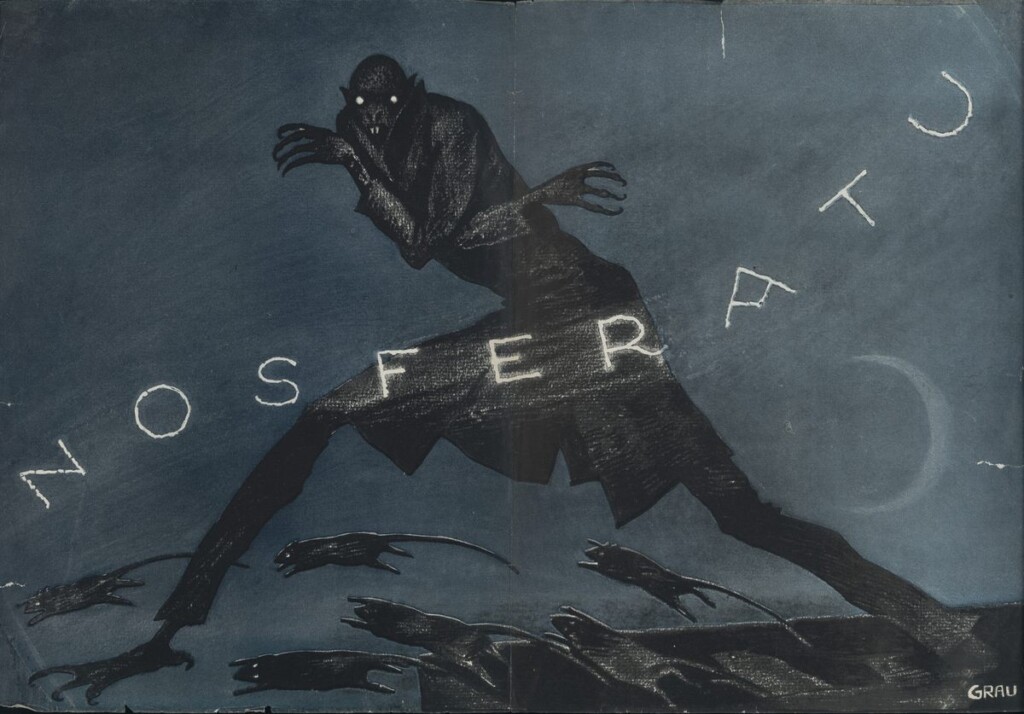
You wake up one morning and find that the border has moved. Not on any map — the maps still show the same confident lines, the same pink wash of territories claimed and administered — but something has crossed it anyway, moving in the opposite direction, and it has taken up residence in the house next door.
The Victorian imagination could not name this feeling cleanly, which is precisely why it needed literature to do it for it. Edward Said‘s Orientalism, published in 1978, documented something that had been structurally true for over a century: that the West did not merely conquer distant territories, it constructed them discursively, turned them into conceptual opposites of itself — irrational where Europe was rational, sensual where Europe was disciplined, ancient and stagnant where Europe was progressive and historical. This production of the Orient as a category of otherness was never innocent. It was the epistemological instrument of extraction, the mental architecture that made exploitation feel like civilizing. What Said’s framework exposes is that this binary was inherently unstable, because it was always haunted by the thing it needed to suppress: the knowledge that the boundary was artificial, that what had been done out there could theoretically be done in here.
Stoker encodes this instability geographically with extraordinary precision. Transylvania is not simply foreign — it is coded as a space where time itself runs differently, where peasants cross themselves at crossroads, where the Carpathian Mountains function as a wall between modernity and something older and more dangerous than modernity can metabolize. Jonathan Harker’s journal entries as he travels eastward in 1897 read like a descent through civilizational strata, each stage of the journey further from the gaslit rationalism of London. The coach passengers who press crucifixes into his hand are not superstitious fools in Stoker’s rendering — they are people who know something that Harker’s empiricist education has not equipped him to receive. The horror that structures the novel’s first section is not the horror of encountering the primitive. It is the horror of discovering that the primitive has a kind of knowledge the civilized have actively amputated from themselves.
When Dracula arrives in Whitby aboard the Demeter, every member of the crew dead, the count himself shifting between wolf and mist and nothing at all, the directional logic of empire inverts completely. The flow of resources, bodies, and vitality that the nineteenth century had organized from periphery to center — rubber from the Congo, opium profits from China, indentured labor from the subcontinent — suddenly reverses. The colonized margin sends something back, and what it sends cannot be quarantined, cannot be administered, cannot be made legible by the institutional frameworks that managed the outward project of extraction. The Count does not come as a refugee or a diplomat or a curiosity. He comes as a landlord. He has already purchased multiple properties in England before he sets foot on its soil, a detail Stoker plants with the quiet precision of someone who understood that capital moves before bodies do.
This is where the repressed guilt that Victorian expansion generated finds its most condensed literary form. The empire had required its citizens to believe that the violence conducted in their name was rational, progressive, and ultimately beneficial — a burden willingly carried by those capable of carrying it. What the vampire literalizes is the return of the portion of that transaction that could never be acknowledged: that something was taken, that something was owed, and that debt does not expire simply because the creditor has been stripped of the language to collect it.

The Regulated Body and Its Hysteria
You watch her sleep and something in you relaxes. She is horizontal, still, contained by sheets and darkness and the weight of propriety she carries even unconscious. This is what Lucy Westenra is, before the count finds her — a woman performing her own domestication so fluently that no one, including herself, has noticed it is a performance.
Charcot’s theatre at the Salpêtrière was running at full capacity in exactly these years. Between 1878 and 1893, Jean-Martin Charcot staged what he called scientific demonstrations before packed amphitheatres in Paris, inducing in his female patients the convulsive, arching, openly erotic poses he had classified under the name of hysteria. He photographed them. He published the photographs. The medical establishment watched women writhe and called it pathology, but the audiences were not primarily scientists — they were men who needed the spectacle of female uncontrollability to remain inside a diagnostic frame, because a frame meant it could be managed, named, and eventually ended. Sigmund Freud attended these lectures in 1885 and brought something back to Vienna that was not quite what Charcot intended: the suspicion that the body in revolt was telling the truth about something the culture refused to hear.
Stoker was not treating patients, but he was reading the same cultural atmosphere. Lucy’s transformation follows the clinical logic of hysteric possession almost precisely — the sleepwalking, the pallor, the sudden appetite, the neck that becomes a site of transgressive inscription. What disturbs her circle of devoted men is not merely that she is dying but that in dying she has begun to want. Victorian medicine had no more threatening category than the woman who desires without waiting to be desired, who moves through the night of her own volition, who turns her throat upward not in surrender but in invitation. The New Woman — a phrase already circulating in the early 1890s through the essays of Sarah Grand and the anxious rebuttals of anti-feminist journalists — was understood to be precisely this creature: educated, mobile, sexually self-aware, unchaperoned by either a husband or a diagnosis.
The staking of Lucy is one of the most violently overdetermined acts in nineteenth-century fiction. It requires four men. It requires the sanction of a Dutch professor who carries the authority of medical science, theological tradition, and patriarchal age simultaneously. It requires that Arthur Holmwood strike the blow himself — the fiancé, the man whose claim on her body was legal and sentimental but had never been physically consummated. The text frames this as liberation, as mercy, as the restoration of her soul. What it actually describes is a surgical re-inscription of ownership: the man who should have penetrated her in sanctioned matrimonial darkness does so finally, and catastrophically, through her sternum, and the novel calls this love. Her final expression is described as one of peace, which is the literature of containment’s oldest and most dishonest word.
Mina Harker survives because she disciplines herself with a ferocity that borders on self-annihilation. She types transcripts, organizes evidence, subordinates her intelligence to the project of helping men act. She is, in Jonathan, Quincey Morris, and Van Helsing’s collective imagination, the brain they use and the purity they protect. When she is briefly contaminated — forced to drink from the count’s chest in a scene whose psychosexual grammar is transparent even without Freud’s vocabulary — the response of the male circle is immediate: she is placed under supervision, her movements tracked, her inner states monitored and recorded. She has become a patient. The fact that she is also the most analytically capable person in the room does not create a contradiction for any of the men present, because it never does, in rooms like that one, in centuries like that one.
Nosferatu
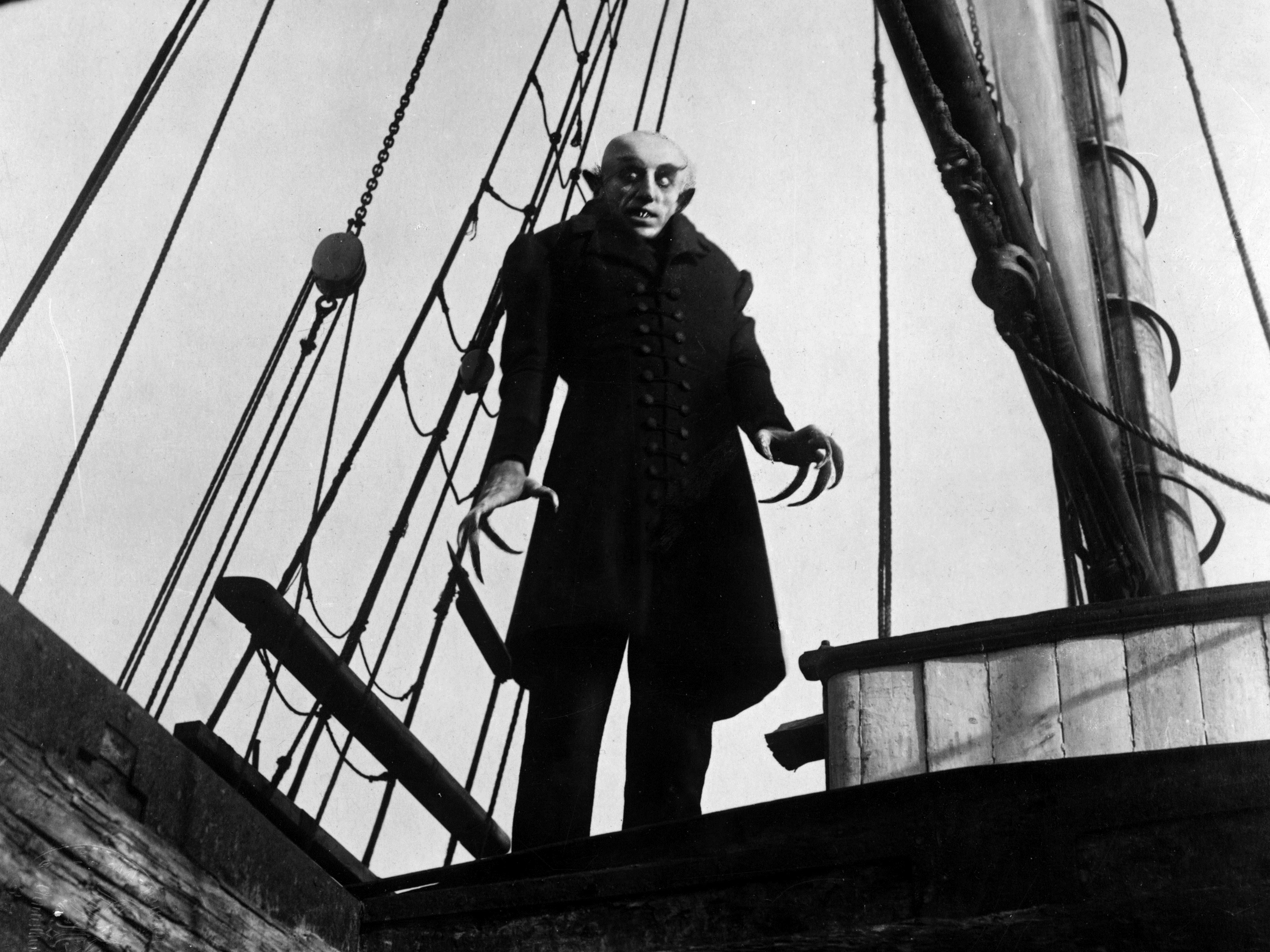
When a young real estate agent, Thomas Hutter, goes to the castle to close a deal, Orlok is attracted by his blood and decides to follow him to his hometown. The arrival of the count causes a series of mysterious deaths and spreads panic among the inhabitants.
Murnau, through evocative images and disturbing atmospheres, creates a work that goes far beyond the simple adaptation of Stoker's novel. The film explores universal themes such as the fear of death, isolation and the loss of humanity. The production of Nosferatu was characterized by some legal difficulties due to the copyright of Bram Stoker's novel. Despite this, Murnau and his crew managed to make a film of great visual impact. The choice of Max Schreck to play Count Orlok was ingenious. His cadaverous appearance and his unnatural movements have made the character of Orlok one of the iconic monsters in the history of cinema. Over the years, Nosferatu has become a cult film, influencing generations of filmmakers and becoming a reference point for the horror genre. The image of Count Orlok, with his elongated nails and sunken eyes, has become an icon of horror cinema.
Blood, Capital, and the Anxiety of Transmission

You inherit nothing and yet something is always feeding on you. The sensation is familiar — a slow drain you cannot account for, a fatigue that arrives without effort, a sense that somewhere, in a system too large to see, your vitality is being converted into someone else’s permanence. Bram Stoker finished Dracula in 1897, the same decade that saw the Baring Brothers banking crisis of 1890 destabilize the London financial markets, that watched the City of London transform from a place of identifiable merchant wealth into an abstract architecture of bonds, futures, and colonial extraction. The timing is not coincidental. It is structural.
The Count arrives in England carrying boxes of Transylvanian earth, but also carrying something the novel’s most anxious characters cannot quite name: an ancient claim to accumulation. Jonathan Harker, the solicitor’s clerk sent to finalize a real estate transaction, is the perfect witness precisely because his job is to trace the legal movement of property. He arrives at Castle Dracula as a professional and leaves as a symptom. What he cannot document, cannot file, cannot reduce to contract language, is that the Count’s wealth is centuries old and has compounded without labor, without production, without any of the Protestant justifications that Victorian capitalism told itself it required. Karl Marx, writing Capital in 1867, described the vampire as a direct metaphor for the behavior of capital itself — “capital is dead labour which, vampire-like, only lives by sucking living labour.” Stoker likely never read those pages, but he was breathing the same cultural atmosphere that made the metaphor feel inevitable to both of them.
What makes the Count genuinely monstrous to the bourgeois professionals who hunt him — Van Helsing, Seward, Harker, Mina — is not his violence. Violence they understand. What destabilizes them is his liquidity. He can convert himself. He moves between forms, crosses water, purchases multiple properties simultaneously under different arrangements, disperses his power across a network of boxes no single agent can locate or control. By 1897, this was precisely how capital was beginning to behave. The joint-stock company, given legal personhood by the Companies Act of 1862, had created entities that accumulated, acted, and could not be killed because they had never been fully alive in any locatable body. The Count is not a medieval throwback. He is a harbinger.
The anxiety of transmission running through the novel’s bloodline logic is inseparable from anxieties about financial contagion. When Lucy Westenra is turned, when Mina’s forehead is burned by the sacred wafer, the horror is partly epidemiological — but it maps directly onto the period’s terror of economic infection. The panic literature of the 1890s financial press used biological language freely: markets were described as feverish, capital was said to hemorrhage, investors spoke of being drained. The crossover was not metaphorical decoration. It reflected a genuine cognitive crisis about how value moved, who it fed, and whether the ordinary mechanisms of law and morality could contain it.
Jonathan Harker’s legal training is rendered useless inside the castle not because the Count operates outside the law but because he operates within a version of it that predates and exceeds the Victorian framework. He holds title. He has documents. He has solicitors. The horror is that every instrument Harker trusts to stabilize property and identity is perfectly functional in the Count’s hands — and produces outcomes that devour the world those instruments were built to protect. The vampire does not break the system. He is what the system looks like when its founding violence is given a face and allowed to walk through the front door of a Mayfair townhouse in broad financial daylight, holding the deed.
The Archive Against the Abyss
You sit down one evening and realize you have been keeping notes on something you cannot name — a sensation, a pattern in someone’s behavior, a thread you keep losing and finding again. The act of writing it down feels less like recording and more like warding.
Bram Stoker’s novel, published in 1897, is structured almost entirely from documents that should not cohere: a solicitor’s diary kept in shorthand, a woman’s journal written in the margins of her days, wax cylinder recordings transcribed onto paper, telegrams exchanged across national borders, newspaper clippings about escaped wolves and strange deaths in harbor towns. No single narrator holds the story. The text assembles itself from fragments, and this is not a stylistic accident. It is a survival strategy made visible on the page.
What Van Helsing’s circle understands — and what Dracula, for all his centuries, does not — is that the chaos of lived experience becomes conquerable only once it has been converted into sequence. Friedrich Nietzsche, writing in 1887 in “On the Genealogy of Morality,” identified the human animal as the creature that makes promises: the being that imposes temporal order on itself, that trains memory against the overwhelming flux of the present. The capacity to say “I will” across time requires first the capacity to say “I remember,” and that capacity is not natural. It is manufactured, enforced, archived. What Stoker’s characters do with their diaries and their phonograph cylinders is precisely this manufacture of a self capable of persisting under pressure — a self that can be consulted, corrected, and synchronized with other selves.
The epistemological panic underneath the novel is Victorian in its particular pitch but modern in its structure. By the 1890s, the technologies of record-keeping had multiplied faster than any consensus about what constituted reliable knowledge. The phonograph was patented in 1877. The typewriter entered commercial production in 1874. Shorthand systems were being standardized. The archive had become both a tool of certainty and a source of new anxiety: if everything could be recorded, then the failure to record something correctly carried catastrophic weight. Mina Harker types her husband’s journal from shorthand herself, collating and cross-referencing with a discipline that reads less like domestic competence and more like epistemological desperation. She is building a case against a force that predates every taxonomy the nineteenth century had constructed.
Dracula himself exists in defiance of documentation. He casts no reflection, leaves no photograph, appears in no reliable account that survives scrutiny. His power is partly the power of the unarchived — the thing that slips between categories, that precedes the naming systems brought to bear on it. He is older than the nation-state, older than property law, older than the medical classifications that Van Helsing deploys with such anxious confidence. Facing him with journals is not naivety. It is the only epistemological weapon available to people whose entire civilization is built on the assumption that what can be written can be controlled.
But the records keep failing in small ways. Dates slip. Testimonies contradict. The phonograph cylinder captures Van Helsing’s voice but not the silence before he spoke, the hesitation, the thing he chose not to say. The archive that the novel presents as its saving logic is also, quietly, a record of everything that could not be saved by logic — every moment where the pen stopped because the hand was shaking, every gap in the timeline that the characters paper over with the shared agreement that the narrative must hold together, because the alternative is to admit that the creature they are hunting is not the only abyss they are circling, and that some of it lives in the distance between what was experienced and what was written down.
A vision curated by a filmmaker, not an algorithm
In this video I explain our vision
🦇 Gothic Shadows: Terror, Society and the Victorian Dark
Bram Stoker’s Dracula is far more than a horror novel — it is a complex mirror reflecting the anxieties, repressions and social contradictions of Victorian England. The articles gathered here explore the cultural, aesthetic and literary territories that illuminate Stoker’s world, from the Gothic imagination to the decadent aesthetics of an era obsessed with death and the unknown.
Sheridan Le Fanu: Irish Gothic and Domestic Horror
Sheridan Le Fanu, Stoker’s Irish predecessor, crafted a domestic Gothic that transformed the familiar home into a space of dread and secret transgression. His influence on Dracula is unmistakable, particularly in the way horror seeps through respectable Victorian interiors. Understanding Le Fanu’s world is essential to grasping the Irish Gothic roots that fed Stoker’s imagination.
GO TO THE SELECTION: Sheridan Le Fanu: Irish Gothic and Domestic Horror
The Aesthetics of Decadentism: When Beauty Became Illness
The aesthetics of Decadentism shaped the cultural climate in which Dracula was conceived and received, turning beauty into something dangerous, corrupted and irresistibly seductive. Stoker’s vampire embodies precisely this Decadent obsession with the allure of death and the transgression of moral boundaries. This article maps the artistic movement that gave Victorian horror its most elegant and disturbing face.
GO TO THE SELECTION: The Aesthetics of Decadentism: When Beauty Became Illness
Edgar Allan Poe and the Cursed House: Architecture of Terror
Edgar Allan Poe‘s vision of the cursed house as a living organism of psychological terror anticipates Stoker’s Transylvanian castle and the Gothic architecture of doom. The crumbling mansion becomes in both authors an externalisation of inner decay, ancestral guilt and the collapse of rational order. Exploring Poe’s architectural terror reveals a founding grammar of Gothic literature that Dracula inherits and transforms.
GO TO THE SELECTION: Edgar Allan Poe and the Cursed House: Architecture of Terror
Discover the Cinema of Shadows on Indiecinema
If these dark corridors of Gothic literature and Victorian terror have stirred your imagination, Indiecinema is the streaming platform where independent cinema explores the same hidden depths. From atmospheric horror to films that question identity, power and the fears society refuses to name, Indiecinema offers a carefully curated journey into the most thought-provoking independent films. Step inside — the dark is waiting.
👉 EXPLORE THE CATALOG: Watch Indie Films in Streaming
A vision curated by a filmmaker, not an algorithm
In this video I explain our vision

