
The House That Breathes
You stop at the iron gate and something stops with you. Not a sound, not a movement — something structural, something in the way the facade angles against the sky as though it has been waiting at precisely that angle for longer than waiting should be possible. The windows catch no light. They return your gaze. You have not yet opened the gate and already the building knows you are there, and this is not a feeling you can dismiss as imagination because imagination implies you invented it, and you did not invent the way the stonework seems to lean almost imperceptibly forward, the way the dead sedge around the tarn lies too flat, the way the whole composition holds together with the specific tension of a body that has decided not to breathe until you move.

Edgar Allan Poe published “The Fall of the House of Usher” in Burton’s Gentleman’s Magazine in September 1839, and what he gave the world was not a Gothic horror story in the tradition it appeared to belong to. It was a treatise on architectural sentience disguised as a narrative about madness and hereditary doom. The house in that story is not a setting. It is not atmosphere. It is not even a symbol, though generations of literary critics have been relieved to reduce it to one. It is an organism that happens to be made of stone and mortar instead of tissue and bone, and Poe establishes this with a precision that is almost clinical before it becomes terrifying.
The crack is the key. Running from the roof to the foundation in a single unbroken line, it is described by the narrator as a barely perceptible fissure, yet its path is exact — roof to base, the full vertical length of the structure — and Poe places it there with the same logic a physician uses when tracing a fracture along a skeleton. This is not decorative ruin. This is a nervous system rendered in stone. The crack does not merely suggest age or neglect; it carries information between the upper registers of the house and its buried foundations the way a spine carries sensation between the brain and the earth. When the house finally collapses at the story’s end, it does not crumble randomly. It splits along that precise line, and the split is a death, not a demolition. The building does not fall apart. It ceases.
What Poe understood, and what the Gothic tradition he inherited had only gestured at, was that architecture is never inert. The German Romantic philosopher Friedrich Schelling wrote in his 1802 Philosophy of Art that architecture is frozen music, which is lovely and means almost nothing when you are standing in the dark outside something that is looking at you. Poe’s contribution was more visceral and more honest: buildings accumulate the psychic residue of the lives lived inside them until the accumulation becomes structural, until the walls are not containing history so much as they are made of it, the way bone is made of calcium deposited slowly over years of pressure. The House of Usher has absorbed Roderick and Madeline and every Usher before them the way limestone absorbs water — slowly, completely, irreversibly — until the distinction between the family and the house is not metaphorical but material.
This is why the narrator cannot look at the house directly without feeling the sensation of insufferable gloom that he immediately attempts to rationalize away. The rationalization is the trap Poe sets. The narrator is an educated man, a reasonable man, a man who trusts his analytical faculties, and so he searches for a natural explanation for his dread, arranging and rearranging the features of the scene in his mind the way you might rearrange furniture in a room that makes you uneasy without knowing why. The unease does not resolve. The house will not be rearranged.
Spider Baby
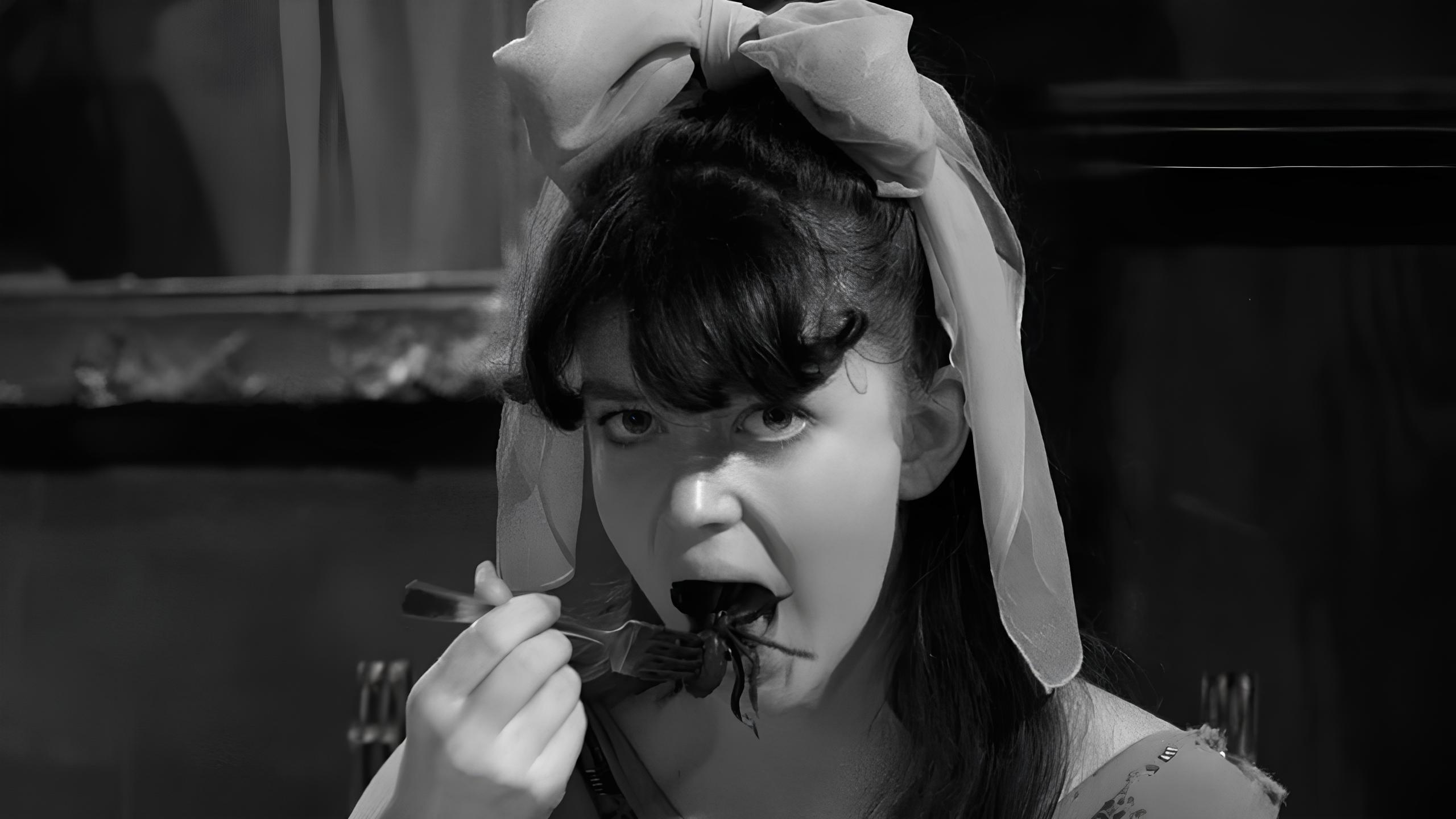
Horror, comedy, by Jack Hill, United States, 1967.
Spider Baby is a grotesque cult horror film that tells the story of the Merrye family, affected by a genetic disease that causes mental regression and feral behavior as they grow older. In an isolated house live Baby, her sisters, and the affectionate caretaker Bruno (Lon Chaney Jr.), who tries to contain their madness when unsuspecting guests arrive. The film mixes a gothic atmosphere, dark humor, and surreal tones, creating a disturbing yet almost fairy-tale world, a bizarre blend between classic horror and morbid comedy. Chaney delivers a surprisingly touching performance, and the direction manages to turn a tiny budget into a unique experience.
Spider Baby is an important cornerstone of American independent cinema: ironic, macabre, melancholic, and unconventional. Spider Baby is an experience that does not rely solely on fear, but plays with the theme of the “monstrous family” to talk about isolation, diversity, and decay, becoming over time a beloved cult title for those who seek a different kind of horror — deformed, grotesque, and unsettling at the same time.
LANGUAGE: English
SUBTITLES: Spanish, French, German, Portuguese
Walls as Psychological Membrane
You have stood in a room that felt wrong before you could say why. Not dangerous, not ugly — wrong. The proportions slightly off, the ceiling pressing closer than it should, the walls holding a particular quality of silence that silence in other rooms does not hold. You adjusted your breathing without noticing. You found reasons to leave.
Gaston Bachelard spent years trying to name that experience philosophically, and in 1958 he published the result: “The Poetics of Space,” a sustained argument that inhabited spaces are not neutral containers but extensions of the inner life. The house, for Bachelard, is where the psyche externalizes itself, projecting its corners and depths outward into stone and timber, turning architecture into a diagram of the self. The attic holds our rational ambitions, the cellar our fears, the nest our earliest sense of shelter. It is a seductive framework, and it has been applied to Poe so many times that the application has become almost automatic — the decaying mansion of the Ushers read as a projection of Roderick’s mental dissolution, the physical crack in the facade mapping onto the fracture inside the man.
The problem is that this reading flatters the reader more than it illuminates the text. It turns the house into a symbol and symbols are, by nature, passive. They mean something assigned to them from outside. Poe’s architecture does not work this way. The house in “The Fall of the House of Usher,” published in 1839, is not a mirror held up to Roderick’s deteriorating mind. It is prior to him. The narrator arrives and feels the wrongness before he has any knowledge of Roderick’s condition, before a single line of dialogue has established the psychological situation. The building acts on him first. The dread precedes the story.
This is a crucial distinction because it reverses the causal arrow entirely. Bachelard’s model is psyche generating space. Poe’s model is space generating psyche. The house does not reflect madness already present in the inhabitant; it produces the conditions under which madness becomes the only coherent response. Roderick Usher does not live in a house that resembles his mind. He lives in a structure that has been engineering his collapse, and possibly the collapse of his entire lineage, through mechanisms that Poe describes with the precision of someone who understood, well ahead of his time, that environment is not backdrop but agent.
The environmental psychology that would later attempt to quantify such effects — research emerging seriously in the 1970s and 1980s demonstrating that spatial configuration, acoustic properties, and light quality measurably alter mood, cognition, and even aggression — was not available to Poe. Yet his fiction anticipated the finding. The narrator of “Usher” undergoes a perceptible psychological shift that he cannot attribute to any event, only to sustained exposure. He tries rationality as a defense — he catalogues the building’s features, attempts an almost clinical description of its appearance — and the rationality dissolves under the pressure of the space itself. Whatever the house emits, it is stronger than the tools a reasonable man brings to resist it.
What Poe understood, and what the metaphorical reading obscures, is that architecture has always been a technology of power over bodies and minds. This was not mysticism on his part. The nineteenth century was actively redesigning space for purposes of psychological control — Jeremy Bentham‘s Panopticon design of 1791 had already formalized the idea that the correct arrangement of walls and sight lines could alter behavior without touching the person inside. Poe simply took the logic further and darker, stripping out the reformist justification and asking what a building might do if its purpose were not to correct behavior but to consume the person entirely.

The Gothic Inheritance Poe Refused to Inherit
You have read the genre before you read Poe, even if you never opened a single novel from the 1760s. The crumbling castle, the hidden passage, the ancestral portrait whose eyes seem to follow you — these images arrived in your imagination already furnished, pre-loaded, as though they belonged to some collective inheritance you never consciously claimed. That sensation of familiarity is not accidental. It is the residue of a moral architecture so thoroughly internalized that it no longer announces itself as morality at all.
Horace Walpole built that architecture with extraordinary precision when he published The Castle of Otranto in 1764. The novel is, at its structural core, a machine for punishing aristocratic transgression. Manfred’s castle does not simply decay — it convulses, bleeds, collapses under the weight of a usurped title and a murdered bloodline. Every supernatural intrusion — the gigantic helmet, the portrait that steps from its frame, the walls that groan — arrives as juridical consequence. The building is a ledger. It remembers every sin committed within its walls, and it collects. Ann Radcliffe refined this mechanism across five novels, most devastatingly in The Mysteries of Udolpho in 1794, where the architecture of fear is ultimately explained away, rationalized, returned to the natural order — because the Gothic, in its English incarnation, required resolution. Evil had to be named, located in a specific moral failure, and expelled. The house could then, in principle, be inherited safely by someone who had not sinned.
What this tradition demanded, underneath all its atmospheric machinery, was accountability. The stones knew what had happened inside them. They were witnesses. And that witness function transformed every ruined tower, every sealed room, every echoing corridor into an instrument of posthumous justice — which means, if you follow the logic to its end, that the tradition was fundamentally optimistic. The universe, however slowly and grotesquely, was settling its accounts.
Poe read all of this. He absorbed Radcliffe deeply enough to understand precisely where her nerve failed her. And then he built something that the English tradition was constitutionally incapable of imagining: a house that does not remember, does not judge, does not punish. The House of Usher does not fall because the Ushers sinned. It falls because it was always going to fall — because the crack running down its facade from turret to foundation was already there when the narrator arrives, already structural, already irreversible. There is no crime being punished. There is no moral debt being called in. The building is indifferent to the humans inside it with the complete, terrifying indifference of matter.
This is the precise point where Poe severed the inherited scaffolding, and the severance was not stylistic — it was philosophical. The English Gothic required a world in which architecture participated in human meaning, in which stone retained the moral temperature of its inhabitants. Poe’s architecture does not participate in anything. It simply exerts pressure. The dissolution of Roderick Usher’s mind and the dissolution of the building proceed in parallel not because one causes the other but because both are expressions of the same entropic process operating simultaneously at different scales — the scale of a nervous system and the scale of a foundation. No guilt is necessary. No transgression is required. Decay needs no justification.
The reader raised on Walpole and Radcliffe arrives at Usher expecting a crime somewhere in the walls, expecting the building to eventually confess its secret and release its occupants into the corrected moral order. Poe denies them that release with something close to surgical cruelty. The house offers no confession because there is nothing to confess. The tarn swallows it whole and the surface closes over and the universe registers absolutely nothing — no relief, no restoration, no settling of any account whatsoever.
Enclosure as Epistemological Trap
You have planned the perfect crime. You have measured the angles, memorized the breathing patterns of the man sleeping in the next room, rehearsed each step across the floorboards to eliminate sound. The geometry of the space is yours. You own it completely — and that ownership is the first symptom of your collapse.
Michel Foucault, in his 1975 anatomy of institutional power, argued that enclosed space functions as a machine for producing knowledge. The cell, the ward, the cell-like room — each becomes a site where visibility is weaponized, where the act of being seen constitutes a form of subjection. The enclosed subject is known, catalogued, rendered legible to the authority that watches from without. Foucault’s enclosed space is terrifying precisely because it is transparent, because it produces an excess of information flowing always in one direction: from the confined body outward toward the surveilling eye. The architecture of confinement, in his reading, is an epistemological instrument — it tells the powerful what they need to know to maintain control.
Poe builds rooms that do precisely the opposite. His interiors do not generate knowledge; they cauterize it. The narrator of “The Tell-Tale Heart,” published in 1843, is not a man who fails to gather information. He is a man destroyed by information he has already gathered and sealed into permanence. He has looked into the old man’s eye, that pale blue eye with a film over it, and has converted that single sensory encounter into a total explanatory system. The eye is evil. Therefore the man must die. Therefore the act of killing will constitute justice, even sanity. The room he moves through is not a prison of the body but a prison of inference — a space in which every new perception gets immediately absorbed into a fixed interpretive architecture that cannot be revised.
This is what makes Poe’s enclosures so philosophically violent. They do not trap men who lack information; they trap men who are convinced they have enough of it. The certainty is the architecture. And certainty, once load-bearing, makes the person inside it structurally incapable of processing contradiction. When the beating begins beneath the floorboards — that sound which the narrator insists is real, which may be the amplified percussion of his own guilt, which may be nothing at all — he cannot treat it as ambiguous data. His epistemic room has no windows. Every perception must confirm the structure already in place, or the entire building falls.
The psychological literature on what Leon Festinger identified in 1957 as cognitive dissonance maps this dynamic with clinical precision: the mind under pressure to maintain coherence will distort incoming evidence before it will abandon the framework that gives the self its shape. But Poe understood something Festinger’s social psychology could only gesture toward — that this mechanism, under sufficient pressure, does not merely distort evidence, it becomes auditory, tactile, architectural. The madness is not metaphorical. The narrator literally hears the walls confirm what he already believes. The room resonates with his certainty until certainty becomes unbearable sound.
There is a particular horror in the fact that no external force imprisons Poe’s narrator. No lock turns from outside. The door to the room where the old man sleeps opens and closes at his own direction. He is confined by the epistemological structure he has built and then moved inside of, the way a person constructs an argument so thoroughly that they can no longer imagine the position from which it might be wrong. The room does not confine the body. The body is free to leave at any moment. What cannot leave, what has no exit, is the capacity to encounter the world as genuinely open — as offering data that might undo rather than confirm.
And the beating grows louder because silence, inside a closed system of certainty, is the one frequency it was never built to receive.
The Architecture of Premature Burial
You wake in a space exactly the width of your shoulders. The ceiling is close enough to fog with your breath. Nothing has changed about the room except that you are now inside the wall rather than standing before it, and the wall has no door.
This was not a metaphor in 1844. It was a documented medical emergency with a body count disputed by competing journals and a legislative paper trail in three countries. Between 1820 and 1860, European and American medical literature recorded over two hundred cases of what practitioners called “apparent death” — the cessation of vital signs insufficient to distinguish true mortality from cataleptic suspension, from the stupor of cholera, from the deep unconscious states induced by opium or extreme grief. The problem was technical before it was philosophical: the stethoscope had been invented by René Laennec in 1816 but remained unevenly distributed; the clinical criteria for death had not been standardized; and the pressure on families and public institutions to inter bodies quickly — before putrefaction in crowded urban cemeteries became a sanitation crisis — meant that the window between diagnosis and burial was often measured in hours. Johann Gottfried Taberger patented a signal coffin in 1829, threading a cord from the corpse’s finger to a bell above the grave. The Count Michel de Karnice-Karnicki received a Belgian patent in 1897 for a more elaborate device triggered by the slightest chest movement. Between these two dates, the fear had become an industry.
Poe published “The Premature Burial” in the Philadelphia Dollar Newspaper on July 31, 1844, and the story’s peculiar genius is structural rather than Gothic. He opens not with fiction but with journalism — cataloguing real cases drawn from medical reports, citing the specificity of dates and names and institutional sources with the flat authority of a coroner’s brief. Only after establishing this documentary ground does he introduce the narrator’s own cataleptic condition and the obsessive countermeasures he engineers into his vault: a spring-loaded lid, a rope connected to a bell, food and water, a means of admitting fresh air. The horror is not that the narrator fears death. It is that he has built a second home inside his tomb — that he has domesticated the space of burial so thoroughly that the boundary between a bedroom and a crypt has ceased to carry meaning.
What Poe understood architecturally — and what his contemporaries missed while debating signal bells — is that the panic about premature burial was never really about being buried alive. It was about the unreliability of walls as guarantors of life. The domestic interior of the 1840s middle-class American home was being codified simultaneously as a moral and spatial category: the parlor, the bedroom, the drawing room each carried defined social functions and emotional temperatures. The home was shelter, evidence of status, theater of the self. To discover that this same architecture — sealed rooms, stone walls, chambers with controlled air and regulated light — was structurally indistinguishable from a vault was to find that domesticity had never promised survival. It had only promised enclosure.
The medical sociologist David Armstrong, in his 1987 analysis of death and the clinic, traces how the nineteenth century progressively relocated mortality from the home into institutional space — the hospital, the mortuary, the asylum — as a way of managing the contamination of the everyday. But Poe’s fiction runs directly against this current: in his architecture, institutional and domestic space do not separate but collapse into each other. The locked chamber is always potentially the room you live in. The body sealed inside the family crypt could be wearing its nightgown. The question the period’s safety-coffin engineers never asked — because engineering cannot ask it — is what it means to trust a room with your unconscious body every single night, sealing yourself inside four walls and a ceiling and closing your eyes in perfect voluntary surrender to whatever the space decides to do with you while you cannot watch.
A vision curated by a filmmaker, not an algorithm
In this video I explain our vision
Roderick Usher and the Aesthete Who Builds His Own Prison

He sits in a room he has curated with the obsessive precision of a man who believes that if he arranges the world correctly, the world will stop hurting him. The fabrics are chosen for their refusal to scratch. The light is filtered until it barely qualifies as light. The instruments are tuned to frequencies that will not disturb the specific frequency of his unraveling. Every object in that room has been placed there as a form of defense, and the total effect is a fortress that has sealed its own architect inside.
What Poe understood about Roderick Usher — and what most readings of that story sentimentalize into romantic suffering — is that hypersensitivity of this kind is not a condition that arrives from outside. It is manufactured through the very act of control. The more Usher refines his environment, the more his nervous system learns to expect refinement, and the more brutal any deviation becomes. This is not affliction as inheritance. This is affliction as the logical consequence of an aesthete’s project taken to its terminus. The philosopher Maurice Merleau-Ponty, writing in Phenomenology of Perception in 1945, argued that the body does not simply inhabit space — it is constituted by its habitual relationship to space. What we reach for, what we avoid, what textures we allow against our skin: these form perception itself, not merely its content. Usher has trained his body to perceive almost everything as assault. He has, through the patient labor of aesthetic refinement, built himself a sensory system capable only of pain.
This is what makes the house so structurally necessary to the story. It is not backdrop. It is the externalized history of Usher’s self-modification. Every room reflects a decision already made about what level of sensation is tolerable, and the cumulative architecture of those decisions has produced a man who can no longer survive contact with an ordinary world. The sociologist Norbert Elias documented in The Civilizing Process, published in 1939, how the long history of Western manners represents a progressive narrowing of what behavior is considered acceptable in shared space — a centuries-long training of bodies to find more and more things disgusting, unbearable, inappropriate. Usher is the private, accelerated version of that civilizational arc: a single human being who has civilized himself past the point of viability.
There is a clinical literature that maps this territory without knowing it is mapping Poe. Researchers studying sensory processing sensitivity — the trait associated with what psychologist Elaine Aron identified and measured across studies beginning in the mid-1990s — consistently find that high sensitivity correlates not simply with greater responsiveness to negative stimuli, but with greater responsiveness to all stimuli, including beauty, nuance, and emotional texture. The sensitive person does not merely suffer more. They register more. What Usher represents is what happens when that registration is treated as a problem to be engineered away rather than a capacity to be lived with. Every buffer he installs between himself and the world takes something from him as well as something threatening. The room grows quieter. The light grows softer. The self grows thinner.
And the house cracks. That famous fissure running from roof to foundation is not a symbol placed there to signal psychological instability — it is the structural record of a building asked to bear a load it was never designed to carry. No architecture can be perfect enough to substitute for a self capable of tolerating imperfection. The moment Usher transfers responsibility for his coherence onto the building entirely, the building begins to express what he cannot: the fundamental instability of any structure whose function is to keep reality out rather than to make reality livable. The walls have been holding something back for a very long time, and what they have been holding back is not the storm outside.
The Racial and Economic Architecture Poe Refused to Name
You are standing in a room where the walls are someone else’s silence, and you have mistaken that silence for atmosphere.
Toni Morrison, in Playing in the Dark: Whiteness and the Literary Imagination, published in 1992, made an argument that most readers of American literature had been trained not to hear: that the Gothic in American letters is not a genre of the supernatural but a formal management of the unspeakable. The haunted house, the decaying estate, the nameless dread rising from below — these are not metaphors pointing toward the abstract. They are the structural residue of a specific historical crime that the white American literary imagination required, needed, and simultaneously could not afford to name directly. The Africanist presence, as Morrison called it, is the ghost that was never a ghost: it was always a person, an economy, a body, rendered formally invisible so that the white subject could experience himself as haunted without acknowledging what was doing the haunting.
The Usher estate has no explained origin. Its wealth has no source anyone in the text thinks to interrogate. The land itself is ancient in a country that was, at the time of Poe’s writing, barely seventy years old. The narrator arrives, observes the fungus growing along the walls, the fissure running from roofline to foundation, the way the whole structure seems to breathe and suppress simultaneously — and accepts all of this as atmospheric, as mood, as the exterior projection of Roderick’s deteriorating nervous system. What he refuses to ask is the question a different kind of reader must eventually ask: how does a family accumulate this, and what did the underground chambers hold before they held Madeline?
The tarn is not just a mirror. In the American landscape of 1839, standing water beside a plantation estate carried a specific historical weight. The underground vaults, described as having once been used for storage of gunpowder and later for entombing a body thought to be dead, map with uncomfortable precision onto a geography of containment that was entirely mundane in the antebellum South — spaces designed to hold, to suppress, to prevent what was below from rising. Madeline’s return from that vault is always read as the return of the repressed in the broadest Freudian sense, but repression is never purely psychological. It is always also institutional. The thing buried in the foundation of American Gothic is not a woman. It is the labor that built the foundation.
There is a strange displacement operating throughout Poe’s work: terror is consistently sourceless, and that sourcelessness is presented as its most frightening quality. The horror of the House of Usher is precisely that no one can explain why it is decaying, why the family line ends here, why the stones themselves seem infected with whatever afflicts the bloodline. This inexplicability is not a failure of craft but a formal achievement of a particular kind of cultural repression. When the economic foundation of a structure cannot be named, the anxiety it generates must be displaced into aesthetic categories — atmosphere, sensibility, the uncanny. The Gothic becomes the aesthetic category that white American culture invented to feel the weight of what it would not describe.
Morrison was not making a biographical claim about Poe’s conscious intentions, and neither is the text that follows from her argument. What she identified was structural: that even without explicit racial content, the architecture of the form carries the load of what was excluded from direct representation. The house that cannot be explained decays in the precise shape of an economy that sustained itself through enforced silence. The narrator who cannot name what terrifies him is not a psychological archetype — he is a historically specific subject, trained by an entire cultural apparatus to stand at the edge of the tarn and see only his own reflection in water that runs deeper than he is prepared to admit.
When the Structure Forecloses the Exit
You walk into the last room and understand, with a clarity that arrives too late to be useful, that the door behind you was never really a door.
Poe builds his interiors along a principle that most readers mistake for atmosphere but which is in fact a precise architectural argument: space in his fiction does not merely contain the character, it progressively revokes the conditions under which escape could be conceived. In “The Masque of the Red Death,” published in 1842, Prince Prospero seals himself and a thousand companions inside an abbey whose seven rooms are arranged in a sequence so deliberate it reads less like a floor plan than a sentence being completed. Each room carries a different color — blue, purple, green, orange, white, violet — and each successive chamber shifts the spectrum further from the warm frequencies associated with vitality, until the seventh room arrives in black, draped with scarlet windowpanes that throw blood-colored light across everything that enters it. No one lingers there. The guests circle back toward the earlier rooms, toward the colors that still carry the suggestion of living. But circling back is not the same as escaping the sequence, and Poe understands this with a ruthlessness that his gothic surface tends to obscure. The architecture does not prevent movement. It prevents the kind of movement that matters.
What makes this formally devastating is that the rooms are not a trap in any mechanical sense. There are no locks beyond the outer gates already sealed against the plague outside. The guests are free to walk the full length of the abbey, and they do. The structure withholds something more fundamental than physical egress — it withholds the conceptual possibility of an outside. Once the abbey is sealed, the world contracts to seven rooms, and whatever logic those rooms obey becomes the only logic available for making sense of being alive. The philosopher Eugene Thacker, writing in “In the Dust of This Planet” in 2011, identifies a category he calls the unthinkable world — not the world as it appears to human perception, nor even the world as science reconstructs it, but the world as it exists in total indifference to the frameworks the human mind uses to process reality. Thacker’s argument is that this third world cannot be survived by the mind that attempts to comprehend it, because comprehension itself is the instrument that breaks on contact with it. Poe had arrived at the same conclusion through architecture rather than philosophy. The house, the abbey, the sealed chamber — these spaces do not threaten the body first. They threaten the framework the body uses to understand itself as something that persists through time, that has a future, that stands in a relationship to space that includes the word elsewhere.
The staircase that descends in Poe never returns not because it is physically circular but because it deposits the one who descends into a register of experience for which the original floor — the one with windows, with exterior walls, with the concept of outdoors — no longer constitutes a meaningful reference. Roderick Usher does not need to be restrained. The house has already performed on his mind the operation that restraint would perform on his body. He moves through rooms that have ceased to be rooms in any functional sense and have become instead the interior architecture of a cognition that can no longer locate an exit because it has lost the category of exit entirely. The horror Poe engineers is not the horror of being unable to leave. It is the horror of becoming the kind of thing for which leaving has ceased to be a thought that can be completed — a mind that has been so thoroughly restructured by its spatial container that freedom, as a concept, no longer assembles itself into anything the mind can reach toward or name.
🏚️ Shadows, Ruins, and the Architecture of Dread
Edgar Allan Poe’s haunted houses are never mere settings — they are living organisms of fear, mirrors of a disintegrating psyche. These related articles explore the aesthetic, philosophical, and literary traditions that give Gothic architecture its terrifying soul, from the Romantic sublime to the uncanny genius loci.
The Aesthetics of the Sublime: When Beauty Is Frightening
The aesthetics of the sublime forms the philosophical backbone of Gothic terror, and Poe understood this intuitively. When beauty crosses into overwhelming vastness or darkness, it triggers a paralysis that is simultaneously attractive and horrifying — precisely the sensation produced by the House of Usher. This article traces the tradition from Longinus to Burke and Kant, revealing how terror became a legitimate and even desirable aesthetic experience.
GO TO THE SELECTION: The Aesthetics of the Sublime: When Beauty Is Frightening
Edmund Burke and the Sublime: Terror as Aesthetic Experience
Edmund Burke was the first thinker to systematically argue that terror, far from being the opposite of aesthetic pleasure, is in fact its most powerful source. His analysis of darkness, vastness, and obscurity reads almost like a blueprint for Poe’s architectural nightmares, where crumbling walls and lightless corridors become instruments of psychological horror. This article examines how Burke’s radical theory transformed the way artists and writers conceived of fear as a creative force.
GO TO THE SELECTION: Edmund Burke and the Sublime: Terror as Aesthetic Experience
Genius Loci: When Places Have a Soul
The concept of genius loci — the spirit of a place — is central to understanding why Poe’s cursed houses feel so alive and malevolent. Places accumulate memory, trauma, and psychic residue, and Poe was a master at making readers feel this invisible but overwhelming presence. This article explores how certain locations seem to possess a soul of their own, haunting their inhabitants long after the walls have crumbled.
GO TO THE SELECTION: Genius Loci: When Places Have a Soul
Arthur Machen: Life and The Great God Pan
Arthur Machen, like Poe before him, believed that true horror lurks beneath the surfaces of the everyday world, hidden within matter itself. His novella The Great God Pan explores the idea that architecture, flesh, and landscape can become conduits for a terrifying supernatural reality that reason cannot contain. Reading Machen alongside Poe illuminates a deep tradition of Gothic literature in which the physical environment becomes a living expression of metaphysical dread.
GO TO THE SELECTION: Arthur Machen: Life and The Great God Pan
Discover the Cinema of Fear and Wonder on Indiecinema
If these dark corridors of literature and aesthetics have awakened something in you, Indiecinema is the streaming platform where independent cinema takes you further. From Gothic horror to philosophical slow cinema, discover films that dare to explore the architecture of the human soul — stream them now on Indiecinema.
👉 EXPLORE THE CATALOG: Watch Indie Films in Streaming
A vision curated by a filmmaker, not an algorithm
In this video I explain our vision

