
The Familiar Made Monstrous
You are winding the key of a small automaton — a gift, perhaps, or something inherited, found in a drawer you had almost forgotten. The figure is a dancer, painted porcelain face, arms hinged at the shoulder, and as the mechanism engages you watch it begin to turn, and for one fraction of a second the motion is so fluid, so precisely human, that something in your chest contracts. Not fear exactly. Something older than fear. The feeling that the boundary you assumed was solid — between the made thing and the living thing, between the world you navigate and the world that watches you navigate it — has just been demonstrated to be a suggestion rather than a fact.

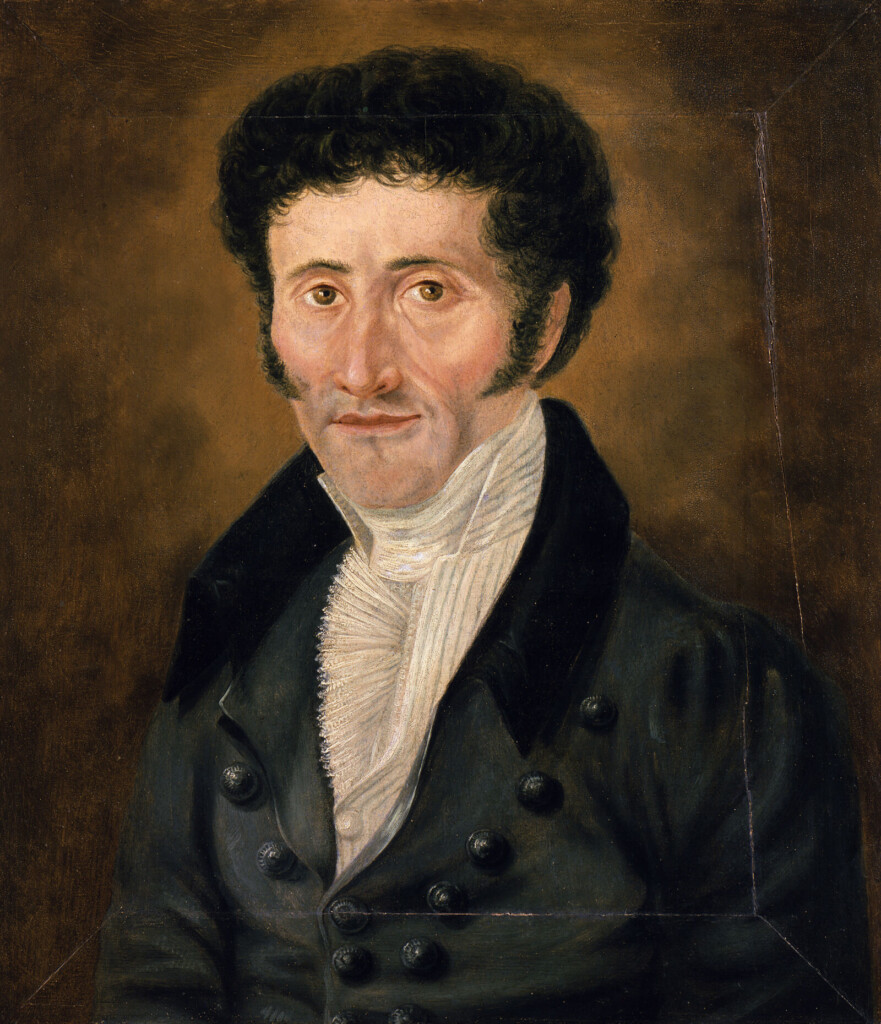
Ernst Theodor Amadeus Hoffmann was writing in the first decades of the nineteenth century, in a Germany caught between Enlightenment rationalism and Romantic excess, and he understood this sensation with a clinical precision that most clinicians would not develop for another hundred years. His stories — “The Sandman” published in 1817, “The Golden Pot” in 1814, “Councillor Krespel,” “Mademoiselle de Scudéri” — do not traffic in dungeons or demons or the operatic machinery of Gothic horror. What they traffic in is domestic space made treacherous. A student’s lodgings. A craftsman’s workshop. A respectable bourgeois household on a street you could name. Hoffmann’s monsters are always in the furniture.
The mechanism he deployed was not invention but distortion. He took the familiar — the doting father, the beloved mentor, the beautiful woman glimpsed across a courtyard, the crafted object in an artisan’s hands — and applied to it a single, precise degree of wrongness. Not enough wrongness to announce itself as fiction. Enough wrongness to make the reader suddenly uncertain about what they already know. Nathanael in “The Sandman” does not encounter a supernatural entity. He encounters a lawyer, a seller of weather-glasses, a man in a grey coat who laughs at the wrong moments and whose eyes seem to Nathanael to be doing something that eyes should not do. Hoffmann understood that horror is not generated by the unknown. It is generated by the almost-known — the thing that arrives wearing the costume of the ordinary and then performs that ordinariness a fraction of a beat too slowly.
Sigmund Freud wrote his essay “Das Unheimliche” — “The Uncanny” — in 1919, and scholars have made a small industry of noting that Hoffmann is Freud’s primary literary example, the figure around whom the entire theoretical apparatus is constructed. What those same scholars note less often is the degree to which Freud was essentially trying to reverse-engineer in theoretical language something Hoffmann had already accomplished intuitively in narrative. The German word unheimlich contains within it its own antonym: unheimlich means uncanny, disturbing, not-at-home, but heimlich means both familiar and secret, homely and concealed. Hoffmann did not need Freud’s etymology to know this. He built it structurally into every story he wrote. The home — the heim — is precisely the site of concealment and therefore the site of terror.
What made him radical, and what continues to make him underestimated, is that he refused the consolation of externalization. The Gothic tradition that surrounded him was deeply invested in putting the horror somewhere else — in ancient castles, foreign landscapes, the past, the aristocratic body now decaying. Hoffmann put the horror in the middle-class present tense. He put it in the workshop of a violin-maker who loves his instrument more than he can love a human being. He put it in the rational mind of a young man who cannot be certain whether what he is seeing is real. He put it in the question that Nathanael can never answer and that Hoffmann never answers for him: whether the madness is arriving from outside or has always been interior, waiting in the familiar rooms of the self like a mechanism already wound.
Nosferatu
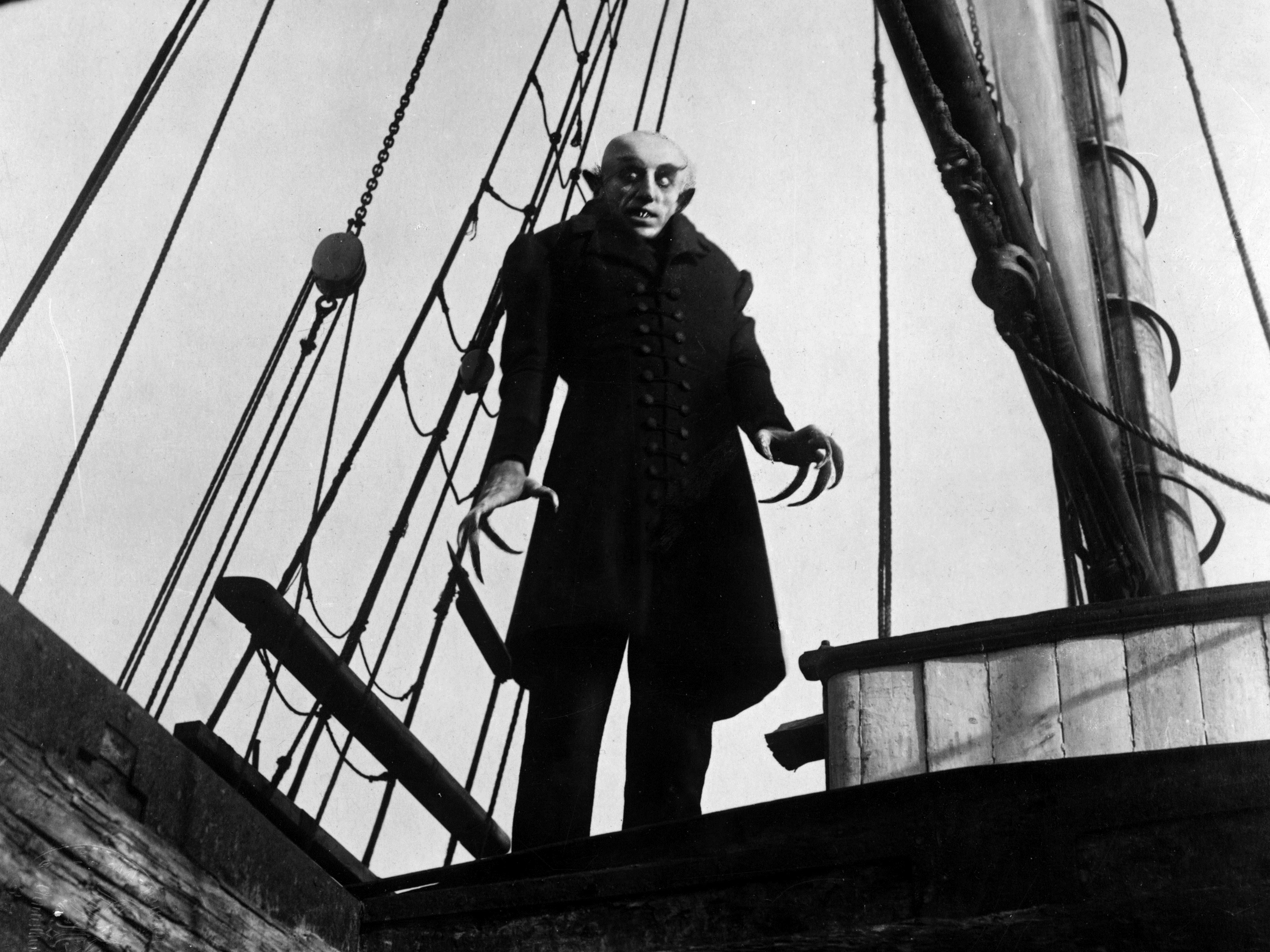
When a young real estate agent, Thomas Hutter, goes to the castle to close a deal, Orlok is attracted by his blood and decides to follow him to his hometown. The arrival of the count causes a series of mysterious deaths and spreads panic among the inhabitants.
Murnau, through evocative images and disturbing atmospheres, creates a work that goes far beyond the simple adaptation of Stoker's novel. The film explores universal themes such as the fear of death, isolation and the loss of humanity. The production of Nosferatu was characterized by some legal difficulties due to the copyright of Bram Stoker's novel. Despite this, Murnau and his crew managed to make a film of great visual impact. The choice of Max Schreck to play Count Orlok was ingenious. His cadaverous appearance and his unnatural movements have made the character of Orlok one of the iconic monsters in the history of cinema. Over the years, Nosferatu has become a cult film, influencing generations of filmmakers and becoming a reference point for the horror genre. The image of Count Orlok, with his elongated nails and sunken eyes, has become an icon of horror cinema.
Hoffmann’s Fractured Biography as Aesthetic Fuel
You are sitting at a desk that is not yours, signing documents that mean nothing to you, and the window behind your supervisor’s head shows a sky you are not allowed to enter. This is not metaphor. For Ernst Theodor Amadeus Hoffmann, it was the actual geometry of most of his adult life — a Prussian civil servant processing legal briefs in Warsaw, then Posen, then Berlin, while somewhere beneath the bureaucratic signature lived a man who composed operas, painted grotesque caricatures on office walls, and heard music in structures that other people called silence.
The father left when Hoffmann was three years old. Königsberg, 1776, a cold Baltic city of Enlightenment rationalism and Kantian order — the very city where Immanuel Kant was, at that precise moment, constructing his architectures of pure reason in the decade before the Critique would appear in 1781. What it means to grow up abandoned in a city that worships rational self-sufficiency is not a small biographical footnote. It is a wound that teaches you, before you have language for it, that the foundations of things are not stable, that the adults who organize reality around you are performing a confidence they do not possess. Hoffmann absorbed this lesson not as trauma in the clinical sense but as epistemology — a way of knowing that the visible surface of the world conceals a different set of rules operating underneath.
The legal career was not incidental punishment. It was the precise mechanism that split him open. Prussia in the early nineteenth century did not offer its minor officials much room for negotiation; the state apparatus ran on compliance, documentation, and the suppression of anything that might be called inner life. Hoffmann complied, functionally. He rose through the ranks, he processed cases, he served in the courts. And he did this while simultaneously composing under the name Kreisler — not a pseudonym chosen for modesty but a character, a fictional musician he invented who was himself but uncontained, a self that could go mad without losing his position, a self that could hear the absolute in a chord progression without being dismissed from service. The doubling was structural. Johannes Kreisler was not a mask Hoffmann wore on weekends. He was the proof that no single identity could hold what Hoffmann actually was.
When the Fantasiestücke in Callots Manier appeared in 1814, readers encountered something that had no clean genre. The title itself pointed toward the French engraver Jacques Callot, whose work distorted human figures into grotesque, carnivalesque shapes that retained enough realism to be disturbing rather than safely fantastical. Hoffmann chose that reference deliberately because Callot’s method matched his own: not the full surrender to fantasy that removes all pressure, but the infiltration of the distorted into the recognizable, so that the reader cannot locate the precise moment when the world went wrong. The Fantasiestücke contained musical criticism, supernatural tales, and the first extended appearances of Kreisler — all bound together by a sensibility that refused to separate aesthetic theory from lived dread.
What his biography actually produced was a man who could not afford the luxury of a unified self, and who therefore understood, viscerally and before the concept had theoretical vocabulary, what it feels like to inhabit two incompatible registers of reality simultaneously. Sigmund Freud would not publish his essay on the uncanny until 1919, more than a century after Hoffmann had already written “The Sandman,” the very text Freud would use as his central exhibit. But Hoffmann did not need the concept. He had the condition. The bureaucratic desk and the composer’s manuscript were not opposites that he struggled to reconcile — they were the engine running at full speed, and the friction between them was precisely what generated the heat that made the writing possible.

Automata, Doubles, and the Anxiety of Mechanism
You are at a party, standing near someone who has been smiling at you for twenty minutes, nodding at precisely the right intervals, laughing a half-second after everyone else. Something in you registers a wrongness before your mind can name it. The eyes move, but nothing behind them moves with the eyes.
Ernst Theodor Amadeus Hoffmann published “Der Sandmann” in 1816 as part of his Nachtstücke collection, and what the story performs on the reader is not quite horror in any conventional sense — it is epistemological vertigo. Nathanael, a student already fractured by a childhood trauma involving the mythological figure of the Sandmann who steals children’s eyes, falls obsessively in love with Olimpia, the daughter of his professor Spalanzani. She dances with supernatural grace, she listens with total attentiveness, she never interrupts, she reflects Nathanael’s words back to him in ways that feel like profound understanding. She is, of course, an automaton. But the story’s violence is not in that revelation. The violence is in the pages before it, when Nathanael is not deceived so much as willing, reaching toward a surface that flatters him, projecting interiority where there is only clockwork. Hoffmann understood something that would take psychology another century to name properly: that recognition of another consciousness is not a perception but an act of faith, and that faith is corruptible by desire.
The Enlightenment had been building toward Olimpia for decades. In 1739, Jacques de Vaucanson unveiled his Digesting Duck in Paris — a brass mechanism of over four hundred moving parts that could eat grain, digest it through a chemical process in its copper stomach, and excrete waste. It was exhibited before the Académie Royale des Sciences and caused a sensation not because it was beautiful but because it was obscene in its implications: if digestion could be replicated by gears and chemistry, what precisely was the remaining argument for a soul? Vaucanson went on to construct a flute player capable of producing twelve melodies with actual breath pressure through actual lips. When Wolfgang von Kempelen exhibited his chess-playing Turk in 1770 before the Habsburg court of Maria Theresa, the question had shifted further still — from bodily function to cognition. The Turk defeated human opponents across Europe for decades, and the fact that it concealed a human operator inside was almost beside the point. What mesmerized the courts of Vienna, Paris, and London was not the machine but the desire to believe in it, the same desire Nathanael carries into his relationship with Olimpia.
Sigmund Freud read “Der Sandmann” closely in his 1919 essay “Das Unheimliche” and placed it at the center of his theory of the uncanny, but he argued the story’s central anxiety was castration — the threatened eyes, the father figure, the stolen gaze. What Freud underweighted, and what Hoffmann actually surfaces with greater precision, is the terror of the self as automaton. Nathanael’s madness is not simply that he loves a machine. It is that in loving her, he becomes more mechanical than she is: repetitive, driven by compulsion, stripped of the improvisational mess that constitutes genuine human response. Olimpia does not threaten him from outside. She reveals what is already operative within him.
By the early nineteenth century, German Naturphilosophie had developed the concept of the Lebenskraft — a vital force distinguishing living organisms from mere matter — in direct reaction to the mechanist implications of Cartesian biology. Friedrich Schelling spent the 1790s elaborating a philosophy of nature in which consciousness and world were not opposed but continuously interpenetrating, precisely because he found the alternative — pure mechanism all the way down — philosophically intolerable. Hoffmann, who read deeply in this tradition, turned the philosophical debate into a narrative trap: Nathanael cannot apply the category of Lebenskraft to Olimpia because his own inner life has contracted to a single fixed point, and a fixed point cannot detect movement in anything else.
What Freud Did and Did Not Understand
You sit across from someone you have known for years — a colleague, a sibling, a lover — and for a fraction of a second, perhaps three heartbeats, you do not recognize them. The face is familiar and foreign simultaneously. Something slides. Then the moment closes, and you tell yourself it was nothing, a trick of the light, fatigue. Hoffmann understood that this was not nothing. He understood that the sliding was the truth, and the recovery was the lie.
When Sigmund Freud published Das Unheimliche in 1919, he reached for Der Sandmann as his primary exhibit, and the choice was both inevitable and revealing. Freud’s argument, assembled with the clinical precision he brought to everything, located the source of Hoffmann’s terror in the threatened loss of the eyes — Nathanael’s obsessive dread of the Sandman who steals children’s eyes for his own offspring — and decoded this as a symbolic displacement of castration anxiety. The logic held. It held the way a key holds when it opens one door while you ignore the twelve others on the same corridor. Freud had found something real inside Hoffmann’s fiction, but the act of finding it involved a kind of intellectual triage that cost more than it admitted.
The philosopher Mladen Dolar, writing in his 1991 essay “I Shall Be with You on Your Wedding-Night,” observed that Freud’s reading of the uncanny was itself an uncanny operation — it domesticated the very disturbance it described by translating cultural horror into individual psychosexual history. To reduce the figure of Coppelius, the sinister lawyer who doubles and merges with the optician Coppola, to a paternal castration threat is to pull a vast social specter into the consulting room and give it a couch. It explains the symptom by evacuating the structure that produced it.
What Freud sealed off, by focusing so intently on Nathanael’s fragile masculinity, was the epistemological catastrophe at the center of Hoffmann’s project. Nathanael is not only a man afraid of bodily mutilation. He is a person whose instruments of perception have been compromised. The telescope he buys from Coppola, through which he watches Olimpia and takes her mechanical stillness for feminine grace, is not a Freudian prop — it is a theory of knowledge under siege. Hoffmann was writing in the immediate aftermath of German Idealism’s peak, in a culture saturated with Naturphilosophie and the Romantic conviction that the self could penetrate reality through intuition alone. Nathanael, gazing through his purchased lens, believes he is seeing more clearly. He is seeing a fabrication. The horror is not that he might lose his eyes; it is that his eyes, intact, deliver him into total delusion.
The doppelgänger motif carries this further in ways Freud’s framework actively resisted. When Otto Rank published his own study Der Doppelgänger in 1914, also drawing on Hoffmann, he read the double primarily as a remnant of narcissistic self-love, an archaic psychological formation. But the double in Hoffmann’s broader work — in Der Elementargeist, in the Kreisler fragments, across the Kater Murr architecture — operates politically. It is the figure through which Hoffmann encodes what cannot be said about authority, surveillance, and the administrative machinery of the Prussian state under which he served as a legal official. He worked for years as a jurist in Berlin, processing the cases of demagogue trials under the Carlsbad Decrees of 1819 — the same year Freud’s foundational essay was being drafted a century later — and the split self of his fiction is inseparable from the experience of being a man who enforces a law he finds monstrous.
Freud’s reading was productive precisely because it was a misreading in the strong sense Harold Bloom would later theorize: it generated meaning by refusing to see the whole. But what it refused to see was the possibility that the uncanny, in Hoffmann’s hands, was not primarily about the family, the body, or the unconscious. It was about the structure of a world that produces doubles because it cannot tolerate singularity — because a person who thinks alone, perceives alone, and refuses the sanctioned lens is the most dangerous thing an administered society can imagine.
The Doppelgänger as Political Figure
You are handed a passport at a border crossing you do not remember approaching, and the face in the photograph is yours, but the signature belongs to someone who made different choices, survived different losses, and chose a road you abandoned at twenty-three. The officer waves you through. The state has decided you are continuous. The state is always deciding this.
What Hoffmann released into German literary culture between 1815 and 1816 was not a psychological curiosity dressed in Gothic costume. Die Elixiere des Teufels — published in two volumes as the Congress of Vienna was still redrawing the map of a continent — placed at the center of its narrative a Capuchin monk named Medardus who encounters his double, loses the boundary between his own will and another’s, commits acts he cannot fully claim, and spends the remainder of the novel unable to establish with any certainty where his guilt begins and his mirror’s ends. The book is 500 pages of jurisdictional terror, and the jurisdiction in question is the self.
The German principalities reconstituting themselves after the Napoleonic dissolution of 1806 needed subjects who were legible. The bureaucratic apparatus that Hegel would describe in the Philosophy of Right in 1820 — the state as the ethical totality within which individual freedom finds its true realization — depended on persons who remained themselves across time, across institutions, across the signatures they affixed to contracts, oaths, and tax registers. A citizen who could not be continuously identified was not merely philosophically inconvenient; he was administratively catastrophic. Hoffmann, who worked as a Prussian judicial councillor in Berlin and understood the architecture of state legibility from the inside, built Medardus precisely as this catastrophe made flesh.
The double in Romantic thought had been theorized before Hoffmann exploited it. Johann Paul Friedrich Richter — writing as Jean Paul — had introduced the term Doppelgänger in Siebenkäs in 1796, but he used it as a philosophical curiosity, a glitch in the metaphysics of personal identity. Hoffmann took the same phenomenon and made it load-bearing for a narrative about criminal accountability. If Medardus and his double have exchanged identities, committed each other’s crimes, worn each other’s faces before witnesses, then the entire apparatus of judgment — confession, evidence, sentencing — rests on a foundation that has already given way. The courtroom scene that haunts the novel’s middle section is not dramatic because someone might hang. It is dramatic because nobody can determine with confidence who is standing in the dock.
This is where the political charge becomes impossible to dismiss as mere aesthetic provocation. The Romantic fascination with the fragmented self that Novalis had explored as mystical longing in the Heinrich von Ofterdingen fragments of 1802 was, in Hoffmann’s hands, turned toward institutions. The question was no longer what the self feels in its dissolution but what the state does when dissolution is the defendant’s primary characteristic. And the answer that Die Elixiere des Teufels keeps returning to is that the state simply proceeds, imposes a narrative of continuous identity by force, and calls the imposition justice. Hoffmann does not write this as protest. He writes it as observation, which is worse.
Friedrich Schlegel had argued in the Athenaeum fragments that irony was the recognition of permanent paradox — the position from which no synthesis is possible or honest. Hoffmann turned irony into institutional critique without ever naming it as such. The monk who cannot own his actions is not a symptom of Gothic excess. He is the figure that exposes what civic identity always required: not genuine continuity, but the performed acceptance of a continuity the governing apparatus needed to believe in.
A vision curated by a filmmaker, not an algorithm
In this video I explain our vision
Music as the Art of Pure Dissolution

You are sitting with a piece of music you cannot explain to anyone. Not because words fail you in the ordinary sense — you are articulate enough, educated enough — but because the experience happens beneath the stratum where language operates. Something reached into you without passing through the gate of meaning, and now you are expected to describe it at a dinner table, and you feel faintly ridiculous, like a man trying to report a dream using only legal terminology.
Hoffmann understood this not as a limitation of the listener but as the fundamental ontological claim of music itself. His 1810 review of Beethoven’s Fifth Symphony, published in the Allgemeine musikalische Zeitung, is almost never read as the philosophical document it actually is. Buried inside what appears to be music criticism is a radical epistemology: instrumental music — freed from text, from program, from the anchoring weight of representational intention — is not merely expressive but cognitively prior. It does not illustrate feelings; it produces states of knowing that have no equivalent in conceptual language. Hoffmann wrote that Beethoven’s music “sets in motion the lever of fear, of awe, of horror, of suffering, and awakens just that infinite longing which is the essence of Romanticism.” The critical word is awakens. Not represents. Not depicts. Music does not point at longing the way a sign points at a building. It generates longing from inside the body, using the nervous system as its instrument.
This is the engine hidden beneath Hoffmann’s fiction. When critics read his prose as gothic atmosphere — the strange automata, the double figures, the corridors that seem to breathe — they are reading the furniture and ignoring the architecture. His literary method was a sustained attempt to colonize the territory he had theorized as music’s exclusive domain. The hallucinatory syntax of “Der Sandmann,” the way events refuse to stabilize into either nightmare or reality, the narratorial frame that keeps collapsing into what it was meant to contain — these are not stylistic quirks or period conventions. They are attempts to make the nervous system respond before the interpretive mind catches up. Hoffmann was trying to produce in prose the cognitive short-circuit he had identified in Beethoven.
What made this project philosophically serious rather than merely ambitious was his precise awareness of the problem. Language is representational at its root. Even when it strains toward the non-referential — in poetry, in incantation, in the fragmented syntax of trauma — it cannot fully escape the signifier-signified contract. Music, as Hoffmann theorized it, had no such contract. It operated by a different mechanism entirely, one closer to what the French neurologist Jean-Martin Charcot would observe in his patients at the Salpêtrière hospital in the 1880s: the body responding to stimuli that bypassed conscious cognition, producing effects without causes the patient could name. Hoffmann arrived at this intuition seventy years earlier not through neurology but through musical practice — he was a working composer, conductor, and critic, not a theorist in an armchair.
The consequence for his fiction is a particular kind of readerly unease that has nothing to do with plot. Readers of Hoffmann frequently report not knowing when they became disturbed, which is the precise sensation he was engineering. The dread does not arrive with a revelation; it has already accumulated by the time the reader notices it, installed through rhythm and repetition and syntactic pressure operating below the threshold of attention. Walter Pater’s 1873 claim in “The Renaissance” that all art constantly aspires toward the condition of music was not an aesthetic preference — it was a recognition of music’s structural advantage in bypassing representation. Hoffmann had already tried to steal that advantage for the written page, which meant working against the material nature of his own medium, using language as a kind of controlled sabotage of itself.
The Reader Hoffmann Actually Wanted
You are already reading this wrong if you expect it to end with your sense of the world intact. That is not an accusation — it is the contract Hoffmann was offering, buried in plain sight inside texts that his contemporaries mostly received as entertainment, as the pleasantly shivering stuff of Romantic atmosphere. But the reader Hoffmann actually wanted was not the one who came to be frightened and then relieved. He wanted the one who recognized, before the first page was finished, that the fright had no relief built into its structure — that the machinery of the story was designed to leave a particular kind of reader more precisely alone with what they already suspected about themselves.
What Hoffmann suspected about selfhood he encoded obsessively across the figure of Johannes Kreisler, the musician who appears fractured and refracted across “Kreisleriana” in the Fantasiestücke of 1814, resurfaces in the unfinished novel Lebens-Ansichten des Katers Murr of 1819 to 1821, and never quite arrives at either madness or resolution. Kreisler is not a case study in artistic neurosis. He is a formal proposition: that the subject who is most conscious of the artificiality of social performance is also the least capable of substituting anything else in its place, and that this incapacity is not a wound but a structural condition of being conscious at all. When Kreisler plays music that his bourgeois patrons cannot hear properly, the joke is not on the patrons alone. It is on Kreisler, who hears it perfectly and is therefore more shattered, not more whole.
Georg Wilhelm Friedrich Hegel, writing his Phenomenology of Spirit in 1807, described what he called the “unhappy consciousness” — the mind that has seen through every external authority and discovered that inwardness is no safe harbor either, that the self that retreats from the world finds only another theater of contradiction. Kreisler lives this without Hegel’s eventual dialectical rescue. He gets the disease without the promised immunity. In Kater Murr, his biography arrives to the reader literally interrupted, literally incomplete, printed on pages interleaved with the memoirs of a self-satisfied tomcat whose smug coherence of identity is presented not as depth but as the comedy of the unreflective. The structural form of the book is the argument: coherent selfhood is the province of those who have simply not looked hard enough.
The implied reader of this construction is someone who already knows what it costs to maintain the performance of continuous identity across a day, a relationship, a career. Not someone clinically disordered, not someone exceptional in their suffering — someone ordinarily fractured, which is to say almost everyone, if they were willing to stop narrating themselves long enough to notice. Hoffmann was not interested in the pathological as a category separate from the normal. He was interested in the precise point at which the normal reveals itself to be pathological all the way down, with no untouched floor beneath it.
This is why Kreisler cannot be resolved by the diagnosis of madness, which would be a relief — would locate his instability as an exception, a deviation from a functioning standard. And he cannot be resolved by the affirmation of his genius, which would be the Romantic consolation, the reassurance that the artist’s suffering redeems him into a higher category of being. Hoffmann refuses both exits with a consistency that feels almost punitive. Kreisler keeps arriving, keeps disappearing mid-sentence, keeps performing lucidity in precisely the registers that make lucidity most suspect. What he offers the reader who is paying the right kind of attention is not identification with a tortured hero but something considerably less comfortable: the recognition that the tools one uses to distinguish one’s own clarity from one’s own confusion are made of the same material as the confusion itself.
The Legacy That Refused to Stay Literary
You do not inherit Hoffmann by choosing him. He arrives uninvited, the way a structural problem arrives — not as influence but as recurrence, the same crack appearing in different walls across different centuries.
Fyodor Dostoevsky did not hide the debt. When he published The Double in 1846, he was twenty-four years old and sufficiently self-aware to know he had walked through a door Hoffmann had already opened. His Golyadkin — that minor Petersburg clerk who watches a more socially fluent version of himself usurp his life from the inside — is not a borrowing of plot but a borrowing of metaphysical architecture. The terror is not that the double is evil. The terror is that the double is better at being you than you are, smoother, more legible to others, more at ease with the social codes you have always fumbled. Dostoevsky understood that Hoffmann’s real subject was never the supernatural object but the self that fractures under the pressure of being witnessed, the ego that splinters not from madness but from the unbearable demand to be coherent across time.
Jacques Offenbach staged something different when he transformed Hoffmann’s tales into Les Contes d’Hoffmann, which premiered at the Opéra-Comique in Paris in February 1881, four months after Offenbach’s own death, the work finished by Ernest Guiraud. The opera performs an act of violent compression: three of Hoffmann’s women collapse into a single trajectory of male desire that always ends in loss, and the automaton Olympia opens the sequence precisely because she represents the founding wound — the moment a man discovers that what he loved was a mechanism. Offenbach aestheticized the horror into something audiences could applaud, which is its own kind of historical evidence: by 1881, the anxiety about artificial life had already been domesticated enough to become entertainment, the uncanny tamed into spectacle without losing its structural power to disturb.
The surrealists in the 1920s refused that domestication. André Breton, building the theoretical scaffolding of his 1924 Manifesto, reached back past the symbolists and the romantics to reclaim the marvelous as a mode of knowledge rather than decoration. Max Ernst, in collages that place Victorian machinery inside bourgeois interiors, was practicing Hoffmannesque logic without naming it — the familiar object rendered monstrous by proximity to the wrong context, the seam between the domestic and the aberrant left deliberately visible. What the surrealists understood, perhaps more precisely than they articulated, was that Hoffmann had not been writing fantasy. He had been writing realism with the ideological filters removed.
Then the concept migrated further, into registers Hoffmann himself could not have imagined. When Jacques Lacan in the early 1950s elaborated the mirror stage — the moment between six and eighteen months when the infant misrecognizes its own reflection as a coherent self, founding identity on an image that is always slightly ahead of the body, always a fiction of unity — he was mapping psychoanalytically the same structure Hoffmann had mapped narratively a century before. The self is not the origin. It is the effect of a reflection that it then mistakes for its cause. Olympia is not the aberration in this account; she is the clarifying limit case, the reflection that never pretended to have an interior.
By the time computing cultures of the late twentieth century began asking seriously what distinguished a person from a sufficiently sophisticated simulation — the Turing test, proposed in 1950, being the institutional form of a question Hoffmann had posed in fiction in 1816 — the philosophical ground had already been prepared by a tradition that ran from Sandmann through Dostoevsky through Lacan. The question was never really about machines. It was always about what we had quietly agreed to pretend the self was, and what would happen when the pretense became technically unnecessary.
🌒 Into the Shadows: Romantic Horror and the Uncanny
E.T.A. Hoffmann’s world of automatons, doubles, and sinister forces did not emerge in isolation — it arose from a rich tradition of Gothic imagination and Romantic philosophy that haunted the European mind. These articles explore the literary, aesthetic, and psychological territories that shaped and echo Hoffmann’s uncanny universe.
Matthew Lewis and The Monk
Matthew Lewis and his scandalous novel The Monk represent one of the darkest expressions of Gothic literature, pushing the genre to its most transgressive limits. Like Hoffmann, Lewis explored the terrifying proximity between the sacred and the diabolical, between reason and obsession. His work reminds us that the uncanny is never far from the corridors of institutional power and repressed desire.
GO TO THE SELECTION: Matthew Lewis and The Monk
Ann Radcliffe and the Gothic Novel
Ann Radcliffe virtually invented the architecture of Gothic dread, populating her novels with mysterious castles, persecuted heroines, and atmospheres thick with inexplicable terror. Her technique of the ‘explained supernatural’ stands in fascinating contrast to Hoffmann’s willingness to let the irrational remain unresolved. Together, Radcliffe and Hoffmann define two poles of a literary tradition that still electrifies readers today.
GO TO THE SELECTION: Ann Radcliffe and the Gothic Novel
The Literary Fantastic: Todorov and the Theory of the Fantastic
Tzvetan Todorov‘s theory of the fantastic provides one of the most rigorous critical tools for understanding what makes Hoffmann’s tales so psychologically destabilizing. Todorov identified the fantastic as the hesitation between a natural and a supernatural explanation — a hesitation that Hoffmann cultivated with masterful precision. Reading Hoffmann through Todorov transforms every uncanny encounter into a philosophical question about the nature of reality.
GO TO THE SELECTION: The Literary Fantastic: Todorov and the Theory of the Fantastic
The Double in Literature: From Dostoevsky to Stevenson
The figure of the double — the Doppelgänger — is perhaps Hoffmann’s most enduring contribution to world literature, haunting subsequent generations from Dostoevsky to Stevenson. This article traces the literary history of this obsessive motif, revealing how the double always signals a fracture within the self that society cannot contain. Hoffmann stands at the origin of this tradition, giving the modern uncanny one of its most terrifying faces.
GO TO THE SELECTION: The Double in Literature: From Dostoevsky to Stevenson
Discover the Cinema of Shadows on Indiecinema
If Hoffmann’s world of the uncanny speaks to you, independent cinema holds an entire universe of films that explore the same shadowy territories — stories where reality fractures, the self divides, and the irrational refuses to be silenced. On Indiecinema you will find a carefully curated selection of independent and auteur films that dare to go where mainstream cinema fears to tread. Join us and let the darkness illuminate something true.
👉 EXPLORE THE CATALOG: Watch Indie Films in Streaming
A vision curated by a filmmaker, not an algorithm
In this video I explain our vision

