
The Invisible Architecture of Obligation
It is three in the morning and you are already awake before the sound finishes forming itself into something recognizable — a cough, a shift in breathing, the soft thud of a body disoriented in darkness. You move through the hallway without turning on the light because you have learned the geometry of this house in a new way, a nocturnal cartography built from months of interrupted sleep. You adjust a pillow, offer water, wait. When you return to your bed you do not sleep. You lie there calculating — medication schedules, the appointment on Thursday, whether the rash you noticed yesterday needs a call to the clinic in the morning. At no point does it occur to you to call this work. It is simply what you do. That invisible assumption is not accidental.

The economist Charlotte Perkins Gilman argued in 1898, in Women and Economics, that the domestic labor performed overwhelmingly by women represented a structural subsidy to the entire productive economy — an output that capitalism consumed without ever acknowledging on any ledger. Her insight was radical not because it was counterintuitive but because it named something so embedded in daily life that it had become, for most people, literally unthinkable. The refusal to think it was not ignorance. It was architecture. Social systems do not survive by hiding their mechanisms clumsily; they survive by making those mechanisms feel like nature, like love, like the simple expression of who a person already is.
By the early 1970s, a coalition of feminist activists — among them Silvia Federici, Mariarosa Dalla Costa, and Selma James — launched what became known as the Wages for Housework campaign, a political project that was also a philosophical provocation. Their 1972 pamphlet, The Power of Women and the Subversion of the Community, argued that unwaged domestic labor was not peripheral to capitalist accumulation but foundational to it. Every factory worker, every office employee, every productive unit in the formal economy arrived at work fed, clothed, emotionally managed, and reproductively sustained by someone who received nothing recognizable as compensation. The campaign was controversial precisely because it made visible what the system required to remain invisible: that care is labor, and that calling it love had been, among other things, an extraordinarily efficient wage suppression strategy.
What makes this history more than an academic footnote is the way it lands in bodies. The National Alliance for Caregiving and AARP published data in 2020 estimating that there are approximately 53 million unpaid family caregivers in the United States alone, providing care valued at roughly 470 billion dollars annually — a figure that exceeds total Medicaid spending. These are not people who chose a profession. They are people who found themselves, through proximity, through gender, through the absence of anyone else, absorbed into a role that the formal economy would otherwise have to fund. The absorption happens quietly, incrementally, through a series of small decisions that each seem reasonable in isolation: you live closest, you have the most flexible schedule, you are the daughter rather than the son, you are the one who noticed first.
The psychological literature on caregiver identity — including research by Carol Levine, who spent decades studying families managing catastrophic illness — suggests that many caregivers do not develop a caregiver identity so much as have one assigned to them before they have finished processing what happened. The role precedes the consent. And once inside it, the person finds that the very qualities the culture celebrates in caregivers — selflessness, attentiveness, emotional availability — are precisely the qualities that make it structurally impossible to refuse, renegotiate, or even fully perceive the terms of the arrangement.
Days Blows by in a Moment
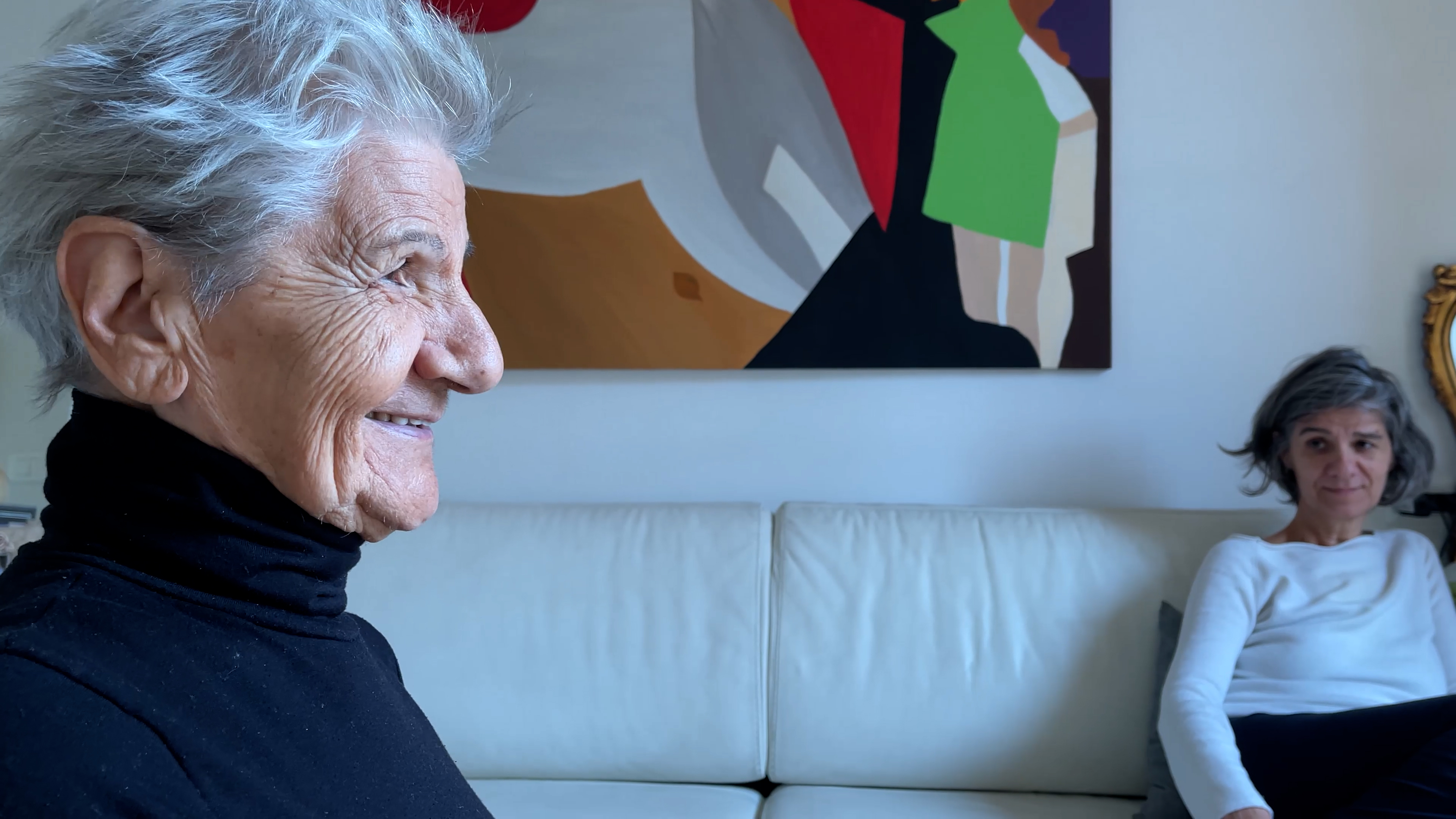
Documentary, by Cristiana Donghi, Italy, 2022.
Ancilla is 86 years old. Two years ago, she moved in with her daughter Emanuela at the pandemic's beginning. Ancilla is slowly losing her memory. He does not remember what she had for lunch, she only remembers events from the past, perhaps only because she has been repeating them for years. Emanuela takes care of her, day after day she wakes her up, prepares her food, washes her, dresses her, and accompanies her a couple of days a week to the hospice and does physiotherapy. This is one of the few contacts with the rest of the world she has left. Ancilla has another child, Mauro, who has been living in London since he left looking for a job. She hasn’t seen him for two years. Daily routines always repeat themselves and change only with the changing seasons. The mother's memories slowly introduce us to Ancilla, her past, the life she lived and that transported her here. Melancholy moments alternate with funny ones and those where patience reaches its limits. Ancilla's sympathy brings a light, fresh breeze into the lives of those around her and allows them to see everything in a way where even the most ominous clouds are blown away momentarily by a breath of wind.
LANGUAGE: Italian
SUBTITLES: English, Spanish, French, German, Portuguese
The Psychological Grammar of Self-Erasure
You wake up one morning and cannot remember the last time someone asked how you were doing and actually waited for the answer. Not the polite social transaction, not the passing corridor question — the kind of waiting that holds space for something true to emerge. You search for the last time you gave an honest answer to that question, and the search comes back empty, and the emptiness does not feel like loss. That is the first symptom.
Identity does not collapse in caregiving. It recedes. The process is so gradual, so internally justified at each individual step, that no single moment ever presents itself as the threshold you crossed. You did not stop being yourself on a Tuesday. You redistributed yourself, incrementally, across someone else’s needs until the redistribution became the self, and the original arrangement became genuinely difficult to recall. Pauline Boss, whose four decades of clinical research produced the concept of ambiguous loss, identified something that most grief frameworks refuse to accommodate: the mind can mourn something that has not technically disappeared. The caregiver’s own personhood occupies exactly this category. It is not gone. It is simply no longer consulted.
What makes this particular form of psychological erosion so durable is that it generates its own justification in real time. Every act of self-suppression arrives dressed as virtue. The decision not to pursue a professional opportunity because the care schedule won’t allow it reads, internally, as responsibility. The choice to cancel social contact because guilt makes presence elsewhere feel fraudulent reads as love. The cultural vocabulary available to caregivers is almost exclusively devotional, and devotion, by its grammar, does not permit complaint. When the language you have been given to describe your experience structurally excludes suffering, the suffering does not disappear — it simply loses its name, and unnamed suffering cannot be brought to anyone for witness or relief.
Research tracking long-term family caregivers across sustained care periods — defined as continuous care exceeding two years — consistently finds burnout affecting somewhere above sixty percent of this population, with clinical depression rates roughly double those of age-matched non-caregiving peers. These numbers are not a portrait of individual failure. They are a portrait of what happens when a role is culturally elevated and structurally unsupported in equal measure. The elevation performs two functions simultaneously: it provides the caregiver with a meaning architecture that sustains them through phases they could not otherwise endure, and it seals the architecture from the outside, making any crack in the devotional facade feel like a moral defection rather than a human signal.
Grief, in the traditional sense, requires an object that is recognizably absent. The caregiver’s grief is more disorienting than that: it orbits a person who is present, whose needs are real and urgent, and toward whom the caregiver often feels genuine love. To grieve the person who still occupies the room — to mourn the relationship that existed before the illness, the dependency, the inversion of roles — requires a psychological sophistication that most people are never invited to develop, because the culture that produced them never acknowledged this grief as legitimate in the first place. What cannot be named cannot be processed, and what cannot be processed accumulates, and accumulation is not the same as endurance, even when it looks identical from the outside.
There is a version of this where the caregiver eventually becomes fluent in describing their own experience with tremendous accuracy — explaining the exhaustion, mapping the complexity of emotion — and still feels absolutely nothing shift in the chest while speaking. The words arrive correct but hollow, because the emotional infrastructure that would make them land has quietly shut down to conserve whatever remains.

Culture as the Silent Enforcer
You are sitting across from your mother at a kitchen table in a city where neither of you speaks the dominant language, and she is telling you, without words, that you are the one. Not your brother in the next suburb. Not the cousin who earns more. You. The election happened decades before this moment, encoded in a structure of obligation so old it has stopped feeling like a choice and started feeling like gravity.
Anthropologists working in East Asian communities have documented what they call the operationalization of filial piety — the Confucian concept of xiao, codified in texts like the Classic of Filial Piety dating to the fourth century BCE — into daily behavioral scripts that assign caregiving roles with a precision that would make a bureaucrat envious. The eldest son carries formal obligation; his wife carries actual labor. Ruth Levine’s cross-cultural fieldwork in multigenerational households found that in societies structured by Confucian hierarchy, daughters-in-law reported higher rates of caregiver burnout than any other family member, including primary care recipients, while simultaneously reporting the lowest rates of perceived legitimacy in expressing distress. The tradition does not merely assign the burden. It builds into its architecture a mechanism that makes the burden invisible to the person carrying it.
The Mediterranean variant operates through a different lexicon but reaches identical coordinates. Familismo, the organizing principle of relational life across southern Italian, Greek, and Latin American households, frames family loyalty not as duty but as identity — the self is constituted through the collective, and to withdraw from care is not to break a rule but to cease to exist as a coherent person. Sociologist Mariano Rojas, working on subjective wellbeing data across Latin American populations, noted that familismo scores correlate positively with life satisfaction in contexts of economic stability and catastrophically invert under conditions of chronic stress. The warmth that binds becomes the rope that holds in place. What looks from the outside like love is sometimes the most elegant trap ever designed by a pre-industrial society that needed women and younger siblings to stay close to the house.
American individualism is supposed to be the escape hatch from all of this, the cultural framework that refuses inherited obligation and insists on chosen commitments. The reality is that individualism does not dissolve the care burden — it privatizes it while simultaneously stripping away the collective infrastructure that made carrying it survivable. A 2020 AARP report estimated that 53 million Americans were providing unpaid family care, a figure that represents roughly 16 percent of the adult population absorbing what would otherwise be a public cost. The ideological insistence on self-reliance means that asking for help is coded as personal failure, that institutional care is coded as abandonment, and that the caregiver who is drowning does so in the specific American style: loudly insisting she is fine. The script is different from the Confucian one. The destination is the same room.
What crosses every cultural boundary is the distribution mechanism: gender, birth order, and geographic proximity function as the fault lines along which the burden slides, regardless of the stated values of the surrounding tradition. The daughter who lives closest, the eldest who remained in the hometown, the woman in a household that has not yet rearranged its taxonomy of who is capable of emotional labor — these variables predict caregiving assignment with a consistency that no amount of cultural specificity can fully obscure. Philippe Ariès, writing in Centuries of Childhood in 1960, argued that family structures are not natural formations but historical artifacts, assembled under specific economic and political pressures. The care arrangements that feel most organic to any given family are precisely the ones that have been rehearsed longest, until the rehearsal disappeared and only the performance remained, stripped of any memory that someone once wrote the lines.
The Gender Fault Line No One Names Aloud

You have already decided, without knowing you decided, that the person sitting at the bedside is a woman. If someone says “family caregiver” and you close your eyes, the figure that assembles itself in the dark is female — her hands known for their patience, her schedule hollowed out to fit around someone else’s needs. This is not an accident of imagination. It is the residue of a statistical reality so consistent across cultures and decades that it has stopped feeling like a pattern and started feeling like nature.
Approximately 75% of all unpaid family caregiving globally is performed by women. This figure, documented by the World Health Organization and corroborated by national labor surveys across contexts as different as Japan, Brazil, and the United Kingdom, does not fluctuate dramatically when you control for employment status, education level, or household income. Women who work full-time still absorb the majority of caregiving labor at home. Women who earn more than their partners still end up as the default coordinator of an aging parent’s medical appointments. The number is stubborn because the arrangement it describes is not accidental — it is structured.
In 1982, Carol Gilligan published “In a Different Voice,” arguing that women’s moral reasoning is oriented around relationships, context, and care rather than the abstract rules and rights that Lawrence Kohlberg had positioned as the apex of ethical development. The argument was liberatory in its original impulse: it insisted that a form of moral intelligence systematically associated with women had been dismissed and undervalued by a psychology built on male subjects. What Gilligan could not fully anticipate was the velocity with which this framework would be absorbed into the very structures it sought to critique. If women are naturally oriented toward relational responsibility, then their disproportionate presence in caregiving roles begins to look not like a coercive arrangement but like a freely chosen expression of who they are. The ethics of care, extracted from its critical context, became a mechanism for making exploitation feel like vocation.
The economic consequences are not metaphorical. Caregiving interrupts careers at the precise moments when professional trajectories consolidate — the late twenties and thirties when networks solidify, promotions accelerate, and pension contributions compound. A 2019 report by the AARP Public Policy Institute estimated that the average female caregiver in the United States loses approximately $324,000 in wages, pension contributions, and Social Security benefits over her lifetime as a direct result of caregiving-related career interruptions. In the United Kingdom, the Carers UK organization has documented that 2.6 million people have left paid employment to take on caregiving responsibilities, with women accounting for the overwhelming majority. These are not marginal losses absorbed painlessly by people who had resources to spare. They are structural penalties that accumulate invisibly, surfacing decades later as retirement poverty, financial dependency, and reduced capacity to absorb a health crisis of their own.
What makes this machinery so difficult to dismantle is that it rarely announces itself as coercion. It arrives as expectation, as assumption, as the quiet certainty shared at a family dinner table that one sibling — the daughter, the one who lives closest, the one without children of her own — is the natural answer to the question no one is willing to ask directly. Erving Goffman’s concept of the interaction order, developed across his work in the 1950s and 1960s, captures something essential here: the rules governing who does what in a social situation are enforced not through law or explicit command but through the humiliation awaiting anyone who violates them. The woman who refuses to be the caregiver does not merely make a practical choice. She breaks a script so deeply embedded that her refusal reads as moral failure — coldness, selfishness, a betrayal of something that feels almost biological.
And the feeling of biological inevitability is exactly where the trap closes.
What Care Does to the One Who Cares
You wake one morning and realize you have stopped making plans. Not in any dramatic sense — there was no moment of surrender, no decision. The future simply narrowed, the way peripheral vision narrows under sustained stress, until what remained was today’s medications, today’s appointment, today’s crisis threshold. Psychologists call this temporal foreclosure, and in caregivers it happens not as a symptom of depression but as an adaptive mechanism, the mind learning to stop investing in futures that the body in your care keeps canceling.
What chronic caregiving does to the nervous system is well documented and almost entirely ignored. Research published in the Proceedings of the National Academy of Sciences in 2004 by Elissa Epel and her colleagues demonstrated that women caring for severely ill children showed measurably shorter telomeres — the protective caps on chromosomes that erode with biological aging — than non-caregiving controls, with the most dramatic shortening in those who reported the highest subjective stress. A decade of cellular aging compressed into years of sustained vigilance. The body is not metaphorically worn down by care; it is literally consumed by it, at the chromosomal level, in ways that outlast the caregiving itself and continue degrading long after the person cared for is gone.
The endocrine architecture shifts too. Sustained exposure to care-related stressors dysregulates the HPA axis — the hypothalamic-pituitary-adrenal circuit that governs cortisol release — producing a pattern of blunted morning cortisol response that researchers associate with burnout, immune suppression, and cognitive erosion. The caregiver’s alertness, their hypervigilance to every sound from the next room, to every change in breathing, is not an exaggeration of ordinary attention. It is a rewired sensory system that no longer knows how to power down, that continues scanning for threat in silence, in sleep, in rooms where the person they cared for no longer lives.
Grief researchers since the early work of Therese Rando in the 1980s have tried to name what happens when mourning begins before death — what Rando called anticipatory grief, the exhausting labor of losing someone incrementally while still being responsible for their survival. But the category breaks under pressure when you examine it closely. Grief implies a clear object of loss, a before and after. What anticipatory mourning in caregiving produces is something stranger: a grief without an event, a continuous low-grade funeral that must be attended while also managing the logistics of the living, while also pretending, in many social contexts, that nothing has ended yet. Medicine has no clean diagnostic code for this state. It falls between categories, the way the caregiver themselves falls between the social roles available — not patient, not bereaved, not worker in any recognized sense, not free.
The philosophical trap at the center of all this is one that the phenomenologist Maurice Merleau-Ponty would have recognized without quite naming: the body that cares becomes, over time, indistinguishable from the act of caring. The caregiver does not merely perform care; their somatic habits, their sleep architecture, their relational reflexes are reorganized around a presence that may be leaving. Identity is not something they can simply reclaim when the caregiving ends, because identity was not simply held in reserve somewhere, waiting. It was remade in the practice.
And this is where the question of choice becomes not rhetorical but genuinely unanswerable. From inside the experience, the caregiver cannot reliably distinguish between what they chose and what was chosen for them by love, by duty, by the absence of anyone else, by a cultural script so deeply internalized it arrived before they had language for consent. The extraction and the devotion feel identical from the inside, which may be precisely what makes care so difficult to honor and so easy to exploit.
A vision curated by a filmmaker, not an algorithm
In this video I explain our vision
🧭 The Hidden Weight of Care: Psychology, Family, and Identity
Caring for a loved one is one of the most profound and demanding human experiences, weaving together love, sacrifice, grief, and self-loss. These related articles explore the psychological and cultural dimensions that shape the caregiver’s inner world — from family bonds and unresolved grief to the emotional inheritance passed down through generations. Understanding these forces is essential for anyone seeking to make sense of what care truly costs and what it can teach us about ourselves.
Grief and the Processing of Loss
Grief is an inseparable companion in the life of the family caregiver, especially when caring for someone whose decline mirrors an ongoing loss before death has even arrived. This article explores the psychological stages and cultural meanings of grief, offering a deeper understanding of how loss is processed over time. For caregivers, recognizing grief as a living, shifting process can be a first step toward emotional survival and integration.
GO TO THE SELECTION: Grief and the Processing of Loss
The Emotional Legacy of Parents: How the Past Shapes Us
The emotional patterns instilled by our parents form an invisible architecture that shapes how we love, sacrifice, and respond to suffering — all of which come intensely to the surface in caregiving roles. This article examines how the emotional legacies of our family of origin continue to act silently within us, often determining whether care becomes nourishing or depleting. Understanding this inheritance is crucial for caregivers who find themselves repeating patterns they never consciously chose.
GO TO THE SELECTION: The Emotional Legacy of Parents: How the Past Shapes Us
Professional Burnout: When Work Becomes a Trap
Professional burnout has become one of the defining experiences of our time, and family caregivers — unpaid, unrecognized, and emotionally overextended — are among its most invisible victims. This article traces the psychological and sociological roots of burnout, exploring how the boundary between dedication and self-destruction becomes dangerously thin. For the family caregiver, the question is not only how to help others, but how to remain whole in the process.
GO TO THE SELECTION: Professional Burnout: When Work Becomes a Trap
Unresolved Conflicts: When Resentment Becomes a Prison
Resentment accumulates silently in caregiving relationships, especially when sacrifice goes unacknowledged, roles are imposed rather than chosen, and old family wounds are never healed. This article investigates the psychology of unresolved conflict and how suppressed anger can harden over time into a prison that traps both caregiver and cared-for. Recognizing resentment as a signal — not a flaw — is a vital step toward authentic and sustainable care.
GO TO THE SELECTION: Unresolved Conflicts: When Resentment Becomes a Prison
Discover the Human Stories That Matter on Indiecinema
The emotional landscapes explored in these articles — grief, burnout, family wounds, and the quiet heroism of care — are also the heartbeat of independent cinema. On Indiecinema, our streaming platform dedicated to independent and author films, you’ll find stories that dare to look closely at the lives we rarely see on mainstream screens. Explore our catalog and let these films accompany you on your own journey of understanding.
👉 EXPLORE THE CATALOG: Watch Indie Films in Streaming
A vision curated by a filmmaker, not an algorithm
In this video I explain our vision

