
The Body Before the Word
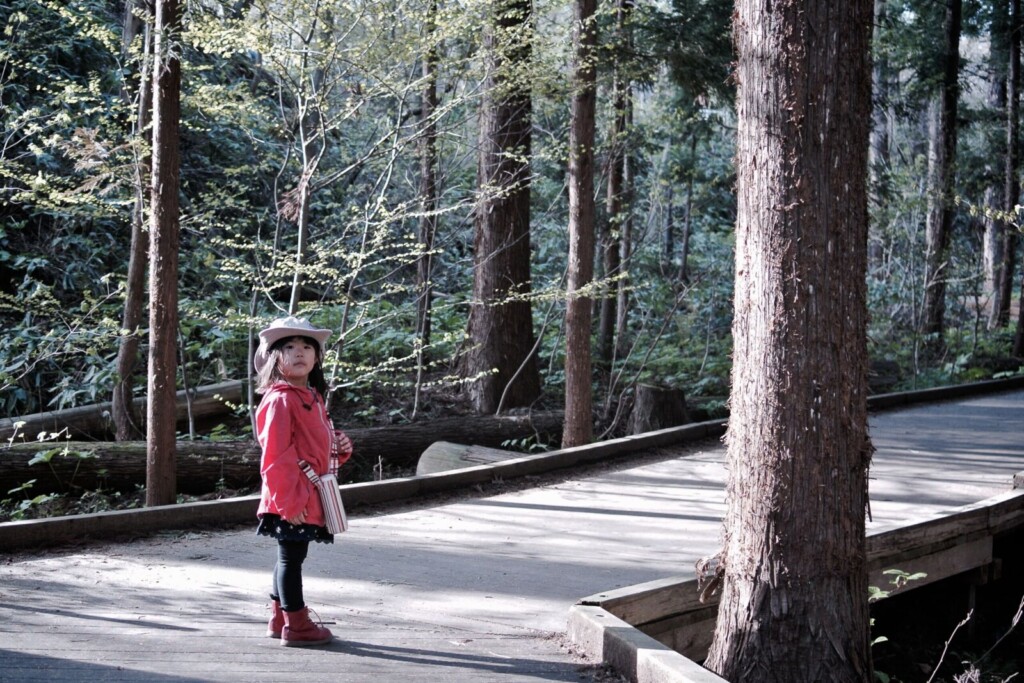
You are standing between two cedars, and you did not decide to stop walking, your body decided for you. Somewhere between the third and fourth breath after your feet went still, something releases in the back of your neck that you did not know was clenched. Your shoulders drop half an inch. Nobody told them to. The air moving in and out of you slows its tempo without instruction, the way a held note finally resolves when the orchestra remembers where the melody was going. You did not come here for this. You came here, perhaps, to walk off a headache, to escape a phone, to give your legs something to do besides carry you between rooms that all smell like the inside of a printer. And yet here is this unbidden softening, arriving before you have thought a single word about why a forest might do anything to a person at all.

This is the part that gets skipped in most retellings, the part before the vocabulary shows up to explain what just happened. Long before anyone hands you the term shinrin-yoku, before you learn it was coined in Japan in 1982 by Tomohide Akiyama, then head of the Japanese Ministry of Agriculture, Forestry and Fisheries, as a way to brand something the culture already suspected but had not yet measured, your own nervous system has already rendered its verdict. It has slowed your heart rate a few beats. It has begun, without your consent, to redistribute blood away from the alarm systems and toward the regions that handle digestion, repair, rest. This is not metaphor. This is a documented shift in autonomic balance, a swing away from the sympathetic nervous system’s readiness for threat and toward the parasympathetic system’s insistence on maintenance and recovery. And it happens whether or not you know the name for any of it. The body does not wait for permission from language.
This ordering matters, and it is worth sitting inside rather than rushing past. Western thought has a long habit of assuming that meaning precedes sensation, that we must first understand a thing before we can be changed by it. Descartes gave this bias its most famous architecture, splitting the thinking self from the mere machinery of the body, as though the mind were a pilot and the flesh a vehicle it merely operated. But stand among trees for four minutes and the hierarchy reverses itself without asking your opinion. The shift in cortisol, the softening of muscle tension around the jaw, the change in the depth of your inhale — these arrive first, and interpretation trails behind like a slow secretary taking dictation after the meeting has already ended. You feel calmer before you decide you are calm. You notice, retroactively, that something has already happened to you.
There is a particular vertigo in this, if you let yourself feel it fully. It means the explanations come after the fact, always, dressed up as causes when they are really just narration. It means that whatever story you eventually tell about why you feel different among trees — the negative ions, the phytoncides, the color green and its supposed effect on the visual cortex — is a story built on top of a change that had already occurred without asking for a story at all. The forest does not wait to be understood. It acts on the body the way weather acts on skin, directly, before the mind has finished clearing its throat to comment.
The Manufacture of a Remedy
The paperwork exists, and that alone should trouble anyone who has read about this practice as though it descended from Shinto priests or Zen monks communing with cedar trees since time immemorial. In 1982, an official at the Japanese Ministry of Agriculture, Forestry and Fisheries, Tomohide Akiyama, put a name to something he wanted citizens to do more of, and the name was shinrin-yoku, forest bathing. This was not the resurrection of a rite. It was a marketing decision, cousin to a slogan, produced inside a government office with budgetary targets and a forestry industry that needed justification for its own preservation. The timber economy was struggling. Domestic wood could not compete with cheaper imports. Someone in that ministry understood that a forest nobody visits is a forest nobody defends, and a forest nobody defends is a line item easily cut. So the trees were given a therapeutic function, and a population exhausted by the specific arithmetic of postwar labor was handed a solution shaped suspiciously like the problem’s photographic negative.
That population was drowning in something with its own vocabulary. Karoshi, death from overwork, had entered Japanese legal and medical discourse by the late 1970s, with courts beginning to recognize fatal heart attacks and strokes among salarymen as compensable workplace deaths. The country that had rebuilt itself into the world’s second-largest economy within three decades of total devastation had done so by converting human bodies into instruments of sustained output, and by the early 1980s the instruments were failing on schedule. A remedy was needed that would not question the arrangement producing the illness. You could not tell a nation to work less when the identity of the nation had been rebuilt around working more. What you could do was prescribe a walk. Not a strike, not a reduction in hours, not a renegotiation of the relationship between corporation and citizen. A walk, in a forest, on a weekend, after which the citizen would return on Monday recalibrated.
This is the part that deserves scrutiny rather than nostalgia: an entire apparatus of scientific validation grew up around the prescription after the prescription already existed. Yoshifumi Miyazaki and Qing Li, researchers at Chiba University and Nippon Medical School respectively, began in the 1990s and 2000s producing the physiological data that shinrin-yoku required to survive as policy. Li’s research measured natural killer cell activity in the blood of subjects before and after forest exposure, publishing results in 2007 and after showing elevated immune markers persisting up to thirty days following a forest trip. Miyazaki’s studies tracked cortisol levels, pulse rate, and sympathetic nervous activity across forest and urban comparison groups. The science is not fraudulent. The sequence is what matters. A government coined a term to solve an economic and political problem, and only afterward did the laboratories arrive to explain why the government had been right, retroactively transforming a bureaucratic slogan into something that could be footnoted, funded, and exported.
There is a particular irony in a nation legislating access to something that requires no legislation at all, that any body with legs and a few unclaimed hours could do without a ministry’s blessing. But that irony assumes the unclaimed hours existed, and in the Japan of 1982 they largely did not. The compulsion to codify rest as a designated activity, complete with certified forest therapy bases, of which there are now over sixty across the country accredited by the Forest Therapy Society, reveals how thoroughly leisure itself had become administered. A person cannot be trusted to wander into trees on their own initiative in a culture that has organized every hour around productivity, so wandering must be scheduled, verified, given a name that sounds ancient enough to bypass suspicion, and stamped with institutional legitimacy before it will be permitted to count as time well spent.

The Laboratory Reclaims the Sacred
In 1990, when the Japanese Ministry of Agriculture, Forestry and Fisheries coined the term shinrin-yoku, there was no accompanying clinical trial, no peer-reviewed justification, only a bureaucratic hunch that the nation’s overworked salarymen needed somewhere to put their bodies that wasn’t a train platform or a fluorescent office. The phrase preceded the proof by more than a decade. It took a Tokyo-born physician named Qing Li, working out of Nippon Medical School, to drag that hunch into a laboratory and demand it explain itself in numbers. Li’s studies, published through the 2000s and gathered into his 2018 book Forest Bathing, drew blood from subjects before and after they spent two or three days walking through cedar and cypress groves, then measured something specific: the activity of natural killer cells, the lymphocytes tasked with destroying tumor and virus-infected cells without waiting for instructions from the rest of the immune system. He found that NK cell activity rose by over fifty percent after a forest weekend and stayed elevated for more than thirty days afterward. He found the intracellular proteins perforin and granulysin, the actual weapons NK cells use to puncture and dissolve compromised cells, increased in concentration. He traced the mechanism to phytoncides, the volatile organic compounds like alpha-pinene and limonene that trees emit as airborne defense against bacteria and insects, compounds that humans absorb simply by breathing under a canopy.
The precision is seductive, and it should be, because it did something no poem about pine trees had managed to do: it got forest exposure prescribed. Japan now has sixty-two designated forest therapy trails, certified through a joint effort by the Forestry Agency and medical researchers, each one measured for phytoncide concentration the way a pharmacist measures dosage. South Korea followed with its own National Forest Therapy program. Physicians in several countries can now write something resembling a nature prescription, an actual referral, because Li’s numbers gave insurance systems and hospital boards a language they could process. Cortisol reduction, blood pressure decline, decreased sympathetic nervous activity, increased parasympathetic activity, all of it charted, all of it replicable enough to survive peer review.
And yet something happens in the translation that deserves scrutiny rather than gratitude. The moment a walk among trees becomes legible only through a granulysin count, the walk has been quietly redefined as a delivery mechanism for a biochemical outcome, which is a different thing from an encounter with something larger than the self. The forest, in this framing, stops being other and becomes instrumental, a machine that produces phytoncides the way a factory produces parts, and the human being becomes a receiver optimized for absorption. This is not a small philosophical quibble. It reflects a much older pattern in which experience is not permitted to matter until it has been quantified, a pattern the sociologist Max Weber diagnosed as the disenchantment of the world, the slow historical process by which mystery gets replaced by calculation as the only accepted route to legitimacy. Weber wrote about this in relation to bureaucracy and religion, but the same logic governs how a contemporary reader decides whether a walk in the woods is worth their Saturday. Awe, on its own terms, has stopped being sufficient evidence of its own value.
There is a kind of quiet violence in that requirement, the demand that wonder produce a receipt. A person standing under redwoods, feeling something loosen in their chest that has no name, should not need a lymphocyte count to know that something real occurred. But the culture that produced Qing Li’s laboratory is the same culture that had already trained its inhabitants to distrust unquantified sensation, so the numbers arrived not as decoration but as rescue, the only vocabulary left in which the trees were allowed to matter.
The Separation That Made the Cure Necessary

You stand at the edge of a cedar grove outside Nagano with a pamphlet in your hand that instructs you, in four languages, how to breathe. Somewhere behind you is a parking lot, a vending machine selling heated coffee in a can, and a guide waiting to lead a group of salaried professionals through two hours of prescribed wandering. Nobody in this clearing arrived by accident. Every person here paid to be told that the trees will help them, and the strange part is that they are right, and the stranger part is that this needed to become a transaction at all.
The rupture did not happen in a forest. It happened at a writing desk in the Dutch Republic sometime around 1630, when René Descartes sat down to compose what would become the Discourse on the Method and, alongside it, the physiological writings that treated animal bodies, and by extension the whole of nonhuman nature, as clockwork. Res extensa, matter in motion, devoid of the soul that Descartes reserved exclusively for the human mind, the res cogitans that alone could think and therefore alone could matter morally. A forest under this schema is not a presence. It is an extended substance, a mechanism of roots and photosynthesis, available for measurement and, eventually, for felling. This was not cruelty. It was clarity, and it built the scientific method that would later produce the very studies proving that cedar-emitted phytoncides lower cortisol. The instrument that severed the bond is the same instrument now certifying that the severing hurt.
The severing had a second, blunter phase. Between roughly 1604 and 1914, England alone enclosed over six million acres of common land, land that had previously been shared, grazed, gathered from, walked through without permission. The Enclosure Acts converted forest and field into private property with fences and gamekeepers, and in doing so they did something enclosure laws rarely get credit for: they made trespass a crime and nature a possession rather than a commons. The peasant who once moved through woodland as a matter of subsistence and habit became, within a few generations, an industrial worker who moved through woodland never, because there was no woodland left near him, and because he had no legal right to enter the woodland that remained. The Industrial Revolution did not simply pollute forests. It first fenced them off, then it moved the human body indoors, into the textile mill, the coal pit, the factory floor lit by gas, sixteen hours at a stretch, and it did this to bodies that had, until a few decades prior, still known what dirt under fingernails felt like on a Tuesday afternoon rather than a scheduled retreat.
By 1903, Georg Simmel was diagnosing what this had done to the nervous system itself. In his essay on the metropolis and mental life, Simmel described the urban dweller as developing a protective organ, a blasé attitude, a deliberate dulling of sensation necessary to survive the sheer overstimulation of city life, the crowds, the money economy, the clocks demanding punctuality down to the minute. Simmel was not writing about pollution or deforestation. He was writing about the interior cost of a nervous system built for forest-density stimuli suddenly asked to process metropolitan-density stimuli, and finding that the only adaptation available was numbness. The blasé attitude is not a personality flaw. It is a survival adaptation to an environment the human perceptual system was never evolved for, and it is precisely this numbness that a weekend in Nagano is now marketed to reverse.
So the same civilizational arc that produced Descartes’ extended substance, the enclosure of six million acres, and Simmel’s blasé metropolitan nerve now produces the guided forest therapy session, priced per person, scheduled for Saturday, complete with a certified guide who will remind you, gently, to touch the bark. The cure and the disease share a birth certificate. Nobody selling you the reattachment is lying about its effects, and that may be the most unsettling part of all.
The Second Immersion
The badge scanner beeps twice before the automatic gate releases you into what the company brochure calls the Renewal Grove, eleven acres of planted cedar and maintained trail behind the third parking structure of a technology campus outside Portland. A facilitator with a lanyard and a clipboard checks names against a schedule. You have exactly twenty-two minutes. The next block, cognitive realignment workshop, begins at 10:15, and the walking meditation before it ends, by design, at 9:53, leaving seven minutes to walk back and refill your water bottle before the room fills again. Somewhere a bell will chime through a hidden speaker mounted in a fiberglass rock to signal the end of stillness.
Qing Li, the Japanese researcher whose 2018 book on forest medicine helped popularize the practice internationally, measured cortisol drops and increases in natural killer cell activity after two- and three-day exposures in actual wilderness, not twenty-two-minute increments between conference calls. The dosage matters. But dosage is precisely what gets lost when an experience designed around dissolution of clock-time gets reinserted into an institution whose entire nervous system runs on clock-time. The forest does not know it has been scheduled. The employee does. And knowing it, something curdles.
There is a particular kind of exhaustion that comes from being told to relax on command, a phenomenon organizational psychologists have documented under names like mandatory fun and enforced wellness, where the very instruction to feel better becomes an additional cognitive load rather than a relief from one. Alex Pentland and other researchers into workplace behavior have quietly noted, in studies conducted at firms testing similar interventions, that resistance to prescribed calm often manifests as measurable increases in reported stress, not decreases, in the weeks following implementation. The forest becomes another KPI. Did you take your nature break. Did you log your minutes in the wellness app. Did you optimize your dopamine baseline before returning to the sprint review.
This is not hypocrisy exactly, or not only hypocrisy. It is something closer to the way capitalism, as theorists from the Frankfurt School onward have observed, absorbs its own critiques and resells them back as products. Herbert Marcuse wrote in 1964 of a one-dimensional society that neutralizes opposition not by suppressing it but by incorporating it, turning even rebellion into a consumable style. The forest bath, born as a refusal of the clock, gets clocked. The practice that emerged specifically because Japanese public health officials in the early 1980s noticed a population dying of overwork, a phenomenon severe enough to require its own word, karoshi, has been folded back into the machinery of the very overwork it was meant to interrupt.
And yet the trees in the corporate grove are still trees. The phytoncides, those airborne compounds released by cedar and cypress that Li’s research links to immune function, do not check the employee badge before entering the bloodstream. Something real still happens in the body during those twenty-two minutes, even if the mind arrives already counting down. This is the tension that refuses to resolve: the intervention can be simultaneously genuine at the level of biology and hollow at the level of meaning, both things at once, without contradiction canceling either truth.
Maybe the employee walking the maintained gravel path feels nothing false at all, feels only relief, however brief, however scheduled, and maybe the critique of scheduled relief is itself a kind of purity test that the person actually living inside the system cannot afford. Maybe the seven minutes to refill the water bottle are still seven minutes not spent answering email. Or maybe that is exactly the story the campus wants you to tell yourself, the small mercy that keeps the larger machine acceptable, sustainable, humane enough to continue. The bell in the fiberglass rock chimes. You are already turning back toward the glass doors before you notice you never stopped thinking about the ten fifteen.
A vision curated by a filmmaker, not an algorithm
In this video I explain our vision
🌲 Into the Woods: Nature's Healing Path
Forest bathing invites us to slow down and reconnect with nature as a source of healing and inner peace. These related articles explore the philosophical, cultural and psychological threads that intertwine with this contemplative practice.
The necessity of a meditative life in a hyperactive world
In a world addicted to speed and constant stimulation, the meditative life offers a radical alternative rooted in silence and presence. This article explores why slowing down, much like forest bathing itself, has become an act of quiet resistance against hyperactivity. It reveals the deep psychological need for stillness that modern life so often denies us.
GO TO THE SELECTION: The necessity of a meditative life in a hyperactive world
Japanese Aesthetics: Wabi-Sabi Mono no Aware and Yugen
Japanese aesthetics offers a profound lens through which to understand forest bathing’s cultural roots. Concepts like wabi-sabi, mono no aware and yugen teach us to find beauty in transience and mystery in the natural world. This article unpacks the philosophical foundations that make the Japanese relationship with nature so distinctive and meaningful.
GO TO THE SELECTION: Japanese Aesthetics: Wabi-Sabi Mono no Aware and Yugen
Phenomenology of Nature: Husserl and Merleau-Ponty
Phenomenology offers powerful tools for understanding our embodied experience of nature, as explored through Husserl and Merleau-Ponty. This article examines how philosophy can articulate the felt, sensory dimension of immersing oneself in a natural environment. It provides an intellectual companion to the lived experience that forest bathing seeks to cultivate.
GO TO THE SELECTION: Phenomenology of Nature: Husserl and Merleau-Ponty
Philosophy of Nature: From Aristotle to Today
From Aristotle to contemporary thinkers, the philosophy of nature traces humanity’s evolving relationship with the natural world. This article offers a historical and conceptual framework for understanding why immersion in nature has long been considered essential to human flourishing. It contextualizes practices like forest bathing within a much older philosophical tradition.
GO TO THE SELECTION: Philosophy of Nature: From Aristotle to Today
🎬 Discover Nature's Stories on the Big Screen
If this journey into the healing power of forests has stirred something in you, let independent cinema deepen the experience. Discover a curated selection of contemplative and nature-inspired films streaming now on Indiecinema.
👉 EXPLORE THE CATALOG: Watch Indie Films in Streaming
A vision curated by a filmmaker, not an algorithm
In this video I explain our vision

