
The Wanting That Never Stops
You open another tab before the first one has finished loading. You are not looking for anything specific — or rather, you are looking for everything at once, which is the same as looking for nothing, except that nothing feels like this: electric, restless, the eyes already moving before the mind has registered what they just passed over. The phone is warm in your hand. You have checked it four times in the last six minutes. You will check it again. And the strangest part, the part that should trouble you more than it does, is that finding something — a message, a purchase, a piece of news — does not stop the motion. It only briefly interrupts it. The wanting resumes almost immediately, as though satisfaction were simply a pause between two cravings rather than a destination.

This is not a modern pathology. It is not caused by algorithms, though algorithms have learned to weaponize it with terrifying precision. The mechanism itself is ancient, and the oldest sustained intellectual tradition to have examined it with clinical seriousness gave it a name in a dead language that still carries more descriptive force than anything contemporary neuroscience has coined: tanha. In Pali, the language of the earliest Buddhist scriptures, the word means literally “thirst.” Not hunger, which implies a body with a genuine deficit, but thirst — the sensation that returns faster, more insistently, and with less connection to actual need. The Pali Canon, a body of texts compiled between the third century BCE and the first century CE, presents tanha not as a sin, not as a character flaw, and not as a symptom of moral weakness. It presents it as a structural feature of unexamined consciousness — the default condition of a mind that has not looked carefully at itself.
The Second Noble Truth, articulated in the Dhammacakkappavattana Sutta, identifies tanha as the origin of dukkha — a word almost always translated as “suffering” but which carries the more precise sense of unsatisfactoriness, of a wheel slightly off its axle, turning but grinding. The Buddha’s diagnosis was not that people want the wrong things. It was that the wanting itself, the engine of grasping, operates independently of its objects. You can satisfy one craving and watch another materialize in its place with the seamless efficiency of an assembly line. The object was never the point. The point was the motion of reaching.
What makes this analysis philosophically radical, even by contemporary standards, is its refusal to locate the problem in the external world. Seneca, writing around 65 CE in his Epistulae Morales, arrived at a structurally similar observation from a completely different direction, noting that a person who travels to escape themselves boards the ship with all their troubles already packed. But Seneca’s framework was still essentially ethical — a matter of character, of training the will. The Buddhist analysis goes deeper, into epistemology. Tanha is not a bad habit. It is what consciousness does when it mistakes itself for a fixed, continuous self that requires constant reinforcement. Every act of grasping is simultaneously an act of self-construction. To crave is to insist, moment by moment, that there is a someone doing the craving — and that this someone is incomplete, endangered, in need of more.
The contemporary psychologist Daniel Kahneman spent decades documenting what he called the “focusing illusion” — the cognitive tendency to believe that whatever we are currently attending to is more important to our wellbeing than it actually is, summarized brutally in a 2006 paper co-authored with others: “Nothing in life is as important as you think it is while you are thinking about it.” The wanting feels like it is about the object. It is never about the object.
Ugetsu
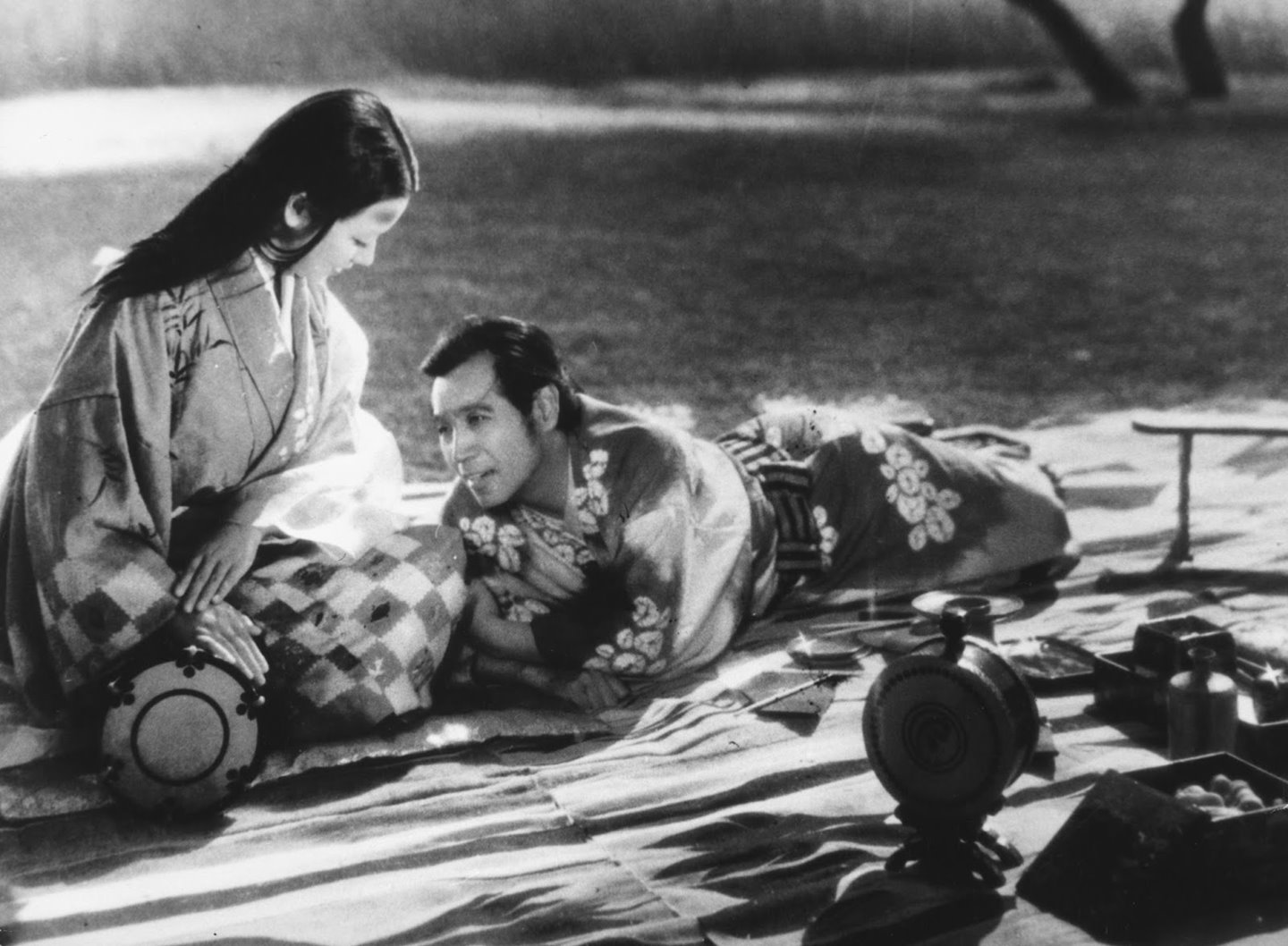
Drama, fantasy, by Kenji Mizoguchi, Japan, 1953.
Japan, late 16th century: the potter Genjurō and his brother Tobei live with their wives Miyagi and Ohama in a village in the Omi region; Genjurō, convinced that he can earn a lot of money by selling his goods in the nearby city, goes to the county of Omizo with Tobei, who joins him with the sole purpose of being able to become a samurai. Back home with a good income, the two work hard to make even more money; Tobei, increasingly obsessed with the ambition of becoming a samurai, needs the money to buy an armor and a spear while Genjurō, overcome by greed, tries to cook a batch of crockery with his brother in just one night. Legend and innovation of cinematic language, a wonderful world next to a brutal and cruel world. Mystery film that opens a discourse with the invisible planes of existence, ghosts and forays into the fantastic, made by Kenji Mizoguchi in a Japan still frozen by the two atomic bombs dropped on Hiroshima and Nagasaki. Fundamental work by Mizoguchi, recognized as one of the greatest expressions of the Seventh Art. A lofty lesson in directing that creates wonder with a dramatic tale of greed and lust for possession. A woman who is a tempting demon and a wife abandoned to a fate of war and misery, Mizoguchi uses the camera to enter "another world".
Food for thought
According to ancient Eastern traditions there are other non-physical planes beyond the physical plane. The etheric plane envelops the physical body, gives it vital energy and acts as an intermediary with the higher levels. Beyond the etheric plane there is the astral plane where entities may exist that have not been able to resign themselves to the loss of their body and wander in search of sensations. They are what are commonly referred to as "ghosts". These entities are looking for bodies that have unbalanced etheric planes to "hook up" to in order to experience sense satisfaction through them.
LANGUAGE: Japanese
SUBTITLES: English, Spanish, French, German, Portuguese
The Second Arrow
You are lying awake at three in the morning, and the wanting itself is not what destroys you. It is the voice that arrives immediately after — the one that says you should not want this, that the wanting proves something shameful about who you are, that a better person would already be free of this particular hunger. The original discomfort was a wound. What follows is what you do to yourself with the wound.
Somewhere around the fifth century BCE, in a subcontinent convulsing with new mercantile energy, a wandering teacher posed this distinction with surgical precision. The Sallatha Sutta, housed in the Samyutta Nikaya, opens with an unsentimentally simple image: a person struck by an arrow. The physical pain is real, undeniable, and belongs to the body’s honest accounting of the world. Then a second arrow strikes, this one self-inflicted — the anguish layered over the first sensation through resistance, through the desperate narrative that this should not be happening, that the fact of pain signals some deeper failure of the self. The Buddha’s genius was not in telling people to stop wanting. It was in identifying that most human suffering is not the wanting at all but the prosecution we conduct against ourselves for having wanted.
This distinction mattered with peculiar urgency in the Gangetic plain of 500 BCE precisely because the people most likely to sit with these teachings were not ascetics who had already renounced everything. They were the vaishyas — the merchant caste — whose entire social function had become the accumulation and movement of wealth along trade routes that were, by that era, threading across the subcontinent with increasing complexity. The rise of janapadas, the territorial republics and kingdoms consolidating around new economic centers, had produced a class of people who were prospering and privately terrified about it. Prosperity felt morally exposed. The more they acquired, the more elaborate their inner tribunal became, indicting them for the very activity their society depended on. The second arrow, in this context, was not metaphorical. It was the lived psychic condition of an entire social stratum.
What the Sallatha Sutta refuses to do is validate that tribunal. It neither condemns the merchant for wanting nor applauds him for renouncing. It simply points out the mechanism: pain arrives, and then a story about the pain arrives, and the story does far more damage than the original sensation. Bhikkhu Bodhi, whose 2000 translation of the Connected Discourses of the Buddha remains the scholarly standard in English, renders the key passage with deliberate plainness — the uninstructed worldling feels both painful and pleasant feelings, but the instructed noble disciple, also feeling them, does not sorrow, does not grieve, does not beat their chest. The difference is not in the presence or absence of feeling. It is in what is built on top of it.
This is the place where Buddhism becomes genuinely uncomfortable for modern readers who arrive expecting a philosophy of serene detachment, because what it actually describes is the compulsive human tendency to add cognitive violence to ordinary experience. Tanha, the Pali term usually translated as craving or thirst, names the first arrow — the raw pull toward pleasure, security, continuation. But dukkha, the word translators collapse into “suffering,” carries an older mechanical meaning: a wheel whose axle hole is slightly off-center, producing not catastrophic breakdown but endless, grinding friction with every rotation. The second arrow does not shatter the wheel. It simply ensures the ride never stops hurting, even when the terrain is smooth, even when everything the craving sought has been obtained.

Nagarjuna’s Trap
You wake up one morning and the wanting is already there before you are. Before you have named the day, before you have remembered who you slept beside or what you owe by Friday, the pull is present — a low gravitational hum oriented toward something you cannot yet specify. Most people interpret this as evidence of a self that has desires. Nagarjuna, writing in Sanskrit around 150 CE, would say the causality runs precisely backward: the desire is not owned by a self; the sensation of selfhood is temporarily assembled by the desire.
His Mulamadhyamakakarika, composed across twenty-seven chapters of terse philosophical verse, performs one of the most radical intellectual operations in the history of human thought. It does not argue that things are illusory in the soft, poetic sense that mystics tend to favor. It argues, through formal logical reduction, that no phenomenon possesses svabhava — inherent, independent, self-sustaining existence. Everything that appears to be a stable entity is in fact a convergence of conditions, and the moment those conditions shift, the entity dissolves. This applies to mountains and to economies. It applies, with particular violence, to the entity you call yourself.
What Nagarjuna’s logic exposes is not that you are unreal but that you are processual — a verb dressed as a noun. The Tibetan Buddhist philosopher Chandrakirti, expanding on Nagarjuna’s framework in the seventh century, used the analogy of a chariot: take apart its wheels, axle, frame, and chassis, and no chariot remains. Reassemble them, and still no chariot appears — only an arrangement of wood and metal to which the mind, seeking coherence, assigns the label. The self operates identically. Strip away the body’s sensations, the memories, the habitual emotional patterns, the social roles, and you will not find a residual experiencer standing in the empty room. You will find the room was never occupied.
This is where greed becomes philosophically unmanageable in a way that moral condemnation never achieves. Every ethical system that tells you greed is wrong still assumes there is a you to correct. Nagarjuna’s analysis cuts deeper: if the self is a construction, then greed is not a defect of character but a strategy of construction. The craving for more money, more recognition, more security, more sensation is not what a person has — it is part of the process by which the momentary impression of being a continuous, bounded person is maintained. Desire is structural. It holds the fiction together.
Consider what this means for the modern economy, which is not merely a system that exploits greed but a system that requires the psychological fiction greed depends on. The consumer who purchases a luxury item is not expressing preference — she is, in Nagarjuna’s terms, re-performing selfhood. The transaction is ontological before it is economic. Martin Heidegger, writing in Being and Time in 1927, identified something adjacent when he described das Man — the anonymous “they-self” — as the entity modern society manufactures in place of authentic existence. The difference is that Heidegger still believed there was an authentic self underneath the social construction, a Dasein capable of retrieval. Nagarjuna forecloses that exit. There is no authentic self waiting beneath the performance, because performance and self are the same process.
This is what makes the trap genuinely inescapable from within ordinary cognition. You cannot decide to stop desiring in order to recover your true self, because the decision-maker is itself a product of the desiring process. The meditator who sits down to eliminate craving and achieve liberation has already imported the craving into the act of sitting — the craving for liberation, for the cessation of craving, which Nagarjuna’s contemporary Vasubandhu catalogued in the Abhidharmakosa as one of the most subtle and durable forms of tanha, precisely because it wears the clothing of renunciation while performing the identical grasping motion in a socially sanctioned register.
Confucius Was Not a Minimalist
You have been told, in one form or another, that the East knows something about wanting less. The idea arrives packaged in clean lines and minimalist aesthetics, sold through breathing exercises and decluttering manuals, and somewhere behind it all sits a vague silhouette of a robed philosopher who has transcended appetite entirely. You absorbed this without quite choosing to. And the figure most commonly conscripted into this fantasy — alongside the Buddha, whose own teachings were far more violent toward comfort than any Western wellness brand will admit — is Confucius, a man who spent his life obsessed with ranks, ceremonies, music, the correct cut of a mourning robe, and the precise emotional register appropriate to a state banquet. Confucius was not retreating from the world. He was trying to organize it down to its last craving.
The Analects, compiled by his disciples after his death in 479 BCE, are not a manual for desire’s elimination. They are a manual for desire’s choreography. Confucius distinguishes clearly between the person who wants without form — who reaches for pleasure, status, and comfort with no regard for timing, context, or social position — and the exemplary person, the junzi, whose wanting has been trained into shape by ritual practice, li. The difference is not between desiring and not desiring. It is between desire that operates like a crowd rushing a door and desire that moves like a procession. What disturbed Confucius was not appetite but appetite without ceremony.
This distinction carries an almost uncomfortable implication: that ritual, in the Confucian framework, is not a cage placed over human wanting but a technology built to make wanting sustainable across a community. When he instructs his disciples on the proper performance of mourning rites, he is not asking them to suppress grief. He is asking them to let grief move through a structure that prevents it from collapsing into spectacle or hardening into private obsession. The rite holds desire in relation to others. Without that relational architecture, desire becomes purely extractive — it consumes without contributing to the social fabric that makes desire meaningful in the first place.
In Book 12 of the Analects, when Yan Hui asks about humaneness, Confucius answers with a formula that has been mistranslated into self-denial more times than it deserves:克己復禮,克己復禮為仁 — overcome the self and return to ritual, and humaneness is achieved. Western readings have leaned hard on “overcome the self” and quietly dropped “return to ritual,” producing a version of Confucius that sounds vaguely Buddhist. But the return is everything. The self is not abolished; it is redirected. You do not stop wanting recognition, belonging, excellence, pleasure. You route those wants through forms that connect them to something larger than your own satisfaction.
What this means historically is that Chinese court culture, shaped in significant part by Confucian values, never produced an aesthetics of poverty or a theology of renunciation at the political center. The imperial examination system — formalized during the Han dynasty, intensified during the Tang, and reaching its most elaborate expression in the Song and Ming periods — was explicitly designed to cultivate and reward ambition. The scholar-official was supposed to want advancement, distinction, and moral authority. He was supposed to want them fiercely. The entire machinery of state depended on that wanting being real and intense. What Confucian education attempted was not its extinction but its refinement into a form that served governance, family continuity, and social reproduction simultaneously.
The Western romanticization of Eastern philosophy as uniformly anti-desire requires a particular kind of forgetting — the kind that arrives not through ignorance but through convenience, because a philosophy that tells you to want less asks nothing structurally difficult of you, while a philosophy that tells you your desires must answer to something beyond yourself
The Hungry Ghost Economy
You open the app at 11:47 PM with no particular need, only a sensation that resembles hunger but isn’t quite that, and by midnight you have purchased something you will not remember wanting by Thursday.
Tibetan Buddhist cosmology names a specific realm of existence for this condition. Among the six realms described in texts like the Bardo Thodol and elaborated across centuries of Vajrayana teaching, the realm of the Pretas — the hungry ghosts — occupies a precise and terrible position. These beings are depicted with enormous, distended stomachs and throats so narrow that nothing can pass through them. They are condemned not to starvation in the ordinary sense but to an architecture of perpetual near-satisfaction: the capacity to want is infinite, the capacity to receive is structurally blocked. What makes this cosmological image philosophically devastating is that it was never intended as a description of a supernatural afterlife punishment. It was intended as a description of a psychological state available to any living human being at any moment, a state that entire economies have since learned to manufacture and sustain at industrial scale.
The average American household carried $90,460 in total debt as of the most recent Federal Reserve consumer finance data, a figure that includes mortgage obligations, auto loans, credit card balances, and student debt — each category representing a different flavor of future self pledged against present desire. What the debt figure alone cannot capture is the temporal structure of the satisfaction these purchases delivered. Consumer psychology research published across multiple journals, including work synthesized in Thomas Gilovich and Leaf Van Boven’s studies on experiential versus material consumption, consistently demonstrates that the affective spike following a material purchase reaches its subjective peak within the first hours of acquisition and collapses to baseline — or below baseline, into what researchers identify as post-purchase dissonance — within 72 hours. The stomach distends. The throat remains narrow. The food, if it arrives at all, passes through and is gone before the hunger registers it as answered.
What is historically remarkable is not that human beings experience this cycle but that the mid-twentieth century made the perpetuation of this cycle an explicit economic objective. In 1955, the American economist Victor Lebow published a paper in the Journal of Retailing that stated with clinical clarity what would become the invisible operating system of postwar consumer culture: “Our enormously productive economy demands that we make consumption our way of life, that we convert the buying and use of goods into rituals, that we seek our spiritual satisfactions, our ego satisfactions, in consumption.” Lebow was not describing a corruption of capitalism. He was describing its necessary internal logic once production capacity outstrips biological need — the system requires not satisfied customers but structurally dissatisfied ones, beings whose throats remain narrow enough that the next transaction is always already necessary.
Buddhism’s diagnosis of tanha — the Pali term for craving, literally meaning thirst — locates the problem not in objects but in the relationship between a perceiving subject and the impermanent world it mistakes for a source of permanent relief. The Second Noble Truth presented in the Dhammacakkappavattana Sutta identifies tanha as the origin of dukkha, of suffering, not because wanting is evil but because wanting operates on a fundamental misunderstanding: it treats conditions that are inherently transient as if they could deliver stable ground. Every purchase is a temporary crystallization of this misunderstanding, and the 72-hour collapse is not a failure of the product — it is the product functioning exactly as the nature of conditioned phenomena guarantees it must.
A vision curated by a filmmaker, not an algorithm
In this video I explain our vision
Daoism’s Silent Indictment
You are standing in a supermarket at 11 p.m., and you cannot remember why you came. The cart is half full. The fluorescent light hums at a frequency just below conscious annoyance. You have been moving through the aisles on a kind of autopilot that feels indistinguishable from purpose, and only now, stalled between two brands of something you do not need, does the motion stop long enough for the question to surface: what exactly are you adding to?
Laozi did not frame it as a question about shopping. He framed it as arithmetic. In the forty-fourth chapter of the Tao Te Ching, composed somewhere around the fourth century BCE, he asks which matters more — your name or your body, your body or your possessions — and then answers with an economist’s cold logic: excessive accumulation necessarily produces excessive loss. The Chinese term he uses for this kind of anxious acquisition is not greed in the moral sense but something closer to structural overcorrection, a deviation from what he calls zhi zu, knowing sufficiency. The person who knows sufficiency is not a person who has enough; they are a person who has ceased to treat the category of enough as a problem requiring perpetual resolution. That is a different thing entirely. One is a state of having. The other is a dismantling of the machine that keeps score.
What makes this a structural critique rather than a spiritual consolation is that Laozi is not telling anyone to want less. He is pointing out that the very architecture of striving — the belief that life is a deficit to be corrected through acquisition — is itself the source of the exhaustion it promises to cure. The Tao Te Ching was written into a feudal Chinese context where lords accumulated territory, grain, and labor with the same compulsive momentum that modern markets demand of their participants. The text is not naive about power. It is precise about the mechanism: that a life organized around accumulation will always experience itself as incomplete, because incompleteness is the operating condition the logic requires in order to keep running.
Zhuangzi pushed this further by making it visceral. His parable of Prince Hui’s cook — a man who has spent nineteen years butchering oxen with a blade that has never needed sharpening — is not a fable about craftsmanship or patience. It is a demonstration of what happens when a person stops fighting the structure of the thing in front of them and begins moving through its actual grain. The cook does not hack. He finds the spaces that are already there. The joints open. The knife glides. What looks like mastery is actually a form of sustained non-imposition, and what looks like efficiency is actually the abandonment of the efficiency mindset altogether. Zhuangzi’s point is that the blade stays sharp precisely because the cook has stopped trying to conquer the animal and started following what the animal already is. Accumulation, by contrast, is the refusal to follow anything — it is the insistence on imposing a trajectory onto reality regardless of what reality’s actual joints might be.
Wu wei, the concept both thinkers orbit, has been domesticated in the West into a kind of advise about relaxing, slowing down, being present. This is a significant misreading. Wu wei is not passivity. It is the active refusal to let a particular economic grammar — one that measures life in units of progress, acquisition, and net positive gain — serve as the only available definition of a complete existence. The Daoist texts are not asking you to do less. They are asking whether the category of doing, structured around accumulation, has quietly annexed the entire territory of what you think a life is supposed to be, and whether you noticed when it happened, and whether you were even in the room.
When Monks Became Merchants
You have probably stood in front of something beautiful and felt, beneath the admiration, a faint unease you could not name — the sense that what you are looking at costs more than it should, that its perfection is sustained by a ledger somewhere you are not permitted to read.
The monasteries of Tang Dynasty China were exactly that kind of beauty. By the eighth century CE, Buddhist institutions across the empire had accumulated landholdings that rivaled those of the aristocracy, operating vast agricultural estates worked by dependent laborers, storing grain in quantities that allowed them to function as regional lenders during famines, and running what historians of the period describe as an early form of pawnbroking — the changpai system — in which sacred precincts housed not only relics and sutras but collateral. The monk at the gate was also, in an administrative sense, a creditor. The dharma was being practiced three courtyards over, and the interest rate was being calculated in the one nearest the road.
This did not happen because Buddhism was corrupted by cynical men who never believed a word of the Pali Canon. It happened because the Tang state needed Buddhism to pacify newly incorporated populations, to legitimize imperial rule through the spiritual prestige of patronage, and to anchor social order in territories where Confucian bureaucratic infrastructure had not yet penetrated. The court gave land to monasteries; monasteries gave legitimacy to courts; and the entire exchange was framed, on all sides, as a form of merit-making. Tanha — the craving that the Eightfold Path was designed to dissolve — had not disappeared. It had been institutionalized, renamed, and dressed in saffron.
What Karl Polanyi argued in 1944 in The Great Transformation about markets applies with equal force to philosophical systems: they do not exist outside of the social formations that produce them. Polanyi showed that what we call the free market was never a spontaneous emergence of human nature but a political construction, assembled deliberately and maintained by state power. The same logic runs backward through the history of every wisdom tradition. Buddhism did not encounter Tang-dynasty material conditions from a position of philosophical purity and then reluctantly compromise. The material conditions shaped which version of the teaching survived, which monasteries received imperial patronage, which sutras were translated and circulated, and which monks rose to positions where their interpretations became orthodoxy. The Weicheng edict of 845 CE — the Huichang Suppression, under Emperor Wuzong — dissolved over four thousand monasteries and forced two hundred and sixty thousand monks and nuns to return to lay life, not because the state had suddenly become philosophically opposed to greed, but because the accumulated monastic wealth had become a structural rival to imperial fiscal power. The suppression was not a moral argument. It was a balance sheet.
What survives persecution is rarely what is most spiritually radical. It is what is most institutionally useful to whoever lifts the persecution. The Chan lineages that re-emerged after 845 were leaner, more decentralized, and — crucially — more adaptable to a form of practice that required less land, fewer dependents, and a rhetoric of austerity that made them politically palatable. The aesthetic of radical simplicity that would later enchant Western readers of Zen was, in part, a scar from a fiscal crisis. The empty bowl was not only a symbol of non-attachment. It was also what remained after confiscation.
There is a mechanism here that operates independently of any specific religion or century: the moment a philosophy of renunciation becomes powerful enough to require an institution for its transmission, the institution begins generating exactly the attachments the philosophy was designed to sever. The teaching survives. The teacher’s original wager — that desire could be seen clearly enough to lose its grip — gets refinanced by the very structures built in its name, until what is being transmitted is the architecture of the answer rather than the question that made the answer necessary.
The Diagnosis Without the Cure
You already sense it before you can name it — that low, persistent friction between what your life is and what you keep insisting it should become, a vibration so constant you have stopped registering it as a signal and begun accepting it as the baseline texture of being alive.
The Sanskrit word dukkha, which Western translators have for centuries rendered as “suffering,” carries an older and more precise violence inside it. The du is a prefix meaning bad or wrong; kha refers to the axle-hole of a wheel. The original image is not a man weeping. It is a wheel spinning on an axle that does not sit correctly in its socket — functional enough to move, damaged enough to grind, the misalignment invisible until the whole structure begins to come apart at speed. Early Buddhist texts were not describing an emotion. They were describing a mechanical condition, a structural error in the way consciousness has organized its relationship to time, to objects, to the self that allegedly possesses them.
What makes this diagnosis so difficult to receive is that it requires no dramatic crisis to be accurate. The grinding does not wait for catastrophe. It operates inside ordinary Tuesday afternoons, inside the moment a desired thing is finally obtained and immediately begins receding in value, inside the gap between the pleasure anticipated and the pleasure delivered — a gap that the philosopher Derek Parfit, working from an entirely different tradition in his 1984 work Reasons and Persons, identified as structurally inescapable when a self tries to locate meaning in future states it cannot actually inhabit once they arrive. Eastern thought arrived at the same architecture of disappointment roughly two and a half millennia earlier, not as a philosophical puzzle but as a clinical observation about how minds actually function under the governance of tanha, the thirst that moves before thought does.
The Abhidharma literature, the vast psychological taxonomies produced by early Buddhist scholastics beginning around the third century BCE, catalogued mental states with a granularity that would not be matched in Western psychology until the twentieth century. What those texts found, mapped across hundreds of categories of mind-moments, was that craving does not simply accompany consciousness — it is woven into the structure of perception itself, activated at the point of contact between a sense organ and its object, before deliberation, before choice, before the story of the self has had time to arrange itself around the experience. The wheel is already off-center before you decide to start walking.
This is the place where Eastern philosophy refuses to behave the way Western audiences have been trained to expect philosophy to behave. There is no redemptive arc embedded in the diagnosis. The Four Noble Truths, which the Pali Canon records the Buddha articulating at Sarnath to an audience of five, are structured as a medical framework — the disease, the cause, the possibility of cessation, the path — but the path is not a solution delivered to a passive recipient. It is a description of conditions under which the mechanism might, in a particular kind of consciousness, begin to run differently. Not fixed. Differently. The distinction is not a small one.
What you are left holding, if you follow the reasoning honestly rather than reaching for the consolation that tends to arrive when Western readers discover Eastern philosophy and immediately domesticate it into a self-help framework, is something closer to a mirror than a map. The mirror does not tell you where to go. It shows you the axle sitting wrong in its socket, the wheel already turning, the road already moving beneath you, the grinding already in progress — and it offers you, with complete equanimity and no particular urgency, the recognition that you have been feeling this your entire life without ever having a word precise enough to describe what was happening.
🪷 The Infinite Maze of Desire and Liberation
Greed, attachment, and the restless hunger of the self form a labyrinth that Eastern philosophy has mapped with extraordinary precision. Buddhism places desire — tanha, the thirst that can never be quenched — at the very root of suffering, offering a path through mindfulness, renunciation, and awakening. The articles below trace the contours of this maze from multiple directions, inviting a deeper reckoning with the nature of want.
Buddhism and 3 Documentaries to Understand it
Buddhism teaches that desire is not merely a personal failing but a structural condition of unenlightened consciousness, and documentary cinema has proven a powerful lens through which to examine its workings. This selection of films opens a window onto Buddhist practice, philosophy, and the daily discipline of releasing attachment. Watching these works alongside philosophical study transforms abstract doctrine into lived, breathing reality.
GO TO THE SELECTION: Buddhism and 3 Documentaries to Understand it
Hesse’s Siddhartha: Analysis
Hesse’s Siddhartha is one of Western literature’s most enduring engagements with the Buddhist understanding of craving and the long road to self-overcoming. The novel follows a young man who must exhaust every form of desire — sensual, intellectual, spiritual — before arriving at true stillness. Reading it as a philosophical document reveals how greed for experience itself can become the subtlest and most tenacious form of attachment.
GO TO THE SELECTION: Hesse’s Siddhartha: Analysis
Schopenhauer’s The World as Will and Representation
Schopenhauer’s concept of the Will as a blind, insatiable force driving all existence offers a striking Western parallel to the Buddhist notion of tanha. His magnum opus argues that desire can never be permanently satisfied, only temporarily stilled, and that suffering is therefore the default condition of conscious life. The resonances with Buddhist metaphysics are not accidental — Schopenhauer was among the first Western philosophers to engage seriously with Eastern thought.
GO TO THE SELECTION: Schopenhauer’s The World as Will and Representation
The Obsession with Success in Contemporary Culture
The contemporary obsession with success functions as a secular religion of desire, channeling greed into socially sanctioned ambitions that promise fulfillment while perpetuating lack. This article examines how modern culture systematically inflames wanting, making contentment seem like failure and accumulation seem like virtue. Seen through a Buddhist lens, the success cult is precisely the kind of collective delusion — a shared tanha — that the Dharma seeks to dissolve.
GO TO THE SELECTION: The Obsession with Success in Contemporary Culture
Explore the Cinema of Inner Freedom on Indiecinema
If these reflections on greed, desire, and liberation have stirred something in you, Indiecinema is the streaming space where cinema becomes a practice of awareness. Discover independent and world films that dare to ask the questions that matter most — and let the screen become your own path through the maze.
👉 EXPLORE THE CATALOG: Watch Indie Films in Streaming
A vision curated by a filmmaker, not an algorithm
In this video I explain our vision

